A 2-chain can interlock with an open -chain
Abstract.
It is an open problem, posed in [3], to determine the minimal such that an open flexible -chain can interlock with a flexible -chain. It was first established in [5] that there is an open -chain in a trapezoid frame that achieves interlocking. This was subsequently improved in [6] to establish interlocking between a 2-chain and an open 11-chain. Here we improve that result once more, establishing interlocking between a 2-chain and a 10-chain. We present arguments that indicate that 10 is likely the minimum.
1. Introduction
An open chain is a linkage of rigid bars (links, line segments, edges) connected at their joints (vertices, endpoints), which forms a simple, unclosed path. A folding of a linkage is any reconfiguration of the linkage obtained by moving the joints such that: (1) The edges remain straight; (2) The number and length of edges are preserved; (3) The edges do not intersect or pass through one another. When the joints of an open chain act as universal joints, it is called a flexible open chain. Often we drop the prefixes “flexible” and “open” when understood from the context. A chain with edges is called a -chain. When emphasizing the edges in a chain, a -chain is often referred as a -link chain. A collection of chains are interlocked if foldings cannot separate them.
Interlocking of open chains was studied in [4, 3], establishing a number of results regarding which collections of chains can and cannot interlock. An open problem posed in [3] is: What is the minimal number such that an open, flexible -chain can interlock with a flexible -chain? It was first established in [5] that there is an open -chain in a trapezoid frame that achieves interlocking. This was subsequently improved in [6] to establish interlocking between a 2-chain and an open 11-chain. Here we improve that result once more, establishing interlocking between a 2-chain and a 10-chain. We present arguments that indicate that 10 is likely the minimum.
Here we summarize results from [4] that we use in the sequel:
-
(1)
No collection of 2-chains can interlock.
-
(2)
Two open 3-chains cannot interlock, even with an additional collection of an arbitrary number of 2-chains.
-
(3)
A 2-chain cannot interlock with an open 4-chain.
-
(4)
A flexible open 3-chain can interlock with a flexible open 4-chain.
A construction of a 3-chain interlocking a 4-chain, which we call a 3/4-tangle, is repeated below in Figure 1.
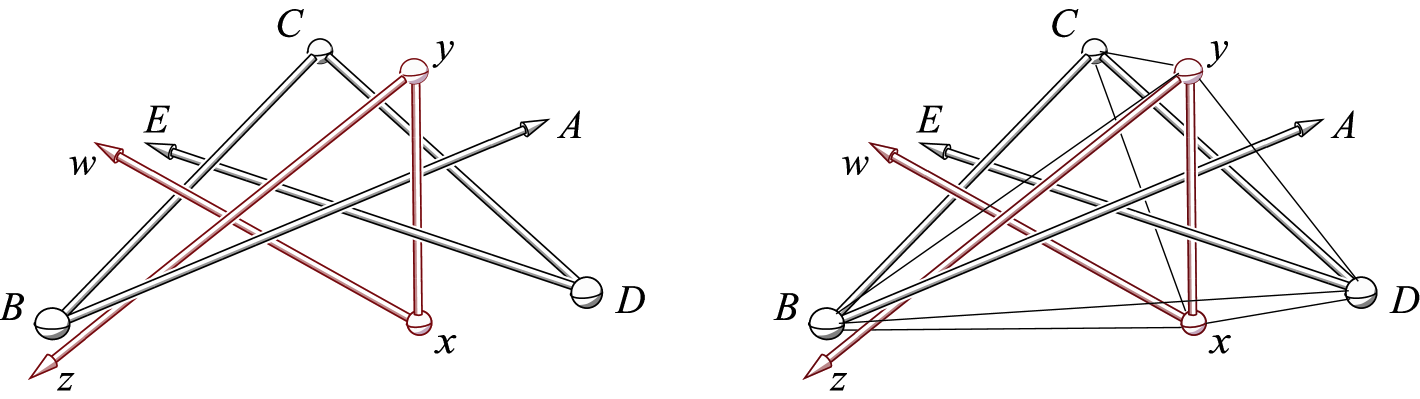
Some facts about the 3/4-tangle:
This 3/4-tangle is crucial to the construction of the -chain in [6] and the construction of the -chain here. In both constructions, the 11-chain and 10-chain are positioned to form a nearly rigid triangular frame which interlock the 2-chain. Note that there are other interlockings of a 3-chain with a 4-chain which could work, but we follow [6] in using the 3/4-tangle in Figure 1 to construct the 10-chain.
To make the 3/4 tangle part of a single open chain, there are four ways to connect the 3-chain with the 4-chain by adding additional link(s). In the discussion in [6] on ways to possibly further reduce the number of links in the 11-chain, two possibilities of allowing maximal sharing of the 3/4-tangle’s 7 links were ruled out. In this paper, we find that one of the two remaining possibilities can allow maximal sharing of two of the 3/4-tangle’s 7 links in the triangle frame. This allows us to prove it indeed provides an open 10-chain interlocking with an open 2-chain.
The idea of proof and proof techniques are very similar to that in [6], and so we follow a similar proof structure. The main difference in proof idea is that the triangle frame shares two of the 7 links of the 3/4-tangle. Therefore the triangle frame employs a total of links. We found it unnecessary to assume that the triangle frame is an isosceles triangle, and so we alter Lemma 2 in [6] accordingly.
2. Idea of Proof
The main idea of the proof, as in [6], is to build a “rigid” triangular frame with small rings at its vertices , which could interlock with a 2-chain, as shown in Figure 2(a) where is shaded. For then pulling away the vertex of the 2-chain from the triangle frame would diminish the angle , and pushing up toward the triangle would increase . But the only slack provided for is that determined by the diameter of the rings, as otherwise the triangular frame is rigid.
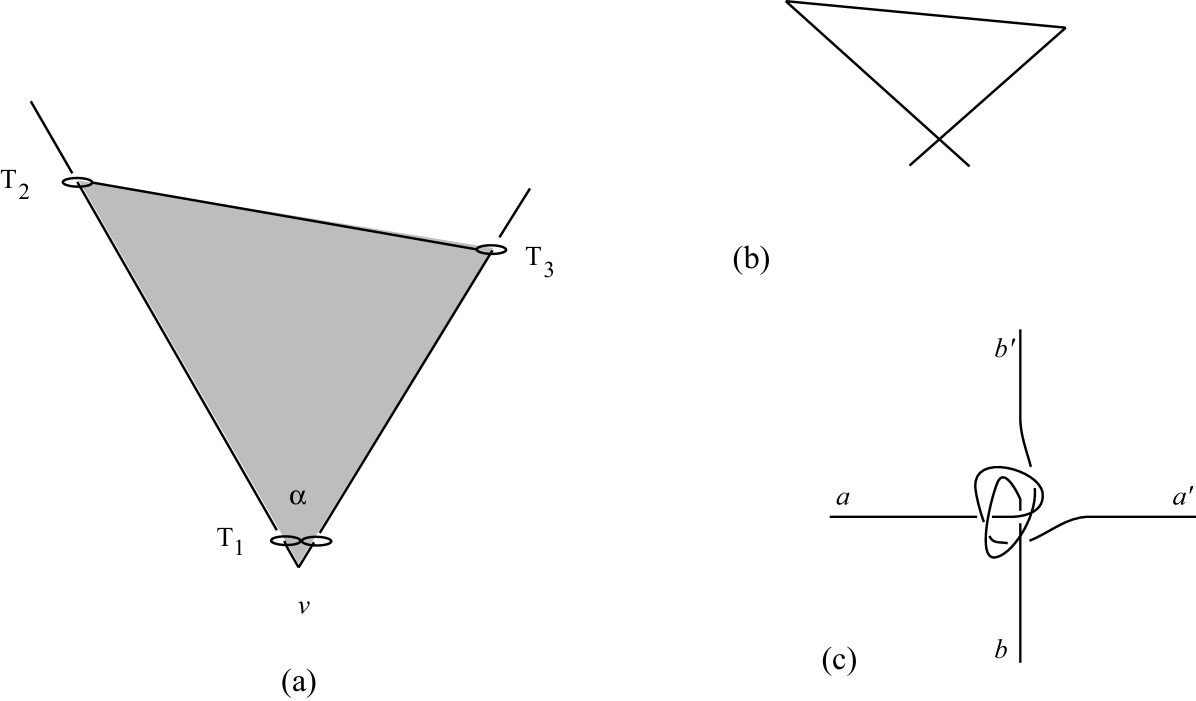
We can construct such a triangle using three links. At each vertex, we take one subchain and confine its crossing with another subchain to within a small region of space. See Figure 2(c) for the idea. This pinning can be achieved by the “-tangle” interlocking from [3] and “jag loops.” So the idea is to replace vertex with a small copy of the 3/4-tangle configuration. This can be accomplished with links for a -tangle, but maximal sharing with both the incident incoming and outgoing triangle links reduces the number of links needed. We can achieve confinement with links at the tangle near . At the other two vertices of the triangle, this can be accomplished with one extra link per vertex. Therefore, together with the links for the main triangle skeleton, we use a total of links.
3. A 2-chain can interlock an open 10-chain
3.1. A 2-chain can interlock an open 10-chain
We take a 3/4-tangle whose joints all stay within an -ball centered at the midpoint of the middle link of the 3-chain. Position the tangle to represent the bottom vertex of a triangle, with the links arranged as shown in Figure 3. At each of the other two vertices, we add an extra link to make a jag loop.
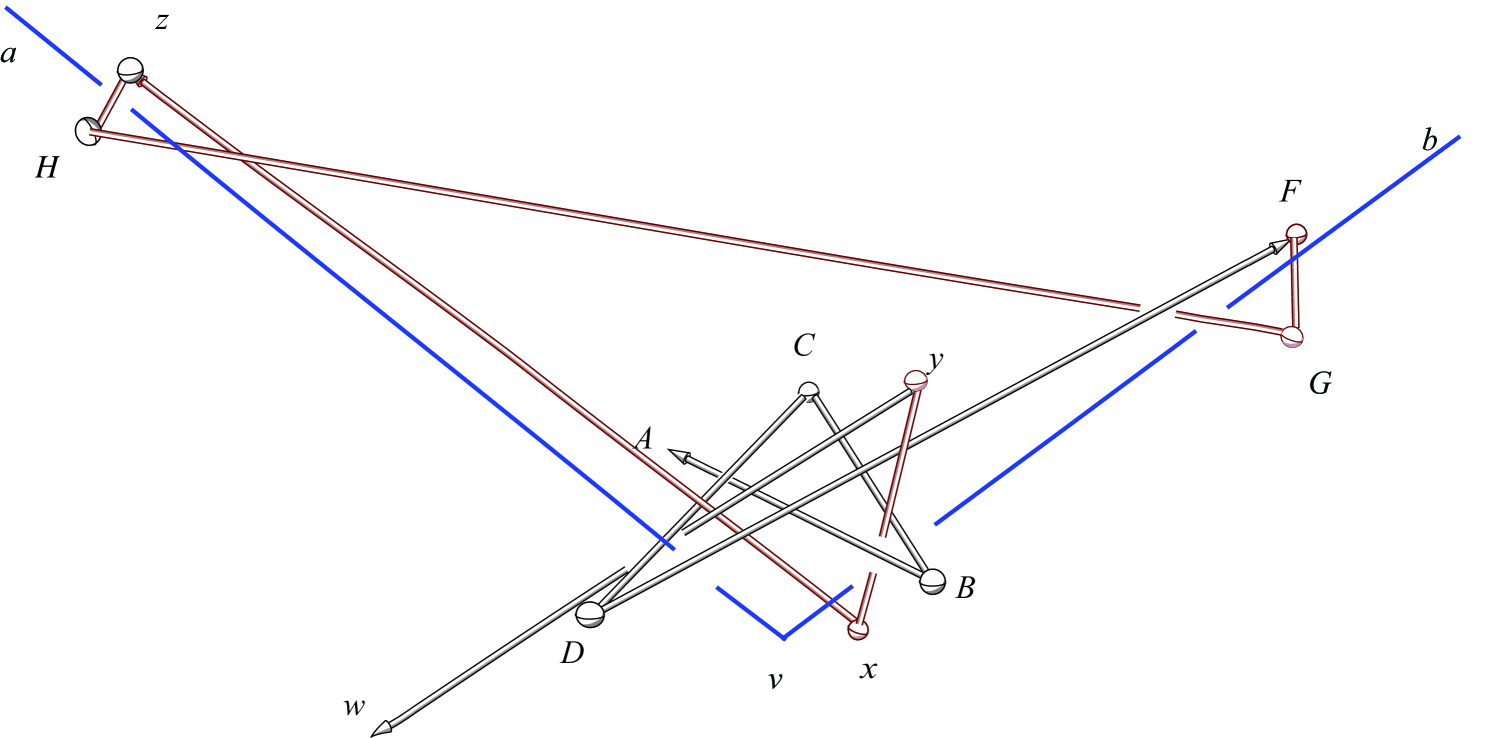
The configuration in Figure 3 is realizable,111 We have constructed physical models of this configuration. that is, there is more than enough flexibility in the design to ensure that and can indeed meet at the 2-chain vertex . To see that this is so, notice that the 3-chain and the 4-chain in the 3/4-tangle can be configured to lie in planes that are nearly orthogonal. If we arrange the plane of the 2-chain at angles with respect to the two orthogonal planes within which the 3-chain and 4-chain lie, then we can thread the 2-chain ( following the link and following ) as in Figure 3 to pass through one jag loop in the 4-chain and one loop made up by the end link and the links of the 3-chain at vertex , at the same time as weaving through the two jag loops at the base of the triangular frame from above, as depicted in the figure.
3.1.1. 2-chain Through Triangle Jag Corners
The jag loops at the other two corners can be assured to remain in an -ball by making the extra link lengths ( and ) shorter than . We can conclude exactly as in [6] that the link passes through an -ball at and cannot unlock with the jag. Note the link passing through the jag loop at is a flip of the case passing through the jag loop at . Thus we have that all corners of the triangle stay within -balls, and both and interlock the jag loops.
3.1.2. The 2-chain Links Are Trapped by the 3/4-tangle
We have exactly the same Lemma 1 as in [6], which we state again below. Our proof is slightly different due to the difference in construction.
Lemma 1.
The vertex of the 2-chain cannot “unweave” from the 3/4-tangle. Thus the links of the 2-chain are trapped by the 3/4-tangle.
Proof.
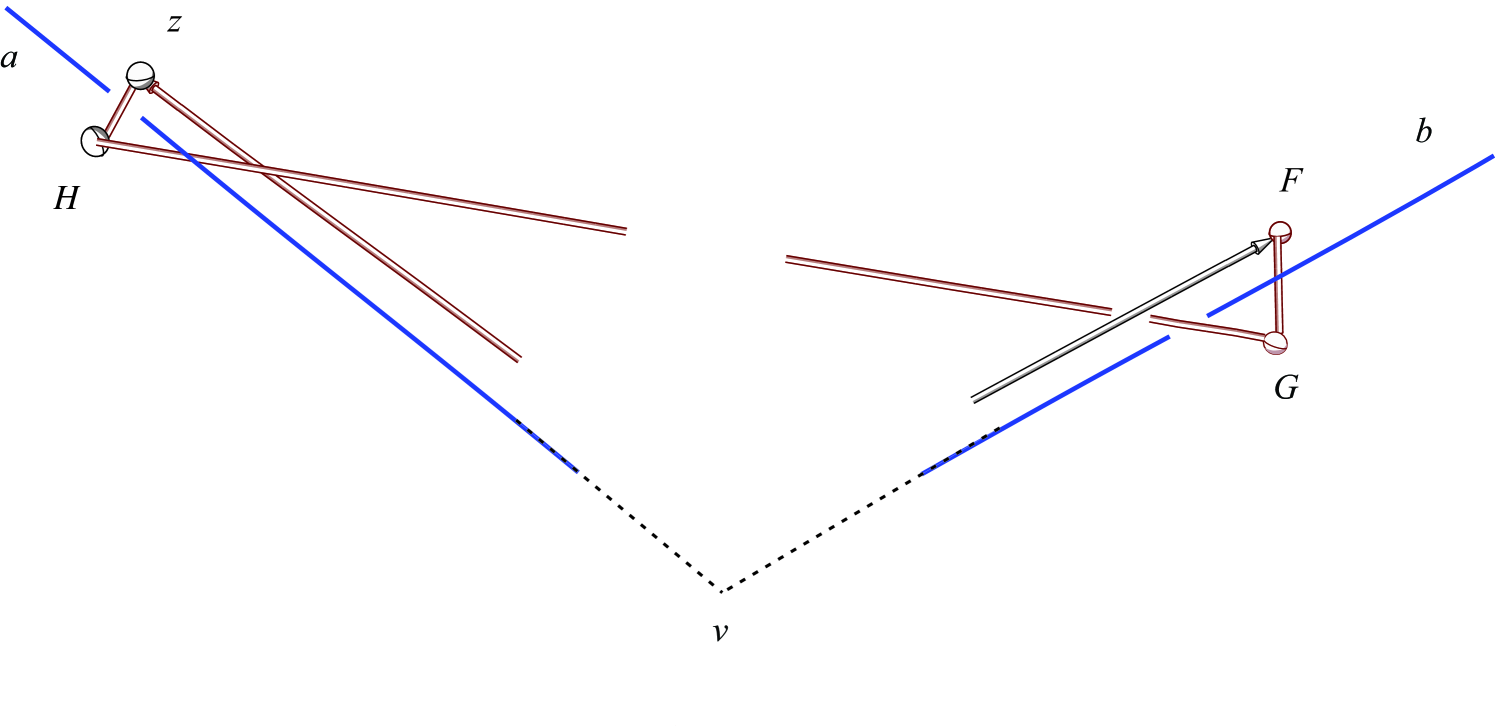
From the construction of the -chain, link pierces , and links and straddle , and . We will prove that the vertex cannot penetrate the tetrahedron , the convex hull with vertices , which is highlighted in Figure 5 below.
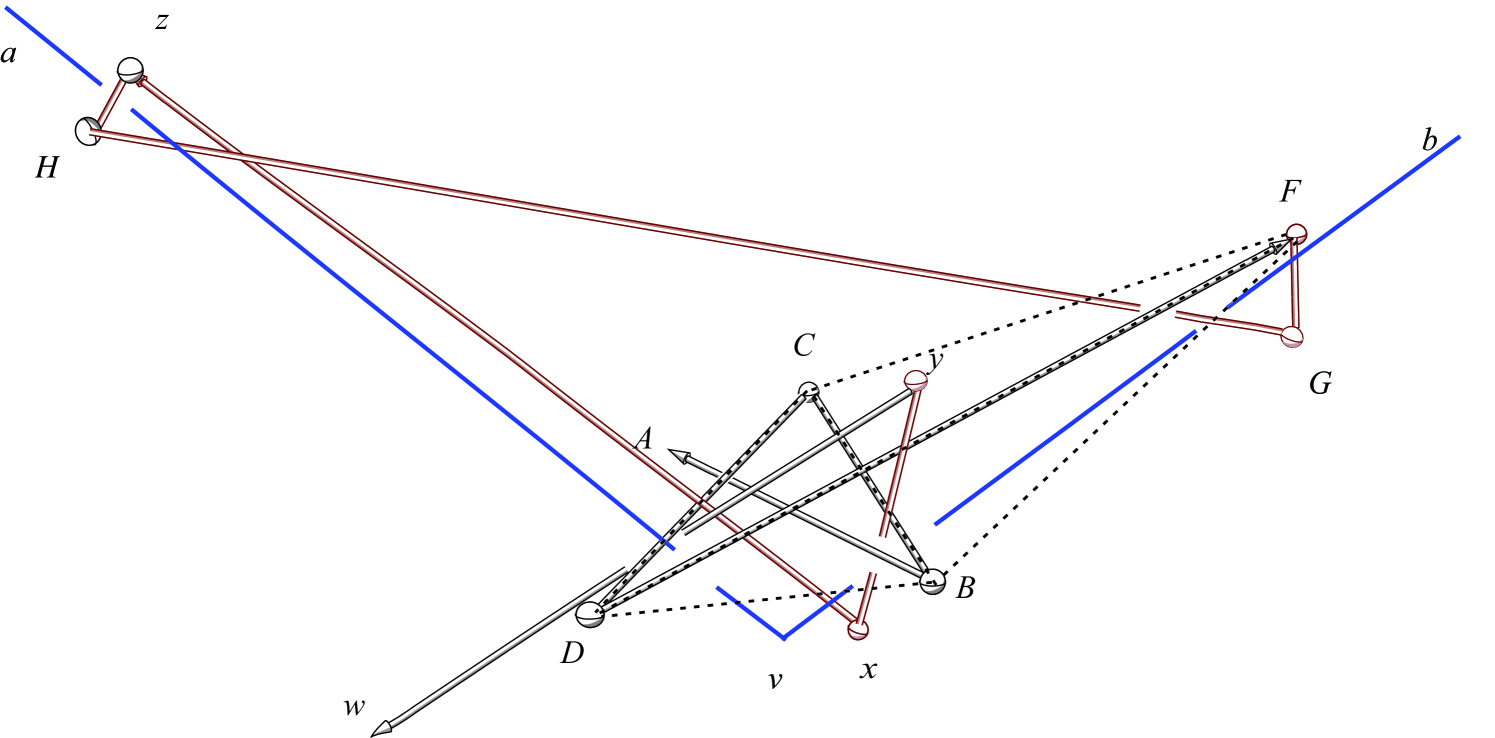
Assume can penetrate , that is, can move into the inside of the tetrahedron . Note that the link passes through the -ball at . When is sufficiently small, and come very close to . We may assume and meet near a point on ; then all points on except stay inside as is convex. This contradicts the fact that is weaved under and and the 2-chain straddles and . So the vertex cannot penetrate the tetrahedron .
∎
Therefore the -chain links are trapped by the 3/4-tangle. Therefore the only way the 2-chain could slide free of the near rigid triangular frame is if one of the end vertices enters the -ball at the jag loop corners.
3.1.3. The Vertex Cannot Move Far
Thus the 2-chain cannot slide free of any of the triangle corners if we make the 2-chain links extra long, so that the two end points cannot enter the -ball containing the corners. We recall Lemma 4 from [5].
When is sufficiently small, a line piercing two disks of radius can angularly deviate from the line connecting the disk centers at most , where is the distance between the disk centers.
Figure 6(a) illustrates the largest angle .
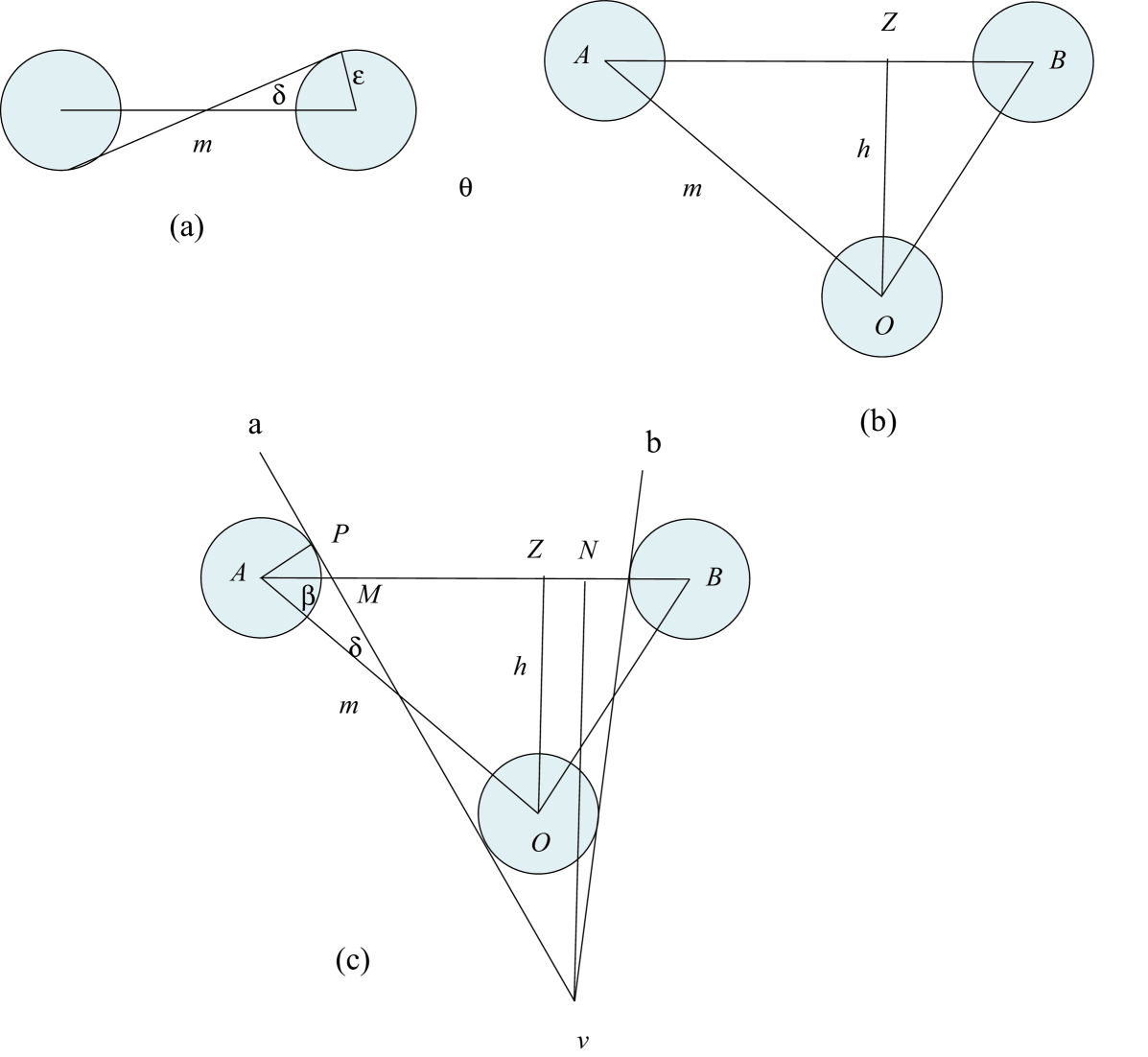
Let be the centers of the three -balls containing the triangle corners, see Figure 6(b). Let the side length , and , and the altitude . Without loss of generality, we assume that is an acute angle (otherwise is acute, and use ). Furthermore, when is sufficiently small, can be assumed to remain an acute angle. Draw a perpendicular line from to line and let be the point of intersection. Similarly, draw a perpendicular line from to line and let be the point of intersection. Let be the point of intersection of and . The following lemma captures the key constraint on the motion of the 2-link chain.
Lemma 2.
If the sides of the triangle pass through the -disks illustrated, then the distance satisfies . Hence is bounded.
Proof.
Since and both pass through the -ball centered at , the distance from to is at least . On the other hand, Figure 6(c) illustrates the largest distance between and . Note is a right triangle, , and , so since the tangent function is increasing on the interval and .
∎
From the proof above, . Since and , we obtain .
3.1.4. Main Theorem
We connect 3D to 2D via the plane determined by the 2-link chain in the proof of the main theorem below.
Theorem 1.
The 2-link chain is interlocked with the 10-link triangle chain.
Proof.
Let be the plane containing the 2-link chain. The links of the 2-chain pass through -balls around the three vertices of the triangle.
meets these balls in disks each of radius . The lemma above shows that the distance from the vertex to is bounded above and below. Thus, by choosing small enough, we limit to any desired amount the distance vertex of the 2-link chain can be pushed toward or separated from the triangle.
Similar to [5], we can establish that the 2-chain links are interlocked with the 3/4-tangle and jag loops through which they pass, under the assumption that the triangle is nearly rigid.
Thus, when we choose small enough (and , long enough) to prevent the two end vertices of the 2-link chain from entering the -balls, it ensures that the 2-link chain is interlocked with the triangle chain. ∎
Below we sketch an argument that suggests, without formally establishing, that 10 links is the minimum needed for interlocking. Our main theorem above proves that the minimum . We argue that the minimum cannot be less than 10 by contradiction. Assume there is a flexible -chain in a nearly rigid triangular frame that can interlock with a flexible 2-chain and . Furthermore, assume that at two vertices of the triangle frame, jag loops are used to allow maximal sharing of links to result in a minimum number of links. Now take away the two extra links at the jag loops and the side of the triangle connecting the jag loops, we consider the remaining links in the -chain, which consists of two open chains with a total of links . In the following we argue that two open chains with a total of links either cannot occur, or cannot form a loop to trap the 2-chain at the vertex . The cases of two open chains with a total of links are:
-
(1)
A 1-chain and an open 5-chain;
-
(2)
A 2-chain and a 4-chain; and
-
(3)
Two 3-chains.
Case (1) cannot happen. For, if it does occur, then the 1-chain would be used as both the end link of the open 9-chain and as a side of the triangular frame, which allows the frame some flexibility and renders it too flexible. In Cases (2) and (3), the chains cannot interlock, so they cannot interlock the 2-chain.
The cases of may be argued analogously to the cases of .
The reason this sketch is not a formal proof is that we are assuming that, in order to reduce the number of links used, interlocking must be achieved by “rigidifying” the 2-chain to a nearly rigid triangle. A more direct contradiction from the assumption of locking with a 9-chain would be desirable.
References
- [1] T. Biedl, E. Demaine, M. Demaine, S. Lazard, A. Lubiw, J. O’Rourke, M. Overmars, S. Robbins, I. Streinu, G. Toussaint, and S. Whitesides. Locked and unlocked polygonal chains in 3D. Discrete Comput. Geom., 26(3):269–282, 2001.
- [2] J. Cantarella and H. Johnston, Nontrivial embeddings of polygonal intervals and unknots in -space, Journal of Knot theory and Its Ramifications, 7(8): 1027–1039, 1998.
- [3] E. D. Demaine, S. Langerman, J. O’Rourke, and J. Snoeyink, Interlocked Open Linkages with Few Joints, Proc. 18th ACM Sympos. Comput. Geom., 189–198, 2002.
- [4] E. D. Demaine, S. Langerman, J. O’Rourke, and J. Snoeyink, Interlocked open and closed linkages with few joints, Comp. Geom. Theory Appl., 26(1): 37–45, 2003.
- [5] J. Glass, S. Langerman, J. O’Rourke, J. Snoeyink and J. K. Zhong, A 2-chain can interlock with a -chain, preprint, http://arxiv.org/abs/cs.CG/0410052.
- [6] J. Glass, B. Lu, J. O’Rourke and J. K. Zhong, A 2-chain can interlock with a -chain, Geombinatorics (2006), Volume XV, paper no. 4, 166-176. Preprint, http://www.cs.smith.edu/ orourke/Papers/ilock11.pdf.