Bottom-charmed baryons in a nonrelativistic quark model
Abstract
In this work, we study the low-lying mass spectra for bottom-charmed baryons in a nonrelativistic quark model by solving the three-body Schrödinger equation. The lowest , , , and states are predicted to be about 6979, 6953, 7109, and 7092 MeV, respectively. Also, the strong decays for the low-lying excited states are investigated. Our results indicate that some of mode wave bottom-charmed baryons are relatively narrow, which can be searched for in future experiments. For the low-lying mode and hybrid states, their strong decays are highly suppressed and they can survive as extremely narrow states. Moreover, the mass spectra and strong decays for bottom-charmed baryons preserve the heavy quark symmetry well. We hope our calculations can provide helpful information for further experimental and theoretical researches.
I Introduction
In the past years, with the development of the large-scale accelerator facilities, plenty of heavy baryons have been observed and significant progress has been achieved in experiments. These discoveries have triggered wide attentions of theorists, which leads the study on mass spectra and internal structures of heavy baryons to a hot topic in hadron physics Chen:2016spr ; Cheng:2021qpd . Understanding the nature of heavy baryons and searching for the missing heavy resonances can help us to establish and complete the hadron spectroscopy and provide a good platform to better investigate the heavy quark symmetry. Until now, most experimental observations in heavy baryon sector belong to the singly heavy baryons, while the doubly heavy baryons are rare. Due to the lack of experimental data, our understanding of the doubly heavy baryons is still scarce, and more experimental and theoretical efforts are encouraged and needed.
In 2002, the SELEX Collaboration reported an evidence of a doubly charmed baryon that has a mass of 3519 1 MeV in the final state Mattson:2002vu and decay mode Ocherashvili:2004hi . However, the existence of was disfavored by the following FOCUS, BaBar, Belle and LHCb Collaborations Ratti:2003ez ; Aubert:2006qw ; Chistov:2006zj ; Aaij:2013voa , and the following theoretical works do not also support this discovery. In 2017, a highly significant structure with a mass of 3621.40 0.72 0.27 0.14 MeV was observed in the mass spectrum by the LHCb Collaboration Aaij:2017ueg . Subsequently, the LHCb Collaboration measured its lifetime LHCb:2018zpl ; LHCb:2019qed and other decay modes LHCb:2018pcs ; LHCb:2019ybf ; LHCb:2019epo ; LHCb:2022rpd . Meanwhile, the LHCb Collaboration paid lots of attentions to hunt for more doubly heavy baryons, however no more signal has been found so far LHCb:2021eaf ; LHCb:2020iko ; LHCb:2021xba ; LHCb:2021rkb ; LHCb:2019gqy ; LHCb:2022fbu . In particular, the and state was placed great expectations to be discovered in the near future, where one charm quark in is replaced by a bottom quark.
Theoretically, there are various methods to predict the mass spectra of doubly heavy baryons, such as potential models Kiselev:2001fw ; Ebert:1996ec ; Tong:1999qs ; Ebert:2002ig ; Gershtein:2000nx ; Roberts:2007ni ; Giannuzzi:2009gh ; Martynenko:2007je ; Valcarce:2008dr ; Eakins:2012jk ; Shah:2017liu ; Wang:2021rjk ; Yu:2022lel ; Li:2022ywz ; Soto:2020pfa , heavy quark symmetry and mass formulas Savage:1990di ; Song:2022csw ; Roncaglia:1995az ; Cohen:2006jg ; Karliner:2014gca ; Wei:2015gsa ; Wei:2016jyk ; Oudichhya:2022ssc , QCD sum rule Zhang:2008rt ; Tang:2011fv ; Wang:2010hs ; Aliev:2012ru ; Aliev:2012nn ; Aliev:2012iv , lattice QCD Liu:2009jc ; Brown:2014ena ; Padmanath:2015jea ; Mathur:2018rwu ; Mathur:2018epb , and so on. Besides the mass spectra, the weak and radiative decays of the doubly heavy baryons are also widely discussed in the literature Faessler:2001mr ; Faessler:2009xn ; Albertus:2009ww ; White:1991hz ; Li:2017ndo ; Yu:2017zst ; Ebert:2004ck ; Roberts:2008wq ; Branz:2010pq ; Hackman:1977am ; Bernotas:2013eia ; Dai:2000hza ; Albertus:2010hi ; Qin:2021zqx ; Bahtiyar:2018vub , which provide helpful information for the experimental searches. Among these fruitful theoretical studies, there were only a few works on strong decay behaviors Eakins:2012fq ; Xiao:2017udy ; Mehen:2017nrh ; Ma:2017nik ; Xiao:2017dly ; Yan:2018zdt ; He:2021iwx ; Chen:2022fye . Based on the experimental and theoretical status, the strong decay of doubly heavy baryons should be urgently investigated and highly valued.
In this work, we concentrate on the bottom-charmed family that is made up of a bottom quark , a charm quark and a light quark (, , or ). When the light quark belongs to up or down quark, the bottom-charmed baryon is named as or ; When the light quark is a strange quark, the bottom-charmed baryon is denoted as or . The study of bottom-charmed baryons does not only provide an opportunity for us to investigate the heavy quark symmetry and chiral dynamics simultaneously, but also supplies a unique platform about the conventional baryons with three non-identical quarks. Moreover, the excited states and their strong decay behaviors are essential for better understanding the spectroscopy for bottom-charmed baryons and helping experimentalists to hunt for more hadrons. Among various properties, the Okubo-Zweig-Iizuka-allowed (OZI-allowed) two-body decay processes are particularly interesting where one light meson is, especially the pion, emitted from the parent baryon. In this process, the meson couples to the light quark, and the heavy quark subsystem behaves simply as a spectator. Hence this provides a good platform to investigate dynamics of chiral symmetry at the single quark level. However, the study on strong decays for bottom-charmed baryon is very scarce Eakins:2012fq , and then it is time to explore this topic systematically.
In a previous work, a nonrelativistic quark model was adopted to study the mass spectrum of heavy baryons with two identical quarks, and gained significant achievements Yoshida:2015tia . However, the case of all three quarks with different masses were not studied. Here, we employ the same quark model to bottom-charmed system by solving the three-body Schrödinger equation in order to get the mass spectrum consistently. Besides the masses, the realistic wave functions are obtained simultaneously, and can be used for strong decay calculations. The lowest , , , and states are predicted to be about 6979, 6953, 7109, and 7092 MeV, respectively. Our results indicate that some of mode , , , states are narrow, which have good potentials to be observed by future experiments. Also, the strong decays of the low-lying mode and hybrid states are highly suppressed and can be searched for in the processes with electromagnetic and weak interactions.
II FORMALISM
II.1 Potential Model
In order to calculate the spectrum of the low-lying bottom-charmed baryons, we adopt a nonrelativistic quark model, where the Hamiltonian can be expressed as
| (1) |
with the kinetic energy
| (2) |
and the effective potential
| (3) |
Here is the center-of-mass energy, is the distance between the th and th quarks. The linear confinement potential and one-gluon-exchange potential are as follows
| (4) |
| (5) |
where is the overall zero-point-energy parameter. The spin-dependent interaction is the sum of spin-spin term , spin-orbit term , and tensor term
| (6) |
| (7) | |||||
| (8) | |||||
The parameters are taken from the original work Yoshida:2015tia and listed in the Table 1. Also, the overall constant is adjusted by fixing the mass of ground state , which is suitable for present bottom-charmed baryons systems.
| Parameters | Value | |
|---|---|---|
| 0.300 | ||
| 0.510 | ||
| 1.750 | ||
| 5.112 | ||
| 0.165 | ||
| 0.090 | ||
| 1.200 | ||
| 0.077 | ||
| 0.077 | ||
| 3.500 | ||
| -1.203 |
The bottom-charmed baryon is a three-quark system, where the Jacobi coordinates can be introduced to eliminate the center-of-mass energy. As illustrated in Figure 1, the Jacobi coordinates are defined as
| (9) |
| (10) |
| (11) |
where and denote the position vector and the mass of the th quark, respectively. The stands for the relative coordinate between bottom and charm quarks, the represents the relative coordinate between the light and heavy subsystems, and the is mass center coordinate.
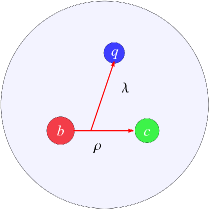
The bottom-charmed baryons can be divided into four types according to the total wave functions, which are denoted as , , and , respectively. These notations follow those of the singly heavy baryons , , , and , and the naming scheme can be referred to Refs. Chen:2016spr ; Eakins:2012jk ; Li:2022ywz . In the present work, the orbital wave functions are expanded in terms of a set of Gaussian basis functions that forms an approximate complete set Hiyama:2003cu ; Hiyama:2018ivm . Then, the explicit expression for spatial part can be written as
| (12) |
with
| (13) |
and
| (14) |
where are the expansion coefficients. It is worth noting that the and mode can be hardly separated in the strict sense for the systems with three non-identical masses. However, in view of the heavy quark symmetry, the orbital wave functions for bottom-charmed baryons can be separated approximately and we prefer to adopt the above trial wave functions to solve the three-body Schrödinger equation.
The range parameters of Gaussian functions are given as
| (15) |
| (16) |
where and are the number of Gaussian functions, and and are the ratio coefficients. According to the Rayleigh-Ritz variational principle, one can have
| (17) |
where the are the matrix elements in the total color-flavor-spin-orbital bases, stands for the eigenvalue, and are the relevant eigenvectors. Finally, the spectrum of bottom-charmed baryons can be obtained by solving the generalized eigenvalue problem.
In constructing the total wave functions, we adopt the coupling scheme to investigate the bottom-charmed baryons, where the states are defined as
| (18) |
The label is the orbital quantum number between the two heavy quarks, the the orbital quantum number between the light and heavy subsystems, the spin quantum number of two heavy quarks, the total angular momentum of heavy quark subsystem, the total angular momentum of light quark system that is usually known as the light quark spin, and the spin-parity for hadrons. More details of different coupling schemes and their relations can be found in our previous work He:2021iwx .
II.2 Pseudoscalar meson emissions
Besides the mass spectrum, the strong decays can reflect the internal structures of hadrons more explicitly. In this subsection, the approach of strong decays for bottom-charmed baryons is introduced briefly. In the quark model, the pseudoscalar meson can couple to the light quark inside a bottom-charmed baryons through the Yukawa interaction, which is considered to contribute predominantly to one-meson emission decays + in Figure 2. The axial-vector coupling between the pseudoscalar meson and a light quark can be written as
| (19) |
where the stands for the quark field, is the quark-axial-vector coupling and is the decay constant. In present work, = 93 and =111 are adopted that have been widely used in quark model calculations Arifi:2022ntc ; Arifi:2021orx ; Nagahiro:2016nsx ; Xiao:2017udy ; Wang:2018fjm ; Liu:2019wdr ; Lu:2022puv .
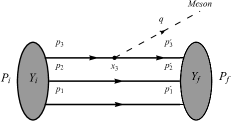
The wave function for the , , , and baryon with mass in the rest frame can be expressed in the momentum representation as
| (20) | ||||
Then, the decay amplitude for + can be obtained by
| (21) | ||||
and the is defined as
| (22) |
The denotes the flavor matrix, is the mass of initial baryon, is the mass of final baryon, is the 4-momentum of outgoing pseudoscalar meson, is the constituent quark mass with , , and .
After calculating the mass spectrum, one can get the wave functions for bottom-charmed baryons, which are applied to estimate the root mean square and the range parameters . These effective values are obtained by equating the root mean square radius of simple harmonic oscillator wave functions to that obtained in the nonrelativistic quark model, which has been widely used in the previous studies of strong decays Close:2005se ; Li:2010vx ; Godfrey:2015dia ; Godfrey:2015dva ; Chen:2016iyi . Then, the helicity amplitude can be derived from the transition operator and effective parameters in the harmonic oscillator wave functions. To calculate the strong decay widths for the pseudoscalar meson emissions, one also need to take into account the phase space factor. Finally, the strong decays for bottom-charmed baryons can be obtained within the helicity bases straightforwardly,
| (23) |
III Results and discussion
In this section, we first calculated the mass spectrum of bottom-charmed baryons, and then estimate the strong decays for mode low-lying excited states. Also, we discuss the relativistic corrections for the Roper-like resonances, the mixture of mode states with the same spin-parity, and the suppression of strong decays for mode and hybrid states. In analogy with singly heavy baryons Chen:2007xf , we adopt the symbols , , , and on the top of capital and to denote the mode wave, mode wave, hybrid, and mode radially excited states, respectively.
III.1 Mass spectrum
In the quark model, for the or family, there should be one ground state, five mode wave states, two mode wave states, two mode wave states, two mode wave states, thirteen hybrid wave states, and two radially excited states; for the or family should exist two ground states, two mode wave states, five mode wave states, six mode wave states, six mode wave states, five hybrid wave states, and four radially excited states. Within the potential model, we obtain the masses and perform them in Table 2, 3, 4, and 5. Also, the full mass spectra are plotted in Figure 3 and 4 for reference.
| States | Mass | |||||||||
|---|---|---|---|---|---|---|---|---|---|---|
| 0 | 0 | 0 | 0 | 1 | 1 | 347 | 6979 | |||
| 1 | 0 | 0 | 0 | 1 | 1 | 507 | 7344 | |||
| 0 | 1 | 0 | 0 | 1 | 1 | 489 | 7640 | |||
| 0 | 0 | 1 | 0 | 1 | 0 | 438 | 7157 | |||
| 0 | 0 | 1 | 0 | 1 | 1 | 437 | 7159 | |||
| 0 | 0 | 1 | 0 | 1 | 1 | 441 | 7192 | |||
| 0 | 0 | 1 | 0 | 1 | 2 | 440 | 7192 | |||
| 0 | 0 | 1 | 0 | 1 | 2 | 432 | 7193 | |||
| 0 | 0 | 0 | 1 | 0 | 0 | 305 | 7391 | |||
| 0 | 0 | 0 | 1 | 0 | 0 | 302 | 7403 | |||
| 0 | 0 | 2 | 0 | 0 | 2 | 501 | 7352 | |||
| 0 | 0 | 2 | 0 | 0 | 2 | 500 | 7354 | |||
| 0 | 0 | 0 | 2 | 0 | 0 | 291 | 7732 | |||
| 0 | 0 | 0 | 2 | 0 | 0 | 282 | 7746 | |||
| 0 | 0 | 1 | 1 | 1 | 0 | 368 | 7543 | |||
| 0 | 0 | 1 | 1 | 1 | 0 | 367 | 7564 | |||
| 0 | 0 | 1 | 1 | 1 | 1 | 366 | 7572 | |||
| 0 | 0 | 1 | 1 | 1 | 1 | 366 | 7575 | |||
| 0 | 0 | 1 | 1 | 1 | 1 | 359 | 7597 | |||
| 0 | 0 | 1 | 1 | 1 | 1 | 359 | 7599 | |||
| 0 | 0 | 1 | 1 | 1 | 1 | 352 | 7604 | |||
| 0 | 0 | 1 | 1 | 1 | 2 | 367 | 7565 | |||
| 0 | 0 | 1 | 1 | 0 | 2 | 366 | 7578 | |||
| 0 | 0 | 1 | 1 | 0 | 2 | 353 | 7595 | |||
| 0 | 0 | 1 | 1 | 0 | 2 | 352 | 7598 | |||
| 0 | 0 | 1 | 1 | 0 | 2 | 352 | 7601 | |||
| 0 | 0 | 1 | 1 | 0 | 2 | 350 | 7609 |
| States | Mass | |||||||||
|---|---|---|---|---|---|---|---|---|---|---|
| 0 | 0 | 0 | 0 | 1 | 1 | 419 | 7109 | |||
| 1 | 0 | 0 | 0 | 1 | 1 | 601 | 7480 | |||
| 0 | 1 | 0 | 0 | 1 | 1 | 351 | 7670 | |||
| 0 | 0 | 1 | 0 | 1 | 0 | 506 | 7297 | |||
| 0 | 0 | 1 | 0 | 1 | 1 | 506 | 7298 | |||
| 0 | 0 | 1 | 0 | 1 | 1 | 500 | 7322 | |||
| 0 | 0 | 1 | 0 | 1 | 2 | 500 | 7322 | |||
| 0 | 0 | 1 | 0 | 1 | 2 | 500 | 7323 | |||
| 0 | 0 | 0 | 1 | 0 | 0 | 362 | 7451 | |||
| 0 | 0 | 0 | 1 | 0 | 0 | 360 | 7458 | |||
| 0 | 0 | 2 | 0 | 0 | 2 | 583 | 7488 | |||
| 0 | 0 | 2 | 0 | 0 | 2 | 582 | 7489 | |||
| 0 | 0 | 0 | 2 | 0 | 0 | 306 | 7761 | |||
| 0 | 0 | 0 | 2 | 0 | 0 | 305 | 7768 | |||
| 0 | 0 | 1 | 1 | 1 | 0 | 431 | 7607 | |||
| 0 | 0 | 1 | 1 | 1 | 0 | 422 | 7625 | |||
| 0 | 0 | 1 | 1 | 1 | 1 | 417 | 7632 | |||
| 0 | 0 | 1 | 1 | 1 | 1 | 417 | 7634 | |||
| 0 | 0 | 1 | 1 | 1 | 1 | 413 | 7652 | |||
| 0 | 0 | 1 | 1 | 1 | 1 | 413 | 7650 | |||
| 0 | 0 | 1 | 1 | 1 | 1 | 412 | 7654 | |||
| 0 | 0 | 1 | 1 | 1 | 2 | 417 | 7637 | |||
| 0 | 0 | 1 | 1 | 0 | 2 | 412 | 7652 | |||
| 0 | 0 | 1 | 1 | 0 | 2 | 411 | 7658 | |||
| 0 | 0 | 1 | 1 | 0 | 2 | 411 | 7659 | |||
| 0 | 0 | 1 | 1 | 0 | 2 | 409 | 7661 | |||
| 0 | 0 | 1 | 1 | 0 | 2 | 405 | 7667 |
| States | Mass | |||||||||
|---|---|---|---|---|---|---|---|---|---|---|
| 0 | 0 | 0 | 0 | 1 | 1 | 373 | 6953 | |||
| 0 | 0 | 0 | 0 | 1 | 1 | 357 | 6997 | |||
| 1 | 0 | 0 | 0 | 1 | 1 | 533 | 7301 | |||
| 1 | 0 | 0 | 0 | 1 | 1 | 520 | 7332 | |||
| 0 | 1 | 0 | 0 | 1 | 1 | 508 | 7593 | |||
| 0 | 1 | 0 | 0 | 1 | 1 | 501 | 7619 | |||
| 0 | 0 | 1 | 0 | 0 | 1 | 438 | 7176 | |||
| 0 | 0 | 1 | 0 | 0 | 1 | 437 | 7178 | |||
| 0 | 0 | 0 | 1 | 1 | 1 | 319 | 7382 | |||
| 0 | 0 | 0 | 1 | 1 | 1 | 315 | 7387 | |||
| 0 | 0 | 0 | 1 | 1 | 1 | 313 | 7396 | |||
| 0 | 0 | 0 | 1 | 1 | 1 | 311 | 7404 | |||
| 0 | 0 | 0 | 1 | 1 | 1 | 310 | 7408 | |||
| 0 | 0 | 2 | 0 | 1 | 2 | 514 | 7331 | |||
| 0 | 0 | 2 | 0 | 1 | 2 | 514 | 7334 | |||
| 0 | 0 | 2 | 0 | 1 | 1 | 503 | 7359 | |||
| 0 | 0 | 2 | 0 | 1 | 1 | 502 | 7360 | |||
| 0 | 0 | 2 | 0 | 1 | 3 | 502 | 7361 | |||
| 0 | 0 | 2 | 0 | 1 | 3 | 502 | 7362 | |||
| 0 | 0 | 0 | 2 | 1 | 1 | 295 | 7732 | |||
| 0 | 0 | 0 | 2 | 1 | 1 | 295 | 7733 | |||
| 0 | 0 | 0 | 2 | 1 | 1 | 280 | 7755 | |||
| 0 | 0 | 0 | 2 | 1 | 1 | 279 | 7759 | |||
| 0 | 0 | 0 | 2 | 1 | 1 | 278 | 7764 | |||
| 0 | 0 | 0 | 2 | 1 | 1 | 276 | 7770 | |||
| 0 | 0 | 1 | 1 | 0 | 1 | 388 | 7549 | |||
| 0 | 0 | 1 | 1 | 0 | 1 | 370 | 7581 | |||
| 0 | 0 | 1 | 1 | 0 | 1 | 368 | 7587 | |||
| 0 | 0 | 1 | 1 | 0 | 1 | 369 | 7583 | |||
| 0 | 0 | 1 | 1 | 0 | 1 | 350 | 7606 |
| States | Mass | |||||||||
|---|---|---|---|---|---|---|---|---|---|---|
| 0 | 0 | 0 | 0 | 1 | 1 | 455 | 7092 | |||
| 0 | 0 | 0 | 0 | 1 | 1 | 397 | 7125 | |||
| 1 | 0 | 0 | 0 | 1 | 1 | 635 | 7441 | |||
| 1 | 0 | 0 | 0 | 1 | 1 | 622 | 7464 | |||
| 0 | 1 | 0 | 0 | 1 | 1 | 345 | 7664 | |||
| 0 | 1 | 0 | 0 | 1 | 1 | 343 | 7681 | |||
| 0 | 0 | 1 | 0 | 0 | 1 | 505 | 7310 | |||
| 0 | 0 | 1 | 0 | 0 | 1 | 504 | 7312 | |||
| 0 | 0 | 0 | 1 | 1 | 1 | 374 | 7439 | |||
| 0 | 0 | 0 | 1 | 1 | 1 | 369 | 7448 | |||
| 0 | 0 | 0 | 1 | 1 | 1 | 366 | 7453 | |||
| 0 | 0 | 0 | 1 | 1 | 1 | 365 | 7458 | |||
| 0 | 0 | 0 | 1 | 1 | 1 | 364 | 7460 | |||
| 0 | 0 | 2 | 0 | 1 | 2 | 590 | 7472 | |||
| 0 | 0 | 2 | 0 | 1 | 2 | 589 | 7474 | |||
| 0 | 0 | 2 | 0 | 1 | 1 | 583 | 7492 | |||
| 0 | 0 | 2 | 0 | 1 | 1 | 583 | 7493 | |||
| 0 | 0 | 2 | 0 | 1 | 3 | 582 | 7494 | |||
| 0 | 0 | 2 | 0 | 1 | 3 | 582 | 7494 | |||
| 0 | 0 | 0 | 2 | 1 | 1 | 365 | 7731 | |||
| 0 | 0 | 0 | 2 | 1 | 1 | 365 | 7732 | |||
| 0 | 0 | 0 | 2 | 1 | 1 | 348 | 7774 | |||
| 0 | 0 | 0 | 2 | 1 | 1 | 349 | 7769 | |||
| 0 | 0 | 0 | 2 | 1 | 1 | 348 | 7773 | |||
| 0 | 0 | 0 | 2 | 1 | 1 | 343 | 7784 | |||
| 0 | 0 | 1 | 1 | 0 | 1 | 445 | 7608 | |||
| 0 | 0 | 1 | 1 | 0 | 1 | 438 | 7641 | |||
| 0 | 0 | 1 | 1 | 0 | 1 | 437 | 7645 | |||
| 0 | 0 | 1 | 1 | 0 | 1 | 433 | 7648 | |||
| 0 | 0 | 1 | 1 | 0 | 1 | 424 | 7661 |
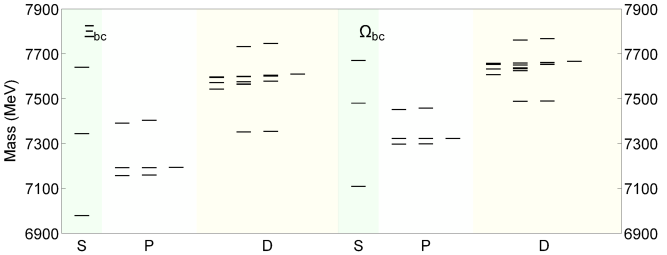
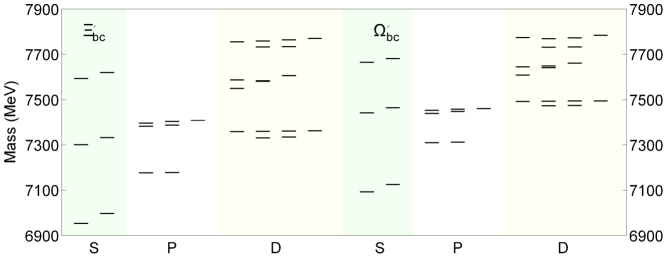
We first refer to the ground states for bottom-charmed baryons. From the Table 6 and Figure 5, The lowest , , , and states are predicted to be about 6979, 6953, 7109, and 7092 MeV, respectively. It can be seen that our results are consistent with some works Ebert:1996ec ; Ebert:2002ig ; Li:2022ywz , while differ with others about MeV Roberts:2007ni ; Oudichhya:2022ssc ; Giannuzzi:2009gh . In the singly heavy baryons , the lowest states are rather than . However, for the bottom-charmed baryons, the lowest states are and , which is totally different with singly heavy sector. This is due to the different masses in spin-spin term in the nonrelativistic quark model for singly and doubly heavy baryons, where the pairwise interactions among three quarks together with spin wave functions compete with each other. Moreover, the mass splittings for and are 44 and 33 MeV, respectively. These quite small mass gaps are caused by spin-spin interaction which is inversely proportional to quark masses. Because of this, the pion emission between the ground states for bottom-charmed baryons is prohibited and only decay mode is by electroweak processes, which is in contrast with the strange sector allowing the strong decay . In particular, For the lowest and states, future experiments can search for them in via weak transitions.
| States | Our work | Ebert:1996ec | Ebert:2002ig | Li:2022ywz | Roberts:2007ni | Oudichhya:2022ssc | Giannuzzi:2009gh | Eakins:2012jk | Brown:2014ena | Karliner:2014gca | Mathur:2018epb | Roncaglia:1995az | ||
|---|---|---|---|---|---|---|---|---|---|---|---|---|---|---|
| 6979 | 7000 | 6963 | 6955 | 7047 | 6920 | 7037 | 6959 | 6933 | 6966 | 7040 | ||||
| 6953 | 6950 | 6933 | 6952 | 7011 | 6902/6906 | 6904 | 7014 | 6943 | 6914 | 6945 | 6990 | |||
| 6997 | 7020 | 6980 | 6980 | 7074 | 7030/7029 | 6936 | 7064 | 6985 | 6969 | 6989 | 7060 | |||
| States | Our work | Ebert:1996ec | Ebert:2002ig | Li:2022ywz | Roberts:2007ni | Oudichhya:2022ssc | Giannuzzi:2009gh | Tong:1999qs | Brown:2014ena | Mathur:2018epb | Roncaglia:1995az | |||
| 7109 | 7090 | 7116 | 7055 | 7165 | 7005 | 7110 | 7032 | 7045 | 7090 | |||||
| 7092 | 7050 | 7088 | 7053 | 7136 | 7035 | 6994 | 7050 | 7045 | 6994 | 7060 | ||||
| 7125 | 7110 | 7130 | 7079 | 7187 | 7149 | 7017 | 7130 | 7059 | 7056 | 7120 |
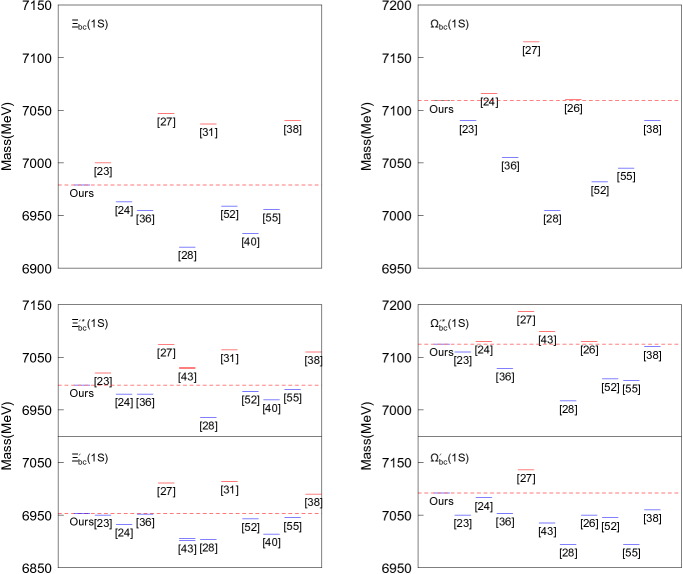
Unlike singly heavy baryons, the heavy quark subsystem is more easily excited owing to its larger reduced mass, and then the mode excited states are lower than the mode ones. It can be seen that our calculated mass spectra for bottom-charmed baryons faithfully reflect this specific feature. Meanwhile, the fine structures of excited states are small and the spectra are highly degenerate, especially for the wave states. Therefore, the low-lying wave excitations are more likely to be recognized both theoretically and experimentally. Moreover, the mass spectra for bottom-charmed baryons show quite similar patterns as other heavy-light systems, such as conventional charmed or bottom mesons, which suggests that the approximate light flavor SU(3) symmetry and heavy super-flavor symmetry are preserved well. Indeed, analogous to the doubly bottom baryons He:2021iwx , the bottom and charm quarks stay close to each other like a static color source, and the light quark is shared by these two heavy quarks.
Here, we can also discuss the theoretical uncertainties arising from parameters and for doubly heavy baryons. We first vary in the range of 1.101.30, and find that the discrepancies between theoretical results and experimental data for the mass splittings of singly heavy baryons can reach up to 39 MeV. Even with this large variation, the uncertainties for doubly heavy baryons are about 7 MeV, which are small enough. The same procedure should also be done for , but the established excited heavy baryons relevant with this parameter are few. Here, we vary this value in a wide range of 0 0.154, and find the uncertainties for doubly heavy baryons are about 10 MeV, which suggests that our predictions are also stable against the parameter .
III.2 Strong decays for mode and states
The strong decays for mode and states are calculated and listed in Table 7 and 11. For the two states, they have the light quark spins and , and the decay widths for and states are about 95 and 21 MeV, respectively. Owing to the limited phase space, both of them can only decay into the channel. Because of relevant partial waves of decaying channels, we have found a rather broad state with wave decay and a narrow state with wave decay, which are roughly consistent with previous work Eakins:2012fq . The distinctions of predicted decay widths may arise from the different phase spaces, wave functions, and phenomenological models.
| State | |||
|---|---|---|---|
| 94.98 | 20.89 | ||
| Total | 94.98 | 20.89 | |
| State | |||
| Total | Narrow | Narrow |
| State | ||||
|---|---|---|---|---|
| 370.92 | 297.85 | 142.99 | ||
| 68.18 | 155.72 | 145.35 | ||
| 22.28 | 87.85 | 89.66 | ||
| 1.52 | 18.91 | 15.06 | ||
| 2.30 | 27.96 | 32.41 | ||
| Total | 465.20 | 588.29 | 425.47 | |
| State | ||||
| 48.19 | 438.76 | 63.59 | ||
| 0.08 | 24.71 | 0.32 | ||
| Total | 48.27 | 463.47 | 63.91 |
For the two states, they lie below the threshold, and then the OZI-allowed strong decay is forbidden. The dominating decay channels should be and . This situation is quite similar to and resonances, where the isospin breaking decay and radiative decay modes dominate. Actually, based on the heavy super-flavor symmetry Savage:1990di , the two states can be related to the charmed mesons and states He:2021iwx . More theoretical studies on this topic can help us to better understand the resonance.
From the Table 11, it can be seen that most of the and states are broad, which can hardly be observed in experiments. For the state, the total width is relatively small, and the dominant decay mode is within leading terms of the nonrelativistic transition amplitude Eq. (21). Compared to the state, the state is broad, which results from the larger momentum of emitted pion and phase space. If we adopt a smaller initial hadronic mass, the partial width of mode and total decay width will decrease rapidly. We will discuss the relativistic corrections for these radially excited states in the following subsection. Moreover, the narrow state mainly decays into the final states, which can be tested by future experiments.
III.3 Strong decays for mode and states
The strong decays for mode and states are estimated and shown in Table 9 and 10. In the coupling scheme, there are five mode states, which can be classified into two groups according to the light quark spin : doublet and triplet. For the doublet, the calculated decay widths are rather broad with the current mass predictions of initial and final states, which agree with the calculations in the quark pair creation model Eakins:2012fq . For the triplet, the predicted decay widths are about 65, 75, and 92 MeV for the , , and states, respectively. The strong decay for is governed by decay mode , while and states can decay into both and channels. The broad doublet and narrow triplet are expected by the heavy quark symmetry, which arise from the enhancement or cancellation in the amplitude with different Clebsch-Gordan coefficients.
| State | ||||||
|---|---|---|---|---|---|---|
| 448.45 | × | × | 20.21 | 58.43 | ||
| × | 334.12 | 65.40 | 54.50 | 33.97 | ||
| Total | 448.45 | 334.12 | 65.40 | 74.71 | 92.40 | |
| State | ||||||
| × | × | 0.00 | 0.08 | |||
| × | 0.90 | |||||
| Total | Narrow | Narrow | Narrow | 0.00 | 0.98 |
| State | |||||||||
|---|---|---|---|---|---|---|---|---|---|
| 11.11 | 17.49 | 66.05 | 56.84 | × | × | 6.72 | 16.21 | ||
| 1.57 | 8.52 | 37.13 | 27.10 | × | × | 0.68 | 1.71 | ||
| 0.03 | 0.20 | 23.40 | 15.12 | × | × | 0.34 | 0.91 | ||
| 78.72 | 51.96 | 7.23 | 33.92 | 76.33 | 30.10 | 21.84 | 12.33 | ||
| 5.30 | 5.85 | 4.14 | 16.80 | 37.95 | 2.16 | 1.70 | 1.01 | ||
| 0.00 | 3.02 | 8.09 | 18.40 | 0.94 | 0.75 | 2.93 | |||
| 0.01 | × | × | 0.08 | 0.22 | 7.76 | 8.07 | × | ||
| × | 0.19 | 0.71 | 0.42 | 0.24 | 1.85 | 5.04 | 9.51 | ||
| × | 0.20 | 0.20 | 4.99 | 0.84 | 6.58 | 5.03 | 0.29 | ||
| 0.06 | 0.31 | 13.92 | 40.32 | 7.88 | 6.55 | 6.60 | 4.79 | ||
| 0.11 | 0.20 | 3.08 | 6.05 | 44.96 | 2.10 | 7.69 | 13.84 | ||
| Total | 96.91 | 84.92 | 158.88 | 209.73 | 186.82 | 58.04 | 64.46 | 63.53 | |
| State | |||||||||
| 1.79 | 4.79 | 95.84 | 72.40 | × | × | 6.36 | 15.01 | ||
| 0.00 | 0.04 | 6.66 | 3.62 | × | × | 0.14 | 0.06 | ||
| 16.74 | 7.89 | 12.65 | 54.71 | 110.63 | 20.58 | 23.43 | 8.15 | ||
| 0.00 | 1.07 | 1.66 | 3.74 | 0.25 | 0.21 | 0.02 | |||
| Total | 18.53 | 12.72 | 116.22 | 132.39 | 114.37 | 20.83 | 30.14 | 23.24 |
For the five states, the predicted masses are below or near threshold, and the total decay widths are extremely narrow. Also, according to the heavy supper-flavor symmetry, these states may have similar properties to mesons, such as the mysterious state. These states can be hunted for through the pion and photon emissions in future experiments. For state, it can also be observed in the and invariant masses. Moreover, the narrow states may be observed more easily than the ground states in the future as well as the singly bottom family.
For the radially excited and states, our calculated decay widths are relatively narrow, and the dominant decay modes are and with the nonrelativistic transition amplitude Eq. (21), respectively. These relatively narrow decays width for radially excited state are usually obtained within the nonrelativistic reduction of the axial-vector coupling between the pseudoscalar meson and light quark. This is due to the kind of selection rule from the structure of the transition operator in the leading order of nonrelativistic expansion, and consequently due to the orthogonality of the orbital wave functions between initial and final baryons. We will continue to discuss the relativistic corrections for Roper-like resonances in the following subsection.
For the and states, they can be divided into and triplets. the triplet are predicted to be relatively broad, while the are narrow states. It can be seen that the approximate heavy quark symmetry is preserved well in present calculations.
III.4 Relativistic corrections of order for Roper-like resonances
The relativistic corrections of order for convetional baryons are investigated in Refs. Arifi:2021orx ; Arifi:2022ntc . The authors found that these corrections of order are significant for the radially excited states, that is Roper-like resonances, while the effects for wave and wave states are small enough. In the present work, we also investigate these relativistic corrections for six radially excited bottom-charmed baryons.
We only take into account the ground states in the final states for comparison. The results are listed in Table LABEL:re, and it can be seen that these relativistic corrections for Roper-like resonances are significant. This specific feature has been found in other Roper-like resonances in the literature. Owning to the lack of experimental information for bottom-charmed baryons, more theoretical and experimental efforts are needed for further exploration.
| State | |||
|---|---|---|---|
| 370.92+274.00 | |||
| 68.18+0.25 | |||
| 22.28+19.24 | |||
| Total | 461.38+293.49 | ||
| State | |||
| 0.08+186.70 | |||
| 48.19+0.81 | |||
| Total | 48.27+187.51 | ||
| State | |||
| 11.11+31.33 | 17.49+131.87 | ||
| 1.57+0.00 | 8.52+0.26 | ||
| 0.03+0.06 | 0.20+12.91 | ||
| 78.72+121.04 | 51.96+120.38 | ||
| 5.30+0.41 | 5.85+17.50 | ||
| 0.00+0.00 | |||
| Total | 96.73+152.84 | 84.02+282.92 | |
| State | |||
| 1.79+31.74 | 4.79+154.91 | ||
| 0.00+0.31 | 0.04+2.93 | ||
| 16.74+139.40 | 7.89+113.66 | ||
| 0.00+0.25 | |||
| Total | 18.53+171.45 | 12.72+271.75 |
III.5 Mixing
In our calculation, we adopt the coupling scheme and the basis in the heavy quark limit to study mass spectra and strong decays for bottom-charmed baryons. Due to the finite mass of heavy quark subsystem, the physical observed resonances may correspond to the superposition of theoretical states in the quark model. For instance, the mixing scheme for mode and states can be formulated as
| (24) |
| (25) |
where is the mixing angle. Also, the wave excited states with the same spin-parity can mix with each other.
In the heavy quark limit, the mixing angle should be zero. Actually, the heavy quark subsystem including bottom and charm quarks are relatively heavy, and heavy quark symmetry should be approximately preserved. Then, the above mixing angles are expected to be small enough. We calculate the mixture for mode states as an illustration and list them in Table 12. It can be found that the mixing angles are tiny, and the mixing effects for spectroscopy can be neglected in bottom-charmed sector. Moreover, there may also exist other mixing scheme, which are believed to be even smaller in these bottom-charmed baryons.
| State | (MeV) | Mass (MeV) | Eigenvector |
|---|---|---|---|
III.6 Low-lying mode and hybrid states
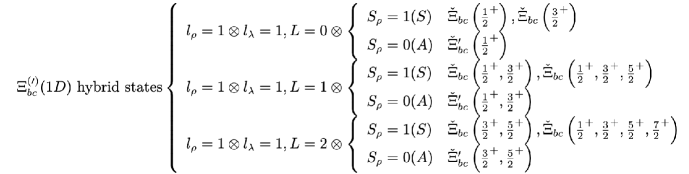
In addition to the presence of mode excitations, the bottom-charmed baryons also have low-lying mode and hybrid states. For example, when , there exists thirteen and five states, which can be seen in Figure 6.
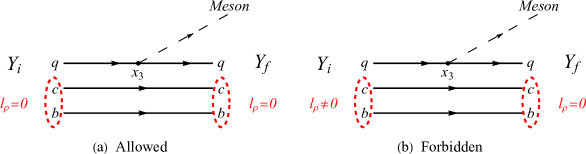
For these low-lying states, the light meson emissions are supposed to be dominating. However, under the spectator assumption for the two heavy quarks, the orbital wave functions of heavy quark subsystems between initial mode or hybrid states and final ground states are orthogonal, which results in the vanishing amplitudes and strong decay widths. More explicitly, the light meson emission occurs for mode excitations, and is irrelevant to the mode variables. Hence, the orthogonality of the different mode wave functions leads to the vanishing matrix element, which is shown in Figure 7. That is to say, our calculated decay modes preserve the heavy diquark symmetry automatically, where the heavy quark subsystems with different quantum numbers cannot transit into each other. Thus, these states should be extremely narrow and the weak and radiative decays may become dominating, which can provide good opportunities to be searched by future experiments.
IV SUMMARY
In this work, we have studied the low-lying mass spectra for bottom-charmed baryons in a nonrelativistic quark model by solving the three-body Schrödinger equation. With the obtained realistic wave functions, we get the root mean square radius and study the strong decays of bottom-charmed baryons. The lowest , , , and states are predicted to be about 6979, 6953, 7109, and 7092 MeV, respectively. Our results indicate that some of mode , , , states are relatively narrow, which have good potentials to be observed by future experiments. Also, the strong decays of the low-lying mode and hybrid states are highly suppressed and can be hunted for in the electroweak processes.
Given the heavy quark symmetry, the heavy quark subsystem in bottom-charmed baryons play a role as a heavy antiquark, and then the heavy super-flavor symmetry emerges. Indeed, our results about the mass spectra and strong decays for bottom-charmed baryons support this claim. With the development of the large-scale accelerator facilities, we expect that more theoretical and experimental efforts are involved to search for more doubly heavy baryons and better understand the heavy quark symmetry.
ACKNOWLEDGMENTS
This work is supported by the National Natural Science Foundation of China under Grants No. 11705056, the Natural Science Foundation of Hunan Province under Grant No. 2023JJ40421, the Key Project of Hunan Provincial Education Department under Grant No. 21A0039, and the State Scholarship Fund of China Scholarship Council under Grant No. 202006725011. A. H. is supported by the Grants-in-Aid for Scientific Research (Grant Numbers 21H04478(A)) and the one on Innovative Areas (No. 18H05407).
References
- (1) H. X. Chen, W. Chen, X. Liu, Y. R. Liu and S. L. Zhu, A review of the open charm and open bottom systems, Rept. Prog. Phys. 80, 076201 (2017).
- (2) H. Y. Cheng, Charmed baryon physics circa 2021, Chin. J. Phys. 78, 324-362 (2022).
- (3) M. Mattson et al. (SELEX Collaboration), First observation of the doubly charmed baryon , Phys. Rev. Lett. 89, 112001 (2002).
- (4) A. Ocherashvili et al. (SELEX Collaboration), Confirmation of the double charm baryon via its decay to , Phys. Lett. B 628, 18 (2005).
- (5) S. P. Ratti, New results on -baryons and a search for -baryons in FOCUS, Nucl. Phys. Proc. Suppl. 115, 33 (2003).
- (6) B. Aubert et al. (BaBar Collaboration), Search for doubly charmed baryons and in BABAR, Phys. Rev. D 74, 011103 (2006).
- (7) R. Chistov et al. (Belle Collaboration), Observation of new states decaying into and , Phys. Rev. Lett. 97, 162001 (2006).
- (8) R. Aaij et al. (LHCb Collaboration), Search for the doubly charmed baryon , JHEP 1312, 090 (2013).
- (9) R. Aaij et al. (LHCb Collaboration), Observation of the doubly charmed baryon , Phys. Rev. Lett. 119, 112001 (2017).
- (10) R. Aaij et al. (LHCb Collaboration), Measurement of the Lifetime of the Doubly Charmed Baryon , Phys. Rev. Lett. 121, 052002 (2018).
- (11) R. Aaij et al. (LHCb Collaboration), Measurement of production in collisions at TeV, Chin. Phys. C 44, 022001 (2020).
- (12) R. Aaij et al. (LHCb Collaboration), First Observation of the Doubly Charmed Baryon Decay , Phys. Rev. Lett. 121, 162002 (2018).
- (13) R. Aaij et al. (LHCb Collaboration), A search for decays, JHEP 10, 124 (2019).
- (14) R. Aaij et al. (LHCb Collaboration), Precision measurement of the mass, JHEP 02, 049 (2020).
- (15) R. Aaij et al. (LHCb Collaboration), Observation of the doubly charmed baryon decay , JHEP 05, 038 (2022).
- (16) R. Aaij et al. (LHCb Collaboration), Search for the doubly charmed baryon , Sci. China Phys. Mech. Astron. 63, 221062 (2020).
- (17) R. Aaij et al. (LHCb Collaboration), Search for the doubly heavy baryon via decays to , JHEP 11, 095 (2020).
- (18) R. Aaij et al. (LHCb Collaboration), Search for the doubly charmed baryon in the final state, JHEP 12, 107 (2021).
- (19) R. Aaij et al. (LHCb Collaboration), Search for the doubly heavy baryons and decaying to and , Chin. Phys. C 45, 093002 (2021).
- (20) R. Aaij et al. (LHCb Collaboration), Search for the doubly charmed baryon , Sci. China Phys. Mech. Astron. 64, 101062 (2021).
- (21) R. Aaij et al. (LHCb Collaboration), Search for the doubly heavy baryon decaying to , arXiv:2204.09541.
- (22) V. V. Kiselev and A. K. Likhoded, Baryons with two heavy quarks, Phys. Usp. 45, 455 (2002).
- (23) D. Ebert, R. N. Faustov, V. O. Galkin, A. P. Martynenko and V. A. Saleev, Heavy baryons in the relativistic quark model, Z. Phys. C 76, 111 (1997).
- (24) D. Ebert, R. N. Faustov, V. O. Galkin and A. P. Martynenko, Mass spectra of doubly heavy baryons in the relativistic quark model, Phys. Rev. D 66, 014008 (2002).
- (25) S. S. Gershtein, V. V. Kiselev, A. K. Likhoded and A. I. Onishchenko, Spectroscopy of doubly heavy baryons, Phys. Rev. D 62, 054021 (2000).
- (26) S. P. Tong, Y. B. Ding, X. H. Guo, H. Y. Jin, X. Q. Li, P. N. Shen and R. Zhang, Spectra of baryons containing two heavy quarks in potential model, Phys. Rev. D 62, 054024 (2000).
- (27) W. Roberts and M. Pervin, Heavy baryons in a quark model, Int. J. Mod. Phys. A 23, 2817 (2008).
- (28) F. Giannuzzi, Doubly heavy baryons in a Salpeter model with AdS/QCD inspired potential, Phys. Rev. D 79, 094002 (2009).
- (29) A. P. Martynenko, Ground-state triply and doubly heavy baryons in a relativistic three-quark model, Phys. Lett. B 663, 317 (2008).
- (30) A. Valcarce, H. Garcilazo and J. Vijande, Towards an understanding of heavy baryon spectroscopy, Eur. Phys. J. A 37, 217 (2008).
- (31) B. Eakins and W. Roberts, Symmetries and Systematics of Doubly Heavy Hadrons, Int. J. Mod. Phys. A 27, 1250039 (2012).
- (32) Z. Shah and A. K. Rai, Excited state mass spectra of doubly heavy baryons, Eur. Phys. J. C 77, 129 (2017).
- (33) J. Soto and J. Tarrús Castellà, Effective field theory for double heavy baryons at strong coupling, Phys. Rev. D 102, 014013 (2020); erratum: Phys. Rev. D 104, 059901 (2021).
- (34) J. B. Wang, G. Li, C. R. Deng, C. S. An and J. J. Xie, resonances with negative parity in the chiral constituent quark model, Phys. Rev. D 104, 094008 (2021).
- (35) G. L. Yu, Z. Y. Li, Z. G. Wang, J. Lu and M. Yan, Systematic analysis of doubly charmed baryons and , Eur. Phys. J. A 59, 126 (2023).
- (36) Z. Y. Li, G. L. Yu, Z. G. Wang and J. Z. Gu, Mass spectra of bottom-charmed baryons. arXiv:2211.15111.
- (37) M. J. Savage and M. B. Wise, Spectrum of baryons with two heavy quarks, Phys. Lett. B 248, 177-180 (1990).
- (38) R. Roncaglia, D. B. Lichtenberg and E. Predazzi, Predicting the masses of baryons containing one or two heavy quarks, Phys. Rev. D 52, 1722 (1995).
- (39) T. D. Cohen and P. M. Hohler, Doubly heavy hadrons and the domain of validity of doubly heavy diquark-anti-quark symmetry, Phys. Rev. D 74, 094003 (2006).
- (40) M. Karliner and J. L. Rosner, Baryons with two heavy quarks: Masses, production, decays, and detection, Phys. Rev. D 90, 094007 (2014).
- (41) K. W. Wei, B. Chen and X. H. Guo, Masses of doubly and triply charmed baryons, Phys. Rev. D 92, 076008 (2015).
- (42) K. W. Wei, B. Chen, N. Liu, Q. Q. Wang and X. H. Guo, Spectroscopy of singly, doubly, and triply bottom baryons, Phys. Rev. D 95, 116005 (2017).
- (43) J. Oudichhya, K. Gandhi and A. Kumar Rai, Mass spectra of cc, bc, cc, and bc baryons in Regge phenomenology, Phys. Scripta 97, 054001 (2022).
- (44) Y. Song, D. Jia, W. Zhang and A. Hosaka, Low-lying doubly heavy baryons: Regge relation and mass scaling, Eur. Phys. J. C 83, 1 (2023).
- (45) J. R. Zhang and M. Q. Huang, Doubly heavy baryons in QCD sum rules, Phys. Rev. D 78, 094007 (2008).
- (46) L. Tang, X. H. Yuan, C. F. Qiao and X. Q. Li, Study of Doubly Heavy Baryon Spectrum via QCD Sum Rules, Commun. Theor. Phys. 57, 435 (2012).
- (47) Z. G. Wang, Analysis of the doubly heavy baryon states with QCD sum rules, Eur. Phys. J. A 45, 267 (2010).
- (48) T. M. Aliev, K. Azizi and M. Savci, Doubly Heavy Spin-1/2 Baryon Spectrum in QCD, Nucl. Phys. A 895, 59 (2012).
- (49) T. M. Aliev, K. Azizi and M. Savci, Mixing angle of doubly heavy baryons in QCD, Phys. Lett. B 715, 149 (2012).
- (50) T. M. Aliev, K. Azizi and M. Savci, The masses and residues of doubly heavy spin-3/2 baryons, J. Phys. G 40, 065003 (2013).
- (51) L. Liu, H. W. Lin, K. Orginos and A. Walker-Loud, Singly and Doubly Charmed J=1/2 Baryon Spectrum from Lattice QCD, Phys. Rev. D 81, 094505 (2010).
- (52) Z. S. Brown, W. Detmold, S. Meinel and K. Orginos, Charmed bottom baryon spectroscopy from lattice QCD, Phys. Rev. D 90, 094507 (2014).
- (53) M. Padmanath, R. G. Edwards, N. Mathur and M. Peardon, Spectroscopy of doubly-charmed baryons from lattice QCD, Phys. Rev. D 91, 094502 (2015).
- (54) N. Mathur and M. Padmanath, Lattice QCD study of doubly-charmed strange baryons, Phys. Rev. D 99, 031501 (2019).
- (55) N. Mathur, M. Padmanath and S. Mondal, Precise predictions of charmed-bottom hadrons from lattice QCD, Phys. Rev. Lett. 121, 202002 (2018).
- (56) A. Faessler, T. Gutsche, M. A. Ivanov, J. G. Korner and V. E. Lyubovitskij, Semileptonic decays of double heavy baryons, Phys. Lett. B 518, 55 (2001).
- (57) A. Faessler, T. Gutsche, M. A. Ivanov, J. G. Korner and V. E. Lyubovitskij, Semileptonic decays of double heavy baryons in a relativistic constituent three-quark model, Phys. Rev. D 80, 034025 (2009).
- (58) C. Albertus, E. Hernandez and J. Nieves, Hyperfine mixing in semileptonic decay of doubly heavy baryons, Phys. Lett. B 683, 21 (2010).
- (59) M. J. White and M. J. Savage, Semileptonic decay of baryons with two heavy quarks, Phys. Lett. B 271, 410 (1991).
- (60) R. H. Li, C. D. Lü, W. Wang, F. S. Yu and Z. T. Zou, Doubly-heavy baryon weak decays: and , Phys. Lett. B 767, 232 (2017).
- (61) F. S. Yu, H. Y. Jiang, R. H. Li, C. D. Lü, W. Wang and Z. X. Zhao, Discovery Potentials of Doubly Charmed Baryons, Chin. Phys. C 42, 051001 (2018).
- (62) D. Ebert, R. N. Faustov, V. O. Galkin and A. P. Martynenko, Semileptonic decays of doubly heavy baryons in the relativistic quark model, Phys. Rev. D 70, 014018 (2004).
- (63) W. Roberts and M. Pervin, Hyperfine Mixing and the Semileptonic Decays of Double-Heavy Baryons in a Quark Model, Int. J. Mod. Phys. A 24, 2401 (2009).
- (64) T. Branz, A. Faessler, T. Gutsche, M. A. Ivanov, J. G. Korner, V. E. Lyubovitskij and B. Oexl, Radiative decays of double heavy baryons in a relativistic constituent three-quark model including hyperfine mixing, Phys. Rev. D 81, 114036 (2010).
- (65) R. H. Hackman, N. G. Deshpande, D. A. Dicus and V. L. Teplitz, M1 Transitions in the MIT Bag Model, Phys. Rev. D 18, 2537 (1978).
- (66) A. Bernotas and V. imonis, Radiative M1 transitions of heavy baryons in the bag model, Phys. Rev. D 87, 074016 (2013).
- (67) W. S. Dai, X. H. Guo, H. Y. Jin and X. Q. Li, Electromagnetic radiation of baryons containing two heavy quarks, Phys. Rev. D 62, 114026 (2000).
- (68) C. Albertus, E. Hernandez and J. Nieves, Hyperfine mixing in electromagnetic decay of doubly heavy baryons, Phys. Lett. B 690, 265 (2010).
- (69) H. Bahtiyar, K. U. Can, G. Erkol, M. Oka and T. T. Takahashi, Radiative transitions of doubly charmed baryons in lattice QCD, Phys. Rev. D 98, 114505 (2018).
- (70) Q. Qin, Y. J. Shi, W. Wang, G. H. Yang, F. S. Yu and R. Zhu, Inclusive approach to hunt for the beauty-charmed baryons , Phys. Rev. D 105, L031902 (2022).
- (71) B. Eakins and W. Roberts, Heavy Diquark Symmetry Constraints for Strong Decays, Int. J. Mod. Phys. A 27, 1250153 (2012).
- (72) L. Y. Xiao, K. L. Wang, Q. F. Lü, X. H. Zhong and S. L. Zhu, Strong and radiative decays of the doubly charmed baryons, Phys. Rev. D 96, 094005 (2017).
- (73) L. Y. Xiao, Q. F. Lü and S. L. Zhu, Strong decays of the 1P and 2D doubly charmed states, Phys. Rev. D 97, 074005 (2018).
- (74) T. Mehen, Implications of Heavy Quark-Diquark Symmetry for Excited Doubly Heavy Baryons and Tetraquarks, Phys. Rev. D 96, 094028 (2017).
- (75) Y. L. Ma and M. Harada, Chiral partner structure of doubly heavy baryons with heavy quark spin-flavor symmetry, J. Phys. G 45, 075006 (2018).
- (76) M. J. Yan, X. H. Liu, S. Gonzàlez-Solís, F. K. Guo, C. Hanhart, U. G. Meißner and B. S. Zou, New spectrum of negative-parity doubly charmed baryons: Possibility of two quasistable states, Phys. Rev. D 98, 091502 (2018).
- (77) H. Z. He, W. Liang and Q. F. Lü, Strong decays of the low-lying doubly bottom baryons, Phys. Rev. D 105, 014010 (2022).
- (78) B. Chen, S. Q. Luo, K. W. Wei and X. Liu, hadron spectroscopy study based on the similarity of double bottom baryon and bottom meson, Phys. Rev. D 105, 074014 (2022).
- (79) T. Yoshida, E. Hiyama, A. Hosaka, M. Oka and K. Sadato, Spectrum of heavy baryons in the quark model, Phys. Rev. D 92, 114029 (2015).
- (80) E. Hiyama, Y. Kino and M. Kamimura, Gaussian expansion method for few-body systems, Prog. Part. Nucl. Phys. 51, 223-307 (2003).
- (81) E. Hiyama and M. Kamimura, Study of various few-body systems using Gaussian expansion method (GEM), Front. Phys. (Beijing) 13, 132106 (2018).
- (82) H. Nagahiro, S. Yasui, A. Hosaka, M. Oka and H. Noumi, Structure of charmed baryons studied by pionic decays, Phys. Rev. D 95, 014023 (2017).
- (83) A. J. Arifi, D. Suenaga and A. Hosaka, Relativistic corrections to decays of heavy baryons in the quark model, Phys. Rev. D 103, 094003 (2021).
- (84) A. J. Arifi, D. Suenaga, A. Hosaka and Y. Oh, Strong decays of multistrangeness baryon resonances in the quark model, Phys. Rev. D 105, 094006 (2022).
- (85) K. L. Wang, Q. F. Lü and X. H. Zhong, Interpretation of the newly observed and states as the -wave bottom baryons, Phys. Rev. D 99, 014011 (2019).
- (86) M. S. Liu, K. L. Wang, Q. F. Lü and X. H. Zhong, baryon spectrum and their decays in a constituent quark model, Phys. Rev. D 101, 016002 (2020).
- (87) Q. F. Lü, H. Nagahiro and A. Hosaka, Understanding the nature of in a coupled-channel approach, Phys. Rev. D 107, 014025 (2023).
- (88) F. E. Close and E. S. Swanson, Dynamics and decay of heavy-light hadrons, Phys. Rev. D 72, 094004 (2005).
- (89) D. M. Li, P. F. Ji and B. Ma, The newly observed open-charm states in quark model, Eur. Phys. J. C 71, 1582 (2011).
- (90) S. Godfrey and K. Moats, Bottomonium Mesons and Strategies for their Observation, Phys. Rev. D 92, 054034 (2015).
- (91) S. Godfrey and K. Moats, Properties of Excited Charm and Charm-Strange Mesons, Phys. Rev. D 93, 034035 (2016).
- (92) B. Chen, K. W. Wei, X. Liu and T. Matsuki, Low-lying charmed and charmed-strange baryon states, Eur. Phys. J. C 77, 154 (2017).
- (93) C. Chen, X. L. Chen, X. Liu, W. Z. Deng and S. L. Zhu, Strong decays of charmed baryons, Phys. Rev. D 75, 094017 (2007).