This paper was converted on www.awesomepapers.org from LaTeX by an anonymous user.
Want to know more? Visit the Converter page.

Dimension theory of Non-Autonomous iterated function systems

Yifei Gu Department of Mathematics, East China Normal University, No. 500, Dongchuan Road, Shanghai 200241, P. R. China 52275500012@stu.ecnu.edu.cn  and  Jun Jie Miao Department of Mathematics, East China Normal University, No. 500, Dongchuan Road, Shanghai 200241, P. R. China jjmiao@math.ecnu.edu.cn
Abstract.

In the paper, we define a class of new fractals named “non-autonomous attractors”, which are the generalization of classic Moran sets and attractors of iterated function systems. Simply to say, we replace the similarity mappings by contractive mappings and remove the separation assumption in Moran structure. We give the dimension estimate for non-autonomous attractors.

Furthermore, we study a class of non-autonomous attractors, named “ non-autonomous affine sets or affine sets”, where the contractions are restricted to affine mappings. To study the dimension theory of such fractals, we define two critical values ss^{*} and sAs_{A}, and the upper box-counting dimensions and Hausdorff dimensions of non-autonomous affine sets are bounded above by ss^{*} and sAs_{A}, respectively. Unlike self-affine fractals where s=sAs^{*}=s_{A}, we always have that ssAs^{*}\geq s_{A}, and the inequality may strictly hold.

Under certain conditions, we obtain that the upper box-counting dimensions and Hausdorff dimensions of non-autonomous affine sets may equal to ss^{*} and sAs_{A}, respectively. In particular, we study non-autonomous affine sets with random translations, and the Hausdorff dimensions of such sets equal to sAs_{A} almost surely.

1. Introduction

1.1. Self-affine sets

Let {Ψi}1iM\{\Psi_{i}\}_{1\leq i\leq M} be a finite set of affine contractions on d\mathbb{R}^{d} with M2M\geq 2 and

(1.1) Ψi(x)=Ti(x)+ai(1iM),\Psi_{i}(x)=T_{i}(x)+a_{i}\qquad(1\leq i\leq M),

where aia_{i} is a translation vector, and TiT_{i} is a linear transformation on d\mathbb{R}^{d}. The set {Ψi}1iM\{\Psi_{i}\}_{1\leq i\leq M} is called a self-affine iterated function system. By the well-known theorem of Hutchinson, see [4, 19], the IFS has a unique attractor, that is a unique non-empty compact EdE\subset\mathbb{R}^{d} such that

(1.2) E=1iMΨi(E),E=\bigcup_{1\leq i\leq M}\Psi_{i}(E),

which is called a self-affine set. If the affine transformations Ψi\Psi_{i} are similarity mappings, we call EE a self- similar set, see [4] for details.

Formulae giving the Hausdorff and box-counting dimensions of self-similar sets satisfying the open set condition are well-known, see [4]. However, calculation of the dimensions of self-affine sets is more awkward, see [2, 9, 12, 15, 22, 25]. For each k=1,2,k=1,2,\cdots, we write k={i1i2ik:1ijM,jk}\mathcal{I}^{k}=\{i_{1}i_{2}\cdots i_{k}:1\leq i_{j}\leq M,\ j\leq k\} for the set of words of length kk. Let ϕs\phi^{s} be the singular value function defined by  (2.14). Falconer in [5] defined the criticla value d(T1,,TM)d(T_{1},\ldots,T_{M}) which is the unique solution to

limk(𝐢kϕs(T𝐢))1k=1,\lim_{k\to\infty}\left(\sum_{\mathbf{i}\in\mathcal{I}^{k}}\phi^{s}(T_{\mathbf{i}})\right)^{\frac{1}{k}}=1,

and it is often called affine dimension or Falconer dimension. Given Ti<12\|T_{i}\|<\frac{1}{2} for i=1,2,M,i=1,2,\ldots M, it turns out that

(1.3) dimHF=dimBF=min{d,d(T1,,TM)},\dim_{\rm H}F=\dim_{\rm B}F=\min\{d,d(T_{1},\ldots,T_{M})\},

for almost all 𝐚=(a1,,aM)Md\mathbf{a}=(a_{1},\ldots,a_{M})\in\mathbb{R}^{Md}(in the sense of MdMd-dimensional Lebesgue measure), we refer the readers to [5, 27] for details. Note that d(T1,,TM)d(T_{1},\ldots,T_{M}) is always the upper bound for the box-counting dimension of self-affine sets, Falconer in [6] proved that the box-counting dimension and affine dimension coincide by applying projection condition with other assumptions. From then on, a considerable amount of literature has been published on the validation of formula (1.3) under various conditions. In particular, in [20], Jordan, Pollicott and Simon studied perturbed self-affine sets where they changed translations into independently identically distributed random variables, and they showed that for Ti<1\|T_{i}\|<1, i=1,2,M,i=1,2,\ldots M, the dimension formula (1.3) holds almost surely. In [10], Falconer and Kempton showed the dimension formula (1.3) holds for all translations in R2R^{2} under various assumptions. We refer readers to [1, 6, 7, 8, 11, 13, 14, 16, 18, 24] for various related studies.

1.2. Moran sets

Moran sets were first studied by Moran in [23], and we recall the definition for the readers’ convenience.

Let {nk}k1\{n_{k}\}_{k\geq 1} be a sequence of integers greater than or equal to 22. For each k=1,2,k=1,2,\cdots, we write

(1.4) Σk={u1u2uk:1ujnj,jk}\Sigma^{k}=\{u_{1}u_{2}\cdots u_{k}:1\leq u_{j}\leq n_{j},\ j\leq k\}

for the set of words of length kk, with Σ0={}\Sigma^{0}=\{\emptyset\} containing only the empty word \emptyset, and write

(1.5) Σ=k=0Σk\Sigma^{*}=\bigcup_{k=0}^{\infty}\Sigma^{k}

for the set of all finite words.

Suppose that JdJ\subset\mathbb{R}^{d} is a compact set with int(J)\mbox{int}(J)\neq\varnothing (we always write int()\cdot) for the interior of a set). Let {Ξk}k1\{\Xi_{k}\}_{k\geq 1} be a sequence of positive real vectors where Ξk=(ck,1,ck,2,,ck,nk)\Xi_{k}=(c_{k,1},c_{k,2},\cdots,c_{k,n_{k}}) for each kk\in\mathbb{N}. We say the collection 𝒥={J𝐮:𝐮Σ}\mathcal{J}=\{J_{\mathbf{u}}:\mathbf{u}\in\Sigma^{*}\} of closed subsets of JJ fulfils the Moran structure if it satisfies the following Moran structure conditions (MSC):

  • (1).

    For each 𝐮Σ\mathbf{u}\in\Sigma^{*}, J𝐮J_{\mathbf{u}} is geometrically similar to JJ, i.e., there exists a similarity Ψ𝐮:dd\Psi_{\mathbf{u}}:\mathbb{R}^{d}\rightarrow\mathbb{R}^{d} such that J𝐮=Ψ𝐮(J)J_{\mathbf{u}}=\Psi_{\mathbf{u}}(J). We write J=JJ_{\emptyset}=J for the empty word \emptyset.

  • (2).

    For all kk\in\mathbb{N} and 𝐮Σk1\mathbf{u}\in\Sigma^{k-1}, the elements J𝐮1,J𝐮2,,J𝐮nkJ_{\mathbf{u}1},J_{\mathbf{u}2},\cdots,J_{\mathbf{u}n_{k}} of 𝒥\mathcal{J} are the subsets of J𝐮J_{\mathbf{u}} with disjoint interiors, ie., int(J𝐮i)int(J𝐮i)=\mbox{int}(J_{\mathbf{u}i})\cap\mbox{int}(J_{\mathbf{u}i^{\prime}})=\varnothing for iii\neq i^{\prime}. Moreover, for all 1ink1\leq i\leq n_{k},

    |J𝐮i||J𝐮|=ck,i,\frac{|J_{\mathbf{u}i}|}{|J_{\mathbf{u}}|}=c_{k,i},

    where |||\cdot| denotes the diameter.

The non-empty compact set

E=E(𝒥)=k=1𝐮ΣkJ𝐮E=E(\mathcal{J})=\bigcap\nolimits_{k=1}^{\infty}\bigcup\nolimits_{\mathbf{u}\in\Sigma^{k}}J_{\mathbf{u}}

is called a Moran set determined by 𝒥\mathcal{J}. For each 𝐮Σk\mathbf{u}\in\Sigma^{k}, the element J𝐮J_{\mathbf{u}} is called a  kkth-level basic set of EE. For each integer k>0,k>0, let dkd_{k} be the unique real solution of the equation

(1.6) i=1k(j=1ni(ci,j)dk)=1.\prod\nolimits_{i=1}^{k}\left(\sum\nolimits_{j=1}^{n_{i}}(c_{i,j})^{d_{k}}\right)=1.

Let dd_{\ast} and dd^{\ast} be the real numbers given respectively by

(1.7) d=lim infkdk,d=lim supkdk.d_{\ast}=\liminf_{k\rightarrow\infty}d_{k},\quad d^{\ast}=\limsup_{k\rightarrow\infty}d_{k}.

It was shown in [17, 28, 29] that if c=inf{ck,j:k,1jnk}>0,c_{*}=\inf\{c_{k,j}:k\in\mathbb{N},1\leq j\leq n_{k}\}>0, the following dimension formulae hold

dimHE=d,dimPE=dim¯BE=d.\dim_{\rm H}E=d_{\ast},\quad\dim_{\rm P}E={\overline{\dim}}_{\rm B}E=d^{\ast}.

The dimension theory of Moran sets has been studied extensively, and we refer the readers to [17, 28, 29] for detail and references therein. Note that, in the definition of Moran sets, the position of J𝐮iJ_{\mathbf{u}i} in J𝐮J_{\mathbf{u}} is very flexible, and the contraction ratios may also vary at each level. Therefore the structures of Moran sets are more complex than self-similar sets, and in general, the inequality

dimHEdim¯BEdim¯BE\dim_{\rm H}E\leq\underline{\dim}_{\rm B}E\leq{\overline{\dim}}_{\rm B}E

holds strictly for Moran fractals. The general lower box dimension formula for Moran sets is still an open question. Except providing various examples, Moran sets are also useful tools for analysing properties of fractal sets in various studies, for example, see [28] and references therein for applications.

Note that similarities and separation assumption are required in the Moran structure, Inspired by the structure of iterated function systems, we generalize the Moran structure to non-autonomous structure where we replace similarities by contractions or affine mappings, and remove the separation assumption. The geometric properties of non-autonomous sets are more complex than Moran sets since mappings may have different contraction ratios in different directions. Therefore, non-autonomous sets provide not only interesting phenomena but also useful tools for fractal analysis. Different to the attractors of iterated function systems, non-autonomous sets do not have dynamical properties any more, and the tools in ergodic theory cannot be invoked. As a result, it is more difficult to explore their dimension formulae and other fractal properties.

In this paper, we investigate the dimension theory of non-autonomous attractors, and particularly, we are interested in a classs of attractors, named “non-autonomous affine sets or affine sets”. In section 2, we first give the definition of non-autonomous attractors and estimate the dimensions of such sets, then we study the non-autonomous affine sets and state the main conclusions in subsection 2.3. The dimension estimates for non-autonomous sets are provided in section 3. Upper and lower box dimensions of non-autonomous affine sets are explored in section 4. We discuss the upper bounds of Hausdorff dimensions of non-autonomous affine sets in section 5, and we give the Hausdorff dimension formula for a spectial class of non-autonomous affine sets with finitely many translations. In section 6, we study the Hausdorff dimension of non-autonomous affine sets with random translations, and we prove that with probability one, the Hausdorff dimensions of such sets equal to a critical value. Finally, in section 7, we compare critical values of non-autonomous affine sets, and we also provide some examples to illustrate our conclusions.

2. Non-autonomous iterated function systems

2.1. Definition of non-autonomous iterated function systems

Let {nk}k=1\{n_{k}\}_{k=1}^{\infty} be a sequence of integers such that nk2n_{k}\geq 2 for all k1k\geq 1. Let Σk\Sigma^{k} and Σ\Sigma^{*} be given by (1.4) and (1.5), respectively. Suppose that JdJ\subset\mathbb{R}^{d} is a compact set with non-empty interior. Let {Ξk}k=1\{\Xi_{k}\}_{k=1}^{\infty} be a sequence of collections of contractive mappings, that is

(2.8) Ξk={Sk,1,Sk,2,,Sk,nk},\Xi_{k}=\{S_{k,1},S_{k,2},\ldots,S_{k,n_{k}}\},

where each Sk,jS_{k,j} satisfies that |Sk,j(x)Sk,j(y)|ck,j|xy||S_{k,j}(x)-S_{k,j}(y)|\leq c_{k,j}|x-y| for some 0<ck,j<10<c_{k,j}<1. We say the collection 𝒥={J𝐮:𝐮Σ}\mathcal{J}=\{J_{\mathbf{u}}:\mathbf{u}\in\Sigma^{*}\} of closed subsets of JJ fulfils the non-autonomous structure with respect to {Ξk}k=1\{\Xi_{k}\}_{k=1}^{\infty} if it satisfies the following conditions:

  • (1).

    For all integers k>0k>0 and all 𝐮Σk1\mathbf{u}\in\Sigma^{k-1}, the elements J𝐮1,J𝐮2,,J𝐮nkJ_{\mathbf{u}1},J_{\mathbf{u}2},\cdots,J_{\mathbf{u}n_{k}} of 𝒥\mathcal{J} are the subsets of J𝐮J_{\mathbf{u}}. We write J=JJ_{\emptyset}=J for the empty word \emptyset.

  • (2).

    For each 𝐮=u1ukΣ\mathbf{u}=u_{1}\ldots u_{k}\in\Sigma^{*}, there exists an transformation Ψ𝐮:dd\Psi_{\mathbf{u}}:\mathbb{R}^{d}\rightarrow\mathbb{R}^{d} such that

    J𝐮=Ψ𝐮(J)=Ψu1ΨujΨuk(J),J_{\mathbf{u}}=\Psi_{\mathbf{u}}(J)=\Psi_{u_{1}}\circ\ldots\circ\Psi_{u_{j}}\ldots\circ\Psi_{u_{k}}(J),

    where Ψuj(x)=Sj,ujx+ωu1uj\Psi_{u_{j}}(x)=S_{j,u_{j}}x+\omega_{u_{1}\ldots u_{j}}, for some ωu1ujd\omega_{u_{1}\ldots u_{j}}\in\mathbb{R}^{d}, and Sj,ujΞjS_{j,u_{j}}\in\Xi_{j}, j=1,2,kj=1,2,\ldots k.

  • (3).

    The maximum of the diameters of J𝐮J_{\mathbf{u}} tends to 0 as |𝐮||\mathbf{u}| tends to \infty, that is,

    limkmax𝐮Σk|J𝐮|=0.\lim_{k\to\infty}\max_{\mathbf{u}\in\Sigma^{k}}|J_{\mathbf{u}}|=0.

We call {Ξk}k=1\{\Xi_{k}\}_{k=1}^{\infty} a non-autonomous iterated function systems(NIFS) determined by 𝒥\mathcal{J}, and the non-empty compact set

(2.9) E=E(𝒥)=k=1𝐮ΣkJ𝐮E=E(\mathcal{J})=\bigcap\nolimits_{k=1}^{\infty}\bigcup\nolimits_{\mathbf{u}\in\Sigma^{k}}J_{\mathbf{u}}

is called a non-autonomous attractor determined by 𝒥\mathcal{J}. For all 𝐮Σk\mathbf{u}\in\Sigma^{k}, the elements J𝐮J_{\mathbf{u}} are called  kkth-level basic sets of EE. If the non-autonomous attractor EE satisfies that for all integers k1k\geq 1 and 𝐮Σk1\mathbf{u}\in\Sigma^{k-1},

int(J𝐮i)int(J𝐮i)= for ii{1,2,,nk},\mathrm{int}(J_{\mathbf{u}i})\cap\mathrm{int}(J_{\mathbf{u}i^{\prime}})=\emptyset\quad\textit{ for }i\neq i^{\prime}\in\{1,2,\ldots,n_{k}\},

we say EE satisfies Moran separation condition (MSC).

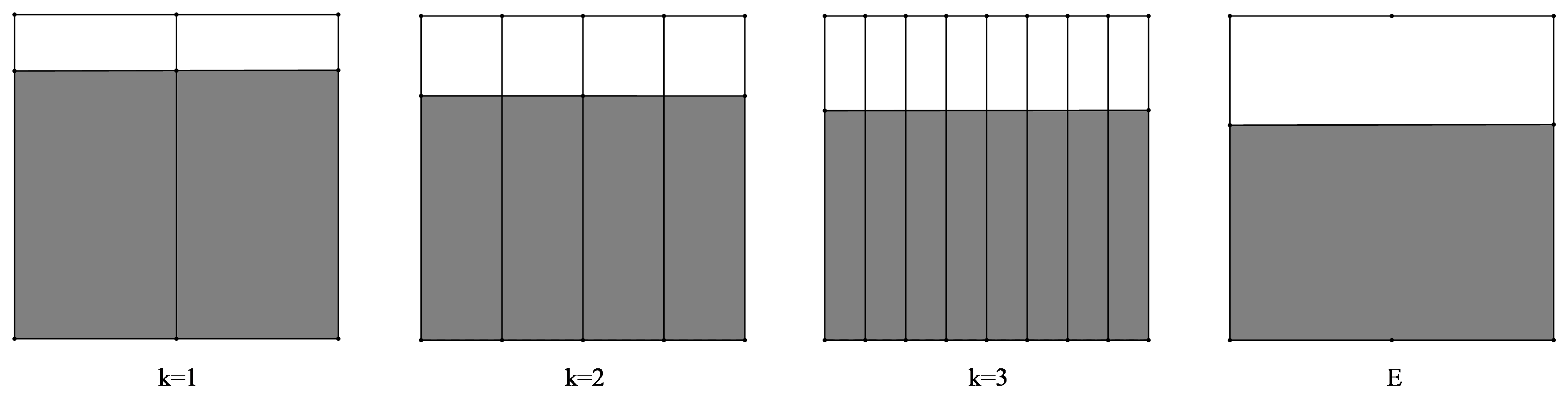
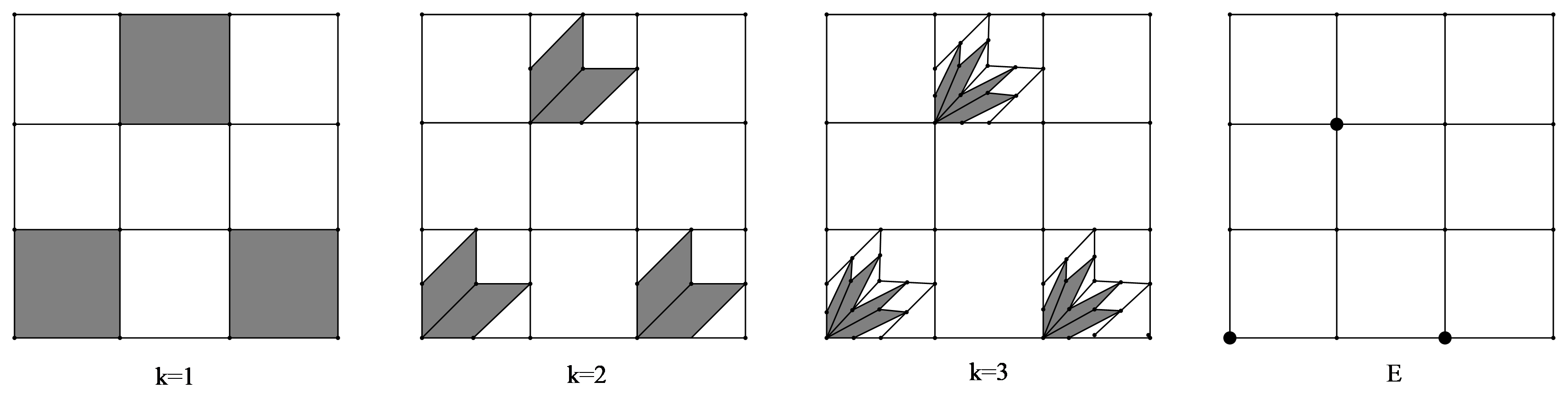
Remark (1) Overlap is allowed in the structure, and Moran sets are special non-autonomous attractors satisfying Moran separation condition. Note that Moran sets are always uncountable, but the cardinality of non-autonomous attractors sets may be finite, countable or uncountable even if Moran separation condition is satisfied, see Example 2 and Example 3 in section 7.

(2) In the definition, the transformation Ψ𝐮\Psi_{\mathbf{u}} may be determined in the following way. For each 𝐮=u1Σ1\mathbf{u}=u_{1}\in\Sigma^{1} and J𝐮𝒥J_{\mathbf{u}}\in\mathcal{J}, there exists an mapping Ψ𝐮:JJ𝐮\Psi_{\mathbf{u}}:J\to J_{\mathbf{u}} such that

J𝐮=Ψ𝐮(J)=S1,u1(J)+ωu1 for some ωu1d.J_{\mathbf{u}}=\Psi_{\mathbf{u}}(J)=S_{1,u_{1}}(J)+\omega_{u_{1}}\qquad\qquad\textit{ for some }\omega_{u_{1}}\in\mathbb{R}^{d}.

Suppose that for each 𝐮Σk1\mathbf{u}\in\Sigma^{k-1} and J𝐮𝒥J_{\mathbf{u}}\in\mathcal{J}, the affine mapping Ψ𝐮:JJ𝐮\Psi_{\mathbf{u}}:J\to J_{\mathbf{u}} is defined. For each 1jnk1\leq j\leq n_{k} and J𝐮j𝒥J_{\mathbf{u}j}\in\mathcal{J}, there exists an affine mapping Ψ𝐮j:JJ𝐮j\Psi_{\mathbf{u}j}:J\to J_{\mathbf{u}j} such that

J𝐮j=Ψ𝐮j(J)=Ψ𝐮(Sk,j(J)+ω𝐮j) for some ω𝐮jd.J_{\mathbf{u}j}=\Psi_{\mathbf{u}j}(J)=\Psi_{\mathbf{u}}\circ\Big{(}S_{k,j}(J)+\omega_{\mathbf{u}j}\Big{)}\qquad\textit{ for some }\omega_{\mathbf{u}j}\in\mathbb{R}^{d}.

(3) The assumption limkmax𝐮Σk|J𝐮|=0\lim_{k\to\infty}\max_{\mathbf{u}\in\Sigma^{k}}|J_{\mathbf{u}}|=0 in the definition is necessary, otherwise the set EE may have positive finite Lebesgue measure, and we do not consider such case in this paper, see Example  1 in section 7.

(4) Non-autonomous iterated function system is also a generalization of the iterated function system. However, for 𝐮𝐯Σk1\mathbf{u}\neq\mathbf{v}\in\Sigma^{k-1}, the transformations Sk,j(x)+ω𝐮jS_{k,j}(x)+\omega_{\mathbf{u}j} and Sk,j(x)+ω𝐯jS_{k,j}(x)+\omega_{\mathbf{v}j} in Ψ𝐮j\Psi_{\mathbf{u}j} and Ψ𝐯j\Psi_{\mathbf{v}j} have the same contractive part Sk,jΞkS_{k,j}\in\Xi_{k} but with different translations. Therefore the non-autonomous attractor EE may be different to the attractor of classic iterated function system even if the sequence {Ξk}\{\Xi_{k}\} is identical, that is, nk=Mn_{k}=M and Ξk={S1,,SM}\Xi_{k}=\{S_{1},\ldots,S_{M}\} for all k>0k>0.

For general non-autonomous sets, it is difficult to find their fractal dimensions, but we are still able to provide some rough estimates if contraction ratios are known.

Theorem 2.1.

Let EE be the non-autonomous attractor given by (2.9). For each integer k1k\geq 1, we assume that

|Sk,i(x)Sk,i(y)|ck,i|xy|,(x,y)J|S_{k,i}(x)-S_{k,i}(y)|\leq c_{k,i}|x-y|,\qquad(x,y)\in J

where ck,i<1c_{k,i}<1, for all i=1,2,,nki=1,2,\ldots,n_{k}. Let dd_{*} and dd^{*} be given by  (1.7). Then

dimHEmin{d,d}.\dim_{\rm H}E\leq\min\{d_{*},d\}.

Furthermore, if c=inf{ck,j:k,1jnk}>0c_{*}=\inf\{c_{k,j}:k\in\mathbb{N},1\leq j\leq n_{k}\}>0, we have that

dim¯BEmin{d,d}.\overline{\dim}_{\rm B}E\leq\min\{d^{*},d\}.

We next obtain a lower bound for Hausdorff and box-counting dimensions in the case where the basic sets of EE satisfy the following condition. We say the non-autonomous set EE satisfies gap separation condition(GSC) if there exists a constant CC such that for all 𝐮Σ\mathbf{u}\in\Sigma^{*}, iji\neq j, we have that

inf{|xy|:xJ𝐮i,yJ𝐮j}C|J𝐮|\inf\{|x-y|:x\in J_{\mathbf{u}i},y\in J_{\mathbf{u}j}\}\geq C|J_{\mathbf{u}}|
Theorem 2.2.

Let EE be the non-autonomous attractor given by (2.9) with gap separation condition satisfied. For each integer k1k\geq 1, we assume that

|Sk,i(x)Sk,i(y)|ck,i|xy|,(x,y)J|S_{k,i}(x)-S_{k,i}(y)|\geq c_{k,i}|x-y|,\qquad(x,y)\in J

where ck,i<1c_{k,i}<1, for all i=1,2,,nki=1,2,\ldots,n_{k}. Let dd_{*} and dd^{*} be given by  (1.7).Then

dimHEd,dim¯BEd.\dim_{\rm H}E\geq d_{*},\qquad\qquad\overline{\dim}_{\rm B}E\geq d^{*}.

Note that if the contractions are all similarities in the NIFS {Ξk}k=1\{\Xi_{k}\}_{k=1}^{\infty}, then c>0c_{*}>0 is frequently used to guarranttee the lower bounds in Theorem 2.2. For general NIFSs, c>0c_{*}>0 is not sufficient for the theorem, see Example 3 for a counterexample.

To study the dimension properties of non-autonomous sets, the following notations are frequently used in our context. Let Σk\Sigma^{k} and Σ\Sigma^{*} be given by (1.4) and (1.5), respectively. Let Σ={(u1u2uk):1uknk}\Sigma^{\infty}=\{(u_{1}u_{2}\ldots u_{k}\ldots):1\leq u_{k}\leq n_{k}\} be the corresponding set of infinite words, where {nk2}k1\{n_{k}\geq 2\}_{k\geq 1} is the sequence of integers.

For 𝐮=u1ukΣk\mathbf{u}=u_{1}\cdots u_{k}\in\Sigma^{k}, we write 𝐮=u1uk1\mathbf{u}^{-}=u_{1}\ldots u_{k-1} and write |𝐮|=k|\mathbf{u}|=k for the length of 𝐮\mathbf{u}. For each 𝐮=u1u2ukΣ\mathbf{u}=u_{1}u_{2}\cdots u_{k}\in\Sigma^{*}, and 𝐯=v1v2Σ\mathbf{v}=v_{1}v_{2}\cdots\in\Sigma^{\infty}, we say 𝐮\mathbf{u} is a curtailment of 𝐯\mathbf{v}, denote by 𝐮𝐯\mathbf{u}\preceq\mathbf{v}, if 𝐮=v1vk=𝐯|k\mathbf{u}=v_{1}\cdots v_{k}=\mathbf{v}|k. We call the set 𝒞𝐮={𝐯Σ:𝐮𝐯}\mathcal{C}_{\mathbf{u}}=\{\mathbf{v}\in\Sigma^{\infty}:\mathbf{u}\preceq\mathbf{v}\} the cylinder of 𝐮\mathbf{u}, where 𝐮Σ\mathbf{u}\in\Sigma^{*}. If 𝐮=\mathbf{u}=\emptyset, its cylinder is 𝒞𝐮=Σ\mathcal{C}_{\mathbf{u}}=\Sigma^{\infty}.

For 𝐮,𝐯Σ\mathbf{u},\mathbf{v}\in\Sigma^{\infty}, let 𝐮𝐯Σ\mathbf{u}\wedge\mathbf{v}\in\Sigma^{*} denote the maximal common initial finite word of both 𝐮\mathbf{u} and 𝐯\mathbf{v}. We topologise Σ\Sigma^{\infty} using the metric d(𝐮,𝐯)=2|𝐮𝐯|d(\mathbf{u},\mathbf{v})=2^{-|\mathbf{u}\wedge\mathbf{v}|} for distinct 𝐮,𝐯Σ\mathbf{u},\mathbf{v}\in\Sigma^{\infty} to make Σ\Sigma^{\infty} a compact metric space. The cylinders 𝒞𝐮={𝐯Σ:𝐮𝐯}\mathcal{C}_{\mathbf{u}}=\{\mathbf{v}\in\Sigma^{\infty}:\mathbf{u}\preceq\mathbf{v}\} for 𝐮Σ\mathbf{u}\in\Sigma^{*} form a base of open and closed neighbourhoods for Σ\Sigma^{\infty}. We call a set of finite words AΣA\subset\Sigma^{*} a covering set for Σ\Sigma^{\infty} if Σ𝐮A𝒞𝐮\Sigma^{\infty}\subset\bigcup_{\mathbf{u}\in A}\mathcal{C}_{\mathbf{u}}.

For 𝐯=v1vkΣk\mathbf{v}=v_{1}\ldots v_{k}\in\Sigma^{k}, we denote compositions of mappings by S𝐯=S1,v1Sk,vkS_{\mathbf{v}}=S_{1,v_{1}}\ldots S_{k,v_{k}}. Let Π:Σd\Pi:\Sigma^{\infty}\rightarrow\mathbb{R}^{d} be the projection given by

Π(𝐮)\displaystyle\Pi(\mathbf{u}) =\displaystyle= k=0(S1,u1+ωu1)(S2,u2+ωu1u2)(Sk,uk+ω𝐮|k)(J)\displaystyle\bigcap_{k=0}^{\infty}(S_{1,u_{1}}+\omega_{u_{1}})(S_{2,u_{2}}+\omega_{u_{1}u_{2}})\cdots(S_{k,u_{k}}+\omega_{\mathbf{u}|k})(J)
=\displaystyle= limk(S1,u1+ωu1)(S2,u2+ωu1u2)(Sk,uk+ω𝐮|k)(x)\displaystyle\lim_{k\to\infty}(S_{1,u_{1}}+\omega_{u_{1}})(S_{2,u_{2}}+\omega_{u_{1}u_{2}})\cdots(S_{k,u_{k}}+\omega_{\mathbf{u}|k})(x)
=\displaystyle= ωu1+S1,u1ωu1u2++S𝐮|kω𝐮|k+1+.\displaystyle\omega_{u_{1}}+S_{1,u_{1}}\omega_{u_{1}u_{2}}+\cdots+S_{\mathbf{u}|k}\omega_{\mathbf{u}|k+1}+\cdots.

It is clear that the attractor EE is the image of Π\Pi, i.e. E=Π(Σ)E=\Pi(\Sigma^{\infty}). Note that the projection Π\Pi is surjective. To emphasize the dependence on translations, we sometimes write Πω(𝐮)\Pi^{\omega}(\mathbf{u}) and EωE^{\omega} instead of Π(𝐮)\Pi(\mathbf{u}) and EE.

Let μ\mu be a finite Borel regular measure on Σ\Sigma^{\infty}. We define μω\mu^{\omega}, the projection of the measure μ\mu onto d\mathbb{R}^{d}, by

(2.11) μω(A)=μ{𝐮:Πω(𝐮)A},\mu^{\omega}(A)=\mu\{\mathbf{u}:\Pi^{\omega}(\mathbf{u})\in A\},

for AdA\subseteq\mathbb{R}^{d}, or equivalently by

(2.12) f(x)𝑑μω(x)=f(Πω(𝐮))𝑑μ(𝐮),\int f(x)d\mu^{\omega}(x)=\int f(\Pi^{\omega}(\mathbf{u}))d\mu(\mathbf{u}),

for every continuous f:df:\mathbb{R}^{d}\to\mathbb{R}. Then μω\mu^{\omega} is a Borel measure supported by EωE^{\omega}.

2.2. Non-autonomous affine iterated function systems

Let {Ξk}k=1\{\Xi_{k}\}_{k=1}^{\infty} be a sequence of collections of contractive matrices, that is

(2.13) Ξk={Tk,1,Tk,2,,Tk,nk},\Xi_{k}=\{T_{k,1},T_{k,2},\ldots,T_{k,n_{k}}\},

where Tk,jT_{k,j} are d×dd\times d matrices with Tk,j<1\|T_{k,j}\|<1 for j=1,2,nkj=1,2,\ldots n_{k}. The collection 𝒥={J𝐮:𝐮Σ}\mathcal{J}=\{J_{\mathbf{u}}:\mathbf{u}\in\Sigma^{*}\} of closed subsets of JJ fulfils the non-autonomous structure with respect to the sequence {Ξk}k=1\{\Xi_{k}\}_{k=1}^{\infty} of contractive matrices. We call {Ξk}k=1\{\Xi_{k}\}_{k=1}^{\infty} the non-autonomous affine iterated function system (NAIFS) determined by 𝒥\mathcal{J}, and we call the attractor EE given by (2.9) a non-autonomous affine set(NAS) or affine set determined by 𝒥\mathcal{J}.

Note that Moran sets may be regarded as a special case of non-autonomous affine sets satisfying Moran separation condition, where Tk,iT_{k,i} is the multiplication of contraction ratio ck,ic_{k,i} and a rotation matrix Ak,iA_{k,i}.

Let T(d,d)T\in\mathcal{L}(\mathbb{R}^{d},\mathbb{R}^{d}) be a contracting and non-singular linear mapping. The singular values α1(T),α2(T),\alpha_{1}(T),\alpha_{2}(T),\ldots, αd(T)\alpha_{d}(T) of TT are the lengths of the (mutually perpendicular) principle semi-axes of T(B)T(B), where BB is the unit ball in d\mathbb{R}^{d}. Equivalently they are the positive square roots of the eigenvalues of TTT^{\ast}T, where TT^{\ast} is the transpose of TT. Conventionally, we write that 1>α1(T)αd(T)>01>\alpha_{1}(T)\geq\ldots\geq\alpha_{d}(T)>0.

For 0sd0\leq s\leq d, the singular value function of TT is defined by

(2.14) ϕs(T)=α1(T)α2(T)αm1(T)αmsm+1(T),\phi^{s}(T)=\alpha_{1}(T)\alpha_{2}(T)\ldots\alpha_{m-1}(T)\alpha_{m}^{s-m+1}(T),

where mm is the integer such that m1<smm-1<s\leq m. For technical convenience, we set ϕs(T)=(α1(T)α2(T)αd(T))s/d=(detT)s/d\phi^{s}(T)=(\alpha_{1}(T)\alpha_{2}(T)\ldots\alpha_{d}(T))^{s/d}=(\det T)^{s/d} for s>ds>d. It is clear that ϕs(T)\phi^{s}(T) is continuous and strictly decreasing in ss. The singular value function is submultiplicative, that is, for all s0s\geq 0,

(2.15) ϕs(TU)ϕs(T)ϕs(U),\phi^{s}(TU)\leq\phi^{s}(T)\phi^{s}(U),

for all T,U(d,d)T,U\in\mathcal{L}(\mathbb{R}^{d},\mathbb{R}^{d}), see  [5] for details.

Let {Ξk}k=1\{\Xi_{k}\}_{k=1}^{\infty} be given by (2.13). We write

(2.16) α+\displaystyle\alpha_{+} =\displaystyle= sup{α1(Tk,i):1inkk},\displaystyle\sup\{\alpha_{1}(T_{k,i}):1\leq i\leq n_{k}\textit{, }k\in\mathbb{N}\},
α\displaystyle\alpha_{-} =\displaystyle= inf{αd(Tk,i):1inkk}.\displaystyle\inf\{\alpha_{d}(T_{k,i}):1\leq i\leq n_{k}\textit{, }k\in\mathbb{N}\}.

Immediately, for each 𝐮Σk\mathbf{u}\in\Sigma^{k}, the singular value function ϕs\phi^{s} of T𝐮T_{\mathbf{u}} is bounded by

(2.17) αskϕs(T𝐮)α+sk.\alpha_{-}^{sk}\leq\phi^{s}(T_{\mathbf{u}})\leq\alpha_{+}^{sk}.

Note that for a self-affine set EE, the sequence {𝐮kϕs(T𝐮)}k=1\{\sum_{\mathbf{u}\in\mathcal{I}^{k}}\phi^{s}(T_{\mathbf{u}})\}_{k=1}^{\infty} is submultiplicative, and this implies that the function

p(s)=limk(𝐮kϕs(T𝐮))1kp(s)=\lim_{k\to\infty}\left(\sum_{\mathbf{u}\in\mathcal{I}^{k}}\phi^{s}(T_{\mathbf{u}})\right)^{\frac{1}{k}}

is continuous and strictly decreasing in ss. This property plays an important role in finding the affine dimensions of self-affine fractals. However, in general, the submultiplicative property does not hold for non-autonomous affine sets. The lack of submultiplicativity causes one of the main difficulties to determine the dimensions of non-autonomous affine sets.

2.3. Main conclusions for non-autonomous affine sets

Given {nk2}k=1\{n_{k}\geq 2\}_{k=1}^{\infty}. Let {Ξk}k=1\{\Xi_{k}\}_{k=1}^{\infty} be the NAIFS (2.13) and EE be the corresponding non-autonomous affine set defined by(2.9). From now on, we always assume that the matrices in Ξk\Xi_{k} for all kk\in\mathbb{N} are nonsingular, and

(2.18) 0<αα+<1.0<\alpha_{-}\leq\alpha_{+}<1.

For each s>0s>0 and 0<ϵ<10<\epsilon<1, let mm be the integer such that m1<smm-1<s\leq m and define

Σ(s,ϵ)={𝐮=u1ukΣ:αm(T𝐮)ϵ<αm(T𝐮)}.\Sigma^{*}(s,\epsilon)=\{\mathbf{u}=u_{1}\ldots u_{k}\in\Sigma^{*}:\alpha_{m}(T_{\mathbf{u}})\leq\epsilon<\alpha_{m}(T_{\mathbf{u}^{-}})\}.

The set Σ(s,ϵ)\Sigma^{*}(s,\epsilon) is a cut-set or stopping in the sense that for every 𝐮Σ\mathbf{u}\in\Sigma^{\infty}, there is a unique integer kk such that 𝐮|kΣ(s,ϵ)\mathbf{u}|k\in\Sigma^{*}(s,\epsilon). For each 𝐮Σ(s,ϵ)\mathbf{u}\in\Sigma^{*}(s,\epsilon), by (2.15) and (2.16), we have that

αϵ<αm(T𝐮)<ϵ.\alpha_{-}\epsilon<\alpha_{m}(T_{\mathbf{u}})<\epsilon.

We define

(2.19) s=inf{s:lim supϵ0𝐮Σ(s,ϵ)ϕs(T𝐮)<}.s^{*}=\inf\Big{\{}s:\limsup_{\epsilon\to 0}\sum_{\mathbf{u}\in\Sigma^{*}(s,\epsilon)}\phi^{s}(T_{\mathbf{u}})<\infty\Big{\}}.

The critical value ss^{*} plays a key role in the box dimensions of non-autonomous affine sets. The following theorem shows that ss^{*} is an upper bound for the upper box dimension of EE.

Theorem 2.3.

Let EE be the non-autonomous affine set given by  (2.9). Then

dim¯BEmin{s,d}.\overline{\dim}_{\rm B}E\leq\min\{s^{*},d\}.

Suppose that the matrices in Ξk\Xi_{k} for all k>0k>0 are scalar matrices, that is Tk,j=diag{αk,j,,αk,j}T_{k,j}=\mathrm{diag}\{\alpha_{k,j},\ldots,\alpha_{k,j}\} is a d×dd\times d scalar matrix for each 1jnk1\leq j\leq n_{k} and each k>0k>0. Suppose that EE satisfies the MSC. Then EE is a Moran set, and ss^{*} gives the upper box dimension.

Corollary 2.4.

Suppose that the matrices TΞkT\in\Xi_{k} are scalar matrices for all k>0k>0. Let EE be the non-autonomous affine set given by  (2.9) and satisfying MSC. Then

dim¯BE=s=d,\overline{\dim}_{\rm B}E=s^{*}=d^{*},

where dd^{*} is given by (1.7).

Next we show that under certain strong restrictions, the critical value ss^{*} gives the upper box dimension of EE. We say the non-autonomous affine set EE satisfies the open projection condition(OPC) if there exists an open set UU such that JU¯J\subset\overline{U} and for each k>0k>0 and 𝐮Σk1\mathbf{u}\in\Sigma^{k-1},

Ui=1,2,,nk(Tk,i+ω𝐮,i)(U),U\supset\bigcup_{i=1,2,\ldots,n_{k}}(T_{k,i}+\omega_{\mathbf{u},i})(U),

with the union disjoint, and

d1{projΘU}=d1{projΘU¯},\mathcal{L}^{d-1}\{\mathrm{proj}_{\Theta}U\}=\mathcal{L}^{d-1}\{\mathrm{proj}_{\Theta}\overline{U}\},

for all (d1)(d-1)-dimensional subspaces Θ\Theta.

Theorem 2.5.

Let EE be the non-autonomous affine set given by  (2.9) and satisfying OPC. Suppose that there exists c>0c>0 such that

d1{projΘ(JΨ𝐮1(E))}c,\mathcal{L}^{d-1}\{\mathrm{proj}_{\Theta}(J\cap\Psi_{\mathbf{u}}^{-1}(E))\}\geq c,

for all (d1)(d-1)-dimensional subspaces Θ\Theta and all 𝐮Σ\mathbf{u}\in\Sigma^{*}. Then

dim¯BE=s.\overline{\dim}_{\rm B}E=s^{*}.

For self-affine fractals, the box-counting dimensions and Hausdorff dimensions are bounded by the same value d(T1,,TM)d(T_{1},\ldots,T_{M}). Unfortunately, ss^{*} does not provide much information for the Hausdorff dimensions of non-autonomous affine sets, and we have to find a different candidate for Hausdorff dimensions.

Fix s0s\geq 0. By applying “Method II” in Rogers [26], we define a Hausdorff type measure on Σ\Sigma^{\infty} as follows. For each integer k>0k>0, let

(k)s(G)=inf{𝐮ϕs(T𝐮):G𝐮𝒞𝐮,|𝐮|k}.\mathcal{M}_{(k)}^{s}(G)=\inf\Big{\{}\sum_{\mathbf{u}}\phi^{s}(T_{\mathbf{u}}):G\subset\bigcup_{\mathbf{u}}\mathcal{C}_{\mathbf{u}},|\mathbf{u}|\geq k\Big{\}}.

We obtain a net measure of Hausdorff type by letting

(2.20) s(G)=limk(k)s(G),\mathcal{M}^{s}(G)=\lim_{k\to\infty}\mathcal{M}_{(k)}^{s}(G),

for all GΣG\subset\Sigma^{\infty}. Note that s\mathcal{M}^{s} is an outer measure which restricts to a measure on the Borel subsets of Σ\Sigma^{\infty}.

We define

(2.21) sA=inf{s:s(Σ)=0}=sup{s:s(Σ)=}.s_{A}=\inf\{s:\mathcal{M}^{s}(\Sigma^{\infty})=0\}=\sup\{s:\mathcal{M}^{s}(\Sigma^{\infty})=\infty\}.

The critical value sAs_{A} is important in studying the Hausdorff dimensions for non-autonomous affine sets. The following theorem shows that sAs_{A} is an upper bound for the Hausdorff dimension of EE.

Theorem 2.6.

Let EE be the non-autonomous affine set given by  (2.9). Then

dimHEmin{sA,d}.\dim_{\rm H}E\leq\min\{s_{A},d\}.

In section 7, we discuss the relations of ss^{*}, sAs_{A} and d(T1,,TM)d(T_{1},\ldots,T_{M}), and we also give some examples to show that sAs_{A} and ss^{*} are sharp bounds for Hausdorff dimensions and upper box dimensions of non-autonomous affine sets, respectively, see Example 4 in section 7.

Given the discontinuity of dimensions of EωE^{\omega} in the translations ω\omega, we can only expect to show that sAs_{A} is also a lower bound for Hausdorff dimensions for almost all constructions, in some sense.

First, we consider a special case where the translations of affine mappings in the non-autonomous structure are selected only from a finite set. Let Γ={a1,,aτ}\Gamma=\{a_{1},\ldots,a_{\tau}\} be a finite collection of translations, where a1,,aτa_{1},\ldots,a_{\tau} are regarded later as variables in d\mathbb{R}^{d}. For each 𝐮=u1ukΣ\mathbf{u}=u_{1}\ldots u_{k}\in\Sigma^{*}, we have that J𝐮=Ψ𝐮(J)=Ψu1Ψuk(J)J_{\mathbf{u}}=\Psi_{\mathbf{u}}(J)=\Psi_{u_{1}}\circ\ldots\circ\Psi_{u_{k}}(J). Suppose that the translation of Ψuj\Psi_{u_{j}} is an element of Γ\Gamma, that is,

Ψuj(x)=Tj,ujx+ωu1uj,ωu1ujΓ,\Psi_{u_{j}}(x)=T_{j,u_{j}}x+\omega_{u_{1}\ldots u_{j}},\qquad\omega_{u_{1}\ldots u_{j}}\in\Gamma,

for j=1,2,,kj=1,2,\ldots,k. We write 𝐚=(a1,,aτ)\mathbf{a}=(a_{1},\ldots,a_{\tau}) as a variable in τd\mathbb{R}^{\tau d}. To emphasize the dependence on these special translations in Γ\Gamma, we denote the non-autonomous affine set by E𝐚E^{\mathbf{a}}. The following conclusion shows that the Hausdorff dimension of E𝐚E^{\mathbf{a}} equals sAs_{A} almost surely.

Theorem 2.7.

Given Γ={a1,,aτ}\Gamma=\{a_{1},\ldots,a_{\tau}\}. Let E𝐚E^{\mathbf{a}} be the non-autonomous affine set given by  (2.9) where the translations of affine mappings are chosen from Γ\Gamma. Suppose that

sup{Tk,j:0<jnk,k>0}<12.\sup\{\|T_{k,j}\|:0<j\leq n_{k},k>0\}<\frac{1}{2}.

Then for τd\mathcal{L}^{\tau d}-almost all 𝐚τd\mathbf{a}\in\mathbb{R}^{\tau d},

(1)(1) dimHE𝐚=sA\dim_{\rm H}E^{\mathbf{a}}=s_{A} if sAds_{A}\leq d,

(2)(2) d(E𝐚)>0\mathcal{L}^{d}(E^{\mathbf{a}})>0 if sA>ds_{A}>d.

As you can see the set E𝐚E^{\mathbf{a}} is special and unnatural, the reason is that there is no obvious candidate which would take the place of the Lebesgue measure in infinite dimensional spaces. Inspired by [8, 20], we study the Hausdorff dimensions of non-autonomous affine sets in probabilistic language.

Let 𝒟\mathcal{D} be a bounded region in d\mathbb{R}^{d}. For each 𝐮Σ\mathbf{u}\in\Sigma^{*}, let ω𝐮𝒟\omega_{\mathbf{u}}\in\mathcal{D} be a random vector distributed according to some Borel probability measure P𝐮P_{\mathbf{u}} that is absolutely continuous with respect to dd-dimensional Lebesgue measure. We assume that the ω𝐮\omega_{\mathbf{u}} are independent identically distributed random vectors. Let 𝐏\mathbf{P} denote the product probability measure 𝐏=𝐮ΣP𝐮\mathbf{P}=\prod_{\mathbf{u}\in\Sigma^{*}}P_{\mathbf{u}} on the family ω={ω𝐮:𝐮Σ}.\omega=\{\omega_{\mathbf{u}}:\mathbf{u}\in\Sigma^{*}\}. In this context, for each 𝐮=u1ukΣ\mathbf{u}=u_{1}\ldots u_{k}\in\Sigma^{*}, we assume that the translation of Ψuj\Psi_{u_{j}} is an element of ω\omega, that is,

Ψuj(x)=Tj,ujx+ωu1uj,ωu1ujω={ω𝐮:𝐮Σ},\Psi_{u_{j}}(x)=T_{j,u_{j}}x+\omega_{u_{1}\ldots u_{j}},\qquad\omega_{u_{1}\ldots u_{j}}\in\omega=\{\omega_{\mathbf{u}}:\mathbf{u}\in\Sigma^{*}\},

for j=1,2,,kj=1,2,\ldots,k. We also assume that the collection of J𝐮=Ψ𝐮(J)=Ψu1Ψuk(J)J_{\mathbf{u}}=\Psi_{\mathbf{u}}(J)=\Psi_{u_{1}}\circ\ldots\circ\Psi_{u_{k}}(J) fulfils the non-autonomous structure, and we call EωE^{\omega} the non-autonomous affine set with random translations.

Next theorem states that, in this probabilistic setting, the Hausdorff dimension of EωE^{\omega} equals sAs_{A} with probability one.

Theorem 2.8.

Let EωE^{\omega} be the non-autonomous affine set with random translation. Then for 𝐏\mathbf{P}-almost all ω\omega,

(1)(1) dimHEω=sA\dim_{\rm H}E^{\omega}=s_{A} if sAds_{A}\leq d,

(2)(2) d(Eω)>0\mathcal{L}^{d}(E^{\omega})>0 if sA>ds_{A}>d.

Finally, we explore the lower box-counting dimension of non-autonomous affine sets. Under open projection condition, we show that sAs_{A} is a lower bound for the lower box dimension.

Theorem 2.9.

Let EE be the non-autonomous affine set given by  (2.9) with the open projection condition satisfied. Suppose that there exists c>0c>0 such that

d1{projΘ(JΨ𝐮1(E))}c,\mathcal{L}^{d-1}\{\mathrm{proj}_{\Theta}(J\cap\Psi_{\mathbf{u}}^{-1}(E))\}\geq c,

for all (d1)(d-1)-dimensional subspaces Θ\Theta and all 𝐮Σ\mathbf{u}\in\Sigma^{*}. Then

dim¯BEsA.\underline{\dim}_{\rm B}E\geq s_{A}.
Corollary 2.10.

Let EE be the non-autonomous affine set in 2\mathbb{R}^{2} given by  (2.9) with the open projection condition satisfied. Suppose that EE has a connected component which is not contained in any straight line, and JΨ𝐮1(E)=EJ\cap\Psi_{\mathbf{u}}^{-1}(E)=E for each 𝐮Σ\mathbf{u}\in\Sigma. Then

dim¯BE=s,dim¯BEsA.\overline{\dim}_{\rm B}E=s^{*},\qquad\underline{\dim}_{\rm B}E\geq s_{A}.

3. Dimension estimates of non-autonomous sets

In this section, we estimate the dimensions of the attractor EE of an NIFS consisting of contractions which are no similarities.

First, we show that the Hausdorff dimension and upper box-counting dimension are upper bounded by dd_{*} and dd^{*} given by  (1.7), respectively, if for all k1k\geq 1,

|Sk,i(x)Sk,i(y)|ck,i|xy|,(x,y)J|S_{k,i}(x)-S_{k,i}(y)|\leq c_{k,i}|x-y|,\qquad(x,y)\in J

where ck,i<1c_{k,i}<1, for all i=1,2,,nki=1,2,\ldots,n_{k}.

Proof of Theorem 2.1.

For 𝐮=u1ukΣ\mathbf{u}=u_{1}\ldots u_{k}\in\Sigma^{*}, we write u=u1uk1u^{*}=u_{1}\ldots u_{k-1} and c𝐮=c1,u1ck,ukc_{\mathbf{u}}=c_{1,u_{1}}\ldots c_{k,u_{k}}. Since for all k1k\geq 1,

|Sk,i(x)Sk,i(y)|ck,i|xy|,(x,y)J|S_{k,i}(x)-S_{k,i}(y)|\leq c_{k,i}|x-y|,\qquad(x,y)\in J

for every i=1,2,,nki=1,2,\ldots,n_{k}, it is clear that |J𝐮|c𝐮|J||J_{\mathbf{u}}|\leq c_{\mathbf{u}}|J|.

First, we prove that dimHEd\dim_{\rm H}E\leq d_{*}. For t>dt>d_{*}, there exits a sequence {ki}\{k_{i}\} such that t>dkit>d_{k_{i}}, and it follows that l=1ki(j=1nl(cl,j)t)<1\prod_{l=1}^{k_{i}}\left(\sum_{j=1}^{n_{l}}(c_{l,j})^{t}\right)<1. For δ>0\delta>0, there exists ii such that max𝐮Σki|J𝐮|<δ\max_{\mathbf{u}\in\Sigma^{k_{i}}}|J_{\mathbf{u}}|<\delta, and the set {J𝐮:𝐮Σki}\{J_{\mathbf{u}}:\mathbf{u}\in\Sigma^{k_{i}}\} is a δ\delta-cover of EE. Hence

δt(E)\displaystyle\mathcal{H}_{\delta}^{t}(E) \displaystyle\leq 𝐮Σki(c1,u1cki,uki|J|)t\displaystyle\sum_{\mathbf{u}\in\Sigma^{k_{i}}}(c_{1,u_{1}}\ldots c_{k_{i},u_{k_{i}}}|J|)^{t}
=\displaystyle= l=1ki(j=1nl(cl,j)t)|J|t\displaystyle\prod_{l=1}^{k_{i}}\left(\sum_{j=1}^{n_{l}}(c_{l,j})^{t}\right)|J|^{t}
<\displaystyle< |J|t.\displaystyle|J|^{t}.

By taking δ0\delta\to 0, we have t(E)|J|t<\mathcal{H}^{t}(E)\leq|J|^{t}<\infty. Since tt is arbitrarily chosen, it follows that dimHEd\dim_{\rm H}E\leq d_{*}.

Next, suppose that c=infk,ick,i>0c_{*}=\inf_{k,i}c_{k,i}>0, and we prove that dim¯BEd\overline{\dim}_{\rm B}E\leq d^{*}.

For each given t>dt>d^{*}, there exists K>0K>0 such that for k>Kk>K, dk<td_{k}<t. It follows that 𝐮Σkc𝐮t<1\sum_{\mathbf{u}\in\Sigma^{k}}c_{\mathbf{u}}^{t}<1. Recall that 𝐮=u1uk1\mathbf{u}^{-}=u_{1}\ldots u_{k-1} for 𝐮=u1ukΣk\mathbf{u}=u_{1}\cdots u_{k}\in\Sigma^{k}. For sufficiently small r>0r>0, let

Σ(r)={𝐮Σ:c𝐮r<c𝐮}.\Sigma^{*}(r)=\{\mathbf{u}\in\Sigma^{*}:c_{\mathbf{u}}\leq r<c_{\mathbf{u}^{-}}\}.

Then {J𝐮:𝐮Σ(r)}\{J_{\mathbf{u}}:\mathbf{u}\in\Sigma^{*}(r)\} is a (r|J|)(r|J|)-cover of EE, and cr<c𝐮c_{*}r<c_{\mathbf{u}}. Let \sharp denote the cardinality of a set. Thus Nr|J|(E)Σ(r)N_{r|J|}(E)\leq\sharp\Sigma^{*}(r), and

𝐮Σ(r)c𝐮t>(cr)tΣ(r).\sum_{\mathbf{u}\in\Sigma^{*}(r)}c_{\mathbf{u}}^{t}>(c_{*}r)^{t}\sharp\Sigma^{*}(r).

Fix sufficiently small r>0r>0. Let

K1=max{|𝐮|:𝐮Σ(r)},K2=min{|𝐮|:𝐮Σ(r)},K_{1}=\max\{|\mathbf{u}|:\mathbf{u}\in\Sigma^{*}(r)\},\qquad K_{2}=\min\{|\mathbf{u}|:\mathbf{u}\in\Sigma^{*}(r)\},

where K1K2>KK_{1}\geq K_{2}>K.

For each 𝐮=u1u1uK1Σ(r)\mathbf{u}=u_{1}u_{1}\ldots u_{K_{1}}\in\Sigma^{*}(r), it is clear that 𝐮j=u1u1uK11jΣ(r)\mathbf{u}^{-}j=u_{1}u_{1}\ldots u_{K_{1}-1}j\in\Sigma^{*}(r) for all j{1,,nK1}j\in\{1,\ldots,n_{K_{1}}\}. If jcK1,jt1\sum_{j}c_{K_{1},j}^{t}\geq 1, we have that

jc𝐮jtc𝐮t(jcK1,jt)c𝐮t.\sum_{j}c_{\mathbf{u}^{*}j}^{t}\geq c_{\mathbf{u}^{*}}^{t}\left(\sum_{j}c_{K_{1},j}^{t}\right)\geq c_{\mathbf{u}^{*}}^{t}.

otherwise for jcK1,jt<1\sum_{j}c_{K_{1},j}^{t}<1, we write that A1={𝐮Σ(r):|𝐮|=K11}{𝐮:𝐮Σ(r),|𝐮|=K1}A_{1}=\{\mathbf{u}\in\Sigma^{*}(r):|\mathbf{u}|=K_{1}-1\}\cup\{\mathbf{u}^{-}:\mathbf{u}\in\Sigma^{*}(r),|\mathbf{u}|=K_{1}\}, and obtain that

𝐮Σ(r)|𝐮|=K11c𝐮t+𝐮Σ(r)|𝐮|=K1c𝐮t\displaystyle\sum_{\mathbf{u}\in\Sigma^{*}(r)\atop|\mathbf{u}|=K_{1}-1}c_{\mathbf{u}}^{t}+\sum_{\mathbf{u}\in\Sigma^{*}(r)\atop|\mathbf{u}|=K_{1}}c_{\mathbf{u}}^{t} \displaystyle\geq 𝐮Σ(r)|𝐮|=K11c𝐮t(jcK1,jt)+𝐮Σ(r)|𝐮|=K1c𝐮t\displaystyle\sum_{\mathbf{u}\in\Sigma^{*}(r)\atop|\mathbf{u}|=K_{1}-1}c_{\mathbf{u}}^{t}\left(\sum_{j}c_{K_{1},j}^{t}\right)+\sum_{\mathbf{u}\in\Sigma^{*}(r)\atop|\mathbf{u}|=K_{1}}c_{\mathbf{u}}^{t}
\displaystyle\geq 𝐮A1c𝐮t(jcK1,jtt).\displaystyle\sum_{\mathbf{u}\in A_{1}}c_{\mathbf{u}}^{t}\left(\sum_{j}c_{K_{1},j}^{t}t\right).

By repeating this process, we have

𝐮Σ(r)c𝐮t𝐮Σkc𝐮t<1,\sum_{\mathbf{u}\in\Sigma^{*}(r)}c_{\mathbf{u}}^{t}\leq\sum_{\mathbf{u}\in\Sigma^{k}}c_{\mathbf{u}}^{t}<1,

for some K1kK2K_{1}\leq k\leq K_{2}. Hence Nr|J|(E)Σ(r)<(cr)tN_{r|J|}(E)\leq\sharp\Sigma^{*}(r)<(c_{*}r)^{-t}, and it implies dim¯BEd\overline{\dim}_{\rm B}E\leq d^{*}. ∎

Next, we show that dd_{*} and dd^{*} given by  (1.7) are the lower bounds of Hausdorff dimension and upper box-counting dimension of non-autonomous set EE, respectively, if EE satisfies GSC, and for all k1k\geq 1,

|Sk,i(x)Sk,i(y)|ck,i|xy|,(x,y)J|S_{k,i}(x)-S_{k,i}(y)|\geq c_{k,i}|x-y|,\qquad(x,y)\in J

where ck,i<1c_{k,i}<1, for all i=1,2,,nki=1,2,\ldots,n_{k}.

Proof of Theorem 2.2.

First, we prove that dimHEd\dim_{\rm H}E\geq d_{*}. For each t<dt<d_{*}, there exists K>0K>0 such that for k>Kk>K, t<dkt<d_{k}, which implies that l=1k(j=1nlcl,jt)>1\prod_{l=1}^{k}(\sum_{j=1}^{n_{l}}c_{l,j}^{t})>1.

Let pk,j=ck,jti=1nkck,itp_{k,j}=\frac{c_{k,j}^{t}}{\sum_{i=1}^{n_{k}}c_{k,i}^{t}}, and μ\mu be a probability Borel measure on Σ\Sigma^{\infty} defined by

μ([𝒞𝐮])=p1,u1pk,uk.\mu([\mathcal{C}_{\mathbf{u}}])=p_{1,u_{1}}\ldots p_{k,u_{k}}.

where 𝐮=u1uk\mathbf{u}=u_{1}\ldots u_{k}. Then μ~=μΠ1\widetilde{\mu}=\mu\circ\Pi^{-1} is a probability Borel measure on EE.

For each xEx\in E, there is a unique 𝐮Σk\mathbf{u}\in\Sigma^{k} such that xJ𝐮x\in J_{\mathbf{u}} for each kk. Fix r>0r>0, we write

Σ(r)={𝐮Σ:Cc𝐮|J|r<Cc𝐮|J|},\Sigma^{*}(r)=\{\mathbf{u}\in\Sigma^{*}:Cc_{\mathbf{u}}|J|\leq r<Cc_{\mathbf{u}^{-}}|J|\},

where CC is the constant in the definition of gap separation condition. Given xEx\in E, there exists 𝐮Σ(r)\mathbf{u}\in\Sigma^{*}(r) such that xJ𝐮x\in J_{\mathbf{u}} . Since EE satisfies gap separation condition, we have that d(J𝐮,J𝐯)C|J𝐮|Cc𝐮|J|>rd(J_{\mathbf{u}},J_{\mathbf{v}})\geq C|J_{\mathbf{u}^{-}}|\geq Cc_{\mathbf{u}^{-}}|J|>r, and it implies that EB(x,r)J𝐮E\cap B(x,r)\subset J_{\mathbf{u}}. Hence

μ~(EB(x,r))\displaystyle\widetilde{\mu}(E\cap B(x,r)) \displaystyle\leq μ~(J𝐮)\displaystyle\widetilde{\mu}(J_{\mathbf{u}})
=\displaystyle= μ([𝒞𝐮])\displaystyle\mu([\mathcal{C}_{\mathbf{u}}])
=\displaystyle= c1,u1tck,uktl=1k(j=1nlcl,jt)\displaystyle\frac{c_{1,u_{1}}^{t}\ldots c_{k,u_{k}}^{t}}{\prod_{l=1}^{k}(\sum_{j=1}^{n_{l}}c_{l,j}^{t})}
\displaystyle\leq c1,u1tck,ukt\displaystyle c_{1,u_{1}}^{t}\ldots c_{k,u_{k}}^{t}
\displaystyle\leq Ct|J|trt.\displaystyle C^{-t}|J|^{-t}r^{t}.

For each UdU\subset\mathbb{R}^{d} such that UEU\cap E\neq\emptyset and |U|Cc|J||U|\leq Cc_{*}|J|, we have that UB(x,|U|)U\subset B(x,|U|) for some xEx\in E, and it implies that μ~(U)Ct|J|t|U|t\widetilde{\mu}(U)\leq C^{-t}|J|^{-t}|U|^{t}. By the Mass distribution principle, see [4, Theorem 4.2], we have that dimHEt\dim_{\rm H}E\geq t. Since tt is arbitrarily chosen, it follows that dimHEd\dim_{\rm H}E\geq d_{*}.

Next, we prove that dim¯BEd\overline{\dim}_{\rm B}E\geq d^{*}. Fix s<t<ds<t<d^{*}. There exists a sequence of {ki}\{k_{i}\} such that dki>td_{k_{i}}>t, and it implies that

𝐮Σkic𝐮t>1.\sum_{\mathbf{u}\in\Sigma^{k_{i}}}c_{\mathbf{u}}^{t}>1.

For each large ii, it is clear that

Σki=l=0{𝐮Σki:2l1<c𝐮2l}.\Sigma^{k_{i}}=\bigcup_{l=0}^{\infty}\{\mathbf{u}\in\Sigma^{k_{i}}:2^{-l-1}<c_{\mathbf{u}}\leq 2^{-l}\}.

Let nln_{l} be cardinality of the set {𝐮Σki:2l1<c𝐮2l}\{\mathbf{u}\in\Sigma^{k_{i}}:2^{-l-1}<c_{\mathbf{u}}\leq 2^{-l}\}. Then there exists lil_{i} such that

nli>2lis(12st),n_{l_{i}}>2^{l_{i}s}(1-2^{s-t}),

and for all 𝐮𝐯Σki\mathbf{u}\neq\mathbf{v}\in\Sigma^{k_{i}}, by the gap separation condition, the gap between J𝐮J_{\mathbf{u}} and J𝐯J_{\mathbf{v}} is at least

inf{|xy|:xJ𝐮,yJ𝐯)C|J𝐮𝐯|C|J𝐮|>2li1C|J|.\inf\{|x-y|:x\in J_{\mathbf{u}},y\in J_{\mathbf{v}})\geq C|J_{\mathbf{u}\wedge\mathbf{v}}|\geq C|J_{\mathbf{u}^{-}}|>2^{-l_{i}-1}C|J|.

This implies that for every xEx\in E, the ball B(x,2li1C|J|)B(x,2^{-l_{i}-1}C|J|) intersects only one basic set J𝐮J_{\mathbf{u}} at kik_{i}th level with c𝐮>2li1c_{\mathbf{u}}>2^{-l_{i}-1}. Hence N2li1C|J|(E)>nliN_{2^{-l_{i}-1}C|J|}(E)>n_{l_{i}}, and immediately, we have that

lim supδ0Nδ(E)δs\displaystyle\limsup_{\delta\to 0}N_{\delta}(E)\delta^{s} \displaystyle\geq lim supiN2li1C|J|(E)(2li1C|J|)s\displaystyle\limsup_{i\to\infty}N_{2^{-l_{i}-1}C|J|}(E)\cdot(2^{-l_{i}-1}C|J|)^{s}
\displaystyle\geq lim supinli2lis2sCs|J|s\displaystyle\limsup_{i\to\infty}n_{l_{i}}2^{-l_{i}s}2^{-s}C^{s}|J|^{s}
\displaystyle\geq 2sCs|J|s(12st)\displaystyle 2^{-s}C^{s}|J|^{s}(1-2^{s-t})

It follows that dim¯Bs\overline{\dim}_{\rm B}\geq s for all s<ds<d^{*}, and the conclusion holds. ∎

4. Box-counting dimensions of non-autonomous affine sets

Recall that for each s>0s>0 and 0<ϵ<10<\epsilon<1, let mm be the integer that m1<smm-1<s\leq m and

Σ(s,ϵ)={𝐮=u1ukΣ:αm(T𝐮)ϵ<αm(T𝐮)}.\Sigma^{*}(s,\epsilon)=\{\mathbf{u}=u_{1}\ldots u_{k}\in\Sigma^{*}:\alpha_{m}(T_{\mathbf{u}})\leq\epsilon<\alpha_{m}(T_{\mathbf{u}^{-}})\}.

For all real ss^{\prime} such that m1<smm-1<s^{\prime}\leq m, we always have that

(4.22) Σ(s,ϵ)=Σ(s,ϵ)=Σ(m,ϵ).\Sigma^{*}(s^{\prime},\epsilon)=\Sigma^{*}(s,\epsilon)=\Sigma^{*}(m,\epsilon).

Since for each 𝐮Σ(m,ϵ)\mathbf{u}\in\Sigma^{*}(m,\epsilon), ϕs(T𝐮)\phi^{s}(T_{\mathbf{u}}) is continuous and strictly decreasing, it is clear that

𝐮Σ(s,ϵ)ϕs(T𝐮)<\sum_{\mathbf{u}\in\Sigma^{*}(s,\epsilon)}\phi^{s}(T_{\mathbf{u}})<\infty

is continuous and strictly decreasing on (m1,m](m-1,m].

Let Nϵ(A)N_{\epsilon}(A) be the smallest number of sets with diameters at most ϵ\epsilon covering the set AdA\subset\mathbb{R}^{d}. First we give the proof for that ss^{*} is the upper bound for the upper box dimension of EE.

Proof of Theorem 2.3.

Let BB be a ball such that JBJ\subset B. Given δ>0\delta>0, there exists an integer kk such that |Ψ𝐮(B)|<δ|\Psi_{\mathbf{u}}(B)|<\delta for all |𝐮|k|\mathbf{u}|\geq k. Let AA be a covering set of Σ\Sigma^{\infty} such that |𝐮|k|\mathbf{u}|\geq k for each 𝐮A\mathbf{u}\in A. Then E𝐮AΨ𝐮(B)E\subset\bigcup_{\mathbf{u}\in A}\Psi_{\mathbf{u}}(B). Each ellipsoid Ψ𝐮(B)\Psi_{\mathbf{u}}(B) is contained in a rectangular parallelepiped of side lengths 2|B|α1,,2|B|αd2|B|\alpha_{1},\ldots,2|B|\alpha_{d} where the αi\alpha_{i} are the singular values of T𝐮T_{\mathbf{u}}.

Fix s>0s>0. Let mm be the least integer greater than or equal to ss. We divide such a parallelepiped into at most

(4|B|)dα1α2αm1αm1m=(4|B|)dϕs(T𝐮)αms(4|B|)^{d}\alpha_{1}\alpha_{2}\ldots\alpha_{m-1}\alpha_{m}^{1-m}=(4|B|)^{d}\phi^{s}(T_{\mathbf{u}})\alpha_{m}^{-s}

cubes of side αmϵ\alpha_{m}\leq\epsilon. Hence, the total number of cubes with side ϵ\epsilon covering 𝐮Σ(s,ϵ)Ψ𝐮(B)\bigcup_{\mathbf{u}\in\Sigma^{*}(s,\epsilon)}\Psi_{\mathbf{u}}(B) is bounded by

(4|B|)d𝐮Σ(s,ϵ)ϕs(T𝐮)αms(4|B|)dαsϵs𝐮Σ(s,ϵ)ϕs(T𝐮).(4|B|)^{d}\sum_{\mathbf{u}\in\Sigma^{*}(s,\epsilon)}\phi^{s}(T_{\mathbf{u}})\alpha_{m}^{-s}\leq(4|B|)^{d}\alpha_{-}^{-s}\epsilon^{-s}\sum_{\mathbf{u}\in\Sigma^{*}(s,\epsilon)}\phi^{s}(T_{\mathbf{u}}).

Since E𝐮Σ(s,ϵ)Ψ𝐮(B)E\subset\bigcup_{\mathbf{u}\in\Sigma^{*}(s,\epsilon)}\Psi_{\mathbf{u}}(B), it is clear that

(4.23) Nϵ(E)(4|B|)dαsϵs𝐮Σ(s,ϵ)ϕs(T𝐮).N_{\epsilon}(E)\leq(4|B|)^{d}\alpha_{-}^{-s}\epsilon^{-s}\sum_{\mathbf{u}\in\Sigma^{*}(s,\epsilon)}\phi^{s}(T_{\mathbf{u}}).

Since we only know that 𝐮Σ(s,ϵ)ϕs(T𝐮)\sum_{\mathbf{u}\in\Sigma^{*}(s,\epsilon)}\phi^{s}(T_{\mathbf{u}}) is continuous and strictly decreasing on (m1,m](m-1,m], we consider the following two cases:

(1)lim supϵ𝐮Σ(s,ϵ)ϕs(T𝐮)<,(2)lim supϵ𝐮Σ(s,ϵ)ϕs(T𝐮)=.(1)\quad\limsup_{\epsilon\to\infty}\sum_{\mathbf{u}\in\Sigma^{*}(s^{*},\epsilon)}\phi^{s^{*}}(T_{\mathbf{u}})<\infty,\qquad(2)\limsup_{\epsilon\to\infty}\sum_{\mathbf{u}\in\Sigma^{*}(s^{*},\epsilon)}\phi^{s^{*}}(T_{\mathbf{u}})=\infty.

Case (1): Since lim supϵ0𝐮Σ(s,ϵ)ϕs(T𝐮)<\limsup_{\epsilon\to 0}\sum_{\mathbf{u}\in\Sigma^{*}(s^{*},\epsilon)}\phi^{s^{*}}(T_{\mathbf{u}})<\infty, there exists a constant ϵ0\epsilon_{0} such that for ϵ<ϵ0\epsilon<\epsilon_{0},

(4.24) 𝐮Σ(s,ϵ)ϕs(T𝐮)<c,\sum_{\mathbf{u}\in\Sigma^{*}(s^{*},\epsilon)}\phi^{s^{*}}(T_{\mathbf{u}})<c,

where cc is a constant. By (4.23), it follows that

Nϵ(E)c1ϵs,N_{\epsilon}(E)\leq c_{1}\epsilon^{-s^{*}},

where c1=c(4|B|)dαsc_{1}=c(4|B|)^{d}\alpha_{-}^{-s^{*}}.Hence

logNϵ(E)logϵc1+slogϵlogϵ,-\frac{\log N_{\epsilon}(E)}{\log\epsilon}\leq\frac{c_{1}+s^{*}\log\epsilon}{\log\epsilon},

and it implies that

dim¯BE=lim supϵ0logNϵ(E)logϵs.\overline{\dim}_{\rm B}E=\limsup_{\epsilon\to 0}\frac{-\log N_{\epsilon}(E)}{\log\epsilon}\leq s^{*}.

Therefore, the conclusion holds.

Case (2): Suppose that lim supϵ0𝐮Σ(s,ϵ)ϕs(T𝐮)=\limsup_{\epsilon\to 0}\sum_{\mathbf{u}\in\Sigma^{*}(s^{*},\epsilon)}\phi^{s^{*}}(T_{\mathbf{u}})=\infty. Let mm be the least integer greater than ss^{*}, and let ss be non-integral with m1s<s<mm-1\leq s^{*}<s<m. By the definition of ss^{*}, there exists s0s_{0} such that s<s0<ss^{*}<s_{0}<s and

lim supϵ0𝐮Σ(s0,ϵ)ϕs0(T𝐮)<.\limsup_{\epsilon\to 0}\sum_{\mathbf{u}\in\Sigma^{*}(s_{0},\epsilon)}\phi^{s_{0}}(T_{\mathbf{u}})<\infty.

Since m1<s0<s<mm-1<s_{0}<s<m, we have that Σ(s0,ϵ)=Σ(s,ϵ)\Sigma^{*}(s_{0},\epsilon)=\Sigma^{*}(s,\epsilon). Hence for each ϵ>0\epsilon>0,

𝐮Σ(s,ϵ)ϕs(T𝐮)<𝐮Σ(s0,ϵ)ϕs0(T𝐮).\sum_{\mathbf{u}\in\Sigma^{*}(s,\epsilon)}\phi^{s}(T_{\mathbf{u}})<\sum_{\mathbf{u}\in\Sigma^{*}(s_{0},\epsilon)}\phi^{s_{0}}(T_{\mathbf{u}}).

It follows that

lim supϵ0𝐮Σ(s,ϵ)ϕs(T𝐮)lim supϵ0𝐮Σ(s0,ϵ)ϕs0(T𝐮)<.\limsup_{\epsilon\to 0}\sum_{\mathbf{u}\in\Sigma^{*}(s,\epsilon)}\phi^{s}(T_{\mathbf{u}})\leq\limsup_{\epsilon\to 0}\sum_{\mathbf{u}\in\Sigma^{*}(s_{0},\epsilon)}\phi^{s_{0}}(T_{\mathbf{u}})<\infty.

By the similar argument as above, we have that

logNϵ(E)logϵc+s0logϵlogϵ,-\frac{\log N_{\epsilon}(E)}{\log\epsilon}\leq\frac{c+s_{0}\log\epsilon}{\log\epsilon},

and it implies that dim¯BEs0<s\overline{\dim}_{\rm B}E\leq s_{0}<s. Since ss is chosen arbitrarily, we have that

dim¯BEs,\overline{\dim}_{\rm B}E\leq s^{*},

and the conclusion holds.

To prove that ss^{*} is the lower bound of upper box dimension, we need the following technical lemma which gives a sufficient condition for the upper box dimension of EE.

Lemma 4.1.

Let EE be the non-autonomous affine set given by  (2.9). Suppose that there exists an increasing sequence {sn}n=1\{s_{n}\}_{n=1}^{\infty} convergent to ss^{*} and a sequence {cn>0}n=1\{c_{n}>0\}_{n=1}^{\infty} such that for each integer n>0n>0,

Nϵ(E)cnϵsn𝐮Σ(sn,ϵ)ϕsn(T𝐮),N_{\epsilon}(E)\geq c_{n}\epsilon^{-s_{n}}\sum_{\mathbf{u}\in\Sigma^{*}(s_{n},\epsilon)}\phi^{s_{n}}(T_{\mathbf{u}}),

for all ϵ>0\epsilon>0. Then dim¯BE=s\overline{\dim}_{\rm B}E=s^{*}.

Proof.

Since {sn}n=1\{s_{n}\}_{n=1}^{\infty} is increasing and convergent to ss^{*}, we assume that sns_{n} is non-integral such that m1<sn<smm-1<s_{n}<s^{*}\leq m for some integer mm. By the definition of ss^{*} and Σ(sn,ϵ)\Sigma^{*}(s_{n},\epsilon), we have that

lim supϵ0𝐮Σ(sn,ϵ)ϕsn(T𝐮)=.\limsup_{\epsilon\to 0}\sum_{\mathbf{u}\in\Sigma^{*}(s_{n},\epsilon)}\phi^{s_{n}}(T_{\mathbf{u}})=\infty.

Hence there exists a sequence {ϵnk}\{\epsilon_{n_{k}}\} such that limkϵnk=0\lim_{k\to\infty}\epsilon_{n_{k}}=0, and

(4.25) 𝐮Σ(sn,ϵnk)ϕsn(T𝐮)>1.\sum_{\mathbf{u}\in\Sigma^{*}(s_{n},\epsilon_{n_{k}})}\phi^{s_{n}}(T_{\mathbf{u}})>1.

Since

Nϵnk(E)cn𝐮Σ(snϵnk)ϕsn(T𝐮)ϵnsn>cnϵnsn,N_{\epsilon_{n_{k}}}(E)\geq c_{n}\sum_{\mathbf{u}\in\Sigma^{*}(s_{n}\epsilon_{n_{k}})}\phi^{s_{n}}(T_{\mathbf{u}})\epsilon_{n}^{-s_{n}}>c_{n}\epsilon_{n}^{-s_{n}},

we have that

lim supklogNϵnk(E)logϵnksn.\limsup_{k\to\infty}-\frac{\log N_{\epsilon_{n_{k}}}(E)}{\log\epsilon_{n_{k}}}\geq s_{n}.

It follows that

dim¯BE=lim supϵ0logNϵ(E)logϵsn,\overline{\dim}_{\rm B}E=\limsup_{\epsilon\to 0}\frac{-\log N_{\epsilon}(E)}{\log\epsilon}\geq s_{n},

for all n>0n>0. Since limnsn=s\lim_{n\to\infty}s_{n}=s, letting nn tends to infinite, the conclusion holds. ∎

Proof of Corollary  2.4.

Since Tk,iT_{k,i} are scalar matrices, for 𝐮=u1ukΣk\mathbf{u}=u_{1}\ldots u_{k}\in\Sigma^{k}, the matrix T𝐮T_{\mathbf{u}} is still a scalar matrix given by

T𝐮=diag{α1,u1α2,u2αk,uk,,α1,u1α2,u2αk,uk}.T_{\mathbf{u}}=\mathrm{diag}\{\alpha_{1,u_{1}}\alpha_{2,u_{2}}\ldots\alpha_{k,u_{k}},\ldots,\alpha_{1,u_{1}}\alpha_{2,u_{2}}\ldots\alpha_{k,u_{k}}\}.

We write

α𝐮=α1,u1α2,u2αk,uk,\alpha_{\mathbf{u}}=\alpha_{1,u_{1}}\alpha_{2,u_{2}}\ldots\alpha_{k,u_{k}},

and it is clear that ϕs(T𝐮)=α𝐮s\phi^{s}(T_{\mathbf{u}})=\alpha_{\mathbf{u}}^{s} and

Σ(s,ϵ)={𝐮Σ:α𝐮ϵ<α𝐮}.\Sigma^{*}(s,\epsilon)=\{\mathbf{u}\in\Sigma^{*}:\alpha_{\mathbf{u}}\leq\epsilon<\alpha_{\mathbf{u}^{-}}\}.

Note that Σ(s,ϵ)\Sigma^{*}(s,\epsilon) is independent of ss.

Fix a sufficiently small ϵ>0\epsilon>0. By (2.16), for each 𝐮Σ(s,ϵ)\mathbf{u}\in\Sigma^{*}(s,\epsilon),

α𝐮αα𝐮>αϵ.\alpha_{\mathbf{u}}\geq\alpha_{-}\alpha_{\mathbf{u}^{-}}>\alpha_{-}\epsilon.

There exists a constant c1c_{1} such that every ball with radius ϵ\epsilon intersects no more than c1c_{1} basic sets J𝐮J_{\mathbf{u}} for 𝐮Σ(s,ϵ)\mathbf{u}\in\Sigma^{*}(s,\epsilon). Hence cardΣ(s,ϵ)c1Nϵ(E)\textrm{card}\,\Sigma^{*}(s,\epsilon)\leq c_{1}N_{\epsilon}(E). It follows that

Nϵ(E)\displaystyle N_{\epsilon}(E) \displaystyle\geq c11cardΣ(s,ϵ)\displaystyle c_{1}^{-1}\textrm{card}\,\Sigma^{*}(s,\epsilon)
\displaystyle\geq c11𝐮Σ(s,ϵ)(α)1α𝐮ϵs\displaystyle c_{1}^{-1}\sum_{\mathbf{u}\in\Sigma^{*}(s,\epsilon)}(\alpha_{-})^{-1}\alpha_{\mathbf{u}}\epsilon^{-s}
\displaystyle\geq cϵs𝐮Σ(s,ϵ)ϕs(T𝐮),\displaystyle c\epsilon^{-s}\sum_{\mathbf{u}\in\Sigma^{*}(s,\epsilon)}\phi^{s}(T_{\mathbf{u}}),

where cc is a constant independent of 𝐮\mathbf{u} and ϵ\epsilon. By Lemma  4.1, we have that

dim¯BEs.\overline{\dim}_{\rm B}E\geq s^{*}.

Combining with Theorem 2.3, the conclusion holds. ∎

Proof of Theorem 2.5.

By Theorem 2.3, it is clear that sdim¯B(E)d1s^{*}\geq\overline{\dim}_{\rm B}(E)\geq d-1. If s=d1s^{*}=d-1, it is clear that

dim¯BE=d1=s,\overline{\dim}_{\rm B}E=d-1=s^{*},

and the conclusion holds. Hence we only need to show dim¯BEs\overline{\dim}_{\rm B}E\geq s^{*} for s>d1s^{*}>d-1.

Let UU be the open set in the OPC condition. Given δ>0\delta>0, we write

Uδ={xU:B(x,δ)U}.U_{-\delta}=\{x\in U:B(x,\delta)\in U\}.

For each given (d1)(d-1)-dimensional subspace Θ\Theta, by the continuity of Lebesgue measure, it is clear that d1(projΘUδ)\mathcal{L}^{d-1}(\mathrm{proj}_{\Theta}U_{-\delta}) monotonically increases to d1(projΘU)\mathcal{L}^{d-1}(\mathrm{proj}_{\Theta}U) as δ\delta tends to 0. Since d1(projΘUδ)\mathcal{L}^{d-1}(\mathrm{proj}_{\Theta}U_{-\delta}) and d1(projΘU)\mathcal{L}^{d-1}(\mathrm{proj}_{\Theta}U) are continuous in Π\Pi with respect to the Grassmann topology on the set of (d1)(d-1)-dimensional subspaces, by Dini’s theorem, we have that d1(projΘUδ)\mathcal{L}^{d-1}(\mathrm{proj}_{\Theta}U_{-\delta}) uniformly converges to d1(projΘU)\mathcal{L}^{d-1}(\mathrm{proj}_{\Theta}U) in Θ\Theta. Since d1(projΘU)=d1(projΘU¯)\mathcal{L}^{d-1}(\mathrm{proj}_{\Theta}U)=\mathcal{L}^{d-1}(\mathrm{proj}_{\Theta}\overline{U}), we may choose δ>0\delta>0 such that

d1(projΘUδ)d1(projΘU¯)12c.\mathcal{L}^{d-1}(\mathrm{proj}_{\Theta}U_{-\delta})\geq\mathcal{L}^{d-1}(\mathrm{proj}_{\Theta}\overline{U})-\frac{1}{2}c.

for all subspaces Θ\Theta. Let G0=projΘUδprojΘ(JΨ𝐮1(E))G_{0}=\mathrm{proj}_{\Theta}U_{-\delta}\cap\mathrm{proj}_{\Theta}(J\cap\Psi_{\mathbf{u}}^{-1}(E)), then

d1(G0)d1(projΘ(JΨ𝐮1(E)))d1(projΘU¯)+d1(projΘUδ)12c.\mathcal{L}^{d-1}(G_{0})\geq\mathcal{L}^{d-1}(\mathrm{proj}_{\Theta}(J\cap\Psi_{\mathbf{u}}^{-1}(E)))-\mathcal{L}^{d-1}(\mathrm{proj}_{\Theta}\overline{U})+\mathcal{L}^{d-1}(\mathrm{proj}_{\Theta}U_{-\delta})\geq\frac{1}{2}c.

For each 𝐮Σ\mathbf{u}\in\Sigma, if Θ\Theta is the (d1)(d-1)-dimensional subspace of d\mathbb{R}^{d} perpendicular to the shortest semi-axis of the ellipsoid Ψ𝐮(B)\Psi_{\mathbf{u}}(B), where BB is the unit ball in d\mathbb{R}^{d}. Let G=Ψ𝐮(G0)G=\Psi_{\mathbf{u}}(G_{0}), then

(4.26) d1(G)12cα1(T𝐮)αd1(T𝐮).\mathcal{L}^{d-1}(G)\geq\frac{1}{2}c\alpha_{1}(T_{\mathbf{u}})\ldots\alpha_{d-1}(T_{\mathbf{u}}).

for y=Ψ𝐮(y0)Gy=\Psi_{\mathbf{u}}(y_{0})\in G, then there exists x0Uδx_{0}\in U_{-\delta} such that projΨ𝐮1Πx0=y0\mathrm{proj}_{\Psi_{\mathbf{u}}^{-1}\Pi}x_{0}=y_{0}. Let x=Ψ𝐮(x0)x=\Psi_{\mathbf{u}}(x_{0}), then projΘx=y\mathrm{proj}_{\Theta}x=y and B(x,δαd(T𝐮))Ψ𝐮(U)B(x,\delta\alpha_{d}(T_{\mathbf{u}}))\subset\Psi_{\mathbf{u}}(U). Hence

(4.27) 1{xΨu(U):projΘx=y}δαd(T𝐮),\mathcal{L}^{1}\{x\in\Psi_{u}(U):\mathrm{proj}_{\Theta}x=y\}\geq\delta\alpha_{d}(T_{\mathbf{u}}),

for all yGy\in G. For all xΨ𝐮(U)x\in\Psi_{\mathbf{u}}(U) such that projΘxG\mathrm{proj}_{\Theta}x\in G, it is clear that the distance from xx to the set EE is no more that|U|αd(T𝐮)|U|\alpha_{d}(T_{\mathbf{u}}). Combining (4.26) and (4.27) together, we obtain that

d{xΨ𝐮(U):|xz||U|αd(T𝐮) for some zE}12cδα1(T𝐮)αd(T𝐮).\mathcal{L}^{d}\{x\in\Psi_{\mathbf{u}}(U):|x-z|\leq|U|\alpha_{d}(T_{\mathbf{u}})\text{ for some }z\in E\}\geq\frac{1}{2}c\delta\alpha_{1}(T_{\mathbf{u}})\ldots\alpha_{d}(T_{\mathbf{u}}).

Arbitrarily choose 0<ϵ<10<\epsilon<1. For each d1<s<sd-1<s<s^{*}, the set Σ(s,ϵ)\Sigma^{*}(s,\epsilon) is independent of ss. Note that OPC condition implies that 𝐮Σ(s,ϵ)Ψ𝐮(U)\bigcup_{\mathbf{u}\in\Sigma^{*}(s,\epsilon)}\Psi_{\mathbf{u}}(U) is a union of disjoint open sets. For each s<sds^{*}<s\leq d,

d{xd:|xz||U|ϵ for some zE}\displaystyle\mathcal{L}^{d}\{x\in\mathbb{R}^{d}:|x-z|\leq|U|\epsilon\text{ for some }z\in E\}
\displaystyle\geq 𝐮Σ(s,ϵ)d{xΨ𝐮(U):|xz||U|αd(T𝐮) for some zE}\displaystyle\sum_{\mathbf{u}\in\Sigma^{*}(s,\epsilon)}\mathcal{L}^{d}\{x\in\Psi_{\mathbf{u}}(U):|x-z|\leq|U|\alpha_{d}(T_{\mathbf{u}})\text{ for some }z\in E\}
\displaystyle\geq 12cδαdsϵds𝐮Σ(s,ϵ)ϕs(T𝐮).\displaystyle\frac{1}{2}c\delta\alpha_{-}^{d-s}\epsilon^{d-s}\sum_{\mathbf{u}\in\Sigma^{*}(s,\epsilon)}\phi^{s}(T_{\mathbf{u}}).

Note that the set {xd:|xz|ϵ for some zE}\{x\in\mathbb{R}^{d}:|x-z|\leq\epsilon\text{ for some }z\in E\} may be covered by N(ϵ)N(\epsilon) balls of radius 2ϵ2\epsilon if EE is covered by N(ϵ)N(\epsilon) balls of radius ϵ\epsilon. Therefore,

d{xd:|xz|ϵ for some zE}N(ϵ)c1(2ϵ)d,\mathcal{L}^{d}\{x\in\mathbb{R}^{d}:|x-z|\leq\epsilon\text{ for some }z\in E\}\leq N(\epsilon)c_{1}(2\epsilon)^{d},

where c1c_{1} is the volume of the d-dimensional unit ball. It follows that

N|U|ϵ(E)2d1|U|dc11cδαdsϵs𝐮Σ(ϵ)ϕs(T𝐮).N_{|U|\epsilon}(E)\geq 2^{-d-1}|U|^{-d}c_{1}^{-1}c\delta\alpha_{-}^{d-s}\epsilon^{-s}\sum_{\mathbf{u}\in\Sigma^{*}(\epsilon)}\phi^{s}(T_{\mathbf{u}}).

By Lemma  4.1, we obtain that dim¯BE=s\overline{\dim}_{\rm B}E=s^{*}, and the conclusion holds. ∎

Next, we prove that sAs_{A} is a lower bound for the lower box-dimension of the non-autonomous affine set EE.

Proof of Theorem 2.9.

Since

d1{E}d1{projΘ(JΨ𝐮1(E))}c\mathcal{L}^{d-1}\{E\}\geq\mathcal{L}^{d-1}\{\mathrm{proj}_{\Theta}(J\cap\Psi_{\mathbf{u}}^{-1}(E))\}\geq c

for all (d1)(d-1)-dimensional subspaces Θ\Theta, the Hausdorff dimension of EE is at least d1d-1. By Theorem  2.6, sAdimHEd1s_{A}\geq\dim_{\rm H}E\geq d-1. If sA=d1s_{A}=d-1, then

dim¯BEdimHEd1=sA.\underline{\dim}_{\rm B}E\geq\dim_{\rm H}E\geq d-1=s_{A}.

Hence it is sufficient to show dim¯BEsA\underline{\dim}_{\rm B}E\geq s_{A} for s>Ad1{}_{A}>d-1.

For every d1<s<sAd-1<s<s_{A}, we have that s(E)=\mathcal{M}^{s}(E)=\infty. Hence there exists a constant c1>0c_{1}>0 such that for all sufficiently small ϵ>0\epsilon>0,

𝐮Σ(s,ϵ)ϕs(T𝐮)c1.\sum_{\mathbf{u}\in\Sigma^{*}(s,\epsilon)}\phi^{s}(T_{\mathbf{u}})\geq c_{1}.

By the same argument as in Theorem 2.5, we have that

d{xd:|xw||U|ϵ for some wE}12cδαdsϵds𝐮Σ(s,ϵ)ϕs(T𝐮).\mathcal{L}^{d}\{x\in\mathbb{R}^{d}:|x-w|\leq|U|\epsilon\text{ for some }w\in E\}\geq\frac{1}{2}c\delta\alpha_{-}^{d-s}\epsilon^{d-s}\sum_{\mathbf{u}\in\Sigma^{*}(s,\epsilon)}\phi^{s}(T_{\mathbf{u}}).

This implies that

d{xd:|xw||U|ϵ for some wE}c2ϵds,\mathcal{L}^{d}\{x\in\mathbb{R}^{d}:|x-w|\leq|U|\epsilon\text{ for some }w\in E\}\geq c_{2}\epsilon^{d-s},

where c2=12cδαdsc_{2}=\frac{1}{2}c\delta\alpha_{-}^{d-s}. Using the Minkowski definition of box-counting dimension, see [4], it follows that

dim¯BE=dlim supr0logd{xd:|xw|r for some wE}logrs,\underline{\dim}_{\rm B}E=d-\limsup_{r\to 0}\frac{\log\mathcal{L}^{d}\{x\in\mathbb{R}^{d}:|x-w|\leq r\text{ for some }w\in E\}}{\log r}\geq s,

for all ssAs\leq s_{A}. Hence dim¯BEsA\underline{\dim}_{\rm B}E\geq s_{A}, and the conclusion holds. ∎

Proof of Corollary  2.10.

Since EE has a connected component that is not contained in any straight line, we choose three non-collinear points x1,x2,x3x_{1},x_{2},x_{3} in the same connected component of EE. We write c=min{xixj:ij}c=\min\{\|x_{i}-x_{j}\|:i\neq j\}. Since JΨ𝐮1(E)=EJ\cap\Psi_{\mathbf{u}}^{-1}(E)=E, it implies that

1{projΘ(JΨ𝐮1(E))}=1{projΘE},\mathcal{L}^{1}\{\mathrm{proj}_{\Theta}(J\cap\Psi_{\mathbf{u}}^{-1}(E))\}=\mathcal{L}^{1}\{\mathrm{proj}_{\Theta}E\},

and it is clear that

1{projΘ(JΨ𝐮1(E))}c.\mathcal{L}^{1}\{\mathrm{proj}_{\Theta}(J\cap\Psi_{\mathbf{u}}^{-1}(E))\}\geq c.

By Theorem 2.5 and Theorem 2.9, the conclusion holds.

5. Hausdorff dimension of non-autonomous affine sets

First, we give the proof that sAs_{A} is an upper bound for the Hausdorff dimension of non-autonomous affine sets.

Proof of Proposition  2.6.

Let BB be a sufficiently large ball such that JBJ\subset B. Given δ>0\delta>0, there exists an integer kk such that |Ψ𝐮(B)|<δ|\Psi_{\mathbf{u}}(B)|<\delta for all 𝐮\mathbf{u} such that |𝐮|k|\mathbf{u}|\geq k. Let AA be a covering set of Σ\Sigma^{\infty} such that |𝐮|k|\mathbf{u}|\geq k for each 𝐮A\mathbf{u}\in A. Then E𝐮AΨ𝐮(B)E\subset\bigcup_{\mathbf{u}\in A}\Psi_{\mathbf{u}}(B). Each ellipsoid Ψ𝐮(B)\Psi_{\mathbf{u}}(B) is contained in a rectangular parallelepiped of side lengths 2|B|α1,,2|B|αd2|B|\alpha_{1},\ldots,2|B|\alpha_{d} where the αi\alpha_{i} are the singular values of T𝐮T_{\mathbf{u}}.

For each s>sAs>s_{A}, let mm be the least integer greater than or equal to ss. We can divide such a parallelepiped into at most

(4|B|α1αm)(4|B|α2αm)(4|B|αm1αm)(4|B|)dm+1\Big{(}4|B|\frac{\alpha_{1}}{\alpha_{m}}\Big{)}\Big{(}4|B|\frac{\alpha_{2}}{\alpha_{m}}\Big{)}\ldots\Big{(}4|B|\frac{\alpha_{m-1}}{\alpha_{m}}\Big{)}\Big{(}4|B|\Big{)}^{d-m+1}

cubes of side αm\alpha_{m}.

Taking such a cover of each ellipsoid Ψ𝐮(B)\Psi_{\mathbf{u}}(B) with 𝐮A\mathbf{u}\in A, it follows that

dδs(E)\displaystyle\mathcal{H}_{\sqrt{d}\delta}^{s}(E) \displaystyle\leq 𝐮A(4|B|)dα1α2αm1αm1m(dαm)s\displaystyle\sum_{\mathbf{u}\in A}(4|B|)^{d}\alpha_{1}\alpha_{2}\ldots\alpha_{m-1}\alpha_{m}^{1-m}(\sqrt{d}\alpha_{m})^{s}
\displaystyle\leq (4|B|d)d𝐮Aϕs(T𝐮).\displaystyle(4|B|\sqrt{d})^{d}\sum_{\mathbf{u}\in A}\phi^{s}(T_{\mathbf{u}}).

Since this holds for every covering set AA with |𝐮|k|\mathbf{u}|\geq k for 𝐮A\mathbf{u}\in A, we have that

dδs(E)(4|B|d)d(k)s(Σ).\mathcal{H}_{\sqrt{d}\delta}^{s}(E)\leq(4|B|\sqrt{d})^{d}\mathcal{M}_{(k)}^{s}(\Sigma^{\infty}).

Letting δ\delta tend to 0, it follows that

s(E)(4|B|d)ds(Σ)<.\mathcal{H}^{s}(E)\leq(4|B|\sqrt{d})^{d}\mathcal{M}^{s}(\Sigma^{\infty})<\infty.

Hence dimHEs\dim_{\rm H}E\leq s for all s>sAs>s_{A}, which implies that dimHEsA\dim_{\rm H}E\leq s_{A}. ∎

The following cited theorem gives a necessary and sufficient condition for absolute continuity of measures, which is very useful in our proofs, and we refer readers to [21, Theorem 2.12] for details.

Theorem 5.1.

Let μ\mu and λ\lambda be Radon measures on d\mathbb{R}^{d}. Then μλ\mu\ll\lambda if and only if

lim infr0μ(B(x,r))λ(B(x,r))<,\liminf_{r\to 0}\frac{\mu(B(x,r))}{\lambda(B(x,r))}<\infty,

for μ\mu-almost all xdx\in\mathbb{R}^{d}.

To show that sAs_{A} is also a lower bound for the Hausdorff dimension of non-autonomous affine sets, we need the following lemmas for the connection between integral estimates and singular value functions.

The first lemma shows that singular value functions provide useful estimates for potential integrals, which was proved by Falconer in [5, Lemma 2.1]. Let B(0,ρ)¯\overline{B(0,\rho)} be the closed ball in d\mathbb{R}^{d} with centre at the origin and radius ρ\rho.

Lemma 5.2.

Let ss satisfy 0<sn0<s\leq n with ss non-integral. Then there exists c>0c>0 such that, for all non-singular linear transformations T(d,d)T\in{\mathcal{L}}(\mathbb{R}^{d},\mathbb{R}^{d}),

B(0,ρ)¯dx|Tx|scϕs(T).\int_{\overline{B(0,\rho)}}\frac{dx}{|Tx|^{s}}\leq\frac{c}{\phi^{s}(T)}.

The next lemma provides a technical result on net measures.

Lemma 5.3.

Let s\mathcal{M}^{s} be the Borel measure defined by  (2.20). If s(Σ)>0\mathcal{M}^{s}(\Sigma^{\infty})>0 then there exists a Borel measure μ\mu on Σ\Sigma^{\infty} such that 0<μ(Σ)<0<\mu(\Sigma^{\infty})<\infty and a constant c>0c>0 such that

(5.28) μ(𝒞𝐮)cϕs(T𝐮),\mu(\mathcal{C}_{\mathbf{u}})\leq c\phi^{s}(T_{\mathbf{u}}),

for all 𝐮Σ\mathbf{u}\in\Sigma^{*}.

Proof.

Since s(Σ)>0\mathcal{M}^{s}(\Sigma^{\infty})>0, by a similar argument to Theorem 5.4 in [3], there exists a compact GΣG\subset\Sigma^{\infty} such that s(G)>0\mathcal{M}^{s}(G)>0 and

s(G𝒞𝐮)cϕs(T𝐮),\mathcal{M}^{s}(G\cap\mathcal{C}_{\mathbf{u}})\leq c\phi^{s}(T_{\mathbf{u}}),

for all 𝐮Σ\mathbf{u}\in\Sigma^{*}, where c>0c>0 is a constant independent of 𝐮\mathbf{u}. (Alternatively, This may be regarded as a special case of Theorem 54 in [26].)

We write μ\mu for the measure given by

μ(A)=s(GA),\mu(A)=\mathcal{M}^{s}(G\cap A),

for all Borel AΣA\subset\Sigma^{\infty}, and the measure μ\mu has the desired properties. ∎

Recall that Γ={a1,,aτ}\Gamma=\{a_{1},\ldots,a_{\tau}\} is a finite collection of translations, where a1,,aτa_{1},\ldots,a_{\tau} are regarded as variables in d\mathbb{R}^{d}. For each 𝐮=u1ukΣ\mathbf{u}=u_{1}\ldots u_{k}\in\Sigma^{*}, J𝐮=Ψ𝐮(J)=Ψu1Ψuk(J)J_{\mathbf{u}}=\Psi_{\mathbf{u}}(J)=\Psi_{u_{1}}\circ\ldots\circ\Psi_{u_{k}}(J). Suppose that the translation of Ψuj\Psi_{u_{j}} is an element of Γ\Gamma, that is,

Ψuj(x)=Tj,ujx+ωu1uj,ωu1ujΓ,\Psi_{u_{j}}(x)=T_{j,u_{j}}x+\omega_{u_{1}\ldots u_{j}},\qquad\omega_{u_{1}\ldots u_{j}}\in\Gamma,

for j=1,2,,kj=1,2,\ldots,k. We write 𝐚=(a1,,aτ)\mathbf{a}=(a_{1},\ldots,a_{\tau}) as a variable in τd\mathbb{R}^{\tau d}. To emphasize the dependence on these special translations in Γ\Gamma, we denote the non-autonomous affine set by E𝐚E^{\mathbf{a}} and denote the projection Π\Pi by Π𝐚\Pi^{\mathbf{a}}, that is

Π𝐚(𝐮)\displaystyle\Pi^{\mathbf{a}}(\mathbf{u}) =\displaystyle= ωu1+T1,u1ωu1u2++T𝐮|kω𝐮|k+1+,ω𝐮|kΓ.\displaystyle\omega_{u_{1}}+T_{1,u_{1}}\omega_{u_{1}u_{2}}+\cdots+T_{\mathbf{u}|k}\omega_{\mathbf{u}|k+1}+\cdots,\qquad\omega_{\mathbf{u}|k}\in\Gamma.

It is clear that E𝐚=Π𝐚(Σ)E^{\mathbf{a}}=\Pi^{\mathbf{a}}(\Sigma^{\infty}). We write 𝐁(0,ρ)¯\overline{\mathbf{B}(0,\rho)} for the closed ball in 𝐑τd\mathbf{R}^{\tau d} with centre the origin and radius ρ\rho.

Lemma 5.4.

Let ss satisfy 0<s<sA0<s<s_{A} with ss non-integral. Suppose that there exists a constant c>0c>0 such that, for all 𝐮,𝐯Σ\mathbf{u},\mathbf{v}\in\Sigma^{\infty}, 𝐮𝐯\mathbf{u}\neq\mathbf{v},

(5.29) 𝐁(0,ρ)¯d𝐚|Π𝐚(𝐮)Π𝐚(𝐯)|scϕs(T𝐮𝐯).\int_{\overline{\mathbf{B}(0,\rho)}}\frac{d\mathbf{a}}{|\Pi^{\mathbf{a}}(\mathbf{u})-\Pi^{\mathbf{a}}(\mathbf{v})|^{s}}\leq\frac{c}{\phi^{s}(T_{\mathbf{u}\wedge\mathbf{v}})}.

Then

dimHE𝐚sA,\dim_{\rm H}E^{\mathbf{a}}\geq s_{A},

for τd\mathcal{L}^{\tau d}-almost all 𝐚\mathbf{a}.

Proof.

For each s<sAs<s_{A}, choose tt such that s<t<sAs<t<s_{A}, then t(Σ)>0\mathcal{M}^{t}(\Sigma^{\infty})>0. By Lemma 5.3, there exists a Borel measure μ\mu on Σ\Sigma^{\infty} such that 0<μ(Σ)<0<\mu(\Sigma^{\infty})<\infty and a constant c1>0c_{1}>0 such that

(5.30) μ(𝒞𝐮)c1ϕt(T𝐮),\mu(\mathcal{C}_{\mathbf{u}})\leq c_{1}\phi^{t}(T_{\mathbf{u}}),

for all 𝐮Σ\mathbf{u}\in\Sigma^{*}. By Tonelli Theorem and (5.29), we have that

𝐚𝐁(0,ρ)¯ΣΣdμ(𝐮)dμ(𝐯)d𝐚|Π𝐚(𝐮)Π𝐚(𝐯)|s\displaystyle\int_{\mathbf{a}\in\overline{\mathbf{B}(0,\rho)}}\int_{\Sigma^{\infty}}\int_{\Sigma^{\infty}}\frac{d\mu(\mathbf{u})d\mu(\mathbf{v})d\mathbf{a}}{|\Pi^{\mathbf{a}}(\mathbf{u})-\Pi^{\mathbf{a}}(\mathbf{v})|^{s}} =\displaystyle= ΣΣ𝐚𝐁(0,ρ)¯d𝐚dμ(𝐮)dμ(𝐯)|Π𝐚(𝐮)Π𝐚(𝐯)|s\displaystyle\int_{\Sigma^{\infty}}\int_{\Sigma^{\infty}}\int_{\mathbf{a}\in\overline{\mathbf{B}(0,\rho)}}\frac{d\mathbf{a}d\mu(\mathbf{u})d\mu(\mathbf{v})}{|\Pi^{\mathbf{a}}(\mathbf{u})-\Pi^{\mathbf{a}}(\mathbf{v})|^{s}}
\displaystyle\leq cΣΣdμ(𝐮)dμ(𝐯)ϕs(T𝐮𝐯)\displaystyle c\int_{\Sigma^{\infty}}\int_{\Sigma^{\infty}}\frac{d\mu(\mathbf{u})d\mu(\mathbf{v})}{\phi^{s}(T_{\mathbf{u}\wedge\mathbf{v}})}
\displaystyle\leq c𝐩Σ𝐮𝐯=μ(𝒞𝐩𝐮)μ(𝒞𝐩𝐯)ϕs(T𝐩)\displaystyle c\sum_{\mathbf{p}\in\Sigma^{*}}\sum_{\mathbf{u}^{\prime}\wedge\mathbf{v}^{\prime}=\emptyset}\frac{\mu(\mathcal{C}_{\mathbf{p}\mathbf{u}^{\prime}})\mu(\mathcal{C}_{\mathbf{p}\mathbf{v}^{\prime}})}{\phi^{s}(T_{\mathbf{p}})}
\displaystyle\leq c𝐩Σμ(𝒞𝐩)2ϕs(T𝐩).\displaystyle c\sum_{\mathbf{p}\in\Sigma^{*}}\frac{\mu(\mathcal{C}_{\mathbf{p}})^{2}}{\phi^{s}(T_{\mathbf{p}})}.

Combining (5.30),(2.17) and (2.18), it follows that

𝐩Σμ(𝒞𝐩)2ϕs(T𝐩)\displaystyle\sum_{\mathbf{p}\in\Sigma^{*}}\frac{\mu(\mathcal{C}_{\mathbf{p}})^{2}}{\phi^{s}(T_{\mathbf{p}})} \displaystyle\leq c1k=0𝐩Σkϕt(T𝐩)μ(𝒞𝐩)ϕs(T𝐩)\displaystyle c_{1}\sum_{k=0}^{\infty}\sum_{\mathbf{p}\in\Sigma^{k}}\frac{\phi^{t}(T_{\mathbf{p}})\mu(\mathcal{C}_{\mathbf{p}})}{\phi^{s}(T_{\mathbf{p}})}
\displaystyle\leq c1k=0𝐩Σkα+k(ts)μ(𝒞𝐩)\displaystyle c_{1}\sum_{k=0}^{\infty}\sum_{\mathbf{p}\in\Sigma^{k}}\alpha_{+}^{k(t-s)}\mu(\mathcal{C}_{\mathbf{p}})
\displaystyle\leq c1μ(Σ)k=0α+k(ts)\displaystyle c_{1}\mu(\Sigma^{\infty})\sum_{k=0}^{\infty}\alpha_{+}^{k(t-s)}
<\displaystyle< .\displaystyle\infty.

Therefore the following estimate

ΣΣdμ(𝐮)dμ(𝐯)|Π𝐚(𝐮)Π𝐚(𝐯)|s<\int_{\Sigma^{\infty}}\int_{\Sigma^{\infty}}\frac{d\mu(\mathbf{u})d\mu(\mathbf{v})}{|\Pi^{\mathbf{a}}(\mathbf{u})-\Pi^{\mathbf{a}}(\mathbf{v})|^{s}}<\infty

holds for τd\mathcal{L}^{\tau d}-almost all 𝐚τd\mathbf{a}\in\mathbb{R}^{\tau d}. By Potential theoretic method, see [4, Theorem 4.13], we obtain that dimHE𝐚s\dim_{\rm H}E^{\mathbf{a}}\geq s for τd\mathcal{L}^{\tau d}-almost all 𝐚τd\mathbf{a}\in\mathbb{R}^{\tau d}. Since s<sAs<s_{A} is arbitrarily chosen, the conclusion holds. ∎

Finally, we prove that sAs_{A} gives the Hausdorff dimension of non-autonomous affine sets E𝐚E^{\mathbf{a}} almost surely.

Proof of Theorem 2.7.

Recall that

Π𝐚(𝐮)=ωu1+T1,u1ωu1u2++T𝐮|kω𝐮|k+1+,ω𝐮|kΓ,\Pi^{\mathbf{a}}(\mathbf{u})=\omega_{u_{1}}+T_{1,u_{1}}\omega_{u_{1}u_{2}}+\cdots+T_{\mathbf{u}|k}\omega_{\mathbf{u}|k+1}+\cdots,\qquad\omega_{\mathbf{u}|k}\in\Gamma,

where Γ={a1,,aτ}\Gamma=\{a_{1},\ldots,a_{\tau}\}. For 𝐮,𝐯Σ\mathbf{u},\mathbf{v}\in\Sigma^{\infty}, we assume that |𝐮𝐯|=n|\mathbf{u}\wedge\mathbf{v}|=n. Without loss of generality, suppose that ω𝐮|n+1=a1\omega_{\mathbf{u}|{n+1}}=a_{1}, w𝐯|n+1=a2w_{\mathbf{v}|{n+1}}=a_{2}. Then

Π𝐚(𝐮)Π𝐚(𝐯)\displaystyle\Pi^{\mathbf{a}}(\mathbf{u})-\Pi^{\mathbf{a}}(\mathbf{v}) =\displaystyle= T𝐮𝐯(ω𝐮|n+1ω𝐯|n+1+(Tn+1,un+1ω𝐮|n+2\displaystyle T_{\mathbf{u}\wedge\mathbf{v}}\Big{(}\omega_{\mathbf{u}|n+1}-\omega_{\mathbf{v}|n+1}+(T_{n+1,u_{n+1}}\omega_{\mathbf{u}|n+2}
+Tn+1,un+1Tn+2,un+2ω𝐮|n+3+)(Tn+1,vn+1ω𝐯|n+2\displaystyle+T_{n+1,u_{n+1}}T_{n+2,u_{n+2}}\omega_{\mathbf{u}|{n+3}}+\ldots)-(T_{n+1,v_{n+1}}\omega_{\mathbf{v}|n+2}
+Tn+1,vn+1Tn+2,vn+2ω𝐮|n+3+))\displaystyle+T_{n+1,v_{n+1}}T_{n+2,v_{n+2}}\omega_{\mathbf{u}|{n+3}}+\ldots)\Big{)}
=\displaystyle= T𝐮𝐯(a1a2+H(𝐚)),\displaystyle T_{\mathbf{u}\wedge\mathbf{v}}(a_{1}-a_{2}+H(\mathbf{a})),

where HH is a linear map from τd\mathbb{R}^{\tau d} to d\mathbb{R}^{d}. We may write H(𝐚)=ajΓ1jτHj(aj)H(\mathbf{a})=\sum_{a_{j}\in\Gamma\atop 1\leq j\leq\tau}H_{j}(a_{j}).

We write

η\displaystyle\eta =\displaystyle= sup{Tk,j:Tk,jΞk,0<jnk,k>0},\displaystyle\sup\{\|T_{k,j}\|:T_{k,j}\in\Xi_{k},0<j\leq n_{k},k>0\},

and we have that η<12.\eta<\frac{1}{2}. Let

m=inf{k2:ω𝐮|n+k=ω𝐯|n+k}.m=\inf\{k\geq 2:\omega_{\mathbf{u}|{n+k}}=\omega_{\mathbf{v}|{n+k}}\}.

If m=m=\infty, it is straightforward that

H1k=2ηk1<1.\|H_{1}\|\leq\sum_{k=2}^{\infty}\eta^{k-1}<1.

Otherwise for m<m<\infty, it is clear that ω𝐮|n+m\omega_{\mathbf{u}|{n+m}} and ω𝐯|n+m\omega_{\mathbf{v}|{n+m}} can not equal to a1a_{1} and a2a_{2} simultaneously. We assume that ω𝐮|n+m=ω𝐯|n+ma1\omega_{\mathbf{u}|{n+m}}=\omega_{\mathbf{v}|{n+m}}\neq a_{1}. Since η<12\eta<\frac{1}{2}, it follows that

H1\displaystyle\|H_{1}\| \displaystyle\leq k=2m1ηk1+k=m+12ηk1<1\displaystyle\sum_{k=2}^{m-1}\eta^{k-1}+\sum_{k=m+1}^{\infty}2\eta^{k-1}<1

This implies that the linear transformation I+H1I+H_{1} is invertible. We define the invertible linear transformation by

(5.31) y=a1a2+H(𝐚),a2=a2,,aτ=aτ.y=a_{1}-a_{2}+H(\mathbf{a}),\ a_{2}=a_{2},\ldots,\ a_{\tau}=a_{\tau}.

For sAds_{A}\leq d, arbitrarily choosing a non-integral 0<s<sA0<s<s_{A}, by Lemma 5.2 and (5.31), it follows that

𝐁(0,ρ)¯d𝐚|Π𝐚(𝐮)Π𝐚(𝐯)|s\displaystyle\int_{\overline{\mathbf{B}(0,\rho)}}\frac{d\mathbf{a}}{|\Pi^{\mathbf{a}}(\mathbf{u})-\Pi^{\mathbf{a}}(\mathbf{v})|^{s}} =\displaystyle= 𝐁(0,ρ)¯d𝐚|T𝐮𝐯(a1a2+H(𝐚))|s\displaystyle\int_{\overline{\mathbf{B}(0,\rho)}}\frac{d\mathbf{a}}{|T_{\mathbf{u}\wedge\mathbf{v}}(a_{1}-a_{2}+H(\mathbf{a}))|^{s}}
\displaystyle\leq c1yB(2+k)ρajBρdyda2|T𝐮𝐯(y)|s\displaystyle c_{1}\int\ldots\int_{y\in B_{(2+k)\rho}\atop a_{j}\in B_{\rho}}\frac{dyda_{2}\ldots}{|T_{\mathbf{u}\wedge\mathbf{v}}(y)|^{s}}
\displaystyle\leq cϕs(T𝐮𝐯).\displaystyle\frac{c}{\phi^{s}(T_{\mathbf{u}\wedge\mathbf{v}})}.

Immediately, Lemma  5.4 implies that

dimHE𝐚sA\dim_{\rm H}E^{\mathbf{a}}\geq s_{A}

for τd\mathcal{L}^{\tau d}-almost all 𝐚\mathbf{a}. Combining Theorem  2.6, the equality

dimHE𝐚=sA\dim_{\rm H}E^{\mathbf{a}}=s_{A}

holds for τd\mathcal{L}^{\tau d}-almost all 𝐚\mathbf{a}.

Next, we prove that d(E𝐚)>0\mathcal{L}^{d}(E^{\mathbf{a}})>0 for sA>ds_{A}>d. Arbitrarily choose d<s<sAd<s<s_{A}. Then by the definition of sAs_{A}, we have that s(Σ)=\mathcal{M}^{s}(\Sigma^{\infty})=\infty. By Lemma  5.3, there exists a Borel measure μ\mu on Σ\Sigma^{\infty} such that 0<μ(Σ)<0<\mu(\Sigma^{\infty})<\infty and a constant c1>0c_{1}>0 such that

(5.32) μ(𝒞𝐮)c1ϕs(T𝐮),\mu(\mathcal{C}_{\mathbf{u}})\leq c_{1}\phi^{s}(T_{\mathbf{u}}),

for all 𝐮Σ.\mathbf{u}\in\Sigma^{*}. Let μ𝐚\mu^{\mathbf{a}} be the projection measure of μ\mu, that is μ𝐚=μ(Π𝐚)1\mu^{\mathbf{a}}=\mu\circ(\Pi^{\mathbf{a}})^{-1}. It is clear that

μ𝐚(E𝐚)=μ(Σ)>0.\mu^{\mathbf{a}}(E^{\mathbf{a}})=\mu(\Sigma^{\infty})>0.

To prove that d(E𝐚)>0\mathcal{L}^{d}(E^{\mathbf{a}})>0, we just need to prove μ𝐚d\mu_{\mathbf{a}}\ll\mathcal{L}^{d}. By Theorem 5.1, it is equivalent to show that for μ𝐚\mu^{\mathbf{a}}-almost all xx,

lim infr0μ𝐚(B(x,r))rd<.\liminf_{r\to 0}\frac{\mu^{\mathbf{a}}(B(x,r))}{r^{d}}<\infty.

For simplicity, we write α1,,αd\alpha_{1},\ldots,\alpha_{d} for the singular values of T𝐮𝐯T_{\mathbf{u}\wedge\mathbf{v}}. For all distinct 𝐮,𝐯Σ\mathbf{u},\mathbf{v}\in\Sigma^{\infty} and ρ>0\rho>0, by (5.31), we have that

τd{𝐚τd:|Π𝐚(𝐮)Π𝐚(𝐯)|ρ}=1l{𝐚τd:|T𝐮𝐯(a1a2+H(𝐚))|ρ}𝑑𝐚\displaystyle\mathcal{L}^{\tau d}\{\mathbf{a}\in\mathbb{R}^{\tau d}:|\Pi^{\mathbf{a}}(\mathbf{u})-\Pi^{\mathbf{a}}(\mathbf{v})|\leq\rho\}=\int{\rm 1\hskip-2.9ptl}_{\{\mathbf{a}\in\mathbb{R}^{\tau d}:|T_{\mathbf{u}\wedge\mathbf{v}}(a_{1}-a_{2}+H(\mathbf{a}))|\leq\rho\}}d\mathbf{a}
c1l{(y,a2,,aτ)τd:|T𝐮𝐯(y)|ρ}𝑑y𝑑a2𝑑aτ\displaystyle\leq c\int{\rm 1\hskip-2.9ptl}_{\{(y,a_{2},\ldots,a_{\tau})\in\mathbb{R}^{\tau d}:|T_{\mathbf{u}\wedge\mathbf{v}}(y)|\leq\rho\}}dyda_{2}\ldots da_{\tau}
cd{T𝐮𝐯1(B(0,ρ))}\displaystyle\leq c\mathcal{L}^{d}\{T_{\mathbf{u}\wedge\mathbf{v}}^{-1}(B(0,\rho))\}
cd{(x1,,xd)d:|x1|ρα1,,|xd|ραd}\displaystyle\leq c\mathcal{L}^{d}\Big{\{}(x_{1},\ldots,x_{d})\in\mathbb{R}^{d}:|x_{1}|\leq\frac{\rho}{\alpha_{1}},\ldots,|x_{d}|\leq\frac{\rho}{\alpha_{d}}\Big{\}}
=cρdϕd(T𝐮𝐯),\displaystyle=c\cdot\frac{\rho^{d}}{\phi^{d}(T_{\mathbf{u}\wedge\mathbf{v}})},

where cc is a constant. Applying Fatou’s Lemma and Fubini’s Theorem, this implies that

lim infr0μ𝐚(B(x,r))rddμ𝐚(x)d𝐚\displaystyle\iint\liminf_{r\to 0}\frac{\mu^{\mathbf{a}}(B(x,r))}{r^{d}}d\mu^{\mathbf{a}}(x)d\mathbf{a}
\displaystyle\leq lim infr01rd1l{(𝐮,𝐯):|Π𝐚(𝐮)Π𝐚(𝐯)|r}𝑑μ(𝐮)𝑑μ(𝐯)𝑑𝐚\displaystyle\liminf_{r\to 0}\frac{1}{r^{d}}\iiint{\rm 1\hskip-2.9ptl}_{\{(\mathbf{u},\mathbf{v}):|\Pi^{\mathbf{a}}(\mathbf{u})-\Pi^{\mathbf{a}}(\mathbf{v})|\leq r\}}d\mu(\mathbf{u})d\mu(\mathbf{v})d\mathbf{a}
\displaystyle\leq lim infr01rdτd{𝐚τd:|Π𝐚(𝐮)Π𝐚(𝐯)|ρ}𝑑μ(𝐮)𝑑μ(𝐯)\displaystyle\liminf_{r\to 0}\frac{1}{r^{d}}\iint\mathcal{L}^{\tau d}\{\mathbf{a}\in\mathbb{R}^{\tau d}:|\Pi^{\mathbf{a}}(\mathbf{u})-\Pi^{\mathbf{a}}(\mathbf{v})|\leq\rho\}d\mu(\mathbf{u})d\mu(\mathbf{v})
\displaystyle\leq c1ϕd(T𝐮𝐯)𝑑μ(𝐮)𝑑μ(𝐯).\displaystyle c\iint\frac{1}{\phi^{d}(T_{\mathbf{u}\wedge\mathbf{v}})}d\mu(\mathbf{u})d\mu(\mathbf{v}).

Furthermore, by (5.32) and (2.17), we have that for 𝐮Σk\mathbf{u}\in\Sigma^{k},

(5.33) μ(𝒞𝐮)ϕd(T𝐮)c1ϕs(T𝐮)ϕd(T𝐮)c1ϕd(T𝐮)sddc1α+(sd)k.\frac{\mu(\mathcal{C}_{\mathbf{u}})}{\phi^{d}(T_{\mathbf{u}})}\leq\frac{c_{1}\cdot\phi^{s}(T_{\mathbf{u}})}{\phi^{d}(T_{\mathbf{u}})}\leq c_{1}\phi^{d}(T_{\mathbf{u}})^{\frac{s-d}{d}}\leq c_{1}\alpha_{+}^{(s-d)k}.

By the similar argument as above, we have that

1ϕd(T𝐮𝐯)𝑑μ(𝐮)𝑑μ(𝐯)\displaystyle\iint\frac{1}{\phi^{d}(T_{\mathbf{u}\wedge\mathbf{v}})}d\mu(\mathbf{u})d\mu(\mathbf{v}) \displaystyle\leq 𝐩Σ𝐮𝐯=μ(𝒞𝐩𝐮)μ(𝒞𝐩𝐯)ϕd(T𝐩)\displaystyle\sum_{\mathbf{p}\in\Sigma^{*}}\sum_{\mathbf{u}^{\prime}\wedge\mathbf{v}^{\prime}=\emptyset}\frac{\mu(\mathcal{C}_{\mathbf{p}\mathbf{u}^{\prime}})\mu(\mathcal{C}_{\mathbf{p}\mathbf{v}^{\prime}})}{\phi^{d}(T_{\mathbf{p}})}
\displaystyle\leq c1k=0𝐩Σkα+(sd)kμ(𝒞𝐩)\displaystyle c_{1}\sum_{k=0}^{\infty}\sum_{\mathbf{p}\in\Sigma^{k}}\alpha_{+}^{(s-d)k}\mu(\mathcal{C}_{\mathbf{p}})
<\displaystyle< .\displaystyle\infty.

Hence for τd\mathcal{L}^{\tau d}-almost all 𝐚\mathbf{a}, the inequality

lim infr0μ𝐚(B(x,r))rd<\liminf_{r\to 0}\frac{\mu^{\mathbf{a}}(B(x,r))}{r^{d}}<\infty

holds for μ𝐚\mu^{\mathbf{a}}-almost all xx. By Theorem 5.1, this implies that μ𝐚d\mu^{\mathbf{a}}\ll\mathcal{L}^{d}. Since μ𝐚(E𝐚)>0\mu^{\mathbf{a}}(E^{\mathbf{a}})>0, it implies that d(E𝐚)>0\mathcal{L}^{d}(E^{\mathbf{a}})>0 for μ𝐚\mu^{\mathbf{a}}-almost all xx, and the conclusion holds.

6. Affine Moran set with random translations

Recall that 𝒟\mathcal{D} is a bounded region in d\mathbb{R}^{d}. For each 𝐮Σ\mathbf{u}\in\Sigma^{*}, the translation ω𝐮𝒟\omega_{\mathbf{u}}\in\mathcal{D} is an independent random vector identically distributed according to the probability measure P=P𝐮P=P_{\mathbf{u}} which is absolutely continuous with respect to dd-dimensional Lebesgue measure. The product probability measure 𝐏\mathbf{P} on the family ω={ω𝐮:𝐮Σ}\omega=\{\omega_{\mathbf{u}}:\mathbf{u}\in\Sigma^{*}\} is given by

𝐏=𝐮ΣP𝐮.\mathbf{P}=\prod_{\mathbf{u}\in\Sigma^{*}}P_{\mathbf{u}}.

For each 𝐮=u1ukΣ\mathbf{u}=u_{1}\ldots u_{k}\in\Sigma^{*}, let J𝐮=Ψ𝐮(J)=Ψu1Ψuk(J)J_{\mathbf{u}}=\Psi_{\mathbf{u}}(J)=\Psi_{u_{1}}\circ\ldots\circ\Psi_{u_{k}}(J), where the translation of Ψuj\Psi_{u_{j}} is an element of ω\omega, that is,

Ψuj(x)=Tj,ujx+ωu1uj,ωu1ujω={ω𝐮:𝐮Σ},\Psi_{u_{j}}(x)=T_{j,u_{j}}x+\omega_{u_{1}\ldots u_{j}},\qquad\omega_{u_{1}\ldots u_{j}}\in\omega=\{\omega_{\mathbf{u}}:\mathbf{u}\in\Sigma^{*}\},

for j=1,2,,kj=1,2,\ldots,k. Assume that the collection 𝒥={J𝐮:𝐮Σ}\mathcal{J}=\{J_{\mathbf{u}}:\mathbf{u}\in\Sigma^{*}\} fulfils the non-autonomous structure. Since

Πω(𝐮)\displaystyle\Pi^{\omega}(\mathbf{u}) =\displaystyle= ωu1+T1,u1ωu1u2++T𝐮|kω𝐮|k+1+,\displaystyle\omega_{u_{1}}+T_{1,u_{1}}\omega_{u_{1}u_{2}}+\cdots+T_{\mathbf{u}|k}\omega_{\mathbf{u}|k+1}+\cdots,

where ω𝐮|j𝒟\omega_{\mathbf{u}|j}\in\mathcal{D}, j=1,2,3…, are random vectors. The points Πω(𝐮)d\Pi^{\omega}(\mathbf{u})\in\mathbb{R}^{d} are random points whose aggregate form the random set EωE^{\omega}, that is,

Eω=𝐮ΣΠω(𝐮)d,E^{\omega}=\bigcup_{\mathbf{u}\in\Sigma^{\infty}}\Pi^{\omega}(\mathbf{u})\subset\mathbb{R}^{d},

and EωE^{\omega} is called non-autonomous affine set with random translations.

Let 𝔼\mathbb{E} denote expectation. Given ΛΣ\Lambda\subset\Sigma^{*}, we write =σ{ω𝐮:𝐮Λ}\mathcal{F}=\sigma\{\omega_{\mathbf{u}}:\mathbf{u}\in\Lambda\} for the sigma-field generated by the random vectors ω𝐮\omega_{\mathbf{u}} for 𝐮Λ\mathbf{u}\in\Lambda and write 𝔼(X|)\mathbb{E}(X|\mathcal{F}) for the expectation of a random variable XX conditional on \mathcal{F}; intuitively this is the expectation of XX given all {ω𝐮:𝐮Λ}\{\omega_{\mathbf{u}}:\mathbf{u}\in\Lambda\}.

With respect to the probability setting, we have a similar conclusion to Lemma 5.4 to estimate the potential integral. Since the proof is almost identical, we omit it.

Lemma 6.1.

Let ss satisfy 0<s<sA0<s<s_{A} with ss non-integral. Suppose that there exists c>0c>0 such that

𝔼(|Πω(𝐮)Πω(𝐯)|s|)cϕs(T𝐮𝐯),\mathbb{E}\Big{(}|\Pi^{\omega}(\mathbf{u})-\Pi^{\omega}(\mathbf{v})|^{-s}\ \Big{|}\ \mathcal{F}\Big{)}\leq\frac{c}{\phi^{s}(T_{\mathbf{u}\wedge\mathbf{v}})},

for all 𝐮,𝐯Σ\mathbf{u},\mathbf{v}\in\Sigma^{\infty}, 𝐮𝐯\mathbf{u}\neq\mathbf{v}, where =σ{ω𝐮:𝐮Λ}\mathcal{F}=\sigma\{\omega_{\mathbf{u}}:\mathbf{u}\in\Lambda\} for any subset Λ\Lambda of Σ\Sigma^{*} such that 𝐯|k+1,𝐯|k+2,Λ\mathbf{v}|k+1,\mathbf{v}|k+2,\ldots\in\Lambda and 𝐮|k+2,𝐮|k+3,Λ\mathbf{u}|k+2,\mathbf{u}|k+3,\ldots\in\Lambda but 𝐮|k+1Λ\mathbf{u}|k+1\notin\Lambda, where |𝐮𝐯|=k|\mathbf{u}\wedge\mathbf{v}|=k. Then

dimHEωsA,\dim_{\rm H}E^{\omega}\geq s_{A},

for almost all ω\omega.

Finally, we prove that for almost all ω\omega, the critical value sAs_{A} gives the Hausdorff dimension of the non-autonomous affine set EwE^{w}.

Proof of Theorem  2.8.

By Theorem  2.6, the critical value sAs_{A} is the upper bound to the Hausdorff dimension of EwE^{w}, that is, dimHEωsA\dim_{\rm H}E^{\omega}\leq s_{A}. We only need to show that sAs_{A} is also the lower bound.

Fix 𝐮,𝐯Σ\mathbf{u},\mathbf{v}\in\Sigma^{*}. Let n=|𝐮𝐯|n=|\mathbf{u}\wedge\mathbf{v}|. Then

|Πω(𝐮)Πω(𝐯)|\displaystyle\Big{|}\Pi^{\omega}(\mathbf{u})-\Pi^{\omega}(\mathbf{v})\Big{|} =\displaystyle= T𝐮𝐯(ω𝐮|n+1+Tn+1,un+1ω𝐮|n+2+Tn+1,un+1Tn+2,un+2ω𝐮|n+3+\displaystyle T_{\mathbf{u}\wedge\mathbf{v}}\Big{(}\omega_{\mathbf{u}|{n+1}}+T_{n+1,u_{n+1}}\omega_{\mathbf{u}|{n+2}}+T_{n+1,u_{n+1}}T_{n+2,u_{n+2}}\omega_{\mathbf{u}|{n+3}}+\ldots
(ω𝐯|n+1+Tn+1,vn+1ω𝐯|n+2+Tn+1,vn+1Tn+2,vn+2ω𝐯|n+3+))\displaystyle-(\omega_{\mathbf{v}|{n+1}}+T_{n+1,v_{n+1}}\omega_{\mathbf{v}|{n+2}}+T_{n+1,v_{n+1}}T_{n+2,v_{n+2}}\omega_{\mathbf{v}|{n+3}}+\ldots)\Big{)}
=\displaystyle= |T𝐮𝐯(w𝐮|n+1+qn(𝐮,𝐯,ω))|,\displaystyle\Big{|}T_{\mathbf{u}\wedge\mathbf{v}}\Big{(}w_{\mathbf{u}|{n+1}}+q_{n}(\mathbf{u},\mathbf{v},\omega)\Big{)}\Big{|},

where qn(𝐮,𝐯,ω)q_{n}(\mathbf{u},\mathbf{v},\omega) is a random vector which is independent of ω𝐮|n+1\omega_{\mathbf{u}|{n+1}}. Since the measure PP is absolutely continuous with respect to d\mathcal{L}^{d} with bounded density, we have that

𝔼(|Πω(𝐮)Πω(𝐯)|s|)=𝒟dP(ω𝐮|n+1)|Πω(𝐮)Πω(𝐯)|s\displaystyle\mathbb{E}\Big{(}|\Pi^{\omega}(\mathbf{u})-\Pi^{\omega}(\mathbf{v})|^{-s}\ \Big{|}\ \mathcal{F}\Big{)}=\int_{\mathcal{D}}\frac{dP(\omega_{\mathbf{u}|n+1})}{|\Pi^{\omega}(\mathbf{u})-\Pi^{\omega}(\mathbf{v})|^{s}}
=0sρs1P{ω𝐮|n+1𝒟:|Πω(𝐮)Πω(𝐯)|<ρ}𝑑ρ\displaystyle=\int_{0}^{\infty}s\rho^{-s-1}P\Big{\{}\omega_{\mathbf{u}|n+1}\in\mathcal{D}:\big{|}\Pi^{\omega}(\mathbf{u})-\Pi^{\omega}(\mathbf{v})\big{|}<\rho\Big{\}}d\rho
=s0ρs1P{ω𝐮|n+1𝒟:|T𝐮𝐯(ω𝐮|n+1+qn(𝐮,𝐯,ω))|<ρ}𝑑ρ\displaystyle=s\int_{0}^{\infty}\rho^{-s-1}P\Big{\{}\omega_{\mathbf{u}|n+1}\in\mathcal{D}:\Big{|}T_{\mathbf{u}\wedge\mathbf{v}}\big{(}\omega_{\mathbf{u}|n+1}+q_{n}(\mathbf{u},\mathbf{v},\omega)\big{)}\Big{|}<\rho\Big{\}}d\rho
C0ρs1d{ω𝐮|n+1𝒟:|T𝐮𝐯(ω𝐮|n+1+qn(𝐮,𝐯,ω))|<ρ}𝑑ρ.\displaystyle\leq C\int_{0}^{\infty}\rho^{-s-1}\mathcal{L}^{d}\Big{\{}\omega_{\mathbf{u}|n+1}\in\mathcal{D}:\Big{|}T_{\mathbf{u}\wedge\mathbf{v}}\big{(}\omega_{\mathbf{u}|n+1}+q_{n}(\mathbf{u},\mathbf{v},\omega)\big{)}\Big{|}<\rho\Big{\}}d\rho.

For simplicity, we write α1,,αd\alpha_{1},\ldots,\alpha_{d} for the singular values of T𝐮𝐯T_{\mathbf{u}\wedge\mathbf{v}}. Let mm be the integer such that s<ms+1s<m\leq s+1. Since DD is a bounded region in d\mathbb{R}^{d}, there exists ρ0>0\rho_{0}>0 such that DB(0,ρ0)D\subset B(0,\rho_{0}). It is clear that

{ω𝐮|n+1𝒟:|T𝐮𝐯(ω𝐮|n+1+qn(𝐮,𝐯,ω))|<ρ}B(0,ρ0)(T𝐮𝐯1(B(0,ρ))qn(𝐮,𝐯,ω)).\{\omega_{\mathbf{u}|n+1}\in\mathcal{D}:|T_{\mathbf{u}\wedge\mathbf{v}}\big{(}\omega_{\mathbf{u}|n+1}+q_{n}(\mathbf{u},\mathbf{v},\omega)\big{)}|<\rho\}\subset B(0,\rho_{0})\cap\Big{(}T_{\mathbf{u}\wedge\mathbf{v}}^{-1}\big{(}B(0,\rho)\big{)}-q_{n}(\mathbf{u},\mathbf{v},\omega)\Big{)}.

By moving B(0,ρ0)B(0,\rho_{0}) to B(T𝐮𝐯1(0),ρ0)B(T_{\mathbf{u}\wedge\mathbf{v}}^{-1}(0),\rho_{0}), we have that

d{B(0,ρ0)(T𝐮𝐯1(B(0,ρ))qn(𝐮,𝐯,ω))}d{T𝐮𝐯1(B(0,ρ))B(T𝐮𝐯1(0),ρ0)}.\mathcal{L}^{d}\Big{\{}B(0,\rho_{0})\cap\Big{(}T_{\mathbf{u}\wedge\mathbf{v}}^{-1}\big{(}B(0,\rho)\big{)}-q_{n}(\mathbf{u},\mathbf{v},\omega)\Big{)}\Big{\}}\leq\mathcal{L}^{d}\big{\{}T_{\mathbf{u}\wedge\mathbf{v}}^{-1}\big{(}B(0,\rho)\big{)}\cap B\big{(}T_{\mathbf{u}\wedge\mathbf{v}}^{-1}(0),\rho_{0}\big{)}\Big{\}}.

Combining with these two facts, we have that

0ρs1d{ωu1un+1𝒟:|T𝐮𝐯(wu1un+1+qn(𝐮,𝐯,ω))|<ρ}𝑑ρ\displaystyle\int_{0}^{\infty}\rho^{-s-1}\mathcal{L}^{d}\Big{\{}\omega_{u_{1}\ldots u_{n+1}}\in\mathcal{D}:\Big{|}T_{\mathbf{u}\wedge\mathbf{v}}\big{(}w_{u_{1}\ldots u_{n+1}}+q_{n}(\mathbf{u},\mathbf{v},\omega)\big{)}\Big{|}<\rho\Big{\}}d\rho
\displaystyle\leq 0ρs1d{T𝐮𝐯1(B(0,ρ))B(T𝐮𝐯1(0),ρ0)}𝑑ρ\displaystyle\int_{0}^{\infty}\rho^{-s-1}\mathcal{L}^{d}\Big{\{}T_{\mathbf{u}\wedge\mathbf{v}}^{-1}\big{(}B(0,\rho)\big{)}\cap B\big{(}T_{\mathbf{u}\wedge\mathbf{v}}^{-1}(0),\rho_{0}\big{)}\Big{\}}d\rho
\displaystyle\leq 0αmρs1d{|x1|ρα1,,|xm|ραm,|xm+1|ρ0,,|xn|ρ0}𝑑t\displaystyle\int_{0}^{\alpha_{m}}\rho^{-s-1}\mathcal{L}^{d}\Big{\{}|x_{1}|\leq\frac{\rho}{\alpha_{1}},\ldots,|x_{m}|\leq\frac{\rho}{\alpha_{m}},|x_{m+1}|\leq\rho_{0},\ldots,|x_{n}|\leq\rho_{0}\Big{\}}dt
+αmρs1d{|x1|ρα1,,|xm1|ραm1,|xm|ρ0,,|xn|ρ0}𝑑t\displaystyle+\int_{\alpha_{m}}^{\infty}\rho^{-s-1}\mathcal{L}^{d}\Big{\{}|x_{1}|\leq\frac{\rho}{\alpha_{1}},\ldots,|x_{m-1}|\leq\frac{\rho}{\alpha_{m-1}},|x_{m}|\leq\rho_{0},\ldots,|x_{n}|\leq\rho_{0}\Big{\}}dt
\displaystyle\leq 0αmρ0nmρms1α1αm𝑑ρ+αmρ0nm+1ρms2α1αm1𝑑ρ\displaystyle\int_{0}^{\alpha_{m}}\frac{\rho_{0}^{n-m}\rho^{m-s-1}}{\alpha_{1}\ldots\alpha_{m}}d\rho+\int_{\alpha_{m}}^{\infty}\frac{\rho_{0}^{n-m+1}\rho^{m-s-2}}{\alpha_{1}\ldots\alpha_{m-1}}d\rho
=\displaystyle= c11α1αm1αmsm+1+c21α1αm1αmsm+1\displaystyle c_{1}\frac{1}{\alpha_{1}\ldots\alpha_{m-1}\alpha_{m}^{s-m+1}}+c_{2}\frac{1}{\alpha_{1}\ldots\alpha_{m-1}\alpha_{m}^{s-m+1}}
=\displaystyle= cϕs(T𝐮𝐯),\displaystyle\frac{c}{\phi^{s}(T_{\mathbf{u}\wedge\mathbf{v}})},

where c1,c2c_{1},c_{2} and cc are constants independent of 𝐮,𝐯\mathbf{u},\mathbf{v} and ω\omega.

Therefore, for all 0<sd0<s\leq d with ss non-integral, we obtain that

𝔼(|Πω(𝐮)Πω(𝐯)|s|)cϕs(T𝐮𝐯),\mathbb{E}\Big{(}|\Pi^{\omega}(\mathbf{u})-\Pi^{\omega}(\mathbf{v})|^{-s}\ \Big{|}\ \mathcal{F}\Big{)}\leq\frac{c}{\phi^{s}(T_{\mathbf{u}\wedge\mathbf{v}})},

for all 𝐮,𝐯Σ\mathbf{u},\mathbf{v}\in\Sigma^{*}, 𝐮𝐯\mathbf{u}\neq\mathbf{v}. By Lemma  6.1, we have that dimHsA\dim_{\rm H}\geq s_{A}, and the conclusion holds.

We next prove part (2). Choose ss such that d<s<sAd<s<s_{A}. By the definition of sAs_{A}, we have that s(Σ)=\mathcal{M}^{s}(\Sigma^{\infty})=\infty. By Lemma  5.3, there exists a Borel measure μ\mu on Σ\Sigma^{\infty} such that 0<μ(Σ)<0<\mu(\Sigma^{\infty})<\infty and a constant c1>0c_{1}>0 such that

(6.34) μ(𝒞𝐮)c1ϕs(T𝐮),\mu(\mathcal{C}_{\mathbf{u}})\leq c_{1}\phi^{s}(T_{\mathbf{u}}),

for all 𝐮Σ.\mathbf{u}\in\Sigma^{*}. Let μω\mu^{\omega} be the projection measure of μ\mu given by (2.11). It is clear that

μω(Eω)=μ(Σ)>0.\mu^{\omega}(E^{\omega})=\mu(\Sigma^{\infty})>0.

By similar argument as above, for all distinct 𝐮,𝐯Σ\mathbf{u},\mathbf{v}\in\Sigma^{\infty} and ρ>0\rho>0, there exist a constant cc such that

𝐏{ωΩ:|Πω(𝐮)Πω(𝐯)|<ρ}\displaystyle\mathbf{P}\{\omega\in\Omega:|\Pi^{\omega}(\mathbf{u})-\Pi^{\omega}(\mathbf{v})|<\rho\}
\displaystyle\leq cd{T𝐮𝐯1(B(0,ρ))}\displaystyle c\mathcal{L}^{d}\{T_{\mathbf{u}\wedge\mathbf{v}}^{-1}(B(0,\rho))\}
\displaystyle\leq cd{(x1,,xd)d:|x1|ρα1,,|xd|ραd}\displaystyle c\mathcal{L}^{d}\Big{\{}(x_{1},\ldots,x_{d})\in\mathbb{R}^{d}:|x_{1}|\leq\frac{\rho}{\alpha_{1}},\ldots,|x_{d}|\leq\frac{\rho}{\alpha_{d}}\Big{\}}
=\displaystyle= cρdϕd(T𝐮𝐯).\displaystyle c\cdot\frac{\rho^{d}}{\phi^{d}(T_{\mathbf{u}\wedge\mathbf{v}})}.

Furthermore, by (6.34) and  (2.17), we have that for 𝐮Σk\mathbf{u}\in\Sigma^{k},

μ(𝒞𝐮)ϕd(T𝐮)c1α+(sd)k.\frac{\mu(\mathcal{C}_{\mathbf{u}})}{\phi^{d}(T_{\mathbf{u}})}\leq c_{1}\alpha_{+}^{(s-d)k}.

Similar to the proof of Theorem 2.7, we have that

lim infr0μω(B(x,r))rddμω(x)d𝐏(ω)\displaystyle\iint\liminf_{r\to 0}\frac{\mu^{\omega}(B(x,r))}{r^{d}}d\mu^{\omega}(x)d\mathbf{P}(\omega)
\displaystyle\leq lim infr01rd𝐏{ωΩ:|Πω(𝐮)Πω(𝐯)|<r}𝑑μ(𝐮)𝑑μ(𝐯)\displaystyle\liminf_{r\to 0}\frac{1}{r^{d}}\iint\mathbf{P}\{\omega\in\Omega:|\Pi^{\omega}(\mathbf{u})-\Pi^{\omega}(\mathbf{v})|<r\}d\mu(\mathbf{u})d\mu(\mathbf{v})
\displaystyle\leq C1ϕd(T𝐮𝐯)𝑑μ(𝐮)𝑑μ(𝐯)\displaystyle C\iint\frac{1}{\phi^{d}(T_{\mathbf{u}\wedge\mathbf{v}})}d\mu(\mathbf{u})d\mu(\mathbf{v})
\displaystyle\leq Cμ(Σ)k=0α+(sd)k\displaystyle C\mu(\Sigma^{\infty})\sum_{k=0}^{\infty}\alpha_{+}^{(s-d)k}
<\displaystyle< ,\displaystyle\infty,

where CC is a constant.

Hence for 𝐏\mathbf{P}-almost all ω\omega, we obtain that

lim infr0μω(B(x,r))rd<,\liminf_{r\to 0}\frac{\mu^{\omega}(B(x,r))}{r^{d}}<\infty,

for μω\mu^{\omega}-almost all xx. Since μω(Eω)>0\mu^{\omega}(E^{\omega})>0, by Theorem 5.1, it follows that d(Eω)>0\mathcal{L}^{d}(E^{\omega})>0 for μω\mu^{\omega}-almost all xx, and the conclusion holds. ∎

7. Comparison of critical values and some examples

In this section, we discuss the relations of the critical values ss^{*}, sAs_{A} and the affine dimension d(T1,,TM)d(T_{1},\ldots,T_{M}). The first conclusion follows straightforward from their definitions.

Proposition 7.1.

Let ss^{*} and sAs_{A} be given by (2.19) and (2.21), respectively. Then

sAs.s_{A}\leq s^{*}.

Note that the inequality may hold strictly, see Example 4. Moreover, d(T1,,TM)d(T_{1},\ldots,T_{M}) generally does not exist in non-autonomous affine IFS.

In the following special cases, the two critical values sAs_{A} and ss^{*} may coincide with d(T1,,TM)d(T_{1},\ldots,T_{M}). Remind that the non-autonomous affine set EE may not be self-affine fractals even if the sequence {Ξk}\{\Xi_{k}\} is identical, see Remark (4) after the definition of non-autonomous affine sets.

Theorem 7.2.

Suppose that Ξk={T1,T2,,TM}\Xi_{k}=\{T_{1},T_{2},\ldots,T_{M}\} and nk=Mn_{k}=M for all k>0k>0. Then

sA=s=d(T1,,TM).s_{A}=s^{*}=d(T_{1},\ldots,T_{M}).
Proof.

Since nk=Mn_{k}=M, we have that Σk={1,,M}k\Sigma^{k}=\{1,\ldots,M\}^{k} for all k>0k>0. This implies that

𝐮Σk+lϕs(T𝐮)\displaystyle\sum_{\mathbf{u}\in\Sigma^{k+l}}\phi^{s}(T_{\mathbf{u}}) =\displaystyle= 𝐮Σk𝐯Σlϕs(T𝐮𝐯)\displaystyle\sum_{\mathbf{u}\in\Sigma^{k}}\sum_{\mathbf{v}\in\Sigma^{l}}\phi^{s}(T_{\mathbf{u}\mathbf{v}})
\displaystyle\leq 𝐮Σkϕs(T𝐮)𝐯Σlϕs(T𝐯).\displaystyle\sum_{\mathbf{u}\in\Sigma^{k}}\phi^{s}(T_{\mathbf{u}})\sum_{\mathbf{v}\in\Sigma^{l}}\phi^{s}(T_{\mathbf{v}}).

Thus 𝐮Σkϕs(T𝐮)\sum_{\mathbf{u}\in\Sigma^{k}}\phi^{s}(T_{\mathbf{u}}) is a submultiplicative sequence, so by the standard property of such sequences, limk(𝐮Σkϕs(T𝐮))1k\lim_{k\to\infty}\big{(}\sum_{\mathbf{u}\in\Sigma^{k}}\phi^{s}(T_{\mathbf{u}})\big{)}^{\frac{1}{k}} exists for each ss. Since for each 𝐮Σ\mathbf{u}\in\Sigma^{*} and 0<h<10<h<1,

ϕs(T𝐮)αhϕs+h(T𝐮)ϕs(T𝐮)α+h,\phi^{s}(T_{\mathbf{u}})\alpha_{-}^{h}\leq\phi^{s+h}(T_{\mathbf{u}})\leq\phi^{s}(T_{\mathbf{u}})\alpha_{+}^{h},

we have that limk(𝐮Σkϕs(T𝐮))1k\lim_{k\to\infty}\big{(}\sum_{\mathbf{u}\in\Sigma^{k}}\phi^{s}(T_{\mathbf{u}})\big{)}^{\frac{1}{k}} is continuous and strictly decreasing in ss. Since the limit is greater than 1 for s=0s=0 and less than 1 for sufficiently large ss, there exists a unique ss, written as d(T1,,TM)=sd(T_{1},\ldots,T_{M})=s, such that

limk(𝐮Σkϕs(T𝐮))1k=1.\lim_{k\to\infty}\Big{(}\sum_{\mathbf{u}\in\Sigma^{k}}\phi^{s}(T_{\mathbf{u}})\Big{)}^{\frac{1}{k}}=1.

First, we show that sd(T1,,TM)s^{*}\geq d(T_{1},\ldots,T_{M}). For each s>d(T1,,TM)s>d(T_{1},\ldots,T_{M}),

𝐮Σϕs(T𝐮)=k=1𝐮Σkϕs(T𝐮)<.\sum_{\mathbf{u}\in\Sigma^{*}}\phi^{s}(T_{\mathbf{u}})=\sum_{k=1}^{\infty}\sum_{\mathbf{u}\in\Sigma^{k}}\phi^{s}(T_{\mathbf{u}})<\infty.

Hence

lim supϵ0𝐮Σ(s,ϵ)ϕs(T𝐮)𝐮Σϕs(T𝐮)<.\limsup_{\epsilon\to 0}\sum_{\mathbf{u}\in\Sigma^{*}(s,\epsilon)}\phi^{s}(T_{\mathbf{u}})\leq\sum_{\mathbf{u}\in\Sigma^{*}}\phi^{s}(T_{\mathbf{u}})<\infty.

It follows that s>ss>s^{*}. Then we have sd(T1,,TM)s^{*}\leq d(T_{1},\ldots,T_{M}).

Next, we show d(T1,,TM)sAd(T_{1},\ldots,T_{M})\leq s_{A}. Let mm be the integer that m1sA<mm-1\leq s_{A}<m. Arbitrarily choosing sA<s<ms_{A}<s<m, then s(Σ)=0\mathcal{M}^{s}(\Sigma^{\infty})=0. Thus there exists a covering set Λ\Lambda of Σ\Sigma^{\infty} such that

𝐮Λϕs(T𝐮)1.\sum_{\mathbf{u}\in\Lambda}\phi^{s}(T_{\mathbf{u}})\leq 1.

Let p=max{|𝐮|:𝐮Λ}p=\max\{|\mathbf{u}|:\mathbf{u}\in\Lambda\}. For ϵ<αp\epsilon<\alpha_{-}^{p}, we define further covering sets Λk\Lambda_{k} by

Λk={𝐮1,𝐮2,,𝐮q:𝐮iΛ,|𝐮1,𝐮2,,𝐮q|k but |𝐮1,𝐮2,,𝐮q1|<k}.\Lambda_{k}=\{\mathbf{u}_{1},\mathbf{u}_{2},\ldots,\mathbf{u}_{q}:\mathbf{u}_{i}\in\Lambda,|\mathbf{u}_{1},\mathbf{u}_{2},\ldots,\mathbf{u}_{q}|\geq k\text{ but }|\mathbf{u}_{1},\mathbf{u}_{2},\ldots,\mathbf{u}_{q-1}|<k\}.

Then by the submultiplicativity of ϕs\phi^{s},

𝐮Λϕs(T𝐮1T𝐮qT𝐮)\displaystyle\sum_{\mathbf{u}\in\Lambda}\phi^{s}(T_{\mathbf{u}_{1}}\ldots T_{\mathbf{u}_{q}}T_{\mathbf{u}}) \displaystyle\leq ϕs(T𝐮1T𝐮q)𝐮Λϕs(T𝐮)\displaystyle\phi^{s}(T_{\mathbf{u}_{1}}\ldots T_{\mathbf{u}_{q}})\sum_{\mathbf{u}\in\Lambda}\phi^{s}(T_{\mathbf{u}})
\displaystyle\leq ϕs(T𝐮1T𝐮q).\displaystyle\phi^{s}(T_{\mathbf{u}_{1}}\ldots T_{\mathbf{u}_{q}}).

Applying this inductively, we obtain that

𝐮Λkϕs(T𝐮)1.\sum_{\mathbf{u}\in\Lambda_{k}}\phi^{s}(T_{\mathbf{u}})\leq 1.

If 𝐮Σk+p\mathbf{u}\in\Sigma^{k+p}, then 𝐮=𝐮𝐯\mathbf{u}=\mathbf{u}^{\prime}\mathbf{v}, where 𝐮Λk\mathbf{u}^{\prime}\in\Lambda_{k} and |𝐯|p|\mathbf{v}|\leq p. Moreover, for such each 𝐮\mathbf{u}^{\prime}, there are at most MpM^{p} such 𝐯\mathbf{v}. Since ϕs(T𝐮)ϕs(T𝐮)\phi^{s}(T_{\mathbf{u}})\leq\phi^{s}(T_{\mathbf{u}^{\prime}}),

𝐮Σk+pϕs(T𝐮)Mp𝐮Λkϕs(T𝐮)Mp.\sum_{\mathbf{u}\in\Sigma^{k+p}}\phi^{s}(T_{\mathbf{u}})\leq M^{p}\sum_{\mathbf{u}\in\Lambda_{k}}\phi^{s}(T_{\mathbf{u}})\leq M^{p}.

Since it holds for all kk, we have that

limk(𝐮Σkϕs(T𝐮))1k1.\lim_{k\to\infty}\Big{(}\sum_{\mathbf{u}\in\Sigma^{k}}\phi^{s}(T_{\mathbf{u}})\Big{)}^{\frac{1}{k}}\leq 1.

Hence sd(T1,,TM)s\geq d(T_{1},\ldots,T_{M}), and it implies that d(T1,,TM)sAd(T_{1},\ldots,T_{M})\leq s_{A}. By Proposition 7.1, we obtain that

sA=s=d(T1,,TM).s_{A}=s^{*}=d(T_{1},\ldots,T_{M}).

The Hausdorff dimension of self-affine sets immediately follows from Theorem 2.7 and Theorem 7.2, see[5, 27]

Corollary 7.3.

Let E𝐚E^{\mathbf{a}} be the self-affine set given by  (1.2), where 𝐚=(a1,,aM)\mathbf{a}=(a_{1},\ldots,a_{M}). Suppose that Tj<12\|T_{j}\|<\frac{1}{2} for all 0<jM0<j\leq M. Then for Md\mathcal{L}^{Md}-almost all 𝐚Md\mathbf{a}\in\mathbb{R}^{Md},

(1)(1) dimHE𝐚=sA\dim_{\rm H}E^{\mathbf{a}}=s_{A} if sAds_{A}\leq d,

(2)(2) d(E𝐚)>0\mathcal{L}^{d}(E^{\mathbf{a}})>0 if sA>ds_{A}>d.

The Hausdorff dimension of self-affine sets with random translation immediately follows from Theorem 2.8 and Theorem 7.2, see[20]

Corollary 7.4.

Let EωE^{\omega} be the self-affine set with random translation. Then for 𝐏\mathbf{P}-almost all ω\omega,

(1)(1) dimHEω=sA\dim_{\rm H}E^{\omega}=s_{A} if sAds_{A}\leq d,

(2)(2) d(Eω)>0\mathcal{L}^{d}(E^{\omega})>0 if sA>ds_{A}>d.

Finally, we give some examples to illustrate the definition of non-autonomous affine sets and our conclusions.

Example 1.

Suppose that d=2d=2 and J=[0,1]2J=[0,1]^{2}. For all k>0k>0, nk=2n_{k}=2,

Ψk,1=(12002k+1+12k+1+2)x,Ψk,2=(12002k+1+12k+1+2)x+(120).\Psi_{k,1}=\begin{pmatrix}\frac{1}{2}&0\\ 0&\frac{2^{k+1}+1}{2^{k+1}+2}\end{pmatrix}x,\quad\Psi_{k,2}=\begin{pmatrix}\frac{1}{2}&0\\ 0&\frac{2^{k+1}+1}{2^{k+1}+2}\end{pmatrix}x+\begin{pmatrix}\frac{1}{2}\\ 0\end{pmatrix}.

Then

limkmax𝐮Σk|J𝐮|=23,\lim_{k\to\infty}\max_{\mathbf{u}\in\Sigma^{k}}|J_{\mathbf{u}}|=\frac{2}{3},

and EE has non-empty interior. Hence all dimensions of EE equals 22.

Refer to caption
Figure 1. non-autonomous affine set with positive finite Lebesgue measure

Note that Moran sets are always uncountable. In the following examples, we show that non-autonomous affine sets may be finite, countable or uncountable even if the Moran separation condition is satisfied.

Example 2.
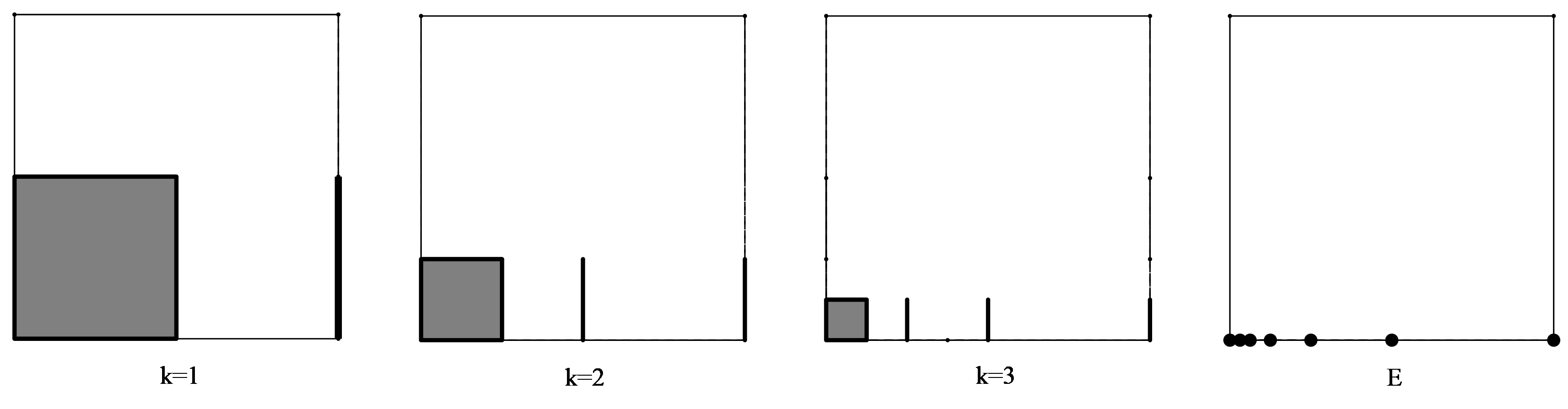
Suppose that d=2d=2 and J=[0,1]2J=[0,1]^{2}. For all k>0k>0, nk=2n_{k}=2,

Ψk,1=(120012)x,Ψk,2=(00012)x+(10).\Psi_{k,1}=\begin{pmatrix}\frac{1}{2}&0\\ 0&\frac{1}{2}\end{pmatrix}x,\quad\Psi_{k,2}=\begin{pmatrix}0&0\\ 0&\frac{1}{2}\end{pmatrix}x+\begin{pmatrix}1\\ 0\end{pmatrix}.

Then

E={(0,0),(1,0),(12,0),(14,0),,(12n,0),}.E=\{(0,0),(1,0),(\frac{1}{2},0),(\frac{1}{4},0),\ldots,(\frac{1}{2^{n}},0),\ldots\}.

It is clear that EE is countable, see Figure 2.

Refer to caption
Figure 2. non-autonomous affine set contains countably many elements
Example 3.

Given J=[0,1]2J=[0,1]^{2} and an integer n2n\geq 2. Let n1=nn_{1}=n and 𝒟{0,1,,n1}2\mathcal{D}\subset\{0,1,\ldots,n-1\}^{2}. We write

Ψ1,j=(1n001n)(x+bj),bj𝒟.\Psi_{1,j}=\begin{pmatrix}\frac{1}{n}&0\\ 0&\frac{1}{n}\end{pmatrix}(x+b_{j}),\quad b_{j}\in\mathcal{D}.

For all k2k\geq 2, we set nk=2n_{k}=2 and

Ψk,1=(1212012)x,Ψk,2=(1201212)x.\Psi_{k,1}=\begin{pmatrix}\frac{1}{2}&\frac{1}{2}\\ 0&\frac{1}{2}\end{pmatrix}x,\quad\Psi_{k,2}=\begin{pmatrix}\frac{1}{2}&0\\ \frac{1}{2}&\frac{1}{2}\end{pmatrix}x.

Then cardE=n\textrm{card}\ E=n. See Figure 3.

Refer to caption
Figure 3. Self-affine set contains only 3 elements, where n=3n=3 and 𝒟={(00),(12),(20)}\mathcal{D}=\{\binom{0}{0},\binom{1}{2},\binom{2}{0}\}.

Next, we give an example that ss^{*} and sAs_{A} are the sharp bounds for the upper box dimension and the Hausdorff dimension of non-autonomous affine sets.

Example 4.

Suppose that d=2d=2 and J=[0,1]2J=[0,1]^{2}. For each integer k>0k>0,

nk={3, if k=1 or 322n<k322n+1 for some integer n09, if 322n1<k322n for some integer n0.n_{k}=\left\{\begin{array}[]{cl}3,&\qquad\textit{ if $k=1$ or }3\cdot 2^{2n}<k\leq 3\cdot 2^{2n+1}\textit{ for some integer }n\geq 0\\ 9,&\qquad\textit{ if }3\cdot 2^{2n-1}<k\leq 3\cdot 2^{2n}\textit{ for some integer }n\geq 0.\end{array}\right.

Let 𝒟k{0,1,,8}×{0,1,2}\mathcal{D}_{k}\in\{0,1,\ldots,8\}\times\{0,1,2\} and |𝒟k|=nk|\mathcal{D}_{k}|=n_{k}. For 1jnk1\leq j\leq n_{k}, Tk,j=diag{19,13}T_{k,j}=\mathrm{diag}\{\frac{1}{9},\frac{1}{3}\}, and

Ψk,j(x)=Tk,j(x+bk,j),\Psi_{k,j}(x)=T_{k,j}(x+b_{k,j}),

where bk,j𝒟kb_{k,j}\in\mathcal{D}_{k}. Let sks_{k} be the number of jj such that (i,j)𝒟k(i,j)\in\mathcal{D}_{k} for some ii. Suppose that for each k>0k>0, sk=2s_{k}=2. Then for 𝐮Σk\mathbf{u}\in\Sigma^{k},

ϕs(T𝐮)={2sk,0<s<1;2(12s)k,1s2.\phi^{s}(T_{\mathbf{u}})=\left\{\begin{array}[]{lcc}2^{-sk},&&0<s<1;\\ 2^{(1-2s)k},&&1\leq s\leq 2.\end{array}\right.

By simple calculation, we have that

s=43,sA=76.s^{*}=\frac{4}{3},\qquad s_{A}=\frac{7}{6}.

But

dim¯BE=5log3+3log26log3<s,\overline{\dim}_{\rm B}E=\frac{5\log 3+3\log 2}{6\log 3}<s^{*},

and

dimHEdim¯BE=5log3+3log26log3<sA.\dim_{\rm H}E\leq\underline{\dim}_{\rm B}E=\frac{5\log 3+3\log 2}{6\log 3}<s_{A}.

References

  • [1] B. Bárány and M. Hochman and A. Rapaport. Hausdorff dimension of planar self-affine sets and measures. Invent. Math., 216, 601–659, 2019.
  • [2] T. Bedford. Crinkly curves, Markov partitions and box dimensions in self-similar sets. PhD thesis, University of Warwick, 1984.
  • [3] K. J. Falconer. The Geometry of Fractal Sets. Cambridge University Press, 1985.
  • [4] K. J. Falconer. Fractal Geometry-Mathematical Foundations and Applications. John Wiley & Sons Inc., 2nd edt, 2003.
  • [5] K. J. Falconer. The Hausdorff dimension of self-affine fractals. Math. Proc. Cambridge Philos. Soc., 103, 339–350, 1988.
  • [6] K. J. Falconer. The dimension of self-affine fractals. II. Math. Proc. Cambridge Philos. Soc., 111, 169–179, 1992.
  • [7] K. J. Falconer. Generalized dimensions of measures on self-affine sets, Nonlinearity 12, 877–891, 1999.
  • [8] K. J. Falconer. Generalized dimensions of measures on almost self-affine sets. Nonlinearity 23, 1047–1069, 2010.
  • [9] K. J. Falconer. Dimensions of self-affine sets: a survey. Further developments in fractals and related fields, 115–134, Trends Math., Birkhäuser/Springer, New York, 2013.
  • [10] K. J. Falconer and T. Kempton. Planar self-affine sets with equal Hausdorff, box and affinity dimensions. Ergodic Theory Dynam. Systems, 38,1369–1388, 2018.
  • [11] D. Feng. Dimension of invariant measures for affine iterated function systems Feng. Duke Math. J. 172, 701–774, 2023.
  • [12] D. Feng and H. Hu. Dimension Theory of Iterated Function Systems. Comm. Pure Appl. Math. 62, 1435–1500, 2009.
  • [13] J. M. Fraser, T. Jordan and N. Jurga Dimensions of equilibrium measures on a class of planar self-affine sets. J. Fractal Geom. 7, 87–111, 2020.
  • [14] M. Hochman and A. Rapaport Hausdorff dimension of planar self-affine sets and measures with overlaps. J. Eur. Math. Soc. 24, 2361–2441, 2022.
  • [15] H. Hu Dimensions of Invariant Sets of Expanding Maps. Commun. Math. Phys. 176, 307–320, 1996.
  • [16] H. Hu Box Dimensions and Topological Pressure for some Expanding Maps. Commun. Math. Phys. 191, 397–407, 1998.
  • [17] S. Hua and W. Li Packing dimension of generalized Moran sets. Progr. Natur. Sci. (English Ed.) 6, 148–152, 1996.
  • [18] I. Hueter and S. P. Lalley Falconer’s formula for the Hausdorff dimension of a self-affine set in R2R^{2}. Ergodic Theory Dynam. Systems 15, 77–97,1995.
  • [19] J. E. Hutchinson. Fractals and self-similarity. Indiana Univ. Math. J., 30, 713–747, 1981.
  • [20] T. Jordan, M. Pollicott, and K. Simon. Hausdorff dimension for randomly perturbed self affine attractors. Comm. Math. Phys., 207, 519–544, 2007.
  • [21] P. Mattila. Geometry of Sets and Measures in Euclidean Spaces. Cambridge University Press, 1995.
  • [22] C. McMullen. The Hausdorff dimension of general Sierpiński carpets. Nagoya Math. J., 96:1–9, 1984.
  • [23] P. A. Moran, Additive functions of intervals and Hausdorff measure, Proc. Camb. Phil. Soc., 42, 15–23, 1946.
  • [24] I. D. Morris and P. Shmerkin On equality of Hausdorff and affinity dimensions, via self-affine measures on positive subsystems. Trans. Amer. Math. Soc. 371, 1547–1582, 2019.
  • [25] Y. Peres and B. Solomyak. Problems on self-similar sets and self-affine sets: an update. In Fractal geometry and stochastics, II (Greifswald/Koserow, 1998), volume 46 of Progr. Probab., 95–106, 2000.
  • [26] C. A. Rogers. Hausdorff Measures. Cambridge University Press, 1998.
  • [27] B. Solomyak. Measure and dimension for some fractal families. Math. Proc. Cambridge Philos. Soc., 124, 531–546, 1998.
  • [28] Z. Wen Mathematical Foundation of Fractal Geometry. Shanghai Scientific and Technological Education Publishing House 2000.
  • [29] Z. Wen Moran sets and Moran classes. Chinese Sci. Bull. 46, 1849–1856, 2001.