Fly-by galaxy encounters with multiple black holes produce star-forming linear wakes
Abstract
We look for simulated star-forming linear wakes such as the one recently discovered by van Dokkum et al. (2023) in the cosmological hydrodynamical simulation ASTRID. Amongst the runaway black holes in ASTRID, none are able to produce clear star-forming wakes. Meanwhile, fly-by encounters, typically involving a compact galaxy (with a central black hole) and a star-forming galaxy (with a duo of black holes) reproduce remarkably well many of the key properties (its length and linearity; recent star formation, etc.) of the observed star-forming linear feature. We predict the feature to persist for approximately 100 Myr in such a system and hence constitute a rare event. The feature contains a partly stripped galaxy (with ) and a dual BH system () in its brightest knot. X-ray emission from AGN in the knot should be detectable in such systems. After from the first fly-by, the galaxies merge leaving behind a triple black hole system in an (still) actively star-forming early-type remnant of mass . Follow-up JWST observations may be key for revealing the nature of these linear features by potentially detecting the older stellar populations constituting the bright knot. Confirmation of such detections may therefore help discriminate a fly-by encounter from a massive BH wake to reveal the origin of such features.
1 Introduction
Given that nearly all galaxies host central black holes, it is likely that during complex dynamical mergers involving multiple galaxies, one or more of the BHs get ejected. Evidence from observations for such anticipated three-body interactions has been sparse till recently. New observations have reported serendipitous discoveries of extended linear star-forming features with unclear origins that likely involve multiple BH interactions and accompanying triggered star formation. van Dokkum et al. (2023) (VD23 hereafter) reports the discovery of a thin stellar streak extending from a nearby compact galaxy at . Based on the length and linearity of the feature, as well as the emission lines associated with dense star-forming gas, the authors interpret it as the stellar wake induced by the passage of a massive black hole (MBH) kicked out from the compact galaxy during a 3-body encounter of the MBHs. In another recent paper, Zaritsky et al. (2023) reports finding an even longer, collimated galactic tail in length, also associated with recent and ongoing star formation. Having discussed the challenges of a more commonplace origin for this feature such as ram pressure or tidal stripping, these authors also propose that this feature is likely created by a three-body encounter between three interacting galaxies. Other observed cases of potential runaway BHs include the one detected in a peculiar source in the COSMOS survey at (CXOCJ100043.1+020637 (CID-42)) that presents as two compact optical sources embedded in the same galaxy with a large velocity offset (Civano et al., 2010).
In this work, we focus on linear features with accompanying star formation activity. If the observed linear features were indeed produced by a runaway BH in a compact star cluster, or even a runaway galaxy itself, they open up a new channel for finding ejected stars and MBHs undergoing complex dynamical interaction. However, the runaway BH explanation itself also faces theoretical challenges: it is not clear, for example, whether a BH with can trigger such a high level of star formation, and leave a trail of stars weighing almost half the mass of the original galaxy ( as per VD23). On the other hand, it is also theoretically challenging to produce bright stellar wakes that are so thin and straight, without having some ejected material associated with them. Further clarification on the origin of these exotic systems demands work from the theoretical side, and the first step would be to identify theoretical counterparts of these observed systems in cosmological simulations, a path we pursue here, so that we can better investigate their origins.
To this end, our work presents a first attempt to query and investigate the origin of extended linear stellar wakes in cosmological simulations and their possible association with runaway MBHs. We use the large volume ASTRID simulation with a large galaxy population (Bird et al., 2022; Ni et al., 2022), allowing us to find the very rare occurrences of extended star-forming systems. Moreover, the updated BH dynamics model (e.g. Chen et al., 2022) produces a vast number of wandering MBHs (Di Matteo et al., 2022) and even potential runaway MBHs among MBH triplets (Hoffman et al., 2023), allowing us to look for connections between stellar wakes and MBH tuples or runaway BHs.
Our letter is organized as follows: in Section 2 we first introduce the ASTRID simulation, and the selection criteria we used to find runaway BHs in the simulation as well as the theoretical counterparts of the currently observed linear features. In Section 3, we present systems from the simulation that morphologically resemble the observed linear star-forming features. We then examine their origin, evolution, and detailed properties of the galaxies and BHs associated with such systems.
2 Method
2.1 Simulations
ASTRID is a cosmological hydrodynamical simulation performed using a new version of the Smoothed Particle Hydrodynamics code MP-Gadget. The simulation evolves a cube of per side with initial tracer particles comprising dark matter and baryons, and has currently reached . ASTRID has a dark matter particle mass resolution of and in the initial conditions. The gravitational softening length is for both DM and gas particles. The simulation includes a full-physics sub-grid treatment for modeling galaxy formation, SMBHs and their associated supernova and AGN (Active Galactic Nuclei) feedback, as well as inhomogeneous hydrogen and helium reionization. We refer the readers to the introductory papers Bird et al. (2022); Ni et al. (2022) for detailed descriptions of physical models deployed in the simulation.
Here we briefly summarize BH modeling, which is most relevant to our current investigation of runaway MBHs. BHs are seeded in haloes with and , with seed masses stochastically drawn between and , motivated by the direct collapse scenario proposed in Lodato & Natarajan (2007). The gas accretion rate onto the black hole is estimated via a Bondi-Hoyle-Lyttleton-like prescription (Di Matteo et al., 2005). The black hole radiates with a bolometric luminosity proportional to the accretion rate , with a mass-to-energy conversion efficiency in an accretion disk according to Shakura & Sunyaev (1973). 5% of the radiated energy is coupled to the surrounding gas as the AGN feedback. Dynamics of the black holes are modeled with a sub-grid dynamical friction model (Tremmel et al., 2015; Chen et al., 2022) to replace the original implementation that directly repositioned BHs to the local minimum of the potential. This gives well-defined black hole trajectories and velocities. Per this implementation, two black holes can merge if their separation is within two times the gravitational softening length , once their kinetic energy is dissipated by dynamical friction and they are gravitationally bound.
2.2 Galaxy Population and Candidate Selection
Galaxies in the simulation are identified with the SUBFIND algorithm (Springel et al., 2001). The large volume of ASTRID provides a rich galaxy population matching the host galaxy of the observed systems, from which we can conduct a comprehensive search for runaway BHs and star-forming wakes. We perform the search at two redshifts, and (the current lowest redshift of the simulation), with the latter being closer in time to the observed streak in VD23 at .
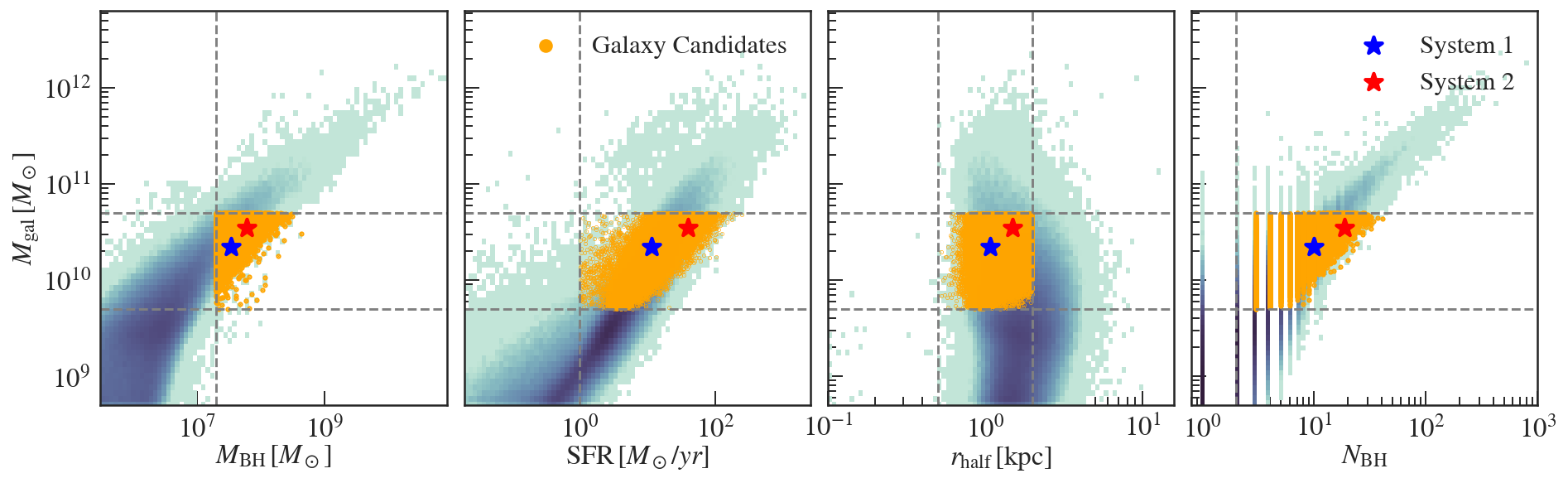
Target galaxies: In Figure 1, we show the properties of galaxies in ASTRID and our selection criteria. To match with the properties of the main galaxy in van Dokkum et al. (2023), we focus on the star-forming (SFR), compact (), and non-satellite galaxies with masses that contain at least 3 BHs with a total BH mass above . We apply the 3-BH criterion because it is necessary to produce a runaway BH. After applying these cuts, we narrow down our search to (11399) galaxies at (), and hereafter we refer to these selected galaxies as our “target galaxies”.
Runaway BH selection: We identify runaway BHs within the target galaxies above (i.e. the orange population in Figure 1). To quantitatively define a “runaway” MBH in these galaxies, we compute the ratio between consecutive apocentric radii between each satellite BH in the galaxy and the central MBH (similar to Hoffman et al., 2023). If we see a consistent and sudden increase in orbital size by a factor of more than three in at least three full orbits, then we categorize the MBH as a “runaway” MBH. Among the target galaxies at , we found potential runaway BHs that satisfy these criteria.
Linear star-forming wake selection: We look for radial linear star-forming features with the following method: we divide all the young stars (stellar age ) in each halo into 45 radial bins [10, 100] kpc from the central galaxy center. To match a observable linear feature, we select systems with at least stars in each bin for 25 continuous radial bins. This gives us 514 (435) candidates with potentially observable stellar streaks at () respectively, which makes up of the target galaxy population (we will refer to these as “linear feature candidates”). We then visually inspect these potential linear features to select the ones with large signal-to-noise, resulting in visually-confirmed linear features at each redshift (note that this number of viable candidates is likely a lower limit as we only look for linearity along the - and - planes).
3 Results
3.1 Do runaway BHs produce linear stellar wakes?
van Dokkum et al. (2023) proposed that one of the most likely mechanisms for producing the observed star-forming wake is a runaway BH induced by a three-body encounter. Following this proposal and the works by Saslaw & De Young (1972) and de la Fuente Marcos & de la Fuente Marcos (2008), we look for possible associations between linear star-forming features and runaway BHs. However, upon an initial search through the target galaxies (orange points in Figure 1), we do not find any visible stellar features along the wakes of the runaway BHs.
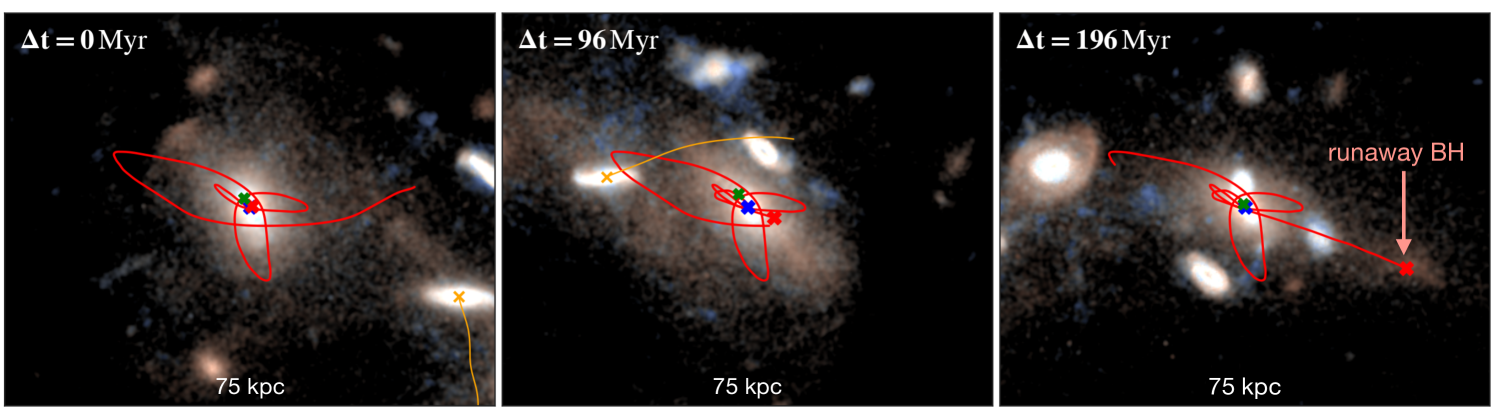
As the BH-induced star formation may be more prominent within a denser circum-galactic medium (CGM) than that in our target galaxies, we relax the upper limit on the galaxy mass and did another search among MBH triplets in larger halos (the sample of MBH triplets from Hoffman et al. (2023)). In these halos, the runaway BHs also tend to be more massive, and the formation of a stellar wake is less affected by the resolution limit. Figure 2 shows an example runaway BH candidate within a MBH triplet, found in a galaxy with mass . In this system, a BH with mass is ejected from the host galaxy after the initial formation of the MBH triplet at a speed of , and it traverses a distance of from the galaxy center in another . Even in this case, we still do not see a star-forming signature associated with the wake of the runaway BH: we found at most total newly formed stars within of the ejected BH.
We note a few limitations of the simulation potentially responsible for this null result: the resolution of ASTRID cannot fully resolve the ejection due to three-body encounters, and BHs that “run away” are mostly disrupted by a blob of incoming stars/gas. This implies that the maximum speed reached by any of our runaway BH candidates is and decreases to at the target separation of , barely reaching the speed to shock the surrounding gas (e.g. Dopita & Sutherland, 1996; Allen et al., 2008). Also, the simulation may lack the mass resolution to resolve gas shocked by a BH: the target runaway BH () is a few times larger than the gas particle mass, and so the gas over-density drawn by the BH may not be directly resolvable. A follow-up study would need to deploy higher-resolution simulations, to detect BHs ejected at a higher velocity in environments similar to our target galaxies to evaluate whether a similar star-forming wake can be produced.
3.2 Stellar wakes associated with fly-by galaxy encounters
Although we do not find visible star-forming wakes associated with the passage of runaway BHs, we do find a few tens of star-forming wakes in the simulation following the method detailed in Section 2. The natural question to ask is then: what mechanisms, if not runaway BHs, produce these wakes? By inspecting the simulation counterparts to the observed systems selected in Section 2.2, we find that most star-forming streaks originate from the fly-by encounter of a recently merged, dual-BH young galaxy with a more massive compact galaxy. We present some representative cases of such systems and their evolution in this section.
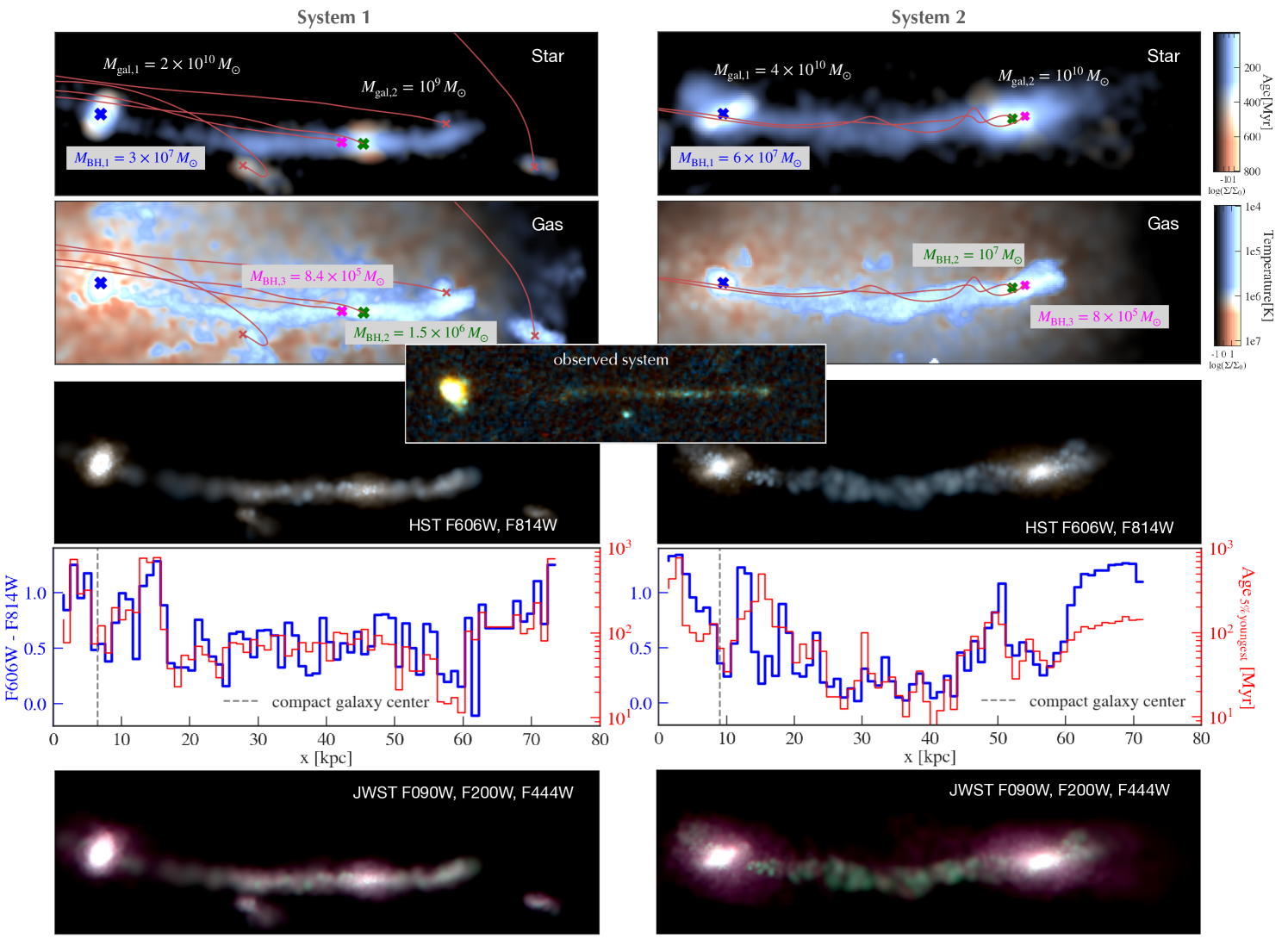
Figure 3 shows star and gas visualizations of two systems with linear star-forming features, and the mock images of the systems seen through the different filters of HST and JWST. In both cases, the young stars extend linearly to more than 50 kpc away from the main, compact galaxy (Galaxy 1, on the left end of each image). The young galaxy (Galaxy 2, on the right) is embedded in a stream of cold, dense gas with clearly distinguishable from the background hot gas in the surrounding medium (second row), along which we see ongoing star formation and young stars formed within a few tens Myrs (fourth row).
Figure 3 also shows the mock HST and JWST observations, created by assigning spectral energy distributions (SEDs) to each star particle according to the Binary Population and Spectral Population Synthesis model (BPASS v2.2.1; Stanway & Eldridge, 2018). These SEDs are convolved with the filter transmission functions associated with the chosen filters. We smooth the stars with an SPH kernel and make 2D projections with pixel sizes matching the sensor for HST and JWST (0.049” for HST ACS, and 0.031”/0.063” for JWST NIRCAM short/long wavelength).
The stellar age along the wake follows a bi-modal distribution: half of the stars are relatively old with ages , and half are formed within during the emergence of the streak. The young stars form the linear feature when captured by the HST F606W and F814W bands (third row), while the older stars are better seen with JWST at longer wavelengths (fifth row). The redder stars may be a distinctive signature of the stripped galaxy scenario, which are unlikely to be found in the runaway-BH case.
3.3 Evolution of the linear feature
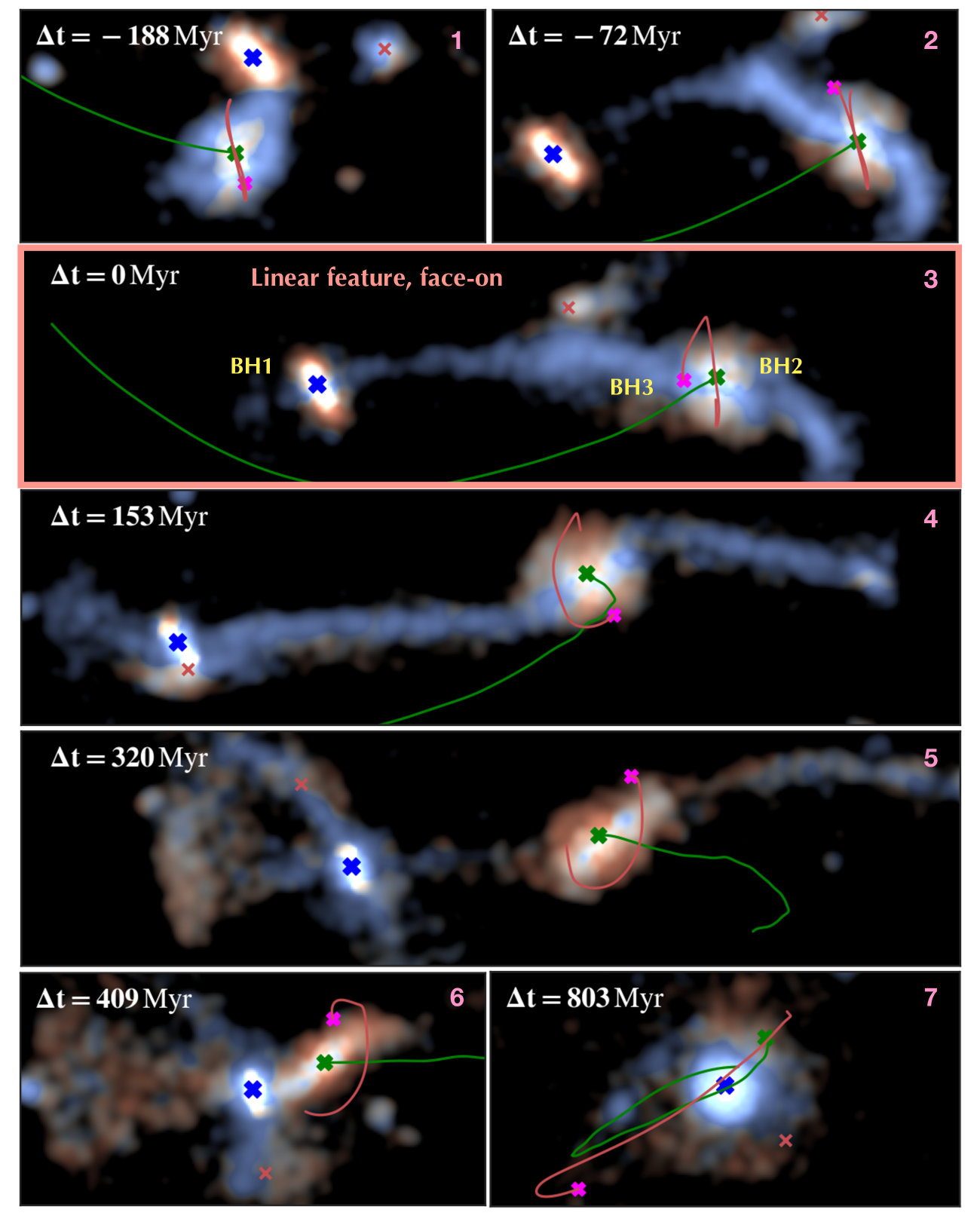
To better understand the formation of the star-forming streak, we trace System 1 across a Gyr before and after the time when the linear feature is most prominent. Figure 4 shows the time evolution of the two galaxies involved in the linear stellar feature in a face-on view. The feature is a by-product of a fly-by encounter between two galaxies at a speed of . The galaxies barely touch each other during their first passage (frame 1), after which Galaxy 1 remains unperturbed while Galaxy 2 develops elongated tidal arms on both sides. The feature formed around after the initial passage between the two galaxies, and lasts for (frame 2-4), after which the stars along the streak become old (frame 5), and the two galaxies experience a head-on collision (frame 6-7).
Our simulated linear features are extreme cases of the tidal arms/tails found in previous numerical studies of galaxy mergers (e.g. Toomre & Toomre, 1972; Barnes & Hernquist, 1992; Ploeckinger et al., 2018). Idealized simulations have shown that within these tails accumulations of gas and stars can be found (e.g. Barnes & Hernquist, 1992; Baumschlager et al., 2019; Shin et al., 2020). These clumps harbor molecular gas which provides a reservoir for new stars (e.g. Mirabel et al., 1991, 1992), and could be the origin of the blue knots along the VD23 system. Upon the close inspection of the visually-confirmed linear features, we find that the long tails are usually associated with dual-BH galaxies. of these tails contain close BH pairs, indicating a recent galaxy merger within the tail. Isolated galaxy simulations may not produce features like System 1 and System 2 if it takes two consecutive galaxy mergers to produce very long star-forming tails.
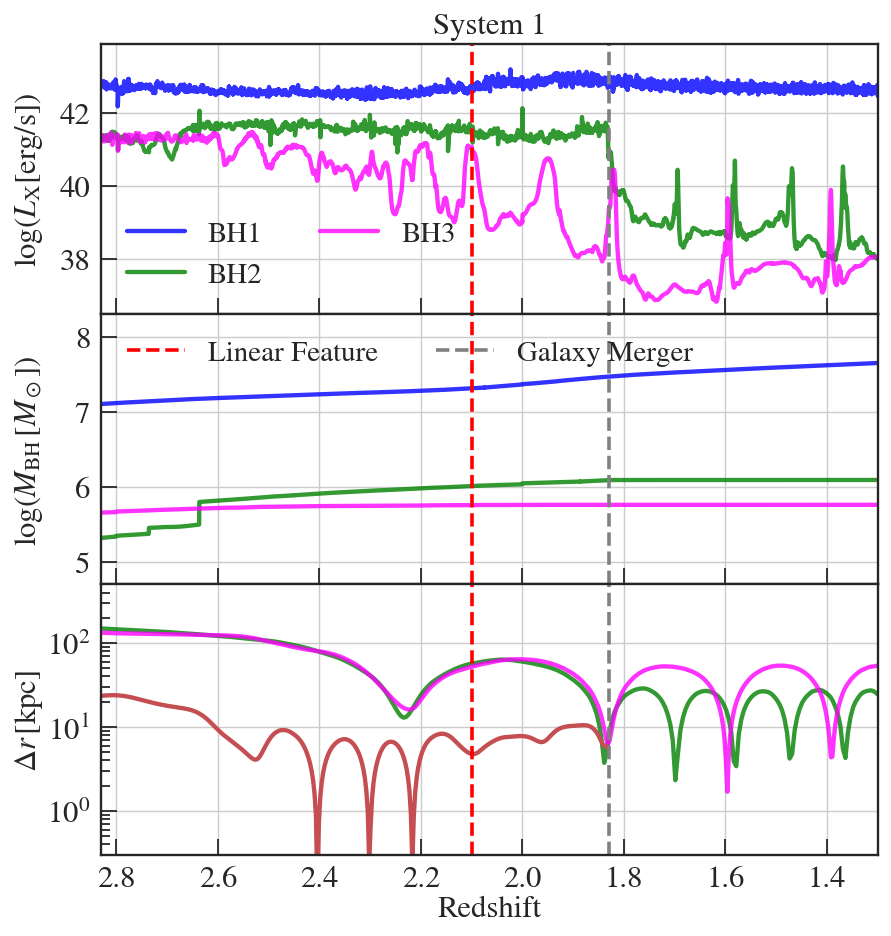
We also show in Figure 4 the trajectories of the BHs along the tail. BH3 has come within Galaxy 2 in a previous galaxy merger a few hundred Myrs before the wake formation. Then it keeps orbiting around BH2 during and after the production of the stellar wake, until the final merger between Galaxy 1 and Galaxy 2 (frame 7), after which both BH2 and BH3 ended up in wide orbits around BH1. We will examine the detailed evolution of the triple-BH system in the next section.
3.4 BHs along the linear feature
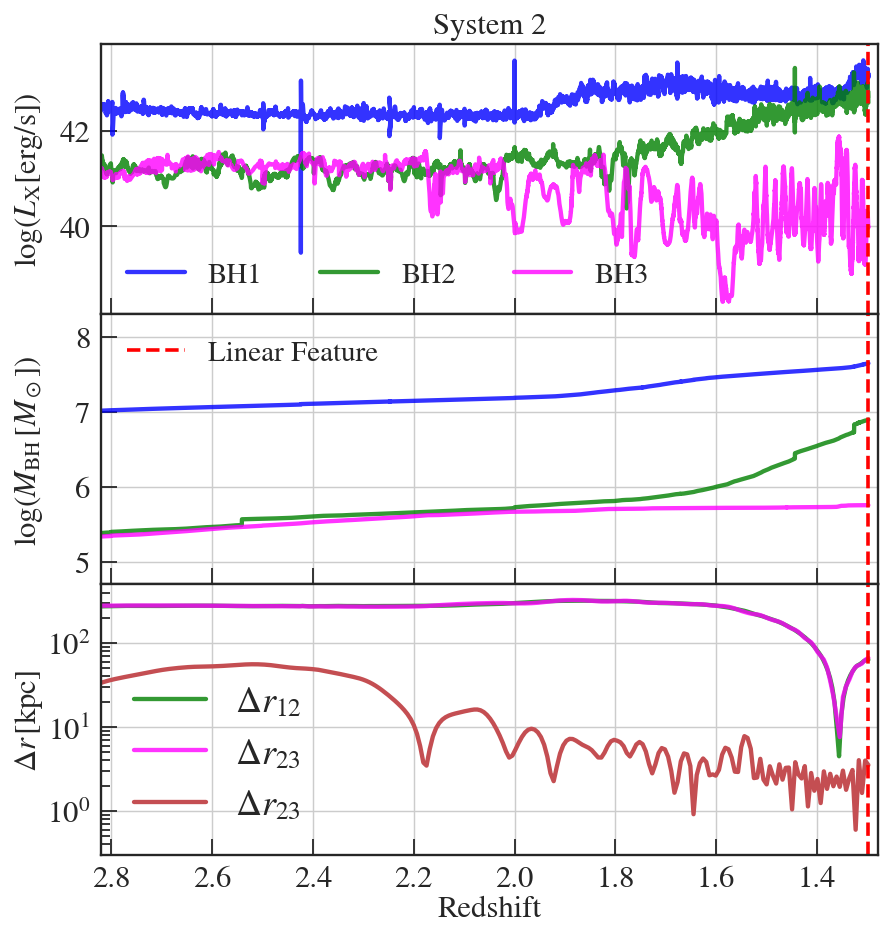
A common feature shared by our linear feature candidates is a dual-BH system along the streak merging into a central BH. Such MBH triplets are indicators of consecutive galaxy mergers producing the stellar streak, and if active, they may be also responsible for triggering the OIII emission along the streak. Here we examine the evolution of BHs along the linear features and their AGN activity.
Figure 5 shows the time evolution of the X-ray luminosity, BH mass, and the orbits of the three BHs associated with the merging galaxies in System 1 and System 2. In both cases, the BH in the compact galaxy is fairly luminous, maintaining an X-ray luminosity of nearly for more than a Gyr. The second brightest BH (BH2) embedded along the linear feature also has a relatively high X-ray emission between . If the observed wake is produced by the scenario we show here, then BH2 is responsible for triggering the OIII emission along the wake. As mentioned in VD23, the amount of OIII emission seen would correspond to an AGN with according to the scaling relation in Ueda et al. (2015). Our BH2s are slightly fainter for a OIII luminosity, but still fall well within the Ueda et al. (2015) relation with the scatter and are capable of triggering the observed OIII signature.
The detectability of the third BH may depend on its orbits within Galaxy 2, but it is possible that BH3 was captured at the pericenter of the orbit and at it is brightest when the linear feature is produced (e.g. the case in System 1). In this (optimistic) case, follow-up observations may simultaneously see an MBH triplet associated with the stellar wake.
4 Conclusions and Discussion
In this work, we identify runaway BHs ejected at from host galaxies, as well as linear star-forming features extending from compact galaxies in the ASTRID simulation at . We look for the association between the two types of systems following the proposal in VD23, and find that runaway BHs do not produce visible star-forming wakes in the simulation.
However, we find that linear star-forming features in fly-by galaxy encounters resemble the recent observation by van Dokkum et al. (2023), with very bright, thin, and straight young stars when seen in the HST F606W/F814W filters. Such linear features potentially exist among compact, star-forming galaxies with and multiple BHs, and the most prominent linear features can last for .
We examine two representative systems with strong linear features in detail, both with stellar masses between and SFRs between . Among the BHs associated with the two galaxies producing the linear feature, the central BH has a bright X-ray emission with , which could potentially be seen by Chandra. The brightest BH along the feature emits at , also with a chance to be detected in the X-rays.
The production of the linear feature involves consecutive encounters between three galaxies. The remnant of the first galaxy merger ( and star-forming) goes through a fly-by encounter with a more massive, compact galaxy, during which its surrounding gas gets tidally stripped, leaving a trace of star-forming gas and young stars. of the visually-confirmed systems with linear features harbor a dual-BH star-forming galaxy along the feature, supporting the three-galaxy encounter scenario. Our findings indicate that these linear features may offer a robust signature for finding BH binaries and multiple-BH systems, but further work is required to better establish the connection between linear long tidal tails and binary-hosting galaxies. There have been catalogs of long tidal tails in the COSMOS field (e.g. Civano et al., 2010; Wen & Zheng, 2016; Ren et al., 2020), out of which two galaxy nuclei can be clearly identified in some extended linear systems.
Finally, although our results show that only tidal features during fly-by galaxy mergers can produce these recently observed features, we acknowledge that our resolution limit leaves room for the possibility of a runaway-BH-induced star-forming wake. Due to the similarity with many features of the observed signatures (star-forming gas, OIII emission, and a population of young stars) shared by these two scenarios, follow-up studies are needed to potentially distinguish between them.
Follow-up observations using longer-wavelength bands with JWST can tell whether there exists an underlying old stellar population along the linear feature. The lack of old stars will greatly support the runaway BH origin of the feature. Meanwhile, higher-resolution simulations can study the triggering of such dense star formation by runaway BHs, and the mass/velocity of the BH required. In both formation channels of the linear feature, follow-up observations may be able to reveal multiple MBH signatures along the feature, and such systems are very likely the sites for complex three-body encounters and mergers between MBHs (e.g. Hoffman & Loeb, 2007; Bonetti et al., 2016; Mannerkoski et al., 2021).
Acknowledgements
We thank Mohit Bhardwaj, Pieter van Dokkum, Charlie Conroy and Qian Yang for their helpful discussions. ASTRID was run on the Frontera facility at the Texas Advanced Computing Center. TDM and RACC acknowledge funding from the NSF AI Institute: Physics of the Future, NSF PHY-2020295, NASA ATP NNX17AK56G, and NASA ATP 80NSSC18K101. TDM acknowledges additional support from NSF ACI-1614853, NSF AST-1616168, NASA ATP 19-ATP19-0084, and NASA ATP 80NSSC20K0519, and RACC from NSF AST-1909193. SB acknowledges funding supported by NASA-80NSSC22K1897.
Data Availability
The code to reproduce the simulation is available at https://github.com/MP-Gadget/MP-Gadget, and continues to be developed. Part of the ASTRID snapshots are available at https://astrid-portal.psc.edu/.
References
- Allen et al. (2008) Allen, M. G., Groves, B. A., Dopita, M. A., Sutherland, R. S., & Kewley, L. J. 2008, ApJS, 178, 20, doi: 10.1086/589652
- Barnes & Hernquist (1992) Barnes, J. E., & Hernquist, L. 1992, Nature, 360, 715, doi: 10.1038/360715a0
- Baumschlager et al. (2019) Baumschlager, B., Hensler, G., Steyrleithner, P., & Recchi, S. 2019, MNRAS, 483, 5315, doi: 10.1093/mnras/sty3418
- Bird et al. (2022) Bird, S., Ni, Y., Di Matteo, T., et al. 2022, MNRAS, 512, 3703, doi: 10.1093/mnras/stac648
- Bonetti et al. (2016) Bonetti, M., Haardt, F., Sesana, A., & Barausse, E. 2016, MNRAS, 461, 4419, doi: 10.1093/mnras/stw1590
- Chen et al. (2022) Chen, N., Ni, Y., Tremmel, M., et al. 2022, MNRAS, 510, 531, doi: 10.1093/mnras/stab3411
- Civano et al. (2010) Civano, F., Elvis, M., Lanzuisi, G., et al. 2010, ApJ, 717, 209, doi: 10.1088/0004-637X/717/1/209
- Conroy & Gunn (2010) Conroy, C., & Gunn, J. E. 2010, FSPS: Flexible Stellar Population Synthesis, Astrophysics Source Code Library, record ascl:1010.043. http://ascl.net/1010.043
- de la Fuente Marcos & de la Fuente Marcos (2008) de la Fuente Marcos, R., & de la Fuente Marcos, C. 2008, ApJ, 677, L47, doi: 10.1086/587962
- Di Matteo et al. (2022) Di Matteo, T., Ni, Y., Chen, N., et al. 2022, arXiv e-prints, arXiv:2210.14960, doi: 10.48550/arXiv.2210.14960
- Di Matteo et al. (2005) Di Matteo, T., Springel, V., & Hernquist, L. 2005, Nature, 433, 604, doi: 10.1038/nature03335
- Dopita & Sutherland (1996) Dopita, M. A., & Sutherland, R. S. 1996, ApJS, 102, 161, doi: 10.1086/192255
- Hoffman et al. (2023) Hoffman, C., Chen, N., Di Matteo, T., et al. 2023, arXiv e-prints, arXiv:2303.04825, doi: 10.48550/arXiv.2303.04825
- Hoffman & Loeb (2007) Hoffman, L., & Loeb, A. 2007, MNRAS, 377, 957, doi: 10.1111/j.1365-2966.2007.11694.x
- Lodato & Natarajan (2007) Lodato, G., & Natarajan, P. 2007, MNRAS, 377, L64, doi: 10.1111/j.1745-3933.2007.00304.x
- Mannerkoski et al. (2021) Mannerkoski, M., Johansson, P. H., Rantala, A., Naab, T., & Liao, S. 2021, ApJ, 912, L20, doi: 10.3847/2041-8213/abf9a5
- Mirabel et al. (1992) Mirabel, I. F., Dottori, H., & Lutz, D. 1992, A&A, 256, L19
- Mirabel et al. (1991) Mirabel, I. F., Lutz, D., & Maza, J. 1991, A&A, 243, 367
- Ni et al. (2022) Ni, Y., Di Matteo, T., Bird, S., et al. 2022, MNRAS, 513, 670, doi: 10.1093/mnras/stac351
- Ploeckinger et al. (2018) Ploeckinger, S., Sharma, K., Schaye, J., et al. 2018, MNRAS, 474, 580, doi: 10.1093/mnras/stx2787
- Ren et al. (2020) Ren, J., Zheng, X. Z., Valls-Gabaud, D., et al. 2020, MNRAS, 499, 3399, doi: 10.1093/mnras/staa2985
- Saslaw & De Young (1972) Saslaw, W. C., & De Young, D. S. 1972, Astrophys. Lett., 11, 87
- Shakura & Sunyaev (1973) Shakura, N. I., & Sunyaev, R. A. 1973, A&A, 24, 337
- Shin et al. (2020) Shin, E.-j., Jung, M., Kwon, G., et al. 2020, ApJ, 899, 25, doi: 10.3847/1538-4357/aba434
- Springel et al. (2001) Springel, V., White, S. D. M., Tormen, G., & Kauffmann, G. 2001, MNRAS, 328, 726, doi: 10.1046/j.1365-8711.2001.04912.x
- Stanway & Eldridge (2018) Stanway, E. R., & Eldridge, J. J. 2018, MNRAS, 479, 75, doi: 10.1093/mnras/sty1353
- Toomre & Toomre (1972) Toomre, A., & Toomre, J. 1972, ApJ, 178, 623, doi: 10.1086/151823
- Tremmel et al. (2015) Tremmel, M., Governato, F., Volonteri, M., & Quinn, T. R. 2015, MNRAS, 451, 1868, doi: 10.1093/mnras/stv1060
- Ueda et al. (2015) Ueda, Y., Hashimoto, Y., Ichikawa, K., et al. 2015, ApJ, 815, 1, doi: 10.1088/0004-637X/815/1/1
- van Dokkum et al. (2023) van Dokkum, P., Pasha, I., Buzzo, M. L., et al. 2023, ApJ, 946, L50, doi: 10.3847/2041-8213/acba86
- Wen & Zheng (2016) Wen, Z. Z., & Zheng, X. Z. 2016, ApJ, 832, 90, doi: 10.3847/0004-637X/832/1/90
- Zaritsky et al. (2023) Zaritsky, D., Crossett, J. P., Jaffé, Y. L., et al. 2023, arXiv e-prints, arXiv:2305.01335, doi: 10.48550/arXiv.2305.01335