∎
University of Victoria, Finnerty Road, Victoria, BC V8W 3P6, Canada
Insights into planet formation from debris disks: I. The solar system as an archetype for planetesimal evolution
Abstract
Circumstellar disks have long been regarded as windows into planetary systems. The advent of high sensitivity, high resolution imaging in the submillimetre where both the solid and gas components of disks can be detected opens up new possibilities for understanding the dynamical histories of these systems and therefore, a better ability to place our own solar system, which hosts a highly evolved debris disk, in context. Comparisons of dust masses from protoplanetary and debris disks have revealed a stark downturn in mass in millimetre-sized grains around a stellar age of 10 Myr, ostensibly in the “transition disk” phase, suggesting a period of rapid accretion of such grains onto planetesimals. This rapid formation phase is in keeping with radionucleide studies of Kuiper Belt Objects in the solar system. Importantly, this suggests that any thermal gradients in the gas of disks of this era will be “frozen in” to the planetesimals as they rapidly accrete from the solids and ices in their vicinity. Measurements of radial gradients in thermal tracers such as DHO, DCN and other tracers can therefore provide insight into the nascent solar system’s abudances. In studies of dynamical evolution of the solar system, it is tacitly assumed that such abundances can reveal the location of formation for bodies now found in the asteroid belt and Kuiper belt. Similarly, evidence of gas detected from collisional evolution in young debris disks could potentially reveal how rapidly objects have dynamically evolved in those systems, most of which will be significantly younger than the solar system.
Keywords:
Circumstellar Disks Planet Formation1 Introduction
Circumstellar disks are found around stars of all ages. Around forming stars, protostellar disks play a critical role in the accretion of material onto forming stars, and over time, the disks can evolve to protoplanetary disks, wherein stable locations in the midplane allows agglomeration processes to assemble the solids from sub-micron sized dust to grains up to centimetres in size, crucial steps in the planet formation process (Blum and Wurm, 2008; Testi et al., 2014).
As protoplanetary disks evolve, they become more tenuous, eventually beginning to erode from the inside out, creating disks with inner holes, coinciding with a decline in infrared excess emission such that half the disks are gone by 3 Myr and no disks are detectable by 6 Myr, based on a study of young clusters by Haisch et al. (2001). During the transition disk epoch, gas can continue to accrete onto planetary embryos and dust grains can continue to grow. Ultimately however, in the late stages of a transition disk, the remaining dust and gas assembled from the natal star-forming cloud or core is dispersed (Espaillat et al., 2014). The decline of near-IR emission, the loss of gas components of the disks and the changes in the dust grain size distribution are all identifiers of transitional objects, but it is not immediately clear whether these changes occur simultaneously or in a sequence (e.g., Wyatt et al., 2015). Therefore, at the end of the transition disk stage, the formation of gas giants and super Earths must be complete, although terrestrial planet formation may continue for up to 100 Myr (see the Chassefière chapter in this work). After the assembly of planetesimals and planets is complete, some parts of the disk may already be dominated by destructive collisions, rather than agglomerative processes, although it is likely destructive collisions occur even from the earliest agglomeration stages in gas-rich disks (Dullemond and Dominik, 2005). When a disk is predominately populated by dust and gas produced in collisions, it is known as a debris disk. Historically, such disks were also referred to as “secondary” or “second-generation” disks owing to their content being entirely derived from collisional evolution of larger bodies, rather than any remnants of the initial protoplanetary disk.
Debris disks represent the longest lived phase of circumstellar disks, ranging from the youngest systems, many of which now are seen to still host remnant protoplanetary gas disks, to very evolved systems, including sub-giant stars (Bonsor et al., 2014, 2013) and white dwarfs, where the measured incidence rates of infrared excess are typically a few percent (e.g., Barber et al., 2012), but have been measured to be as high as 14% (Kilic and Redfield, 2007). White dwarfs also show evidence of “pollution” of their atmospheres due to deposition of material, most likely from a circumstellar disk or remnant planetesimals (e.g., Zuckerman et al., 2003; Dufour et al., 2012). All these evolved systems have in common the fact that their protoplanetary disk phase and succeeded in forming planetesimals of at least 100 km in size. Such objects may be essential for planetary assembly, but not all find their way into planets. Instead, the collisions of these planetesimals provide the source of debris disk dust emission for the lifetime of the system.
The sun is a middle-aged star, and we see its debris disk components primarily through direct detection of the planetesimals (asteroids and comets) that make up the largest end of its size distribution. Currently, collisions within the Kuiper Belt occur on very long timescales, meaning its mass is relatively constant, but its dust emission is relatively low. Breakup of large objects can still occur, however, as evidenced by the asteroid P/2010 A2, which is observed to be fragmenting, either due to impact or rotationally induced breakup (Agarwal et al., 2013). This object is just one of many examples of ongoing destruction of larger bodies in our own solar system (see review of Jewitt et al., 2015).
The solar debris disk could not yet be detected in surveys of disks around other stars (e.g., with Spitzer, Herschel or WISE). Based on models of the solar system’s dynamical evolution, Booth et al. (2009) predict its brightness variation over time. When surveys of debris disks reach comparable limits to the Kuiper belt’s dust fractional luminosity (), we will be better able to judge whether many such faint systems exist.
Observations of individual planetesimals are not possible around other stars; instead, we see the dust emission produced by the collisional cascade that represents the steady state evolution of many debris disks (Wyatt et al., 2007; Wyatt, 2008). The observational evidence for debris disks shows that their planetesimal belts are long-lived, existing around stars of any age, and that they can be anomalously bright at late times, suggesting that stochastic as well as steady-state processes act within them. Depending on the wavelength observed and even the resolution of the imaged region, the dust distribution can appear very different. For instance, millimeter/centimeter grains are preferentially observed near their radius of formation, since they do not migrate far before being ground down to smaller sizes. Therefore, these larger grains are the best tracers of the planetesimal belts in external debris disks because they indicate the location of active collision processes (Wyatt, 2006). In contrast, scattered light imaging highlights the location of much smaller grains, which are easily pushed around in the system, moving inward due to PR drag or stellar wind drag or outward due to radiation pressure or stellar (particle) winds. Emission from warmer dust is also seen at infrared wavelengths, typically highlighting the location of asteroidal or terrestrial zones of warm dust as illustrated by Figure 1 of Matthews et al. (2014). Generally, the timescales for the evolution of warm dust (as seen by Spitzer and WISE) are much shorter than the cold dust detected in the Kuiper belt analogues (by IRAS, Spitzer and Herschel), which explains why warm dust less frequently detected, with incidence rates of a few percent, rather than the 15-25% for cold dust (Matthews et al., 2014).
Debris disks are considered signposts of planetary systems because evidence of a bright debris disk indicates that the planetesimals in the disk have been stirred, inducing collisions. For a recent review of stirring mechanisms, see Section 6 of Matthews et al. (2014) and references therein. Wyatt et al. (2012) and Marshall et al. (2014) find evidence for a correlation between the presence of a bright debris disk and the presence of low-mass planets, many of which were not known when the systems were targeted by Herschel surveys for debris disks. In parallel, the Herschel Survey 4 Kuiper Belts Around RV-detected Planet hosts (SKARPS) targeted 97 planet host stars and also find a higher correlation of brighter disks with low-mass planet systems (i.e., those in which the largest planet mass is a Saturn mass) than with systems in which a higher mass planet is present, though the number of low-mass planet systems are still small (Bryden et al., private communication). The limited number of low-mass planet systems prevents statistical analysis of the joint DUNES/DEBRIS dataset from firmly establishing the correlation (Moro-Martín et al., 2015), although we note that the statistics can improve in the DUNES and DEBRIS samples as more planets are identified in nearby systems.
Wyatt et al. (2015) recently authored a detailed summary of the steps that occur as a protoplanetary disk becomes a debris disk. We do not attempt to replicate that work here. In the first part of this section, we briefly discuss recent results that provide insight into the critical epoch of planetesimal formation based on observations. We then discuss the implications of the detections of gas disks around debris dust systems and the implications for interpretating measured abundances in terms of the dynamical history of those systems. We then step back from extrasolar debris disks to highlight what can be learned about the origins of the solar system from its planetesimal population. The observations of the solar system’s planetesimal population are interpreted based the reasonable assumption that the chemical features observed in asteroids and comets today were inherited from the local disk at the time and place of the planetesimals’ formation (i.e., the transition disk phase), and the system subsequently evolved dynamically. Finally, we highlight the deuterium fraction as a key disciminator of the solar system’s planetesimal history and its potential in external debris disks.
2 Tracing the critical epoch of planetesimal formation
Planetesimals, i.e., solid bodies ranging in size from 10s - 1000s of km, may form very early in protoplanetary disks. The agglomeration process must overcome the meter-size barrier to produce oligarchs capable of assembling into the cores of giant planets or terrestrial planets in their own right (e.g., see Weidenschilling, 1980; Carrera et al., 2015). Observations of many planetary systems reveal that not all the planetesimals are assembled into larger bodies, however. Many asteroids and comets remain to undergo collisional evolution. Based on recent Herschel and Spitzer surveys, % of A stars (Thureau et al., 2014; Su et al., 2009) show evidence of a measured far-infrared excess (to the survey depths) with a detectably higher rate of detection for younger stars in the Spitzer sample. Herschel surveys of solar type (FGK) stars, find a detection rate of % (Eiroa et al., 2013), with evidence of a significant decrease in the rate of measured incidence from % for F-type stars to % for G/K-type stars (Sibthorpe et al. 2016, in preparation). The survey data do not yet probe disks as faint as our own Kuiper Belt. The range of system ages where dust from planetesimal collisions can be observed is a strong indication of the longevity of debris disks.
In contrast to the debris disk phase, the period during which the planetesimals can be assembled must be relatively short ( 10 Myr) since the gaseous disk components are significantly depleted for most systems after that time. This timescale is also reinforced by the planetesimal population of the solar system itself, as we discuss below. To study the assembly of planetesimals, protoplanetary and transition disks must be observed.
With the advent of the Atacama Large Millimeter/submillimeter Array (ALMA), thermal imaging of circumstellar disks with comparable resolution to scattered light imaging and high sensitivity has at last become feasible. Even in its early science phase, ALMA has observed many transition era disks, typified by the loss or strong depletion of the inner disk material (see the review by Espaillat et al., 2014); recent ALMA results establish that some gas does remain the inner regions cleared of dust (van der Marel et al., 2015b). Observations have revealed very similar morphologies in several transition disks, including dust disks that are typically much more radially confined than the gas disk components, and asymmetries are also commonly observed (e.g., HD 100546, Pineda et al., 2014; Walsh et al., 2014). Most significantly, many disks exhibit highly asymmetric dust dust structures, suggesting that that planetesimal formation processes may be highly localized in the disk. For example, van der Marel et al. (2013) observed a significant azimuthal asymmetry in the disk around Oph IRS 48, revealing an enhanced mm-grain “dust trap” containing up to 9 Earth masses of material (assuming grains up to 4 mm in size) while the 18.7 m emission from VISIR reveal that the smaller grains were much more uniformly distributed in the disk. The authors suggest this dust trap feature is consistent with a vortex, which confines material both radially and azimuthally. Pérez et al. (2014) note strong azimuthally asymmetric distributions of dust consistent with vorticity in the disks of SAO 206462 and SR21, and HD 142527 (Casassus et al., 2013; Fukagawa et al., 2013) exhibits a disk in which dust is confined to a horseshoe pattern peaking at the northern edge of the disk.
The composition of planets and planetesimals varies according to the constituent materials available where they form in the protoplanetary disk. Therefore, the variations in conditions across the disk have a significant impact on the larger bodies produced. For example, condensation fronts of various volatile species form boundaries between different types of compositions (Öberg et al., 2011). Icy grains are more porous and grow more quickly than pure silicates. In addition, many studies show that surface mass densities are enhanced near snow lines, creating favourable conditions to form or grow planetesimals. Zhang et al. (2015) illustrate that the spectral index map derived from ALMA data toward the protoplanetary disk HL Tau (ALMA Partnership et al., 2015) reveals that the gaps observed in the disk correspond well to the expected location of condensation fronts of water ice, ammonia and hydrates formed from amorphous water ice and other species. Zhang et al. (2015) show that the flux ratio between 1.3 mm and 0.87 mm is more extreme in the areas of lower emission, and they suggest that the variation observed is best explained by a model with two dust populations, one of which is the product of signficant grain growth within the “dips” visible in the disk.
The HL Tau data, and the theoretical models with which they are consistent, suggest that this era of disk evolution may be the most critical in the assembly of planetary masses. The assemblage of so much material concentrated in small regions of the disk is the key to pebble accretion scenarios theories (see Johansen et al., 2007). Pebble accretion allows solids, through mass accretion over a short period of time, to grow from relatively small ( m) bodies to planetary scale oligarghs or embryos, vaulting over the meter-size barrier, which has been an impediment to core accretion theories of planet formation.
Another window into the evolution of grains is offered by measurements of dust emission in the submillimetre and millimetre regime. Because the emission is optically thin and the opacity is relatively simply modeled (as a power law in frequency), the flux density can be viewed as a proxy for mass (in millimeter-sized grains), provided one has some information about the dust temperature. The dust masses of many disks have been measured and can be compiled to gauge how dust mass varies with age. From observations at millimetre wavlengths, grains larger than centimetre sizes will not be observable, so disks may appear to diminish in mass as agglomeration occurs. Figure 1 shows that there is a marked decline of over two orders of magnitude in the dust mass of millimetre-sized grains in disks around the 10 Myr epoch, but the decline in fact extends over a range from Myr. This timescale for the decline of millimetre continuum emission is longer than the 3 Myr timescale observed by Haisch et al. (2001) during which time one half of the disks had disappeared in the infrared. This makes sense because the infrared emission traces emission closest to the star, whereas the millimeter emission preferentially traces cooler grains further from the star, which take longer to evolve or dissipate.
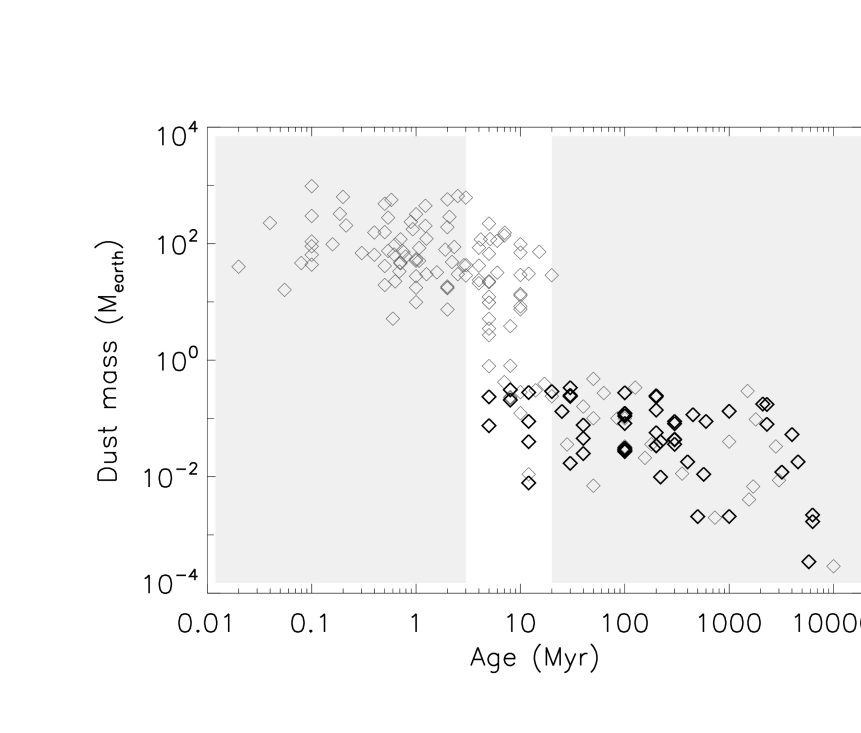
The fate of the millimetre grains lies in one of two paths: either they are rapidly ground down to smaller dust grains, rendering them susceptible to forces capable of rapidly removing the grains from the system via radiation pressure or, for low mass stars, stellar wind (e.g., Augereau and Beust, 2006; Strubbe and Chiang, 2006). Either way, their mass would be permanently removed from the disk, possibly following a short period of anomalously bright emission at infrared wavelengths and in scattered light due to the enhanced amount of small grains in the system. The alternative possibility is that the dust grains undergo a period of rapid grain growth to sizes that do not radiate efficiently at these observing wavelengths ( cm), rendering them invisible.
3 The critical role of gas
Due to the absence of gas detections in debris disks, they were typically described as gas-poor, and the absence of gas emission was considered characteristic of debris systems. While this continues to be a generally accurate paradigm, there are now almost a dozen systems which have gas detections. The earliest detections were of CI and CO in UV absorption spectra toward Pictoris (Roberge et al., 2000) and AU Microscopii via fluorescent H2 emission lines (France et al., 2007). More recently, detections are typically measurements of CO in emission, e.g., Pictoris (Dent et al., 2014), 49 Ceti (Dent et al., 2005; Hughes et al., 2008; Zuckerman and Song, 2012; Roberge et al., 2013, 2014), HD 21997 (Kóspál et al., 2013), HD 32297 (J.S. Greaves et al. in preparation), and several debris disk targets in the Sco-Cen association (J. Carpenter et al., in preparation). In the case of the ALMA observations of Pictoris, the distribution of gas mirrors that of the dust emission, with an extreme asymmetry to one side of the edge-on disk, likely at the location of a recent collision (Dent et al., 2014). In several other disks, the CO distribution is not ostensibly asymmetric and exhibits a Keplerian rotation curve. For example, the circumstellar disk of the 30 Myr old star HD 21997 has been resolved by ALMA. Its dust distribution is consistent with a debris disk (Moór et al., 2013), while the presence of the CO gas disk (Kóspál et al., 2013) in such an evolved source presents an ambiguity: is it remnant gas from a protoplanetary disk in its last throes or is the gas, as well as the dust, second generation, a product of the same collisions that produce the dust?
Kóspál et al. (2013) and Zuckerman and Song (2012) before them have pointed out that the CO mass () estimated in the HD 21997 disk indicates an unusually gas-rich disk for a debris dust system, suggesting HD 21997 (and 49 Ceti, Zuckerman and Song, 2012) may just represent atypically massive protoplanetary disks. If the detected gas remains from the protoplanetary and transition disk phase, then the CO is just a proxy for emission and the mass could be as high as . If this system is established as a true hybrid system, in which the dust is generated by collisional processing of larger bodies but the gas is not, then this object may represent an example of the final phase of a transition disk, before the remnant protoplanetary disk (small grains and gas) is dissipated and the disk becomes a true debris disk (Wyatt et al., 2015).
The possibility that gas removal is the final step in the evolution of a protoplanetary disk to a debris disk is significant because of the critical role played by gas in the final assembly of planetesimals. Gas acts to stabilize orbits of planetesimals and planets, and in its presence, small dust grains are well coupled to and co-orbiting with the gas disk. Slowing the relative velocities of dust grains enhances agglomeration properties in the disk, as described in the case of vortices in the previous section. The gas is also the primary reservoir of the magnetic field in the disk, which can act to create dead zones where mass can be focussed to enhance agglomeration processes (Dzyurkevich et al., 2013).
In the solar system, the timing of gas dispersal can be constrained by the size distribution of material being delivered from the Oort Cloud. Small objects ( 10 km, Brasser et al., 2007) would be more strongly affected than larger bodies by an increase in gas drag in the outer disk. If the delivery of material into the Oort cloud occurs in the presence of significant primordial gas, a reduced Oort Cloud results. In our own solar system this would be observable as a suppression in the number of 1-2 km size Oort cloud comets. Therefore, in the presence of gas, the material that would normally have arrived in a system’s Oort Cloud region remains in the protoplanetary disk region, providing a substantial reservoir of short-period comets (Brasser et al., 2007). Significant gas presence during the late stage re-ordering might then provide the conditions needed for the substantial cometary number densities needed to explain the significant collisional processing seen in some systems, i.e., CO levels which could require a cometary collision every 6 seconds (e.g., 49 Ceti, Zuckerman and Song, 2012).
As we will discuss below in more detail, the fact that gas chemistry is highly temperature dependent for many processes means that there will be variation in compositions in the gas throughout the disk, a radial function of temperature, and even potentially scale height. Over time, this, coupled with gas-solid chemistry, can lead to a diversity of surface properties in the planetesimals which should follow a systematic gradient as imparted from the disk. Once the gas is removed from the system, those diverse properties serve as a record of the location of those planetesimals in the disk, which should allow us to determine the final location of those planetesimals before significant dynamical evolution occurs.
Most models of the solar system are in fact predicated on this assumption, i.e., that the characteristics of the planetesimals we see today reveal that the dynamical history of the solar system must include several upheavals to account for the current observed properties of the population. The observed structure of the Kuiper belt clearly reveals that Neptune at least migrated (Malhotra, 1993) and mostly likely scattered from a formation location near the present day locations of Saturn and Uranus (Levison and Morbidelli, 2003). Meanwhile, the presence of Main Belt Comets and the variation among the surface properties of the various asteroid classes may imply that Jupiter and Saturn also had a complex migration history (Walsh et al., 2012). Such large scale restructuring events may be observable as chemical gradient anomalies in exo-debris disks when the gas is observable.
4 Insights from the Solar System
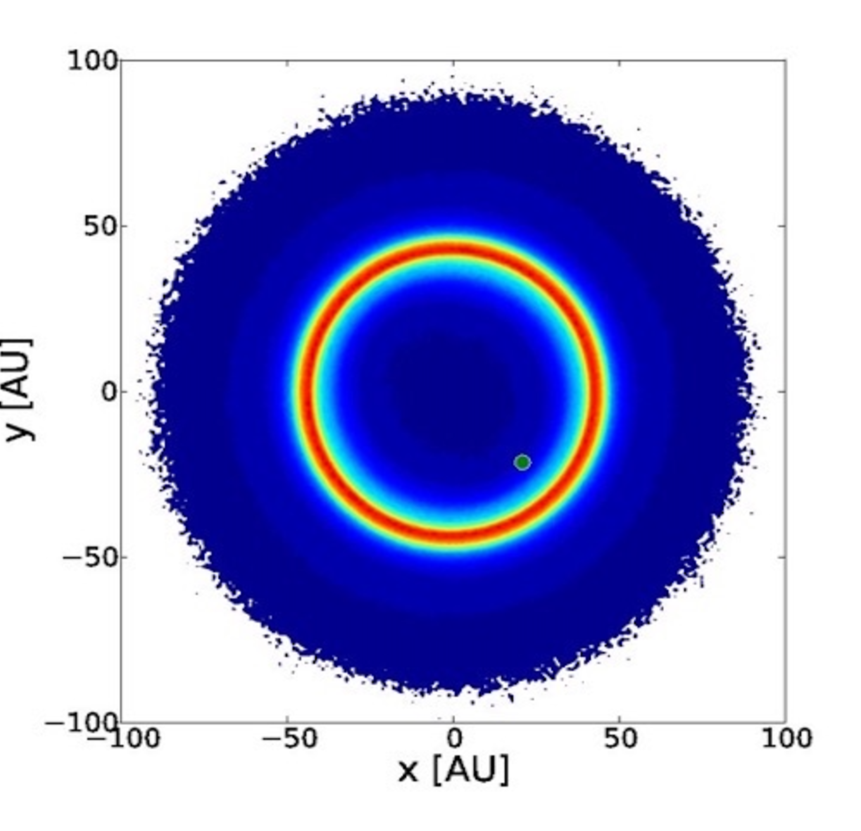
The debris disks of the solar system provide directly measurable examples of the suspected sources of dust seen around other stars. Observations of the current day structure of the Kuiper belt suggest that the early Kuiper belt experienced a large scale instability. Booth et al. (2009) provide a model of expected emission during such a destabilizing event in our solar system and compare that emission to detected debris disk systems. Lawler (2014) provides a model of the expected exo-debris disk emission that would be produced by the current Kuiper belt (see Figure 2). The current day fractional luminosity () is many orders of magnitude lower than the early disk predictions (a few ) from Booth et al. (2009). The orbital structure of the Kuiper belt provides an excellent motivation for the interpretation of currently observed exo-debris disks and their decay.
The solar zodiacal dust, which may be compared to warm dust around other stars, is, in the majority, produced through disruptive splitting of Jupiter family comets (JFCs) rather than through sublimation or asteroid belt collisions (Nesvornỳ et al., 2010). The size distribution of the zodiacal dust can be measured directly and is found to be consistent with a collisional cascade that occurs near the site of dust production (Jupiter’s orbital distance) and then transported inward through PR-drag. Earlier in the evolution of our planetary system we expect that the production of JFCs would greatly exceed the current rate, due to a larger supply source in the region of the Kuiper belt, resulting in an inner warm dust belt that would be easily detected. Thus, the detection of warm dust, so called “exo-zodi” debris disk components, may be an indicator of a large cometary population that is undergoing disruption. The extrasolar disk systems in which warm dust has been detected exhibit significantly stronger emission than is seen around the Sun; see Kennedy and Wyatt (2013) for a discussion of such systems and their possible origins. (As for cold Kuiper belt analogues, we cannot yet detected warm excesses comparable to that of our own solar system.) The composition of the warm dust, having being produced predominantly by objects that formed in the more distant interplanetary region, is then not indicative of the local planetesimal formation conditions, but rather those at large distances where the temperatures, densities and chemical abundances would have been very different.
The time scales for the process of accretion are well constrained by measurements of isotopic ages of the meteorite population. Ages are ascertained by measurements of the decay products of 26Al (26Mg) in comparison to lead-lead dating (i.e., comparisons of 207Pb or 206Pb to 204Pb). Comparing ages of adjacent components of a meterorite reveal the timescale for its creation, because once 26Al is created, it must be bound up quickly before it undergoes decay. Applying these dating techniques to calcium-aluminum-rich inclusions (CAIs) and other components (called “grains”) of H4 (among the most primordial and least heat-processed) chondrites indicate that these “grains” formed and underwent metamorphic processes within a few million years of the formation of the CAIs (Zinner and Göpel, 2002).
This time scale for formation of 26Mg-rich grains sets a short upper bound on the planetesimal formation timescale as the grains are taken up into the chondrites prior to the decay of 26Al. These rapid (few million year) timescales are consistent with evidence that stars older than about 10 Myr are depleted in gas and do not possess protoplanetary dust disks (see Section 3). Models of the processes of disk evolution and planetesimal accretion must keep these formation timescales in mind.
The observable material in the asteroid and Kuiper belts have chemical properties that hold the signature of the thermal histories of those objects. Within the asteroid belt there is a clear gradient in reflected surface properties from refractory rich to volatile rich, while the Kuiper belt exhibits a diversity of processed surface ices. The gradients seen in the asteroid belt are nominally reflective of the formation locations of those objects. There are, however, anomalous objects whose properties appear more consistent with formation elsewhere within the disk, and these may indicate post-formation transport of already formed objects (Walsh et al., 2012). If the Kuiper belt ices are indicative of variations in formation location, then the diversity of surfaces reflects a large scale re-ordering of the system which would have left a detectable but very short-lived excess IR emission (Booth et al., 2009). Although collisions within the belt are currently rare, they were likely frequent during this re-ordering processes. As the transport of material was from the warmer (interior to Neptune) zone to the colder zone, the gas liberated from the ice during the collisional processing would be deficient in the volatile species that would have survived had the colliding objects formed in-situ. Detection of abundance anomalies in second generation gas in extrasolar debris disks may be a signature that such large scale re-ordering has occurred in those systems.
The observed orbital diversity in the Kuiper belt requires the giant planets to have experienced a large scale migration phase after their formation. Pluto’s orbital resonance with Neptune has long been recognized the strongest evidence of a past migration phase for Neptune (Malhotra, 1993). Subsequent surveys of the Kuiper belt, see Bannister (in press) for a complete listing, have revealed a rich orbital resonance structure that is not well matched by models that do not include Neptune migration (Gladman et al., 2012) while clearly indicating that smooth migration cannot have been the complete story. The Outer Solar System Origins Survey (OSSOS, Bannister et al., 2015, submitted) is specifically designed to measure the relative abundances of the various resonance populations and determine the migration history of the outer solar system. Within the non-resonant populations, the cold component of the main classical Kuiper belt (see Kavelaars et al., 2009, for definition) is composed of two distinct subcomponents: the Kernel and the Stirred (Petit et al., 2011). The Kernel component may be explained as the result of a ‘skip’ in Neptune’s migration during a secular rearrangement of the outer solar system orbital architecture (Nesvorny, 2015a). The structural rearrangements would have resulted in increased collisional cross-sections within sub-components of the Kuiper belt, likely resulting in the dust-ring type structures seen in extrasolar debris disks today.
It is possible that the Kernel subcomponent of the Kuiper belt formed in situ, rather than through migration processes from elsewhere in the disk. Then, the inferred mass of the protoplanetary disk, particularly in the region of the Kernel component, presents a challenge for ‘standard’ accretion scenarios. The reason in situ formation must be considered is that nearly 100% of the larger members of the cold classical Kuiper belt objects (KBOs) are binary systems (Noll et al., 2014), with a large fraction having the separation between the two components being a substantial fraction of the systems Hill radius. These wide-binary cold classical KBOs are very weakly bound and thus easily disrupted. The weakness of the binding argues in favor of their formation ‘in-situ’ at their current physical location (Parker and Kavelaars, 2012). Indeed, the systems are so weakly bound that they would not survive in a bath of smaller objects produced during a collisional cascade (Parker and Kavelaars, 2012). These two constraints appear to require that the Kuiper belt region itself experienced in-situ planetesimal accretion that must have proceeded in a low-density environment where collisional disruption was minimal. Formation within a dust-trap inside the protoplanetary disk may provide these conditions. Such dust-traps may have already been observed in transition disk systems (i.e., van der Marel et al., 2015a; Pinilla et al., 2015). In such a scenario, where there is no nearby massive planet, the planetesimal disk would be left relatively undisturbed, post-formation in the trap, resulting in little debris dust. This suggests that such cold accretion systems may build up, undetected. The “cold disks” reported by Krivov et al. (2013) are also suggestive of such a process.
Unlike the cold classical components, the dynamically hot, high inclination distribution component of the Kuiper belt appears to have been implanted by a large scale scattering process. The hot component appears to stretch from just beyond the orbit of Neptune out to 60+ AU (Kavelaars et al., 2009). Additionally, the inclination distribution of the hot component appears to require that the post scattering migration of Neptune was slow (Nesvorny, 2015b). This component possesses very little in the way of large separation binaries (Grundy et al., 2010) suggesting a different dynamical history for this population compared to the Kernel component. The hot component has surface reflectance (Tegler and Romanishin, 1998; Fraser and Brown, 2012; Peixinho et al., 2015) and size distributions (Bernstein et al., 2004; Fuentes et al., 2010; Fraser et al., 2010; Petit et al., 2011) that appear to be distinct from the cold classical KBOs. The scattering event that produced the hot component would likely have resulted in significant collisional processing and dust production, especially if the event occurs in the inner solar system. Detection of sudden or very high levels of dust production in other systems (e.g., such as the detection of large amounts of warm dust by Meng et al., 2014; Melis et al., 2013) could be evidence that such large scale scattering events are common, as suggested by the solar system evolution models that contain them.
The chemical compositions of today’s cometary population may provide some insight into the past restructuring processes. Observations of fractionation ratios in deuterated ice species such as DHO and DCN provide probes of the temperature at which the molecules condensed onto ice-forming grains (Mousis et al., 2000). The ice fractions and types of ice available provide additional constraints on the formation conditions (Allamandola et al., 1988). Disentangling which signatures result from interstellar origins (Mumma et al., 1996) and which might be a signature of re-arrangement of the planetesimal disk (Kavelaars et al., 2011) presents a significant challenge.
4.1 Deuterium fractionation in the early solar disk
One of the most distinctive imprints of the early disk is expected to be the fractionation of deuterium, or the “D/H ratio.” In the low temperatures of the protostellar core of a forming solar system, fractionation of deuterium is expected to be enhanced in the gas phase and locked into microscopic ice particles even before the disk is formed (e.g. Kavelaars et al., 2011; Jørgensen and van Dishoeck, 2010). The level of fractionation of water, defined as , is enhanced to about 35 times solar, while the level of fractionation of HCN, , is over 150 times solar. When the deuterium-enriched material is carried into the disk, the grains are heated and the molecules are released into the gas phase. What fraction of the deuterated species relative to the hydrogen species enters the gas phase depends on the individual molecule and the period of heating. The closer they are to the forming star, the warmer the grains become and more deuterium is released, and the fractionation can then vary based on the local gas chemistry. In the most distant parts of the disk, the grains may never get warm enough to release a given species into the gas phase (e.g., 30 K for water or HCN), in which case, the high ratio from the protostellar core should be retained. We therefore expect the D/H ratio to be large in the outer disk but drop closer to the star where temperatures are higher and deuterium enrichment is not favored.
Earth’s value of is consistent with the lower values measured for primitive chondrites in the asteroid belt, an enrichment factor about 4 times solar (see, for example, Figure 3 of Altwegg et al., 2015). Oort cloud comets, Saturn’s moon Enceladus and the Rosetta measurement of comet 67P/CG show much higher values. The giant planets and the Sun have minimal enrichment factors consistent with a homogeneous protosolar nebula. Chondrites in fact show a large variation in , ranging from 4 to as high as 30, suggesting some condensed from the gas of the solar nebula, while others are consistent with formation in situ near the Earth. Several comets also show values consistent with Earth, but most show values between 10-20 with large error bars (i.e., at least 2x Earth). Interestingly, among the Jupiter family comets (JFCs), the recent result of (Altwegg et al., 2015) from Rosetta shows that comet 67P/CG has a very elevated value of , which is at odds with the other members of its class. The authors argue based on this result that the JFCs may be highly hetergeneous, reflecting diverse origins. Furthermore, the new measurement supports models that argue in favour of an asteroidal origin for Earth’s oceans and its atmosphere, rather than a cometary one.
Interpretation of the variation in cometary D/H measurements in terms of the D/H ratio in the solar disk is greatly complicated by the fact that the objects observed have undergone dynamical evolution. Their D/H ratios were “locked in” at the values present in the gas phase when the ices condensed onto the asteroids and comets we observe today. We can’t turn back the clock on the solar system, but we can observe young systems at this critical phase to measure how their D/H ratio varies. Since the D/H ratio in the gas phase should exhibit temperature (and hence radial) dependence, we should be able to observe a radial dependence if we can resolve such a disk.
Models, like Kavelaars et al. (2011), attempt to map the formation location of cometesimals using the observed variation of in cometary bodies. If it can be established that the D/H ratio of a protoplanetary system had a temperature dependence, then the formation distance of a given comet or asteroid can be recovered based on its relative D/H ratio. Such a tool would allow the original configuration of our solar system to be retraced, and importantly, untangle its dynamical evolution.
5 Tracing the chemical history of planetesimals
Where did Earth’s water and atmosphere originate? This has been one of the key issues motivating the study of small bodies, comets and asteroids, in the solar system.
One of the key assumptions in the current model of the Solar system is that periods of dynamical instability occurred in the early stages of its evolution, particularly among the giant planets. This dynamical evolution was critical to Earth’s habitability since these periods of upheaval were likely responsible for the delivery of the water and atmosphere we currently enjoy. Recent evidence, however, has called into question the long-accepted cometary origins for terrestrial oceans. Instead, it seems increasingly apparent that Earth’s water has its likely origin in asteroids and bodies which formed much closer to the Earth (Altwegg et al., 2015; O’Brien et al., 2014; Albertsson et al., 2014). This interpretation is based on the idea that chemical evolution must also have occurred in the early solar system. As planetesimals form inside a protoplanetary disk, the chemical signatures and abundances in the disk should be recorded in those solid bodies, creating a record of the chemical diversity of the nascent solar disk.
What can this tell us about planet formation?
The position of objects in the solar system has evolved dynamically over time. Interpretation of the solar system’s evolution relies on an assumption about the gas chemistry in the solar disk at the time the planets and planetesimals formed. These assumptions can be tested by observing protoplanetary disks at late stages and debris disks at early stages to directly measure the radial dependence of certain chemical tracers that are believed to have varied significantly at the time the planetesimal formation was completed. The probability is high, and it may seem obvious, that a variation in the D/H ratio was present in the solar system’s disk when the planetesimals were formed, but this ratio has never been resolved in a disk of this era. Öberg et al. (2012) and Qi et al. (2008) measured the DCN abundances in the 8-12 Myr old TW Hydra disk and report a global of , many times the expected value in the early solar nebula, (Mousis et al., 2000), suggesting this ratio should be detectable in other disks.
The most ideal targets would be those disks now being identified which appear to have highly evolved dust properties, but retain gas distributions that are potentially the remnants of a protoplanetary disk, e.g., HD 21997 (Kóspál et al., 2013; Moór et al., 2013). Changes to the dust grains can occur independently from the gas, since large pebbles are so poorly coupled to the gas that their disappearance would not alter the gas disk architecture. This scenario describes the situation in HD 21997 very well. Therefore it is likely that young debris systems exist in which the deuteration fraction has been imprinted onto the planetesimal population, according to the thermal chemistry at their formation location, and the gas phase is still present to measure that D/H ratio as well.
6 Summary
The study of debris disks provides direct evidence of planetesimal formation in other systems. Since debris disks must be stirred to see the bright collisionally produced dust detected thus far around 20-25% of AFGK stars, it can be presumed that in many, if not all, cases, the debris disks are also signposts of planetary systems as well. The timescales by which systems have evolved to exhibit debris disk qualities puts strong contraints on the limits of time available for giant planet formation; in actuality, the transition period from protoplanetary levels of dust and gas to debris levels of dust (and rarely detectable gas) is very abrupt. For this reason, young associations of known age are particular targets of study. Some, such as the TW Hydra moving group ( Myr) contain disks that are protoplanetary around some stars and still capable of forming planets (i.e., such as TW Hydra itself, Andrews et al., 2012; Bergin et al., 2013) while other stars are already debris disk hosts (e.g., HR 4796A and TWA 7, Koerner et al., 1998; Matthews et al., 2007).
The detection of gas associated with young debris disks (and of course late transition disks) has the potential to provide substantial information about the dynamical evolution of systems outside the solar system and provide important constraints on the evolution of the solar system itself. Systems in the transition epoch between protoplanetary and debris levels of mm-grain emission are ripe for detection of gas disk components. Therefore, observations of disks around the 10 Myr epoch transition period may capture the last phase of coalescence of solid material onto planetesimals, and therefore any gas detections should reflect the abundances and compositions deposited onto the planetesimals. Disks emerging from the transition as debris disks may exhibit detectable secondary gas disks, in which observed gas, like the dust, is a collisional product of the planetesimals.
The increased sensitivity and resolution of ALMA in particular is enabling the detection of secondary gas disks and even gradients in those disks, as evidenced by the recent detection of CO gas associated with several debris disks in Sco-Cen (J.Carpenter et al., in preparation) and the detection of the secondary gas disk asymmetry of Pictoris (Dent et al., 2014). To current sensitivity limits, % of nearby stars (less for G/K stars than A/F stars) show evidence of infrared excess emission associated with dust emission of debris disks. Despite the increased number of detected debris disks, the stronger dust and gas emission toward the shorter phase transition disks suggest that they can reveal more readily the location of planetesimal belt formation. This is particularly true at ALMA’s observing wavelengths and resolution, as evidence by the strong body of work on sites of dust agglomeration already in the literature.
Wyatt et al. (2015) have identified the rapid growth of planetesimals prior to the loss of gas as one of the critical phases of the birth of a debris disk. This rapid formation phase is also supported by observations of radio-nucleotide signatures in the solar system. The radial thermal gradient in a transition disk should result in a radial variation of the refractory and volatile material being taken up into planetesimals and in predictable variations of thermally sensitive molecules such as DHO, DCN and other deuterated species. Resolved radial variations in these species will soon provide a detailed mapping of the thermal processes in the remotely observed systems.
Detailed studies of dynamical and physical properties of Kuiper Belt Objects are untangling the past evoluton of giant planets, a necessary step in the understanding of giant planet formation in our solar system. Evidence of large scale re-ordering in the solar system suggests that chemical signatures in secondary gas and dust grain reflected light do not reflect the local conditions but provide evidence of transport of material in the system. Similarly, outside the solar system, detailed studies of resolved dust and gas distributions combined with known or future detections of planetary perturbers could dissect the history of the planetary system’s dynamical evolution, since species trapped in planetesimal ices and released by collisions provide a record of the location of formation. This in effect would permit us to use the disk’s ongoing collision evolution to trace its dynamical history.
Acknowledgements.
The authors acknowledge the efforts of O. Panić and W. Holland, who provided the revised SONS data of Figure 1 prior to publication and S. Lawler for a revision of Figure 2 for this publication. The authors also acknowledge the efforst of two referees, whose queries and suggestions improved this work.References
- Agarwal et al. (2013) J. Agarwal, D. Jewitt, H. Weaver, Dynamics of Large Fragments in the Tail of Active Asteroid P/2010 A2. Astrophys. J. 769, 46 (2013). doi:10.1088/0004-637X/769/1/46
- Albertsson et al. (2014) T. Albertsson, D. Semenov, T. Henning, Chemodynamical Deuterium Fractionation in the Early Solar Nebula: The Origin of Water on Earth and in Asteroids and Comets. Astrophys. J. 784, 39 (2014). doi:10.1088/0004-637X/784/1/39
- Allamandola et al. (1988) L.J. Allamandola, S.A. Sandford, G.J. Valero, Photochemical and thermal evolution of interstellar/precometary ice analogs. Icarus 76, 225–252 (1988). doi:10.1016/0019-1035(88)90070-X
- ALMA Partnership et al. (2015) ALMA Partnership, C.L. Brogan, L.M. Pérez, T.R. Hunter, W.R.F. Dent, A.S. Hales, R.E. Hills, S. Corder, E.B. Fomalont, C. Vlahakis, Y. Asaki, D. Barkats, A. Hirota, J.A. Hodge, C.M.V. Impellizzeri, R. Kneissl, E. Liuzzo, R. Lucas, N. Marcelino, S. Matsushita, K. Nakanishi, N. Phillips, A.M.S. Richards, I. Toledo, R. Aladro, D. Broguiere, J.R. Cortes, P.C. Cortes, D. Espada, F. Galarza, D. Garcia-Appadoo, L. Guzman-Ramirez, E.M. Humphreys, T. Jung, S. Kameno, R.A. Laing, S. Leon, G. Marconi, A. Mignano, B. Nikolic, L.-A. Nyman, M. Radiszcz, A. Remijan, J.A. Rodón, T. Sawada, S. Takahashi, R.P.J. Tilanus, B. Vila Vilaro, L.C. Watson, T. Wiklind, E. Akiyama, E. Chapillon, I. de Gregorio-Monsalvo, J. Di Francesco, F. Gueth, A. Kawamura, C.-F. Lee, Q. Nguyen Luong, J. Mangum, V. Pietu, P. Sanhueza, K. Saigo, S. Takakuwa, C. Ubach, T. van Kempen, A. Wootten, A. Castro-Carrizo, H. Francke, J. Gallardo, J. Garcia, S. Gonzalez, T. Hill, T. Kaminski, Y. Kurono, H.-Y. Liu, C. Lopez, F. Morales, K. Plarre, G. Schieven, L. Testi, L. Videla, E. Villard, P. Andreani, J.E. Hibbard, K. Tatematsu, The 2014 ALMA Long Baseline Campaign: First Results from High Angular Resolution Observations toward the HL Tau Region. Astrophys. J. Lett. 808, 3 (2015). doi:10.1088/2041-8205/808/1/L3
- Altwegg et al. (2015) K. Altwegg, H. Balsiger, A. Bar-Nun, J.J. Berthelier, A. Bieler, P. Bochsler, C. Briois, U. Calmonte, M. Combi, J. De Keyser, P. Eberhardt, B. Fiethe, S. Fuselier, S. Gasc, T.I. Gombosi, K.C. Hansen, M. Hässig, A. Jäckel, E. Kopp, A. Korth, L. LeRoy, U. Mall, B. Marty, O. Mousis, E. Neefs, T. Owen, H. Rème, M. Rubin, T. Sémon, C.-Y. Tzou, H. Waite, P. Wurz, 67P/Churyumov-Gerasimenko, a Jupiter family comet with a high D/H ratio. Science 347(27), 1261952 (2015). doi:10.1126/science.1261952
- Andrews et al. (2012) S.M. Andrews, D.J. Wilner, A.M. Hughes, C. Qi, K.A. Rosenfeld, K.I. Öberg, T. Birnstiel, C. Espaillat, L.A. Cieza, J.P. Williams, S.-Y. Lin, P.T.P. Ho, The TW Hya Disk at 870 m: Comparison of CO and Dust Radial Structures. Astrophys. J. 744, 162 (2012). doi:10.1088/0004-637X/744/2/162
- Augereau and Beust (2006) J.-C. Augereau, H. Beust, On the AU Microscopii debris disk. Density profiles, grain properties, and dust dynamics. Astron. Astrophys 455, 987–999 (2006). doi:10.1051/0004-6361:20054250
- Bannister et al. (2015, submitted) M.T. Bannister, J.J. J. J. Kavelaars, J.-M. Petit, The outer solar system origins survey. i: Design and first-quarter discoveries. Astron. J.(2015, submitted)
- Bannister (in press) M.T. Bannister, Mapping the deep: discovery surveys in the outer Solar System. Planetary and Space Science (in press)
- Barber et al. (2012) S.D. Barber, A.J. Patterson, M. Kilic, S.K. Leggett, P. Dufour, J.S. Bloom, D.L. Starr, The Frequency of Debris Disks at White Dwarfs. Astrophys. J. 760, 26 (2012). doi:10.1088/0004-637X/760/1/26
- Bergin et al. (2013) E.A. Bergin, L.I. Cleeves, U. Gorti, K. Zhang, G.A. Blake, J.D. Green, S.M. Andrews, N.J. Evans II, T. Henning, K. Öberg, K. Pontoppidan, C. Qi, C. Salyk, E.F. van Dishoeck, An old disk still capable of forming a planetary system. Nat. 493, 644–646 (2013). doi:10.1038/nature11805
- Bernstein et al. (2004) G.M. Bernstein, D.E. Trilling, R.L. Allen, M.E. Brown, M. Holman, R. Malhotra, The Size Distribution of Trans-Neptunian Bodies. Astron. J. 128, 1364–1390 (2004). doi:10.1086/422919
- Blum and Wurm (2008) J. Blum, G. Wurm, The Growth Mechanisms of Macroscopic Bodies in Protoplanetary Disks. Annu. Rev. Astron. Astrophys. 46, 21–56 (2008). doi:10.1146/annurev.astro.46.060407.145152
- Bonsor et al. (2013) A. Bonsor, G.M. Kennedy, J.R. Crepp, J.A. Johnson, M.C. Wyatt, B. Sibthorpe, K.Y.L. Su, Spatially resolved images of dust belt(s) around the planet-hosting subgiant CrB. Mon. Not. R. Astron. Soc. 431, 3025–3035 (2013). doi:10.1093/mnras/stt367
- Bonsor et al. (2014) A. Bonsor, G.M. Kennedy, M.C. Wyatt, J.A. Johnson, B. Sibthorpe, Herschel observations of debris discs orbiting planet-hosting subgiants. Mon. Not. R. Astron. Soc. 437, 3288–3297 (2014). doi:10.1093/mnras/stt2128
- Booth et al. (2009) M. Booth, M.C. Wyatt, A. Morbidelli, A. Moro-Martín, H.F. Levison, The history of the Solar system’s debris disc: observable properties of the Kuiper belt. Mon. Not. R. Astron. Soc. 399, 385–398 (2009). doi:10.1111/j.1365-2966.2009.15286.x
- Brasser et al. (2007) R. Brasser, M.J. Duncan, H.F. Levison, Embedded star clusters and the formation of the Oort cloud. II. The effect of the primordial solar nebula. Icarus 191, 413–433 (2007). doi:10.1016/j.icarus.2007.05.003
- Carrera et al. (2015) D. Carrera, A. Johansen, M.B. Davies, How to form planetesimals from mm-sized chondrules and chondrule aggregates. Astron. Astrophys 579, 43 (2015). doi:10.1051/0004-6361/201425120
- Casassus et al. (2013) S. Casassus, G. van der Plas, S.P. M, W.R.F. Dent, E. Fomalont, J. Hagelberg, A. Hales, A. Jordán, D. Mawet, F. Ménard, A. Wootten, D. Wilner, A.M. Hughes, M.R. Schreiber, J.H. Girard, B. Ercolano, H. Canovas, P.E. Román, V. Salinas, Flows of gas through a protoplanetary gap. Nat. 493, 191–194 (2013). doi:10.1038/nature11769
- Dent et al. (2005) W.R.F. Dent, J.S. Greaves, I.M. Coulson, CO emission from discs around isolated HAeBe and Vega-excess stars. Mon. Not. R. Astron. Soc. 359, 663–676 (2005). doi:10.1111/j.1365-2966.2005.08938.x
- Dent et al. (2014) W.R.F. Dent, M.C. Wyatt, A. Roberge, J.-C. Augereau, S. Casassus, S. Corder, J.S. Greaves, I. de Gregorio-Monsalvo, A. Hales, A.P. Jackson, A.M. Hughes, A.-M. Lagrange, B. Matthews, D. Wilner, Molecular Gas Clumps from the Destruction of Icy Bodies in the Pictoris Debris Disk. Science 343, 1490–1492 (2014). doi:10.1126/science.1248726
- Dufour et al. (2012) P. Dufour, M. Kilic, G. Fontaine, P. Bergeron, C. Melis, J. Bochanski, Detailed Compositional Analysis of the Heavily Polluted DBZ White Dwarf SDSS J073842.56+183509.06: A Window on Planet Formation? Astrophys. J. 749, 6 (2012). doi:10.1088/0004-637X/749/1/6
- Dullemond and Dominik (2005) C.P. Dullemond, C. Dominik, Dust coagulation in protoplanetary disks: A rapid depletion of small grains. Astron. Astrophys 434, 971–986 (2005). doi:10.1051/0004-6361:20042080
- Dzyurkevich et al. (2013) N. Dzyurkevich, N.J. Turner, T. Henning, W. Kley, Magnetized Accretion and Dead Zones in Protostellar Disks. Astrophys. J. 765, 114 (2013). doi:10.1088/0004-637X/765/2/114
- Eiroa et al. (2013) C. Eiroa, J.P. Marshall, A. Mora, B. Montesinos, O. Absil, J.C. Augereau, A. Bayo, G. Bryden, W. Danchi, C. del Burgo, S. Ertel, M. Fridlund, A.M. Heras, A.V. Krivov, R. Launhardt, R. Liseau, T. Löhne, J. Maldonado, G.L. Pilbratt, A. Roberge, J. Rodmann, J. Sanz-Forcada, E. Solano, K. Stapelfeldt, P. Thébault, S. Wolf, D. Ardila, M. Arévalo, C. Beichmann, V. Faramaz, B.M. González-García, R. Gutiérrez, J. Lebreton, R. Martínez-Arnáiz, G. Meeus, D. Montes, G. Olofsson, K.Y.L. Su, G.J. White, D. Barrado, M. Fukagawa, E. Grün, I. Kamp, R. Lorente, A. Morbidelli, S. Müller, H. Mutschke, T. Nakagawa, I. Ribas, H. Walker, DUst around NEarby Stars. The survey observational results. Astron. Astrophys 555, 11 (2013). doi:10.1051/0004-6361/201321050
- Espaillat et al. (2014) C. Espaillat, J. Muzerolle, J. Najita, S. Andrews, Z. Zhu, N. Calvet, S. Kraus, J. Hashimoto, A. Kraus, P. D’Alessio, An Observational Perspective of Transitional Disks. Protostars and Planets VI, 497–520 (2014). doi:10.2458/azu_uapress_9780816531240-ch022
- France et al. (2007) K. France, A. Roberge, R.E. Lupu, S. Redfield, P.D. Feldman, A Low-Mass H2 Component to the AU Microscopii Circumstellar Disk. Astrophys. J. 668, 1174–1181 (2007). doi:10.1086/521348
- Fraser and Brown (2012) W.C. Fraser, M.E. Brown, The Hubble Wide Field Camera 3 Test of Surfaces in the Outer Solar System: The Compositional Classes of the Kuiper Belt. Astrophys. J. 749, 33 (2012). doi:10.1088/0004-637X/749/1/33
- Fraser et al. (2010) W.C. Fraser, M.E. Brown, M.E. Schwamb, The luminosity function of the hot and cold Kuiper belt populations. Icarus 210, 944–955 (2010). doi:10.1016/j.icarus.2010.08.001
- Fuentes et al. (2010) C.I. Fuentes, M.J. Holman, D.E. Trilling, P. Protopapas, Trans-Neptunian Objects with Hubble Space Telescope ACS/WFC. Astrophys. J. 722, 1290–1302 (2010). doi:10.1088/0004-637X/722/2/1290
- Fukagawa et al. (2013) M. Fukagawa, T. Tsukagoshi, M. Momose, K. Saigo, N. Ohashi, Y. Kitamura, S.-i. Inutsuka, T. Muto, H. Nomura, T. Takeuchi, H. Kobayashi, T. Hanawa, E. Akiyama, M. Honda, H. Fujiwara, A. Kataoka, S.Z. Takahashi, H. Shibai, Local Enhancement of the Surface Density in the Protoplanetary Ring Surrounding HD 142527. Pub. Astron. Soc. Jpn. 65, 14 (2013). doi:10.1093/pasj/65.6.L14
- Gladman et al. (2012) B. Gladman, S.M. Lawler, J.-M. Petit, J. Kavelaars, R.L. Jones, J.W. Parker, C. Van Laerhoven, P. Nicholson, P. Rousselot, A. Bieryla, M.L.N. Ashby, The Resonant Trans-Neptunian Populations. Astron. J. 144, 23 (2012). doi:10.1088/0004-6256/144/1/23
- Grundy et al. (2010) W.M. Grundy, K.S. Noll, M.W. Buie, S.D. Benecchi, H.G. Roe, S.B. Porter, F. Nimmo, J.A. Stansberry, D.C. Stephens, H.F. Levison, Transneptunian Binaries: Statistics of Orbital Properties, in AAS/Division for Planetary Sciences Meeting Abstracts #42. Bulletin of the American Astronomical Society, vol. 42, 2010, p. 991
- Haisch et al. (2001) K.E. Haisch Jr., E.A. Lada, C.J. Lada, Disk Frequencies and Lifetimes in Young Clusters. Astrophys. J. Lett. 553, 153–156 (2001). doi:10.1086/320685
- Hughes et al. (2008) A.M. Hughes, D.J. Wilner, I. Kamp, M.R. Hogerheijde, A Resolved Molecular Gas Disk around the Nearby A Star 49 Ceti. Astrophys. J. 681, 626–635 (2008). doi:10.1086/588520
- Jewitt et al. (2015) D. Jewitt, H. Hsieh, J. Agarwal, The Active Asteroids. ArXiv e-prints (2015)
- Johansen et al. (2007) A. Johansen, J.S. Oishi, M.-M. Mac Low, H. Klahr, T. Henning, A. Youdin, Rapid planetesimal formation in turbulent circumstellar disks. Nat. 448, 1022–1025 (2007). doi:10.1038/nature06086
- Jørgensen and van Dishoeck (2010) J.K. Jørgensen, E.F. van Dishoeck, The HDO/H2O Ratio in Gas in the Inner Regions of a Low-mass Protostar. Astrophys. J. Lett. 725, 172–175 (2010). doi:10.1088/2041-8205/725/2/L172
- Kavelaars et al. (2009) J.J. Kavelaars, R.L. Jones, B.J. Gladman, J.-M. Petit, J.W. Parker, C. Van Laerhoven, P. Nicholson, P. Rousselot, H. Scholl, O. Mousis, B. Marsden, P. Benavidez, A. Bieryla, A. Campo Bagatin, A. Doressoundiram, J.L. Margot, I. Murray, C. Veillet, The Canada-France Ecliptic Plane Survey–L3 Data Release: The Orbital Structure of the Kuiper Belt. Astron. J. 137, 4917–4935 (2009). doi:10.1088/0004-6256/137/6/4917
- Kavelaars et al. (2011) J.J. Kavelaars, O. Mousis, J.-M. Petit, H.A. Weaver, On the Formation Location of Uranus and Neptune as Constrained by Dynamical and Chemical Models of Comets. Astrophys. J. Lett. 734, 30 (2011). doi:10.1088/2041-8205/734/2/L30
- Kennedy and Wyatt (2013) G.M. Kennedy, M.C. Wyatt, The bright end of the exo-Zodi luminosity function: disc evolution and implications for exo-Earth detectability. Mon. Not. R. Astron. Soc. 433, 2334–2356 (2013). doi:10.1093/mnras/stt900
- Kilic and Redfield (2007) M. Kilic, S. Redfield, A Dusty Disk around WD 1150-153: Explaining the Metals in White Dwarfs by Accretion from the Interstellar Medium versus Debris Disks. Astrophys. J. 660, 641–650 (2007). doi:10.1086/513008
- Koerner et al. (1998) D.W. Koerner, M.E. Ressler, M.W. Werner, D.E. Backman, Mid-Infrared Imaging of a Circumstellar Disk around HR 4796: Mapping the Debris of Planetary Formation. Astrophys. J. Lett. 503, 83–87 (1998). doi:10.1086/311525
- Kóspál et al. (2013) Á. Kóspál, A. Moór, A. Juhász, P. Ábrahám, D. Apai, T. Csengeri, C.A. Grady, T. Henning, A.M. Hughes, C. Kiss, I. Pascucci, M. Schmalzl, ALMA Observations of the Molecular Gas in the Debris Disk of the 30 Myr Old Star HD 21997. Astrophys. J. 776, 77 (2013). doi:10.1088/0004-637X/776/2/77
- Krivov et al. (2013) A.V. Krivov, C. Eiroa, T. Löhne, J.P. Marshall, B. Montesinos, C. del Burgo, O. Absil, D. Ardila, J.-C. Augereau, A. Bayo, G. Bryden, W. Danchi, S. Ertel, J. Lebreton, R. Liseau, A. Mora, A.J. Mustill, H. Mutschke, R. Neuhäuser, G.L. Pilbratt, A. Roberge, T.O.B. Schmidt, K.R. Stapelfeldt, P. Thébault, C. Vitense, G.J. White, S. Wolf, Herschel’s ”Cold Debris Disks”: Background Galaxies or Quiescent Rims of Planetary Systems? Astrophys. J. 772, 32 (2013). doi:10.1088/0004-637X/772/1/32
- Lawler (2014) S.M. Lawler, The Debiased Kuiper Belt: Our Solar System as a Debris Disk, in IAU Symposium, ed. by M. Booth, B.C. Matthews, J.R. Graham IAU Symposium, vol. 299, 2014, pp. 232–236. doi:10.1017/S1743921313008466
- Levison and Morbidelli (2003) H.F. Levison, A. Morbidelli, The formation of the Kuiper belt by the outward transport of bodies during Neptune’s migration. Nat. 426, 419–421 (2003)
- Malhotra (1993) R. Malhotra, The origin of Pluto’s peculiar orbit. Nat. 365, 819–821 (1993). doi:10.1038/365819a0
- Marshall et al. (2014) J.P. Marshall, A. Moro-Martín, C. Eiroa, G. Kennedy, A. Mora, B. Sibthorpe, J.-F. Lestrade, J. Maldonado, J. Sanz-Forcada, M.C. Wyatt, B. Matthews, J. Horner, B. Montesinos, G. Bryden, C. del Burgo, J.S. Greaves, R.J. Ivison, G. Meeus, G. Olofsson, G.L. Pilbratt, G.J. White, Correlations between the stellar, planetary, and debris components of exoplanet systems observed by Herschel. Astron. Astrophys 565, 15 (2014). doi:10.1051/0004-6361/201323058
- Matthews et al. (2007) B.C. Matthews, P.G. Kalas, M.C. Wyatt, Mass and Temperature of the TWA 7 Debris Disk. Astrophys. J. 663, 1103–1109 (2007). doi:10.1086/518643
- Matthews et al. (2014) B.C. Matthews, A.V. Krivov, M.C. Wyatt, G. Bryden, C. Eiroa, Observations, Modeling, and Theory of Debris Disks. Protostars and Planets VI, 521–544 (2014). doi:10.2458/azu_uapress_9780816531240-ch023
- Melis et al. (2013) C. Melis, B. Zuckerman, J.H. Rhee, I. Song, S.J. Murphy, M.S. Bessell, Copious Amounts of Hot and Cold Dust Orbiting the Main Sequence A-type Stars HD 131488 and HD 121191. Astrophys. J. 778, 12 (2013). doi:10.1088/0004-637X/778/1/12
- Meng et al. (2014) H.Y.A. Meng, K.Y.L. Su, G.H. Rieke, D.J. Stevenson, P. Plavchan, W. Rujopakarn, C.M. Lisse, S. Poshyachinda, D.E. Reichart, Large impacts around a solar-analog star in the era of terrestrial planet formation. Science 345, 1032–1035 (2014). doi:10.1126/science.1255153
- Moór et al. (2013) A. Moór, A. Juhász, Á. Kóspál, P. Ábrahám, D. Apai, T. Csengeri, C. Grady, T. Henning, A.M. Hughes, C. Kiss, I. Pascucci, M. Schmalzl, K. Gabányi, ALMA Continuum Observations of a 30 Myr Old Gaseous Debris Disk around HD 21997. Astrophys. J. Lett. 777, 25 (2013). doi:10.1088/2041-8205/777/2/L25
- Moro-Martín et al. (2015) A. Moro-Martín, J.P. Marshall, G. Kennedy, B. Sibthorpe, B.C. Matthews, C. Eiroa, M.C. Wyatt, J.-F. Lestrade, J. Maldonado, D. Rodriguez, J.S. Greaves, B. Montesinos, A. Mora, M. Booth, G. Duchêne, D. Wilner, J. Horner, Does the Presence of Planets Affect the Frequency and Properties of Extrasolar Kuiper Belts? Results from the Herschel Debris and Dunes Surveys. Astrophys. J. 801, 143 (2015). doi:10.1088/0004-637X/801/2/143
- Mousis et al. (2000) O. Mousis, D. Gautier, D. Bockelée-Morvan, F. Robert, B. Dubrulle, A. Drouart, Constraints on the Formation of Comets from D/H Ratios Measured in H 2O and HCN. Icarus 148, 513–525 (2000). doi:10.1006/icar.2000.6499
- Mumma et al. (1996) M.J. Mumma, M.A. Disanti, N. dello Russo, M. Fomenkova, K. Magee-Sauer, C.D. Kaminski, D.X. Xie, Detection of Abundant Ethane and Methane, Along with Carbon Monoxide and Water, in Comet C/1996 B2 Hyakutake: Evidence for Interstellar Origin. Science 272, 1310–1314 (1996). doi:10.1126/science.272.5266.1310
- Nesvorny (2015a) D. Nesvorny, Jumping Neptune Can Explain the Kuiper Belt Kernel. ArXiv e-prints (2015a)
- Nesvorny (2015b) D. Nesvorny, The Evidence for Slow Migration of Neptune from the Inclination Distribution of Kuiper Belt Objects. ArXiv e-prints (2015b)
- Nesvornỳ et al. (2010) D. Nesvornỳ, P. Jenniskens, H.F. Levison, W.F. Bottke, D. Vokrouhlickỳ, M. Gounelle, Cometary origin of the zodiacal cloud and carbonaceous micrometeorites. implications for hot debris disks. The Astrophysical Journal 713(2), 816 (2010)
- Noll et al. (2014) K.S. Noll, A.H. Parker, W.M. Grundy, All Bright Cold Classical KBOs are Binary, in AAS/Division for Planetary Sciences Meeting Abstracts. AAS/Division for Planetary Sciences Meeting Abstracts, vol. 46, 2014, pp. 507–05
- Öberg et al. (2011) K.I. Öberg, R. Murray-Clay, E.A. Bergin, The Effects of Snowlines on C/O in Planetary Atmospheres. Astrophys. J. Lett. 743, 16 (2011). doi:10.1088/2041-8205/743/1/L16
- Öberg et al. (2012) K.I. Öberg, C. Qi, D.J. Wilner, M.R. Hogerheijde, Evidence for Multiple Pathways to Deuterium Enhancements in Protoplanetary Disks. Astrophys. J. 749, 162 (2012). doi:10.1088/0004-637X/749/2/162
- O’Brien et al. (2014) D.P. O’Brien, K.J. Walsh, A. Morbidelli, S.N. Raymond, A.M. Mandell, Water delivery and giant impacts in the Grand Tack scenario. Icarus 239, 74–84 (2014). doi:10.1016/j.icarus.2014.05.009
- Panić et al. (2013) O. Panić, W.S. Holland, M.C. Wyatt, G.M. Kennedy, B.C. Matthews, J.F. Lestrade, B. Sibthorpe, J.S. Greaves, J.P. Marshall, N.M. Phillips, J. Tottle, First results of the SONS survey: submillimetre detections of debris discs. Mon. Not. R. Astron. Soc. 435, 1037–1046 (2013). doi:10.1093/mnras/stt1293
- Parker and Kavelaars (2012) A.H. Parker, J.J. Kavelaars, Collisional Evolution of Ultra-wide Trans-Neptunian Binaries. Astrophys. J. 744, 139 (2012). doi:10.1088/0004-637X/744/2/139
- Peixinho et al. (2015) N. Peixinho, A. Delsanti, A. Doressoundiram, Reanalyzing the visible colors of Centaurs and KBOs: what is there and what we might be missing. Astron. Astrophys 577, 35 (2015). doi:10.1051/0004-6361/201425436
- Pérez et al. (2014) L.M. Pérez, A. Isella, J.M. Carpenter, C.J. Chandler, Large-scale Asymmetries in the Transitional Disks of SAO 206462 and SR 21. Astrophys. J. Lett. 783, 13 (2014). doi:10.1088/2041-8205/783/1/L13
- Petit et al. (2011) J.-M. Petit, J.J. Kavelaars, B.J. Gladman, R.L. Jones, J.W. Parker, C. Van Laerhoven, P. Nicholson, G. Mars, P. Rousselot, O. Mousis, B. Marsden, A. Bieryla, M. Taylor, M.L.N. Ashby, P. Benavidez, A. Campo Bagatin, G. Bernabeu, The Canada-France Ecliptic Plane Survey–Full Data Release: The Orbital Structure of the Kuiper Belt. Astron. J. 142, 131 (2011). doi:10.1088/0004-6256/142/4/131
- Pineda et al. (2014) J.E. Pineda, S.P. Quanz, F. Meru, G.D. Mulders, M.R. Meyer, O. Panić, H. Avenhaus, Resolved Images of the Protoplanetary Disk around HD 100546 with ALMA. Astrophys. J. Lett. 788, 34 (2014). doi:10.1088/2041-8205/788/2/L34
- Pinilla et al. (2015) P. Pinilla, N. van der Marel, L.M. Pérez, E.F. van Dishoeck, S. Andrews, T. Birnstiel, G. Herczeg, K.M. Pontoppidan, T. van Kempen, Testing particle trapping in transition disks with ALMA. Astron. Astrophys 584, 16 (2015). doi:10.1051/0004-6361/201526655
- Qi et al. (2008) C. Qi, D.J. Wilner, Y. Aikawa, G.A. Blake, M.R. Hogerheijde, Resolving the Chemistry in the Disk of TW Hydrae. I. Deuterated Species. Astrophys. J. 681, 1396–1407 (2008). doi:10.1086/588516
- Roberge et al. (2000) A. Roberge, P.D. Feldman, A.M. Lagrange, A. Vidal-Madjar, R. Ferlet, A. Jolly, J.L. Lemaire, F. Rostas, High-Resolution Hubble Space Telescope STIS Spectra of C I and CO in the Pictoris Circumstellar Disk. Astrophys. J. 538, 904–910 (2000). doi:10.1086/309157
- Roberge et al. (2013) A. Roberge, I. Kamp, B. Montesinos, W.R.F. Dent, G. Meeus, J.K. Donaldson, J. Olofsson, A. Moór, J.-C. Augereau, C. Howard, C. Eiroa, W.-F. Thi, D.R. Ardila, G. Sandell, P. Woitke, Herschel Observations of Gas and Dust in the Unusual 49 Ceti Debris Disk. Astrophys. J. 771, 69 (2013). doi:10.1088/0004-637X/771/1/69
- Roberge et al. (2014) A. Roberge, B.Y. Welsh, I. Kamp, A.J. Weinberger, C.A. Grady, Volatile-rich Circumstellar Gas in the Unusual 49 Ceti Debris Disk. Astrophys. J. Lett. 796, 11 (2014). doi:10.1088/2041-8205/796/1/L11
- Strubbe and Chiang (2006) L.E. Strubbe, E.I. Chiang, Dust Dynamics, Surface Brightness Profiles, and Thermal Spectra of Debris Disks: The Case of AU Microscopii. Astrophys. J. 648, 652–665 (2006). doi:10.1086/505736
- Su et al. (2009) K.Y.L. Su, G.H. Rieke, K.R. Stapelfeldt, R. Malhotra, G. Bryden, P.S. Smith, K.A. Misselt, A. Moro-Martin, J.P. Williams, The Debris Disk Around HR 8799. Astrophys. J. 705, 314–327 (2009). doi:10.1088/0004-637X/705/1/314
- Tegler and Romanishin (1998) S.C. Tegler, W. Romanishin, Two distinct populations of Kuiper-belt objects. Nat. 392, 49 (1998). doi:10.1038/32108
- Testi et al. (2014) L. Testi, T. Birnstiel, L. Ricci, S. Andrews, J. Blum, J. Carpenter, C. Dominik, A. Isella, A. Natta, J.P. Williams, D.J. Wilner, Dust Evolution in Protoplanetary Disks. Protostars and Planets VI, 339–361 (2014). doi:10.2458/azu_uapress_9780816531240-ch015
- Thureau et al. (2014) N.D. Thureau, J.S. Greaves, B.C. Matthews, G. Kennedy, N. Phillips, M. Booth, G. Duchêne, J. Horner, D.R. Rodriguez, B. Sibthorpe, M.C. Wyatt, An unbiased study of debris discs around A-type stars with Herschel. Mon. Not. R. Astron. Soc. 445, 2558–2573 (2014). doi:10.1093/mnras/stu1864
- van der Marel et al. (2013) N. van der Marel, E.F. van Dishoeck, S. Bruderer, T. Birnstiel, P. Pinilla, C.P. Dullemond, T.A. van Kempen, M. Schmalzl, J.M. Brown, G.J. Herczeg, G.S. Mathews, V. Geers, A Major Asymmetric Dust Trap in a Transition Disk. Science 340, 1199–1202 (2013). doi:10.1126/science.1236770
- van der Marel et al. (2015a) N. van der Marel, P. Pinilla, J. Tobin, T. van Kempen, S. Andrews, L. Ricci, T. Birnstiel, A Concentration of Centimeter-sized Grains in the Ophiuchus IRS 48 Dust Trap. Astrophys. J. Lett. 810, 7 (2015a). doi:10.1088/2041-8205/810/1/L7
- van der Marel et al. (2015b) N. van der Marel, E.F. van Dishoeck, S. Bruderer, L. Pérez, A. Isella, Gas density drops inside dust cavities of transitional disks around young stars observed with ALMA. Astron. Astrophys 579, 106 (2015b). doi:10.1051/0004-6361/201525658
- Walsh et al. (2014) C. Walsh, A. Juhász, P. Pinilla, D. Harsono, G.S. Mathews, W.R.F. Dent, M.R. Hogerheijde, T. Birnstiel, G. Meeus, H. Nomura, Y. Aikawa, T.J. Millar, G. Sandell, ALMA Hints at the Presence of two Companions in the Disk around HD 100546. Astrophys. J. Lett. 791, 6 (2014). doi:10.1088/2041-8205/791/1/L6
- Walsh et al. (2012) K.J. Walsh, A. Morbidelli, S.N. Raymond, D.P. O’Brien, A.M. Mandell, Populating the asteroid belt from two parent source regions due to the migration of giant planets: The Grand Tack. Meteoritics and Planetary Science 47, 1941–1947 (2012). doi:10.1111/j.1945-5100.2012.01418.x
- Weidenschilling (1980) S.J. Weidenschilling, Dust to planetesimals - Settling and coagulation in the solar nebula. Icarus 44, 172–189 (1980). doi:10.1016/0019-1035(80)90064-0
- Wyatt (2006) M.C. Wyatt, Dust in Resonant Extrasolar Kuiper Belts: Grain Size and Wavelength Dependence of Disk Structure. Astrophys. J. 639, 1153–1165 (2006). doi:10.1086/499487
- Wyatt (2008) M.C. Wyatt, Evolution of Debris Disks. Annu. Rev. Astron. Astrophys. 46, 339–383 (2008). doi:10.1146/annurev.astro.45.051806.110525
- Wyatt et al. (2007) M.C. Wyatt, R. Smith, K.Y.L. Su, G.H. Rieke, J.S. Greaves, C.A. Beichman, G. Bryden, Steady State Evolution of Debris Disks around A Stars. Astrophys. J. 663, 365–382 (2007). doi:10.1086/518404
- Wyatt et al. (2012) M.C. Wyatt, G. Kennedy, B. Sibthorpe, A. Moro-Martín, J.-F. Lestrade, R.J. Ivison, B. Matthews, S. Udry, J.S. Greaves, P. Kalas, S. Lawler, K.Y.L. Su, G.H. Rieke, M. Booth, G. Bryden, J. Horner, J.J. Kavelaars, D. Wilner, Herschel imaging of 61 Vir: implications for the prevalence of debris in low-mass planetary systems. Mon. Not. R. Astron. Soc. 424, 1206–1223 (2012). doi:10.1111/j.1365-2966.2012.21298.x
- Wyatt et al. (2015) M.C. Wyatt, O. Panić, G.M. Kennedy, L. Matrà, Five steps in the evolution from protoplanetary to debris disk. Astrophys. Space Sci. 357, 103 (2015). doi:10.1007/s10509-015-2315-6
- Zhang et al. (2015) K. Zhang, G.A. Blake, E.A. Bergin, Evidence of Fast Pebble Growth Near Condensation Fronts in the HL Tau Protoplanetary Disk. Astrophys. J. Lett. 806, 7 (2015). doi:10.1088/2041-8205/806/1/L7
- Zinner and Göpel (2002) E. Zinner, C. Göpel, Aluminum-26 in h4 chondrites: Implications for its production and its usefulness as a fine-scale chronometer for early solar system events. Meteoritics and Planetary Science 37, 1001–1013 (2002)
- Zuckerman and Song (2012) B. Zuckerman, I. Song, A 40 Myr Old Gaseous Circumstellar Disk at 49 Ceti: Massive CO-rich Comet Clouds at Young A-type Stars. Astrophys. J. 758, 77 (2012). doi:10.1088/0004-637X/758/2/77
- Zuckerman et al. (2003) B. Zuckerman, D. Koester, I.N. Reid, M. Hünsch, Metal Lines in DA White Dwarfs. Astrophys. J. 596, 477–495 (2003). doi:10.1086/377492