[g] Robert J. Perry
Lattice QCD Constraints on the Fourth Mellin Moment of the Pion Light Cone Distribution Amplitude using the HOPE method
Abstract
The light-cone distribution amplitude (LCDA) of the pion contains information about the parton momentum carried by the quarks and is an important theoretical input for various predictions of exclusive processes at high energy, including the pion electromagnetic form factor. Progress towards constraining the fourth Mellin moment of the LCDA using the heavy-quark operator product expansion (HOPE) method is presented.
1 Introduction
The pion light-cone distribution amplitude (LCDA) is a non-perturbative quantity required for the description of a range of exclusive processes in high-energy quantum chromodynamics (QCD) [1]. It is denoted and is defined via the matrix element of the transition between the vacuum and a charged pion state,
| (1) |
where is a light-like () Wilson line connecting and and is the renormalization scale. In the above equation, is the pion decay constant and is the four-momentum of the pion. In the light-cone gauge, the pion LCDA can be interpreted as the probability amplitude to convert the pion into a state of a quark and an antiquark carrying momentum fractions and , respectively.
Such non-perturbative quantities are natural targets of lattice QCD (LQCD) calculations. However, many of the matrix elements appearing in hadron structure calculations contain non-local operators defined with light-like separations. Matrix elements of such operators cannot be directly accessed in a Euclidean field theory. As a result, in the last two decades a number of alternative strategies for extracting information about these non-perturbative matrix elements using LQCD have been proposed [2, 3, 4, 5, 6, 7, 8, 9, 10]. This work follows the approach suggested in Ref. [4] and expanded on in Refs. [11, 12, 13, 14, 15], which relates hadronic matrix elements directly computable in a Euclidean field theory to a heavy-quark operator product expansion (HOPE), where the non-perturbative information about the LCDA is encoded in its Mellin moments. The moments are defined as
| (2) |
and can be determined by fitting lattice data to the HOPE. The use of a fictitious heavy quark in the computation has the advantage that the heavy quark mass serves as a hard scale which suppresses higher-twist corrections, and can be varied to study their residual higher-twist effects present in the numerical data.
In Ref. [14], the HOPE method was implemented to extract the second Mellin moment of the pion LCDA. The success of this approach motivates the current attempt to extend this formalism to obtain the fourth Mellin moment, , about which little is currently known. The only existing determination of the fourth Mellin moment from lattice QCD is at a single lattice spacing of [16]. In this proceedings, progress towards the first continuum limit determination of the fourth Mellin moment of the pion LCDA is presented. The structure of this article is as follows: the HOPE method is briefly reviewed in Sec. 2, the numerical implementation is explained in Sec. 3, and finally the conclusions of this work are given in Sec. 4.
2 The HOPE Method
The HOPE method has been previously discussed in Refs. [4, 11, 12, 13, 14, 15]. Here, only the main results will be restated. The starting point of the approach for extracting moments of the pion LCDA is the hadronic matrix element
| (3) |
where the current is given by and is the heavy quark field. The HOPE expression for this matrix element is [4, 13]
| (4) |
where is the heavy quark mass, and are the four-momenta of the pion and current, respectively. The scalar functions depend on the kinematic invariants , , and . The Wilson coefficients, , have been computed in the scheme [13], and thus the resulting heavy quark and Mellin moments are also to be understood in this scheme at the renormalization scale . Performing a Fourier transform in the temporal direction, one obtains
| (5) |
This quantity can be determined from a ratio of two- and three-point correlators computed using LQCD.
3 Numerical Implementation of HOPE Method
The quenched gauge fields used in this study were tuned to a constant physical volume of and a constant pion mass of . Leading finite volume effects arise from the ‘around-the-world’ pion contributions, which are small at this pion mass () and currently neglected in the analysis. Details on the lattice action, including the improvement obtained from the use of Wilson-clover fermions can be found in Ref. [14]. Further details on the lattice ensembles and quark masses used are listed in Table 1. The required two- and three-point functions were generated using the software package Chroma with the QPhiX inverters [17, 18].
The starting point for a numerical implementation of the HOPE method is a calculation of certain two- and three-point correlators using LQCD. In particular, one computes the correlation functions
| (6) |
and
| (7) |
where is a suitably chosen interpolating operator with the quantum numbers of a single pseudoscalar meson. The ambiguity in exactly how one chooses the interpolating operator can be exploited to suppress excited state contributions. Completeness of the energy eigenstates of the theory and translational invariance allows one to express this two-point correlator as
| (8) |
where . It is desirable to choose an interpolating operator which has reduced overlap with excited state contributions so that a single exponential dominates Eq. (8). In this study, momentum smearing [19] and the variational method [20, 21] are employed together to produce an optimized interpolating operator. Both of these techniques are discussed below.
For , the two-point correlator is saturated with the contribution of the lowest-lying hadronic state and can be written as
| (9) |
which allows a determination of the overlap factor and the pion ground state energy . Excited state contributions are exponentially suppressed by the mass-gap , and by the magnitude of the relative overlap factor, . Similarly, for , the three-point correlation function takes the form
| (10) |
with , and is a relative overlap factor. Thus, one can divide the three-point correlator by the leading exponential behaviour and show that in the large Euclidean time limit,
| (11) |
From this and Eqs. (4) and (5), one can extract the Mellin moments from a study of LQCD correlation functions.
| (fm) | () | |||||
| 6.10050 | 0.0813 | 5000 | 0.134900 | 0.1300 | 1.2 | |
| 0.1250 | 1.7 | |||||
| 0.1200 | 2.0 | |||||
| 0.1160 | 2.3 | |||||
| 0.1100 | 2.7 | |||||
| 6.30168 | 0.0600 | 5000 | 0.135154 | 0.125 | 1.7 | |
| 0.1180 | 2.0 | |||||
| 0.1130 | 3.1 | |||||
| 0.1095 | 3.4 | |||||
| 6.43306 | 0.0502 | 5000 | 0.135145 | 0.1270 | 2.0 | |
| 0.1220 | 2.7 | |||||
| 0.1150 | 3.4 | |||||
| 6.59773 | 0.0407 | 2500 | 0.135027 | 0.1285 | - | |
| 0.1244 | ||||||
| 0.1150 | ||||||
| 0.1192 | ||||||
| 0.1100 |
3.1 Operator Optimization
In this section, an optimized interpolating operator for the pion is constructed by utilizing a combination of momentum smearing and the variational method. First introduced in Ref. [19], the technique of momentum smearing allows one to increase the operator overlap with hadronic states with finite three-momentum. As proposed in the original paper, this technique is paired with an implementation of gauge-invariant Gaussian smearing. The smeared operators may be written as
| (12) |
The function defines the specific smearing algorithm. The width of the Gaussian smearing was taken as for , and a smearing momentum fraction of as proposed in Ref. [19] was employed.
By enlarging the set of operators, one can construct an improved variational estimate of the ground state operator. This study uses a two-operator set for the pion given by
| (13) | ||||
| (14) |
While modern spectroscopy studies utilize larger sets of operators [23], this study is only concerned with extracting ground state quantities, and thus the variational method is simply used to provide an operator with improved overlap to the ground state. Therefore the improvement gained by employing the two operators given above is sufficient for the current study. After computing the two-by-two correlator matrix defined by these operators, the generalized eigenvalue problem,
| (15) |
is solved. In principle, both the eigenvectors and the corresponding eigenvalues are time dependent. An optimized interpolating operator for the ground state pion is thus given by
| (16) |
In this study, both and are fixed to ensure that matrix elements computed with this operator are linear combinations of LQCD correlation functions and thus exhibit a simple spectral representation. This optimized interpolating operator is used in calculations of both the two-point and three-point correlation functions.
3.2 Extracting the Mellin Moments
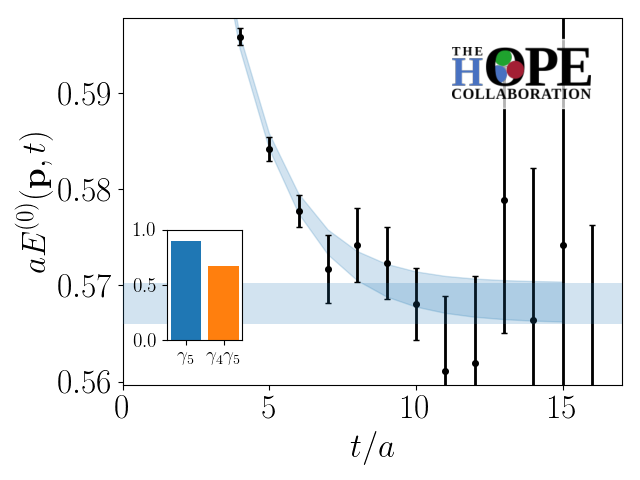
In order to implement the HOPE method, a standard spectroscopic analysis of the two-point correlator data obtained from the optimized interpolating operator is required. Fits to this data are performed following the algorithm outlined in Ref. [23]. In particular, fits are performed for a range of for fixed . A weighted average of these fits is then performed using the weighting procedure outlined in Ref. [24]. An example of this procedure is shown in Fig. 1.
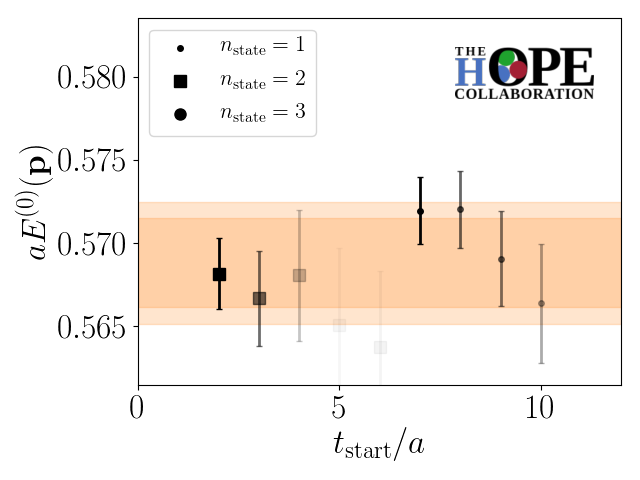
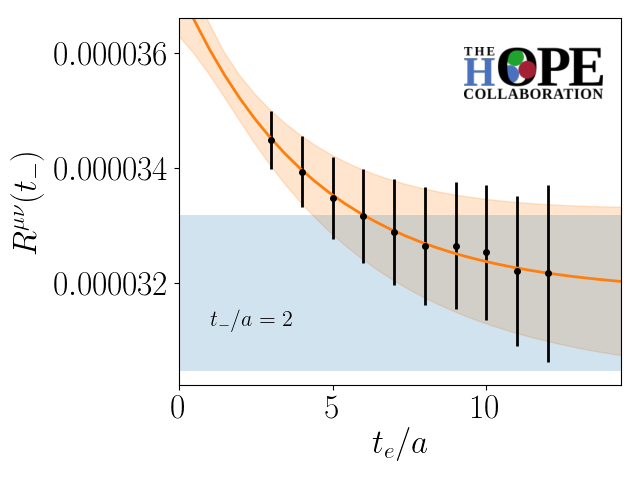
Having extracted a variational estimate of the required ground-state energy, it is now possible to construct the ratio in Eq. (11). By computing this matrix element for a range of on the ensemble, one can analyse the excited state contamination in the matrix element . This is demonstrated in Fig. 2. From this study it is possible to see that excited state contamination is small for . Since these three-point correlation functions require the use of the sequential source method, additional values require an approximately linear increase in the total computational cost. In this analysis, data was generated using corresponding to in physical units. The same distances in physical units were used for on the other gauge field ensembles.
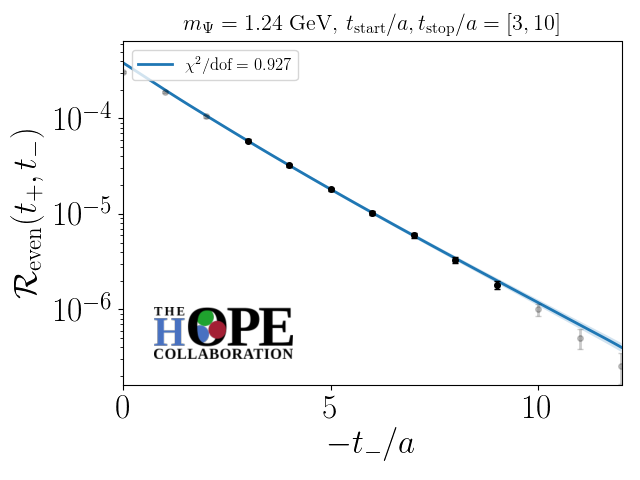
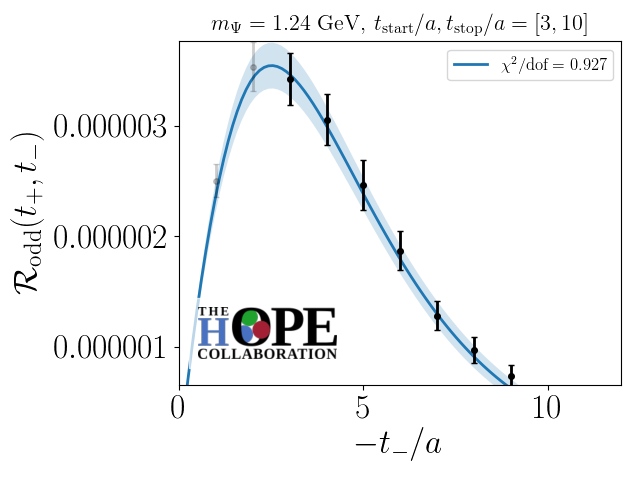
The resulting numerical calculation of Eq. (11) for with a heavy quark mass of is shown in Fig. (3). By fitting the Fourier transform of Eq. 4 truncated to include the second and fourth Mellin moments to this numerical data, information about the Mellin moments of the pion LCDA can be obtained. Since this fit is perfomed at finite lattice spacing, it is important to note that these results contain residual lattice artifacts, and may be contaminated with higher-twist contributions due to the truncation of the HOPE to the leading twist-two contribution only. In the next section, a combined continuum, twist-two extrapolation of the fitted lattice data will be described.
3.3 Continuum, Twist-Two Extrapolation
A combined continuum, twist-two extrapolation must be performed to connect the numerical data obtained in the previous section with the pion LCDA moments. The parameterization is [14]
| (17) |
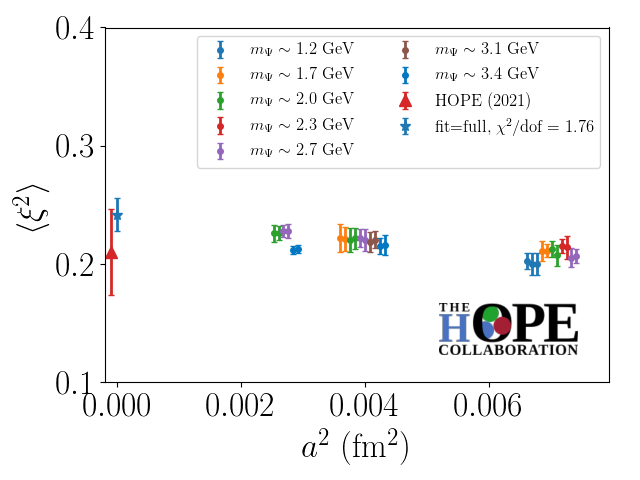
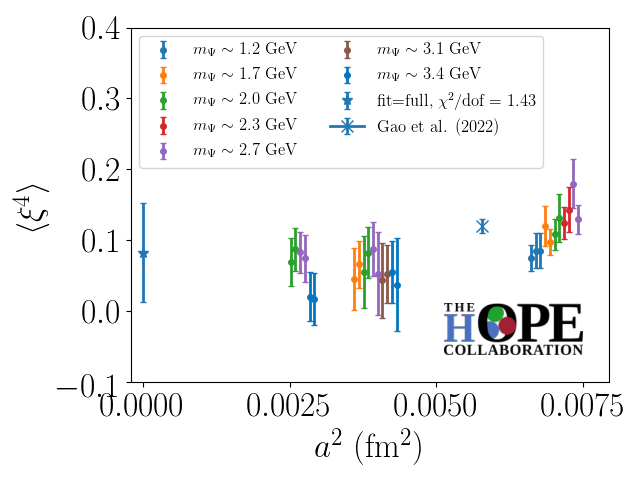
where , , and are dimensionless parameters fit to the numerical data, and the renormalization scale () dependence is given explicitly. Global fits to all ensembles and heavy quark masses are performed independently for the second and fourth moment data. The resulting combined continuum, twist-two extrapolated moments are shown in Fig. 4.
This analysis finds
| (18) | |||
| (19) |
in the quenched approximation with , where the quoted errors are purely statistical. The result for the second Mellin moment is in good agreement with the previous HOPE determination of the quantity using the same gauge field samples [14]. While the statistical uncertainty for the fourth Mellin moment is large, it is important to note that this preliminary analysis constitutes the first continuum limit determination of this quantity from LQCD. Data taking for this project is still in progress, with the aim of reducing the statistical errors in this combined continuum, twist-two extrapolation.
4 Conclusion
In this proceedings, progress towards a determination of the fourth Mellin moment of the pion LCDA using the HOPE method is presented. The current analysis used numerical results computed at three lattice spacings. Data on a fourth lattice spacing closer to the continuum limit is being computed. A combination of momentum smearing and the variational method is used to improve the overlap of the interpolating operator with the ground state pion and reduce excited state contamination. The resulting optimized interpolating operator is used to compute the hadronic matrix element appearing in the HOPE method. After fitting the HOPE to the numerical data, the resulting fit parameters are extrapolated to the continuum, twist-two limit, where they can be identified with the Mellin moments of the pion LCDA. As a result of this extrapolation, this report presents the first preliminary continuum limit determination of the fourth Mellin moment from LQCD.
Acknowledgments
The authors thank ASRock Rack Inc. for their support of the construction of an Intel Knights Landing cluster at National Yang Ming Chiao Tung University, where the numerical calculations were performed. Help from Balint Joo in tuning Chroma is acknowledged. We thank M. Endres for providing the ensembles of gauge field configurations used in this work. The authors thankfully acknowledge the computer resources at MareNostrum and the technical support provided by BSC (RES-FI-2023-1-0030). WD and AVG are supported by U.S. Department of Energy under grant Contract Numbers DE-SC0011090 and DE-SC0023116. WD is further supported by the National Science Foundation under Cooperative Agreement PHY-2019786 (The NSF AI Institute for Artificial Intelligence and Fundamental Interactions, http://iaifi.org/). AVG was additionally supported by the resources of the Fermi National Accelerator Laboratory (Fermilab), a U.S. Department of Energy, Office of Science, Office of High Energy Physics HEP User Facility. CJDL is supported by the Taiwanese NSTC grant number 112-2112-M-A49 -021 -MY3. RJP has been supported by project PID2020-118758GB-I00, financed by the Spanish MCIN/ AEI/10.13039/501100011033/. YZ is supported by the U.S. Department of Energy, Office of Science, Office of Nuclear Physics through Contract No. DE-AC02-06CH11357
References
- [1] G. Lepage and S.J. Brodsky, Exclusive Processes in Perturbative Quantum Chromodynamics, Phys. Rev. D 22 (1980) 2157.
- [2] U. Aglietti, M. Ciuchini, G. Corbo, E. Franco, G. Martinelli and L. Silvestrini, Model independent determination of the light cone wave functions for exclusive processes, Phys. Lett. B 441 (1998) 371 [hep-ph/9806277].
- [3] K.-F. Liu, Parton degrees of freedom from the path integral formalism, Phys. Rev. D 62 (2000) 074501 [hep-ph/9910306].
- [4] W. Detmold and C.-J.D. Lin, Deep-inelastic scattering and the operator product expansion in lattice QCD, Phys. Rev. D 73 (2006) 014501 [hep-lat/0507007].
- [5] V. Braun and D. Müller, Exclusive processes in position space and the pion distribution amplitude, Eur. Phys. J. C 55 (2008) 349 [0709.1348].
- [6] Z. Davoudi and M.J. Savage, Restoration of Rotational Symmetry in the Continuum Limit of Lattice Field Theories, Phys. Rev. D 86 (2012) 054505 [1204.4146].
- [7] X. Ji, Parton Physics on a Euclidean Lattice, Phys. Rev. Lett. 110 (2013) 262002 [1305.1539].
- [8] A. Chambers, R. Horsley, Y. Nakamura, H. Perlt, P. Rakow, G. Schierholz et al., Nucleon Structure Functions from Operator Product Expansion on the Lattice, Phys. Rev. Lett. 118 (2017) 242001 [1703.01153].
- [9] A. Radyushkin, Quasi-parton distribution functions, momentum distributions, and pseudo-parton distribution functions, Phys. Rev. D 96 (2017) 034025 [1705.01488].
- [10] Y.-Q. Ma and J.-W. Qiu, Exploring Partonic Structure of Hadrons Using ab initio Lattice QCD Calculations, Phys. Rev. Lett. 120 (2018) 022003 [1709.03018].
- [11] W. Detmold, I. Kanamori, C.-J.D. Lin, S. Mondal and Y. Zhao, Moments of pion distribution amplitude using operator product expansion on the lattice, PoS LATTICE2018 (2018) 106 [1810.12194].
- [12] HOPE collaboration, A Preliminary Determination of the Second Mellin Moment of the Pion’s Distribution Amplitude Using the Heavy Quark Operator Product Expansion, in Asia-Pacific Symposium for Lattice Field Theory, 9, 2020 [2009.09473].
- [13] HOPE collaboration, Parton physics from a heavy-quark operator product expansion: Formalism and Wilson coefficients, Phys. Rev. D 104 (2021) 074511 [2103.09529].
- [14] HOPE collaboration, Parton physics from a heavy-quark operator product expansion: Lattice QCD calculation of the second moment of the pion distribution amplitude, Phys. Rev. D 105 (2022) 034506 [2109.15241].
- [15] HOPE collaboration, Progress in the determination of Mellin moments of the pion LCDA using the HOPE method, PoS LATTICE2021 (2022) 488 [2111.14563].
- [16] X. Gao, A.D. Hanlon, N. Karthik, S. Mukherjee, P. Petreczky, P. Scior et al., Pion distribution amplitude at the physical point using the leading-twist expansion of the quasi-distribution-amplitude matrix element, Phys. Rev. D 106 (2022) 074505 [2206.04084].
- [17] R.G.L.C. Edwards and B.U.C. Joó, The chroma software system for lattice qcd, Nucl. Phys. Proc. Suppl. 140 (2005) 832 [hep-lat/0409003].
- [18] B. Joó, D.D. Kalamkar, T. Kurth, K. Vaidyanathan and A. Walden, Optimizing wilson-dirac operator and linear solvers for intel© knl, in High Performance Computing, M. Taufer, B. Mohr and J. Kunkel, eds., vol. 9945 of Lecture Notes in Computer Science, pp. 415–427, Springer (2016).
- [19] G.S. Bali, B. Lang, B.U. Musch and A. Schäfer, Novel quark smearing for hadrons with high momenta in lattice QCD, Phys. Rev. D 93 (2016) 094515 [1602.05525].
- [20] C. Michael and I. Teasdale, Extracting Glueball Masses From Lattice QCD, Nucl. Phys. B 215 (1983) 433.
- [21] M. Luscher and U. Wolff, How to Calculate the Elastic Scattering Matrix in Two-dimensional Quantum Field Theories by Numerical Simulation, Nucl. Phys. B 339 (1990) 222.
- [22] W. Detmold and M.G. Endres, Scaling properties of multiscale equilibration, Phys. Rev. D 97 (2018) 074507 [1801.06132].
- [23] S. Amarasinghe, R. Baghdadi, Z. Davoudi, W. Detmold, M. Illa, A. Parreno et al., Variational study of two-nucleon systems with lattice QCD, Phys. Rev. D 107 (2023) 094508 [2108.10835].
- [24] NPLQCD, QCDSF collaboration, Charged multihadron systems in lattice QCD+QED, Phys. Rev. D 103 (2021) 054504 [2003.12130].