LSST Cadence Optimization White Paper in Support of Observations of Unresolved Tidal Stellar Streams in Galaxies beyond the Local Group
Abstract
Deep observations of faint surface brightness stellar tidal streams in external galaxies with LSST are addressed in this White Paper contribution. We propose using the Wide–Fast–Deep survey that contains several nearby galaxies (at distances where the stars themselves are not resolved, i.e., beyond 20 Mpc). In the context of hierarchical galaxy formation, it is necessary to understand the prevalence and properties of tidal substructure around external galaxies based on integrated (i.e., unresolved) diffuse light. This requires collecting observations on much larger samples of galaxies than the Milky Way and M31. We will compare the observed structures to the predictions of cosmological models of galactic halo formation that inform us about the number and properties of streams around Milky Way-like galaxies. The insight gained from these comparisons will allow us to infer the properties of stream progenitors (masses, dynamics, metallicities, stellar populations). The changes in the host galaxies caused by the interactions with the dissolving companion galaxies will be another focus of our studies. We conclude by discussing synergies with WFIRST and Euclid, and also provide concrete suggestions for how the effects of scattered light could be minimized in LSST images to optimize the search for low surface brightness features, such as faint unresolved stellar tidal streams.
1 White Paper Information
Please contact Seppo Laine, Caltech/IPAC, seppo@ipac.caltech.edu, with any questions about this white paper.
This white paper addresses:
-
1.
Science Category: Milky Way Structure and Formation: Exploring the Faint Surface Brightness Universe.
-
2.
Survey Type Category: Wide–Fast–Deep Survey.
-
3.
Observing Strategy Category: Targeting areas of sky off the Galactic plane.
2 Scientific Motivation
Previous deep, wide-area photometric surveys have revealed a large number of faint stellar substructures (“streams”) around galaxies like the Milky Way (MW), resulting from the tidal disruption of lower-mass galaxies in “minor mergers” or previous major mergers. While detailed studies of resolved streams around the MW and M31 imply a dynamic hierarchical accretion history, consistent with CDM cosmological galaxy formation models (e.g., Bullock & Johnston, 2005; De Lucia & Helmi, 2008; Cooper et al., 2010, 2013; Pillepich, Madau, & Mayer, 2015; Rodríguez–Gómez et al., 2016), we need to study a much larger sample of galaxies to test whether the merging histories of MW and M31 are typical of galaxies in their mass range (e.g., Mutch, Croton, & Poole, 2011; Morales et al., 2018).
A crucial ingredient in testing whether the merging histories of the MW and M31 are typical (consistent with CDM cosmological galaxy formation models) is the acquisition of adequately deep images, as the majority of the predicted tidal stellar streams have surface brightnesses in the R-band fainter than about 29 AB mag arcsec-2. While a few deep imaging surveys of the outskirts of local galaxies have recently been completed (e.g., Tal et al., 2009; Martínez Delgado et al., 2010; Ludwig et al., 2012; Duc et al., 2015) or are ongoing (Abraham & van Dokkum, 2014), the majority of nearby galaxies have not been observed down to surface brightnesses needed to detect streams from ancient minor mergers.
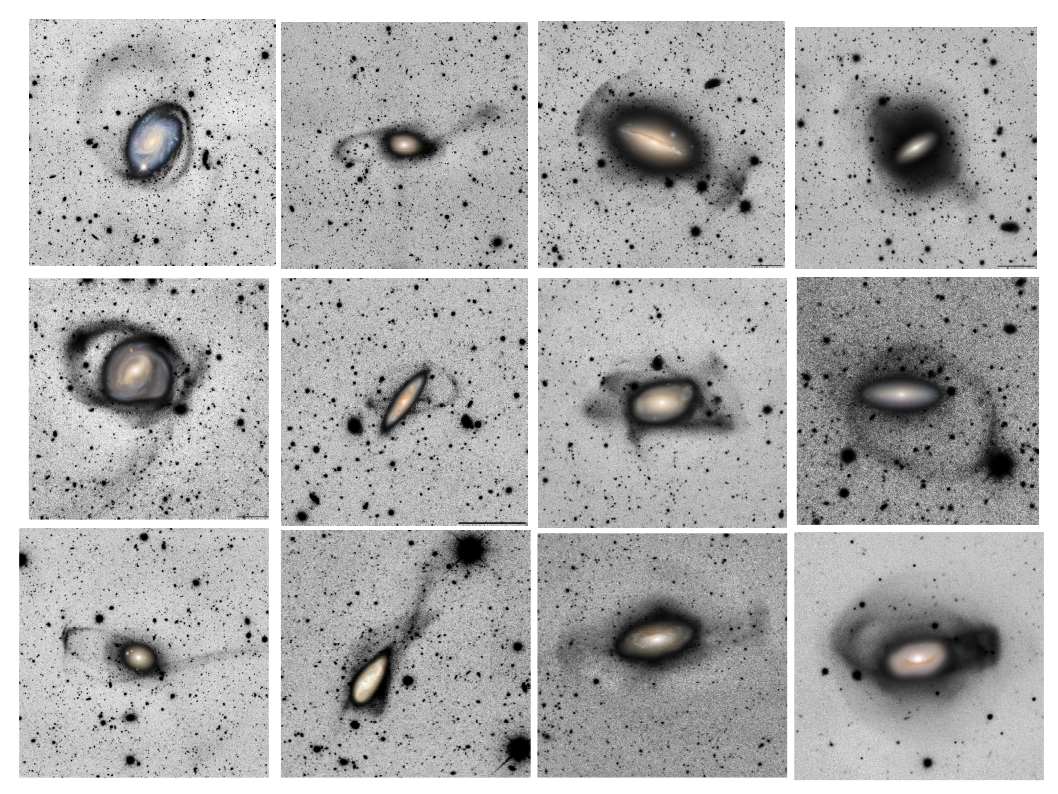
By focusing on nearby spiral galaxies with diffuse-light overdensities, more than 50 previously unknown stellar structures in galaxies at distances 80 Mpc have been discovered so far (Martínez-Delgado 2018). The morphologies of the diffuse-light structures include “great circle”-like (such as are seen around the Milky Way) streams that roughly trace the orbit of the merging satellite galaxy (Sanders & Binney, 2013), isolated shells, giant debris clouds, jet-like features, and large diffuse structures that may be old, phase mixed remnants of merged companions (see Figure 2 for examples). Again, very similar features are seen in cosmological simulations of minor mergers (Johnston et al., 2008; Cooper et al., 2010). Although it appears in many cases that the progenitor companion has been completely disrupted, a few examples (Martínez Delgado et al., 2012, 2015; Amorisco, 2015) show surviving cores of merging companion galaxies, often exhibiting long tails departing from the progenitor satellite.
One of the main objectives of a conceivable LSST stream survey among MW-like galaxies is the comparison of the observed frequency and the parameters of the streams, such as their spatial coherence, length, width, inclination, morphology, color and surface brightness to those seen in cosmological simulations. These models suggest that remnants from mergers 0–8 Gyrs ago are still visible as substructures in the halos of nearby galaxies. Information about the streams comes from 1) morphology of the low surface brightness emission, as Johnston et al. (2008, their Fig. 3) and Hendel & Johnston (2015) have shown that different morphologies of tidal debris occupy different regions in the accretion time vs. orbital eccentricity/energy plane; 2) the progenitor’s luminosity; 3) stellar population of the stream (to infer its stellar mass); 4) shape and width of the streams (to obtain the dynamical properties of the progenitors; Johnston et al., 2001; Erkal, Sanders & Belokurov, 2016); 5) color of the stream (to determine whether a minor or major merger was involved); 6) mass and morphological type of the host galaxy (to obtain the frequency of mergers); and 7) (combined with the previously listed information) surface brightness that can be used to time the epoch of the merger (and thus the rate at which new streams are being formed in the local Universe; Johnston et al., 2001).
The halos in the simulations of Bullock & Johnston (2005) typically have about two streams brighter than 30 AB mag arcsec-2. However, the majority of substructures are at surface brightnesses fainter than 30 AB mag arcsec-2. Our current inability to see the fainter streams (corresponding to either earlier merger epochs or lower mass progenitors) implies that currently the merger history that we study in galaxies beyond the Local Group is strongly biased towards the most recent (the last few tens of percent of mass accretion) and/or most massive minor merger events. Thus we are only sensitive to the most metal-rich populations, as validated by studies of resolved stars around M31 (McConnachie et al., 2018) and Cen A (Crnojević et al., 2016). Close to the center of a galaxy (Rproj 30 kpc) the substructure is most likely generated by the most massive merged satellite galaxies, as dynamical friction will have brought them quickly to the central regions. Therefore, our current view of tidal streams in nearby galaxies is highly biased towards the most massive minor mergers which are relatively rare for MW-like galaxies.
Studying the frequency, mass ratios and stellar populations of minor mergers with the help of stellar tidal streams in external galaxies will also provide critical input on a number of open astrophysical questions, such as 1) heating and thickening of the host galaxy disk by satellite mergers, including the frequency and impact of low orbital inclination satellites, most recently showcased by the Gaia-Enceladus galaxy remains in the MW (Helmi et al., 2018); 2) as discussed above, the hierarchical build-up of the primaries; 3) dark matter halo shapes, when combined with N-body simulations and 4) the fundamental nature of dark matter. Regarding this last point, there are alternative candidate particles to cold dark matter that are well motivated from particle physics and that result in radically different properties for astronomical objects on the small scales probed by stellar streams. One of the currently popular alternatives to CDM is sterile neutrinos with a mass of a few keV, which behave as warm dark matter (WDM). On the large scales probed by the cosmic microwave background and large-scale structure, they are indistinguishable from CDM. But on small scales they are very different. In particular, they require a cutoff in the mass function of dark matter halos on scales of about 109 M⊙ for particle masses of interest. It is likely that WDM models predict different properties for tidal stellar streams, although this is still to be verified with high-resolution simulations. Other particle models, such as certain types of self-interacting particles, also predict a cutoff in the halo mass function, which may also lead to differences in the properties of the streams.
The spectral energy distributions (SEDs) of the merged galaxies can be best studied by combining the LSST observations with data from near-IR wavelengths. WFIRST will provide a survey of several deep fields efficiently and will provide an ideal complementary data set near the peak of the stellar SED. The optical images from Euclid may also be useful. The combined LSST/Euclid/WFIRST data set will provide a broad wavelength baseline for the estimation of the ages, metallicities and masses of the stellar populations of disrupted companions, producing valuable constraints on the minor merging history in CDM models of hierarchical galaxy formation.
3 Technical Description
3.1 High-level description
Our project will be implemented in essentially three steps: 1) producing deep images from the Wide–Fast–Deep (WFD) survey with LSST and combining the data from WFIRST/Euclid; 2) searching systematically (both by visual inspection and by automatic detection algorithms trained by visual inspection detections) for tidal stellar streams in integrated light and quantifying their parameters and frequency, together with detection limits; and 3) quantitatively comparing the observations to results from cosmological simulations (mock images from the latter will be created, including realistic observational artifacts and systematic errors).
Detecting the faint streams requires dark-sky conditions and high precision calibration data (e.g., exquisite flat-field quality over a relatively large angular scale). More specifically, stellar streams are typically found at large galactocentric distances (15 kpc R 100 kpc, or farther) and could be found out to a significant portion of the virial radius of the parent galaxy (for the MW or M31, Rvirial 250 kpc). Thus, surveys for stellar debris must produce images over large angular scales (from 50′ for systems at 20 Mpc). Our requirement for resolving the widths of the streams is 200 pc (2′′ – 0.8′′ at 20 – 50 Mpc; the median seeing requirement for LSST is 0.7′′), as we are interested in studying streams left behind by dwarf galaxies (the globular cluster streams in our Galaxy are about 100 pc in width). However, in practice we need much higher resolution than 2 arcseconds as we need to resolve and mask out the background galaxies (complementary higher resolution WFIRST and Euclid observations, discussed later, will help). We also aim to locate the progenitor along the stream, if it has not been completely disrupted. The various bands of the LSST are needed to study color variations along the stream. The mean color of the stream will be calculated by averaging luminosities from the LSST bands that have sufficient depth. All color information will be used to constrain the spectral energy distribution and compared to those seen in cosmological simulations of streams. The deepest band can be used to set the apertures where the colors are measured. Finally, proper SED modeling can be done to derive stellar masses (marginalizing over the uncertainties in metallicity, dust and star formation history; e.g., Zibetti, Charlot, & Rix, 2009; Laine et al., 2016).
3.2 Sample
Because we are interested in nearby galaxies (streams at larger distances than usual can be imaged due to the smaller PSF core size of the LSST than in many past and current surveys), and isolated systems in order to exclude major interactions and mergers from our sample, we will use the data from the main WFD. We will select mostly galaxies that are “analogs to the MW.” This will help us to compare the upcoming detailed observations of the MW with LSST and Gaia with similar galaxies in the nearby Universe, allowing us to estimate whether the Milky Way is typical in its accretion history. Therefore, we will select galaxies with an absolute -band AB magnitude of or brighter. We will also select galaxies that are away from the Galactic plane, b 20∘, to avoid confusion with cirrus. While Galactic cirrus emission can be found in every direction around the MW, we will compare the LSST images of diffuse faint surface brightness emission to images from WISE, AKARI and IRAS (and Herschel, when available) around 100 microns to avoid misidentifying diffuse emission with cirrus (Mihos et al., 2017). We will also impose isolation criteria on our sample galaxies, such that isolated galaxies and galaxies in “fossil groups” are included (those where the difference between the brightest and second brightest members is larger than 2.5 mag inside a projected radius of 1 Mpc and Vgal Vneighbor 250 km s-1; Karachentsev et al. 2009).
Mock images made out of cosmological simulations will include realistic observational effects such as sky noise, flat-field uncertainties, and contamination from background and foreground objects for the comparison with LSST image stacks. The models include magneto-hydrodynamical simulations from the IllustrisTNG project (Weinberger et al., 2017; Pillepich et al., 2018) and the Copernicus Complexio (CoCo) cosmological N-body simulations (Hellwing et al., 2016).
3.3 Image depth
We target an image depth 29 AB mag arcsec-2. Expected sky brightness is 22 V AB mag arcsec-2.
3.4 Filter choice
A broad wavelength coverage from 0.3 to 1.1 m (LSST filters , , , , , ) is optimal for diagnostics of stellar populations. Our ability to obtain colors will be limited by the filter with the shallowest data we can use, and therefore we will focus on imaging. We plan to extend the wavelength coverage to 2 microns using WFIRST images in the areas where those data are available.
3.5 Ideal pointing
The whole WFD survey area outside the Galactic plane (b 20∘).
3.6 Exposure constraints
No constraint on exposure length. The proposed 215 sec visits should work well for a tidal stellar stream survey, as a large number of visits can be used to reject variable phenomena (both image artifacts and astrophysical events) from the images.
3.7 Other constraints
While low surface brightness observations can benefit from dithering and sky rotation to eliminate scattered light from the individual exposures, what really matters is the background subtraction. A local background will eliminate all extended LSB features. For NGVS (The Next Generation Virgo Cluster Survey) and MATLAS (Mass Assembly of early-Type GaLAxies with their fine Structures) the background was determined from either adjacent fields or images obtained with large offsets, larger than the size of the structure we want to probe. This allowed us to produce a large background image that could be subtracted from all individual ones. The gain was 2–3 mags with such a strategy, as it eliminates systematic effects in the camera. We want to make sure that the LSST will allow the subtraction of a large background area and that the pipeline will not eliminate what we are seeking.
Reflections and scattered light in the optical path are a real concern for deep wide-field surface photometry. While the LSST has spent significant effort to minimize scattered light, reflections from bright stars in the field can still contaminate images with extended diffuse halos of light. Worse yet, these reflections are not static; they move with respect to their parent star, depending on the position of the star in the optical beam. This means that static star subtraction models applied to stacked images will be insufficient to remove these features. Instead, active-subtraction techniques applied at the data reduction stage (e.g., Slater et al., 2009) must be used to deal with these reflections by modeling and removing them on a star-by-star basis from the individual raw image frames. This makes it imperative that LSST data servers provide users with the raw images, not just the image stacks.
3.8 Technical trades
We would prefer deeper observations at the expense of covering a smaller fraction of the sky, as our sample size is expected to be sufficient for statistically significant conclusions even in the case of reduced sample numbers compared to what was stated above.
The trade-off between the single visit exposure time and the number of visits is not relevant to the proposed science, unless the number of visits drops to ten or fewer, which is extremely unlikely.
The single visit limiting depth is not of concern to us either. The overall uniformity of depth over the survey field is more important. If this depth varies by factors of two or more, it is more difficult to obtain statistically significant conclusions for a large sample size.
It would be acceptable to drop the depth in two or three bands to substantially below the rest of the bands. We need at least three deep photometric bands (preferably spaced as far from each other in wavelength as possible) to perform meaningful estimates of the stellar populations in any detected streams.
3.9 Combining LSST data with WFIRST and Euclid
To obtain the most accurate possible determination of the stellar populations of the detected streams, we will combine the LSST images with images from WFIRST and Euclid. These will extend the coverage further into the near-infrared and produce more accurate determinations of the stellar populations, but the common survey areas are smaller than the LSST WFD survey (about 11,000 square degrees with Euclid and much smaller with WFIRST). Different possible scenarios of combining the data from these missions are under consideration, including pixel-matched measurement and separate measurements with native pixel size but over the exact same sky region.
4 Performance Evaluation
The most obvious heuristic is the total depth achieved during the survey which is directly related to the number of detections of low surface brightness streams in integrated light. Based on the deepest imaging observations ever taken, 8 hours on-source using the 10.4-meter Grant Telescopio de Canarias (GTC) telescope and with an average seeing of 0.8–0.9 arcseconds (Trujillo & Fliri, 2016), we have made an approximate estimate of the expected low surface brightness limit that the LSST can provide after the scheduled 825 visits to the same sky location. This corresponds to a total amount of time on source of 3.44h. The expected surface brightness limits will be (3; 1010 arcsec2 boxes): 29.9 (), 31.1 (), 30.6 (), 30.1 (), 28.7 () AB mag arcsec-2. Each visit that consists of 30 seconds on-source will correspond to the following limits (3): 26.6 (), 27.8 (), 27.3 (), 26.8 (), 25.4 () AB mag arcsec-2. If the WFD survey depth is increased by 10%, our total detection limit goes up only by 0.05 mag arcsec-2.
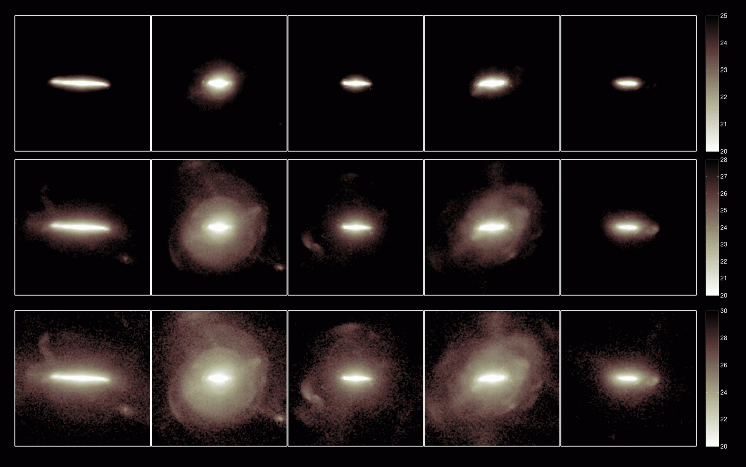
As suggested by the state-of-the art cosmological simulations (e.g., see Figure 1), these surface brightness limits would enable us to detect new stellar tidal streams in diffuse or integrated light around 80–90% of our sample of a few thousand galaxies out to several hundred Mpc. For obtaining stellar population diagnostics, we require at least a 5 detection in a minimum of three bands. We estimate that with the current WFD survey parameters we would be able to perform stellar population diagnostics in a few thousand stellar tidal stream systems in integrated light.
5 Special Data Processing
Obtaining quantitative information from measurements of low surface brightness emission requires reducing data in a completely different way from that of point source driven data. One requirement we impose on the data is that individual images should be made available, not just coadds, as scattered light is much easier to remove from individual frames than from image stacks. In addition to the removal of scattered light, there are several other considerations for low surface brightness measurements. While the LSST data reduction pipeline masks high surface brightness sources, the effects from these sources and bright stars can masquerade as low surface brightness emission because of the extended PSF. We propose to use software such as imfit (Erwin, 2015) to remove the stellar envelope from bright host galaxy emission by modeling the host galaxy surface brightness model assuming it is a simple Sersic profile.
We will also select images for the deepest image stacks based on sky brightness at the time of the observations, taking into account the vicinity (and phase) of the Moon to the observed area of the sky, as well as experiment with using all data, regardless of the Moon phase.
Another consideration for the detection of low surface brightness emission is stellar aureole (from ice particles in thin cirrus clouds in the atmosphere). We propose to develop techniques to remove this emission from the LSST images.
To estimate the limiting surface brightness in the image stacks, we intend to run simulations by injecting substructure into the simulated images to test recovery as a function of surface brightness.
Once the images have been reduced, and the erroneous sources of low surface brightness emission have been removed, we will use special techniques to detect tidal stellar streams in diffuse (or integrated) light, such as software adapted from HSC–SSP (Subaru Hyper Suprime-Cam Strategic Program; Kado–Fong et al., 2018). We will use adaptive smoothing techniques (similar to Zibetti, 2010), NoiseChisel and iterative unsharp masking techniques that separate structure in the image by spatial frequency. While we will inspect the images by eye to detect features, we will also develop algorithms for automatic detection and morphological classification of streams, which are expected to be available by the time LSST starts operations (c.f. Hendel et al., 2018).
Finally, we will perform an estimation of the limiting surface brightness (3) in the stacked images and will make the re-reduced stacked deep images available to the community as soon as the basic image reduction has been completed.
6 References
- Abraham & van Dokkum (2014) Abraham, R. G. & van Dokkum, P. G. 2014, PASP, 126, 55
- Amorisco (2015) Amorisco, N. C. 2015, MNRAS, 450, 575
- Bullock & Johnston (2005) Bullock, J. S. & Johnston, K. V. 2005, ApJ, 635, 931
- Cooper et al. (2010) Cooper, A. P., et al. 2010, MNRAS, 406, 744
- Cooper et al. (2013) Cooper, A. P., et al. 2013, MNRAS, 434, 3348
- Crnojević et al. (2016) Crnojević, D., et al. 2016, ApJ, 823, 19
- De Lucia & Helmi (2008) De Lucia, G. & Helmi, A. 2008, MNRAS, 391, 14
- Duc et al. (2015) Duc, P.–A., et al. 2015, MNRAS, 446, 120
- Erkal, Sanders & Belokurov (2016) Erkal, D., Sanders, J. L., Belokurov, V. 2016, MNRAS, 461, 1590
- Erwin (2015) Erwin, P. 2015, ApJ, 799, 226
- Grand et al. (2016) Grand, R.J.J. et al. 2017, MNRAS, 467, 179
- Hellwing et al. (2016) Hellwing, W. A., et al. 2016, MNRAS, 457, 3492
- Helmi et al. (2018) Helmi, A., et al. 2018, Nature, 563, 85
- Hendel & Johnston (2015) Hendel, D. & Johnston, K. V. 2015, MNRAS, 454, 2472
- Hendel et al. (2018) Hendel, D., et al. 2018, arXiV:1811:10613
- Johnston et al. (2001) Johnston, K. V., Sackett, P. D., Bullock, J. S. 2001, ApJ, 557, 137
- Johnston et al. (2008) Johnston, K. V., et al. 2008, ApJ, 689, 936
- Kado–Fong et al. (2018) Kado–Fong, E., et al. 2018, ApJ, 866, 103
- Karachentsev et al. (2009) Karachentsev, I. D., Kashibadze, O. G., Makarov, D. I., & Tully, R. B. 2009, MNRAS, 393, 1265
- Laine et al. (2016) Laine, S., et al. 2016, AJ, 152, 72
- Ludwig et al. (2012) Ludwig, J., Pasquali, A., Grebel, E. K., & Gallager, J. S. III 2012, AJ, 144, 190
- Martínez Delgado et al. (2010) Martínez–Delgado, D., et al. 2010, AJ, 140, 962
- Martínez Delgado et al. (2012) Martínez–Delgado, D., et al. 2012, ApJ, 748, 24
- Martínez Delgado et al. (2015) Martínez–Delgado, D., et al. 2015, AJ, 150, 116
- Martínez Delgado (2018) Martínez Delgado, D. 2018, in Highlights of the Spanish Astrophysics X, Montesinos, B., Asensio-Ramos, A., Buitrago, F., Schodel, R., Villaver, E., Peréz-Hoyos, S. (eds.), in press
- McConnachie et al. (2018) McConnachie, A. W., et al. 2018, ApJ, in press (arXiV:1810:08234)
- Mihos et al. (2017) Mihos, J. C., et al. 2018, ApJ, 834, 16
- Morales et al. (2018) Morales, G., et al. 2018, A&A, in press (arXiV:1804:03330)
- Mutch, Croton, & Poole (2011) Mutch, S. J., Croton, D. J., & Poole, G. B. 2011, ApJ, 736, 84
- Pillepich, Madau, & Mayer (2015) Pillepich, A., Madau, P, & Mayer, L. 2015, ApJ, 799, 184
- Pillepich et al. (2018) Pillepich, A., et al. 2018, MNRAS, 473, 4077
- Rodríguez–Gómez et al. (2016) Rodríguez–Gómez, V., et al. 2016, MNRAS, 458, 2371
- Sanders & Binney (2013) Sanders, J. L., & Binney, J. 2013, MNRAS, 433, 1826
- Slater et al. (2009) Slater, C. T., Harding, P., Mihos, J. C. 2009, PASP, 121, 1267
- Tal et al. (2009) Tal, T., van Dokkumn, P. G., Jenica, N., & Bezanson, R. 2009, AJ, 138, 1417
- Trujillo & Fliri (2016) Trujillo, I., & Fliri, J. 2016, ApJ, 823, 123
- Weinberger et al. (2017) Weinberger, R., et al. 2017, MNRAS, 465, 3291
- Zibetti (2010) Zibetti, S. 2010, Astrophysics Source Code Library, ascl:1010.024
- Zibetti, Charlot, & Rix (2009) Zibetti, S., Charlot, S., & Rix, H.–W. 2009, MNRAS, 400, 1181