Magnetic order, disorder, and excitations under pressure in the Mott insulator Sr2IrO4
Abstract
Protected by the interplay of on-site Coulomb interactions and spin-orbit coupling, Sr2IrO4 at high pressure is a rare example of a Mott insulator with a paramagnetic ground state. Here, using optical Raman scattering, we measure both the phonon and magnon evolution in Sr2IrO4 under pressure, and identify three different magnetically-ordered phases, culminating in a spin-disordered state beyond 18 GPa. A strong first-order structural phase transition drives the magnetic evolution at 10 GPa with reduced structural anisotropy in the IrO6 cages, leading to increasingly isotropic exchange interactions between the Heisenberg spins and a spin-flip transition to -axis-aligned antiferromagnetic order. In the disordered phase of Heisenberg pseudospins, the spin excitations are quasi-elastic and continuous to 10 meV, potentially hosting a gapless quantum spin liquid in Sr2IrO4.
Mott’s treatment of the metal-insulator transition [1] is a central pillar in the understanding of correlated-electron systems. In transition-metal compounds, electron correlations are governed by the on-site Coulomb potential , in relationship with other inter-atomic variables such as the hopping integral, super-exchange interactions, and crystal fields. The intra-atomic spin-orbit coupling is weak and can be treated in most cases as a perturbation [1, 2]. In and transition-metal compounds, the strong opens an extra dimension in parameter space. The interaction between and can lead to new states across insulating, magnetic, and topological phases [3].
Sr2IrO4 exhibits the characteristics of spin-orbit-coupling assisted “Mottness” [1, 3, 4, 5, 6]. The insulating state with pseudospins arises from a Coulomb splitting the half-filled upper band, which is created by the combined effect of crystal field and spin-orbit coupling [3, 4, 6]. The magnetic moments of the Ir4+ ions are well protected from many distortions of the local octahedral IrO6 cages (Fig. 1a), such as a tetragonal stretch in Sr2IrO4 [7], trigonal distortions in both Na2IrO3 [8] and Ir2O7 (=Gd, Sm, Eu, Nd, Pr) [9], and a triclinic distortion of the local coordinates in Sr3CuIrO6 [10]. Similarly, the measured staggered moment of Ir4+ is consistent across systems built on the IrO6 unit, ranging between [7, 8, 11, 12, 13] in the systems above, smaller than expected for a state [7, 8].
At ambient pressure, Sr2IrO4 is antiferromagnetic below K. Within each two-dimensional plane of IrO6 cages, magnetic moments arrange non-collinearly to form a wave vector; they also collectively tilt to form a small ferromagnetic component along either the - or -axis in the square lattice [7]. An additional wave vector of is formed by stacking the moments in each plane along the -axis in a “” pattern [4], leading to an overall wave vector [7]. To understand the underlying physics of the strongly-correlated electronic state, Sr2IrO4 has been examined under external tuning parameters such as chemical doping, pressure, and varying IrO6 plane stacking configurations in Sr3Ir2O7 [14, 15, 16, 17, 18, 19]. Both Sr3Ir2O7 [14] and Mn or Ru doped Sr2IrO4 [15, 16] are antiferromagnets with the Ir moments aligned parallel to the -axis, and insulators even in the paramagnetic phase [14, 15, 16]. Under pressure, the insulating phase in Sr2IrO4 and Sr3Ir2O7 persists to at least 185 and 104 GPa, respectively [17, 18]. By contrast, the antiferromagnetic order in Sr2IrO4 is likely suppressed at about 20 GPa [19]. The nature and the number of unique magnetic phases over this pressure range, and a full description of the transitions between them, have not been explored definitively.
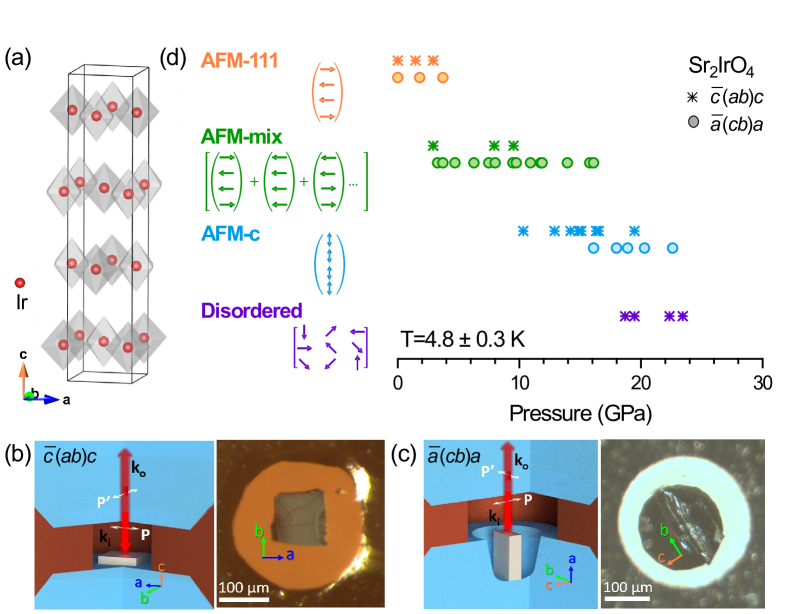
Both the insulating phase and an individual magnetic Ir4+ state in the IrO6 cage are protected by the intra-atomic and respectively, and are robust under pressure. By contrast, the antiferromagnetism is not protected and its specific forms are dependent on the detailed balance between various exchange interactions at the inter-atomic level. Here we employ high-pressure, optical Raman scattering [20] to probe simultaneously the evolution of the lattice and spin degrees of freedom, and their excitations, in Sr2IrO4, revealing four unique magnetic phases from ambient pressure to beyond 20 GPa (Fig.1), all connected through first-order phase transitions. At 10 GPa, a change of lattice symmetry from tetragonal to orthorhombic significantly reduces the anisotropy in the IrO6 cage and exchange anisotropy, as confirmed by magnetic Raman scattering. The increasingly Heisenberg-type spins flip to align antiferromagnetically along the -axis. In the high-pressure spin-disordered phase, we measure a broad spin excitation spectrum down to at least 9 cm-1 in the low temperature limit. A high-pressure paramagnetic ground state of Heisenberg pseudospins in the presence of a Mott gap serve as necessary conditions for a quantum spin liquid, and our bounding of spin excitations to energies below 1.1 meV constrains the nature of the paramagnetic state with regards to the potential quantum order.
To fully access the phonon and magnon modes, our Raman instrument was built to measure inelastic energies down to 9 cm-1 at K and above 20 GPa in two different sample configurations [20]. Phonon Raman spectra are measured in the and configurations, with and indicating incident and scattered laser directions in a backscattering geometry to the sample coordinate and parallel to the sample surface normal (Fig. 1). and represent circularly polarized (for incident) and unpolarized (for detected) photons, respectively. For magnetic Raman scattering (Fig. 2), the polarizations of the incident and scattered light are kept orthogonal, in and , enhancing the magnon cross section relative to the inelastic charge background. We frequently checked the configuration under pressure and noticed no alteration of the observed magnon modes.
The ambient pressure Raman phonon spectra in both configurations (Fig. 3a) reveal four , one , and two modes (189, 278, 337, 395, 495, 562, and 692 cm-1) that are consistent with Ref. [21]. We attribute two others (240 and 718 cm-1) to modes [21, 22] where a polarization component along the -axis is included (Fig. 3a). Both the and the scattering configurations identify a single magnon mode at 19-20 cm-1 at ambient pressure (Fig. 2), with otherwise featureless spectra between 9 cm-1 and the mode at 189 cm-1.
From 0 to 24 GPa, we observe distinctive spectroscopic signatures of four magnetic ground states (Fig. 2), all connected through first-order phase transitions with large coexistence regions. The ambient pressure order persists to GPa, indicated by a single magnon at 20 cm-1 (Figs. 2a-2d).
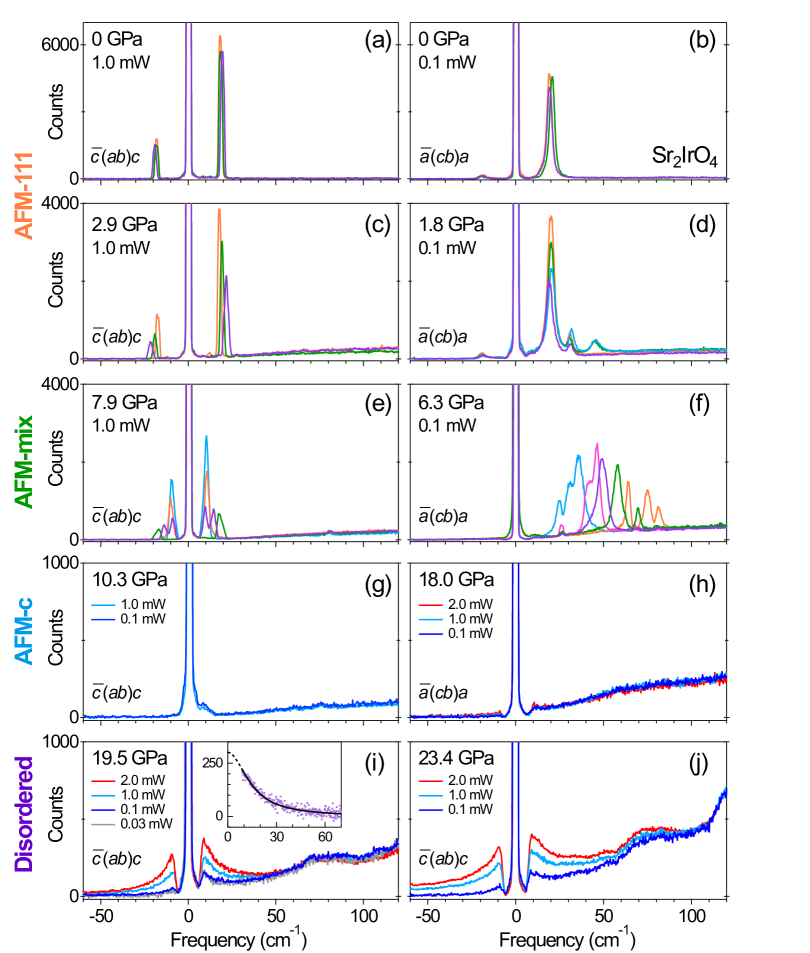
Between 3 to GPa, variations in the magnon spectra emerge, with distinctions between the and configurations and spatial variation across the sample surface. The magnon spectra typically exhibit two peaks at 10-14 cm-1 and 18-20 cm-1, respectively (Fig. 2e), with varying intensity ratios at different sample surface spots, indicating intrinsically different volumes. Previous Raman measurements of Sr2IrO4 in the configuration with a 0.5 T magnetic field in the - plane demonstrate a single magnon peak at 10-12 cm-1 [23], indicative of a -axis stacking pattern of “” [4]. While the 20 cm-1 magnon represents the “” stacking pattern along the -axis, our observation points to a coexistence of the “” and “” phases. Furthermore, magnon spectra in the configuration demonstrate both the spatial inhomogeneity with different profiles across the sample surface and collective spectral weight covering the range between 20 and 80 cm-1 (Fig. 2f). While magnon spectra are sensitive signatures of underlying antiferromagnetic order, the large variety, with an overall broad and continuous distribution of magnon energies, indicates that this AFM-mix phase features many types of -axis stacking patterns such as “”, “”, and “” [5], with spatially varying domain composition. The sharp peak profiles of Raman scattering, even at the upper limit of 16.1 GPa 111See Supplementary Materials., signify that these stackings are thermodynamic phases with finite correlation lengths along the -axis. Recent resonant x-ray diffraction measurements under pressure [19] suggest that the Ir spins remain confined to the - plane and order antiferromagnetically within each IrO6 layer. The layers experience a crossover from “” to “” stacking as pressure increases. Our results instead suggest a heterogeneous phase coexistence of many distinct, but energetically close stacking configurations exist for GPa. Our magnetic Raman scattering clarifies the ambiguity in Ref. [19] with regard to the extent of both the phase region and the distinctive types of antiferromagnetic order present.
When the pressure reaches above 10 GPa, the magnon spectra in Sr2IrO4 start to disappear in strongly first-order fashion from the Raman sensitive region above 9 cm-1 for both the and configurations (Figs. 2g-2h). Despite the absence of low-wavenumber features in this pressure range, the magnetic moments remain ordered in Sr2IrO4. This is supported by the temperature-independent Raman spectra from 8 to 25 K, set by different incident laser powers of 0.1 to 2.0 mW to locally heat the scattering volume (Figs. 2g-2h). The measured Raman spectra are identical when normalized by the total flux of incident photons, in sharp contrast to the temperature dependence of spectra in the disordered phase (see below).
The featureless low-wavenumber Raman spectra (Figs. 2g-2h) appear simultaneously with changes in the Raman lattice modes, mainly a split of the mode at 395 cm-1 to a double-peak profile with a significantly-reduced intensity across the pressure phase boundary (Figs. 3b-3c). This strong correlation is observed both for a single spot on the sample surface at different pressures (Figs. 3b-3c) and in several different spots across the sample surface at the same pressure [24]. The peak splitting and intensity collapsing behavior of this mode was also observed at 300 K and 42 GPa in Refs. [18, 25], and correlated with a reduction to two-fold symmetry within the - plane in an orthorhombic structure [18]. Here, the tetragonal-orthorhombic structural phase boundary moves from 42 GPa at 300 K to 10 GPa at 5 K.
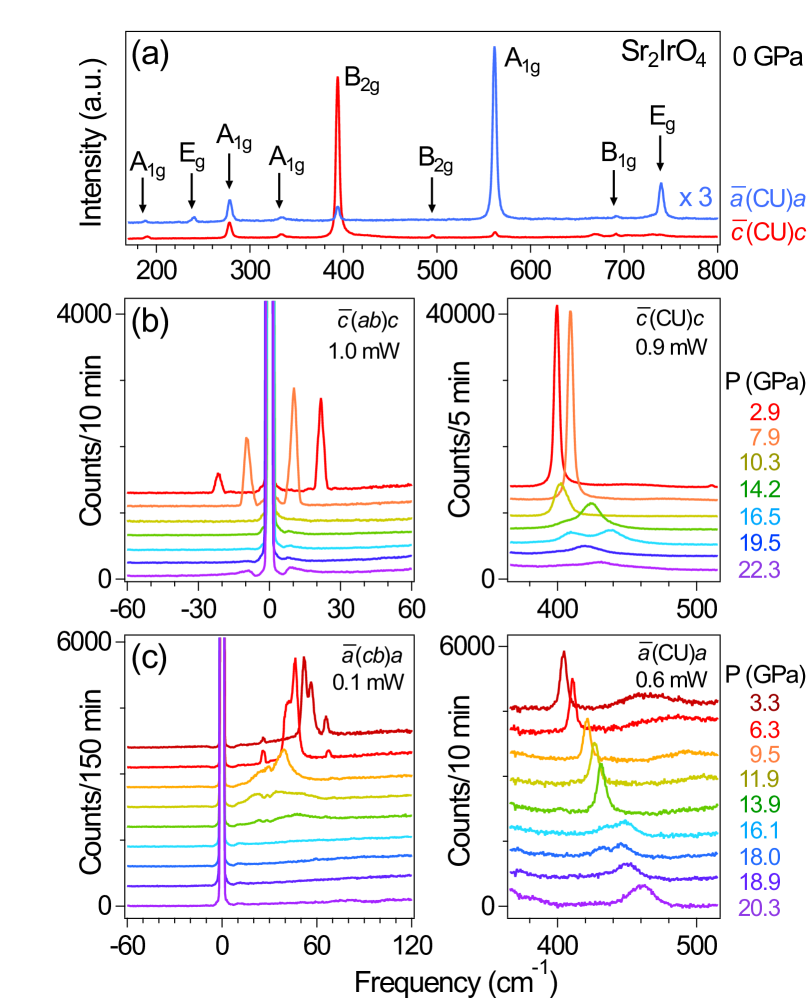
The new set of phonon and magnon Raman spectra suggests a new type of spin order above 10 GPa. Ref. [19] has stated an absence of (1, 0, odd) magnetic reflections to rule out a spin-flip transition to a -axis collinear antiferromagnetic state. However, both raw data and integrated intensities in Figs. 1e and 1g of Ref. [19] demonstrate a significantly-reduced, but still finite amount of (1, 0, odd) and (1, 0, even) reflections between 10 and 18 GPa. Ref. [19] attributed it to a volumetric suppression of the low-pressure antiferromagnetic “” and “” orders, but left the magnetic state in the majority volume unexplained. We argue that the strong reduction in magnetic diffraction intensities is indicative of the bulk volume experiencing a spin flip transition.
Previously, a difference of over two orders of magnitude was reported between resonant x-ray magnetic diffraction intensities of Sr2IrO4 and Sr3Ir2O7 at ambient pressure [14], which was attributed to a reduction of the structure factor between staggered moments aligning either within the - plane or the -axis. The same argument can be applied to the observed intensity reduction in Sr2IrO4 at 10 GPa [19]. Ref. [19] does not include an x-ray polarization analysis, which is technically feasible under pressure [9, 26], to definitively verify a spin-flip transition [16]. The existence of comparable intensities of the (1, 0, odd) and (1, 0, even) reflections between 10-18 GPa in Ref. [19] is similar to the diffraction patterns of -axis-aligned antiferromagnet Sr3Ir2O7 at ambient pressure [14], suggesting that the AFM-c phase have multiple stacking patterns [14, 15, 16], analogous to the AFM-mix phase (Fig. 1d).
Microscopically, the spin-flip process in Sr2IrO4 is related to the IrO6 cage distortion. At ambient pressure, the Ir-O bonds in Sr2IrO4 are 3.7% longer along the -axis than those within the - plane [7]. Under pressure, Sr2IrO4 has an anisotropic compressibility between the - plane and the -axis [18]. While is less compressible than and both below and above the orthorhombic structural transition, at the transition (42 GPa and 300 K) it collapses by 9.0%, whereas expands by % and stays constant [18, 25]. This results in a substantial reduction in the and ratios and hence a reduced Ir-O bond length anisotropy. In Sr3Ir2O7, the Ir-O bond length anisotropy is only 2.3% [11], small enough that the single-magnon mode is not observed in Raman scattering for the -axis aligned spins. The 19 cm-1 one-magnon peak also disappears at ambient pressure in a Sr2IrO4 crystal grown in a magnetic field [27]. Study of its antiferromagnetic order could provide a potential comparison, along with optical Raman studies of the -axis spin-order in Mn- and Ru-doped Sr2IrO4 [15, 16].
Above 18.5 GPa, a disordered spin phase appears, characterized by a continuous Raman excitation spectrum (Figs. 2i-2j) from the lower boundary of instrumental sensitivity at 9 cm-1 to as high as 90 cm-1. This inelastic excitation is commonly described as quasi-elastic scattering (QES), and is facilitated by increasing temperature. With clear spatial inhomogeneity across the sample surface, QES only exists in the high-pressure phase where the antiferromagnetic order in Sr2IrO4 is fully suppressed. Using incident laser power to adjust the local sample temperature and the QES intensity, the spectral difference of QES between two temperatures is fit to a Lorentzian form (Fig. 2i inset), indicative of fluctuations [28, 29, 30]. The half-width-at-half-maximum of QES remains large (15 cm-1) and temperature independent. QES at this energy scale has been observed for magnetic excitations in FePS3 [31], SrCu2(BO3)2 [29], and a variety of quantum spin liquid candidates [30], and at thermal structural phase transition in KH2PO4 [32]. QES in Sr2IrO4 exists only on the high-pressure side of the phase transition, and persists throughout the measured pressure range from 18.6 to 23.4 GPa (Figs. 2i-2j). Furthermore, the sample temperature of 25 K with 2 mW laser heating is still much lower than the Debye temperature. All these suggest that the QES is not driven by mechanisms specific to a phase transition and softened phonon modes [28], but by magnetic fluctuations in the spin-disordered phase.
Although the lattice structure and phonon Raman modes are different between Sr2IrO4 and La2CuO4, the Cu and Ir sublattices are similar, so their magnon spectra are expected to be determined by the same Hamiltonian with different parameter values. The spin Hamiltonian is often expressed as [33, 23, 34, 35]: The first summation describes interactions between spins within a two-dimensional plane, where the dominant isotropic Heisenberg exchange is modified by anisotropic Ising spin exchange and Dzyaloshinskii-Moriya (DM) interactions ( and , respectively). The last term sums over isotropic Heisenberg interactions between spin pairs on neighboring layers. We neglect additional anisotropic interactions in the Hamiltonian, such as anisotropic interlayer, dipolar, and Jahn-Teller spin-lattice types.
At ambient pressure, inelastic neutron scattering identified in La2CuO4 two magnon gaps of 1-2 and 3-5 meV at the zone center and an overall energy scale meV [34, 36]. The magnon gaps were attributed to a DM interaction and an anisotropic exchange interaction , respectively. Optical Raman measurements reveal a single magnon at 17-20 cm-1 in both La2CuO4 and Sr2IrO4 at low temperature, zero field, and ambient pressure [21, 23, 35]. While this mode was identified with the DM anisotropy in La2CuO4 [35, 36], the large difference in between Ir and Cu (0.4-0.6 and 0.01 eV [37]) prevents the 20 cm-1 magnon in Sr2IrO4 from being attributed to DM interactions, but instead the anisotropic exchange . With the magnon band gap at the zone center [33, 36], a gap size of 20 cm-1 would lead to meV in Sr2IrO4 at ambient pressure, similar to that in La2CuO4 [36].
With K and meV at ambient pressure [37], and the absence of QES in ordered phases under pressure, Sr2IrO4 demonstrates a low level of spin frustration. Below 10 GPa, the exchange anisotropy is expected to increase as the ratio increases with pressure until the orthorhombic structural transition [18]. This explains the observed magnon energies reaching as high as 80 cm-1(Fig. 2f). However, hydrostatic pressure generally reduces the anisotropy in lattice compressibility [38]. In the AFM-c state, the reduced IrO6 cage distortion result in a more isotropic local environment and the Ir4+ ions approach the full rotational degrees of freedom of Heisenberg spins. The reduced anisotropy diminishes the energy of the zone-center magnon mode, possibly to below the energy sensitivity of Raman scattering.
Raman scattering’s sensitivity to inelastic energies of 1.1 meV is comparable to the energy sensitivity of inelastic neutron scattering measurements [39, 40]. While magnetic exchange interactions and gapped, discrete dispersion relationships at energies less than 1 meV are well documented [40], the continuous spectral weight above 9 cm-1 in Figs. 2i-2j and the Lorentzian form suggest that the QES in Sr2IrO4 extends below 9 cm-1 and the observed spin excitations could be gapless in zero magnetic field. This reflects the reduced exchange anisotropy entering the ordered AFM-c phase continues to higher pressure. A single IrO6 layer in Sr2IrO4 could be mapped onto a model of Heisenberg spins on a two-dimensional square lattice, leading to a quantum spin liquid with SU(2) gauge structure and a gapped excitation spectrum [19], and the broad pressure range of observed QES response can support the necessary stability of a quantum spin liquid. Nevertheless, optical Raman techniques only verify inelastic energy dispersion at . While our high-pressure Raman scattering provides a strong upper bound on the gap size and could indicate a gapless scenario, dispositive experimental evidence for a quantum spin liquid awaits additional characterization. For that, neutron or x-ray experiments measuring the complete inelastic spectrum over the entire Brillouin zone are necessary.
Acknowledgements.
Acknowledgments: We thank G. Stenning and D. Nye for help with the instruments in the Materials Characterisation Laboratory at the ISIS Neutron and Muon Source. Y.F. acknowledges support from the Okinawa Institute of Science and Technology Graduate University, with subsidy funding from the Cabinet Office, Government of Japan. X.L., D.M.S., and T.F.R. acknowledge support from AFOSR Grant No. FA9550-20-1-0263. D.H. acknowledges support from DOE Grant No. DE-SC0010533. F.B. was supported by the Swiss National Science Foundation. A.d.l.T. acknowledges support from the Swiss National Science Foundation through an Early Postdoc Mobility Fellowship (P2GEP2_165044).References
- Mott [1949] N. F. Mott, Proceedings of the Physical Society. Section A 62, 416 (1949).
- Si et al. [2009] Q. Si, E. Abrahams, J. Dai, and J.-X. Zhu, New J. Phys. 11, 045001 (2009).
- Witczak-Krempa et al. [2014] W. Witczak-Krempa, G. Chen, Y. B. Kim, and L. Balents, Annu. Rev. Condens. Matter Phys. 5, 57 (2014).
- Kim et al. [2009] B. J. Kim, H. Ohsumi, T. Komesu, S. Sakai, T. Morita, H. Takagi, and T. Arima, Science 323, 1329 (2009).
- Di Matteo and Norman [2016] S. Di Matteo and M. R. Norman, Phys. Rev. B 94, 075148 (2016).
- Phillips et al. [2020] P. W. Phillips, L. Yeo, and E. W. Huang, Nat. Phys. 16, 1175 (2020).
- Ye et al. [2013] F. Ye, S. Chi, B. C. Chakoumakos, J. A. Fernandez-Baca, T. Qi, and G. Cao, Phys. Rev. B 87, 140406 (2013).
- Ye et al. [2012] F. Ye, S. Chi, H. Cao, B. C. Chakoumakos, J. A. Fernandez-Baca, R. Custelcean, T. F. Qi, O. B. Korneta, and G. Cao, Phys. Rev. B 85, 180403 (2012).
- Wang et al. [2020] Y. Wang, T. F. Rosenbaum, D. Prabhakaran, A. T. Boothroyd, and Y. Feng, Phys. Rev. B 101, 220404 (2020).
- Liu et al. [2012] X. Liu, V. M. Katukuri, L. Hozoi, W.-G. Yin, M. P. M. Dean, M. H. Upton, J. Kim, D. Casa, A. Said, T. Gog, T. F. Qi, G. Cao, A. M. Tsvelik, J. van den Brink, and J. P. Hill, Phys. Rev. Lett. 109, 157401 (2012).
- Cao et al. [2002] G. Cao, Y. Xin, C. S. Alexander, J. E. Crow, P. Schlottmann, M. K. Crawford, R. L. Harlow, and W. Marshall, Phys. Rev. B 66, 214412 (2002).
- Guo et al. [2016] H. Guo, C. Ritter, and A. C. Komarek, Phys. Rev. B 94, 161102 (2016).
- Asih et al. [2017] R. Asih, N. Adam, S. S. Mohd-Tajudin, D. P. Sari, K. Matsuhira, H. Guo, M. Wakeshima, Y. Hinatsu, T. Nakano, Y. Nozue, S. Sulaiman, M. I. Mohamed-Ibrahim, P. K. Biswas, and I. Watanabe, J. Phys. Soc. Jpn. 86, 024705 (2017).
- Fujiyama et al. [2012] S. Fujiyama, K. Ohashi, H. Ohsumi, K. Sugimoto, T. Takayama, T. Komesu, M. Takata, T. Arima, and H. Takagi, Phys. Rev. B 86, 174414 (2012).
- Calder et al. [2012] S. Calder, G.-X. Cao, M. D. Lumsden, J. W. Kim, Z. Gai, B. C. Sales, D. Mandrus, and A. D. Christianson, Phys. Rev. B 86, 220403 (2012).
- Calder et al. [2015] S. Calder, J. W. Kim, G.-X. Cao, C. Cantoni, A. F. May, H. B. Cao, A. A. Aczel, M. Matsuda, Y. Choi, D. Haskel, B. C. Sales, D. Mandrus, M. D. Lumsden, and A. D. Christianson, Phys. Rev. B 92, 165128 (2015).
- Zocco et al. [2014] D. A. Zocco, J. J. Hamlin, B. D. White, B. J. Kim, J. R. Jeffries, S. T. Weir, Y. K. Vohra, J. W. Allen, and M. B. Maple, J. Phys.: Condens. Matter 26, 255603 (2014).
- Chen et al. [2020] C. Chen, Y. Zhou, X. Chen, T. Han, C. An, Y. Zhou, Y. Yuan, B. Zhang, S. Wang, R. Zhang, L. Zhang, C. Zhang, Z. Yang, L. E. DeLong, and G. Cao, Phys. Rev. B 101, 144102 (2020).
- Haskel et al. [2020] D. Haskel, G. Fabbris, J. H. Kim, L. S. I. Veiga, J. R. L. Mardegan, C. A. Escanhoela, S. Chikara, V. Struzhkin, T. Senthil, B. J. Kim, G. Cao, and J.-W. Kim, Phys. Rev. Lett. 124, 067201 (2020).
- Li et al. [2020] X. Li, S. E. Cooper, A. Krishnadas, D. M. Silevitch, T. F. Rosenbaum, and Y. Feng, Rev. Sci. Instrum. 91, 113902 (2020).
- Gretarsson et al. [2017] H. Gretarsson, J. Sauceda, N. H. Sung, M. Höppner, M. Minola, B. J. Kim, B. Keimer, and M. Le Tacon, Phys. Rev. B 96, 115138 (2017).
- Cetin et al. [2012] M. F. Cetin, P. Lemmens, V. Gnezdilov, D. Wulferding, D. Menzel, T. Takayama, K. Ohashi, and H. Takagi, Phys. Rev. B 85, 195148 (2012).
- Gim et al. [2016] Y. Gim, A. Sethi, Q. Zhao, J. F. Mitchell, G. Cao, and S. L. Cooper, Phys. Rev. B 93, 024405 (2016).
- Note [1] See Supplementary Materials.
- Samanta et al. [2018] K. Samanta, F. M. Ardito, N. M. Souza-Neto, and E. Granado, Phys. Rev. B 98, 094101 (2018).
- Wang et al. [2019] Y. Wang, T. F. Rosenbaum, and Y. Feng, IUCrJ 6, 507 (2019).
- Cao et al. [2020] G. Cao, H. Zhao, B. Hu, N. Pellatz, D. Reznik, P. Schlottmann, and I. Kimchi, npj Quantum Mater. 5, 83 (2020).
- Fleury and Lyons [1983] P. A. Fleury and K. B. Lyons, Ferroelectrics 52, 3 (1983).
- Lemmens et al. [2000] P. Lemmens, M. Grove, M. Fischer, G. Güntherodt, V. N. Kotov, H. Kageyama, K. Onizuka, and Y. Ueda, Phys. Rev. Lett. 85, 2605 (2000).
- Wulferding et al. [2020] D. Wulferding, Y. Choi, W. Lee, and K.-Y. Choi, J. Phys.: Condens. Matter 32, 043001 (2020).
- Sekine et al. [1990] T. Sekine, M. Jouanne, C. Julien, and M. Balkanski, Phys. Rev. B 42, 8382 (1990).
- Kaminow and Damen [1968] I. P. Kaminow and T. C. Damen, Phys. Rev. Lett. 20, 1105 (1968).
- Hayes and Loudon [1978] W. Hayes and R. Loudon, Scattering of Light by Crystals (Wiley, New York, 1978).
- Keimer et al. [1993] B. Keimer, R. J. Birgeneau, A. Cassanho, Y. Endoh, M. Greven, M. A. Kastner, and G. Shirane, Z. Phys. B 91, 373 (1993).
- Gozar et al. [2004] A. Gozar, B. S. Dennis, G. Blumberg, S. Komiya, and Y. Ando, Phys. Rev. Lett. 93, 027001 (2004).
- Peters et al. [1988] C. J. Peters, R. J. Birgeneau, M. A. Kastner, H. Yoshizawa, Y. Endoh, J. Tranquada, G. Shirane, Y. Hidaka, M. Oda, M. Suzuki, and T. Murakami, Phys. Rev. B 37, 9761 (1988).
- Kim et al. [2012] J. Kim, D. Casa, M. H. Upton, T. Gog, Y.-J. Kim, J. F. Mitchell, M. van Veenendaal, M. Daghofer, J. van den Brink, G. Khaliullin, and B. J. Kim, Phys. Rev. Lett. 108, 177003 (2012).
- Feng et al. [2012] Y. Feng, J. Wang, R. Jaramillo, J. van Wezel, S. Haravifard, G. Srajer, Y. Liu, Z. A. Xu, P. B. Littlewood, and T. F. Rosenbaum, Proc. Natl. Acad. Sci. USA 109, 7224 (2012).
- Kajimoto et al. [2019] R. Kajimoto, T. Yokoo, M. Nakamura, Y. Kawakita, M. Matsuura, H. Endo, H. Seto, S. Itoh, K. Nakajima, and S. Ohira-Kawamura, Physica B 562, 148 (2019).
- Savici et al. [2009] A. T. Savici, G. E. Granroth, C. L. Broholm, D. M. Pajerowski, C. M. Brown, D. R. Talham, M. W. Meisel, K. P. Schmidt, G. S. Uhrig, and S. E. Nagler, Phys. Rev. B 80, 094411 (2009).