M. Ablikim1, M. N. Achasov10,c, P. Adlarson67, S. Ahmed15, M. Albrecht4, R. Aliberti28, A. Amoroso66A,66C, M. R. An32, Q. An63,49, X. H. Bai57, Y. Bai48, O. Bakina29, R. Baldini Ferroli23A, I. Balossino24A, Y. Ban38,k, K. Begzsuren26, N. Berger28, M. Bertani23A, D. Bettoni24A, F. Bianchi66A,66C, J. Bloms60, A. Bortone66A,66C, I. Boyko29, R. A. Briere5, H. Cai68, X. Cai1,49, A. Calcaterra23A, G. F. Cao1,54, N. Cao1,54, S. A. Cetin53A, J. F. Chang1,49, W. L. Chang1,54, G. Chelkov29,b, D. Y. Chen6, G. Chen1, H. S. Chen1,54, M. L. Chen1,49, S. J. Chen35, X. R. Chen25, Y. B. Chen1,49, Z. J Chen20,l, W. S. Cheng66C, G. Cibinetto24A, F. Cossio66C, X. F. Cui36, H. L. Dai1,49, X. C. Dai1,54, A. Dbeyssi15, R. E. de Boer4, D. Dedovich29, Z. Y. Deng1, A. Denig28, I. Denysenko29, M. Destefanis66A,66C, F. De Mori66A,66C, Y. Ding33, C. Dong36, J. Dong1,49, L. Y. Dong1,54, M. Y. Dong1,49,54, X. Dong68, S. X. Du71, Y. L. Fan68, J. Fang1,49, S. S. Fang1,54, Y. Fang1, R. Farinelli24A, L. Fava66B,66C, F. Feldbauer4, G. Felici23A, C. Q. Feng63,49, J. H. Feng50, M. Fritsch4, C. D. Fu1, Y. Gao63,49, Y. Gao38,k, Y. Gao64, Y. G. Gao6, I. Garzia24A,24B, P. T. Ge68, C. Geng50, E. M. Gersabeck58, A Gilman61, K. Goetzen11, L. Gong33, W. X. Gong1,49, W. Gradl28, M. Greco66A,66C, L. M. Gu35, M. H. Gu1,49, S. Gu2, Y. T. Gu13, C. Y Guan1,54, A. Q. Guo22, L. B. Guo34, R. P. Guo40, Y. P. Guo9,h, A. Guskov29, T. T. Han41, W. Y. Han32, X. Q. Hao16, F. A. Harris56, N Hüsken22,28, K. L. He1,54, F. H. Heinsius4, C. H. Heinz28, T. Held4, Y. K. Heng1,49,54, C. Herold51, M. Himmelreich11,f, T. Holtmann4, Y. R. Hou54, Z. L. Hou1, H. M. Hu1,54, J. F. Hu47,m, T. Hu1,49,54, Y. Hu1, G. S. Huang63,49, L. Q. Huang64, X. T. Huang41, Y. P. Huang1, Z. Huang38,k, T. Hussain65, W. Ikegami Andersson67, W. Imoehl22, M. Irshad63,49, S. Jaeger4, S. Janchiv26,j, Q. Ji1, Q. P. Ji16, X. B. Ji1,54, X. L. Ji1,49, Y. Y. Ji41, H. B. Jiang41, X. S. Jiang1,49,54, J. B. Jiao41, Z. Jiao18, S. Jin35, Y. Jin57, T. Johansson67, N. Kalantar-Nayestanaki55, X. S. Kang33, R. Kappert55, M. Kavatsyuk55, B. C. Ke43,1, I. K. Keshk4, A. Khoukaz60, P. Kiese28, R. Kiuchi1, R. Kliemt11, L. Koch30, O. B. Kolcu53A,e, B. Kopf4, M. Kuemmel4, M. Kuessner4, A. Kupsc67, M. G. Kurth1,54, W. Kühn30, J. J. Lane58, J. S. Lange30, P. Larin15, A. Lavania21, L. Lavezzi66A,66C, Z. H. Lei63,49, H. Leithoff28, M. Lellmann28, T. Lenz28, C. Li39, C. H. Li32, Cheng Li63,49, D. M. Li71, F. Li1,49, G. Li1, H. Li63,49, H. Li43, H. B. Li1,54, H. J. Li16, J. L. Li41, J. Q. Li4, J. S. Li50, Ke Li1, L. K. Li1, Lei Li3, P. R. Li31, S. Y. Li52, W. D. Li1,54, W. G. Li1, X. H. Li63,49, X. L. Li41, Xiaoyu Li1,54, Z. Y. Li50, H. Liang1,54, H. Liang63,49, H. Liang27, Y. F. Liang45, Y. T. Liang25, G. R. Liao12, L. Z. Liao1,54, J. Libby21, C. X. Lin50, B. J. Liu1, C. X. Liu1, D. Liu63,49, F. H. Liu44, Fang Liu1, Feng Liu6, H. B. Liu13, H. M. Liu1,54, Huanhuan Liu1, Huihui Liu17, J. B. Liu63,49, J. L. Liu64, J. Y. Liu1,54, K. Liu1, K. Y. Liu33, Ke Liu6, L. Liu63,49, M. H. Liu9,h, P. L. Liu1, Q. Liu54, Q. Liu68, S. B. Liu63,49, Shuai Liu46, T. Liu1,54, W. M. Liu63,49, X. Liu31, Y. Liu31, Y. B. Liu36, Z. A. Liu1,49,54, Z. Q. Liu41, X. C. Lou1,49,54, F. X. Lu50, H. J. Lu18, J. D. Lu1,54, J. G. Lu1,49, X. L. Lu1, Y. Lu1, Y. P. Lu1,49, C. L. Luo34, M. X. Luo70, P. W. Luo50, T. Luo9,h, X. L. Luo1,49, X. R. Lyu54, F. C. Ma33, H. L. Ma1, L. L. Ma41, M. M. Ma1,54, Q. M. Ma1, R. Q. Ma1,54, R. T. Ma54, X. X. Ma1,54, X. Y. Ma1,49, F. E. Maas15, M. Maggiora66A,66C, S. Maldaner4, S. Malde61, Q. A. Malik65, A. Mangoni23B, Y. J. Mao38,k, Z. P. Mao1, S. Marcello66A,66C, Z. X. Meng57, J. G. Messchendorp55, G. Mezzadri24A, T. J. Min35, R. E. Mitchell22, X. H. Mo1,49,54, Y. J. Mo6, N. Yu. Muchnoi10,c, H. Muramatsu59, S. Nakhoul11,f, Y. Nefedov29, F. Nerling11,f, I. B. Nikolaev10,c, Z. Ning1,49, S. Nisar8,i, S. L. Olsen54, Q. Ouyang1,49,54, S. Pacetti23B,23C, X. Pan9,h, Y. Pan58, A. Pathak1, P. Patteri23A, M. Pelizaeus4, H. P. Peng63,49, K. Peters11,f, J. Pettersson67, J. L. Ping34, R. G. Ping1,54, R. Poling59, V. Prasad63,49, H. Qi63,49, H. R. Qi52, K. H. Qi25, M. Qi35, T. Y. Qi9, T. Y. Qi2, S. Qian1,49, W. B. Qian54, Z. Qian50, C. F. Qiao54, L. Q. Qin12, X. P. Qin9, X. S. Qin41, Z. H. Qin1,49, J. F. Qiu1, S. Q. Qu36, K. H. Rashid65, K. Ravindran21, C. F. Redmer28, A. Rivetti66C, V. Rodin55, M. Rolo66C, G. Rong1,54, Ch. Rosner15, M. Rump60, H. S. Sang63, A. Sarantsev29,d, Y. Schelhaas28, C. Schnier4, K. Schoenning67, M. Scodeggio24A,24B, D. C. Shan46, W. Shan19, X. Y. Shan63,49, J. F. Shangguan46, M. Shao63,49, C. P. Shen9, P. X. Shen36, X. Y. Shen1,54, H. C. Shi63,49, R. S. Shi1,54, X. Shi1,49, X. D Shi63,49, J. J. Song41, W. M. Song27,1, Y. X. Song38,k, S. Sosio66A,66C, S. Spataro66A,66C, K. X. Su68, P. P. Su46, F. F. Sui41, G. X. Sun1, H. K. Sun1, J. F. Sun16, L. Sun68, S. S. Sun1,54, T. Sun1,54, W. Y. Sun34, W. Y. Sun27, X Sun20,l, Y. J. Sun63,49, Y. K. Sun63,49, Y. Z. Sun1, Z. T. Sun1, Y. H. Tan68, Y. X. Tan63,49, C. J. Tang45, G. Y. Tang1, J. Tang50, J. X. Teng63,49, V. Thoren67, W. H. Tian43, Y. T. Tian25, I. Uman53B, B. Wang1, C. W. Wang35, D. Y. Wang38,k, H. J. Wang31, H. P. Wang1,54, K. Wang1,49, L. L. Wang1, M. Wang41, M. Z. Wang38,k, Meng Wang1,54, T. Wang12, W. Wang50, W. H. Wang68, W. P. Wang63,49, X. Wang38,k, X. F. Wang31, X. L. Wang9,h, Y. Wang50, Y. Wang63,49, Y. D. Wang37, Y. F. Wang1,49,54, Y. Q. Wang1, Y. Y. Wang31, Z. Wang1,49, Z. Y. Wang1, Ziyi Wang54, Zongyuan Wang1,54, D. H. Wei12, F. Weidner60, S. P. Wen1, D. J. White58, U. Wiedner4, G. Wilkinson61, M. Wolke67, L. Wollenberg4, J. F. Wu1,54, L. H. Wu1, L. J. Wu1,54, X. Wu9,h, Z. Wu1,49, L. Xia63,49, H. Xiao9,h, S. Y. Xiao1, Z. J. Xiao34, X. H. Xie38,k, Y. G. Xie1,49, Y. H. Xie6, T. Y. Xing1,54, G. F. Xu1, Q. J. Xu14, W. Xu1,54, X. P. Xu46, Y. C. Xu54, F. Yan9,h, L. Yan9,h, W. B. Yan63,49, W. C. Yan71, Xu Yan46, H. J. Yang42,g, H. X. Yang1, L. Yang43, S. L. Yang54, Y. X. Yang12, Yifan Yang1,54, Zhi Yang25, M. Ye1,49, M. H. Ye7, J. H. Yin1, Z. Y. You50, B. X. Yu1,49,54, C. X. Yu36, G. Yu1,54, J. S. Yu20,l, T. Yu64, C. Z. Yuan1,54, L. Yuan2, X. Q. Yuan38,k, Y. Yuan1, Z. Y. Yuan50, C. X. Yue32, A. Yuncu53A,a, A. A. Zafar65, Y. Zeng20,l, B. X. Zhang1, Guangyi Zhang16, H. Zhang63, H. H. Zhang50, H. H. Zhang27, H. Y. Zhang1,49, J. J. Zhang43, J. L. Zhang69, J. Q. Zhang34, J. W. Zhang1,49,54, J. Y. Zhang1, J. Z. Zhang1,54, Jianyu Zhang1,54, Jiawei Zhang1,54, L. M. Zhang52, L. Q. Zhang50, Lei Zhang35, S. Zhang50, S. F. Zhang35, Shulei Zhang20,l, X. D. Zhang37, X. Y. Zhang41, Y. Zhang61, Y. H. Zhang1,49, Y. T. Zhang63,49, Yan Zhang63,49, Yao Zhang1, Yi Zhang9,h, Z. H. Zhang6, Z. Y. Zhang68, G. Zhao1, J. Zhao32, J. Y. Zhao1,54, J. Z. Zhao1,49, Lei Zhao63,49, Ling Zhao1, M. G. Zhao36, Q. Zhao1, S. J. Zhao71, Y. B. Zhao1,49, Y. X. Zhao25, Z. G. Zhao63,49, A. Zhemchugov29,b, B. Zheng64, J. P. Zheng1,49, Y. Zheng38,k, Y. H. Zheng54, B. Zhong34, C. Zhong64, L. P. Zhou1,54, Q. Zhou1,54, X. Zhou68, X. K. Zhou54, X. R. Zhou63,49, X. Y. Zhou32, A. N. Zhu1,54, J. Zhu36, K. Zhu1, K. J. Zhu1,49,54, S. H. Zhu62, T. J. Zhu69, W. J. Zhu9,h, W. J. Zhu36, Y. C. Zhu63,49, Z. A. Zhu1,54, B. S. Zou1, J. H. Zou1
(BESIII Collaboration)
1 Institute of High Energy Physics, Beijing 100049, People’s Republic of China
2 Beihang University, Beijing 100191, People’s Republic of China
3 Beijing Institute of Petrochemical Technology, Beijing 102617, People’s Republic of China
4 Bochum Ruhr-University, D-44780 Bochum, Germany
5 Carnegie Mellon University, Pittsburgh, Pennsylvania 15213, USA
6 Central China Normal University, Wuhan 430079, People’s Republic of China
7 China Center of Advanced Science and Technology, Beijing 100190, People’s Republic of China
8 COMSATS University Islamabad, Lahore Campus, Defence Road, Off Raiwind Road, 54000 Lahore, Pakistan
9 Fudan University, Shanghai 200443, People’s Republic of China
10 G.I. Budker Institute of Nuclear Physics SB RAS (BINP), Novosibirsk 630090, Russia
11 GSI Helmholtzcentre for Heavy Ion Research GmbH, D-64291 Darmstadt, Germany
12 Guangxi Normal University, Guilin 541004, People’s Republic of China
13 Guangxi University, Nanning 530004, People’s Republic of China
14 Hangzhou Normal University, Hangzhou 310036, People’s Republic of China
15 Helmholtz Institute Mainz, Staudinger Weg 18, D-55099 Mainz, Germany
16 Henan Normal University, Xinxiang 453007, People’s Republic of China
17 Henan University of Science and Technology, Luoyang 471003, People’s Republic of China
18 Huangshan College, Huangshan 245000, People’s Republic of China
19 Hunan Normal University, Changsha 410081, People’s Republic of China
20 Hunan University, Changsha 410082, People’s Republic of China
21 Indian Institute of Technology Madras, Chennai 600036, India
22 Indiana University, Bloomington, Indiana 47405, USA
23 INFN Laboratori Nazionali di Frascati , (A)INFN Laboratori Nazionali di Frascati, I-00044, Frascati, Italy; (B)INFN Sezione di Perugia, I-06100, Perugia, Italy; (C)University of Perugia, I-06100, Perugia, Italy
24 INFN Sezione di Ferrara, (A)INFN Sezione di Ferrara, I-44122, Ferrara, Italy; (B)University of Ferrara, I-44122, Ferrara, Italy
25 Institute of Modern Physics, Lanzhou 730000, People’s Republic of China
26 Institute of Physics and Technology, Peace Ave. 54B, Ulaanbaatar 13330, Mongolia
27 Jilin University, Changchun 130012, People’s Republic of China
28 Johannes Gutenberg University of Mainz, Johann-Joachim-Becher-Weg 45, D-55099 Mainz, Germany
29 Joint Institute for Nuclear Research, 141980 Dubna, Moscow region, Russia
30 Justus-Liebig-Universitaet Giessen, II. Physikalisches Institut, Heinrich-Buff-Ring 16, D-35392 Giessen, Germany
31 Lanzhou University, Lanzhou 730000, People’s Republic of China
32 Liaoning Normal University, Dalian 116029, People’s Republic of China
33 Liaoning University, Shenyang 110036, People’s Republic of China
34 Nanjing Normal University, Nanjing 210023, People’s Republic of China
35 Nanjing University, Nanjing 210093, People’s Republic of China
36 Nankai University, Tianjin 300071, People’s Republic of China
37 North China Electric Power University, Beijing 102206, People’s Republic of China
38 Peking University, Beijing 100871, People’s Republic of China
39 Qufu Normal University, Qufu 273165, People’s Republic of China
40 Shandong Normal University, Jinan 250014, People’s Republic of China
41 Shandong University, Jinan 250100, People’s Republic of China
42 Shanghai Jiao Tong University, Shanghai 200240, People’s Republic of China
43 Shanxi Normal University, Linfen 041004, People’s Republic of China
44 Shanxi University, Taiyuan 030006, People’s Republic of China
45 Sichuan University, Chengdu 610064, People’s Republic of China
46 Soochow University, Suzhou 215006, People’s Republic of China
47 South China Normal University, Guangzhou 510006, People’s Republic of China
48 Southeast University, Nanjing 211100, People’s Republic of China
49 State Key Laboratory of Particle Detection and Electronics, Beijing 100049, Hefei 230026, People’s Republic of China
50 Sun Yat-Sen University, Guangzhou 510275, People’s Republic of China
51 Suranaree University of Technology, University Avenue 111, Nakhon Ratchasima 30000, Thailand
52 Tsinghua University, Beijing 100084, People’s Republic of China
53 Turkish Accelerator Center Particle Factory Group, (A)Istanbul Bilgi University, 34060 Eyup, Istanbul, Turkey; (B)Near East University, Nicosia, North Cyprus, Mersin 10, Turkey
54 University of Chinese Academy of Sciences, Beijing 100049, People’s Republic of China
55 University of Groningen, NL-9747 AA Groningen, The Netherlands
56 University of Hawaii, Honolulu, Hawaii 96822, USA
57 University of Jinan, Jinan 250022, People’s Republic of China
58 University of Manchester, Oxford Road, Manchester, M13 9PL, United Kingdom
59 University of Minnesota, Minneapolis, Minnesota 55455, USA
60 University of Muenster, Wilhelm-Klemm-Str. 9, 48149 Muenster, Germany
61 University of Oxford, Keble Rd, Oxford, UK OX13RH
62 University of Science and Technology Liaoning, Anshan 114051, People’s Republic of China
63 University of Science and Technology of China, Hefei 230026, People’s Republic of China
64 University of South China, Hengyang 421001, People’s Republic of China
65 University of the Punjab, Lahore-54590, Pakistan
66 University of Turin and INFN, (A)University of Turin, I-10125, Turin, Italy; (B)University of Eastern Piedmont, I-15121, Alessandria, Italy; (C)INFN, I-10125, Turin, Italy
67 Uppsala University, Box 516, SE-75120 Uppsala, Sweden
68 Wuhan University, Wuhan 430072, People’s Republic of China
69 Xinyang Normal University, Xinyang 464000, People’s Republic of China
70 Zhejiang University, Hangzhou 310027, People’s Republic of China
71 Zhengzhou University, Zhengzhou 450001, People’s Republic of China
a Also at Bogazici University, 34342 Istanbul, Turkey
b Also at the Moscow Institute of Physics and Technology, Moscow 141700, Russia
c Also at the Novosibirsk State University, Novosibirsk, 630090, Russia
d Also at the NRC ”Kurchatov Institute”, PNPI, 188300, Gatchina, Russia
e Also at Istanbul Arel University, 34295 Istanbul, Turkey
f Also at Goethe University Frankfurt, 60323 Frankfurt am Main, Germany
g Also at Key Laboratory for Particle Physics, Astrophysics and Cosmology, Ministry of Education; Shanghai Key Laboratory for Particle Physics and Cosmology; Institute of Nuclear and Particle Physics, Shanghai 200240, People’s Republic of China
h Also at Key Laboratory of Nuclear Physics and Ion-beam Application (MOE) and Institute of Modern Physics, Fudan University, Shanghai 200443, People’s Republic of China
i Also at Harvard University, Department of Physics, Cambridge, MA, 02138, USA
j Currently at: Institute of Physics and Technology, Peace Ave.54B, Ulaanbaatar 13330, Mongolia
k Also at State Key Laboratory of Nuclear Physics and Technology, Peking University, Beijing 100871, People’s Republic of China
l School of Physics and Electronics, Hunan University, Changsha 410082, China
m Also at Guangdong Provincial Key Laboratory of Nuclear Science, Institute of Quantum Matter, South China Normal University, Guangzhou 510006, China
Abstract
Based on events collected with the
BESIII detector at BEPCII, the branching fraction of the isospin
violating decay
is measured to be , where the first uncertainty is statistical, the second is
systematic, and the third is the uncertainty arising from
interference with the continuum. This result is significantly
smaller than the measurement based on CLEO-c data sets. The decays
are measured via
, and the branching fractions
are determined to be
,
,
, where the third uncertainties are
systematic due to the branching fractions.
pacs:
Valid PACS appear here
††preprint: APS/123-QED
I Introduction
Experimental studies of charmonium decays are essential for
understanding the structures and decay mechanisms of charmonium states.
These measurements enable tests of non-perturbative Quantum Chromodynamics (QCD) models. Further, charmonium decays to baryon pairs
provide a novel method to explore the properties of
baryons a3 ; polarization . In recent years, there have been
searches for missing decays and measurements of angular distributions
and polarizations of many and two-body decays
to baryon and anti-baryon final states with much improved precision by
the CLEO, BESII, and BESIII
collaborations CLEO-measurement ; BES-measurement1 ; BES-measurement2 ; BES-measurement3 ; BESIII-measurement1 ; BESIII-measurement2 ; BESIII-measurement3 ; 1803.02039 ; 1907.13041 ; 1911.06669 ; 2004.07701 ; 2007.03679 .
In addition, these measurements also provide the possibility to
determine the relative phase between strong and electro-magnetic
amplitudes a4 .
In spite of the significant improvements achieved on
and decays into baryon pairs, information
on isospin symmetry breaking decays is still limited due to their low
decay rates. Recently, a measurement of the
isospin violating decay
is reported and obtained a
branching fraction of
based on decay events collected with CLEO-c detector a2 . This result is much larger than theoretical predictions a4 , and a specific mechanism is proposed by the authors of Ferroli:2020xnv to explain its abnormal largeness.
In our analysis, we use a sample of
events collected at BESIII to measure
the branching fraction of , with , .
With the same final states, we can also study the
pair decay from the P-wave charmonium
states, which are produced via a radiative transition from
the . Using events
collected in BESIII previously reported the branching-fraction
measurements of
and Beschicj .
II Detector and Monte Carlo simulation
The BESIII detector Ablikim:2009aa records symmetric collisions
provided by the BEPCII storage ring Yu:IPAC2016-TUYA01 , which operates with a peak luminosity of cm-2s-1
in the center-of-mass energy range from 2.0 to 4.7 GeV.
BESIII has collected large data samples in this energy region Ablikim:2019hff . The cylindrical core of the BESIII detector covers 93% of the full solid angle and consists of a helium-based multilayer drift chamber (MDC), a plastic scintillator time-of-flight
system (TOF), and a CsI(Tl) electromagnetic calorimeter (EMC),
which are all enclosed in a superconducting solenoidal magnet
providing a 1.0 T magnetic field. The solenoid is supported by an
octagonal flux-return yoke with resistive plate counter muon
identification modules interleaved with steel.
The acceptance of charged particles and photons is 93% of the 4 solid angle.
The charged-particle momentum resolution at is
, and the resolution is for electrons
from Bhabha scattering. The EMC measures photon energies with a
resolution of () at GeV in the barrel (end cap)
region. The time resolution in the TOF barrel region is 68 ps, while
that in the end cap region is 110 ps.
Simulated Monte Carlo (MC) samples produced with geant4-based geant4 software, which includes the geometric
description of the BESIII detector and the detector response, are used
to determine detection efficiencies, estimate background
contributions, and study systematic uncertainties. The simulation models
the beam energy spread and initial state radiation (ISR) in the
annihilations with the generator kkmcref:kkmc . The inclusive MC sample simulates every possible process, who includes the production of the resonance, the ISR production of the
, and the continuum processes incorporated in kkmcref:kkmc . The known decay modes are modeled with evtgenref:evtgen using branching fractions taken from the
Particle Data Group PDG , and the remaining unknown charmonium
decays are modeled with lundcharmref:lundcharm . Final
state radiation (FSR) from charged particles is
incorporated using photosphotos . For the
signal processes, we use MC samples of
decays generated
with uniform phase space (PHSP), while
decays are generated according
to helicity amplitudes angleUncer and with PHSP.
III
III.1 Event selection
Since the final state of interest is we require each candidate to contain four
charged tracks with zero net charge, and at least one photon. Each charged
track, detected in the MDC is required to satisfy
, where is defined with respect to the
-axis, which is the symmetry axis of the MDC. The distance of
closest approach to the interaction point (IP) must be less than
30 cm along the -axis, and less than 10 cm in the transverse
plane. Pions and protons are identified by the magnitude of their
momentum, and charged tracks with momentum larger than 0.7
in the lab frame are identified as protons. Other
tracks are identified as pions. An isolated cluster in the EMC is
considered to be a photon if the following requirements are satisfied:
1) the deposited energy of each shower must be more than 25 MeV in the
barrel region () and more than 50 MeV in the
end cap region (); 2) to suppress
electronic noise and showers unrelated to the event, the difference
between the EMC time and the event start time is required to be within
(0, 700) ns; 3) to exclude showers that originate from charged
tracks, the angle between the position of each shower in the EMC and
the closest extrapolated charged track of or
must be greater than 10 degrees, and greater than 20 degrees for the
track.
The candidate is reconstructed with any
combination satisfying a secondary vertex
fit secondvertex . The secondary vertex fit is required to be
successful, but no additional requirements are placed on the fit
. To improve the momentum and energy resolution and to
reduce background contributions, a six-constraint (6C) kinematic fit
is applied to the event candidates with constraints on the total
four-momentum and the invariant masses of the
and candidates. The of the kinematic
fit is required to be less than 25.
To further suppress background, we require: 1) the
for the hypothesis is less than those
for any or hypothesis: ,
; 2) the (
lifetime must satisfy
where and are the decay length and its
uncertainty obtained from the secondary vertex fit; 3) the invariant
mass of the , is
required to be greater than 3.48 in order to
suppress the background; 4) and are required to suppress
background from .
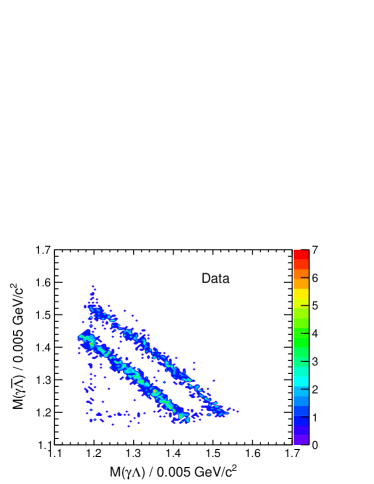
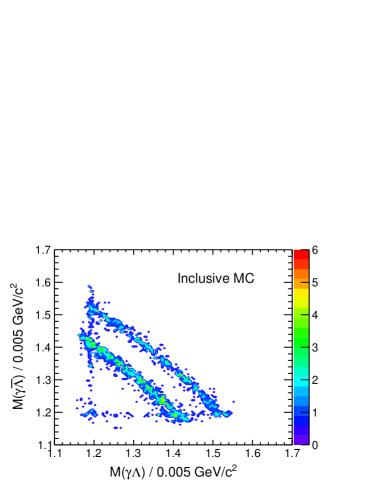
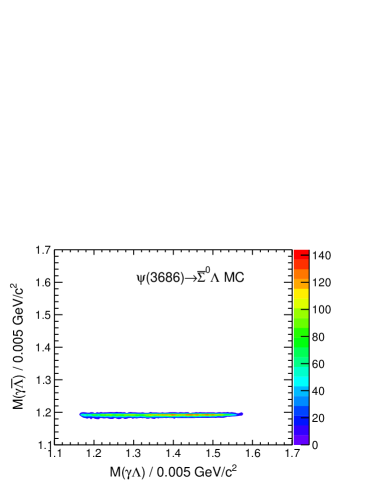
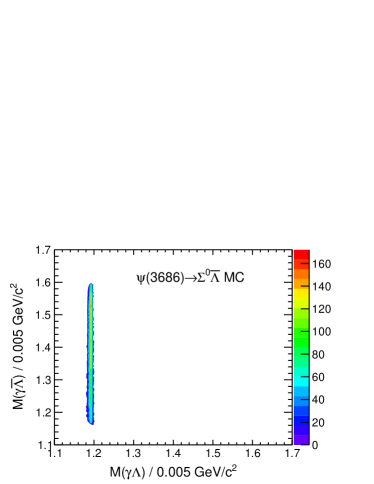
After imposing the above requirements, Fig. 1 shows the
scatter plots of versus for data, inclusive MC samples, and signal MC samples
of and
processes. The signals are clearly visible in Fig. 1 (a). The two
sloped bands are backgrounds from , which are
well simulated by the inclusive MC samples as shown in
Fig. 1 (b). The inclusive MC indicates that the only
peaking background is from . Figures 1 (c) and (d) are the signal shapes of
and
, which are vertical and
horizonal bands in the scatter plot distributions, respectively.
Figure 1: Scatter distributions of versus at the
resonance. (a), (b), (c) and (d) are distributions from data,
inclusive MC samples, and signal MC samples of
and
decays,
respectively.
III.2 Signal yields and branching fraction calculation
We determine the signal yields by an unbinned maximum likelihood fit
to the two-dimensional distributions of the and
invariant masses. The signal shapes are
determined from signal MC simulation for the and processes. The
background shape includes five items: , with = 0,
1, 2, and other background contributions. The shapes of the first
four items are determined from MC simulation while the last one is
described by a two-variable first-order polynomial function
where , , are constant
parameters that are determined in the fit. The background yields are
floated in the fit except the peaking background which is included with its magnitude
determined from previous measurements a2 . The
background yields are consistent with expectation after considering
branching fractions PDG and efficiencies.
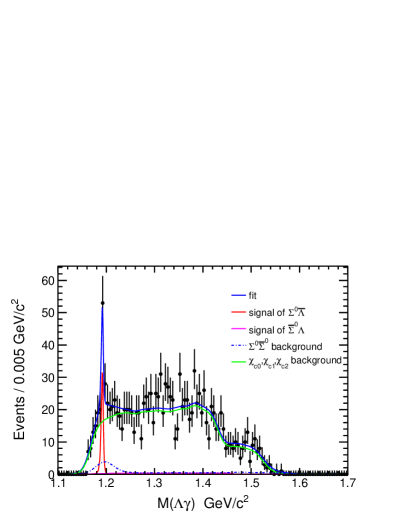
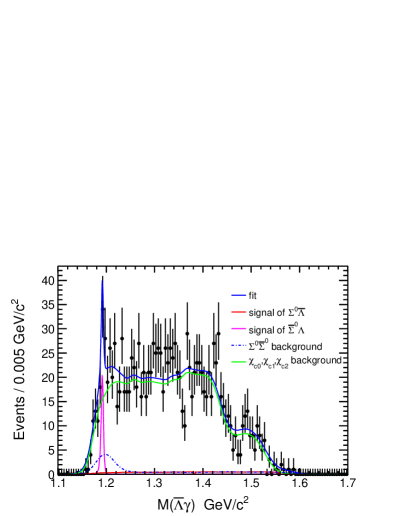
Figure 2 shows the projections of the two-dimensional
fitting results. The numbers of signal events are determined to be
,
from the fit.
The contribution from the continuum process,
is estimated from the collision data at 3.773 GeV with
integrated luminosity of 2931.8 pb-1 taken during 2010 and
2011. The same event selection criteria as for the decay is
applied.
In addition,
GeV/ GeV/ is required to suppress background from the , process. An unbinned one dimensional maximum likelihood fit is
done to determine signal yields, where the peaking background has been considered with its shape from MC simulation and magnitude from previous measurements a2 . The other backgrounds are described with a second order
polynomial function. To account for the difference of the
integrated luminosity and cross sections between the two energy points
3.686 GeV and 3.773 GeV, a scaling factor is applied. The
continuum contributions at 3.686 GeV are determined to be: and in the and
processes, respectively, where the
contributions from
decay have been ignored due to its low production.
The branching fraction of is calculated by
(1)
Here, is the total number of
events totalnumber , PDG , and the efficiency
is determined from
simulation. The branching fraction
of is determined to be
. Similarly, the branching fraction of
is calculated to be
, with . The clear difference between and comes from the different selection criteria on the open angle between photon and (anti-)proton. The combined branching fraction of
is
, where the uncertainty is statistical only.
Figure 2: The projections from the two-dimensional fit to and . Dots with
error bars are data, blue solid curves are fitting results, red
and pink curves are the signals, blue dotted lines are from
normalized
background contributions, green lines show the background contributions, the contributions from other backgrounds are too small to be drawn on the plots.
III.3 Systematic uncertainties
The systematic uncertainties on the branching-fraction measurement
include those from track and photon reconstruction efficiencies, kinematic
fit, angle requirement, reconstruction efficiency, signal and background
shapes, and the branching fraction of decay.
The uncertainty due to photon detection efficiency is per
photon, which is determined from a study of the control sample photonEfficiency .
The efficiency of reconstruction is studied
using the control sample of decays, and a correction factor trackEfficiency is applied to the efficiencies obtained
from MC simulation. The uncertainty of the correction factor, 1.1%
already includes the uncertainties of MDC tracking and
reconstruction, and 1.1% is taken as the
uncertainty of the efficiency of
reconstruction.
To study the uncertainty caused by the requirement on the angle
between the position of each shower in the EMC and the closest
extrapolated charged track, we utilize the processes
due to their large statistics. Two sets of branching
fractions are obtained. One is with the nominal requirement, i.e.
the angle of each shower is at least away from tracks and away from track;
the other one requires the angle of each shower is at least
away from tracks and
away from track. The difference of the branching fractions obtained with the nominal and
modified requirements is , which is taken as the associated
systematic uncertainty.
To study the uncertainty associated with the kinematic fit, the track
helix parameters are corrected in the MC
simulation kfitUncer . The resulting efficiency
difference before and after the correction is taken as the systematic
uncertainty related to the kinematic fit.
The systematic uncertainty associated with the signal shape is mainly
due to the resolution difference between data and MC simulation. It is
estimated by smearing the signal shape with a resolution of of the one determined from MC simulation according to the study using the control sample of
. The difference
is 0.4% and is taken as the corresponding
systematic uncertainty due to the signal shape.
For the peaking background, we fixed the shape and number of events in
the fitting. We vary the number of background events by its uncertainty. A difference of 1.9% is assigned as systematic uncertainty.
The uncertainty associated with the , , and
backgrounds is estimated by fixing their contributions to the
world average values PDG instead of floating them in the
nominal fit. The differences between fixing and floating are
0.7%, 0.4%, and 2.1% for , , and ,
respectively, and are taken as the systematic uncertainties.
The systematic uncertainty for the description of the other background
contributions is estimated by changing from a two-variable first-order
polynomial to a two-variable second-order polynomial to describe the
shape of the other backgrounds. The systematic uncertainty is determined to be 0.1%.
In the signal MC sample, is simulated with an uniform distribution over phase space. However, the angular distribution should be described as
physicsmode where is the polar angle
of the (anti) baryon. Since the observed number of events does not
allow the determination of the angular distribution in our analysis,
we generate MC samples with and , the two
extreme scenarios. The efficiency difference between them is divided by
under the assumption that the prior distribution of
is uniform, and the result is taken as the
uncertainty associated to the angular distribution.
The uncertainty on the total number of events is totalnumber . The uncertainty of the decay branching
fraction is taken from the world average
value PDG . Table 1 lists all sources and
values of systematic uncertainties, and the total systematic
uncertainty is determined by adding them in quadrature.
Table 1: Systematic uncertainties for the branching fraction of decay.
Source
c.c.
Photon efficiency
1.0
efficiency correction
1.1
Angle requirement
1.6
Kinematic fit
0.3
Signal shape
0.4
Peaking background
1.9
Background of
0.7
Background of
0.4
Background of
2.1
Other non-resonance background
0.1
Physics model
6.9
1.1
Number of
0.6
Total
7.9
III.4 Discussion and result
So far, we have not considered possible interference between the
decay and the continuum process, which is
described by
(2)
where
and are the amplitudes of
and the continuum
contribution, respectively.
The difference between and
, corresponding to the extreme constructive and
destructive cases respectively, is adopted as the uncertainty
associated with the interference. This difference is divided by
, since the prior distribution of the interference angle is
assumed to be uniform. Finally, the branching fractions are and , where the uncertainties are only the systematic arising from interference. The
combined branching fraction of is , where the first uncertainty is statistic, the second
is systematic, and the third is the uncertainty due to interference with
the continuum.
IV
IV.1 Event selection and background study
The initial selection criteria for charged tracks and photons and
the reconstruction are the same as those
described above for .
Additional selection criteria are 1.) the from the
kinematic fit is required to be less than 50, and 2.) to veto
background, the
combination is required to be
outside of the region, that
is defined as within MeV to the nominal mass PDG .
The veto is also removed.
After all selection requirements have been applied,
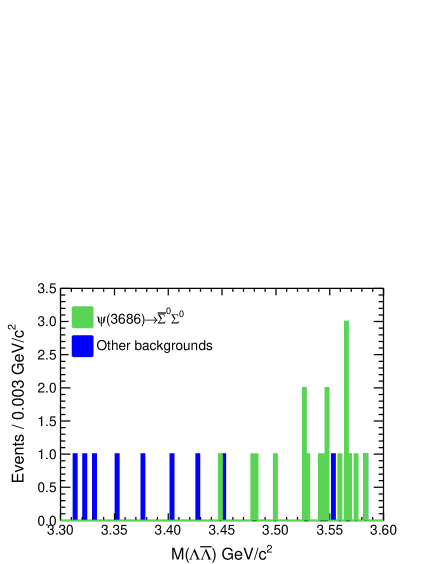
Fig. 3 shows all background contributions according to
the inclusive MC sample, which include two parts: non-flat background contributions that tend to accumulate in
the region and flat non- background
contributions. Both background levels are quite low compared with the
signal.
Figure 3: The background distributions from the inclusive MC
samples. The green histogram is the
background, and the blue one is all the other background
contributions.
IV.2 Signal yields and branching fractions
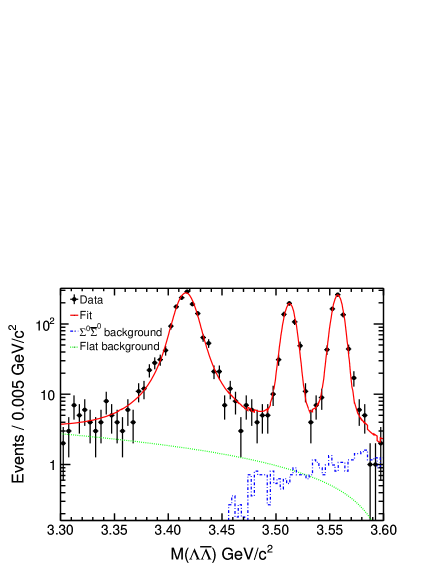
To determine the signal yields, we fit the invariant mass distribution with an
unbinned maximum likelihood fit. Each signal shape is
described by a Breit-Wigner function convolved with a Gaussian
function, and the parameters of the Breit-Wigner functions are fixed
to the world average values PDG . The Gaussian function
represents the resolutions, whose parameters are floated in the fit
but shared with all three resonances. The background shape
is composed of two parts: a MC simulation of events with both shape and number fixed
and a second-order polynomial with floating parameters to describe
other background contributions. The results are shown in
Fig. 4. The amount of other backgrounds from the fit is obvious larger than that simulated in inclusive MC as shown in Fig. 3. It indicates the inclusive MC simulation is not perfect yet. The fitted signal yields
are , , .
Figure 4: Fitting results of the invariant mass
distribution. Dots with error bars are data, the red solid line is
the fitting curve, the blue dashed line is background and the green dashed line is all
other background contributions.
The product branching fractions of are determined by
(3)
where is the efficiency. We calculate the branching fractions of decays based on world averaged
values of PDG . The results are listed in
Table 3.
IV.3 Systematic uncertainties
The uncertainties in the branching-fraction measurement include
photon and reconstruction efficiencies, kinematic fit, signal and
background shapes, fitting range, and the branching fraction of decay.
The uncertainties due to the photon detection and
reconstruction efficiencies, the requirement on the angle between the
position of each shower in the EMC and the closest extrapolated
charged tracks, the branching fraction, and the number of
events are the same as in the study of , while that due to the
kinematic fit is calculated in the same manner.
For the signal shapes,
the single Gaussian is changed to a double Gaussian, and the
differences in the yields of signal events, and for and respectively, are
taken as the systematic uncertainties associated with the signal
shapes. We study the uncertainty associated with other backgrounds shape by changing description from the second-order polynomial function to the third-order polynomial function. It turns out the difference is negligible.
Table 2: Systematic uncertainties of the branching fractions for decays.
Source
Photon efficiency
1.0
1.0
1.0
efficiency correction
1.1
1.1
1.1
Kinematic fit
0.5
0.8
0.8
Angle requirement
1.6
1.6
1.6
Signal shape
0.6
0.3
0.1
Peaking background
0.0
0.2
0.4
Fitting range
0.6
1.8
0.7
Angular distribution
0.0
3.0
8.7
1.1
1.1
1.1
Number of
0.6
0.6
0.6
sum
2.7
4.4
9.1
2.0
2.5
2.1
Total
3.4
5.1
9.4
The uncertainty associated with the fitting range is estimated by
varying it from [3.30, 3.60] to [3.32, 3.62]
The differences 0.6%, 1.8%, and 0.7% for ,
, and are taken as the uncertainty due to the
fitting range.
Table 3: The number of observed events , efficiencies (), product branching fractions, and the branching fractions of decays compared with the world average values,
where the
third uncertainties for are the uncertainties due to the branching
fractions of decays.
Mode
This work
22.80%
22.61%
20.16%
The angular distributions of are known. However, knowledge of the angular distributions is still limited. We
generate signal MC samples with an uniform distribution over phase space. To estimate the
uncertainty caused by the angular distribution, we adopt the method
used in Ref. Beschicj . We regenerate the signal MC samples
according to the helicity amplitudes defined in Ref. angleUncer , where is the helicity of in the rest frame of .
The amplitudes and are both set to be to obtain the efficiency again, and
the differences of and between these two models
are taken as the associated systematic uncertainties.
Table 2 lists all sources of systematic uncertainty and
the values for each decay channel. The total systematic uncertainties are
determined by adding each contribution in quadrature.
IV.4 Result
The branching fractions, compared with the world
averaged values, are listed in Table 3, where the
third uncertainties for are the uncertainties due to the branching fractions
of .
V summary
The branching fraction of the isospin symmetry breaking decay
is measured to be
, where
the first uncertainty is statistical, the second is systematic, the
third one is the uncertainty due to interference with the
continuum. Compared with the result using CLEO-c data a2 , , our result is significantly smaller. Our measurement
is consistent with the theoretical prediction a4 , , within 1. However our branching fraction
is measured under the assumption of no interference which corresponds
to an angle of , while the angle is assumed to
be in Ref. a4 . If is adopted,
the branching fraction is measured to be , and the difference between our measurement and
the theoretical prediction is larger than 1 but still smaller
than 2.
With the increased data sample collected at the BESIII detector, the
branching fractions of are
measured via with improved
precision. The branching fractions are determined to be
, , , where the first and second uncertainties are statistical and
systematic, and the third ones are the systematic uncertainties due to the
uncertainties on the branching
fractions. These results, which supersede the previous BESIII
measurements of branching fractions () in Ref. Beschicj , are consistent with
the world average values PDG , but not with the theoretical
predictions 36 ; 37 ; 38 . This should be understood.
Acknowledgements.
The BESIII collaboration thanks the staff of BEPCII and the IHEP computing center for their strong support. This work is supported in part by National Key Research and Development Program of China under Contracts Nos. 2020YFA0406300, 2020YFA0406400; National Natural Science Foundation of China (NSFC) under Contracts Nos. 11875115, 11625523, 11635010, 11735014, 11822506, 11835012, 11935015, 11935016, 11935018, 11961141012; the Chinese Academy of Sciences (CAS) Large-Scale Scientific Facility Program; Joint Large-Scale Scientific Facility Funds of the NSFC and CAS under Contracts Nos. U1732263, U1832207,U2032110; CAS Key Research Program of Frontier Sciences under Contracts Nos. QYZDJ-SSW-SLH003, QYZDJ-SSW-SLH040; 100 Talents Program of CAS; INPAC and Shanghai Key Laboratory for Particle Physics and Cosmology; ERC under Contract No. 758462; European Union Horizon 2020 research and innovation programme under Contract No. Marie Sklodowska-Curie grant agreement No 894790; German Research Foundation DFG under Contracts Nos. 443159800, Collaborative Research Center CRC 1044, FOR 2359, FOR 2359, GRK 214; Istituto Nazionale di Fisica Nucleare, Italy; Ministry of Development of Turkey under Contract No. DPT2006K-120470; National Science and Technology fund; Olle Engkvist Foundation under Contract No. 200-0605; STFC (United Kingdom); The Knut and Alice Wallenberg Foundation (Sweden) under Contract No. 2016.0157; The Royal Society, UK under Contracts Nos. DH140054, DH160214; The Swedish Research Council; U. S. Department of Energy under Contracts Nos. DE-FG02-05ER41374, DE-SC-0012069.
References
(1)
D. M. Asner .,
Int. J. Mod. Phys. A 24, 499 (2009).
(2)
M. Ablikim et al., [BESIII Collaboration], Nature Phys. 15, 631-634 (2019).
(3)
T. K. Pedlar et al., [CLEO Collaboration], Phys. Rev. D 72, 051108 (2005).
(4)
M. Ablikim et al., [BESIII Collaboration], Phys. Lett. B 648, 149 (2007).
(5)
M. Ablikim et al., [BESIII Collaboration], Phys. Lett. B 632, 181 (2006).
(6)
M. Ablikim et al., [BESIII Collaboration], Phys. Rev. D 78, 092005 (2008).
(7)
M. Ablikim et al., [BESIII Collaboration], Phys. Rev. D 86, 032014 (2012).
(8)
M. Ablikim et al., [BESIII Collaboration], Phys. Rev. D 86, 032008 (2012).
(9)
M. Ablikim et al., [BESIII Collaboration], Phys. Rev. D 93, 072003 (2016).
(10)
M. Ablikim et al., [BESIII Collaboration],
Phys. Rev. D 98, 032006 (2018).
(11)
M. Ablikim et al., [BESIII Collaboration],
Phys. Rev. D 100, 051101 (2019).
(12)
M. Ablikim et al., [BESIII Collaboration],
Phys. Rev. D 101, 012004 (2020).
(13)
M. Ablikim et al., [BESIII Collaboration],
Phys. Rev. Lett. 125, 052004 (2020).
(14)
M. Ablikim et al., [BESIII Collaboration],
arXiv:2007.03679 [hep-ex].
(15)
K. Zhu, X. H. Mo, C. Z. Yuan, P. Wang, Int. J. Mod. Phys. A 30, 1550148 (2015).
(16)
S. Dobbs, Kamal K. Seth, A. Tomaradze, T. Xiao, and G. Bonvicini, Phys. Rev. D 96, 092004 (2017).
(17)
R. B. Ferroli, A. Mangoni and S. Pacetti,
Eur. Phys. J. C 80, 903 (2020)
(18)
M. Ablikim et al., [BESIII Collaboration], Phys. Rev. D 87, 032007 (2013).
(19)
M. Ablikim et al., [BESIII Collaboration],
Nucl. Instrum. Meth. A 614, 345 (2010).
(20)
C. H. Yu et al.,
Proceedings of IPAC2016, Busan, Korea, (2016).
(21)
M. Ablikim et al., [BESIII Collaboration],
Chin. Phys. C 44, 040001 (2020).
(22)
S. Agostinelli et al., [Geant4 Collaboration],
Nucl. Instrum. Meth. A 506, 250 (2003).
(23)
S. Jadach, B. F. L. Ward and Z. Was,
Phys. Rev. D 63, 113009 (2001);
Comput. Phys. Commun. 130, 260 (2000).
(24)
D. J. Lange,
Nucl. Instrum. Meth. A 462, 152 (2001);
R. G. Ping,
Chin. Phys. C 32, 599 (2008).
(25)
P. A. Zyla et al., [Particle Data Group],
Prog. Theor. Exp. Phys. 2020, 083C01 (2020).
(26)
J. C. Chen, G. S. Huang, X. R. Qi, D. H. Zhang and Y. S. Zhu,
Phys. Rev. D 62, 034003 (2000);
R. L. Yang, R. G. Ping and H. Chen,
Chin. Phys. Lett 31, 061301 (2014).
(27)
E. Richter-Was,
Phys. Lett. B 303, 163 (1993).
(28)
G. R. Liao, R. G. Ping, and Y. X. Yang, Chin. Phys. Lett 26, 051101 (2009).
(29)
M. Xu et al., Chin. Phys. C 33, 428 (2009).
(30)
M. Ablikim ., [BESIII Collaboration], Chin. Phys. C 42, 023001 (2018).
(31)
M. Ablikim et al., [BESIII Collaboration], Phys. Rev. D 83, 112005 (2011).
(32)
M. Ablikim et al., [BESIII Collaboration], Phys. Rev. D 95, 052003 (2017).
(33)
M. Ablikim et al., [BESIII Collaboration], Phys. Rev. D 87, 012002 (2013).
(34)
P. Kessler, Nucl. Phys. B 15, 253-266 (1970).
(35)
R. G. Ping, B. S. Zou, and H. C. Chiang, Eur. Phys. J. A 23, 129 (2005).
(36)
X. H. Liu and Q. Zhao, J. Phys. G 38, 035007 (2011).