zhangxin@mail.neu.edu.cn
Null test for cosmic curvature using Gaussian process
Abstract
The cosmic curvature , which determines the spatial geometry of the universe, is an important parameter in modern cosmology. Any deviation from would have a profound impact on primordial inflation paradigm and fundamental physics. In this work, we adopt a cosmological model-independent method to test whether deviates from zero. We use the Gaussian process to reconstruct the reduced Hubble parameter and the derivative of distance from observational data, and then determine with a null test relation. The cosmic chronometer (CC) Hubble data, baryon acoustic oscillation (BAO) Hubble data, and supernovae Pantheon sample are considered. Our result is consistent with a spatially flat universe within the domain of reconstruction , at the confidence level. In the redshift interval , the result favors a flat universe, while at , it tends to favor a closed universe. In this sense, there is still a possibility for a closed universe. We also carry out the null test of the cosmic curvature at using the simulated gravitational wave standard sirens, CC+BAO and redshift drift Hubble data. The result shows that in the future, with the synergy of multiple high-quality observations, we can tightly constrain the spatial geometry or exclude the flat universe.
I Introduction
The cosmic curvature is an important parameter that is related to many fundamental problems in modern cosmology. Knowing whether the universe is spatially open (), flat (), or closed () is crucial for us to understand its evolution and the property of dark energy. A flat universe is strongly favored by some cosmological observations. For instance, the Planck 2018 cosmic microwave background (CMB) observations combined with the baryon acoustic oscillations (BAO) measurements give , suggesting that our universe is flat to a error of (Aghanim et al., 2020). However, it was found that the Planck TT,TE,EE+lowE power spectra data alone favors a slightly closed universe, (Aghanim et al., 2020; Park and Ratra, 2019; Handley, 2021; Di Valentino et al., 2019). This deviation from a flat universe is interpreted as the undetected systematics, statistical fluctuation, or new physics beyond the cold dark matter (CDM) model. Efstathiou and Gratton (Efstathiou and Gratton, 2020) recently revisited the issue and claimed that the Planck data are still consistent with a flat universe. Whether this crisis really exists is still under debate.
It should be pointed out that most of the curvature parameter estimations assume a specific cosmological model. However, there is a strong degeneracy between the curvature parameter and the dark energy equation of state , so it is difficult to constrain them simultaneously, which hinders our understanding of dark energy. Therefore, it is necessary to measure the cosmic curvature in a cosmological model-independent way. For this purpose, many novel and feasible methods have been proposed; see e.g., Refs. (Bernstein, 2006; Shafieloo and Clarkson, 2010; Li et al., 2014, 2016, 2019; Sapone et al., 2014; Räsänen et al., 2015; Scolnic et al., 2018; Yu and Wang, 2016; L’Huillier and Shafieloo, 2017; Liao, 2019; Rana et al., 2017; Wang et al., 2020a; Wei and Wu, 2017; Xia et al., 2017; Denissenya et al., 2018; Wei, 2018; Witzemann et al., 2018; Collett et al., 2019; Qi et al., 2019; Wei and Melia, 2020; Zhou and Li, 2020; Dhawan et al., 2021; Jesus et al., 2020; Vagnozzi et al., 2021; Zhao et al., 2021; Wei et al., 2022; Wei and Melia, 2022; Koksbang, 2022; Liu et al., 2022; Zhang et al., 2022).
In Ref. (Cai et al., 2016), Cai et al. proposed a model-independent method to test whether the cosmic curvature deviates from zero. They adopted the observational data to reconstruct the reduced Hubble parameter and distance-redshift relation , and then combined the reconstructions to perform the null test of . In their analysis, the measurements from cosmic chronometer (CC) and BAO observations as well as the Union2.1 type Ia supernovae (SNe Ia) sample are considered, and the result favors a flat universe. Due to the increase of observational data, Yang and Gong (Yang and Gong, 2021) reperformed the null test using the CC data and SNe Ia Pantheon compilation, and the result is still consistent with a flat universe. In Ref. (Yang and Gong, 2021), the BAO data are not considered. It should be pointed out that the CC data may not constitute a reliable source of information due to some concerns (Kjerrgren and Mortsell, 2021). In contrast, the data from BAO observations are much more accurate and reliable. In the present work, we consider both the CC and BAO measurements, i.e., we shall use the latest CC+BAO data and SNe Ia Pantheon sample to test the spatial flatness of the universe.
Furthermore, we also explore what role the future gravitational wave (GW) standard sirens and CC+BAO+redshift drift (RD) observations will play in the null test of . GWs can serve as standard sirens, since the GW waveform carries the information of the luminosity distance to source (Schutz, 1986; Holz and Hughes, 2005; Zhang, 2019). If the source’s redshift can be determined, for example, by identifying the electromagnetic counterpart of the GW event, we can then establish the -redshift relation. We simulate the GW data based on the planned space-based GW detector, DECihertz Interferometer Gravitational wave Observatory (DECIGO) (Kawamura et al., 2021). In the coming decades, with the advent of some powerful optical and radio telescopes, such as the Euclid (Amendola et al., 2018), Subaru Prime Focus Spectrograph (PFS) (Ellis et al., 2014), Dark Energy Spectroscopic Instrument (DESI) Aghamousa et al. (2016a, b), and Square Kilometre Array (SKA) Bacon et al. (2020), we can better measure the Hubble parameter using the CC and BAO methods. We simulate the CC+BAO data in the redshift interval according to the observational data. In the future, another promising way to measure is the RD method (Loeb, 1998). We simulate the high- Hubble data based on hypothetical RD observations of the upcoming European Extremely Large Telescope (E-ELT). We shall use the simulated GW and CC+BAO+RD data to perform the null test of and compare the result with that using the current CC+BAO and SNe Ia data.
In this work, we adopt a machine learning method, the Gaussian process (GP), to reconstruct the cosmological functions. It has been widely used in cosmological researches; see e.g., Refs. (Holsclaw et al., 2010; Shafieloo et al., 2012; Seikel et al., 2012; Yahya et al., 2014; Yang et al., 2015; Cai et al., 2016; Wang et al., 2017a; Elizalde and Khurshudyan, 2019; Elizalde et al., 2018; Liao et al., 2019; Cai et al., 2020; Mukherjee and Banerjee, 2021a, 2022a; Mehrabi and Rezaei, 2021; Aljaf et al., 2021; Vazirnia and Mehrabi, 2021; Mukherjee and Mukherjee, 2021; Mukherjee and Banerjee, 2021b; Ruiz-Zapatero et al., 2022; Hwang et al., 2022; Mukherjee and Banerjee, 2022b; Elizalde et al., 2022; Elizalde and Khurshudyan, 2022). The GP method allows one to reconstruct a function and its derivative from data without assuming any particular parametrization, so it is suitable for our purpose. The artificial neural network (ANN) has recently emerged as a promising tool for reconstructing functions (Wang et al., 2020b, 2021; Liu et al., 2021; Qi et al., 2023), however, as far as we know, ANN has difficulties in reconstructing the derivative of a function. For this reason, our research is based on the GP analysis.
II Methodology
In the homogeneous and isotropic universe, the FLRW metric is applied to describe its spacetime:
| (1) |
where is the speed of light, is the scale factor, and is a constant that is related to the cosmic curvature by , with being the Hubble parameter. We use to represent the present value of , and then , and correspond to the open, flat and closed universe, respectively. The luminosity distance can be expressed as
| (2) |
where
| (6) |
and is the reduced Hubble parameter.
Differentiating Eq. (2), we have (Clarkson et al., 2007, 2008)
| (7) |
where is the dimensionless comoving distance. Obviously, the curvature parameter can be directly determined by using the Hubble parameter and luminosity distance according to Eq. (7). Thus, we can perform the null test of . Note that will bring a singularity at . For simplicity, we transform Eq. (7) to
| (8) |
We can see that the left-hand side of Eq. (8) is non-zero when if is nonvanishing. Therefore, the null test of is equivalent to the null test of the left-hand side of Eq. (8). Following Cai et al. (Cai et al., 2016), we define
| (9) |
For a spatially flat universe,
| (10) |
is always true at any redshift, so the deviation from it will imply a nonvanishing cosmic curvature. To carry out the null test of Eq. (10), we need to reconstruct the functions of , , and using the observational data. In this work, we adopt the GP method to reconstruct the cosmological functions without assuming a specific cosmological model. Therefore, a cosmological model-independent test of whether deviates from zero is performed in this work; note here that we do not assume a specific dark energy model, but of course an FLRW model of the homogeneous and isotropic universe is adopted.
GP is a non-parametric smoothing method for reconstructing functions (Holsclaw et al., 2010; Shafieloo et al., 2012; Seikel et al., 2012; Yahya et al., 2014; Yang et al., 2015; Cai et al., 2016; Wang et al., 2017a; Elizalde and Khurshudyan, 2019; Elizalde et al., 2018; Liao et al., 2019; Cai et al., 2020; Mukherjee and Banerjee, 2021a, 2022a; Mehrabi and Rezaei, 2021; Aljaf et al., 2021; Vazirnia and Mehrabi, 2021; Mukherjee and Mukherjee, 2021; Mukherjee and Banerjee, 2021b; Ruiz-Zapatero et al., 2022; Hwang et al., 2022; Mukherjee and Banerjee, 2022b; Elizalde et al., 2022; Elizalde and Khurshudyan, 2022), which assumes that at each point , the reconstructed function is a Gaussian distribution. Furthermore, the functions at different points are related by a covariance function. We can model a data set using a GP as
| (11) |
where is the mean function which provides the mean of random variables at each observational point, and is the covariance function which correlates the values of different at data points and separated by distance units.
There is a wide range of possible covariance functions, and the choice of covariance function actually affects the reconstruction to some extent (Seikel et al., 2012). Here, we consider the commonly used squared exponential covariance function,
| (12) |
where denotes the overall amplitude of the oscillations around the mean and gives a measure of the correlation length between the GP nodes. Both and are hyperparameters, which will be optimized by GP with the observational data. Given the GP for , the GP for the first derivative is consequently given by
| (13) |
Therefore, it is convenient to calculate the derivative of reconstructed function. In this work, we use the publicly available GaPP code to implement our analysis (Seikel et al., 2012).
The specific calculation process of GaPP is as follows. For a set of input points, , the covariance matrix is calculated by . Even in the absence of observations, we can generate a random function from GP, i.e., we can generate a vector of function values at with :
| (14) |
where is a prior of the mean of , which is set to zero in this paper. For observations, , one can also use a GP to describe them. We stress that is assumed to be scattered around the underlying function, i.e., , where Gaussian noise with variance is assumed. Therefore, we need to add the variance to the covariance matrix,
| (15) |
where is the vector of values and is the covariance matrix of the data. For uncorrelated data, we use .
The above two GPs for and can be combined in the joint distribution:
| (22) |
Here is known from observations. To reconstruct , one can consider the conditional distribution,
| (23) |
where
| (24) |
and
| (25) |
are the mean and covariance of , respectively. Eq. (23) is the posterior distribution of Eqs. (14) and (15). To reconstruct using the above equations, we need to know the hyperparameters and , which can be determined by maximizing the logarithm marginal likelihood,
| (26) |
The hyperparameters will be fixed after being optimized through Eq. (II), then the reconstructed function at the chosen points can be calculated from Eqs. (24) and (II). Therefore, GP is model-independent and without free parameters.
III Data
Here we present the data used for reconstructions. We do not consider to use the CMB data, because (i) we do not use observations to constrain a specific model, (ii) the reconstructions cannot be performed up to the early universe (e.g., the last scattering), and (iii) the inconsistencies in the measurements of the early- and late-universe observations (such as the well-known “Hubble tension”) should also be considered. Thus, we only use the late-universe observations in this work. In the first two subsections III.1 and III.2, we present the CC+BAO and SNe Ia real data, and in the last two subsections III.3 and III.4, we present the GW and CC+BAO+RD mock data.
III.1 CC + BAO
| Redshift | Reference | |||
|---|---|---|---|---|
| 0.07 | 69 | 19.6 | (Zhang et al., 2014) | |
| 0.09 | 69 | 12 | (Simon et al., 2005) | |
| 0.12 | 68.6 | 26.2 | (Zhang et al., 2014) | |
| 0.17 | 83 | 8 | (Simon et al., 2005) | |
| 0.179 | 75 | 4 | (Moresco et al., 2012) | |
| 0.199 | 75 | 5 | (Moresco et al., 2012) | |
| 0.2 | 72.9 | 29.6 | (Zhang et al., 2014) | |
| 0.27 | 77 | 14 | (Simon et al., 2005) | |
| 0.28 | 88.8 | 36.6 | (Zhang et al., 2014) | |
| 0.352 | 83 | 14 | (Moresco et al., 2012) | |
| 0.38 | 83 | 13.5 | (Moresco et al., 2016) | |
| 0.4 | 95 | 17 | (Simon et al., 2005) | |
| 0.4004 | 77 | 10.2 | (Moresco et al., 2016) | |
| 0.425 | 87.1 | 11.2 | (Moresco et al., 2016) | |
| 0.445 | 92.8 | 12.9 | (Moresco et al., 2016) | |
| 0.47 | 89 | 49.6 | (Ratsimbazafy et al., 2017) | |
| 0.4783 | 80.9 | 9 | (Moresco et al., 2016) | |
| 0.48 | 97 | 62 | (Stern et al., 2010) | |
| 0.593 | 104 | 13 | (Moresco et al., 2012) | |
| 0.68 | 92 | 8 | (Moresco et al., 2012) | |
| 0.75 | 98.8 | 33.6 | (Borghi et al., 2022) | |
| 0.781 | 105 | 12 | (Moresco et al., 2012) | |
| 0.875 | 125 | 17 | (Moresco et al., 2012) | |
| 0.88 | 90 | 40 | (Stern et al., 2010) | |
| 0.9 | 117 | 23 | (Simon et al., 2005) | |
| 1.037 | 154 | 20 | (Moresco et al., 2012) | |
| 1.3 | 168 | 17 | (Simon et al., 2005) | |
| 1.363 | 160 | 33.6 | (Moresco, 2015) | |
| 1.43 | 177 | 18 | (Simon et al., 2005) | |
| 1.53 | 140 | 14 | (Simon et al., 2005) | |
| 1.75 | 202 | 40 | (Simon et al., 2005) | |
| 1.965 | 186.5 | 50.4 | (Moresco, 2015) |
| Redshift | Reference | |||
|---|---|---|---|---|
| 0.24 | 79.69 | 2.99 | (Gaztanaga et al., 2009) | |
| 0.3 | 81.7 | 6.22 | (Oka et al., 2014) | |
| 0.31 | 78.17 | 4.74 | (Wang et al., 2017b) | |
| 0.34 | 83.8 | 3.66 | (Gaztanaga et al., 2009) | |
| 0.35 | 82.7 | 8.4 | (Chuang and Wang, 2013) | |
| 0.36 | 79.93 | 3.39 | (Wang et al., 2017b) | |
| 0.38 | 81.5 | 1.9 | (Alam et al., 2017) | |
| 0.40 | 82.04 | 2.03 | (Wang et al., 2017b) | |
| 0.43 | 86.45 | 3.68 | (Gaztanaga et al., 2009) | |
| 0.44 | 82.6 | 7.8 | (Blake et al., 2012) | |
| 0.44 | 84.81 | 1.83 | (Wang et al., 2017b) | |
| 0.48 | 87.79 | 2.03 | (Wang et al., 2017b) | |
| 0.51 | 90.4 | 1.9 | (Alam et al., 2017) | |
| 0.52 | 94.35 | 2.65 | (Wang et al., 2017b) | |
| 0.56 | 93.33 | 2.32 | (Wang et al., 2017b) | |
| 0.57 | 87.6 | 7.8 | (Chuang et al., 2013) | |
| 0.57 | 96.8 | 3.4 | (Anderson et al., 2014) | |
| 0.59 | 98.48 | 3.19 | (Wang et al., 2017b) | |
| 0.6 | 87.9 | 6.1 | (Blake et al., 2012) | |
| 0.61 | 97.3 | 2.1 | (Alam et al., 2017) | |
| 0.64 | 98.82 | 2.99 | (Wang et al., 2017b) | |
| 0.73 | 97.3 | 7 | (Blake et al., 2012) | |
| 0.978 | 113.72 | 14.63 | (Zhao et al., 2019) | |
| 1.23 | 131.44 | 12.42 | (Zhao et al., 2019) | |
| 1.526 | 148.11 | 12.71 | (Zhao et al., 2019) | |
| 1.944 | 172.63 | 14.79 | (Zhao et al., 2019) | |
| 2.3 | 224 | 8 | (Busca et al., 2013) | |
| 2.33 | 224 | 8 | (Bautista et al., 2017) | |
| 2.34 | 222 | 7 | (Delubac et al., 2015) | |
| 2.36 | 226 | 8 | (Font-Ribera et al., 2014) | |
| 2.4 | 227.8 | 5.61 | (du Mas des Bourboux et al., 2017) |
The Hubble parameter , which describes the expansion rate of the universe, can be measured in two important ways. One method is to calculate the differential ages of passively evolving galaxies (usually called cosmic chronometers), which provides the model-independent measurements (Jimenez and Loeb, 2002; Koksbang, 2021). In the framework of general relativity, the Hubble parameter can be written in terms of the differential time evolution of the universe in a given redshift interval , as
| (27) |
By using the CC measurements, we can obtain their redshifts and differences in age, thus achieving the estimation of . The CC method does not assume any fiducial cosmological model. We summarize the total 32 CC measurements in Table 1. The sources of these data are quoted in the table. In should be pointed out that the CC data may not constitute a reliable source of information considering the concerns given in Ref. (Kjerrgren and Mortsell, 2021).
Another method is to detect the radial BAO features using the galaxy surveys and Ly- forest measurements (Gaztanaga et al., 2009; Oka et al., 2014; Wang et al., 2017b; Chuang and Wang, 2013; Alam et al., 2017; Blake et al., 2012; Chuang et al., 2013; Anderson et al., 2014; Busca et al., 2013; Zhao et al., 2019; Bautista et al., 2017; Delubac et al., 2015; Font-Ribera et al., 2014; du Mas des Bourboux et al., 2017). The BAO scale provides us with a standard ruler to measure the distances in cosmology. Note that the radial BAO measurements can only obtain the combination , where is the sound horizon,
| (28) |
evaluated at the drag epoch , with the sound speed. In order to obtain , one first needs to determine the sound horizon. In this work, the fiducial value of is derived from the Planck 2018 CMB observations (Aghanim et al., 2020). We compile the 31 BAO data in Table 2, which are summarized in Refs. (Mukherjee and Banerjee, 2021b; Lian et al., 2021). The data set includes almost all the radial BAO data reported in various galaxy surveys. Note that some of the data points are correlated since either they belong to the same analysis or there is an overlap between galaxy samples. In this paper, we consider not only the central values and standard deviations of the BAO data, but also the covariances among the data points, which are publicly available in the cited references. It can be seen that the BAO data are generally more accurate than the CC data. Of course, the BAO measurements also face some challenges (Ellis and Stoeger, 1987), especially the environmental dependence of the BAO peak location (Roukema et al., 2015, 2016). We also note that there is a noticeable systematic difference between the BAO and CC measurements (Ding et al., 2015; Zheng et al., 2016). Therefore, it is more reasonable to reconstruct the function of using the CC and BAO data, respectively. However, to tighten the constraints on the cosmic curvature, we use both CC and BAO data to reconstruct .
III.2 SNe Ia
The data we used for reconstructing and is the Pantheon compilation (Scolnic et al., 2018), which contains 1048 SNe Ia covering the redshift range of . For an SN Ia, the distance modulus and the luminosity distance are related by
| (29) |
and the observed distance modulus is
| (30) |
where is the rest-frame -band peak magnitude, and represent the time stretch of light curve and the supernova color at maximum brightness, respectively, and is the absolute -band magnitude. and are two nuisance parameters, which could be calibrated to zero by the BEAMS with Bias Corrections method (Kessler and Scolnic, 2017). Then the observed distance modulus can be expressed as
| (31) |
Once the absolute magnitude is known, the luminosity distances can be obtained.
III.3 GW standard sirens
We simulate the GW standard sirens based on the spaceborne DECIGO and assume the GWs are from the binary neutron star (BNS) mergers. For the redshift distribution of BNSs, we employ the form (Zhao et al., 2011; Zhang et al., 2020a, 2019; Li et al., 2020; Jin et al., 2020, 2021; Wu et al., 2022)
| (32) |
where is the comoving distance and is the time evolution of the burst rate,
| (33) |
It should be mentioned that there are other strategies to quantify the redshift distribution of BNS (Ding et al., 2019; Yang, 2021; Belgacem et al., 2019; Ciolfi et al., 2021). We then calculate the fiducial value of luminosity distance in the Planck best-fit flat CDM model using
| (34) |
where , , and . The total measurement errors of consist of the instrumental error, the weak lensing error, and the peculiar velocity error, i.e.,
| (35) |
For the simulation of , we refer the reader to Ref. (Nishizawa et al., 2011). For the error caused by the weak lensing, we adopt the form given in Ref. (Hirata et al., 2010). The error caused by the peculiar velocity of the GW source can be found in Ref. (Gordon et al., 2007). Note that we will consider the Gaussian randomness. At each redshift point , the mean of luminosity distance is sampled from the normal distribution . DECIGO is expected to detect GW events from BNSs within the redshift range of , as the expectation of its 1-year operation (Kawamura et al., 2021). Considering the determination of electromagnetic counterparts, we choose a normal expected scenario, i.e., GW events with redshifts (Zhang et al., 2022), as an example in this work. For a comprehensive analysis on the redshift determination of GW events from optical follow-up observations, we refer the reader to Ref. (Zhang et al., 2022). For the studies on the GW standard sirens from the coalescences of (super)massive black hole binaries based on the space-based GW observatories LISA, Taiji, and TianQin, as well as the pulsar timing arrays, see, e.g., Refs. Wang et al. (2020c); Zhao et al. (2020); Wang et al. (2022a); Mei et al. (2021); Bian et al. (2021); Auclair et al. (2022); Wang et al. (2022b).
III.4 Future CC+BAO+RD
In the future, with the advent of powerful optical and radio telescopes, we can better measure the Hubble parameter using the CC and BAO methods. In addition, the neutral hydrogen (H i) intensity mapping technique will enable us to measure the BAO signals more efficiently (Bull et al., 2015; Xu and Zhang, 2020; Zhang et al., 2021; Wu and Zhang, 2022; Zhang et al., 2020b). In this work, a total of 63 data are considered, and we are optimistic that 200 observational data at will be realized in the coming decades. Following Ma & Zhang (Ma and Zhang, 2011), we assume that the redshift of the CC+BAO subjects to a Gamma distribution and the error of increases linearly with redshift. We fit the real data with first degree polynomial to obtain , and then two lines and are selected symmetrically around it to ensure that most data points fall into the area between them. The mock data are generated according to the normal distribution , where is set to ensure that falls in the area with probability. Then the mean of is sampled from . For more details, we refer the reader to Ref. (Ma and Zhang, 2011).
Now we turn to simulating the high- RD data. In an observing time interval , the shift in the spectroscopic velocity of a source can be expressed as (Liske et al., 2008)
| (36) |
Loeb (Loeb, 1998) pointed out that the high-resolution spectrographs on large telescopes have the potential to measure the shifts in absorption-line spectra of distant quasi-stellar objects (QSOs). By observing the Ly- absorption lines of QSOs, the E-ELT could measure the velocity shifts in the redshift range of (Loeb, 1998; Liske et al., 2008; Zhang et al., 2010; Geng et al., 2014a, b, 2015a, 2015b; Guo and Zhang, 2016; He et al., 2017). According to the study of Liske et al. (Liske et al., 2008), the achievable precision of can be estimated as
| (37) |
where is the signal-to-noise ratio of the Ly- spectrum, is the number of observed QSOs at the effective redshift , and the exponent is up to and for . In this work, we assume five RD measurements at effective redshifts , 3.0, 3.5, 4.0, and 4.5, with in each of five redshift bins (Martins et al., 2016; Alves et al., 2019), namely a total of 30 observable quasars. In addition, we make the assumptions of yr and for the RD measurements. We simulate the RD data in the Planck best-fit flat CDM model, and the error of is calculated from the precision of .
IV Results and discussions
We first need to normalize the observational Hubble parameter and luminosity distance data to get the and data. From Eq. (10), we have
| (38) |
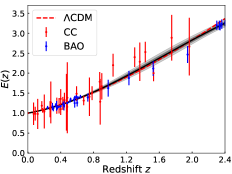
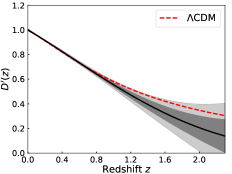
where is the normalization factor. Since the two factors can cancel out each other, whose value will not influence the null test of the cosmic curvature. In this work, we adopt to normalize the CC+BAO data as the observational . For consistency, we use the same to normalize the SNe Ia data as the observational . We then adopt the GP method to reconstruct the functions of , , and , and the results are shown in Fig. 1. The black line is the mean of the reconstruction and the shaded grey regions are the () and () confidence level (C.L.) of the reconstruction. One may find that the errors of the reconstructed function are significantly smaller than the errors of the data themselves. This is due to the basic assumptions that the distribution of the function at each point is Gaussian and the data points are correlated by the covariance function. As can be seen, the error of does not increase significantly with redshift due to the relatively accurate BAO data. However, the error of and becomes very large at because the data in that region are scarce and of poor quality. In addition, all the reconstructed functions in the redshift interval are consistent well with a flat CDM model with , which is adopted for a comparison.


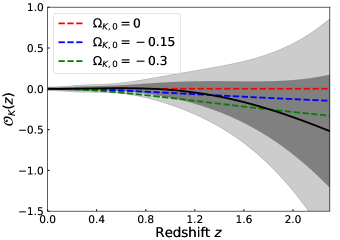
With the GP reconstructions, we can then carry out the null test of the cosmic curvature. In Ref. (Cai et al., 2016), the authors applied the Monte Carlo sampling to determine . Different from them, we use the error propagation formula to calculate the error of at each point . The result is shown in the left panel of Fig. 2. The red dashed line refers to the spatially flat universe with . It can be seen that the result is consistent with the flat universe within the domain , falling within the C.L. We note that the mean of is very close to zero in the redshift interval , however, it becomes more and more negative at . In addition, the universe with almost falls out of the C.L. at . This indicates that there is still a possibility for a spatially closed universe. Notably, the reconstruction at prefers a closed universe over an open one. We also plot the CDM model with negative curvature in Fig. 2. As can be seen, a universe with can fall within the C.L. and a universe with can fall within the C.L. Note that the curves shown in Fig. 2 are plotted by assuming a CDM model (with ) which is adopted here for a comparison.
In the GP analysis above, we only consider the squared exponential covariance function. In fact, the choice of covariance function will influence the result. To illustrate the effect, we take the Matern92 covariance function as an example, which is given by
| (39) |
Following the process described above, we perform the null test again, and the updated result is shown in the right panel of Fig. 2. The result is still consistent with the flat universe, falling within the C.L. At , the mean of also deviates from zero and becomes negative. The difference is that the error of using the Matern92 covariance function is slightly larger than that using the squared exponential covariance function. In general, the difference does exist, but it is not significant enough to change our conclusions. In the following, we adopt only the GP with squared exponential covariance to complete our analysis.
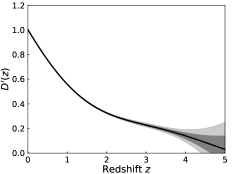
The large error of leaves the big window open for a possible non-flat universe. Therefore, it is necessary to forge new cosmological probes to precisely measure the Hubble parameter and luminosity distance, thus tightening the constraints on the cosmic curvature. In the next decades, the GW standard siren and RD method will be greatly developed. We can adopt them to measure and . Then, it is worth further studying the issue of combining the GW and RD observations with the traditional CC and BAO measurements to test the spatial flatness of the universe. We normalize the simulated CC+BAO+RD data as the data, and normalize the GW data as the data. Note that the error of RD is relatively small and decreases with redshift, which is very helpful for us to reconstruct the cosmological function. Having obtained the data sets of and , we adopt GP to reconstruct , , and , and the results are shown in Fig. 3. As can be seen, the error of does not increase significantly even up to the redshift of . In addition, the error of reconstructed from the GW data is obviously smaller than that from the SNe Ia data. Here, we wish to note that although the RD method is promising in measuring the Hubble parameter, the actual measurement will be fairly challenging even with the powerful facilities such as the E-ELT.
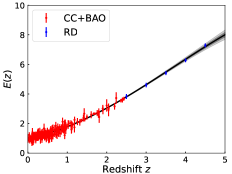
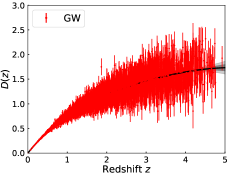
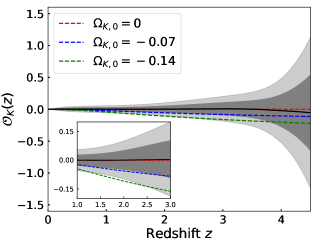
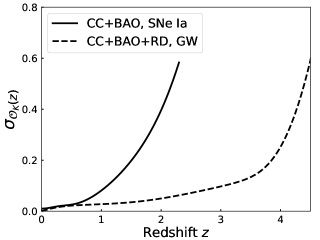
With the reconstructions of and , we use the error propagation formula to determine , and the result is shown in the left panel of Fig. 4. We see that the mean of is very close to zero in the redshift interval . Some weak deviations are mainly due to the consideration of Gaussian randomness in the simulations. The result strongly favors a flat universe, which is consistent with the assumed flat CDM model. Note that we only consider at . Even though we have reconstructed the function of at , the part of is extrapolated, whose accuracy cannot be guaranteed. On the other hand, the GW data at are scarce and of poor quality, so the reconstruction is not convincing. We also plot the CDM model with negative curvature in the left panel of Fig. 4. As can be seen, the reconstruction at can rule out the universe with at C.L. and the universe with at C.L. Similarly, we can rule out the universe with positive curvature in this way. We have tested that if the number of CC+BAO data reaches 300, the reconstruction at can rule out the universe with at C.L. and the universe with at C.L. We compare the error of derived from the different data in the right panel of Fig. 4. It can be seen that the error of derived from the future {CC+BAO+RD, GW} data is significantly smaller than that from the current {CC+BAO, SNe Ia} data. Concretely, for example, the error provided by {CC+BAO+RD, GW} is less than that given by {CC+BAO, SNe Ia} at by 66.6% (and at by ). Moreover, the error of derived from {CC+BAO, SNe Ia} grows rapidly at , while the error of from {CC+BAO+RD, GW} does not grow rapidly until . All these analyses indicate that with the synergy of multiple high-quality observations in the future, we can better determine the spatial topology of the universe.
In this work, we simulated only five RD measurements at high redshifts by observing the Ly- absorption lines of QSOs. It should be pointed out that the SKA Phase I can measure the RD at by observing the H i emission lines of galaxies (Weltman et al., 2020; Liu et al., 2020; Qi et al., 2021). However, due to the excellent performance of CC+BAO in reconstructing , we did not consider this case. In addition, we did not consider the future observations of supernovae, because the GW data can reconstruct and very well, as shown in Fig. 3. We note that the GW standard siren method also has the potential to measure the Hubble parameter (Nishizawa et al., 2011). In principle, the observations of luminosity distances to GW sources across the sky should not be directional. However, mainly due to the local motion of the observer, there are tiny anisotropies in the luminosity distance, which enables us to measure . In this work, we considered a conservative scenario, i.e., GW events with determined redshifts. In very optimistic scenarios, DECIGO is expected to detect GW events with determined redshifts. If that can be done, we can reconstruct the functions of and with breathtaking precision and measure the Hubble parameter at with a few percent accuracy (Nishizawa et al., 2011). Then we can test the spatial flatness of the universe in a cosmological model-independent way using only the GW data. We plan to explore this possibility in a future work.
V Conclusions
In this paper, we adopt a cosmological model-independent method to test whether the cosmic curvature deviates from zero. We use the Gaussian process method to reconstruct the reduced Hubble parameter and the distance-redshift relation , independently. In the reconstruction, we do not assume any specific cosmological model. By combining the reconstructions of and , we can determine , which is zero at any redshift for a spatially flat universe with . Thus, we can carry out the null test of . We adopt the latest CC Hubble data, radial BAO Hubble data, and Pantheon SNe Ia data to implement our analysis.
Our result is consistent with a universe with within the domain of reconstruction , falling within the confidence level. We stress that the reconstruction favors a flat universe at , however, it tends to favor a closed universe at . In this sense, there is still a possibility for a closed universe. The error of the reconstructed function grows rapidly at due to the poor-quality observational data in that region, so it is necessary to forge new cosmological probes to precisely measure the luminosity distance and Hubble parameter. The GW standard siren and redshift drift observations that can be used to measure and will be greatly developed in the next decades. We simulated the GW standard siren and RD data based on the hypothetical observations of the upcoming DECIGO and E-ELT, respectively. The traditional methods for measuring the Hubble parameter are also promising, and we simulated the CC+BAO data for the next decades. Combining these mock data, we performed the flatness test of the universe. We find that with the synergy of multiple high-quality observations in the future, we can tightly constrain the spatial geometry of the universe or exclude the flat universe with .
Acknowledgements.
We thank Purba Mukherjee, Bo-Yang Zhang, Bo Wang, Tian-Nuo Li, Shang-Jie Jin, Ling-Feng Wang, and Ze-Wei Zhao for fruitful discussions. We sincerely thank Purba Mukherjee for providing us with the BAO data. This work was supported by the National SKA Program of China (Grants Nos. 2022SKA0110200 and 2022SKA0110203) and the National Natural Science Foundation of China (Grants Nos. 11975072, 11835009, and 11875102).References
- Aghanim et al. (2020) N. Aghanim et al. (Planck), Astron. Astrophys. 641, A6 (2020), eprint 1807.06209.
- Park and Ratra (2019) C.-G. Park and B. Ratra, Astrophys. J. 882, 158 (2019), eprint 1801.00213.
- Handley (2021) W. Handley, Phys. Rev. D 103, L041301 (2021), eprint 1908.09139.
- Di Valentino et al. (2019) E. Di Valentino, A. Melchiorri, and J. Silk, Nature Astron. 4, 196 (2019), eprint 1911.02087.
- Efstathiou and Gratton (2020) G. Efstathiou and S. Gratton, Mon. Not. Roy. Astron. Soc. 496, L91 (2020), eprint 2002.06892.
- Bernstein (2006) G. Bernstein, Astrophys. J. 637, 598 (2006), eprint astro-ph/0503276.
- Shafieloo and Clarkson (2010) A. Shafieloo and C. Clarkson, Phys. Rev. D 81, 083537 (2010), eprint 0911.4858.
- Li et al. (2014) Y.-L. Li, S.-Y. Li, T.-J. Zhang, and T.-P. Li, Astrophys. J. Lett. 789, L15 (2014), eprint 1404.0773.
- Li et al. (2016) Z. Li, G.-J. Wang, K. Liao, and Z.-H. Zhu, Astrophys. J. 833, 240 (2016), eprint 1611.00359.
- Li et al. (2019) S.-Y. Li, Y.-L. Li, T.-J. Zhang, and T. Zhang (2019), eprint 1910.09794.
- Sapone et al. (2014) D. Sapone, E. Majerotto, and S. Nesseris, Phys. Rev. D 90, 023012 (2014), eprint 1402.2236.
- Räsänen et al. (2015) S. Räsänen, K. Bolejko, and A. Finoguenov, Phys. Rev. Lett. 115, 101301 (2015), eprint 1412.4976.
- Scolnic et al. (2018) D. M. Scolnic et al. (Pan-STARRS1), Astrophys. J. 859, 101 (2018), eprint 1710.00845.
- Yu and Wang (2016) H. Yu and F. Y. Wang, Astrophys. J. 828, 85 (2016), eprint 1605.02483.
- L’Huillier and Shafieloo (2017) B. L’Huillier and A. Shafieloo, JCAP 01, 015 (2017), eprint 1606.06832.
- Liao (2019) K. Liao, Phys. Rev. D 99, 083514 (2019), eprint 1904.01744.
- Rana et al. (2017) A. Rana, D. Jain, S. Mahajan, and A. Mukherjee, JCAP 03, 028 (2017), eprint 1611.07196.
- Wang et al. (2020a) B. Wang, J.-Z. Qi, J.-F. Zhang, and X. Zhang, Astrophys. J. 898, 100 (2020a), eprint 1910.12173.
- Wei and Wu (2017) J.-J. Wei and X.-F. Wu, Astrophys. J. 838, 160 (2017), eprint 1611.00904.
- Xia et al. (2017) J.-Q. Xia, H. Yu, G.-J. Wang, S.-X. Tian, Z.-X. Li, S. Cao, and Z.-H. Zhu, Astrophys. J. 834, 75 (2017), eprint 1611.04731.
- Denissenya et al. (2018) M. Denissenya, E. V. Linder, and A. Shafieloo, JCAP 03, 041 (2018), eprint 1802.04816.
- Wei (2018) J.-J. Wei, Astrophys. J. 868, 29 (2018), eprint 1806.09781.
- Witzemann et al. (2018) A. Witzemann, P. Bull, C. Clarkson, M. G. Santos, M. Spinelli, and A. Weltman, Mon. Not. Roy. Astron. Soc. 477, L122 (2018), eprint 1711.02179.
- Collett et al. (2019) T. Collett, F. Montanari, and S. Rasanen, Phys. Rev. Lett. 123, 231101 (2019), eprint 1905.09781.
- Qi et al. (2019) J.-Z. Qi, S. Cao, S. Zhang, M. Biesiada, Y. Wu, and Z.-H. Zhu, Mon. Not. Roy. Astron. Soc. 483, 1104 (2019), eprint 1803.01990.
- Wei and Melia (2020) J.-J. Wei and F. Melia, Astrophys. J. 897, 127 (2020), eprint 2005.10422.
- Zhou and Li (2020) H. Zhou and Z.-X. Li, Astrophys. J. 889, 186 (2020), eprint 1912.01828.
- Dhawan et al. (2021) S. Dhawan, J. Alsing, and S. Vagnozzi, Mon. Not. Roy. Astron. Soc. 506, L1 (2021), eprint 2104.02485.
- Jesus et al. (2020) J. F. Jesus, R. Valentim, P. H. R. S. Moraes, and M. Malheiro, Mon. Not. Roy. Astron. Soc. 500, 2227 (2020), eprint 1907.01033.
- Vagnozzi et al. (2021) S. Vagnozzi, A. Loeb, and M. Moresco, Astrophys. J. 908, 84 (2021), eprint 2011.11645.
- Zhao et al. (2021) S. Zhao, B. Liu, Z. Li, and H. Gao, Astrophys. J. 916, 70 (2021).
- Wei et al. (2022) J.-J. Wei, Y. Chen, S. Cao, and X.-F. Wu, Astrophys. J. Lett. 927, L1 (2022), eprint 2202.07860.
- Wei and Melia (2022) J.-J. Wei and F. Melia, Astrophys. J. 928, 165 (2022), eprint 2202.07865.
- Koksbang (2022) S. M. Koksbang, Phys. Rev. D 106, 063514 (2022), eprint 2208.12450.
- Liu et al. (2022) T. Liu, S. Cao, S. Zhang, C. Zheng, and W. Guo, Astrophys. J. 939, 37 (2022), eprint 2204.07365.
- Zhang et al. (2022) Y. Zhang, S. Cao, X. Liu, T. Liu, Y. Liu, and C. Zheng, Astrophys. J. 931, 119 (2022), eprint 2204.06801.
- Cai et al. (2016) R.-G. Cai, Z.-K. Guo, and T. Yang, Phys. Rev. D 93, 043517 (2016), eprint 1509.06283.
- Yang and Gong (2021) Y. Yang and Y. Gong, Mon. Not. Roy. Astron. Soc. 504, 3092 (2021), eprint 2007.05714.
- Kjerrgren and Mortsell (2021) A. A. Kjerrgren and E. Mortsell (2021), eprint 2106.11317.
- Schutz (1986) B. F. Schutz, Nature 323, 310 (1986).
- Holz and Hughes (2005) D. E. Holz and S. A. Hughes, Astrophys. J. 629, 15 (2005), eprint astro-ph/0504616.
- Zhang (2019) X. Zhang, Sci. China Phys. Mech. Astron. 62, 110431 (2019), eprint 1905.11122.
- Kawamura et al. (2021) S. Kawamura et al., PTEP 2021, 05A105 (2021), eprint 2006.13545.
- Amendola et al. (2018) L. Amendola et al., Living Rev. Rel. 21, 2 (2018), eprint 1606.00180.
- Ellis et al. (2014) R. Ellis et al. (PFS Team), Publ. Astron. Soc. Jap. 66, R1 (2014), eprint 1206.0737.
- Aghamousa et al. (2016a) A. Aghamousa et al. (DESI) (2016a), eprint 1611.00036.
- Aghamousa et al. (2016b) A. Aghamousa et al. (DESI) (2016b), eprint 1611.00037.
- Bacon et al. (2020) D. J. Bacon et al. (SKA), Publ. Astron. Soc. Austral. 37, e007 (2020), eprint 1811.02743.
- Loeb (1998) A. Loeb, Astrophys. J. Lett. 499, L111 (1998), eprint astro-ph/9802122.
- Holsclaw et al. (2010) T. Holsclaw, U. Alam, B. Sanso, H. Lee, K. Heitmann, S. Habib, and D. Higdon, Phys. Rev. Lett. 105, 241302 (2010), eprint 1011.3079.
- Shafieloo et al. (2012) A. Shafieloo, A. G. Kim, and E. V. Linder, Phys. Rev. D 85, 123530 (2012), eprint 1204.2272.
- Seikel et al. (2012) M. Seikel, C. Clarkson, and M. Smith, JCAP 06, 036 (2012), eprint 1204.2832.
- Yahya et al. (2014) S. Yahya, M. Seikel, C. Clarkson, R. Maartens, and M. Smith, Phys. Rev. D 89, 023503 (2014), eprint 1308.4099.
- Yang et al. (2015) T. Yang, Z.-K. Guo, and R.-G. Cai, Phys. Rev. D 91, 123533 (2015), eprint 1505.04443.
- Wang et al. (2017a) G.-J. Wang, J.-J. Wei, Z.-X. Li, J.-Q. Xia, and Z.-H. Zhu, Astrophys. J. 847, 45 (2017a), eprint 1709.07258.
- Elizalde and Khurshudyan (2019) E. Elizalde and M. Khurshudyan, Phys. Rev. D 99, 103533 (2019), eprint 1811.03861.
- Elizalde et al. (2018) E. Elizalde, M. Khurshudyan, and S. Nojiri, Int. J. Mod. Phys. D 28, 1950019 (2018), eprint 1809.01961.
- Liao et al. (2019) K. Liao, A. Shafieloo, R. E. Keeley, and E. V. Linder, Astrophys. J. Lett. 886, L23 (2019), eprint 1908.04967.
- Cai et al. (2020) Y.-F. Cai, M. Khurshudyan, and E. N. Saridakis, Astrophys. J. 888, 62 (2020), eprint 1907.10813.
- Mukherjee and Banerjee (2021a) P. Mukherjee and N. Banerjee, Eur. Phys. J. C 81, 36 (2021a), eprint 2007.10124.
- Mukherjee and Banerjee (2022a) P. Mukherjee and N. Banerjee, Phys. Dark Univ. 36, 100998 (2022a), eprint 2007.15941.
- Mehrabi and Rezaei (2021) A. Mehrabi and M. Rezaei, Astrophys. J. 923, 274 (2021), eprint 2110.14950.
- Aljaf et al. (2021) M. Aljaf, D. Gregoris, and M. Khurshudyan, Eur. Phys. J. C 81, 544 (2021), eprint 2005.01891.
- Vazirnia and Mehrabi (2021) M. Vazirnia and A. Mehrabi, Phys. Rev. D 104, 123530 (2021), eprint 2107.11539.
- Mukherjee and Mukherjee (2021) P. Mukherjee and A. Mukherjee, Mon. Not. Roy. Astron. Soc. 504, 3938 (2021), eprint 2104.06066.
- Mukherjee and Banerjee (2021b) P. Mukherjee and N. Banerjee, Phys. Rev. D 103, 123530 (2021b), eprint 2105.09995.
- Ruiz-Zapatero et al. (2022) J. Ruiz-Zapatero, C. García-García, D. Alonso, P. G. Ferreira, and R. D. P. Grumitt, Mon. Not. Roy. Astron. Soc. 512, 1967 (2022), eprint 2201.07025.
- Hwang et al. (2022) S.-g. Hwang, B. L’Huillier, R. E. Keeley, M. J. Jee, and A. Shafieloo (2022), eprint 2206.15081.
- Mukherjee and Banerjee (2022b) P. Mukherjee and N. Banerjee, Phys. Rev. D 105, 063516 (2022b), eprint 2202.07886.
- Elizalde et al. (2022) E. Elizalde, M. Khurshudyan, K. Myrzakulov, and S. Bekov (2022), eprint 2203.06767.
- Elizalde and Khurshudyan (2022) E. Elizalde and M. Khurshudyan, Eur. Phys. J. C 82, 811 (2022).
- Wang et al. (2020b) G.-J. Wang, X.-J. Ma, S.-Y. Li, and J.-Q. Xia, Astrophys. J. Suppl. 246, 13 (2020b), eprint 1910.03636.
- Wang et al. (2021) G.-J. Wang, X.-J. Ma, and J.-Q. Xia, Mon. Not. Roy. Astron. Soc. 501, 5714 (2021), eprint 2004.13913.
- Liu et al. (2021) T. Liu, S. Cao, S. Zhang, X. Gong, W. Guo, and C. Zheng, Eur. Phys. J. C 81, 903 (2021), eprint 2110.00927.
- Qi et al. (2023) J.-Z. Qi, P. Meng, J.-F. Zhang, and X. Zhang (2023), eprint 2302.08889.
- Clarkson et al. (2007) C. Clarkson, M. Cortes, and B. A. Bassett, JCAP 08, 011 (2007), eprint astro-ph/0702670.
- Clarkson et al. (2008) C. Clarkson, B. Bassett, and T. H.-C. Lu, Phys. Rev. Lett. 101, 011301 (2008), eprint 0712.3457.
- Zhang et al. (2014) C. Zhang, H. Zhang, S. Yuan, T.-J. Zhang, and Y.-C. Sun, Res. Astron. Astrophys. 14, 1221 (2014), eprint 1207.4541.
- Simon et al. (2005) J. Simon, L. Verde, and R. Jimenez, Phys. Rev. D 71, 123001 (2005), eprint astro-ph/0412269.
- Moresco et al. (2012) M. Moresco et al., JCAP 08, 006 (2012), eprint 1201.3609.
- Moresco et al. (2016) M. Moresco, L. Pozzetti, A. Cimatti, R. Jimenez, C. Maraston, L. Verde, D. Thomas, A. Citro, R. Tojeiro, and D. Wilkinson, JCAP 05, 014 (2016), eprint 1601.01701.
- Ratsimbazafy et al. (2017) A. L. Ratsimbazafy, S. I. Loubser, S. M. Crawford, C. M. Cress, B. A. Bassett, R. C. Nichol, and P. Väisänen, Mon. Not. Roy. Astron. Soc. 467, 3239 (2017), eprint 1702.00418.
- Stern et al. (2010) D. Stern, R. Jimenez, L. Verde, M. Kamionkowski, and S. A. Stanford, JCAP 02, 008 (2010), eprint 0907.3149.
- Borghi et al. (2022) N. Borghi, M. Moresco, and A. Cimatti, Astrophys. J. Lett. 928, L4 (2022), eprint 2110.04304.
- Moresco (2015) M. Moresco, Mon. Not. Roy. Astron. Soc. 450, L16 (2015), eprint 1503.01116.
- Gaztanaga et al. (2009) E. Gaztanaga, A. Cabre, and L. Hui, Mon. Not. Roy. Astron. Soc. 399, 1663 (2009), eprint 0807.3551.
- Oka et al. (2014) A. Oka, S. Saito, T. Nishimichi, A. Taruya, and K. Yamamoto, Mon. Not. Roy. Astron. Soc. 439, 2515 (2014), eprint 1310.2820.
- Wang et al. (2017b) Y. Wang et al. (BOSS), Mon. Not. Roy. Astron. Soc. 469, 3762 (2017b), eprint 1607.03154.
- Chuang and Wang (2013) C.-H. Chuang and Y. Wang, Mon. Not. Roy. Astron. Soc. 435, 255 (2013), eprint 1209.0210.
- Alam et al. (2017) S. Alam et al. (BOSS), Mon. Not. Roy. Astron. Soc. 470, 2617 (2017), eprint 1607.03155.
- Blake et al. (2012) C. Blake et al., Mon. Not. Roy. Astron. Soc. 425, 405 (2012), eprint 1204.3674.
- Chuang et al. (2013) C.-H. Chuang et al., Mon. Not. Roy. Astron. Soc. 433, 3559 (2013), eprint 1303.4486.
- Anderson et al. (2014) L. Anderson et al. (BOSS), Mon. Not. Roy. Astron. Soc. 441, 24 (2014), eprint 1312.4877.
- Zhao et al. (2019) G.-B. Zhao et al., Mon. Not. Roy. Astron. Soc. 482, 3497 (2019), eprint 1801.03043.
- Busca et al. (2013) N. G. Busca et al., Astron. Astrophys. 552, A96 (2013), eprint 1211.2616.
- Bautista et al. (2017) J. E. Bautista et al., Astron. Astrophys. 603, A12 (2017), eprint 1702.00176.
- Delubac et al. (2015) T. Delubac et al. (BOSS), Astron. Astrophys. 574, A59 (2015), eprint 1404.1801.
- Font-Ribera et al. (2014) A. Font-Ribera et al. (BOSS), JCAP 05, 027 (2014), eprint 1311.1767.
- du Mas des Bourboux et al. (2017) H. du Mas des Bourboux et al., Astron. Astrophys. 608, A130 (2017), eprint 1708.02225.
- Jimenez and Loeb (2002) R. Jimenez and A. Loeb, Astrophys. J. 573, 37 (2002), eprint astro-ph/0106145.
- Koksbang (2021) S. M. Koksbang, Phys. Rev. Lett. 126, 231101 (2021), eprint 2105.11880.
- Lian et al. (2021) Y. Lian, S. Cao, M. Biesiada, Y. Chen, Y. Zhang, and W. Guo, Mon. Not. Roy. Astron. Soc. 505, 2111 (2021), eprint 2105.04992.
- Ellis and Stoeger (1987) G. F. R. Ellis and W. Stoeger, Class. Quant. Grav. 4, 1697 (1987).
- Roukema et al. (2015) B. F. Roukema, T. Buchert, J. J. Ostrowski, and M. J. France, Mon. Not. Roy. Astron. Soc. 448, 1660 (2015), eprint 1410.1687.
- Roukema et al. (2016) B. F. Roukema, T. Buchert, H. Fujii, and J. J. Ostrowski, Mon. Not. Roy. Astron. Soc. 456, L45 (2016), eprint 1506.05478.
- Ding et al. (2015) X. Ding, M. Biesiada, S. Cao, Z. Li, and Z.-H. Zhu, Astrophys. J. Lett. 803, L22 (2015), eprint 1503.04923.
- Zheng et al. (2016) X. Zheng, X. Ding, M. Biesiada, S. Cao, and Z. Zhu, Astrophys. J. 825, 17 (2016), eprint 1604.07910.
- Kessler and Scolnic (2017) R. Kessler and D. Scolnic, Astrophys. J. 836, 56 (2017), eprint 1610.04677.
- Zhao et al. (2011) W. Zhao, C. Van Den Broeck, D. Baskaran, and T. G. F. Li, Phys. Rev. D 83, 023005 (2011), eprint 1009.0206.
- Zhang et al. (2020a) J.-F. Zhang, H.-Y. Dong, J.-Z. Qi, and X. Zhang, Eur. Phys. J. C 80, 217 (2020a), eprint 1906.07504.
- Zhang et al. (2019) J.-F. Zhang, M. Zhang, S.-J. Jin, J.-Z. Qi, and X. Zhang, JCAP 09, 068 (2019), eprint 1907.03238.
- Li et al. (2020) H.-L. Li, D.-Z. He, J.-F. Zhang, and X. Zhang, JCAP 06, 038 (2020), eprint 1908.03098.
- Jin et al. (2020) S.-J. Jin, D.-Z. He, Y. Xu, J.-F. Zhang, and X. Zhang, JCAP 03, 051 (2020), eprint 2001.05393.
- Jin et al. (2021) S.-J. Jin, L.-F. Wang, P.-J. Wu, J.-F. Zhang, and X. Zhang, Phys. Rev. D 104, 103507 (2021), eprint 2106.01859.
- Wu et al. (2022) P.-J. Wu, Y. Shao, S.-J. Jin, and X. Zhang (2022), eprint 2202.09726.
- Ding et al. (2019) X. Ding, M. Biesiada, X. Zheng, K. Liao, Z. Li, and Z.-H. Zhu, JCAP 04, 033 (2019), eprint 1801.05073.
- Yang (2021) T. Yang, JCAP 05, 044 (2021), eprint 2103.01923.
- Belgacem et al. (2019) E. Belgacem, Y. Dirian, S. Foffa, E. J. Howell, M. Maggiore, and T. Regimbau, JCAP 08, 015 (2019), eprint 1907.01487.
- Ciolfi et al. (2021) R. Ciolfi et al., Exper. Astron. 52, 245 (2021), eprint 2104.09534.
- Nishizawa et al. (2011) A. Nishizawa, A. Taruya, and S. Saito, Phys. Rev. D 83, 084045 (2011), eprint 1011.5000.
- Hirata et al. (2010) C. M. Hirata, D. E. Holz, and C. Cutler, Phys. Rev. D 81, 124046 (2010), eprint 1004.3988.
- Gordon et al. (2007) C. Gordon, K. Land, and A. Slosar, Phys. Rev. Lett. 99, 081301 (2007), eprint 0705.1718.
- Wang et al. (2020c) L.-F. Wang, Z.-W. Zhao, J.-F. Zhang, and X. Zhang, JCAP 11, 012 (2020c), eprint 1907.01838.
- Zhao et al. (2020) Z.-W. Zhao, L.-F. Wang, J.-F. Zhang, and X. Zhang, Sci. Bull. 65, 1340 (2020), eprint 1912.11629.
- Wang et al. (2022a) L.-F. Wang, S.-J. Jin, J.-F. Zhang, and X. Zhang, Sci. China Phys. Mech. Astron. 65, 210411 (2022a), eprint 2101.11882.
- Mei et al. (2021) J. Mei et al. (TianQin), PTEP 2021, 05A107 (2021), eprint 2008.10332.
- Bian et al. (2021) L. Bian et al., Sci. China Phys. Mech. Astron. 64, 120401 (2021), eprint 2106.10235.
- Auclair et al. (2022) P. Auclair et al. (LISA Cosmology Working Group) (2022), eprint 2204.05434.
- Wang et al. (2022b) L.-F. Wang, Y. Shao, G.-P. Zhang, J.-F. Zhang, and X. Zhang (2022b), eprint 2201.00607.
- Bull et al. (2015) P. Bull, P. G. Ferreira, P. Patel, and M. G. Santos, Astrophys. J. 803, 21 (2015), eprint 1405.1452.
- Xu and Zhang (2020) Y. Xu and X. Zhang, Sci. China Phys. Mech. Astron. 63, 270431 (2020), eprint 2002.00572.
- Zhang et al. (2021) M. Zhang, B. Wang, P.-J. Wu, J.-Z. Qi, Y. Xu, J.-F. Zhang, and X. Zhang, Astrophys. J. 918, 56 (2021), eprint 2102.03979.
- Wu and Zhang (2022) P.-J. Wu and X. Zhang, JCAP 01, 060 (2022), eprint 2108.03552.
- Zhang et al. (2020b) J.-F. Zhang, B. Wang, and X. Zhang, Sci. China Phys. Mech. Astron. 63, 280411 (2020b), eprint 1907.00179.
- Ma and Zhang (2011) C. Ma and T.-J. Zhang, Astrophys. J. 730, 74 (2011), eprint 1007.3787.
- Liske et al. (2008) J. Liske et al., Mon. Not. Roy. Astron. Soc. 386, 1192 (2008), eprint 0802.1532.
- Zhang et al. (2010) J. Zhang, L. Zhang, and X. Zhang, Phys. Lett. B 691, 11 (2010), eprint 1006.1738.
- Geng et al. (2014a) J.-J. Geng, J.-F. Zhang, and X. Zhang, JCAP 07, 006 (2014a), eprint 1404.5407.
- Geng et al. (2014b) J.-J. Geng, J.-F. Zhang, and X. Zhang, JCAP 12, 018 (2014b), eprint 1407.7123.
- Geng et al. (2015a) J.-J. Geng, Y.-H. Li, J.-F. Zhang, and X. Zhang, Eur. Phys. J. C 75, 356 (2015a), eprint 1501.03874.
- Geng et al. (2015b) J.-J. Geng, R.-Y. Guo, D.-Z. He, J.-F. Zhang, and X. Zhang, Front. Phys. (Beijing) 10, 109501 (2015b), eprint 1511.06957.
- Guo and Zhang (2016) R.-Y. Guo and X. Zhang, Eur. Phys. J. C 76, 163 (2016), eprint 1512.07703.
- He et al. (2017) D.-Z. He, J.-F. Zhang, and X. Zhang, Sci. China Phys. Mech. Astron. 60, 039511 (2017), eprint 1607.05643.
- Martins et al. (2016) C. J. A. P. Martins, M. Martinelli, E. Calabrese, and M. P. L. P. Ramos, Phys. Rev. D 94, 043001 (2016), eprint 1606.07261.
- Alves et al. (2019) C. S. Alves, A. C. O. Leite, C. J. A. P. Martins, J. G. B. Matos, and T. A. Silva, Mon. Not. Roy. Astron. Soc. 488, 3607 (2019), eprint 1907.05151.
- Weltman et al. (2020) A. Weltman et al., Publ. Astron. Soc. Austral. 37, e002 (2020), eprint 1810.02680.
- Liu et al. (2020) Y. Liu, J.-F. Zhang, and X. Zhang, Eur. Phys. J. C 80, 304 (2020), eprint 1907.07522.
- Qi et al. (2021) J.-Z. Qi, S.-J. Jin, X.-L. Fan, J.-F. Zhang, and X. Zhang, JCAP 12, 042 (2021), eprint 2102.01292.