This paper was converted on www.awesomepapers.org from LaTeX by an anonymous user.
Want to know more? Visit the Converter page.

On best constants in L2L^{2} approximation

Andrea Bressan111 Dipartimento di matematica, Università di Pavia, via Ferrata 5, 27100 Pavia, Italia, email: andrea.bressan@unipv.it    Michael S. Floater222 Department of Mathematics, University of Oslo, Moltke Moes vei 35, 0851 Oslo, Norway, email: michaelf@math.uio.no    Espen Sande333 Department of Mathematics, University of Rome Tor Vergata, Via della Ricerca Scientifica 1, 00133 Rome, Italy email: sande@mat.uniroma2.it.
Abstract

In this paper we provide explicit upper and lower bounds on certain L2L^{2} nn-widths, i.e., best constants in L2L^{2} approximation. We further describe a numerical method to compute these nn-widths approximately, and prove that this method is superconvergent. Based on our numerical results we formulate a conjecture on the asymptotic behaviour of the nn-widths. Finally we describe how the numerical method can be used to compute the breakpoints of the optimal spline spaces of Melkman and Micchelli, which have recently received renewed attention in the field of Isogeometric Analysis.

Math Subject Classification: Primary: 41A15, 41A44, Secondary: 34B27

Keywords: eigenvalues, eigenfunctions, nn-widths, splines, isogeometric analysis, total positivity, Green’s functions

1 Introduction

In this paper we consider the following nn-width problem: determine the smallest constant dnd_{n} for which there exists an nn-dimensional subspace XnX_{n} of L2(a,b)L^{2}(a,b) such that for all uHr(a,b)u\in H^{r}(a,b), r1r\geq 1,

minvXnuvdnu(r).\min_{v\in X_{n}}\|u-v\|\leq d_{n}\|u^{(r)}\|. (1)

This problem was originally studied in the first half of the previous century by Kolmogorov [14], who showed that dnd_{n}, for nrn\geq r, corresponds to the (n+1)(n+1)-st eigenvalue of a certain differential operator. In fact, for r=1r=1 he showed that dn=(ba)/(nπ)d_{n}=(b-a)/(n\pi).

The related problem of finding a subspace XnX_{n} that achieves the smallest constant dnd_{n} in (1), a so-called optimal subspace for Hr(a,b)H^{r}(a,b), was also studied by Kolmogorov. He showed that an optimal subspace for Hr(a,b)H^{r}(a,b) is the span of the first nn eigenfunctions of the mentioned eigenvalue problem. Further optimal subspaces were later found by Melkman and Micchelli [17] and by Floater and Sande [8]. The nn-width problem was a major topic in the 70s and 80s [11, 12, 24, 13, 18, 17, 15, 23, 22] and there has been recent activity in the context of Isogeometric Analysis (IGA) [7, 8, 10, 9, 21, 4].

In [14] Kolmogorov further claimed that for (a,b)=(0,1)(a,b)=(0,1),

dn=(1πn)r+O(1n)r+1,d_{n}=\Big{(}\frac{1}{\pi n}\Big{)}^{r}+O\Big{(}\frac{1}{n}\Big{)}^{r+1}, (2)

as nn\to\infty. In [20, Chapter VII] Pinkus gives a proof that dn=O(nr)d_{n}=O(n^{-r}) as nn\to\infty. As far as we know, no further asymptotic results concerning dnd_{n} are known.

Our first result is to provide the following bounds for dnd_{n}.

Theorem 1.

For all nrn\geq r we have

(nr+1)πbadn1/rnπba.\frac{(n-r+1)\pi}{b-a}\leq d_{n}^{-1/r}\leq\frac{n\pi}{b-a}.

Note that in the case (a,b)=(0,1)(a,b)=(0,1) this theorem gives a proof of (2).

Isogeometric Galerkin methods have been previously used to approximate nn-widths [7]. Our tests suggest that these methods are adequate for small values of rr and nn, e.g. up to r,n5r,n\approx 5. The second contribution in this paper is to propose a simple superconvergent collocation method that computes a good approximation of dnd_{n} for rr and nn in the range of tens. A byproduct of the numerical method is the approximate computation of the internal knots of the first optimal spline space of Melkman and Micchelli [17]. These knots were recently used by Chan and Evans [4] in their numerical method for wave propagation based on IGA. By using the optimal knots of Melkman and Micchelli they were able to improve the approximation properties and the maximum stable timestep for their method. Numerical methods to approximate these knots are therefore highly desirable in the context of IGA.

The results of our numerical method lead us to the following conjecture:

Conjecture 1.

For all r1r\geq 1,

|dn1/r(n(r1)/2)πba|0asn.\left|d_{n}^{-1/r}-\frac{(n-(r-1)/2)\pi}{b-a}\right|\to 0\quad\text{as}\quad n\to\infty.

In other words, it appears that dn1/rd_{n}^{-1/r} approaches the midpoint of the upper and lower bounds in Theorem 1.

2 Proof of Theorem 1

First we prove the lower bound of dnd_{n}. Let

H1r={uHr(a,b):u(k)(a)=u(k)(b)=0, 1k<r,k odd}.H^{r}_{1}=\{u\in H^{r}(a,b):u^{(k)}(a)=u^{(k)}(b)=0,\,1\leq k<r,\,k\text{ odd}\}.

As proved in [10, Theorem 1], the nn-width of H1rH^{r}_{1} is (ba)r/(πn)r(b-a)^{r}/(\pi n)^{r}, i.e., for each n1n\geq 1 there exists XnX_{n} such that

minvXnuv(baπn)ru(r),uH1r,\min_{v\in X_{n}}\|u-v\|\leq\Big{(}\frac{b-a}{\pi n}\Big{)}^{r}\|u^{(r)}\|,\qquad\forall u\in H^{r}_{1}, (3)

and for no XnX_{n} the above inequality holds for with a smaller constant. Since H1rH^{r}_{1} is a subset of Hr(a,b)H^{r}(a,b) we have

dn(baπn)r.d_{n}\geq\Big{(}\frac{b-a}{\pi n}\Big{)}^{r}.

The upper bound for dnd_{n} is obtained by making a specific choice of XnX_{n}. Let SS be the space of Cr2C^{r-2} piecewise polynomials of degree r1r-1 on the uniform partition of (a,b)(a,b) in mm segments. Then for all uHr(a,b)u\in H^{r}(a,b) we have by [3, Theorem 1] (or [21, Theorem 1]) that

minvSuv(baπm)ru(r).\min_{v\in S}\|u-v\|\leq\Big{(}\frac{b-a}{\pi m}\Big{)}^{r}\|u^{(r)}\|. (4)

Since dimS=m+r1\dim S=m+r-1, letting n=dimSrn=\dim S\geq r we deduce that

dn(baπ(nr+1))r.d_{n}\leq\Big{(}\frac{b-a}{\pi(n-r+1)}\Big{)}^{r}.

This completes the proof of Theorem 1.

3 Associated eigenvalue problems

It follows from [14, 17, 20, 8] that dn2d_{n}^{-2} is equal to the (n+1)(n+1)-th smallest eigenvalue (counting the rr multiplicities of zero) of the eigenvalue problem

{(1)rψ(2r)(x)=μψ(x)x(a,b),ψ(k)(a)=ψ(k)(b)=0k=r,r+1,,2r1.\left\{\begin{aligned} &(-1)^{r}\psi^{(2r)}(x)=\mu\psi(x)&&&x\in(a,b),\\ &\psi^{(k)}(a)=\psi^{(k)}(b)=0&&&k=r,r+1,\dots,2r-1.\end{aligned}\right. (5)

Moreover, the eigenfunctions corresponding to the nn smallest eigenvalues span an optimal space XnX_{n}. Note in particular, that 0 is an eigenvalue of (5) with multiplicity rr and the null space is the space of polynomials of degree r1r-1. It is straightforward to see that in the case r=1r=1 the eigenvalue problem (5) can be solved analytically, and in this case the eigenvalues are

0,(πba)2,(2πba)2,(3πba)2,0,\left(\frac{\pi}{b-a}\right)^{2},\left(\frac{2\pi}{b-a}\right)^{2},\left(\frac{3\pi}{b-a}\right)^{2}\ldots,

and the eigenfunctions are

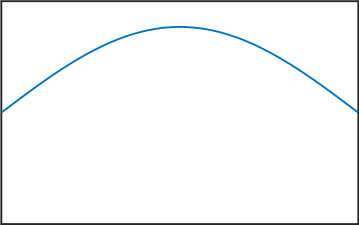
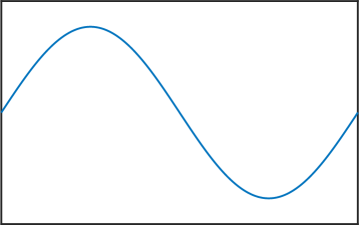
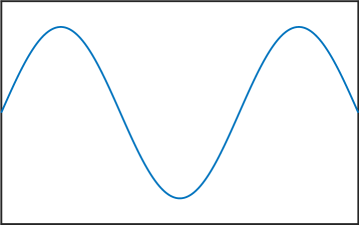
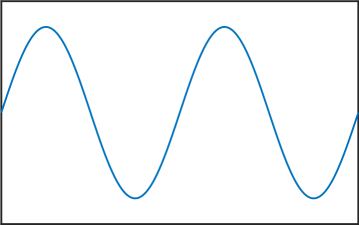
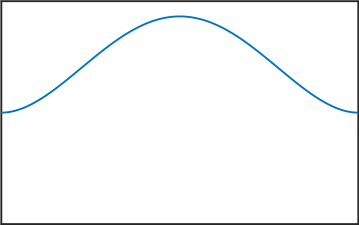
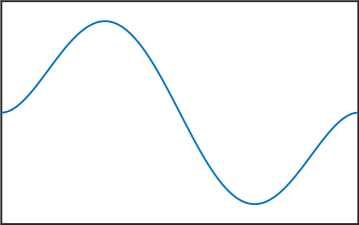
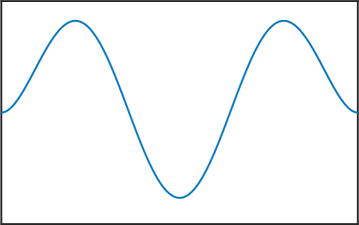
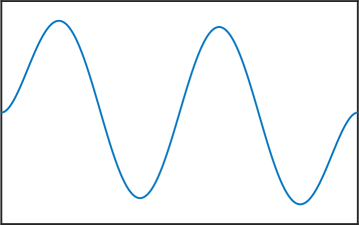
1,cos(πxaba),cos(2πxaba),cos(3πxaba),.1,\cos\left(\pi\frac{x-a}{b-a}\right),\cos\left(2\pi\frac{x-a}{b-a}\right),\cos\left(3\pi\frac{x-a}{b-a}\right),\ldots.

It can further be shown that for any rr the eigenvalue problem in (5) has the same non-zero eigenvalues as the problem with Dirichlet boundary conditions [8]:

{(1)rϕ(2r)(x)=μϕ(x)x(a,b),ϕ(k)(a)=ϕ(k)(b)=0k=0,1,,r1.\left\{\begin{aligned} &(-1)^{r}\phi^{(2r)}(x)=\mu\phi(x)&&&x\in(a,b),\\ &\phi^{(k)}(a)=\phi^{(k)}(b)=0&&&k=0,1,\dots,r-1.\end{aligned}\right. (6)

In particular, (6) has a trivial null space. Thus, for nrn\geq r, dn2d_{n}^{-2} is the (n+1r)(n+1-r)-th eigenvalue of (6). For r=1r=1 the eigenvalues of (6) are

(πba)2,(2πba)2,(3πba)2,\left(\frac{\pi}{b-a}\right)^{2},\left(\frac{2\pi}{b-a}\right)^{2},\left(\frac{3\pi}{b-a}\right)^{2}\ldots,

and the eigenfunctions are

sin(πxaba),sin(2πxaba),sin(3πxaba),.\sin\left(\pi\frac{x-a}{b-a}\right),\sin\left(2\pi\frac{x-a}{b-a}\right),\sin\left(3\pi\frac{x-a}{b-a}\right),\ldots.

Let gg be the Green’s function associated to (6). Since the differential operator in (6) is self-adjoint it follows that gg is symmetric, i.e., g(x,y)=g(y,x)g(x,y)=g(y,x). Moreover, it is the distributional solution of

{x2rg(x,y)=(1)rδy,x(a,b),xkg(x,y)|x{a,b}=0,k=0,1,,r1,y(a,b)\left\{\begin{aligned} &\partial^{2r}_{x}g(x,y)=(-1)^{r}\delta_{y},&&&x\in(a,b),\\ &\partial^{k}_{x}g(x,y)|_{x\in\{a,b\}}=0,&&&k=0,1,\ldots,r-1,\ y\in(a,b)\end{aligned}\right. (7)

where δy\delta_{y} is the Dirac’s delta at yy, i.e., δyf=f(y)\delta_{y}f=f(y).

Lemma 1.

The Green’s function associated to (6) satisfies

g(x,y)=(ya)r(by)r(2r1)!(ba)B[a,,ar times,y,b,,br times](x),g(x,y)=\frac{(y-a)^{r}(b-y)^{r}}{(2r-1)!(b-a)}B[\underbrace{a,\dots,a}_{r\text{ times}},y,\underbrace{b,\dots,b}_{r\text{ times}}](x), (8)

where B[ξ1,,ξn]B[\xi_{1},\dots,\xi_{n}] is the B-spline with knots ξ1,,ξn\xi_{1},\dots,\xi_{n}.

Proof.

Equation (7) implies that g(,y)g(\cdot,y) is a piecewise polynomial of degree 2r12r-1 with unit jump of the (2r1)(2r-1)-th derivative. The boundary conditions in (7) are satisfied by the rr repetitions of the knots aa and bb. Using the jump formula for the highest order derivative of a B-spline in Lemma 3.22 of [16] we then obtain (8), since the factor in front of the B-spline normalizes the jump of the (2r1)(2r-1)-th derivative of g(,y)g(\cdot,y). ∎

For example, for r=1r=1,

B[a,y,b](x)={(xa)/(ya)xy,(bx)/(by)xy,B[a,y,b](x)=\begin{cases}(x-a)/(y-a)&x\leq y,\cr(b-x)/(b-y)&x\geq y,\end{cases}

and so

g(x,y)={(xa)(by)/(ba)xy,(ya)(bx)/(ba)xy.g(x,y)=\begin{cases}(x-a)(b-y)/(b-a)&x\leq y,\cr(y-a)(b-x)/(b-a)&x\geq y.\end{cases}

For r=2r=2,

B[a,a,y,b,b](x)=(xa)2(ya)2(ba)2((ba)(yx)+2(bx)(ya)),xy,B[a,a,y,b,b](x)=\frac{(x-a)^{2}}{(y-a)^{2}(b-a)^{2}}\big{(}(b-a)(y-x)+2(b-x)(y-a)\big{)},\quad x\leq y,

and so

g(x,y)=(xa)2(by)26(ba)3((ba)(yx)+2(bx)(ya)),xy.g(x,y)=\frac{(x-a)^{2}(b-y)^{2}}{6(b-a)^{3}}\big{(}(b-a)(y-x)+2(b-x)(y-a)\big{)},\quad x\leq y.

By the symmetry of g(x,y)g(x,y), we have

g(x,y)=g(y,x),yx.g(x,y)=g(y,x),\quad y\leq x.

For general rr, we can evaluate g(x,y)g(x,y) for x[a,y]x\in[a,y] by first using the usual Cox-de Boor-Mansfield algorithm to evaluate the B-spline in (8) (after adding knots to both ends of the knot vector appropriately) and then multiplying by the scaling factor. For x[y,b]x\in[y,b], we just set g(x,y)=g(y,x)g(x,y)=g(y,x).

4 A superconvergent numerical method

In this section we describe a simple numerical method to approximate the eigenvalues and eigenfunctions of (6). We remind that for r=1r=1 the eigenvalues and eigenfunctions are known analytically and so we only need to consider the case r2r\geq 2. Recalling that gg is the Green’s function to (6) we discretize the following equivalent formulation of (6)

abg(x,y)ϕ(y)𝑑y=λϕ(x),\int_{a}^{b}g(x,y)\phi(y)\,dy=\lambda\phi(x), (9)

where λ=1/μ\lambda=1/\mu. We consider the uniform partition of [a,b][a,b] in m+1m+1 segments with nodes Ξ=[ξ0,,ξm+1]\Xi=[\xi_{0},\dots,\xi_{m+1}]

ξk=a+kh,h=(ba)/(m+1).\xi_{k}=a+kh,\qquad h=(b-a)/(m+1).

By approximating the integral in (9) with the trapezoidal rule on each segment [ξi,ξi+1][\xi_{i},\xi_{i+1}] and remembering g(x,a)=g(x,b)=0g(x,a)=g(x,b)=0 we obtain the approximate equation

λϕ(x)=abg(x,y)ϕ(y)𝑑yh=1mg(x,ξ)ϕ(ξ).\lambda\phi(x)=\int_{a}^{b}g(x,y)\phi(y)\,dy\approx h\sum_{\ell=1}^{m}g(x,\xi_{\ell})\phi(\xi_{\ell}).

Discretizing ϕ\phi with its values 𝒗ϕ\bm{v}_{\phi} at ξ1,,ξm\xi_{1},\dots,\xi_{m} we obtain the finite dimensional eigenproblem

𝙶𝒗ϕ=λ𝒗ϕ,𝙶:=[g(ξk,ξ)]k,=1,,m.{\mathtt{G}}\bm{v}_{\phi}=\lambda\bm{v}_{\phi},\qquad{\mathtt{G}}:=[g(\xi_{k},\xi_{\ell})]_{k,\ell=1,\dots,m}. (10)

The kk-th eigenpair of (10) are then an approximation to the kk-th eigenpair of (6) and (9). We remark that such approximations of the eigenvalues of integral operators have been studied before [1, 2, 5, 19]. Let (λk,ϕk)(\lambda_{k},\phi_{k}) be the kk-th eigenpair of (9) and (λk,h,ϕk,h)(\lambda_{k,h},\phi_{k,h}) be the kk-th eigenpair of (10) such that maxx[a,b]|ϕk(x)|=maxx[a,b]|ϕk,h(x)|=1\max_{x\in[a,b]}|\phi_{k}(x)|=\max_{x\in[a,b]}|\phi_{k,h}(x)|=1. From [2] and [19] we then obtain the following error estimate for our eigenvalues and eigenfunctions: for all rr and kk there exists a constant C>0C>0 such that for all h<(k+1)1h<(k+1)^{-1} we have

|λkλk,h|\displaystyle|\lambda_{k}-\lambda_{k,h}| Cmaxx[a,b]|Ek(x)|,\displaystyle\leq C\max_{x\in[a,b]}|E_{k}(x)|, (11)
maxx[a,b]|ϕk(x)ϕk,h(x)|\displaystyle\max_{x\in[a,b]}|\phi_{k}(x)-\phi_{k,h}(x)| Cmaxx[a,b]|Ek(x)|,\displaystyle\leq C\max_{x\in[a,b]}|E_{k}(x)|,

where Ek(x)E_{k}(x) is the quadrature error of the trapezoidal rule

Ek(x):=abfk(x,y)𝑑yh=1mfk(x,ξ),E_{k}(x):=\int_{a}^{b}f_{k}(x,y)\,dy-h\sum_{\ell=1}^{m}f_{k}(x,\xi_{\ell}),

and fk(x,y):=g(x,y)ϕk(y)f_{k}(x,y):=g(x,y)\phi_{k}(y). Since fk(x,)C2([a,b])f_{k}(x,\cdot)\in C^{2}([a,b]) for all r2r\geq 2 we expect the error to be O(h2)O(h^{2}) as h0h\to 0. However, for r3r\geq 3, the method is superconvergent as we prove by the following argument. The function g(x,)C2r2([a,b])g(x,\cdot)\in C^{2r-2}([a,b]) for each x[a,b]x\in[a,b] and since the eigenfunction ϕkC([a,b])\phi_{k}\in C^{\infty}([a,b]) we have fk(x,)C2r2([a,b])f_{k}(x,\cdot)\in C^{2r-2}([a,b]). Now for any pr2p\leq r-2 we can use the Euler-Maclaurin expansion [6, Section 3.4.5] to obtain

Ek(x)=\displaystyle E_{k}(x)= j=1pB2j(2j)!h2j(y2j1fk(x,b)y2j1fk(x,a))\displaystyle-\sum_{j=1}^{p}\frac{B_{2j}}{(2j)!}h^{2j}(\partial_{y}^{2j-1}f_{k}(x,b)-\partial_{y}^{2j-1}f_{k}(x,a))
B2p+2(2p+2)!h2p+2y2p+2fk(x,ηx),\displaystyle-\frac{B_{2p+2}}{(2p+2)!}h^{2p+2}\partial_{y}^{2p+2}f_{k}(x,\eta_{x}),

for some ηx(a,b)\eta_{x}\in(a,b), and where BjB_{j} is the jj-th Bernoulli number. From the fact that yjg(x,y)|y=a,b=yjϕk(y)|y=a,b=0\partial_{y}^{j}g(x,y)|_{y=a,b}=\partial_{y}^{j}\phi_{k}(y)|_{y=a,b}=0 for all j=0,,r1j=0,\ldots,r-1, we deduce that yjfk(x,y)|y=a,b=0\partial_{y}^{j}f_{k}(x,y)|_{y=a,b}=0 for all j=0,,2r1j=0,\ldots,2r-1. We now let p=r2p=r-2 and take the maximum over all the ηx[a,b]\eta_{x}\in[a,b] to obtain

|λkλk,h|+maxx[a,b]|ϕk(x)ϕk,h(x)|Ch2r2maxx,y[a,b]|y2r2fk(x,y)|.|\lambda_{k}-\lambda_{k,h}|+\max_{x\in[a,b]}|\phi_{k}(x)-\phi_{k,h}(x)|\leq Ch^{2r-2}\max_{x,y\in[a,b]}|\partial_{y}^{2r-2}f_{k}(x,y)|. (12)

Recalling that dn=λn+1r1/2d_{n}=\lambda_{n+1-r}^{1/2} this implies that for some constant C>0C>0, depending only on rr and nn, we have

|dnλn+1r,h1/2|Ch2r2.|d_{n}-\lambda_{n+1-r,h}^{1/2}|\leq Ch^{2r-2}.

Even faster convergence appears in our numerical tests, suggesting that the “real” order is 2r2r; see Figs. 13. We also observe that the method seems to achieve machine precision for relatively small values of mm.

The matrix 𝙶{\mathtt{G}} in (10) is totally positive and symmetric, consequently only its upper triangular part needs to be computed. As explained in the previous section, the coefficients of 𝙶{\mathtt{G}} can be efficiently computed using the usual B-spline recurrence relation. The numerical method allow us to compute dnd_{n} for different values of rr. Using a mesh of size h=1/2048h=1/2048 on [0,1][0,1] we computed the first 66 eigenvalues of 𝙶{\mathtt{G}} for r=1,,20r=1,\dots,20. These correspond to dn2d_{n}^{2} for n=r,,r+5n=r,\dots,r+5. In Table 1 we report the error between the computed and conjectured approximation of dn1/rd_{n}^{-1/r}. The numbers in the table suggest Conjecture 1.

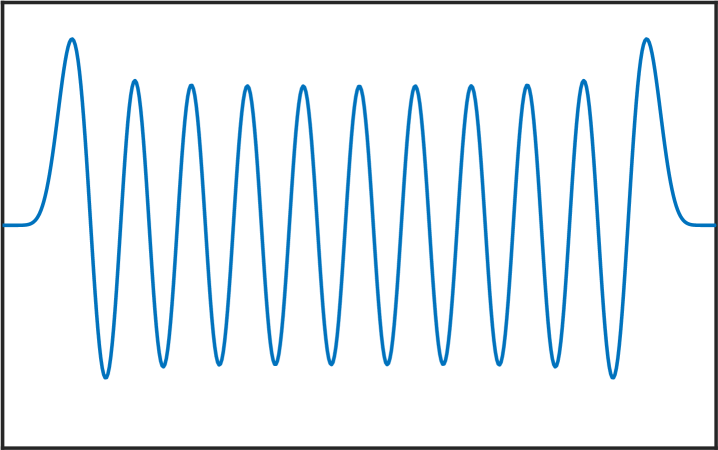
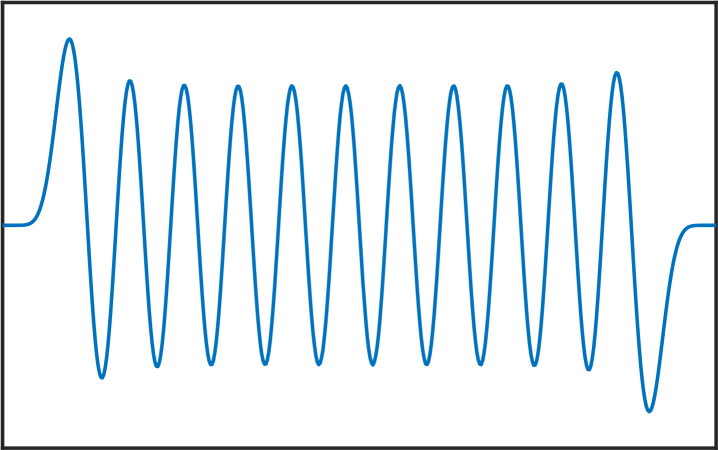
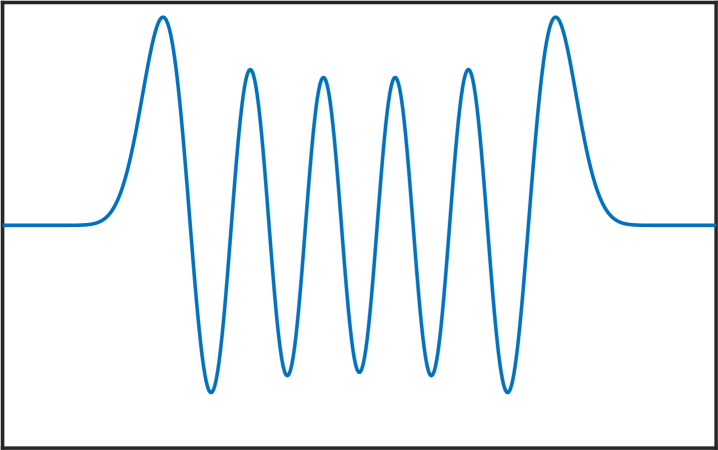
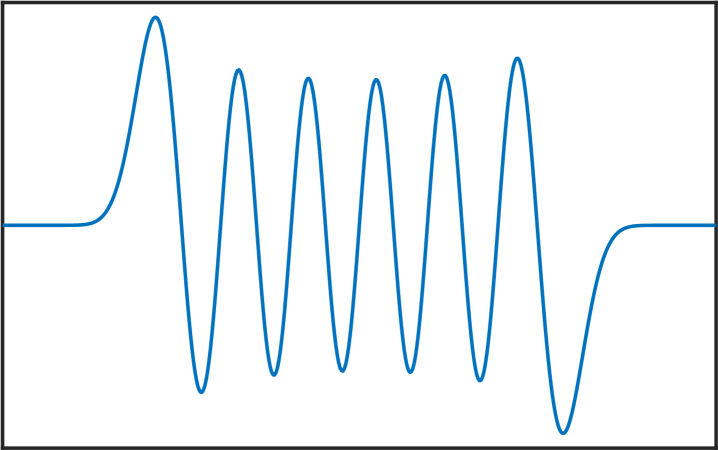
Melkman and Micchelli [17] proved that for all rr there exists an optimal space XnX_{n} containing Cr2C^{r-2} piecewise polynomials of degree r1r-1. The zeros of the eigenfunctions in (6) are exactly the internal knots of these spline spaces. Thus, the presented numerical method allows us to compute these knots, and as stated in the introduction, this can be very useful for Isogeometric Analysis [4]. See Figure 4 for various computed eigenfunctions in the case m=500m=500.

nn\rr 11 22 33 44 55 66
rr 9.80e08-9.80e-08 3.75e033.75e-03 3.33e16-3.33e-16 4.49e03-4.49e-03 8.65e03-8.65e-03 1.23e02-1.23e-02
r+1r+1 3.92e07-3.92e-07 9.89e05-9.89e-05 2.42e042.42e-04 2.33e052.33e-05 6.79e04-6.79e-04 1.70e03-1.70e-03
r+2r+2 8.82e07-8.82e-07 3.05e063.05e-06 3.33e16-3.33e-16 3.76e053.76e-05 1.95e05-1.95e-05 2.23e04-2.23e-04
r+3r+3 1.57e06-1.57e-06 1.03e07-1.03e-07 6.30e07-6.30e-07 3.65e063.65e-06 7.60e067.60e-06 2.13e05-2.13e-05
r+4r+4 2.45e06-2.45e-06 3.62e093.62e-09 5.55e16-5.55e-16 1.07e071.07e-07 2.02e062.02e-06 1.42e071.42e-07
r+5r+5 3.53e06-3.53e-06 1.36e10-1.36e-10 1.95e091.95e-09 1.95e08-1.95e-08 3.19e073.19e-07 7.51e077.51e-07
r+6r+6 4.80e06-4.80e-06 1.11e12-1.11e-12 9.99e16-9.99e-16 3.22e09-3.22e-09 3.47e083.47e-08 2.50e072.50e-07
r+7r+7 6.27e06-6.27e-06 1.02e11-1.02e-11 6.57e12-6.57e-12 1.98e10-1.98e-10 1.78e091.78e-09 5.95e085.95e-08
r+8r+8 7.93e06-7.93e-06 1.56e11-1.56e-11 3.22e15-3.22e-15 7.20e127.20e-12 2.85e10-2.85e-10 1.17e081.17e-08
r+9r+9 9.79e06-9.79e-06 2.33e11-2.33e-11 1.78e141.78e-14 2.83e122.83e-12 1.05e10-1.05e-10 1.93e091.93e-09
r+10r+10 1.19e05-1.19e-05 3.36e11-3.36e-11 3.11e153.11e-15 2.35e132.35e-13 1.93e11-1.93e-11 2.43e102.43e-10
r+11r+11 1.41e05-1.41e-05 4.69e11-4.69e-11 9.77e15-9.77e-15 8.20e14-8.20e-14 1.97e12-1.97e-12 1.52e111.52e-11
r+12r+12 1.66e05-1.66e-05 6.37e11-6.37e-11 1.24e14-1.24e-14 5.33e14-5.33e-14 1.36e12-1.36e-12 1.21e11-1.21e-11
r+13r+13 1.92e05-1.92e-05 8.48e11-8.48e-11 7.03e14-7.03e-14 2.22e162.22e-16 2.70e132.70e-13 8.33e12-8.33e-12
r+14r+14 2.20e05-2.20e-05 1.11e10-1.11e-10 6.00e156.00e-15 1.09e12-1.09e-12 5.37e13-5.37e-13 6.12e12-6.12e-12
r+15r+15 2.51e05-2.51e-05 1.42e10-1.42e-10 1.67e141.67e-14 1.48e121.48e-12 1.07e111.07e-11 4.82e11-4.82e-11
r+16r+16 2.83e05-2.83e-05 1.80e10-1.80e-10 1.60e141.60e-14 6.26e146.26e-14 1.19e111.19e-11 5.00e11-5.00e-11
r+17r+17 3.17e05-3.17e-05 2.25e10-2.25e-10 1.25e14-1.25e-14 1.55e13-1.55e-13 1.76e111.76e-11 8.50e118.50e-11
r+18r+18 3.54e05-3.54e-05 2.78e10-2.78e-10 2.79e14-2.79e-14 2.03e122.03e-12 3.13e11-3.13e-11 3.25e10-3.25e-10
r+19r+19 3.92e05-3.92e-05 3.39e10-3.39e-10 3.19e13-3.19e-13 3.85e123.85e-12 1.38e111.38e-11 5.46e10-5.46e-10
r+20r+20 4.32e05-4.32e-05 4.10e10-4.10e-10 2.74e132.74e-13 1.78e13-1.78e-13 7.52e12-7.52e-12 6.63e10-6.63e-10
r+21r+21 4.74e05-4.74e-05 4.92e10-4.92e-10 4.04e13-4.04e-13 4.82e134.82e-13 4.22e11-4.22e-11 3.85e103.85e-10
r+22r+22 5.18e05-5.18e-05 5.85e10-5.85e-10 3.02e133.02e-13 1.30e111.30e-11 2.68e112.68e-11 4.53e114.53e-11
r+23r+23 5.64e05-5.64e-05 6.92e10-6.92e-10 4.88e144.88e-14 1.09e11-1.09e-11 7.96e117.96e-11 3.42e10-3.42e-10
r+24r+24 6.12e05-6.12e-05 8.12e10-8.12e-10 8.22e13-8.22e-13 1.75e111.75e-11 5.40e105.40e-10 5.61e095.61e-09
r+25r+25 6.62e05-6.62e-05 9.47e10-9.47e-10 2.58e132.58e-13 1.81e111.81e-11 5.76e105.76e-10 3.92e093.92e-09
r+26r+26 7.14e05-7.14e-05 1.10e09-1.10e-09 2.63e132.63e-13 6.21e12-6.21e-12 1.75e10-1.75e-10 1.52e091.52e-09
r+27r+27 7.68e05-7.68e-05 1.27e09-1.27e-09 2.89e13-2.89e-13 2.32e11-2.32e-11 2.74e10-2.74e-10 2.08e09-2.08e-09
r+28r+28 8.24e05-8.24e-05 1.45e09-1.45e-09 2.16e132.16e-13 2.44e11-2.44e-11 1.89e09-1.89e-09 1.64e091.64e-09
r+29r+29 8.82e05-8.82e-05 1.66e09-1.66e-09 7.63e137.63e-13 3.21e113.21e-11 5.23e105.23e-10 2.31e08-2.31e-08
Table 1: The relative difference between the conjectured and computed value of dn1/rd_{n}^{-1/r} for r=1,,20r=1,\dots,20 and n=r,,r+5n=r,\dots,r+5 when h=211h=2^{-11}.
10310^{-3}10210^{-2}10110^{-1}101310^{-13}101110^{-11}10910^{-9}10710^{-7}10510^{-5}10310^{-3}10110^{-1}Mesh sizeErrorn=2n=3n=4n=5n=6n=7n=8
Figure 1: Convergence of (λh,n+1r)1/2(\lambda_{h,n+1-r})^{1/2} to dnd_{n} for r=2r=2 and n=2,,8n=2,\dots,8 in terms of hh. The result with h=211h=2^{-11} was taken as a reference. The dashed lines are h2h^{2} and h4h^{4}. Note that d8103d_{8}\approx 10^{-3} in this case.
10310^{-3}10210^{-2}10110^{-1}101810^{-18}101610^{-16}101410^{-14}101210^{-12}101010^{-10}10810^{-8}10610^{-6}10410^{-4}Mesh sizeErrorn=3n=4n=5n=6n=7n=8n=9
Figure 2: Convergence of (λh,n+1r)1/2(\lambda_{h,n+1-r})^{1/2} to dnd_{n} for r=3r=3 and n=3,,9n=3,\dots,9 in terms of hh. The result with h=211h=2^{-11} was taken as a reference. The dashed lines are h4h^{4} and h6h^{6}. Note that d8104d_{8}\approx 10^{-4} in this case.
10310^{-3}10210^{-2}10110^{-1}102010^{-20}101810^{-18}101610^{-16}101410^{-14}101210^{-12}101010^{-10}10810^{-8}10610^{-6}10410^{-4}Mesh sizeErrorn=4n=5n=6n=7n=8n=9n=10
Figure 3: Convergence of (λh,n+1r)1/2(\lambda_{h,n+1-r})^{1/2} to dnd_{n} for r=4r=4 and n=4,,10n=4,\dots,10 in terms of hh. The result with h=211h=2^{-11} was taken as a reference. The dashed lines are h6h^{6} and h8h^{8}. Note that d8105d_{8}\approx 10^{-5} in this case.
Refer to caption
Refer to caption
Refer to caption
Refer to caption
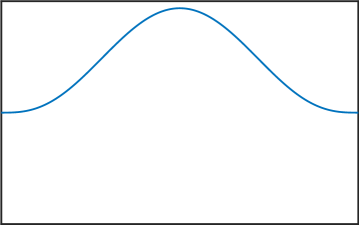
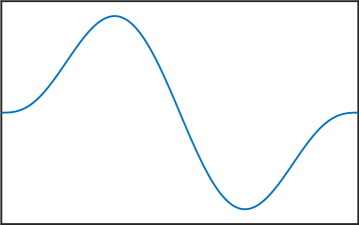
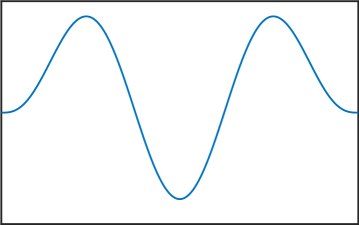
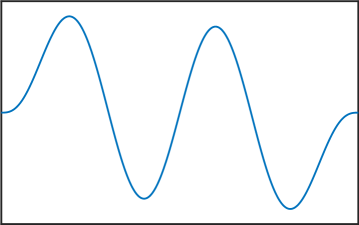
(a) First four eigenfunctions, r=1r=1.
Refer to caption
Refer to caption
Refer to caption
Refer to caption
(b) First four eigenfunctions, r=2r=2.
Refer to caption
Refer to caption
Refer to caption
Refer to caption
(c) First four eigenfunctions, r=3r=3.
Refer to caption
Refer to caption
(d) Eigenfunctions 2121 and 2222, r=10r=10.
Refer to caption
Refer to caption
(e) Eigenfunctions 1111 and 1212, r=20r=20.
Figure 4: Computed eigenfunctions on the interval [a,b]=[1,1][a,b]=[-1,1] with m=500m=500 for various choices of rr and kk.

Acknowledgements

Andrea Bressan was partially supported by the European Research Council through the FP7 Ideas Consolidator Grant HIGEOM n.616563, and by the Italian Ministry of Education, University and Research (MIUR) through the “Dipartimenti di Eccellenza Program (2018-2022) - Dept. of Mathematics, University of Pavia”. Espen Sande was supported by the Beyond Borders Programme of the University of Rome Tor Vergata through the project ASTRID (CUP E84I19002250005) and by the MIUR Excellence Department Project awarded to the Department of Mathematics, University of Rome Tor Vergata (CUP E83C18000100006). Andrea Bressan and Espen Sande are members of Gruppo Nazionale per il Calcolo Scientifico, Istituto Nazionale di Alta Matematica.

References

  • [1] P. M. Anselone and J. W. Lee, Spectral properties of integral operators with nonnegative kernels, Linear Algebra and Appl. 9 (1974), 67–87.
  • [2] K. Atkinson, Convergence rates for approximate eigenvalues of compact integral operators, SIAM J. Numer. Anal. 12 (1975), 213–222.
  • [3] A. Bressan and E. Sande, Approximation in FEM, DG and IGA: a theoretical comparison, Numer. Math. 143 (2019), 923–942.
  • [4] J. Chan and J. A. Evans, Multi-patch discontinuous Galerkin isogeometric analysis for wave propagation: explicit time-stepping and efficient mass matrix inversion, Comput. Methods Appl. Mech. Engrg. 333 (2018), 22–54.
  • [5] F. Chatelin, The spectral approximation of linear operators with applications to the computation of eigenelements of differential and integral operators, SIAM review 23 (1981), 495–522.
  • [6] G. Dahlquist and Å. Björck, Numerical methods in scientific computing: Volume 1, Society for Industrial and Applied Mathematics, 2008.
  • [7] J. A. Evans, Y. Bazilevs, I. Babuska, and T. J. R. Hughes, n-Widths, sup-infs, and optimality ratios for the k-version of the isogeometric finite element method, Comput. Methods Appl. Mech. Engrg. 198 (2009), 1726–1741.
  • [8] M. S. Floater and E. Sande, Optimal spline spaces of higher degree for L2L^{2} nn-widths, J. Approx. Theory 216 (2017), 1–15.
  • [9]   , On periodic L2L^{2} nn-widths, J. Comput. Appl. Math. 349 (2019), 403–409.
  • [10]   , Optimal spline spaces for L2L^{2} nn-width problems with boundary conditions, Constr. Approx. 50 (2019), 1–18.
  • [11] A. Ioffe and V. M. Tihomirov, Duality of convex functions and extremum problems, Russian Math. Surveys 23 (1968), 53–124.
  • [12] S. Karlin, Total positivity, Vol. I, Stanford University Press, Stanford, California, 1968.
  • [13] L. A. Karlovitz, Remarks on variational characterizations of eigenvalues and n-width problems, J. Math. Anal. Appl. 53 (1976), 99–110.
  • [14] A. Kolmogorov, Über die beste Annäherung von Funktionen einer gegebenen Funktionenklasse, Ann. of Math. 37 (1936), 107–110.
  • [15] N. P. Korneichuk, Exact constants in approximation theory, Cambridge University press, Cambridge, 1991.
  • [16] Tom Lyche and Knut Morken, Spline methods draft, 2011.
  • [17] A. A. Melkman and C. A. Micchelli, Spline spaces are optimal for L2L^{2} nn-widths, Illinois J. Math. 22 (1978), 541–564.
  • [18] C. A. Micchelli and A. Pinkus, On n-widths in L-infinity, Trans. Amer. Math. Soc. 234 (1977), 139–174.
  • [19] J. E. Osborn, Spectral approximation for compact operators, Math. Comp. 29 (1975), 712–725.
  • [20] A. Pinkus, n-Widths in approximation theory, Springer-Verlag, Berlin, 1985.
  • [21] E. Sande, C. Manni, and H. Speleers, Sharp error estimates for spline approximation: Explicit constants, nn-widths, and eigenfunction convergence, Math. Models Methods Appl. Sci. 29 (2019), 1175–1205.
  • [22] M. H. Schultz, Error bounds for polynomial spline interpolation, Math. Comp. 24 (1970), 507–515.
  • [23] A. Yu. Shadrin, Inequalities of Kolmogorov type and estimates of spline interpolation on periodic classes W2mW^{m}_{2}, Mat. Zametki 48 (1990), 132–139.
  • [24] V. M. Tikhomirov, Approximation theory, Analysis II: Convex Analysis and Approximation Theory (R. V. Gamkrelidze, ed.), Springer Berlin Heidelberg, 1990, pp. 93–243.