This paper was converted on www.awesomepapers.org from LaTeX by an anonymous user.
Want to know more? Visit the Converter page.

]http://www-tkm.physik.uni-karlsruhe.de/ greiter/

On the linear dispersion–linear potential quantum oscillator

Martin Greiter Institut für Theorie der Kondensierten Materie, Karlsruhe Institute of Technology, 76128 Karlsruhe, Germany [
(July 26, 2025)
Abstract

We solve the bi-linear quantum oscillator H=v|p|+F|x|H=v|p|+F|x| both quasi-classically and numerically.

Linear quantum oscillator; Confinement; Linear dispersion; Spinons; Spin ladder models
pacs:
03.65.Ge; 02.60.Cb; 75.10.Kt; 75.10.Pq

I Introduction

With the quantum theory, as it was called at the time, nearing it first centennial anniversary, it is a rare opportunity to study an one-dimensional ideal oscillator which has not been solved long ago. The motion of a (non-relativistic) quantum particle with a linear dispersion, ϵp=v|p|\epsilon_{p}=v\cdot|p|, where p=kp=\hbar k is the momentum and vv is a parameter, in a linearly confining potential V(x)=F|x|V(x)=F\cdot|x|, where xx is the position and the constant force FF again a parameter, however, appears to provide an example. While the problem may look trivial at first, it is not. The usual method of quantization by replacing either pixp\rightarrow-i\hbar\frac{\partial}{\partial x} or xipx\rightarrow i\hbar\frac{\partial}{\partial p} cannot be applied directly, as one cannot sensibly define the absolute value of a differential operator.

The problem is not just of academic interest, but even of relevance to a recent experiment lake-09np50 ; greiter09np5 . Spinons, the fractionally quantized and elementary excitations in antiferromagnetic spin chains, are well known to disperse linearly at low energies, with vv proportional to the antiferromagnetic exchange constant JJ along the chains Giamarchi04 . Spinons carry the spin of an electron but no charge. Since the antiparticle for a spinon is just another spinon with its spin reversed, the spectrum has only a positive energy branch. An one couples two chains antiferromagnetically Dagotto-96s618 , the coupling JJ_{\perp} will induce a linear confinement potential between pairs of spinons, as the rungs between two spinons become effectively decorrelated Shelton-96prb8521 ; greiter02prb054505 . To a very first approximation, the energy gap in the spin ladder is hence given by the ground state energy of the bi-linear oscillator

H=v|p|+F|x|,H=v|p|+F|x|, (1)

which we study in this Article. The ground state is symmetric under one-dimensional parity xxx\rightarrow-x and corresponds to a spinon pair in the triplet channel, while the first excited state is antisymmetric under xxx\rightarrow-x corresponds to the lowest singlet excitation in the spin ladder. It the context of this problem, it is hence desirable to know what the lowest eigenvalues of (1) are. From dimensional considerations, it is immediately clear that they must scale like vF\sqrt{\hbar\;\!vF}.

II Quasiclassical Approach

Even though the usual method of quantization can not be applied directly, the problem can still be approached quasi-classically. Applying the Bohr-Sommerfeld quantization condition Landau3

12πp𝑑x=n+12,\frac{1}{2\pi\hbar}\oint pdx=n+\frac{1}{2}, (2)

where we are supposed to integrate over the entire classical orbit, results with p(x)=EnF|x|vp(x)=\frac{E_{n}-F|x|}{v} in

12π 40En/FEnFxv𝑑x=n+12.\frac{1}{2\pi\hbar}\,4\int_{0}^{E_{n}/F}\frac{E_{n}-Fx}{v}dx=n+\frac{1}{2}. (3)

Carrying out the integration yields

En=π(n+12)vF.E_{n}=\sqrt{\pi\left(n+\frac{1}{2}\right)}\cdot\sqrt{\hbar\;\!vF}. (4)

We expect this to constitute a reasonable approximation for the higher energy levels, but probably not for the low lying ones. Indeed, this is what we will find as we solve the problem numerically below.

III Mathematical Formulation

Before proceeding with the numerical solution, let us rewrite the eigenvalue equation Hψ(x)=Eψ(x)H\psi(x)=E\psi(x) as a differential (and integral) equation in position space. For convenience, we consider the dimensionless Hamiltonian

H=|k|+|x|,H=|k|+|x|, (5)

which is obtained from (1) by rescaling

HvFH,vFkk,andFvxx.\frac{H}{\sqrt{\hbar\;\!vF}}\rightarrow H,\;\sqrt{\frac{\hbar\;\!v}{F}}k\rightarrow k,\;\text{and}\ \sqrt{\frac{F}{\hbar\;\!v}}x\rightarrow x. (6)

Let us denote the eigenvalues of (5) by λ\lambda and the eigenfunctions by ϕ(x)\phi(x). With

ϕ~(k)\displaystyle\tilde{\phi}(k) \displaystyle\equiv 12πϕ(x)eikx𝑑x,\displaystyle\frac{1}{\sqrt{2\pi}}\int_{-\infty}^{\infty}\phi(x)e^{-ikx}dx, (7)
ϕ(x)\displaystyle\phi(x) =\displaystyle= 12πϕ~(k)eikx𝑑k,\displaystyle\frac{1}{\sqrt{2\pi}}\int_{-\infty}^{\infty}\tilde{\phi}(k)e^{ikx}dk, (8)

we may write

|k|ϕ(x)\displaystyle|k|\,\phi(x) =\displaystyle= 12πksign(k)ϕ~(k)eikx𝑑k\displaystyle\frac{1}{\sqrt{2\pi}}\int_{-\infty}^{\infty}k\;\text{sign}(k)\,\tilde{\phi}(k)e^{ikx}dk (9)
=\displaystyle= ix12πsign(k)ϕ~(k)eikx𝑑k\displaystyle-i\frac{\partial}{\partial x}\frac{1}{\sqrt{2\pi}}\int_{-\infty}^{\infty}\text{sign}(k)\,\tilde{\phi}(k)e^{ikx}dk
=\displaystyle= ix12πs~(xx)ϕ(x)𝑑x,\displaystyle-i\frac{\partial}{\partial x}\frac{1}{\sqrt{2\pi}}\int_{-\infty}^{\infty}\tilde{s}(x-x^{\prime})\,\phi(x^{\prime})dx^{\prime},

where

sign(k)={+1k01k<0\text{sign}(k)=\begin{cases}+1&k\geq 0\\ -1&k<0\end{cases}

is the sign function and

s~(x)\displaystyle\tilde{s}(x) =\displaystyle= 12πlimϵ0sign(k)eϵ|k|eikx𝑑k\displaystyle\frac{1}{\sqrt{2\pi}}\lim_{\epsilon\rightarrow 0}\int_{-\infty}^{\infty}\text{sign}(k)\,e^{-\epsilon|k|}e^{ikx}dk (10)
=\displaystyle= 2i2πlimϵ0xx2+ϵ2=2i2π𝒫1x,\displaystyle\frac{2i}{\sqrt{2\pi}}\lim_{\epsilon\rightarrow 0}\frac{x}{x^{2}+\epsilon^{2}}\,=\frac{2i}{\sqrt{2\pi}}\,\mathcal{P}\frac{1}{x},

where 𝒫\mathcal{P} denotes the principal part, is the Fourier transform thereof. The eigenfunctions ϕ(x)\phi(x) with eigenvalues λ\lambda of (5) are hence the solutions of

1πx𝒫ϕ(x)xx𝑑x+|x|ϕ(x)=λϕ(x).\frac{1}{\pi}\frac{\partial}{\partial x}\mathcal{P}\!\int_{-\infty}^{\infty}\frac{\phi(x^{\prime})}{x-x^{\prime}}dx^{\prime}+|x|\,\phi(x)=\lambda\phi(x). (11)

While (11) provides a clear mathematical formulation of the problem, we are not aware of any method to solve it analytically, nor consider it a viable starting point for numerical work.

IV Numerical Solution

To solve (5) numerically, we exactly diagonalize a finite Hamiltonian matrix we obtain through discretization of position space with a suitably chosen cutoff.

Let this discrete Hilbert space consist of NN sites, with the positions

xi=a(iN+12)x_{i}=a\left(i-\frac{N+1}{2}\right) (12)

where i=1,2,Ni=1,2,\ldots N and aa is the lattice constant. The cutoff |xc|=Na/2|x_{c}|={Na}/{2} in real space implies a cutoff

λc=Na2\lambda_{c}=\frac{Na}{2} (13)

for the potential energy in (5), which must be chosen significantly larger than the largest eigenvalue λn\lambda_{n} we wish to evaluate reliably. (From (4), we expect λn\lambda_{n} to be of order π(n+12)\sqrt{\pi\left(n+\frac{1}{2}\right)}.) On the other hand, the classically allowed part of the Hilbert space will contain only of the order of N/λc{N}/{\lambda_{c}} sites for the ground state, which implies that we must further require λcN\lambda_{c}\ll N.

The lattice provides us simultaneously with a cutoff in momentum space, πakπ-\pi\leq ak\leq\pi. We may hence expand |k||k| in a Fourier series,

|ak|=b02+m=1bmcos(mak)|ak|=\frac{b_{0}}{2}+\sum_{m=1}^{\infty}b_{m}\cos(mak) (14)

with

bm=1πππ𝑑k|k|cos(mk)={πm=04π1m2modd0otherwise,b_{m}=\frac{1}{\pi}\int_{-\pi}^{\pi}dk|k|\cos(mk)=\begin{cases}\pi&m=0\\ -\frac{4}{\pi}\frac{1}{m^{2}}&m\ \text{odd}\\ 0&\text{otherwise},\end{cases} (15)

as one may easily verify through integration by parts. We proceed by writing (5) in second quantized notation,

H\displaystyle H =\displaystyle= k|k|ckck+i|xi|cici\displaystyle\sum_{k}|k|\,c_{k}^{\dagger}c_{k}+\sum_{i}|x_{i}|\,c_{i}^{\dagger}c_{i} (16)
=\displaystyle= 1ak|ak|ckck+ai|iN+12|cici\displaystyle\frac{1}{a}\sum_{k}|ak|\,c_{k}^{\dagger}c_{k}+a\sum_{i}\left|i-\frac{N+1}{2}\right|\,c_{i}^{\dagger}c_{i}\quad

where

ck=1Nieikxici,ci=1Nkeikxick.c_{k}^{\dagger}=\frac{1}{\sqrt{N}}\sum_{i}e^{ikx_{i}}c_{i}^{\dagger},\quad c_{i}^{\dagger}=\frac{1}{\sqrt{N}}\sum_{k}e^{-ikx_{i}}c_{k}^{\dagger}. (17)

Since

kcos(mak)ckck=12i(cici+m+h.c.),\sum_{k}\cos(mak)\,c_{k}^{\dagger}c_{k}=\frac{1}{2}\sum_{i}(c_{i}^{\dagger}c_{i+m}+\text{h.c.}), (18)

we obtain

H=i,j=1NcihijcjH=\sum_{i,j=1}^{N}c_{i}^{\dagger}h_{ij}c_{j} (19)

with

hij={N2λcπ2+2λcN|iN+12|i=jN2λc2π1(ij)2ijodd0otherwise,h_{ij}=\begin{cases}\frac{N}{2\lambda_{c}}\frac{\pi}{2}+\frac{2\lambda_{c}}{N}\left|i-\frac{N+1}{2}\right|&i=j\\[3.0pt] -\frac{N}{2\lambda_{c}}\frac{2}{\pi}\frac{1}{(i-j)^{2}}&i-j\ \text{odd}\\[3.0pt] 0&\text{otherwise},\end{cases} (20)

where we have substituted 2λcN\frac{2\lambda_{c}}{N} for aa.

mm λ2m\lambda_{2m} λ2m+1\lambda_{2m+1} λ2m\lambda_{2m} λ2m+1\lambda_{2m+1}
numerically quasi-classically
0 1.10408 2.23229 1.2533 2.1708
1 2.77281 3.33002 2.8025 3.3160
2 3.75118 4.16416 3.7599 4.1568
3 4.51300 4.85855 4.5189 4.8541
4 5.16402 5.46623 5.1675 5.4631
5 5.74065 6.01303 5.7434 6.0107
6 6.26457 6.51426 6.2666 6.5124
7 6.74763 6.97965 6.7493 6.9782
8 7.19841 7.41595 7.1997 7.4147
9 7.62246 7.82800 7.6236 7.8269
Table 1: Eigenvalues λn\lambda_{n} for n=0,,19n=0,\ldots,19 obtained by exact diagonalization of (20) for N=20001N=20001, λc=20\lambda_{c}=20. From the scaling behavior with NN and comparisons of different values for λc\lambda_{c}, we estimate the error due to the finite size to be less than ±0.00002\pm 0.00002 for nn even and ±0.00001\pm 0.00001 for nn odd. For comparison, we also list the quasi-classical values (4).

Numerical diagonalization of hijh_{ij} yields the eigenvalues λn\lambda_{n} and eigenfunctions ϕn(xi)\phi_{n}(x_{i}) of (5), and hence the eigenvalues and eigenfunctions

En=λnvF,ψn(x)=ϕn(Fvx)E_{n}=\lambda_{n}\sqrt{\hbar\;\!vF},\ \ \psi_{n}(x)=\phi_{n}\!\!\left(\sqrt{\frac{F}{\hbar\;\!v}}\,x\right) (21)

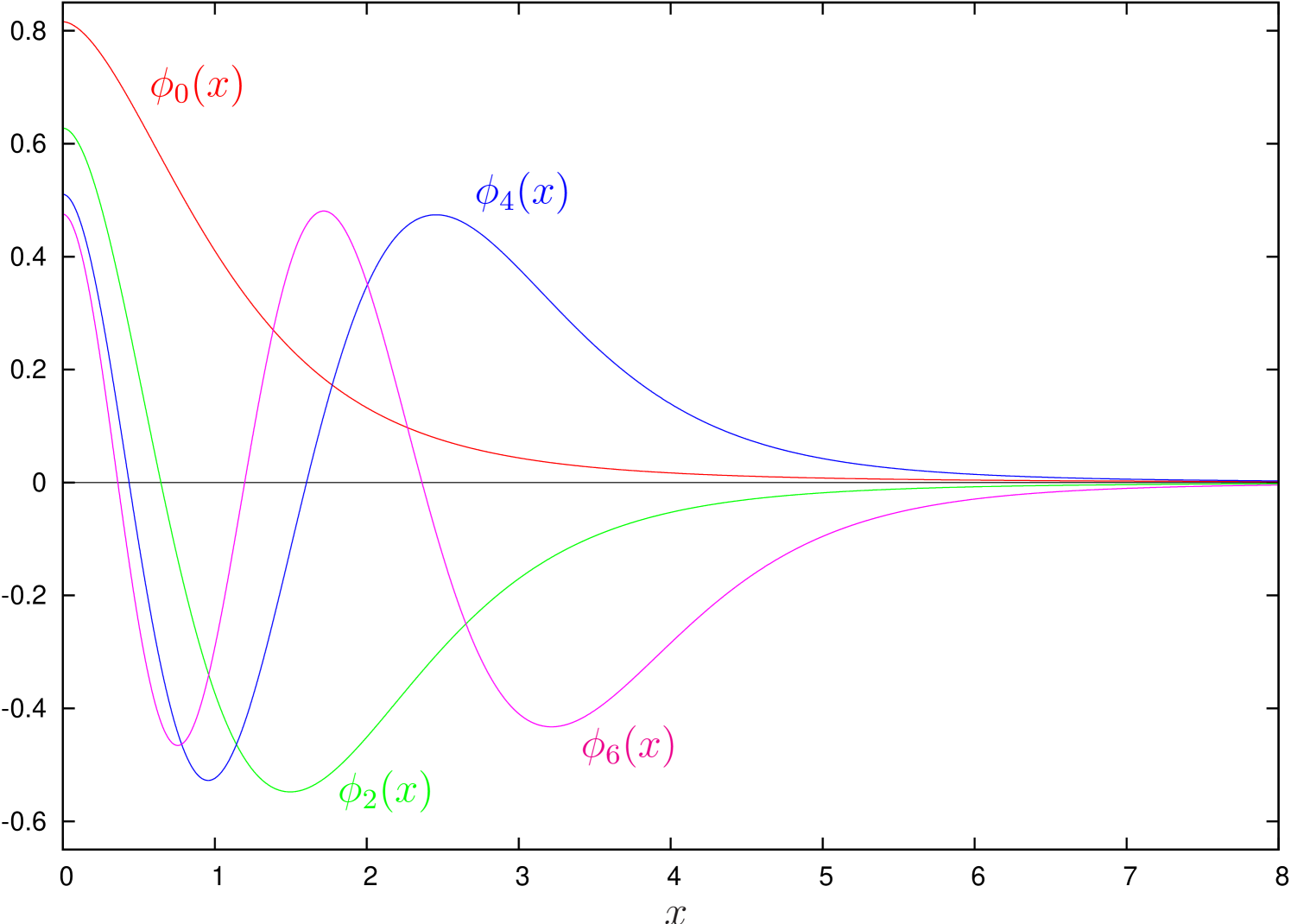
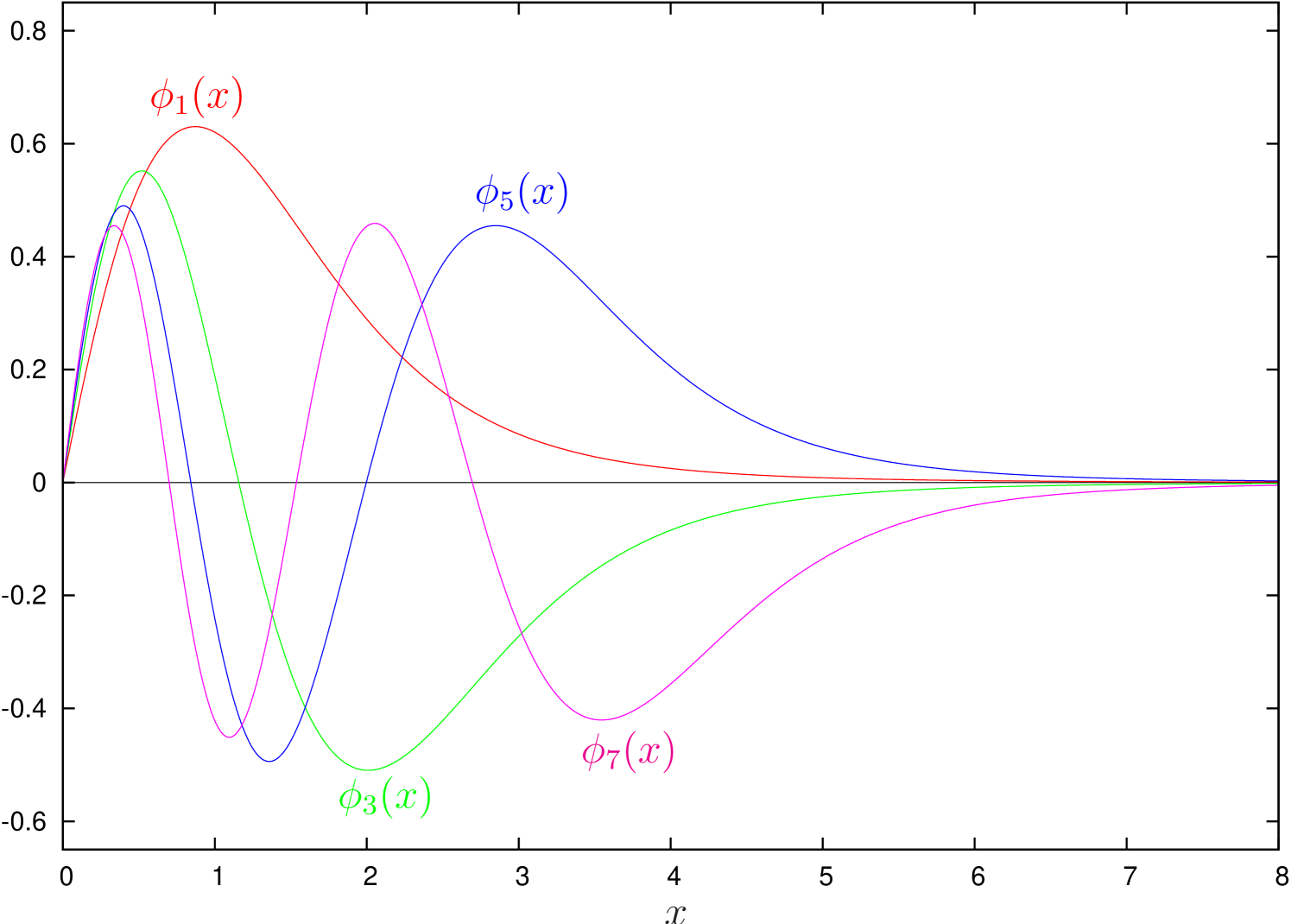
of (1). The results for N=20001N=20001, λc=20\lambda_{c}=20 are listed in Table 1 and Figures 1 and 2. (We have chosen an odd number for NN, because this means that the position x=0x=0, where the potential |x||x| is not differentiable, coincides with a lattice point. Including this point improves the convergence of the eigenvalues and functions for nn even.) From Table 1, we see that the quasi-classically obtained eigenvalues converge towards the numerically obtained values as nn is increased.

Refer to caption
Figure 1: (Color online) The first four symmetric eigenfunctions ϕn(x)=ϕn(x)\phi_{n}(-x)=\phi_{n}(x) for nn even obtained numerically for N=20001N=20001, λc=20\lambda_{c}=20.
Refer to caption
Figure 2: (Color online) The first four antisymmetric eigenfunctions ϕn(x)=ϕn(x)\phi_{n}(-x)=-\phi_{n}(x) for nn odd obtained numerically for N=20001N=20001, λc=20\lambda_{c}=20.
Refer to caption
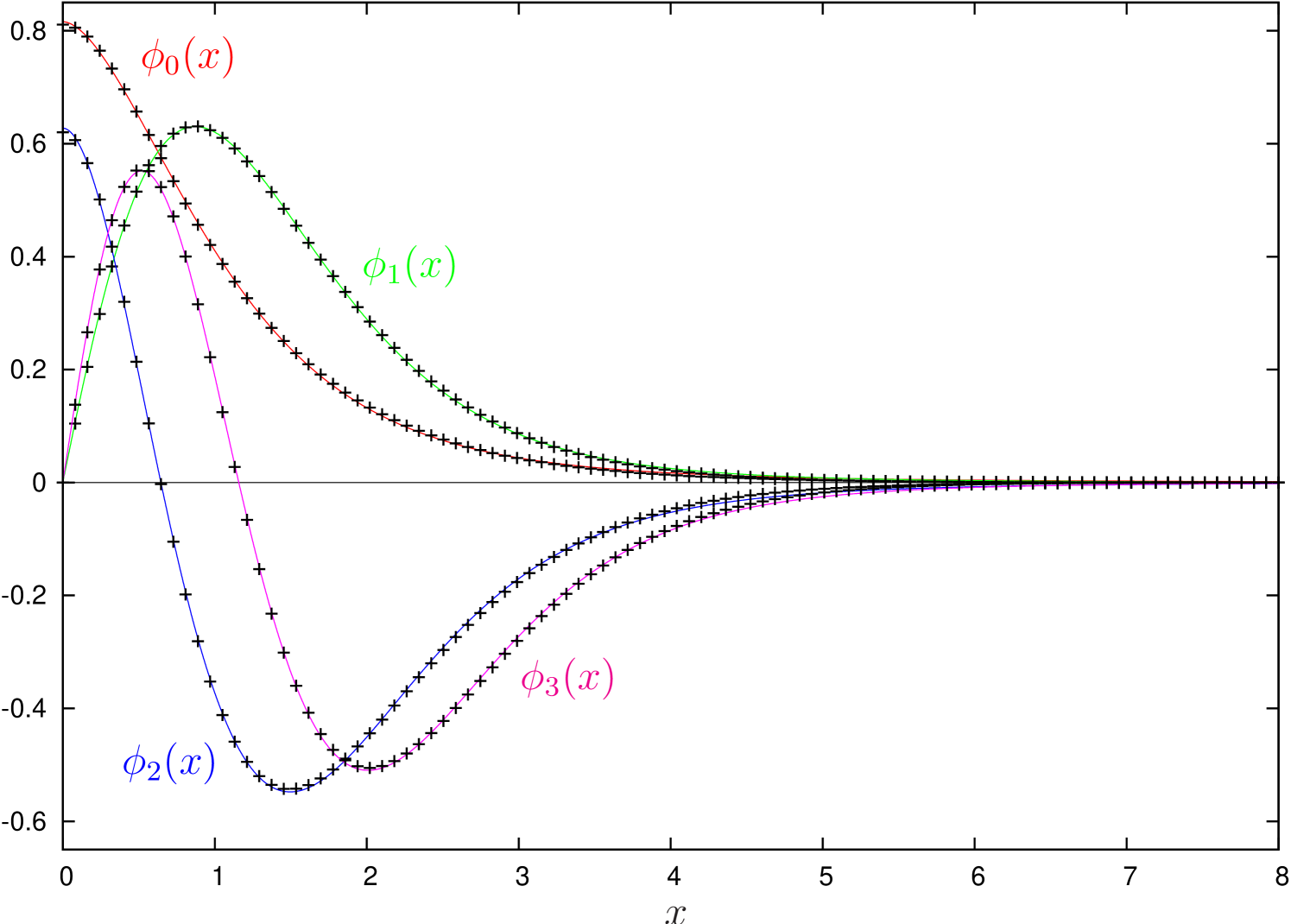
Figure 3: (Color online) Juxtapositions of the first four eigenfunctions ϕn(x)\phi_{n}(x) obtained numerically (lines) with the fits described in the text (black crosses).
nn ana_{n} bnb_{n} cnc_{n} dnd_{n}
0 1.1849 0.57196 0.4681
1 1.7443 0.96843 1.9494
2 1.9517 0.94194 2.2398 0.64431
3 2.2842 1.17617 2.9428 1.15453
Table 2: Parameters obtained numerically from fitting (22) and (23) to the functions ϕn(x)\phi_{n}(x) obtained by exact diagonalization of (20) for N=20001N=20001, λc=20\lambda_{c}=20.

The eigenfunctions obtained numerically can be approximated by

ϕn(x)=xnexp(anx2+bn2+cn)\phi_{n}(x)=x^{n}\exp\Bigl{(}-a_{n}\sqrt{x^{2}+b_{n}^{2}}+c_{n}\Bigr{)} (22)

for n=0,1n=0,1 and by

ϕn(x)=xn2(dn2x2)exp(anx2+bn2+cn)\phi_{n}(x)=x^{n-2}\left(d_{n}^{2}-x^{2}\right)\exp\Bigl{(}-a_{n}\sqrt{x^{2}+b_{n}^{2}}+c_{n}\Bigr{)} (23)

for n=2,3n=2,3, with parameters ana_{n}, bnb_{n}, cnc_{n}, and dnd_{n} listed in Table 2. Comparisons of these fits to the numerically obtained eigenfunctions are shown in Figure 3. The fits are not as good an approximation as Figure 3 may suggest, however, as they fall off as exp(a|x|)\exp(-a|x|) while the true eigenfunctions ϕn(x)\phi_{n}(x) fall off as 1/x31/x^{3} for nn even and as 1/x41/x^{4} for nn odd as xx\rightarrow\infty.

This asymptotic behavior of the eigenfunctions can be understood physically through second order perturbation theory. If we consider a small region around a point xλx\gg\lambda (i.e., very far away from the classically allowed region for the eigenstate with energy λ\lambda), the amplitude there will be governed by scattering into this region from the classically allowed region, which contains almost the entire amplitude of the state. From (20), this scattering is proportional to

λnλtλn+λtϕn(x)(xx)2𝑑x{1x2neven1x3nodd,\int_{-\lambda_{n}-\lambda_{t}}^{\lambda_{n}+\lambda_{t}}\frac{\phi_{n}(x^{\prime})}{(x-x^{\prime})^{2}}dx^{\prime}\propto\begin{cases}\frac{1}{x^{2}}&n\ \text{even}\\[3.0pt] \frac{1}{x^{3}}&n\ \text{odd},\end{cases} (24)

where λt\lambda_{t} is a cutoff to insure that we include the tail immediately surrounding the classically allowed region in the integral (from Figs. 1 and 2, we see that λt=3\lambda_{t}=3 would be a reasonable choice). With the potential energy in the region we consider given by |x||x|, the amplitude for finding the particle there will be proportional to 1/x31/x^{3} for nn even and as 1/x41/x^{4} for nn odd.

The numerical work reported here indicates that, within the limits of accuracy, the solutions are differentiable at x=0x=0, i.e., the expansion of ϕn(x)\phi_{n}(x) around x=0x=0 does not contain a term proportional to |x||x| for nn even or x|x|x\,|x| for nn odd. Unfortunately, we have not been able to reach a conclusion regarding higher terms, and cannot tell whether there are terms proportional to x2|x|x^{2}|x| for nn even or x3|x|x^{3}|x| for nn odd.

V Further Considerations

It would be highly desirable to identify the exact eigenvalues and functions of (5). Unfortunately, we have as of yet not even succeeded in obtaining those for the ground state. A few thoughts on this problem, however, are possibly worth mentioning.

V.1 Fourier Symmetry

As the Hamiltonian (5) maps onto itself under Fourier transformation, and all the eigenstates are non-degenerate, the eigenfunctions ϕ(x)\phi(x) must likewise map into itself under Fourier transformation (7),

ϕ~n(x)=(i)nϕn(x).\tilde{\phi}_{n}(x)=(-i)^{n}\phi_{n}(x). (25)

This condition is directly fulfilled by certain functions, like the Gaussian eigenfunctions of the harmonic oscillator H=12(k2+x2)H=\frac{1}{2}(k^{2}+x^{2}),

ϕn(x)=(xx)nexp(x22),\phi_{n}(x)=\left(x-\frac{\partial}{\partial x}\right)^{n}\exp\left(-\frac{x^{2}}{2}\right),

or the function

ϕ0(x)=1cosh(π2x).\phi_{0}(x)=\frac{1}{\cosh\left(\sqrt{\frac{\pi}{2}}x\right)}.

The eigenfunctions of (5), however, do not need to be of any such particular form. For example, the Ansatz

ϕn(x)=inφ~n(x)+φn(x)\phi_{n}(x)=i^{n}\tilde{\varphi}_{n}(x)+\varphi_{n}(x) (26)

satisfies (25) in general, as (7) implies φ~~n(x)=φn(x)=(1)nφn(x){\tilde{\tilde{\varphi}}}_{n}(x)=\varphi_{n}(-x)=(-1)^{n}\varphi_{n}(x).

It is conceivable that the function φ(x)\varphi(x) displays the required asymptotic behavior mentioned above, while the Fourier transform φ~(x)\tilde{\varphi}(x) falls off more rapidly. A first guess for the ground state along these lines might be

φ0(x)=1(x2+a2)3/2,\varphi_{0}(x)=\frac{1}{(x^{2}+a^{2})^{3/2}}, (27)

with its Fourier transform given by a modified Bessel function of the second kind,

φ~0(x)=2π|x|aK1(a|x|).\tilde{\varphi}_{0}(x)=\sqrt{\frac{2}{\pi}}\frac{|x|}{a}K_{1}(a|x|). (28)

With a1.172a\approx 1.172, this provides a very reasonable approximation, but does not solve the problem exactly.

V.2 Asymptotic Behavior

Even though we are unable to solve (11), we can use it to determine the asymptotic behavior of the solutions ϕn(x)\phi_{n}(x) as xx\rightarrow\infty accurately. Let us first consider even eigenfunctions ϕn(x)=ϕn(x)\phi_{n}(-x)=\phi_{n}(x). Then (11) becomes

1πx𝒫02xϕn(x)x2x2𝑑x+|x|ϕn(x)=λnϕn(x),\frac{1}{\pi}\frac{\partial}{\partial x}\mathcal{P}\!\int_{0}^{\infty}\frac{2x\phi_{n}(x^{\prime})}{x^{2}-x^{\prime 2}}dx^{\prime}+|x|\,\phi_{n}(x)=\lambda_{n}\phi_{n}(x), (29)

For x+x\rightarrow+\infty, we obtain

2π1x20ϕn(x)𝑑x+O(1x4)+(xλn)ϕn(x)=0.-\frac{2}{\pi}\frac{1}{x^{2}}\int_{0}^{\infty}\phi_{n}(x^{\prime})dx^{\prime}+\,\text{O}\Bigl{(}\frac{1}{x^{4}}\Bigr{)}+(x-\lambda_{n})\,\phi_{n}(x)=0. (30)

With (7) and (25), however, we may write

ϕn(x)𝑑x=2πϕ~n(0)=(i)n2πϕn(0),\int_{-\infty}^{\infty}\phi_{n}(x)dx=\sqrt{2\pi}\tilde{\phi}_{n}(0)=(-i)^{n}\sqrt{2\pi}\phi_{n}(0), (31)

and hence obtain for nn even

ϕn(x)=(1)n/22πϕn(0)(1x3+λnx4+O(1x5)).\phi_{n}(x)=(-1)^{n/2}\sqrt{\frac{2}{\pi}}\phi_{n}(0)\biggl{(}\frac{1}{x^{3}}+\frac{\lambda_{n}}{x^{4}}+\,\text{O}\Bigl{(}\frac{1}{x^{5}}\Bigr{)}\!\biggr{)}. (32)

Similarly, we write (11) for the odd eigenfunctions ϕn(x)=ϕn(x)\phi_{n}(-x)=-\phi_{n}(x)

1πx𝒫02xϕn(x)x2x2𝑑x+|x|ϕn(x)=λnϕn(x),\frac{1}{\pi}\frac{\partial}{\partial x}\mathcal{P}\!\int_{0}^{\infty}\frac{2x^{\prime}\phi_{n}(x^{\prime})}{x^{2}-x^{\prime 2}}dx^{\prime}+|x|\,\phi_{n}(x)=\lambda_{n}\phi_{n}(x), (33)

For x+x\rightarrow+\infty, we obtain

4π1x30xϕn(x)𝑑x+O(1x5)+(xλn)ϕn(x)=0-\frac{4}{\pi}\frac{1}{x^{3}}\int_{0}^{\infty}x^{\prime}\phi_{n}(x^{\prime})dx^{\prime}+\text{O}\Bigl{(}\frac{1}{x^{5}}\Bigr{)}+(x-\lambda_{n})\,\phi_{n}(x)=0 (34)

With (7) and (25), the integral becomes

xϕn(x)𝑑x\displaystyle\int_{-\infty}^{\infty}x\,\phi_{n}(x)dx =\displaystyle= 2πikϕ~n(k)|k=0.\displaystyle\sqrt{2\pi}\cdot i\frac{\partial}{\partial k}\tilde{\phi}_{n}(k)\Bigl{|}_{k=0}\Bigr{.} (35)
=\displaystyle= (i)n12πϕn(0).\displaystyle(-i)^{n-1}\sqrt{2\pi}\phi_{n}^{\prime}(0).

This yields for nn odd

ϕn(x)=(1)(n1)222πϕn(0)(1x4+λnx5+O(1x6)).\phi_{n}(x)=(-1)^{\frac{\scriptstyle(n-1)}{\scriptstyle 2}}2\sqrt{\frac{2}{\pi}}\phi_{n}^{\prime}(0)\biggl{(}\frac{1}{x^{4}}+\frac{\lambda_{n}}{x^{5}}+\,\text{O}\Bigl{(}\frac{1}{x^{6}}\Bigr{)}\!\biggr{)}. (36)

The asymptotic behavior emphasizes how different the bi-linear oscillator (5) is from the well known harmonic oscillator.

V.3 Integral relations

We can apply some general properties of Hilbert transformations, defined asErdeyli54

[f](x)1π𝒫f(x)xx𝑑x,\mathcal{H}[f](x)\equiv\frac{1}{\pi}\mathcal{P}\!\int_{-\infty}^{\infty}\frac{f(x^{\prime})}{x-x^{\prime}}dx^{\prime}, (37)

where 𝒫\mathcal{P} denotes the principle part, to rewrite (11). With

x[f](x)\displaystyle\frac{\partial}{\partial x}\mathcal{H}[f](x) =\displaystyle= [f](x),\displaystyle\mathcal{H}[f^{\prime}](x), (38)
[[f]](x)\displaystyle\mathcal{H}\big{[}\mathcal{H}[f]\big{]}(x) =\displaystyle= f(x),\displaystyle-f(x), (39)

we obtain

ϕn(x)x+1π𝒫(λn|x|)ϕn(x)xx𝑑x=0.\frac{\partial\phi_{n}(x)}{\partial x}+\frac{1}{\pi}\mathcal{P}\!\int_{-\infty}^{\infty}\frac{(\lambda_{n}-|x^{\prime}|)\phi_{n}(x^{\prime})}{x-x^{\prime}}dx^{\prime}=0. (40)

Expanding the integral for the limit xx\rightarrow\infty, we obtain for nn even

ϕn(x)x=2π1x0(λnx)ϕn(x)𝑑x+O(1x3).\frac{\partial\phi_{n}(x)}{\partial x}=\frac{2}{\pi}\frac{1}{x}\int_{0}^{\infty}(\lambda_{n}-x^{\prime})\phi_{n}(x^{\prime})dx^{\prime}+\,\text{O}\Bigl{(}\frac{1}{x^{3}}\Bigr{)}. (41)

With (32), this implies

0(xλn)ϕn(x)𝑑x=0,\int_{0}^{\infty}(x-\lambda_{n})\phi_{n}(x)dx=0, (42)

and with (31)

0xϕn(x)𝑑x=(1)n/2π2λnϕn(0).\int_{0}^{\infty}x\phi_{n}(x)dx=(-1)^{n/2}\sqrt{\frac{\pi}{2}}\lambda_{n}\phi_{n}(0). (43)

Similarly, we obtain in this limit for nn odd

ϕn(x)x=2π1x20x(λnx)ϕn(x)𝑑x+O(1x4).\frac{\partial\phi_{n}(x)}{\partial x}=\frac{2}{\pi}\frac{1}{x^{2}}\int_{0}^{\infty}x^{\prime}(\lambda_{n}-x^{\prime})\phi_{n}(x^{\prime})dx^{\prime}+\,\text{O}\Bigl{(}\frac{1}{x^{4}}\Bigr{)}. (44)

With (36), this implies

0x(xλn)ϕn(x)𝑑x=0,\int_{0}^{\infty}x(x-\lambda_{n})\phi_{n}(x)dx=0, (45)

and with (35)

0x2ϕn(x)𝑑x=(1)(n1)2π2λnϕn(0).\int_{0}^{\infty}x^{2}\phi_{n}(x)dx=(-1)^{\frac{\scriptstyle(n-1)}{\scriptstyle 2}}\sqrt{\frac{\pi}{2}}\lambda_{n}\phi_{n}(0). (46)

VI Conclusion

We have succeeded in solving the bi-linear oscillator H=v|p|+F|x|H=v|p|+F|x| both quasi-classically and numerically. In an attempt to solve it analytically as well, we have derived a differential and integral equation, and obtained the asymptotic behavior for large xx. We further formulated several conditions the solutions must satisfy. The problem of obtaining an analytical solution, however, is still open.

Acknowledgements.
I am grateful to R. von Baltz, W. Lang, A.D. Mirlin, and P. Wölfle for valuable discussions of this problem.

References

  • (1) B. Lake, A. M. Tsvelik, S. Notbohm, D. A. Tennant, T. G. Perring, M. Reehuis, C. Sekar, G. Krabbes, and B. Büchner, Nat. Phys. 6, 50 (2009).
  • (2) M. Greiter, Nat. Phys. 6, 5 (2009).
  • (3) T. Giamarchi, Quantum Physics in One Dimension (Oxford University Press, Oxford, 2004).
  • (4) E. Dagotto and T. M. Rice, Science 271, 618 (1996).
  • (5) D. G. Shelton, A. A. Nersesyan, and A. M. Tsvelik, Phys. Rev. B 53, 8521 (1996).
  • (6) M. Greiter, Phys. Rev. B 66, 054505 (2002).
  • (7) L. D. Landau and E. M. Lifshitz, Quantum Mechanics (Butterworth-Heinemann, Oxford, 1981).
  • (8) Tables of Integral Transforms, edited by A. Erdélyi (McGraw-Hill, New York, 1954), Vol. II.