This paper was converted on www.awesomepapers.org from LaTeX by an anonymous user.
Want to know more? Visit the Converter page.

Optimal reinsurance and investment under common shock dependence between financial and actuarial markets

Claudia Ceci Claudia Ceci, Department of Economics, University “G. D’Annunzio” of Chieti-Pescara, Viale Pindaro, 42, I-65127 Pescara, Italy. c.ceci@unich.it Katia Colaneri Katia Colaneri, Department of Economics and Finance, University of Rome Tor Vergata, via Columbia, 2, I-00133 Rome, Italy katia.colaneri@uniroma2.it  and  Alessandra Cretarola Alessandra Cretarola, Department of Mathematics and Computer Science, University of Perugia, Via Luigi Vanvitelli, 1, I-06123 Perugia, Italy. alessandra.cretarola@unipg.it
Abstract.

We study optimal proportional reinsurance and investment strategies for an insurance company which experiences both ordinary and catastrophic claims and wishes to maximize the expected exponential utility of its terminal wealth. We propose a model where the insurance framework is affected by environmental factors, and aggregate claims and stock prices are subject to common shocks, i.e. drastic events such as earthquakes, extreme weather conditions, or even pandemics, that have an immediate impact on the financial market and simultaneously induce insurance claims. Using the classical stochastic control approach based on the Hamilton-Jacobi-Bellman equation, we provide a verification result for the value function via classical solutions to two backward partial differential equations and characterize the optimal reinsurance and investment strategies. Finally, we make a comparison analysis to discuss the effect of common shock dependence.

Keywords: Optimal proportional reinsurance; optimal investment; common shock dependence; environmental factors; Hamilton-Jacobi-Bellman equation.

JEL Classification: G11, G22, C61.

AMS Classification: 60G55, 60J60, 91G05, 91G10, 93E20.

1. Introduction

The insurance business and the overall social economy are closely related and play crucial roles in the financial system. Basically, insurance promotes economic development and social stability via its own deepening and functions of transferring risks, financial intermediary, and loss compensation. Indeed, insurance companies safeguard the financial stability of households and firms by insuring their risks. Moreover, there are growing links between banks and insurance companies, which act as large investors and improve the economic efficiency of the system by spreading individual risks in the financial market. For instance, the policyholder transfers the risk to insurers by paying premiums and insurers employ premiums to make investments.
It is important to realize that, similarly to any other business, insurance companies require protection against risk. Reinsurance helps insurers to manage their risks by absorbing some of their losses. Legally, reinsurance is an insurance contract in which one insurance company indemnifies, for a premium, another insurance company against all or part of the losses that it may incur. Additionally, the management of the surplus of an insurance company may also involve investments in the financial market. Optimal reinsurance and investment problems for various risk models have gained a lot of interest in financial and insurance literature. They have been widely investigated under different criteria, especially via expected utility maximization, mean-variance criterion and ruin probability minimization (see e.g. Irgens and Paulsen [16], Liu and Ma [21], Shen and Zeng [26], Gu et al. [13], Brachetta and Ceci [6], Cao et al. [10] and references therein). Despite the richness of contributions, only a few papers on optimal investment-reinsurance address the problem in relation to dependent risks. Nevertheless, more and more natural and manmade disasters in recent years have brought great damage to the safety of lives and properties for people and have demonstrated that the insurance businesses and the financial market are not independent to each other. Therefore, considering dependent risk models in the actuarial literature has become necessary.
Pandemics, such as COVID-19, as well as other economically destructive natural phenomena such as hurricanes, earthquakes and wildfires, may have serious consequences for insurance companies, see e.g. some empirical studies as Born and Viscusi [4], Benali and Feki [1], Richter and Wilson [23]. Reinsurance allows insurance companies to manage potential claim shocks by transferring a specific portion or category of risk out of their portfolios to reinsurers’ portfolios, and hence, to stabilize their earnings and to increase their capacity to issue more business.
The main novelty of this paper is to consider an optimal investment-reinsurance problem for an insurance company with two lines of business in a stochastic-factor model which accounts for a common shock dependence between the financial and the insurance markets. Precisely, the two lines of business correspond to ordinary claims and catastrophic claims, whose arrival intensities are affected by environmental (stochastic) factors, as well as the insurance and reinsurance premia; furthermore, we assume that the arrival of catastrophic claims affects risky asset prices by inducing downward jumps. This modeling framework implies that the financial and the insurance frameworks are correlated by means of a common shock. Optimal reinsurance and investment problems in dependent financial and non-life insurance markets are also studied e.g. in Hainaut [14], Brachetta and Schmidli [8]. In Hainaut [14] a potential contagion risk between financial and insurance activities due to catastrophic events is modeled by time-changed processes; in Brachetta and Schmidli [8], instead, a diffusion risk model with an external driver modeling a stochastic environment is considered. It is important to stress that in most of the contributions on optimal investment-reinsurance problems the expression common shock dependence refers to the assumption of dependent classes of insurance business, see e.g. Yuen et al. [27], Liang and Yuen [18], Han et al. [15], where only the optimal proportional reinsurance problem is addressed, and see e.g. Bi et al. [2, 3], Zhang and Zhao [28] which also include the optimal investment problem. To the best of our knowledge, there are only a few papers, where the modeling framework allows for a common shock affecting both the stock market and the insurance market, see Liang et al. [19, 20]. However, in this literature, the insurance risk model is modulated by a compound Poisson process with constant arrival intensity and risky asset jump sizes (induced by the common shock) are independent of the claim sizes; moreover, only classical premium calculation principles are considered, which considerably simplify the analysis. Instead, in our setting, claim arrival intensities of both business lines are modeled as functions of additional exogenous stochastic factors; therefore, intensities of the claims arrival process are stochastic and evolve according to changing environmental conditions. Stochastic intensity models can be also found in non-life insurance settings by means of shot-noise Cox processes, see e.g. Dassios and Jang [12], Schmidt [25], Cao et al. [10], and more generally, stochastic risk factor models in insurance are further considered in Liang and Bayraktar [17], Brachetta and Ceci [6, 5, 7]. To disentangle the effect of catastrophic and ordinary claims on the financial market we assume that they may produce jumps of different sizes on asset prices and these jumps depend on the claims size as well. In addition, we apply an extended version of the classical expected value and variance premium calculation principles.
The portfolio of the insurance company consists of the retention levels of proportional reinsurance agreements and the investment strategy in the financial market, where a riskless asset and a risky asset are traded. Using the classical stochastic control approach based on the Hamilton-Jacobi-Bellman equation, we provide a verification result for the value function (see Theorem 4.1) via classical solutions to two backward partial differential equations, one of which accounts for dependence between the insurance and the financial markets, and to the best of our knowledge, has not been previously analyzed in the literature. We characterize the optimal strategy (see Proposition 5.1, Proposition 5.5 and Proposition 6.1) and discuss its properties by considering a comparison with a corresponding scenario without a common shock effect.
The paper is organized as follows. Section 2 introduces the mathematical framework for the financial-insurance market model. In Section 3 we formulate the main assumptions and describe the optimization problem. Section 4 includes the derivation of the Hamilton-Jacobi-Bellman equation and the Verification Theorem. In Section 5 we solve the resulting minimization problems, discussing in Section 5.1 how the results apply under the expected value premium, and we characterize the optimal investment-reinsurance strategy in Section 6. The effects of the common shock on the optimal strategy are investigated in Section 6.1. Moreover, some sufficient conditions for existence and uniqueness of the solution to the Hamilton-Jacobi-Bellman equation are provided in Section 7. Finally, most technical proofs are collected in Appendix A.

2. The mathematical model

Let (Ω,,𝐏;𝔽)(\Omega,\mathcal{F},\mathbf{P};\mathbb{F}) be a filtered probability space and assume that the filtration 𝔽={t,t[0,T]}\mathbb{F}=\{\mathcal{F}_{t},\ t\in[0,T]\} satisfies the usual hypotheses. The time TT is a finite time horizon that may represent the maturity of a reinsurance contract. We consider two independent counting processes N(1)={Nt(1),t[0,T]}N^{(1)}=\{N_{t}^{(1)},\ t\in[0,T]\}, N(2)={Nt(2),t[0,T]}N^{(2)}=\{N_{t}^{(2)},\ t\in[0,T]\} that indicate the number of ordinary claims and catastrophic claims, respectively. In the sequel, we refer to ordinary and catastrophic claims as two business lines for the same insurance company. The jump times of N(1)N^{(1)} and N(2)N^{(2)} correspond to claim arrival times and are denoted by {Tn(1)}n\{T^{(1)}_{n}\}_{n\in\mathbb{N}} and {Tn(2)}n\{T^{(2)}_{n}\}_{n\in\mathbb{N}}. We assume that the claim size of each line of business is described by two sequences of independent and identically distributed +\mathbb{R}^{+}-valued random variables denoted by {Zn(1)}n\{Z^{(1)}_{n}\}_{n\in\mathbb{N}} and {Zn(2)}n\{Z^{(2)}_{n}\}_{n\in\mathbb{N}}, respectively, with cumulative distribution functions F(1),F(2):[0,1]F^{(1)},F^{(2)}:\mathbb{R}\to[0,1], satisfying the condition

0+z2F(i)(dz)<,i=1,2.\int_{0}^{+\infty}z^{2}F^{(i)}(\mathrm{d}z)<\infty,\ \quad i=1,2.

For any n,mn,m\in\mathbb{N}, Zn(1)Z^{(1)}_{n} and Zm(2)Z^{(2)}_{m} indicate the claim amount at time Tn(1)T^{(1)}_{n} and Tm(2)T^{(2)}_{m} for each business line. Processes N(1)N^{(1)}, N(2)N^{(2)}, and the families of variables {Zn(1)}n\{Z^{(1)}_{n}\}_{n\in\mathbb{N}} and {Zn(2)}n\{Z^{(2)}_{n}\}_{n\in\mathbb{N}} are assumed to be mutually independent.

We now introduce two stochastic processes Y(1)={Yt(1),t[0,T]}Y^{(1)}=\{Y_{t}^{(1)},\ t\in[0,T]\}, Y(2)={Yt(2),t[0,T]}Y^{(2)}=\{Y_{t}^{(2)},\ t\in[0,T]\} representing environmental factors that affect arrival intensities of ordinary and catastrophic claims respectively. To model claim arrival intensities of the processes N(1)N^{(1)} and N(2)N^{(2)}, we consider two strictly positive measurable functions λ(i):[0,T]×(0,+)\lambda^{(i)}:[0,T]\times\mathbb{R}\to(0,+\infty), with i=1,2i=1,2, and define the processes {λ(i)(t,Yt(i)),t[0,T]}\{\lambda^{(i)}(t,Y_{t}^{(i)}),\ t\in[0,T]\}, for i=1,2i=1,2, satisfying

𝔼[0Tλ(i)(t,Yt(i))dt]<,i=1,2.\mathbb{E}\left[\int_{0}^{T}\lambda^{(i)}(t,Y^{(i)}_{t})\mathrm{d}t\right]<\infty,\quad i=1,2. (2.1)

According to the classical construction of a Cox process we assume that for i=1,2i=1,2,

𝔼[Nt(i)Ns(i)=kTY(i)s]=(stλ(i)(u,Yu(i))du)kk!estλ(i)(u,Yu(i))du,0s<tT,\mathbb{E}[N^{(i)}_{t}-N^{(i)}_{s}=k\mid\mathcal{F}^{Y^{(i)}}_{T}\lor\mathcal{F}_{s}]=\frac{\bigl{(}\int_{s}^{t}\lambda^{(i)}(u,Y^{(i)}_{u})\,\mathrm{d}u\bigr{)}^{k}}{k!}e^{-\int_{s}^{t}\lambda^{(i)}(u,Y^{(i)}_{u})\,\mathrm{d}u},\quad 0\leq s<t\leq T,

for every k=0,1,k=0,1,\dots, where TY(i):=σ{Yt(i), 0tT}\mathcal{F}^{Y^{(i)}}_{T}:=\sigma\{Y^{(i)}_{t},\ 0\leq t\leq T\}. Then, the process {λ(i)(t,Yt(i)),t[0,T]}\{\lambda^{(i)}(t,Y_{t}^{(i)}),\ t\in[0,T]\} provides the intensity of the counting process N(i)N^{(i)}, for i=1,2i=1,2, and condition (2.1) guarantees that N(1)N^{(1)} and N(2)N^{(2)} are non-explosive (see Brémaud [9]).

We define the cumulative claim process C={Ct,t[0,T]}C=\{C_{t},\ t\in[0,T]\} as

Ct=Ct(1)+Ct(2):=j=1Nt(1)Zj(1)+j=1Nt(2)Zj(2),t[0,T],C_{t}=C_{t}^{(1)}+C_{t}^{(2)}:=\sum_{j=1}^{N_{t}^{(1)}}Z_{j}^{(1)}+\sum_{j=1}^{N_{t}^{(2)}}Z_{j}^{(2)},\quad t\in[0,T], (2.2)

where for any t[0,T]t\in[0,T], Ct(1)C_{t}^{(1)} and Ct(2)C_{t}^{(2)} represent the cumulative claim amount corresponding to each line of business in the time interval [0,t][0,t].

Example 2.1.

Although we keep the parameters quite general, in our setting it is reasonable to assume that catastrophic claims occur less frequently then ordinary claims. Moreover one can choose the parameters of the claim size distributions such that catastrophic events correspond to larger claims. An example of intensities that model this situation is

λ(1)(t,y(1))\displaystyle\lambda^{(1)}(t,y^{(1)}) =λ(t)f1(y(1))\displaystyle=\lambda(t)f_{1}(y^{(1)})
λ(2)(t,y(2))\displaystyle\lambda^{(2)}(t,y^{(2)}) =λ(t)f2(y(2))\displaystyle=\lambda(t)f_{2}(y^{(2)})

for functions λ:[0,T](0,+)\lambda:[0,T]\to(0,+\infty), f1:(1,2)f_{1}:\mathbb{R}\to(1,2) and f2:(0,1)f_{2}:\mathbb{R}\to(0,1). We could also choose, for instance, that claim sizes of both types are exponentially distributed with distribution functions F(1)(z)=1eazF^{(1)}(z)=1-e^{-az} and F(2)(z)=1ebzF^{(2)}(z)=1-e^{-bz} with b>a>0b>a>0, for all z>0z>0.

We model the dynamics of the stochastic factors Y(1)Y^{(1)}, Y(2)Y^{(2)} by diffusion processes

dYt(1)=b(1)(t)dt+a(1)(t)dWt(1),Y0(1)=y(1),\displaystyle\mathrm{d}Y^{(1)}_{t}=b^{(1)}(t)\mathrm{d}t+a^{(1)}(t)\mathrm{d}W^{(1)}_{t},\quad Y^{(1)}_{0}=y^{(1)}\in\mathbb{R}, (2.3)
dYt(2)=b(2)(t)dt+a(2)(t)dWt(2),Y0(2)=y(2),\displaystyle\mathrm{d}Y^{(2)}_{t}=b^{(2)}(t)\mathrm{d}t+a^{(2)}(t)\mathrm{d}W^{(2)}_{t},\quad Y^{(2)}_{0}=y^{(2)}\in\mathbb{R}, (2.4)

where a(i),b(i):[0,T]a^{(i)},b^{(i)}:[0,T]\to\mathbb{R}, for i=1,2i=1,2, are measurable functions such that

0T((a(i)(t))2+|b(i)(t)|)dt<\displaystyle\int_{0}^{T}\left(\left(a^{(i)}(t)\right)^{2}+|b^{(i)}(t)|\right)\mathrm{d}t<\infty (2.5)

and W(1)={Wt(1),t[0,T]}W^{(1)}=\{W_{t}^{(1)},\ t\in[0,T]\}, W(2)={Wt(2),t[0,T]}W^{(2)}=\{W_{t}^{(2)},\ t\in[0,T]\} are independent Brownian motions also independent of C(1),C(2)C^{(1)},C^{(2)}.

In the sequel, we will make use of the notation m(1)(dt,dz)m^{(1)}(\mathrm{d}t,\mathrm{d}z) and m(2)(dt,dz)m^{(2)}(\mathrm{d}t,\mathrm{d}z) to indicate the random counting measures associated with C(1)C^{(1)} and C(2)C^{(2)} respectively, and which are defined by

m(i)(dt,dz)=nδ{Tn(i),Zn(i)}(dt,dz)𝟏{Tn(i)T},i=1,2,\displaystyle m^{(i)}(\mathrm{d}t,\mathrm{d}z)=\sum_{n\in\mathbb{N}}\delta_{\{T^{(i)}_{n},Z^{(i)}_{n}\}}(\mathrm{d}t,\mathrm{d}z){\mathbf{1}}_{\{T^{(i)}_{n}\leq T\}},\quad i=1,2, (2.6)

where δ{t,z}\delta_{\{t,z\}} denotes the Dirac measure at point (t,z)(t,z). The dual predictable projections of the random measure are computed in the lemma below.

Lemma 2.2.

Let N(1)N^{(1)} and N(2)N^{(2)} be Cox processes with stochastic intensities given by {λ(1)(t,Yt(1)),t[0,T]}\{\lambda^{(1)}(t,Y_{t}^{(1)}),\ t\in[0,T]\} and {λ(2)(t,Yt(2)),t[0,T]}\{\lambda^{(2)}(t,Y_{t}^{(2)}),\ t\in[0,T]\}, respectively. Then, the dual predictable projections of the measures m(i)(dt,dz)m^{(i)}(\mathrm{d}t,\mathrm{d}z), i=1,2i=1,2 are given by

ν(i)(dt,dz)=λ(i)(t,Yt(i))F(i)(dz)dti=1,2.\displaystyle\nu^{(i)}(\mathrm{d}t,\mathrm{d}z)=\lambda^{(i)}(t,Y^{(i)}_{t})F^{(i)}(\mathrm{d}z)\mathrm{d}t\quad i=1,2. (2.7)
Proof.

This is a consequence of the fact that for every nonnegative, predictable and [0,+)[0,+\infty)-indexed process {H(t,z),z[0,+),t[0,T]}\{H(t,z),\ z\in[0,+\infty),t\in[0,T]\}, we have

𝔼[0T0+H(t,z)m(i)(dt,dz)]=𝔼[0T0+H(t,z)λ(i)(t,Yt(i))F(i)(dz)dt],i=1,2,\mathbb{E}\biggl{[}\int_{0}^{T}\int_{0}^{+\infty}H(t,z)\,m^{(i)}(\mathrm{d}t,\mathrm{d}z)\biggr{]}=\mathbb{E}\biggl{[}\int_{0}^{T}\int_{0}^{+\infty}H(t,z)\lambda^{(i)}(t,Y^{(i)}_{t})F^{(i)}(\mathrm{d}z)\mathrm{d}t\biggr{]},\quad i=1,2, (2.8)

see Brémaud [9, Theorem T3, Chapter VIII]. ∎

The insurance company invests premia received by the policyholders in a financial market where a riskless asset and a risky asset are negotiated and subscribes reinsurance contracts for each business line. Securities are traded continuously on the time interval [0,T][0,T] and their price processes B={Bt,t[0,T]}B=\{B_{t},\ t\in[0,T]\} and P={Pt,t[0,T]}P=\{P_{t},\ t\in[0,T]\} follow the dynamics

dBt=r(t)Btdt,B0=1,\mathrm{d}B_{t}=r(t)B_{t}\mathrm{d}t,\quad B_{0}=1, (2.9)

where r:[0,T]r:[0,T]\to\mathbb{R} is an integrable function (i.e. 0T|r(s)|ds<\int_{0}^{T}|r(s)|\mathrm{d}s<\infty) representing the interest rate, and

dPt=Pt(μ(t)dt+σ(t)dWt0+K(t,z)m(2)(dt,dz)),P0=p0>0,\mathrm{d}P_{t}=P_{t-}\left(\mu(t)\mathrm{d}t+\sigma(t)\mathrm{d}W_{t}-\int_{0}^{+\infty}K(t,z)m^{(2)}(\mathrm{d}t,\mathrm{d}z)\right),\quad P_{0}=p_{0}>0, (2.10)

where W={Wt,t[0,T]}W=\{W_{t},\ t\in[0,T]\} is a standard Brownian motion independent of W(1),W(2),C(1)W^{(1)},W^{(2)},C^{(1)} and C(2)C^{(2)}, and the measurable functions μ:[0,T]\mu:[0,T]\to\mathbb{R} and σ:[0,T](0,+)\sigma:[0,T]\to(0,+\infty) are such that

0T(|μ(t)|+σ2(t))dt<,\int_{0}^{T}\left(|\mu(t)|+\sigma^{2}(t)\right)\mathrm{d}t<\infty,

and K:[0,T]×[0,+)[0,1)K:[0,T]\times[0,+\infty)\to[0,1). The latter, i.e. K(t,z)[0,1)K(t,z)\in[0,1), ensures that PP stays positive. Moreover, because of condition (2.1) and the fact that K(t,z)[0,1)K(t,z)\in[0,1), it holds that

𝔼[0T0+K(t,z)λ(2)(t,Yt(2))F(2)(dz)dt]<.\displaystyle\mathbb{E}\left[\int_{0}^{T}\int_{0}^{+\infty}K(t,z)\lambda^{(2)}(t,Y^{(2)}_{t})F^{(2)}(\mathrm{d}z)\mathrm{d}t\right]<\infty.

The model for the price dynamics has the following interpretation: when a catastrophic claim arrives, it instantaneously affects the asset price which jumps downwards of an amount that depends on the size of the claim. Common shocks naturally induce dependence between the financial and the pure insurance frameworks.

Notation 2.3.

In the sequel we use the notation B(t1,t2)=et1t2r(s)dsB(t_{1},t_{2})=e^{\int_{t_{1}}^{t_{2}}r(s)\mathrm{d}s}, for 0t1<t2T0\leq t_{1}<t_{2}\leq T, to identify the accumulation factor, and hence B(0,t)=BtB(0,t)=B_{t} is the price of the riskless asset at time tt. We also set B¯:=e0T|r(s)|ds\overline{B}:=e^{\int_{0}^{T}|r(s)|\mathrm{d}s}.

3. The insurance and investment problem

The gross risk premium rate of each business line is described by a nonnegative predictable process {c(i)(t,Yt(i)),t[0,T]}\{c^{(i)}(t,Y^{(i)}_{t}),\ t\in[0,T]\}, for i=1,2i=1,2, where c(i):[0,T]×(0,+)c^{(i)}:[0,T]\times\mathbb{R}\to(0,+\infty) are measurable functions such that

𝔼[0Tc(i)(t,Yt(i))dt]<,i=1,2.\mathbb{E}\left[\int_{0}^{T}c^{(i)}(t,Y^{(i)}_{t})\,\mathrm{d}t\right]<\infty,\quad i=1,2. (3.1)

To partially cover for the losses, the insurance company buys proportional reinsurance contracts with retention level u[0,1]u\in[0,1], that is, retained losses are modeled via functions g(i)(z,u)=zug^{(i)}(z,u)=zu, for i=1,2i=1,2, where 1u1-u represents the percentage of losses covered by the reinsurance111It is well known that proportional reinsurance satisfies the properties of self-insurance functions (see, e.g. Schmidli [24, Chapter 4]).. We assume that the insurance company continuously buys reinsurance agreements whose reinsurance premium processes are defined as follows.

Definition 3.1 (Reinsurance premia).

For i=1,2i=1,2, let the functions q(i):[0,T]××[0,1][0,+)q^{(i)}:[0,T]\times\mathbb{R}\times[0,1]\to[0,+\infty) be such that q(i)(t,y,u)q^{(i)}(t,y,u) is continuous with continuous first and second derivatives with respect to uu and such that

  • (i)

    q(i)(t,y,1)=0q^{(i)}(t,y,1)=0, for every (t,y)[0,T]×(t,y)\in[0,T]\times\mathbb{R}, meaning that a null reinsurance is not expensive;

  • (ii)

    q(i)(t,y,0)>c(i)(t,y)q^{(i)}(t,y,0)>c^{(i)}(t,y), for each (t,y)[0,T]×(t,y)\in[0,T]\times\mathbb{R}, which prevents the insurance company from making a risk-free profit;

  • (iii)

    q(i)u(t,y,u)0\frac{\partial q^{(i)}}{\partial u}(t,y,u)\leq 0 for all (t,y,u)[0,T]××[0,1](t,y,u)\in[0,T]\times\mathbb{R}\times[0,1], since premia are decreasing with respect to the retention level (i.e. increasing with respect to the protection).

The derivatives q(i)u(t,y,0)\frac{\partial q^{(i)}}{\partial u}(t,y,0) and q(i)u(t,y,1)\frac{\partial q^{(i)}}{\partial u}(t,y,1) are interpreted as right and left derivatives, respectively.

Given a reinsurance strategy {ut(i),t[0,T]}\{u^{(i)}_{t},\ t\in[0,T]\} for i=1,2i=1,2, the associated reinsurance premium process is given by {q(i)(t,Yt(i),ut(i)),t[0,T]}\{q^{(i)}(t,Y^{(i)}_{t},u^{(i)}_{t}),\ t\in[0,T]\}.

We also assume

𝔼[0Tq(i)(t,Yt(i),0)dt]<,i=1,2,\mathbb{E}\biggl{[}\int_{0}^{T}q^{(i)}(t,Y^{(i)}_{t},0)\,\mathrm{d}t\biggr{]}<\infty,\quad i=1,2, (3.2)

which means that the total expected premium payment in case of full reinsurance does not explode.

Example 3.2.

Here, we propose two forms for the insurance and the reinsurance premia which represent an extension to the stochastic case of the classical expected value and variance premium calculation principles. We suppose that Z(i)Z^{(i)} denotes a random variable having distribution function F(i)F^{(i)}, i=1,2i=1,2.

  • (1)

    Under the expected value principle, we can choose c(i)(t,Yt(i))c^{(i)}(t,Y^{(i)}_{t}) and q(i)(t,Yt(i),ut(i))q^{(i)}(t,Y^{(i)}_{t},u^{(i)}_{t}) as

    c(i)(t,y(i))\displaystyle c^{(i)}(t,y^{(i)}) =(1+θ(i))𝔼[Z(i)]λ(i)(t,y(i)),\displaystyle=(1+\theta^{(i)})\mathbb{E}[Z^{(i)}]\lambda^{(i)}(t,y^{(i)}), (3.3)
    q(i)(t,y(i),u(i))\displaystyle q^{(i)}(t,y^{(i)},u^{(i)}) =(1+θR(i))0+z(1ut(i))λ(i)(t,y(i))F(i)(dz),\displaystyle=(1+\theta_{R}^{(i)})\int_{0}^{+\infty}z(1-u^{(i)}_{t})\lambda^{(i)}(t,y^{(i)})F^{(i)}(\mathrm{d}z), (3.4)

    for i=1,2,i=1,2, with θR(i)>θ(i)>0\theta_{R}^{(i)}>\theta^{(i)}>0 being the safety loading of the reinsurance and insurance companies, respectively (see Brachetta and Ceci [5, 6]).

  • (2)

    Under the variance premium principle, we can take c(i)(t,Yt(i))c^{(i)}(t,Y^{(i)}_{t}) and q(i)(t,Yt(i),ut(i))q^{(i)}(t,Y^{(i)}_{t},u^{(i)}_{t}) with

    c(i)(t,y(i))\displaystyle c^{(i)}(t,y^{(i)}) =𝔼[Z(i)]λ(i)(t,y(i))+θ(i)𝔼[Z(i)2]λ(i)(t,y(i)),\displaystyle=\mathbb{E}[Z^{(i)}]\lambda^{(i)}(t,y^{(i)})+\theta^{(i)}\mathbb{E}[{Z^{(i)}}^{2}]\lambda^{(i)}(t,y^{(i)}), (3.5)
    q(i)(t,y(i),u(i))\displaystyle q^{(i)}(t,y^{(i)},u^{(i)}) =0+z(1ut(i))λ(i)(t,y(i))F(i)(dz)+θR(i)0+z2(1ut(i))2λ(i)(t,y(i))F(i)(dz)\displaystyle=\int_{0}^{+\infty}z(1-u^{(i)}_{t})\lambda^{(i)}(t,y^{(i)})F^{(i)}(\mathrm{d}z)+\theta_{R}^{(i)}\int_{0}^{+\infty}z^{2}(1-u^{(i)}_{t})^{2}\lambda^{(i)}(t,y^{(i)})F^{(i)}(\mathrm{d}z) (3.6)

    for i=1,2i=1,2.

In both cases the expected cumulative premia are strictly greater than the expected cumulative losses. Indeed, from (2.8), for each t[0,T]t\in[0,T] and for i=1,2i=1,2

𝔼[0tc(i)(s,Ys(i))ds]>𝔼[Ct(i)]=𝔼[0t0+zm(i)(ds,dz)]=𝔼[Z(i)]𝔼[0tλ(i)(s,Ys(i))ds]\displaystyle\mathbb{E}\biggl{[}\int_{0}^{t}c^{(i)}(s,Y_{s}^{(i)})\mathrm{d}s\biggr{]}>\mathbb{E}[C^{(i)}_{t}]=\mathbb{E}\left[\int_{0}^{t}\int_{0}^{+\infty}zm^{(i)}(\mathrm{d}s,\mathrm{d}z)\right]=\mathbb{E}[Z^{(i)}]\mathbb{E}\left[\int_{0}^{t}\lambda^{(i)}(s,Y^{(i)}_{s})\mathrm{d}s\right] (3.7)

and for any predictable reinsurance strategy {ut(i),t[0,T]}\{u^{(i)}_{t},t\in[0,T]\} we have

𝔼[0tq(i)(s,Ys(i),us(i))ds]>𝔼[0t0+z(1us(i))λ(i)(s,Ys(i))F(i)(dz)]\displaystyle\mathbb{E}\biggl{[}\int_{0}^{t}q^{(i)}(s,Y^{(i)}_{s},u^{(i)}_{s})\mathrm{d}s\biggr{]}>\mathbb{E}\biggl{[}\int_{0}^{t}\int_{0}^{+\infty}z(1-u^{(i)}_{s})\lambda^{(i)}(s,Y^{(i)}_{s})F^{(i)}(\mathrm{d}z)\biggr{]} (3.8)
=𝔼[0t0+z(1us(i))m(i)(ds,dz)]=𝔼[n=1Nt(i)Zn(i)(1uTn(i)(i))],\displaystyle=\mathbb{E}\biggl{[}\int_{0}^{t}\int_{0}^{+\infty}z(1-u^{(i)}_{s})m^{(i)}(\mathrm{d}s,\mathrm{d}z)\biggr{]}=\mathbb{E}\biggl{[}\sum_{n=1}^{N_{t}^{(i)}}Z_{n}^{(i)}\left(1-u^{(i)}_{T_{n}^{(i)}}\right)\biggr{]}, (3.9)

for every t[0,T]t\in[0,T] and for i=1,2i=1,2.

The total surplus (or total reserve) process is R={Rt:=Rt(1),u(1)+Rt(2),u(2),t[0,T]}R=\{R_{t}:=R^{{(1)},u^{(1)}}_{t}+R^{{(2)},u^{(2)}}_{t},\ t\in[0,T]\}, where for each i=1,2i=1,2, R(i),u(i)R^{{(i)},u^{(i)}} is the surplus process associated to each line of business with a given reinsurance strategy {ut(i),t[0,T]}\{u^{(i)}_{t},\ t\in[0,T]\} satisfying

dRt(i),u(i)=[c(i)(t,Yt(i))q(i)(t,Yt(i),ut(i))]dt0+zut(i)m(i)(dt,dz),\mathrm{d}R^{{(i)},u^{(i)}}_{t}=\left[c^{(i)}(t,Y^{(i)}_{t})-q^{(i)}(t,Y^{(i)}_{t},u^{(i)}_{t})\right]\mathrm{d}t-\int_{0}^{+\infty}zu_{t}^{(i)}\,m^{(i)}(\mathrm{d}t,\mathrm{d}z), (3.10)

and R0+R_{0}\in\mathbb{R}^{+} is the initial wealth of the insurance company.

Let {ut(i),t[0,T]}\{u^{(i)}_{t},\ t\in[0,T]\}, for i=1,2i=1,2, be the dynamic retention levels corresponding to each reinsurance contract and let {wt,t[0,T]}\{w_{t},\ t\in[0,T]\} be the total amount invested in the risky asset. We assume that for every t[0,T]t\in[0,T], wtw_{t} takes values in \mathbb{R}, which means that short-selling and borrowing from the bank account are allowed. Then, the wealth of the insurance company associated with the reinsurance-investment strategy α={αt:=(ut(1),ut(2),wt),t[0,T]}\alpha=\{\alpha_{t}:=(u^{(1)}_{t},u^{(2)}_{t},w_{t}),\ t\in[0,T]\} satisfies

dXtα=dRt(1),u(1)+dRt(2),u(2)+wtdPtPt+(Xtαwt)dBtBt,X0α=R0+.\mathrm{d}X^{\alpha}_{t}=\mathrm{d}R^{{(1)},u^{(1)}}_{t}+\mathrm{d}R^{{(2)},u^{(2)}}_{t}+w_{t}\frac{\mathrm{d}P_{t}}{P_{t}}+(X^{\alpha}_{t}-w_{t})\frac{\mathrm{d}B_{t}}{B_{t}},\qquad X^{\alpha}_{0}=R_{0}\in\mathbb{R}^{+}. (3.11)
Remark 3.3.

By expanding equation (3.11) we get that

dXtα=\displaystyle\mathrm{d}X^{\alpha}_{t}= μtXdt+wtσ(t)dWt0+zut(1)m(1)(dt,dz)0+(zut(2)+wtK(t,z))m(2)(dt,dz),\displaystyle\mu^{X}_{t}\mathrm{d}t+w_{t}\sigma(t)\mathrm{d}W_{t}-\int_{0}^{+\infty}zu_{t}^{(1)}m^{(1)}(\mathrm{d}t,\mathrm{d}z)-\int_{0}^{+\infty}\left(zu_{t}^{(2)}+w_{t}K(t,z)\right)m^{(2)}(\mathrm{d}t,\mathrm{d}z), (3.12)

with X0α=R0+X^{\alpha}_{0}=R_{0}\in\mathbb{R}^{+}, where μtX=μX(t,Xtα,Yt(1),Yt(2),αt)\mu^{X}_{t}=\mu^{X}(t,X^{\alpha}_{t},Y^{(1)}_{t},Y^{(2)}_{t},\alpha_{t}) is given by

μX(t,x,y(1),y(2),α)=μX(t,x,y(1),y(2),u(1),u(2),w)\displaystyle\mu^{X}(t,x,y^{(1)},y^{(2)},\alpha)=\mu^{X}(t,x,y^{(1)},y^{(2)},u^{(1)},u^{(2)},w) (3.13)
:=c(1)(t,y(1))+c(2)(t,y(2))(q(1)(t,y(1),u(1))+q(2)(t,y(2),u(2)))+w(μ(t)r(t))+xr(t).\displaystyle\qquad:=c^{(1)}(t,y^{(1)})+c^{(2)}(t,y^{(2)})-\left(q^{(1)}(t,y^{(1)},u^{(1)})+q^{(2)}(t,y^{(2)},u^{(2)})\right)+w\left(\mu(t)-r(t)\right)+xr(t). (3.14)

Moreover, it is easy to verify that

Xtα=R0B(0,t)+0tB(s,t)(c(1)(s,Ys(1))+c(2)(s,Ys(2))q(1)(s,Ys(1),us(1))q(2)(s,Ys(2),us(2)))ds\displaystyle X^{\alpha}_{t}=R_{0}B(0,t)+\int_{0}^{t}B(s,t)\left(c^{(1)}(s,Y^{(1)}_{s})+c^{(2)}(s,Y^{(2)}_{s})-q^{(1)}(s,Y^{(1)}_{s},u^{(1)}_{s})-q^{(2)}(s,Y^{(2)}_{s},u^{(2)}_{s})\right)\mathrm{d}s (3.15)
+0tB(s,t)ws(μ(s)r(s))ds+0tB(s,t)wsσ(s)dWs0t0+B(s,t)zus(1)m(1)(ds,dz)\displaystyle\quad+\int_{0}^{t}B(s,t)w_{s}\left(\mu(s)-r(s)\right)\mathrm{d}s+\int_{0}^{t}{B(s,t)w_{s}\sigma(s)\,\mathrm{d}W_{s}}-\int_{0}^{t}\int_{0}^{+\infty}B(s,t)zu_{s}^{(1)}\,m^{(1)}(\mathrm{d}s,\mathrm{d}z) (3.16)
0t0+B(s,t)[zus(2)+wsK(s,z)]m(2)(ds,dz),\displaystyle\quad-\int_{0}^{t}\int_{0}^{+\infty}B(s,t)[zu_{s}^{(2)}+w_{s}K(s,z)]\,m^{(2)}(\mathrm{d}s,\mathrm{d}z), (3.17)

for every t[0,T]t\in[0,T], where B(s,t)B(s,t), 0s<tT0\leq s<t\leq T, is defined in Notation 2.3.

The goal of the insurance company is to maximize the expected utility from its terminal wealth, that is, to solve the optimization problem

supα𝒜𝔼[U(XTα)],\displaystyle\sup_{\alpha\in\mathcal{A}}{\mathbb{E}\bigl{[}U(X_{T}^{\alpha})\bigr{]}}, (3.18)

where U(x)=1eγxU(x)=1-e^{-\gamma x} represents the exponential preferences of the insurance company, with risk aversion parameter γ>0\gamma>0, and 𝒜\mathcal{A} denotes the class of admissible reinsurance-investment strategies defined as follows.

Definition 3.4.

A strategy α={αt=(ut(1),ut(2),wt),t[0,T]}\alpha=\{\alpha_{t}=(u^{(1)}_{t},u^{(2)}_{t},w_{t}),\ t\in[0,T]\} with values in [0,1]×[0,1]×[0,1]\times[0,1]\times\mathbb{R} is said to be admissible if it is predictable and satisfies 𝔼[eγXTα]<\displaystyle\mathbb{E}\left[e^{-\gamma X^{\alpha}_{T}}\right]<\infty,

𝔼[0T(|ws|(|μ(s)r(s)|+λ(2)(s,Ys(2)))+ws2σ2(s))ds]<,\displaystyle\mathbb{E}\left[\int_{0}^{T}\left(|w_{s}|\left(|\mu(s)-r(s)|+\lambda^{(2)}(s,Y^{(2)}_{s})\right)+w^{2}_{s}\sigma^{2}(s)\right)\mathrm{d}s\right]<\infty, (3.19)
𝔼[0TeγB¯(z+|ws|)λ(2)(s,Ys(2))F(2)(dz)ds]<,\displaystyle\mathbb{E}\left[\int_{0}^{T}e^{\gamma\overline{B}(z+|w_{s}|)}\lambda^{(2)}(s,Y^{(2)}_{s})F^{(2)}(\mathrm{d}z)\mathrm{d}s\right]<\infty, (3.20)

where B¯\overline{B} is defined in Notation 2.3.

Condition (3.20) guarantees that the Verification theorem (see Theorem 4.1 below) applies. Nevertheless, this condition is satisfied by the optimal strategy under suitable assumptions on the model coefficients.

Now, we assume that the following assumptions are in force throughout the paper; they provide a set of sufficient conditions for a strategy α\alpha to be admissible (see Proposition 3.6).

Assumption 3.5.
  • (i)

    There is an integrable function δ:[0,T](0,+)\delta:[0,T]\to(0,+\infty) such that for i=1,2,i=1,2,

    q(i)(t,y(i),0)δ(t)λ(i)(t,y(i))δ(t), for all (t,y(i))[0,T]×.\displaystyle q^{(i)}(t,y^{(i)},0)\leq\delta(t)\quad\quad\lambda^{(i)}(t,y^{(i)})\leq\delta(t),\quad\mbox{ for all }\ (t,y^{(i)})\in[0,T]\times\mathbb{R}. (3.21)
  • (ii)

    For i=1,2,i=1,2, it holds that

    𝔼[e2γZ(i)B¯]<,𝔼[Z(i)2eγZ(i)B¯]<.\displaystyle\mathbb{E}\left[e^{2\gamma Z^{(i)}\overline{B}}\right]<\infty,\quad\mathbb{E}\left[{Z^{(i)}}^{2}e^{\gamma Z^{(i)}\overline{B}}\right]<\infty. (3.22)
  • (iii)

    There is a constant C>0C>0 such that |μ(t)r(t)|σ(t)C\frac{|\mu(t)-r(t)|}{\sigma(t)}\leq C, for all t[0,T]t\in[0,T].

Proposition 3.6.

Let α={αt=(ut(1),ut(2),wt),t[0,T]}\alpha=\{\alpha_{t}=(u^{(1)}_{t},u^{(2)}_{t},w_{t}),\ t\in[0,T]\} be a predictable strategy with values in [0,1]×[0,1]×[0,1]\times[0,1]\times\mathbb{R}. Assume that there is a square integrable function η:[0,T](0,+)\eta:[0,T]\to(0,+\infty) such that

|wt|η(t),t[0,T],𝐏a.s.,\displaystyle|w_{t}|\leq\eta(t),\quad t\in[0,T],\ \mathbf{P}-\mbox{a.s.}, (3.23)

and

0T(η(s)(|μ(s)r(s)|+δ(s))+η2(s)σ2(s))ds<,\displaystyle\int_{0}^{T}\Big{(}\eta(s)(|\mu(s)-r(s)|+\delta(s))+\eta^{2}(s)\sigma^{2}(s)\Big{)}\mathrm{d}s<\infty, (3.24)
0Tδ(s)e2γη(s)B¯ds<.\displaystyle\int_{0}^{T}\delta(s)e^{2\gamma\eta(s)\overline{B}}\mathrm{d}s<\infty. (3.25)

Then, α\alpha is an admissible strategy, i.e. α𝒜\alpha\in\mathcal{A}.

The proof of Proposition 3.6 is postponed to Appendix A.

4. The value function

We define the value function corresponding to the optimization problem (3.18) as

V(t,y(1),y(2),x):=infα𝒜𝔼t,y(1),y(2),x[eγXTα],(t,y(1),y(2),x)[0,T)×3,\displaystyle V(t,y^{(1)},y^{(2)},x):=\inf_{\alpha\in\mathcal{A}}{\mathbb{E}^{t,y^{(1)},y^{(2)},x}\bigl{[}e^{-\gamma X_{T}^{\alpha}}\bigr{]}},\quad(t,y^{(1)},y^{(2)},x)\in[0,T)\times\mathbb{R}^{3}, (4.1)

where the notation 𝔼t,y(1),y(2),x[]\mathbb{E}^{t,y^{(1)},y^{(2)},x}[\cdot] stands for the conditional expectation given Yt(1)=y(1),Yt(2)=y(2)Y^{(1)}_{t}=y^{(1)},Y^{(2)}_{t}=y^{(2)} and Xtα=xX^{\alpha}_{t}=x.

If VV is sufficiently smooth, by classical control theory results it can be characterized as the solution of the Hamilton-Jacobi-Bellman (in short HJB) equation

Vt(t,y(1),y(2),x)+infα[0,1]×[0,1]×tαV(t,y(1),y(2),x)=0,(t,y(1),y(2),x)[0,T)×3,\frac{\partial V}{\partial t}(t,y^{(1)},y^{(2)},x)+\inf_{\alpha\in[0,1]\times[0,1]\times\mathbb{R}}\mathcal{L}^{\alpha}_{t}V(t,y^{(1)},y^{(2)},x)=0,\quad(t,y^{(1)},y^{(2)},x)\in[0,T)\times\mathbb{R}^{3},\\ (4.2)

with the final condition

V(T,y(1),y(2),x)=eγx,(y(1),y(2),x)3,V(T,y^{(1)},y^{(2)},x)=e^{-\gamma x},\quad(y^{(1)},y^{(2)},x)\in\mathbb{R}^{3}, (4.3)

where, for any constant control α=(u(1),u(2),w)[0,1]×[0,1]×\alpha=(u^{(1)},u^{(2)},w)\in[0,1]\times[0,1]\times\mathbb{R}, the operator tα\mathcal{L}_{t}^{\alpha} denotes the infinitesimal generator of the process (Y(1),Y(2),Xα)(Y^{(1)},Y^{(2)},X^{\alpha}) which satisfies

tαf(y(1),y(2),x)\displaystyle\mathcal{L}^{\alpha}_{t}f(y^{(1)},y^{(2)},x) (4.4)
=fy(1)b(1)(t)+fy(2)b(2)(t)+fxμX(t,x,y(1),y(2),α)+122fy(1)2(a(1))2(t)+122fy(2)2(a(2))2(t)\displaystyle\ =\frac{\partial f}{\partial y^{(1)}}b^{(1)}(t)+\frac{\partial f}{\partial y^{(2)}}b^{(2)}(t)+\frac{\partial f}{\partial x}\mu^{X}(t,x,y^{(1)},y^{(2)},\alpha)+\frac{1}{2}\frac{\partial^{2}f}{\partial{y^{(1)}}^{2}}({a^{(1)}})^{2}(t)+\frac{1}{2}\frac{\partial^{2}f}{\partial{y^{(2)}}^{2}}({a^{(2)}})^{2}(t) (4.5)
+122fx2w2σ2(t)+0+(f(y(1),y(2),xzu(1))f(y(1),y(2),x))λ(1)(t,y(1))F(1)(dz)\displaystyle\ +\frac{1}{2}\frac{\partial^{2}f}{\partial x^{2}}w^{2}\sigma^{2}(t)+\int_{0}^{+\infty}\left(f(y^{(1)},y^{(2)},x-zu^{(1)})-f(y^{(1)},y^{(2)},x)\right)\lambda^{(1)}(t,y^{(1)})F^{(1)}(\mathrm{d}z) (4.6)
+0+(f(y(1),y(2),xzu(2)wK(t,z))f(y(1),y(2),x))λ(2)(t,y(2))F(2)(dz),\displaystyle\ +\int_{0}^{+\infty}\left(f(y^{(1)},y^{(2)},x-zu^{(2)}-wK(t,z))-f(y^{(1)},y^{(2)},x)\right)\lambda^{(2)}(t,y^{(2)})F^{(2)}(\mathrm{d}z), (4.7)

for every function ff which is 𝒞2\mathcal{C}^{2} in (y(1),y(2),x)3(y^{(1)},y^{(2)},x)\in\mathbb{R}^{3}.

We will characterize the value function as the unique classical solution of the HJB equation222A classical solution is a function v(t,y(1),y(2))v(t,y^{(1)},y^{(2)}) that is 𝒞1\mathcal{C}^{1} in tt and 𝒞2\mathcal{C}^{2} in (y(2),y(2),x)(y^{(2)},y^{(2)},x) on [0,T]×3[0,T]\times\mathbb{R}^{3} and which satisfies equation (4.2) with final condition (4.3). following a guess-and-very approach. We consider the function

V(t,y(1),y(2),x)=eγxB(t,T)ψ(t,y(1),y(2)),V(t,y^{(1)},y^{(2)},x)=e^{-\gamma xB(t,T)}\psi(t,y^{(1)},y^{(2)}), (4.8)

where ψ\psi is a function that does not depend on xx. Plugging (4.8) into the HJB equation (4.2) leads to the following reduced HJB equation

ψt(t,y(1),y(2))+tY(1),Y(2)ψ(t,y(1),y(2))\displaystyle\displaystyle\frac{\partial\psi}{\partial t}(t,y^{(1)},y^{(2)})+\mathcal{L}_{t}^{Y^{(1)},Y^{(2)}}\psi(t,y^{(1)},y^{(2)}) (4.9)
+ψ(t,y(1),y(2))(infu(1)[0,1]Ψ1(t,y(1),u(2))+infu(2)[0,1],wΨ2(t,y(2),u(2),w))=0,\displaystyle+\psi(t,y^{(1)},y^{(2)})\Big{(}\inf_{u^{(1)}\in[0,1]}\Psi_{1}(t,y^{(1)},u^{(2)})+\inf_{u^{(2)}\in[0,1],\ w\in\mathbb{R}}\Psi_{2}(t,y^{(2)},u^{(2)},w)\Big{)}=0, (4.10)

for all (t,y(1),y(2))[0,T)×2(t,y^{(1)},y^{(2)})\in[0,T)\times\mathbb{R}^{2} with the terminal condition

ψ(T,y(1),y(2))=1,(y(1),y(2))2,\psi(T,y^{(1)},y^{(2)})=1,\quad(y^{(1)},y^{(2)})\in\mathbb{R}^{2}, (4.11)

where tY(1),Y(2)\mathcal{L}_{t}^{Y^{(1)},Y^{(2)}} denotes the infinitesimal generator of the process (Y(1),Y(2))(Y^{(1)},Y^{(2)}) given by

tY(1),Y(2)f(y(1),y(2))=fy(1)b(1)(t)+fy(2)b(2)(t)+122fy(1)2(a(1))2(t)+122fy(2)2(a(2))2(t),\mathcal{L}_{t}^{Y^{(1)},Y^{(2)}}f(y^{(1)},y^{(2)})=\frac{\partial f}{\partial y^{(1)}}b^{(1)}(t)+\frac{\partial f}{\partial y^{(2)}}b^{(2)}(t)+\frac{1}{2}\frac{\partial^{2}f}{\partial{y^{(1)}}^{2}}({a^{(1)}})^{2}(t)+\frac{1}{2}\frac{\partial^{2}f}{\partial{y^{(2)}}^{2}}({a^{(2)}})^{2}(t), (4.12)

and the functions Ψ1\Psi_{1} and Ψ2\Psi_{2} are respectively given by

Ψ1(t,y(1),u(1))\displaystyle\Psi_{1}(t,y^{(1)},u^{(1)}) (4.13)
=γB(t,T)(q(1)(t,y(1),u(1))c(1)(t,y(1)))+0+(eγB(t,T)zu(1)1)λ(1)(t,y(1))F(1)(dz)\displaystyle\quad=\gamma B(t,T)\left(q^{(1)}(t,y^{(1)},u^{(1)})-c^{(1)}(t,y^{(1)})\right)+\int_{0}^{+\infty}\biggl{(}e^{\gamma B(t,T)zu^{(1)}}-1\biggr{)}\lambda^{(1)}(t,y^{(1)})F^{(1)}(\mathrm{d}z) (4.14)
Ψ2(t,y(2),u(2),w)\displaystyle\Psi_{2}(t,y^{(2)},u^{(2)},w) (4.15)
=γB(t,T)[(q(2)(t,y(2),u(2))c(2)(t,y(2)))+12γB(t,T)σ2(t)w2w(μ(t)r(t))]\displaystyle\quad=\gamma B(t,T)\biggl{[}\left(q^{(2)}(t,y^{(2)},u^{(2)})-c^{(2)}(t,y^{(2)})\right)+\frac{1}{2}\gamma B(t,T)\sigma^{2}(t)w^{2}-w(\mu(t)-r(t))\biggr{]} (4.16)
+0+(eγB(t,T)(zu(2)+wK(t,z))1)λ(2)(t,y(2))F(2)(dz).\displaystyle\quad\quad+\int_{0}^{+\infty}\biggl{(}e^{\gamma B(t,T)(zu^{(2)}+wK(t,z))}-1\biggr{)}\lambda^{(2)}(t,y^{(2)})F^{(2)}(\mathrm{d}z). (4.17)

We start with a verification result.

Theorem 4.1 (Verification Theorem).

Let ψ𝒞1,2,2((0,T)×2)𝒞([0,T]×2)\psi\in\mathcal{C}^{1,2,2}((0,T)\times\mathbb{R}^{2})\cap\mathcal{C}([0,T]\times\mathbb{R}^{2}) be a classical solution of the HJB equation (4.10) with the final condition (4.11). Then, the function V(t,y(1),y(2),x)V(t,y^{(1)},y^{(2)},x) given in equation (4.8) is the value function of (4.1). Furthermore, let u(1)(t,y(1)){u^{(1)}}^{*}(t,y^{(1)}) and (u(2)(t,y(2)),w(t,y(2)))({u^{(2)}}^{*}(t,y^{(2)}),w^{*}(t,y^{(2)})) be minimizers of infu(1)[0,1]Ψ1(t,y(1),u(2))\inf_{u^{(1)}\in[0,1]}\Psi_{1}(t,y^{(1)},u^{(2)}), and infu(2)[0,1],wΨ2(t,y(2),u(2),w)\inf_{u^{(2)}\in[0,1],\ w\in\mathbb{R}}\Psi_{2}(t,y^{(2)},u^{(2)},w), respectively. Then, αt=(u(1)(t,Yt(1)),u(2)(t,Yt(2)),w(t,Yt(2)))𝒜\alpha^{*}_{t}=({u^{(1)}}^{*}(t,Y^{(1)}_{t}),{u^{(2)}}^{*}(t,Y^{(2)}_{t}),w^{*}(t,Y^{(2)}_{t}))\in\mathcal{A} is an optimal strategy.

The proof of the Verification Theorem is provided in Appendix A.

Next, we look for a solution to the HJB equation (4.10) of the form ψ(t,y(1),y(2))=ψ1(t,y(1))ψ2(t,y(2))\psi(t,y^{(1)},y^{(2)})=\psi_{1}(t,y^{(1)})\psi_{2}(t,y^{(2)}). Plugging this function into (4.10) allows to split the problem in the following two backward PDEs

ψ1t(t,y(1))+tY(1)ψ1(t,y(1))+ψ1(t,y(1))infu(1)[0,1]Ψ1(t,y(1),u(1))=0\displaystyle\frac{\partial\psi_{1}}{\partial t}(t,y^{(1)})+\mathcal{L}_{t}^{Y^{(1)}}\psi_{1}(t,y^{(1)})+\psi_{1}(t,y^{(1)})\inf_{u^{(1)}\in[0,1]}\Psi_{1}(t,y^{(1)},u^{(1)})=0 (4.18)
ψ2t(t,y(2))+tY(2)ψ2(t,y(2))+ψ2(t,y(2))inf(u(2),w)[0,1]×Ψ2(t,y(2),u(2),w)=0,\displaystyle\frac{\partial\psi_{2}}{\partial t}(t,y^{(2)})+\mathcal{L}_{t}^{Y^{(2)}}\psi_{2}(t,y^{(2)})+\psi_{2}(t,y^{(2)})\inf_{(u^{(2)},w)\in[0,1]\times\mathbb{R}}\Psi_{2}(t,y^{(2)},u^{(2)},w)=0, (4.19)

with the final conditions ψ1(T,y(1))=ψ2(T,y(2))=1\psi_{1}(T,y^{(1)})=\psi_{2}(T,y^{(2)})=1, where tY(1)\mathcal{L}_{t}^{Y^{(1)}} and tY(2)\mathcal{L}_{t}^{Y^{(2)}} denote the infinitesimal generators of the processes Y(1)Y^{(1)} ad Y(2)Y^{(2)}, respectively, and given by

tY(i)f(y(i))=fy(i)b(i)(t)+122fy(i)2(a(i))2(t),i=1,2.\displaystyle\mathcal{L}_{t}^{Y^{(i)}}f(y^{(i)})=\frac{\partial f}{\partial y^{(i)}}b^{(i)}(t)+\frac{1}{2}\frac{\partial^{2}f}{\partial{y^{(i)}}^{2}}({a^{(i)}})^{2}(t),\quad i=1,2. (4.20)

A backward PDE similar to (4.18) is studied in Brachetta and Ceci [6] in the case of constant risk-less interest rate. In Brachetta and Ceci [6, Corollary 8.3] sufficient conditions on c(1)(t,y(1))c^{(1)}(t,y^{(1)}), q(1)(t,y(1),u(1))q^{(1)}(t,y^{(1)},u^{(1)}), λ(1)(t,y(1))\lambda^{(1)}(t,y^{(1)}) and a(1)(t)a^{(1)}(t) are given to ensure existence and uniqueness of a classical solution. The result is reported, for completeness in Proposition 7.1 in Section 7.

Instead, the backward PDE (4.19), which accounts for dependence between the insurance and the financial markets, to the best of our knowledge, has not been previously discussed in the literature.

We now consider the minimization problems

infu(1)[0,1]Ψ1(t,y(1),u(1)),(t,y(1))[0,T]×,\inf_{u^{(1)}\in[0,1]}\Psi_{1}(t,y^{(1)},u^{(1)}),\quad(t,y^{(1)})\in[0,T]\times\mathbb{R}, (4.21)
inf(u(2),w)[0,1]×Ψ2(t,y(2),u(2),w),(t,y(2))[0,T]×,\inf_{(u^{(2)},w)\in[0,1]\times\mathbb{R}}\Psi_{2}(t,y^{(2)},u^{(2)},w),\quad(t,y^{(2)})\in[0,T]\times\mathbb{R}, (4.22)

where the functions Ψ1(t,y(1),u(1))\Psi_{1}(t,y^{(1)},u^{(1)}) and Ψ2(t,y(2),u(2),w)\Psi_{2}(t,y^{(2)},u^{(2)},w) are given in (4.14) and (4.17), respectively. We study problems (4.21) and (4.22) and discuss their solutions in the next section.

5. Solution of the minimization problems (4.21) and (4.22)

We begin with the problem (4.21).

Proposition 5.1.

Assume that 2q(1)u(1)2(t,y(1),u(1))0,\frac{\partial^{2}q^{(1)}}{\partial{u^{(1)}}^{2}}(t,y^{(1)},u^{(1)})\geq 0, for all (t,y(1),u(1))[0,T]××[0,1](t,y^{(1)},u^{(1)})\in[0,T]\times\mathbb{R}\times[0,1]. Then, for any (t,y(1))[0,T]×(t,y^{(1)})\in[0,T]\times\mathbb{R}, the function Ψ1(t,y(1),u(1))\Psi_{1}(t,y^{(1)},u^{(1)}) is strictly convex with respect to u(1)[0,1]u^{(1)}\in[0,1] and there is a unique measurable function u(1)(t,y(1))u^{{(1)}^{*}}(t,y^{(1)}) given by

u(1)(t,y(1))={0(t,y(1))A01(t,y(1))A1u¯(1)(t,y(1))(t,y(1))(A0A1)cu^{{(1)}^{*}}(t,y^{(1)})=\begin{cases}0&(t,y^{(1)})\in A_{0}\\ 1&(t,y^{(1)})\in A_{1}\\ \bar{u}^{(1)}(t,y^{(1)})&(t,y^{(1)})\in(A_{0}\cup A_{1})^{c}\end{cases} (5.1)

which solves the problem (4.21), where (A0A1)c(A_{0}\cup A_{1})^{c} denotes the complementary of the set A0A1[0,T]×A_{0}\cup A_{1}\subset[0,T]\times\mathbb{R}, the sets A0A_{0} and A1A_{1} are given by

A0={(t,y(1))[0,T]×:q(1)u(1)(t,y(1),0)+λ(1)(t,y(1))𝔼[Z(1)]0},\displaystyle A_{0}=\left\{(t,y^{(1)})\in[0,T]\times\mathbb{R}:\frac{\partial q^{(1)}}{\partial{u^{(1)}}}(t,y^{(1)},0)+\lambda^{(1)}(t,y^{(1)})\mathbb{E}[Z^{(1)}]\ \geq 0\right\}, (5.2)
A1={(t,y(1))[0,T]×:q(1)u(1)(t,y(1),1)+λ(1)(t,y(1))𝔼[Z(1)eγB(t,T)Z(1)]0},\displaystyle A_{1}=\left\{(t,y^{(1)})\in[0,T]\times\mathbb{R}:\frac{\partial q^{(1)}}{\partial{u^{(1)}}}(t,y^{(1)},1)+\lambda^{(1)}(t,y^{(1)})\mathbb{E}[Z^{(1)}e^{\gamma B(t,T)Z^{(1)}}]\leq 0\right\}, (5.3)

and u¯(1)(t,y(1))(0,1)\bar{u}^{(1)}(t,y^{(1)})\in(0,1) is the unique solution of the equation

q(1)u(1)(t,y(1),u(1))+λ(1)(t,y(1))0+zeγB(t,T)zu(1)F(1)(dz)=0.\frac{\partial q^{(1)}}{\partial{u^{(1)}}}(t,y^{(1)},u^{(1)})+\lambda^{(1)}(t,y^{(1)})\int_{0}^{+\infty}ze^{\gamma B(t,T)zu^{(1)}}F^{(1)}(\mathrm{d}z)=0. (5.4)
Proof.

We first observe that

A0={(t,y(1))[0,T]×:Ψ1u(1)(t,y(1),0)0},\displaystyle A_{0}=\left\{(t,y^{(1)})\in[0,T]\times\mathbb{R}:\ \frac{\partial\Psi_{1}}{\partial{u^{(1)}}}(t,y^{(1)},0)\geq 0\right\}, (5.5)
A1={(t,y(1))[0,T]×:Ψ1u(1)(t,y(1),1)0}.\displaystyle A_{1}=\left\{(t,y^{(1)})\in[0,T]\times\mathbb{R}:\ \frac{\partial\Psi_{1}}{\partial{u^{(1)}}}(t,y^{(1)},1)\leq 0\right\}. (5.6)

Then, the result follows by Proposition 4.1 and Lemma 4.1 in Brachetta and Ceci [6]. ∎

Example 5.2.

We now discuss the optimal strategies for the reinsurance premia introduced in Example 3.2.

  • (1)

    Under the expected value principle, for all (t,y(1),u(1))[0,T]××[0,1](t,y^{(1)},u^{(1)})\in[0,T]\times\mathbb{R}\times[0,1] we have that

    q(1)u(1)(t,y(1),u(1))=(1+θR(1))λ(1)(t,y(1))𝔼[Z(1)].\frac{\partial q^{(1)}}{\partial{u^{(1)}}}(t,y^{(1)},u^{(1)})=-(1+\theta_{R}^{(1)})\lambda^{(1)}(t,y^{(1)})\mathbb{E}[Z^{(1)}].

    In this case, A0=A_{0}=\emptyset, which implies that full reinsurance is never optimal and u(1)(t)=min(1,u¯(1)(t))u^{{(1)}^{*}}(t)=\min(1,\bar{u}^{(1)}(t)) with u¯(1)(t)(0,+)\bar{u}^{(1)}(t)\in(0,+\infty) being the unique solution of the equation

    (1+θR(1))𝔼[Z(1)]=0+zeγB(t,T)zu(1)F(1)(dz)=𝔼[Z(1)eγB(t,T)u(1)Z(1)].(1+\theta_{R}^{(1)})\mathbb{E}\left[Z^{(1)}\right]=\int_{0}^{+\infty}ze^{\gamma B(t,T)zu^{(1)}}F^{(1)}(\mathrm{d}z)=\mathbb{E}\left[Z^{(1)}e^{\gamma B(t,T)u^{(1)}Z^{(1)}}\right].
  • (2)

    Under the variance principle, for all (t,y(1),u(1))[0,T]××[0,1](t,y^{(1)},u^{(1)})\in[0,T]\times\mathbb{R}\times[0,1] we have that

    q(1)u(1)(t,y(1),u(1))=λ(1)(t,y(1))𝔼[Z(1)]2θR(1)λ(1)(t,y(1))(1u(1))𝔼[(Z(1))2].\frac{\partial q^{(1)}}{\partial{u^{(1)}}}(t,y^{(1)},u^{(1)})=-\lambda^{(1)}(t,y^{(1)})\mathbb{E}\left[Z^{(1)}\right]-2\theta_{R}^{(1)}\lambda^{(1)}(t,y^{(1)})(1-u^{(1)})\mathbb{E}\left[(Z^{(1)})^{2}\right].

    Consequently, A0=A1=A_{0}=A_{1}=\emptyset. In this case full and null reinsurances are never optimal and the optimal reinsurance u(1)(t)(0,1)u^{{(1)}^{*}}(t)\in(0,1) is the unique solution of the equation

    𝔼[Z(1)]+2θR(1)(1u(1))𝔼[(Z(1))2]=0+zeγB(t,T)zu(1)F(1)(dz).\mathbb{E}\left[Z^{(1)}\right]+2\theta_{R}^{(1)}(1-u^{(1)})\mathbb{E}\left[(Z^{(1)})^{2}\right]=\int_{0}^{+\infty}ze^{\gamma B(t,T)zu^{(1)}}F^{(1)}(\mathrm{d}z). (5.7)

Note that in both cases the optimal reinsurance strategy is deterministic, that is, it does not depend on the stochastic factor.

Now, we consider the minimization problem (4.22). The next proposition shows that the function Ψ2\Psi_{2} is convex and hence a minimum exists.

Proposition 5.3.

Assume that 2q(2)u(2)2(t,y(2),u(2))0,\frac{\partial^{2}q^{(2)}}{\partial{u^{(2)}}^{2}}(t,y^{(2)},u^{(2)})\geq 0, for all (t,y(2),u(2))[0,T]××[0,1](t,y^{(2)},u^{(2)})\in[0,T]\times\mathbb{R}\times[0,1]. Then, for all (t,y(2))[0,T]×(t,y^{(2)})\in[0,T]\times\mathbb{R}, the function Ψ2(t,y(2),u(2),w)\Psi_{2}(t,y^{(2)},u^{(2)},w) is strictly convex in (u(2),w)[0,1]×(u^{(2)},w)\in[0,1]\times\mathbb{R}.

Proof.

To prove the result, we show that Hessian matrix of the function Ψ2\Psi_{2} is positive definite. For any (t,y(2))[0,T]×(t,y^{(2)})\in[0,T]\times\mathbb{R}, the second order derivatives of Ψ2\Psi_{2} are

2Ψ2u(2)2(t,y(2),u(2),w)=γB(t,T)2q(2)u(2)2(t,y(2),u(2))\displaystyle\frac{\partial^{2}\Psi_{2}}{\partial{u^{(2)}}^{2}}(t,y^{(2)},u^{(2)},w)=\gamma B(t,T)\frac{\partial^{2}q^{(2)}}{\partial{u^{(2)}}^{2}}(t,y^{(2)},u^{(2)}) (5.8)
+(γB(t,T))2λ(2)(t,y(2))0+z2eγB(t,T)(zu(2)+wK(t,z))F(2)(dz),\displaystyle\quad\quad+\left(\gamma B(t,T)\right)^{2}\lambda^{(2)}(t,y^{(2)})\int_{0}^{+\infty}z^{2}e^{\gamma B(t,T)(zu^{(2)}+wK(t,z))}F^{(2)}(\mathrm{d}z), (5.9)
2Ψ2wu(2)(t,y(2),u(2),w)=(γB(t,T))2λ(2)(t,y(2))0+zK(t,z)eγB(t,T)(zu(2)+wK(t,z))F(2)(dz),\displaystyle\frac{\partial^{2}\Psi_{2}}{\partial w\partial u^{(2)}}(t,y^{(2)},u^{(2)},w)=\left(\gamma B(t,T)\right)^{2}\lambda^{(2)}(t,y^{(2)})\int_{0}^{+\infty}zK(t,z)e^{\gamma B(t,T)(zu^{(2)}+wK(t,z))}F^{(2)}(\mathrm{d}z), (5.10)
2Ψ2w2(t,y(2),u(2),w)=(γB(t,T))2[σ2(t)+λ(2)(t,y(2))0+K(t,z)2eγB(t,T)(zu(2)+wK(t,z))F(2)(dz)].\displaystyle\frac{\partial^{2}\Psi_{2}}{\partial w^{2}}(t,y^{(2)},u^{(2)},w)=\left(\gamma B(t,T)\right)^{2}\biggl{[}\sigma^{2}(t)+\lambda^{(2)}(t,y^{(2)})\int_{0}^{+\infty}K(t,z)^{2}e^{\gamma B(t,T)(zu^{(2)}+wK(t,z))}F^{(2)}(\mathrm{d}z)\biggr{]}. (5.11)

We note that (5.9) and (5.11) are positive, for each (t,y(2))[0,T]×(t,y^{(2)})\in[0,T]\times\mathbb{R}. Moreover, for every (t,y(2))[0,T]×(t,y^{(2)})\in[0,T]\times\mathbb{R}, by the Cauchy-Schwarz inequality, we have that

(2Ψ2wu(2)(t,y(2),u(2),w))2(γB(t,T))4(λ(2)(t,y(2)))2\displaystyle\left(\frac{\partial^{2}\Psi_{2}}{\partial w\partial u^{(2)}}(t,y^{(2)},u^{(2)},w)\right)^{2}\leq\left(\gamma B(t,T)\right)^{4}(\lambda^{(2)}(t,y^{(2)}))^{2} (5.12)
×0+z2eγB(t,T)(zu(2)+wK(t,z))F(2)(dz)0+K(t,z)2eγB(t,T)(zu(2)+wK(t,z))F(2)(dz)\displaystyle\quad\times\int_{0}^{+\infty}z^{2}e^{\gamma B(t,T)(zu^{(2)}+wK(t,z))}F^{(2)}(\mathrm{d}z)\int_{0}^{+\infty}K(t,z)^{2}e^{\gamma B(t,T)(zu^{(2)}+wK(t,z))}F^{(2)}(\mathrm{d}z) (5.13)
<2Ψ2u(2)2(t,y(2),u(2),w)2Ψ2w2(t,y(2),u(2),w),\displaystyle\quad<\frac{\partial^{2}\Psi_{2}}{\partial{u^{(2)}}^{2}}(t,y^{(2)},u^{(2)},w)\ \frac{\partial^{2}\Psi_{2}}{\partial w^{2}}(t,y^{(2)},u^{(2)},w), (5.14)

which implies that the determinant of the Hessian matrix of the function Ψ2\Psi_{2} is positive definite for all (u(2),w)[0,1]×(u^{(2)},w)\in[0,1]\times\mathbb{R}. ∎

We now consider the function q(2)(t,y(2),u(2))q^{(2)}(t,y^{(2)},u^{(2)}), with the same properties of Definition (3.1), extended for u(2)<0u^{(2)}<0 and u(2)>1u^{(2)}>1. For all (t,y(2),u(2),w)[0,T]×3(t,y^{(2)},u^{(2)},w)\in[0,T]\times\mathbb{R}^{3} we introduce the functions

H(t,y(2),u(2),w)\displaystyle H(t,y^{(2)},u^{(2)},w) =λ(2)(t,y(2))0+zeγB(t,T)(zu(2)+wK(t,z))F(2)(dz)+q(2)u(2)(t,y(2),u(2)),\displaystyle=\lambda^{(2)}(t,y^{(2)})\int_{0}^{+\infty}ze^{\gamma B(t,T)(zu^{(2)}+wK(t,z))}F^{(2)}(\mathrm{d}z)+\frac{\partial q^{(2)}}{\partial{u^{(2)}}}(t,y^{(2)},u^{(2)}), (5.15)
H~(t,y(2),u(2),w)\displaystyle\widetilde{H}(t,y^{(2)},u^{(2)},w) =γB(t,T)σ2(t)w(μ(t)r(t))\displaystyle=\gamma B(t,T)\sigma^{2}(t)w-\!(\mu(t)-r(t)) (5.16)
+λ(2)(t,y(2))0+K(t,z)eγB(t,T)(zu(2)+wK(t,z))F(2)(dz).\displaystyle+\lambda^{(2)}(t,y^{(2)})\int_{0}^{+\infty}K(t,z)e^{\gamma B(t,T)(zu^{(2)}+wK(t,z))}F^{(2)}(\mathrm{d}z). (5.17)

The following result is an auxiliary lemma which will be applied in the proof of Proposition 5.5 below, where the candidate optimal reinsurance strategy corresponding to the second line of business is characterized.

Lemma 5.4.

Assume that 2q(2)u(2)2(t,y(2),u(2))0,\frac{\partial^{2}q^{(2)}}{\partial{u^{(2)}}^{2}}(t,y^{(2)},u^{(2)})\geq 0, (t,y(2),u(2))[0,T]×2(t,y^{(2)},u^{(2)})\in[0,T]\times\mathbb{R}^{2} and that

limu(2)H(t,y(2),u(2),w)<0,limu(2)+H(t,y(2),u(2),w)>0,\lim_{u^{(2)}\to-\infty}H(t,y^{(2)},u^{(2)},w)<0,\quad\lim_{u^{(2)}\to+\infty}H(t,y^{(2)},u^{(2)},w)>0, (5.18)

for all (t,w,y(2))[0,T]×2.(t,w,y^{(2)})\in[0,T]\times\mathbb{R}^{2}. Then, for all (t,y(2))[0,T]×(t,y^{(2)})\in[0,T]\times\mathbb{R}, the system

H(t,y(2),u(2),w)=0\displaystyle H(t,y^{(2)},u^{(2)},w)=0 (5.19)
H~(t,y(2),u(2),w)=0,\displaystyle\widetilde{H}(t,y^{(2)},u^{(2)},w)=0, (5.20)

has a unique solution (u¯(2)(t,y(2)),w¯(t,y(2)))2(\bar{u}^{{(2)}}(t,y^{(2)}),\bar{w}(t,y^{(2)}))\in\mathbb{R}^{2}.

The proof of Lemma 5.4 is given in Appendix A. Here, we stress one of the properties of the solution which will be also used later. The solution w~(t,y(2),u(2))\widetilde{w}(t,y^{(2)},u^{(2)}) of equation (5.20) is monotonic decreasing in u(2)u^{(2)}\in\mathbb{R}, for every (t,y(2))[0,T]×(t,y^{(2)})\in[0,T]\times\mathbb{R} (see Step 2 in the proof of Lemma 5.4). This implies that, for every u(2)(0,1)u^{(2)}\in(0,1), w~(t,y(2),u(2))\widetilde{w}(t,y^{(2)},u^{(2)}) is bounded from above and below by the solutions of equation (5.20) with u(2)=0,1u^{(2)}=0,1. Explicitly,

w~(t,y(2),1)<w~(t,y(2),u(2))<w~(t,y(2),0),\widetilde{w}(t,y^{(2)},1)<\widetilde{w}(t,y^{(2)},u^{(2)})<\widetilde{w}(t,y^{(2)},0), (5.21)

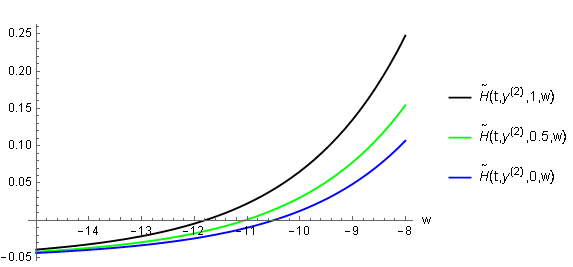
for all u(2)(0,1)u^{(2)}\in(0,1). For the sake of clarity, in Figure 1 we plot H~(t,y(2),u(2),w)\widetilde{H}(t,y^{(2)},u^{(2)},w) as a function of ww for fixed (t,y(2))(t,y^{(2)}) corresponding to three different values of u(2)u^{(2)}, namely, u(2)=0,1,12u^{(2)}=0,1,\frac{1}{2}. In this example we choose t=0t=0, y(2)=0.2y^{(2)}=-0.2, λ(2)(0,0.2)=10e0.2\lambda^{(2)}(0,-0.2)=10e^{0.2}, γ=0.5\gamma=0.5, r(0)=0.02r(0)=0.02, μ(0)=0.05\mu(0)=0.05, σ(0)=0.1\sigma(0)=0.1, and the jump size distribution F(2)(z)F^{(2)}(z) is assumed to be exponential with expectation equal to 11. The function H~(t,y(2),u(2),w)\widetilde{H}(t,y^{(2)},u^{(2)},w) intercepts the horizontal axis at values w~(t,y(2),1),w~(t,y(2),0.5),w~(t,y(2),0)\widetilde{w}(t,y^{(2)},1),\widetilde{w}(t,y^{(2)},0.5),\widetilde{w}(t,y^{(2)},0), which satisfy the chain of inequalities (5.21).
Refer to caption
Figure 1. The function H~(t,y(2),u(2),w)\widetilde{H}(t,y^{(2)},u^{(2)},w) as a function of ww for fixed (t,y(2))(t,y^{(2)}) and values of u(2)=0,1,0.5u^{(2)}=0,1,0.5. The function H~(t,y(2),u(2),w)\widetilde{H}(t,y^{(2)},u^{(2)},w) intercepts the horizontal axis at values w~(t,y(2),1),w~(t,y(2),0.5),w~(t,y(2),0)\widetilde{w}(t,y^{(2)},1),\widetilde{w}(t,y^{(2)},0.5),\widetilde{w}(t,y^{(2)},0) which satisfy the chain of inequalities (5.21).
Proposition 5.5.

Under the same hypotheses of Lemma 5.4, there is a unique minimizer (u(2)(t,y(2)),w(t,y(2)))(u^{{(2)}^{*}}(t,y^{(2)}),w^{*}(t,y^{(2)})) of problem (4.22) given by

u(2)(t,y(2))=max{min{u¯(2)(t,y(2)),1},0},u^{{(2)}^{*}}(t,y^{(2)})=\max\left\{\min\left\{\bar{u}^{{(2)}}(t,y^{(2)}),1\right\},0\right\}, (5.22)

for all (t,y(2))[0,T]×,(t,y^{(2)})\in[0,T]\times\mathbb{R}, and

w(t,y(2))={w~(t,y(2),0)(t,y(2))A~0w~(t,y(2),1)(t,y(2))A~1w¯(t,y(2))(t,y(2))(A~0A~1)c,w^{*}(t,y^{(2)})=\begin{cases}\widetilde{w}(t,y^{(2)},0)&(t,y^{(2)})\in\widetilde{A}_{0}\\ \widetilde{w}(t,y^{(2)},1)&(t,y^{(2)})\in\widetilde{A}_{1}\\ \bar{w}(t,y^{(2)})&(t,y^{(2)})\in(\widetilde{A}_{0}\cup\widetilde{A}_{1})^{c},\end{cases} (5.23)

where

  • (i)

    (u¯(2)(t,y(2)),w¯(t,y(2)))(\bar{u}^{{(2)}}(t,y^{(2)}),\bar{w}(t,y^{(2)})) is the unique solution of the system of equations (5.19)–(5.20);

  • (ii)

    w~(t,y(2),0)\widetilde{w}(t,y^{(2)},0), and w~(t,y(2),1)\widetilde{w}(t,y^{(2)},1) are unique solutions of equation (5.20) with u(2)=0,1u^{(2)}=0,1, respectively (see Step 2 in the proof of Lemma 5.4);

  • (iii)

    (A~0A~1)c(\widetilde{A}_{0}\cup\widetilde{A}_{1})^{c} is the complementary of the set A~0A~1\widetilde{A}_{0}\cup\widetilde{A}_{1} and the sets A~0\widetilde{A}_{0} and A~1\widetilde{A}_{1} are given by

    A~0:={(t,y(2))[0,T]×:u¯(2)(t,y(2))0},\displaystyle\widetilde{A}_{0}:=\{(t,y^{(2)})\in[0,T]\times\mathbb{R}:\ \bar{u}^{(2)}(t,y^{(2)})\leq 0\}, (5.24)
    A~1:={(t,y(2))[0,T]×:u¯(2)(t,y(2))1}.\displaystyle\widetilde{A}_{1}:=\{(t,y^{(2)})\in[0,T]\times\mathbb{R}:\ \bar{u}^{(2)}(t,y^{(2)})\geq 1\}. (5.25)
Proof.

Let us observe that the first order conditions in problem (4.22) read as the system (5.19)–(5.20). Then, by Proposition 5.3 and by Lemma 5.4 , the minimizer of the problem (4.22) on the set

{(t,y(2))[0,T]×:0<u¯(2)(t,y(2))<1}\left\{(t,y^{(2)})\in[0,T]\times\mathbb{R}:0<\bar{u}^{{(2)}}(t,y^{(2)})<1\right\}

is given by (u(2)(t,y(2))=u¯(2)(t,y(2)),w(t,y(2))=w¯(t,y(2)))(u^{{(2)}^{*}}(t,y^{(2)})=\bar{u}^{(2)}(t,y^{(2)}),w^{*}(t,y^{(2)})=\bar{w}(t,y^{(2)})).

The following three cases arise.

  • (i)

    If (t,y(2))A~0(t,y^{(2)})\in\widetilde{A}_{0}, using the fact that w~(t,y(2),u(2))\widetilde{w}(t,y^{(2)},u^{(2)}) is monotonic in u(2)u^{(2)} (see the inequalities in (5.21)) and that Ψ2u(2)(t,y(2),u(2),w)\frac{\partial\Psi_{2}}{\partial u^{(2)}}(t,y^{(2)},u^{(2)},w) is increasing in u(2)[0,1]u^{(2)}\in[0,1] and in ww\in\mathbb{R}, it holds that

    Ψ2u(2)(t,y(2),0,w~(t,y(2),0))Ψ2u(2)(t,y(2),u¯(2)(t,y(2)),w¯(t,y(2)))=0,\frac{\partial\Psi_{2}}{\partial u^{(2)}}(t,y^{(2)},0,\widetilde{w}(t,y^{(2)},0))\geq\frac{\partial\Psi_{2}}{\partial u^{(2)}}(t,y^{(2)},\bar{u}^{(2)}(t,y^{(2)}),\bar{w}(t,y^{(2)}))=0,

    because 0>u¯(2)(t,y(2))0>\bar{u}^{(2)}(t,y^{(2)}) and w~(t,y(2),0)>w¯(t,y(2))\widetilde{w}(t,y^{(2)},0)>\bar{w}(t,y^{(2)}). This implies that Ψ2(t,y(2),u(2),w~(t,y(2),0))\Psi_{2}(t,y^{(2)},u^{(2)},\widetilde{w}(t,y^{(2)},0)) is increasing in u(2)[0,1]u^{(2)}\in[0,1] and hence, for (t,y(2))A~0(t,y^{(2)})\in\widetilde{A}_{0}, the minimizer of problem (4.22) is given by (u(2)(t,y(2))=0,w(t,y(2))=w~(t,y(2),0))(u^{{{(2)}}^{*}}(t,y^{(2)})=0,w^{*}(t,y^{(2)})=\widetilde{w}(t,y^{(2)},0)).

  • (ii)

    If (t,y(2))A~1(t,y^{(2)})\in\widetilde{A}_{1}, since w~(t,y(2),u(2))\widetilde{w}(t,y^{(2)},u^{(2)}) is monotonic in u(2)u^{(2)} (see (5.21)) and Ψ2u(2)(t,y(2),u(2),w)\frac{\partial\Psi_{2}}{\partial u^{(2)}}(t,y^{(2)},u^{(2)},w) is increasing in u(2)[0,1]u^{(2)}\in[0,1] and in ww\in\mathbb{R}, we also get that

    Ψ2u(2)(t,y(2),1,w~(t,y(2),1))Ψ2u(2)(t,y(2),u¯(2)(t,y(2)),w¯(t,y(2)))=0.\frac{\partial\Psi_{2}}{\partial u^{(2)}}(t,y^{(2)},1,\widetilde{w}(t,y^{(2)},1))\leq\frac{\partial\Psi_{2}}{\partial u^{(2)}}(t,y^{(2)},\bar{u}^{{(2)}}(t,y^{(2)}),\bar{w}(t,y^{(2)}))=0.

    Then, Ψ2(t,y(2),u(2),w~(t,y(2),1))\Psi_{2}(t,y^{(2)},u^{(2)},\widetilde{w}(t,y^{(2)},1)) is decreasing in u(2)[0,1]u^{(2)}\in[0,1], and the minimizer of problem (4.22) for (t,y(2))A~1(t,y^{(2)})\in\widetilde{A}_{1}, is given by (u(2)(t,y(2))=1,w(t,y(2))=w~(t,y(2),1))(u^{{{(2)}}^{*}}(t,y^{(2)})=1,w^{*}(t,y^{(2)})=\widetilde{w}(t,y^{(2)},1)).

  • (iii)

    Finally, if (t,y(2))(A0A1)c(t,y^{(2)})\in(A_{0}\cup A_{1})^{c}, the minimizer of problem (4.22) is given by (u(2)(t,y(2))=u¯(2)(t,y(2)),w(t,y(2))=w¯(t,y(2)))(u^{{{(2)}}^{*}}(t,y^{(2)})=\bar{u}^{{(2)}}(t,y^{(2)}),w^{*}(t,y^{(2)})=\bar{w}(t,y^{(2)})).

Remark 5.6.

Note that the assumptions of Lemma 5.4 (and hence of Proposition 5.5) are fulfilled under the classical premium principles. Indeed, under the expected value principle we have

H(t,w,y(2),u(2))=λ(2)(t,y(2))(0+zeγB(t,T)(zu(2)+wK(t,z))F(2)(dz)(1+θR(2))𝔼[Z(2)])H(t,w,y^{(2)},u^{(2)})=\lambda^{(2)}(t,y^{(2)})\left(\int_{0}^{+\infty}ze^{\gamma B(t,T)(zu^{(2)}+wK(t,z))}F^{(2)}(\mathrm{d}z)-(1+\theta_{R}^{(2)})\mathbb{E}[Z^{(2)}]\right) (5.26)

and under the variance principle

H(t,w,y(2),u(2))=λ(2)(t,y(2))(0+zeγB(t,T)(zu(2)+wK(t,z))F(2)(dz)𝔼[Z(2)]2θR(2)(1u(2))𝔼[(Z(2))2]).\begin{split}&H(t,w,y^{(2)},u^{(2)})\\ &\qquad=\lambda^{(2)}(t,y^{(2)})\left(\int_{0}^{+\infty}ze^{\gamma B(t,T)(zu^{(2)}+wK(t,z))}F^{(2)}(\mathrm{d}z)-\mathbb{E}[Z^{(2)}]-2\theta_{R}^{(2)}(1-u^{(2)})\mathbb{E}[(Z^{(2)})^{2}]\right).\end{split} (5.27)
Proposition 5.7 (Properties of ww^{*}).

Suppose that the hypotheses of Lemma 5.4 hold. Then,

w(t,y(2))μ(t)r(t)γB(t,T)σ2(t),w^{*}(t,y^{(2)})\leq\frac{\mu(t)-r(t)}{\gamma B(t,T)\sigma^{2}(t)}, (5.28)

for all (t,y(2))[0,T]×(t,y^{(2)})\in[0,T]\times\mathbb{R}. In particular, if 𝔼[K(t,Z(2))]=0+K(t,z)F(2)(dz)>0\mathbb{E}[K(t,Z^{(2)})]=\int_{0}^{+\infty}K(t,z)F^{(2)}(\mathrm{d}z)>0, for all t[0,T]t\in[0,T], inequality (5.28) is strict. Moreover,

w(t,y(2))min{0,μ(t)r(t)γB(t,T)σ2(t)δ(t)0+eγB(t,T)zF(2)(dz)γB(t,T)σ2(t)},w^{*}(t,y^{(2)})\geq\min\left\{0,\frac{\mu(t)-r(t)}{\gamma B(t,T)\sigma^{2}(t)}-\frac{\delta(t)\int_{0}^{+\infty}e^{\gamma B(t,T)z}F^{(2)}(\mathrm{d}z)}{\gamma B(t,T)\sigma^{2}(t)}\right\}, (5.29)

for all (t,y(2))[0,T]×(t,y^{(2)})\in[0,T]\times\mathbb{R} and where δ(t)\delta(t) is introduced in Assumption 3.5. Finally, if we set

C1\displaystyle C_{1} :={(t,y(2))[0,T]×:μ(t)r(t)<λ(2)(t,y(2))0+K(t,z)F(2)(dz)},\displaystyle:=\left\{(t,y^{(2)})\in[0,T]\times\mathbb{R}:\ \mu(t)-r(t)<\lambda^{(2)}(t,y^{(2)})\int_{0}^{+\infty}K(t,z)F^{(2)}(\mathrm{d}z)\right\}, (5.30)
C2\displaystyle C_{2} :={(t,y(2))[0,T]×:μ(t)r(t)>λ(2)(t,y(2))0+K(t,z)eγB(t,T)zF(2)(dz)},\displaystyle:=\left\{(t,y^{(2)})\in[0,T]\times\mathbb{R}:\ \mu(t)-r(t)>\lambda^{(2)}(t,y^{(2)})\int_{0}^{+\infty}K(t,z)e^{\gamma B(t,T)z}F^{(2)}(\mathrm{d}z)\right\},\qquad{} (5.31)

then we get that w(t,y(2))<0w^{*}(t,y^{(2)})<0, for all (t,y(2))C1(t,y^{(2)})\in C_{1} and w(t,y(2))>0w^{*}(t,y^{(2)})>0, for all (t,y(2))C2(t,y^{(2)})\in C_{2}.

The proof of Proposition 5.7 can be found in Appendix A. Notice that the case 𝔼[K(t,Z(2))]>0\mathbb{E}[K(t,Z^{(2)})]>0, for all t[0,T]t\in[0,T], corresponds to the case where common shock is not negligible.

5.1. Expected value principle

Now, we discuss the case where the insurance and reinsurance premia c(2)(t,y(2)),q(2)(t,y(2),u(2))c^{(2)}(t,y^{(2)}),q^{(2)}(t,y^{(2)},u^{(2)}) are computed according to the expected value principle, that is,

c(2)(t,y(2))\displaystyle c^{(2)}(t,y^{(2)}) =(1+θ(2))𝔼[Z(2)]λ(2)(t,y(2)),\displaystyle=(1+\theta^{(2)})\mathbb{E}[Z^{(2)}]\lambda^{(2)}(t,y^{(2)}), (5.32)
q(2)(t,y(2),u(2))\displaystyle q^{(2)}(t,y^{(2)},u^{(2)}) =(1+θR(2))𝔼[Z(2)](1u(2))λ(2)(t,y(2)).\displaystyle=(1+\theta_{R}^{(2)})\mathbb{E}[Z^{(2)}](1-u^{(2)})\lambda^{(2)}(t,y^{(2)}). (5.33)

We derive explicit formulas for the optimal strategy under the following additional assumptions on the distribution of the claim size and the jumps of the price process.

Assumption 5.8.

The random variable Z(2)Z^{(2)} takes values in a compact set and K(t,z)=k(t)zK(t,z)=k(t)z, with 0<k(t)<1D0<k(t)<\frac{1}{D}, where D:=inf{z(0,+):F(2)(z)=1}<D:=\inf\{z\in(0,+\infty):\ F^{(2)}(z)=1\}<\infty.

Equation (4.17), in this case, reads as

Ψ2(t,y(2),u(2),w)\displaystyle\Psi_{2}(t,y^{(2)},u^{(2)},w) =γB(t,T)𝔼[Z(2)]λ(2)(t,y(2))[θR(2)θ(2)(1+θR(2))u(2)]\displaystyle=\gamma B(t,T)\mathbb{E}[Z^{(2)}]\lambda^{(2)}(t,y^{(2)})\left[\theta_{R}^{(2)}-\theta^{(2)}-(1+\theta_{R}^{(2)})u^{(2)}\right] (5.34)
+γB(t,T)[12γB(t,T)σ2(t)w2(μ(t)r(t))w]\displaystyle+\gamma B(t,T)\biggl{[}\frac{1}{2}\gamma B(t,T)\sigma^{2}(t)w^{2}-(\mu(t)-r(t))w\biggr{]} (5.35)
+λ(2)(t,y(2))0+(eγB(t,T)z(u(2)+wk(t))1)F(2)(dz).\displaystyle+\lambda^{(2)}(t,y^{(2)})\int_{0}^{+\infty}\left(e^{\gamma B(t,T)z(u^{(2)}+wk(t))}-1\right)F^{(2)}(\mathrm{d}z). (5.36)

Now, we consider the first order conditions

H(t,u(2),w)=0,\displaystyle H(t,u^{(2)},w)=0, (5.37)
H~(t,y(2),u(2),w)=0,\displaystyle\widetilde{H}(t,y^{(2)},u^{(2)},w)=0, (5.38)

with

H(t,u(2),w)=\displaystyle H(t,u^{(2)},w)= λ(2)(t,y(2))(1+θR(2))𝔼[Z(2)]+λ(2)(t,y(2))0+zeγB(t,T)z(u(2)+wk(t))F(2)(dz),\displaystyle-\lambda^{(2)}(t,y^{(2)})(1+\theta_{R}^{(2)})\mathbb{E}[Z^{(2)}]+\lambda^{(2)}(t,y^{(2)})\int_{0}^{+\infty}ze^{\gamma B(t,T)z(u^{(2)}+wk(t))}F^{(2)}(\mathrm{d}z), (5.39)
H~(t,y(2),u(2),w)=\displaystyle\widetilde{H}(t,y^{(2)},u^{(2)},w)= γB(t,T)σ2(t)w(μ(t)r(t))\displaystyle\gamma B(t,T)\sigma^{2}(t)w-(\mu(t)-r(t)) (5.40)
+k(t)λ(2)(t,y(2))0+zeγB(t,T)z(u(2)+wk(t))F(2)(dz).\displaystyle+k(t)\lambda^{(2)}(t,y^{(2)})\int_{0}^{+\infty}ze^{\gamma B(t,T)z(u^{(2)}+wk(t))}F^{(2)}(\mathrm{d}z). (5.41)

We set ϕ(t)=u(2)+wk(t)\phi(t)=u^{(2)}+wk(t). Then, (5.37) is equivalent to

(1+θR(2))𝔼[Z(2)]=0+zeγB(t,T)zϕF(2)(dz).(1+\theta_{R}^{(2)})\mathbb{E}[Z^{(2)}]=\int_{0}^{+\infty}ze^{\gamma B(t,T)z\phi}F^{(2)}(\mathrm{d}z). (5.42)

Equation (5.42) has a unique deterministic solution ϕ(t)>0\phi^{*}(t)>0. Indeed, define the function

h(t,ϕ)=0+zeγB(t,T)zϕF(2)(dz);h(t,\phi)=\int_{0}^{+\infty}ze^{\gamma B(t,T)z\phi}F^{(2)}(\mathrm{d}z);

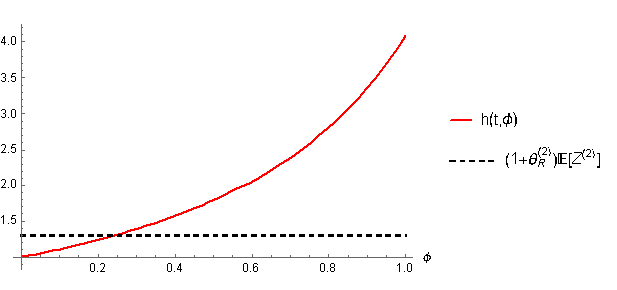
for all t[0,T]t\in[0,T], we get h(t,0)=𝔼[Z(2)]<(1+θR(2))𝔼[Z(2)]h(t,0)=\mathbb{E}[Z^{(2)}]<(1+\theta_{R}^{(2)})\mathbb{E}[Z^{(2)}], and also, h(t,ϕ)h(t,\phi) is continuous and increasing in ϕ\phi and satisfies limϕ+h(t,ϕ)=+\lim_{\phi\to+\infty}h(t,\phi)=+\infty. Figure 2 provides a representation of the function ϕh(t,ϕ)\phi\mapsto h(t,\phi) at t=0t=0 under the parameters r(0)=0.02,γ=12r(0)=0.02,\gamma=\frac{1}{2} and θR(2)=0.3\theta_{R}^{(2)}=0.3. Here, the jump size distribution F(2)(z)F^{(2)}(z) is assumed to be truncated exponential with the density f(2)(z)=cez𝟏[0,100](z)f^{(2)}(z)=ce^{-z}{\mathbf{1}}_{[0,100]}(z) and c=11e100c=\frac{1}{1-e^{-100}}. We see that the function intercepts the level (1+θR(2))𝔼[Z(2)](1+\theta_{R}^{(2)})\mathbb{E}[Z^{(2)}] at a unique point.

Refer to caption
Figure 2. The function h(t,ϕ)h(t,\phi) as a function of ϕ\phi at t=0t=0. The function H~(t,y(2),u(2),w)\widetilde{H}(t,y^{(2)},u^{(2)},w) intercepts the level (1+θR(2))𝔼[Z(2)](1+\theta_{R}^{(2)})\mathbb{E}[Z^{(2)}] at a unique point ϕ\phi^{*}.

Now let

u¯(2)(t,y(2))=ϕ(t)w¯(t,y(2))k(t),\bar{u}^{(2)}(t,y^{(2)})=\phi^{*}(t)-\bar{w}(t,y^{(2)})k(t), (5.43)

where ϕ(t)>0\phi^{*}(t)>0 is the unique solution of the equation (5.42) and

w¯(t,y(2))=μ(t)r(t)γB(t,T)σ2(t)λ(2)(t,y(2))k(t)(1+θR(2))𝔼[Z(2)]γB(t,T)σ2(t),\bar{w}(t,y^{(2)})=\frac{\mu(t)-r(t)}{\gamma B(t,T)\sigma^{2}(t)}-\frac{\lambda^{(2)}(t,y^{(2)})k(t)(1+\theta_{R}^{(2)})\mathbb{E}[Z^{(2)}]}{\gamma B(t,T)\sigma^{2}(t)}, (5.44)

for all (t,y(2))[0,T]×(t,y^{(2)})\in[0,T]\times\mathbb{R}. Similarly to Proposition 5.5, we define the sets

A~0\displaystyle\widetilde{A}_{0} ={(t,y(2))[0,T]×:u¯(2)(t,y(2))0},\displaystyle=\{(t,y^{(2)})\in[0,T]\times\mathbb{R}:\ \bar{u}^{(2)}(t,y^{(2)})\leq 0\}, (5.45)
A~1\displaystyle\widetilde{A}_{1} ={(t,y(2))[0,T]×:u¯(2)(t,y(2))1},\displaystyle=\{(t,y^{(2)})\in[0,T]\times\mathbb{R}:\ \bar{u}^{(2)}(t,y^{(2)})\geq 1\}, (5.46)
(A~0A~1)c\displaystyle(\widetilde{A}_{0}\cup\widetilde{A}_{1})^{c} ={(t,y(2))[0,T]×: 0<u¯(2)(t,y(2))<1},\displaystyle=\{(t,y^{(2)})\in[0,T]\times\mathbb{R}:\ 0<\bar{u}^{(2)}(t,y^{(2)})<1\}, (5.47)

and let the functions w~(t,y(2),0)\widetilde{w}(t,y^{(2)},0) and w~(t,y(2),0)\widetilde{w}(t,y^{(2)},0) be the unique solutions of equation (5.38) with u(2)=0,1u^{(2)}=0,1, respectively.

Corollary 5.9.

Under the expected premium principle, problem (4.22) admits a unique minimizer (u(2)(t,y(2)),w(t,y(2)))(u^{{(2)}^{*}}(t,y^{(2)}),w^{*}(t,y^{(2)})) given by

u(2)(t,y(2))=max{min{u¯(2)(t,y(2)),1},0},u^{{{(2)}}^{*}}(t,y^{(2)})=\max\left\{\min\left\{\bar{u}^{(2)}(t,y^{(2)}),1\right\},0\right\}, (5.48)

for all (t,y(2))[0,T]×(t,y^{(2)})\in[0,T]\times\mathbb{R}, and

w(t,y(2))={w~(t,y(2),0)(t,y(2))A~0,w~(t,y(2),1)(t,y(2))A~1,w¯(t,y(2))(t,y(2))(A~0A~1)c.w^{*}(t,y^{(2)})=\begin{cases}\widetilde{w}(t,y^{(2)},0)&(t,y^{(2)})\in\widetilde{A}_{0},\\ \widetilde{w}(t,y^{(2)},1)&(t,y^{(2)})\in\widetilde{A}_{1},\\ \bar{w}(t,y^{(2)})&(t,y^{(2)})\in(\widetilde{A}_{0}\cup\widetilde{A}_{1})^{c}.\end{cases} (5.49)
Proof.

Using the definition (5.42) of ϕ(t)\phi^{*}(t) and plugging it into equation (5.38) leads to

γB(t,T)σ2(t)w(μ(t)r(t))=λ(2)(t,y(2))k(t)(1+θR(2))𝔼[Z(2)],\gamma B(t,T)\sigma^{2}(t)w-(\mu(t)-r(t))=-\lambda^{(2)}(t,y^{(2)})k(t)(1+\theta_{R}^{(2)})\mathbb{E}[Z^{(2)}], (5.50)

for all (t,y(2))[0,T]×(t,y^{(2)})\in[0,T]\times\mathbb{R}. Equation (5.50) has a unique solution given by

w¯(t,y(2))=μ(t)r(t)γB(t,T)σ2(t)λ(2)(t,y(2))k(t)(1+θR(2))𝔼[Z(2)]γB(t,T)σ2(t),\bar{w}(t,y^{(2)})=\frac{\mu(t)-r(t)}{\gamma B(t,T)\sigma^{2}(t)}-\frac{\lambda^{(2)}(t,y^{(2)})k(t)(1+\theta_{R}^{(2)})\mathbb{E}[Z^{(2)}]}{\gamma B(t,T)\sigma^{2}(t)}, (5.51)

for all (t,y(2))[0,T]×(t,y^{(2)})\in[0,T]\times\mathbb{R}. The rest of the proof follows by Proposition 5.5. ∎

6. The optimal reinsurance-investment strategy and its properties

We now collect the results of the previous sections and derive the optimal reinsurance and investment strategy corresponding to the problem (3.18).

Proposition 6.1.

Under the hypotheses of Lemma 5.4, assume existence and uniqueness of a classical solution to the HJB equation (4.10) with the final condition (4.11). Moreover, suppose that for all t[0,T]t\in[0,T]

σ(t)>σ>0,\displaystyle\sigma(t)>\sigma>0, (6.1)

and that

0Tδ(t)eκδ(t)dt<,\displaystyle\int_{0}^{T}\delta(t)e^{\kappa\delta(t)}\mathrm{d}t<\infty, (6.2)

where κ=2σ2B¯𝔼[eγB¯Z(2)]\kappa=\frac{2}{\sigma^{2}}\overline{B}\mathbb{E}\left[e^{\gamma\overline{B}Z^{(2)}}\right], B¯\overline{B} is defined in Notation 2.3 and δ(t)\delta(t) is introduced in Assumption 3.5. Then, the process {(u(1)(t,Yt(1)),u(2)(t,Yt(2)),w(t,Yt(2))):t[0,T]}\{(u^{{(1)}^{*}}(t,Y^{(1)}_{t}),u^{{(2)}^{*}}(t,Y^{(2)}_{t}),w^{*}(t,Y^{(2)}_{t})):t\in[0,T]\}, where u(1)(t,y(1))u^{{(1)}^{*}}(t,y^{(1)}) is computed in Proposition 5.1 and the pair (u(2)(t,y(2)),w(t,y(2)))(u^{{(2)}^{*}}(t,y^{(2)}),w^{*}(t,y^{(2)})) is computed in Proposition 5.5, provides the optimal strategy for the problem (3.18).

Proof.

Let

η(t)=max{|μ(t)r(t)|γB(t,T)σ2(t),δ(t)γB(t,T)σ2(t)0+eγB(t,T)zF(2)(dz)},t[0,T].\eta(t)=\max\left\{\frac{|\mu(t)-r(t)|}{\gamma B(t,T)\sigma^{2}(t)},\frac{\delta(t)}{\gamma B(t,T)\sigma^{2}(t)}\int_{0}^{+\infty}e^{\gamma B(t,T)z}F^{(2)}(\mathrm{d}z)\right\},\quad t\in[0,T].

We show that conditions (3.23), (3.24) and (3.25) in Proposition 3.6 are satisfied.

By Proposition 5.7, we immediately have that |w(t,Yt(2))|η(t)|w^{*}(t,Y^{(2)}_{t})|\leq\eta(t), for every t[0,T]t\in[0,T]. Moreover, by (6.1) and Assumption 3.5, we get

0T(η(s)(|μ(s)r(s)|+δ(s))+η2(s)σ2(s))ds<.\displaystyle\int_{0}^{T}\Big{(}\eta(s)(|\mu(s)-r(s)|+\delta(s))+{\eta}^{2}(s)\sigma^{2}(s)\Big{)}\mathrm{d}s<\infty. (6.3)

Finally, by (6.2)

0Tδ(t)e2γB¯γB(t,T)σ2(t)δ(t)0+eγB(t,T)zF(2)(dz)dt0Tδ(t)e2B¯σ2(t)δ(t)𝔼[eγB¯Z(2)]dt=0Tδ(t)eκδ(t)𝑑t<,\displaystyle\int_{0}^{T}\delta(t)e^{\frac{2\gamma\overline{B}}{\gamma B(t,T)\sigma^{2}(t)}\delta(t)\int_{0}^{+\infty}e^{\gamma B(t,T)z}F^{(2)}(\mathrm{d}z)}\mathrm{d}t\leq\int_{0}^{T}\delta(t)e^{\frac{2\overline{B}}{\sigma^{2}(t)}\delta(t)\mathbb{E}[e^{\gamma\overline{B}Z^{(2)}}]}\mathrm{d}t=\int_{0}^{T}\delta(t)e^{\kappa\delta(t)}dt<\infty, (6.4)

which implies (3.25). Then, the triplet {(u(1)(t,Yt(1)),u(2)(t,Yt(2)),w(t,Yt(2))),t[0,T]}\{(u^{{(1)}^{*}}(t,Y^{(1)}_{t}),u^{{(2)}^{*}}(t,Y^{(2)}_{t}),w^{*}(t,Y^{(2)}_{t})),\ t\in[0,T]\} is an admissible strategy and the statement follows by applying the Verification Theorem 4.1 and Proposition 5.5. ∎

Remark 6.2.

If the arrival intensity of catastrophic claims is assumed to be bounded, i.e. for all t[0,T]×t\in[0,T]\times\mathbb{R}, λ(2)(t,y(2))δ\lambda^{(2)}(t,y^{(2)})\leq\delta, for a positive constant δ\delta, then condition (6.2) is trivially satisfied.

6.1. The effect of common shocks

To underline the characteristics of our model we compare optimal investment and reinsurance strategies with common shock dependence between the insurance risk process and the risky asset, with those corresponding to a modelling framework where common shocks is not accounted for.

If there is no common shock, that is, when K(t,z)=0K(t,z)=0, the optimal investment and reinsurance strategy is given by {(u(1)(t,Yt(1)),u(2),no(t,Yt(2)),wno(t)),t[0,T]}\{(u^{{{(1)}}^{*}}(t,Y^{(1)}_{t}),u^{{{(2)},no}^{*}}(t,Y^{(2)}_{t}),w^{{no}^{*}}(t)),\ t\in[0,T]\}, where

wno(t)=μ(t)r(t)γB(t,T)σ2(t),u(2),no(t,y(2))=max{min{u¯(2),no(t,y(2)),1},0},w^{{no}^{*}}(t)=\frac{\mu(t)-r(t)}{\gamma B(t,T)\sigma^{2}(t)},\;u^{{{(2)},no}^{*}}(t,y^{(2)})=\max\{\min\{\bar{u}^{{(2)},no}(t,y^{(2)}),1\},0\},

and u¯(2),no(t,y(2))\bar{u}^{{(2)},no}(t,y^{(2)}) is the unique solution of the equation

Hno(t,y(2),u(2))=q(2)u(2)(t,y(2),u(2))+λ(2)(t,y(2))0+zeγB(t,T)zu(2)F(2)(dz)=0.H^{no}(t,y^{(2)},u^{(2)})=\frac{\partial q^{(2)}}{\partial{u^{(2)}}}(t,y^{(2)},u^{(2)})+\lambda^{(2)}(t,y^{(2)})\int_{0}^{+\infty}ze^{\gamma B(t,T)zu^{(2)}}F^{(2)}(\mathrm{d}z)=0. (6.5)

When there is no common shock, the optimal investment strategy turns out to be deterministic (i.e. function of time only) and the reinsurance strategies {(u(1)(t,Yt(1)),u(2),no(t,Yt(2)),t[0,T]}\{(u^{{{(1)}}^{*}}(t,Y^{(1)}_{t}),u^{{{(2)},no}^{*}}(t,Y^{(2)}_{t}),\ t\in[0,T]\} depend in general on the stochastic factors Y(1)Y^{(1)}, Y(2)Y^{(2)} that affect claim arrival intensities of each business line. Under classical premium principles, the dependence of reinsurance strategies on the factors Y(1)Y^{(1)}, Y(2)Y^{(2)} disappears, as seen in Example 5.2.

Below, we provide a comparison result between the common shock setting and the no-common shock setting.

Proposition 6.3.

Assume that 𝔼[K(t,Z(2))]>0\mathbb{E}[K(t,Z^{(2)})]>0, for all t[0,T]t\in[0,T] (i.e. common shock is not negligible), the hypotheses of Proposition 6.1 hold, and let C1C_{1} and C2C_{2} be defined in (5.30) and (5.31), respectively. Then, the following inequalities hold

  • (i)

    w(t,Yt(2))<w,no(t)w^{*}(t,Y^{(2)}_{t})<w^{*,no}(t), for all t[0,T]t\in[0,T];

  • (ii)

    u(2)(t,Yt(2))>u(2),no(t,Yt(2))u^{{{(2)}}^{*}}(t,Y_{t}^{(2)})>u^{{{(2)},no}^{*}}(t,Y_{t}^{(2)}) for all (t,Y(2))C1(t,Y^{(2)})\in C_{1};

  • (iii)

    u(2)(t,Yt(2))<u(2),no(t,Yt(2))u^{{(2)}^{*}}(t,Y_{t}^{(2)})<u^{{{(2)},no}^{*}}(t,Y_{t}^{(2)}), for all (t,Y(2))C2(t,Y^{(2)})\in C_{2}.

Moreover, for all [0,T]\in[0,T], the values of w(t,Yt(2))w^{*}(t,Y^{(2)}_{t}) get smaller as the intensity λ(2)(t,Yt(2))\lambda^{(2)}(t,Y^{(2)}_{t}) of claim arrival as well as with the jump size of the risky asset due to the shock (i.e. K(t,Z(2))K(t,Z^{(2)})) get larger.

Proof.

The property (i) follows directly by Proposition 5.7. We now show conditions (ii) and (iii). For all w>0w>0, we have that H(t,y(2),u(2),w)>Hno(t,y(2),u(2))H(t,y^{(2)},u^{(2)},w)>H^{no}(t,y^{(2)},u^{(2)}), for all (t,y(2),u(2))[0,T]×2(t,y^{(2)},u^{(2)})\in[0,T]\times\mathbb{R}^{2}, and for all w<0w<0 the inequality reverses, H(t,y(2),u(2),w)<Hno(t,y(2),u(2))H(t,y^{(2)},u^{(2)},w)<H^{no}(t,y^{(2)},u^{(2)}), for all (t,y(2),u(2))[0,T]×2(t,y^{(2)},u^{(2)})\in[0,T]\times\mathbb{R}^{2}. These inequalities imply that, if the optimal quote invested in the risky asset is positive, then the optimal retention level under common shock is lower than the case where no-common shock, that is u(2)(t,Yt(2))<u(2),no(t,Yt(2))u^{{{(2)}}^{*}}(t,Y^{(2)}_{t})<u^{{{(2)},no}^{*}}(t,Y^{(2)}_{t}). Conversely, if the optimal quote invested in the risky asset is negative we have that u(2)(t,Yt(2))>u(2),no(t,Yt(2))u^{{(2)}^{*}}(t,Y_{t}^{(2)})>u^{{{(2)},no}^{*}}(t,Y_{t}^{(2)}). Hence, properties (ii) and (iii) follow by applying Proposition 5.7.

Finally, the monotonic dependence of the optimal investment strategy with common shock by the quantities λ(2)(t,Yt(2))\lambda^{(2)}(t,Y^{(2)}_{t}) and K(t,Z(2))K(t,Z^{(2)}) follows by the form of the function H~\widetilde{H} given in (5.17). ∎

We now make a few observations on the behavior of the insurance company.

  • 1.

    The optimal quote invested in the risky asset in case of common shock dependence, relies upon the stochastic factor Y(2)Y^{(2)} which affects the arrival intensity of the second line of business. Moreover, this is always smaller than the optimal investment strategy without common shock. Instead, the optimal reinsurance strategy in case of common shock dependence does not always dominate the case of no-common shock. Whether it is smaller or larger than the optimal reinsurance without common shock depends on the optimal investment strategy.
    If the impact of the shock on the risky asset price is small enough, i.e. if (t,Yt(2))C2(t,Y^{(2)}_{t})\in C_{2}, the insurance company invests a positive quote in the risky asset (i.e. buys the risky asset) and the optimal proportional quote to be transferred to reinsurance is larger than in case of no-common shock. Conversely, if the impact of the shock on the risky asset price is large, i.e. if (t,Yt(2))C1(t,Y^{(2)}_{t})\in C_{1}, the insurance company has a completely different behavior: it short-sells the asset and buys less reinsurance. In other words, the insurance company transfers to the reinsurance a smaller percentage of its claims compared to the case without common shock.

  • 2.

    Due to the form of the function H~\widetilde{H} in equation (5.17), we get that for all t[0,T]t\in[0,T], the difference between the investment strategies without and with common shock, w,no(t)w(t,Yt(2))w^{*,no}(t)-w^{*}(t,Y^{(2)}_{t}) increases when the intensity λ(2)(t,Yt(2))\lambda^{(2)}(t,Y^{(2)}_{t}) of claim arrival as well as with the jump size of the risky asset due to the shock, that is the quantity K(t,Z(2))K(t,Z^{(2)}), increase.

  • 3.

    An analogous effect of common shocks on the optimal strategies is obtained by Liang et al. [20] under different modelling assumptions, i.e. when arrival intensities are assumed to be constant and risky asset jump size (induced by the common shock) are taken independent of the claim sizes. In Liang et al. [20], it is shown under the classical premium principle that whether the optimal reinsurance strategy with common shock is smaller or larger than that without common shock depends on the values of the parameters of the model and that the optimal investment strategy with common shock is always smaller than the one without common shock dependence. Moreover, it decreases as the claims arrival intensity parameter gets larger.

Comparison under the Expected Value Principle

Under the expected value principle discussed in Section 5.1, the case of no-common shock is obtained by taking k(t)=0k(t)=0. The optimal strategy is given by {(u(1)(t),u(2),no(t),w,no(t)),t[0,T]}\{(u^{{{(1)}}^{*}}(t),u^{{{(2)},no}^{*}}(t),w^{*,no}(t)),\ t\in[0,T]\}, where u(2),no(t)=min{1,u¯(2),no(t)}u^{{{(2)},no}^{*}}(t)=\min\{1,\bar{u}^{{(2)},no}(t)\}, u¯(2),no(t)>0\bar{u}^{{(2)},no}(t)>0 is the unique solution to the following equation

(1+θR(2))𝔼[Z(2)]=0+zeγB(t,T)zu(2)F(2)(dz),(1+\theta_{R}^{(2)})\mathbb{E}[Z^{(2)}]=\int_{0}^{+\infty}ze^{\gamma B(t,T)zu^{(2)}}F^{(2)}(\mathrm{d}z),

and

w,no(t)=μ(t)r(t)γB(t,T)σ2(t).w^{*,no}(t)=\frac{\mu(t)-r(t)}{\gamma B(t,T)\sigma^{2}(t)}.

Hence, the optimal strategy is a function of time only. Accounting for common shock introduces an additional stochastic term in the investment strategy given by λ(2)(t,Yt(2))k(t)(1+θR(2))𝔼[Z(2)]γB(t,T)σ2(t)-\frac{\lambda^{(2)}(t,Y^{(2)}_{t})k(t)(1+\theta_{R}^{(2)})\mathbb{E}[Z^{(2)}]}{\gamma B(t,T)\sigma^{2}(t)}, see equation (5.51). In this specific case, we can detect explicitly the effect of common shock on the optimal reinsurance strategy through the quantity

u¯(2)(t,Yt(2))=u¯(2),no(t)k(t)w¯(t,Yt(2)).\bar{u}^{{(2)}}(t,Y^{(2)}_{t})=\bar{u}^{{(2)},no}(t)-k(t)\bar{w}(t,Y^{(2)}_{t}).

The same considerations of the general case apply to this example, too. In particular, since for all t[0,T]t\in[0,T], w¯(t,Yt(2))\bar{w}(t,Y^{(2)}_{t}) gets smaller as λ(2)(t,Yt(2))\lambda^{(2)}(t,Y^{(2)}_{t}) and k(t)k(t) gets larger (see equation (5.51)) and u¯(2),no(t)\bar{u}^{{(2)},no}(t) does not depend on λ(2)(t,Yt(2))\lambda^{(2)}(t,Y^{(2)}_{t}) and k(t)k(t), then u¯(2)(t,Yt(2))\bar{u}^{{(2)}}(t,Y^{(2)}_{t}) increases with λ(2)(t,Yt(2))\lambda^{(2)}(t,Y^{(2)}_{t}) and k(t)k(t) for all t[0,T]t\in[0,T]. Consequently, the optimal reinsurance strategy in the second line of business u(2)(t,Yt(2))u^{{(2)}^{*}}(t,Y^{(2)}_{t}), for each t[0,T]t\in[0,T], increases whenever the claims arrival intensity λ(2)(t,Yt(2))\lambda^{(2)}(t,Y^{(2)}_{t}) and amplitude of risky asset jump k(t)k(t) increase.

Moreover, the optimal reinsurance strategy in the second line of business u(2)(t,Yt(2))u^{{(2)}^{*}}(t,Y^{(2)}_{t}) increases with respect to the reinsurance safety loading θR(2)\theta_{R}^{(2)}, for all t[0,T]t\in[0,T]. This comes as a consequence of the fact that w¯(t,Yt(2))\bar{w}(t,Y^{(2)}_{t}) is decreasing and u¯(2),no(t)\bar{u}^{{(2)},no}(t) is increasing, with respect to the reinsurance safety loading θR(2)\theta_{R}^{(2)} for all t[0,T]t\in[0,T]. The fact that reinsurance premium increases with the claim arrival intensity and the reinsurance safety loading explains monotonic property of the optimal reinsurance strategy with respect to these quantities. The effect produced by amplitude of risky asset jumps, k(t)k(t), instead, is a strict consequence of common shock dependence. Moreover, we observe that

|u(2)(t,Yt(2))u(2),no(t)|k(t)|w¯(t,Yt(2))|,|u^{{(2)}^{*}}(t,Y^{(2)}_{t})-u^{{{(2)},no}^{*}}(t)|\leq k(t)|\bar{w}(t,Y^{(2)}_{t})|,

which provides an upper bound on the difference of reinsurance strategies with and without common shock, in terms of the investment strategy and the amplitude of jumps.

We finally see that if

(t,Yt(2)){(t,y(2))[0,T]×:μ(t)r(t)>λ(2)(t,y(2))k(t)(1+θR(2))𝔼[Z(2)]},(t,Y^{(2)}_{t})\in\left\{(t,y^{(2)})\in[0,T]\times\mathbb{R}:\ \mu(t)-r(t)>\lambda^{(2)}(t,y^{(2)})k(t)(1+\theta_{R}^{(2)})\mathbb{E}[Z^{(2)}]\right\},

then by (5.51), |w¯(t,Yt(2))|=w¯(t,Yt(2))>0|\bar{w}(t,Y^{(2)}_{t})|=\bar{w}(t,Y^{(2)}_{t})>0, and hence |u(2)(t,y(2))u(2),no(t)|=u(2),no(t)u(2)(t,Yt(2))|u^{{(2)}^{*}}(t,y^{(2)})-u^{{{(2)},no}^{*}}(t)|=u^{{{(2)},no}^{*}}(t)-u^{{(2)}^{*}}(t,Y^{(2)}_{t}) decreases when λ(2)(t,Yt(2))\lambda^{(2)}(t,Y^{(2)}_{t}) increases.

If, instead,

(t,Yt(2)){(t,y(2))[0,T]×:μ(t)r(t)<λ(2)(t,y(2))k(t)(1+θR(2))𝔼[Z(2)]},(t,Y^{(2)}_{t})\in\left\{(t,y^{(2)})\in[0,T]\times\mathbb{R}:\ \mu(t)-r(t)<\lambda^{(2)}(t,y^{(2)})k(t)(1+\theta_{R}^{(2)})\mathbb{E}[Z^{(2)}]\right\},

then |w¯(t,Yt(2))|=w¯(t,Yt(2))>0|\bar{w}(t,Y^{(2)}_{t})|=-\bar{w}(t,Y^{(2)}_{t})>0, and hence |u(2)(t,Yt(2))u(2),no(t)|=u(2)(t,Yt(2))u(2),no(t)|u^{{(2)}^{*}}(t,Y^{(2)}_{t})-u^{{{(2)},no}^{*}}(t)|=u^{{(2)}^{*}}(t,Y^{(2)}_{t})-u^{{{(2)},no}^{*}}(t) increases when λ(2)(t,Yt(2))\lambda^{(2)}(t,Y^{(2)}_{t}) and the reinsurance safety loading θR(2)\theta_{R}^{(2)} decrease (because u(2),no(t)u^{{{(2)},no}^{*}}(t) also increases with θR(2)\theta_{R}^{(2)}).

7. Existence and uniqueness of classical solution to the HJB-equation

In this section we provide sufficient conditions for existence and uniqueness of a classical solution ψ(t,y(1),y(2))\psi(t,y^{(1)},y^{(2)}) to the reduced HJB-equation (4.10). We have seen that this is implied by existence of classical solutions to PDEs (4.18) and (4.19).

Proposition 7.1.

Assume that the functions

  • (i)

    c(1)c^{(1)}, and λ(1)\lambda^{(1)} are bounded and Lipschitz-continuous in (t,y(1))[0,T]×(t,y^{(1)})\in[0,T]\times\mathbb{R};

  • (ii)

    q(1)q^{(1)} is bounded and Lipschitz-continuous in (t,y(1))[0,T]×(t,y^{(1)})\in[0,T]\times\mathbb{R} uniformly with respect to u(1)[0,1]u^{(1)}\in[0,1];

  • (iii)

    a(1)a^{(1)} is continuous with a(1)(t)>κ>0a^{(1)}(t)>\kappa>0.

Then, there exists a unique solution ψ1(t,y(1))C1,2([0,T]×)\psi_{1}(t,y^{(1)})\in C^{1,2}([0,T]\times\mathbb{R}) of the PDE (4.18).

Proof.

This result has been proved in Brachetta and Ceci [6, Corollary 8.3]. It can also be derived from Pham [22, Theorem 5.3], under similar hypotheses. ∎

Proposition 7.2.

Assume that the functions

  • (i)

    a(2),b(2),μ,r,σa^{(2)},b^{(2)},\mu,r,\sigma are continuous, with a(2)(t),σ(t)>κ>0a^{(2)}(t),\sigma(t)>\kappa>0;

  • (ii)

    the functions c(2),q(2)c^{(2)},q^{(2)} are continuous, Lipschitz in (t,y(2))[0,T]×(t,y^{(2)})\in[0,T]\times\mathbb{R}, uniformly with respect to u(2)[0,1]u^{(2)}\in[0,1];

  • (iii)

    λ(2)\lambda^{(2)} is bounded.

Then, there exists a unique solution ψ2(t,y(2))C1,2([0,T]×)\psi_{2}(t,y^{(2)})\in C^{1,2}([0,T]\times\mathbb{R}) of the PDE (4.19).

Proof.

The proof of this result follows, for instance from Pham [22, Theorem 5.3] or from Colaneri and Frey [11, Theorem 1]. ∎

8. Conclusions

In this paper we have investigated the optimal investment and proportional reinsurance problem of an insurance company with exponential utility preferences in a stochastic-factor model where the stock market and the insurance market are correlated by means of a common shock. The insurance company experiences two types of claims, namely ordinary claims and catastrophic claims, which correspond to two different lines of business, and their arrival intensities are affected by environmental (stochastic) factors, as well as the insurance and reinsurance premia; moreover, the arrival of catastrophic claims affects risky asset prices by inducing downward jumps. The proposed model specification includes then two main features: firstly, a possible dependence between the financial and the pure insurance frameworks due to the common shock effect; secondly, a dependence of claim arrival intensities on some exogenous stochastic factors, and that allows to consider more general valuation premia.
Under suitable conditions on model coefficients, by applying the Hamilton-Jacobi-Bellman approach we have provided a classical solution of the resulting optimization problem and characterized the optimal investment and reinsurance strategy. We have performed a comparison analysis on the optimal strategies with and without a common shock effect in the underlying financial-insurance setting. Our findings show that in the common shock case, the insurance company invests a smaller quote in the financial market, compared to the optimal investment strategy without common shock, and the reinsurance strategy corresponding to the second line of business depends on the investment strategy. In particular, when the impact of the common shock on the risky asset price is small, the insurance company takes a long position in the risky asset and the optimal reinsurance is smaller than in case of no-common shock. Conversely, when the impact of the common shock on the risky asset price is large the insurance company takes a short position in the risky assets and the optimal reinsurance is larger than in case of no-common shock. The optimal investment strategies with and without common shocks deviate more, as the intensity λ(2)(t,Yt(2))\lambda^{(2)}(t,Y^{(2)}_{t}) of claim arrival increases and the size of jumps K(t,Z(2))K(t,Z^{(2)}) of the risky asset due to the shock gets larger. This behavior is confirmed in case of classical valuation principles, e.g. the expected value principle, where in addition it is possible to explicitly quantify an upper bound for difference of reinsurance strategies with and without common shock, in terms of the investment strategy and the amplitude of asset price jumps.

Acknowledgements

The authors are members of INdAM-GNAMPA and their work has been partially supported through the Project U-UFMBAZ-2020-000791.

Appendix A Proofs

This section collects a few technical proofs of the results stated in the paper.

Proof of Proposition 3.6.

We start with the condition (3.19). We have

𝔼[0T(|wt|(|μ(t)r(t)|+λ(2)(t,Yt(2)))+wt2σ2(t))dt]\displaystyle\mathbb{E}\left[\int_{0}^{T}\left(|w_{t}|\left(|\mu(t)-r(t)|+\lambda^{(2)}(t,Y^{(2)}_{t})\right)+w^{2}_{t}\sigma^{2}(t)\right)\mathrm{d}t\right] (A.1)
𝔼[0Tη(t)(|μ(t)r(t)|+δ(t))+η2(t)σ2(t)dt],\displaystyle\leq\mathbb{E}\left[\int_{0}^{T}\eta(t)\left(|\mu(t)-r(t)|+\delta(t)\right)+\eta^{2}(t)\sigma^{2}(t)\mathrm{d}t\right], (A.2)

which is finite because of conditions (3.23), (3.24) and (i)(i) in Assumption 3.5. Condition (3.20) is implied by (3.25). Next, we will prove that 𝔼[eγXTα]<\mathbb{E}\left[e^{-\gamma X^{\alpha}_{T}}\right]<\infty. First, we observe that c(1)(t,Yt(1))+c(2)(t,Yt(2))>0c^{(1)}(t,Y^{(1)}_{t})+c^{(2)}(t,Y^{(2)}_{t})>0 and that q(1)(t,Yt(1),ut(1))+q(2)(t,Yt(2),ut(2))q(1)(t,Yt(1),0)+q(2)(t,Yt(2),0))<2δ(t)q^{(1)}(t,Y^{(1)}_{t},u^{(1)}_{t})+q^{(2)}(t,Y^{(2)}_{t},u^{(2)}_{t})\leq q^{(1)}(t,Y^{(1)}_{t},0)+q^{(2)}(t,Y^{(2)}_{t},0))<2\delta(t). Then, it holds that

eγ0TB(t,T)(c(1)(t,Yt(1))+c(2)(t,Yt(2))q(1)(t,Yt(1),ut(1))q(2)(t,Yt(2),ut(2)))dte2γB¯0Tδ(t)dt=k0<.\displaystyle e^{-\gamma\int_{0}^{T}B(t,T)(c^{(1)}(t,Y^{(1)}_{t})+c^{(2)}(t,Y^{(2)}_{t})-q^{(1)}(t,Y^{(1)}_{t},u^{(1)}_{t})-q^{(2)}(t,Y^{(2)}_{t},u^{(2)}_{t}))\mathrm{d}t}\leq e^{2\gamma\overline{B}\int_{0}^{T}\delta(t)\mathrm{d}t}=k_{0}<\infty. (A.3)

Denote k1=k0eR0B¯k_{1}=k_{0}e^{R_{0}\overline{B}} and ϱ=2γB¯\varrho=2\gamma\overline{B}. From equation (3.17) we have that

𝔼[eγXTα]=eR0B¯𝔼[eγ0TB(t,T)(c(1)(t,Yt(1))+c(2)(t,Yt(2))q(1)(t,Yt(1),ut(1))q(2)(t,Yt(2),ut(2)))dt\displaystyle\mathbb{E}\left[e^{-\gamma X^{\alpha}_{T}}\right]=e^{R_{0}\overline{B}}\mathbb{E}\big{[}e^{-\gamma\int_{0}^{T}B(t,T)(c^{(1)}(t,Y^{(1)}_{t})+c^{(2)}(t,Y^{(2)}_{t})-q^{(1)}(t,Y^{(1)}_{t},u^{(1)}_{t})-q^{(2)}(t,Y^{(2)}_{t},u^{(2)}_{t}))\mathrm{d}t} (A.4)
×eγ0TB(t,T)wtσ(t)(μ(t)r(t)σ(t)dt+dWt)eγ0TB(t,T)0+zut(1)m(1)(dt,dz)eγ0TB(t,T)0+(zut(2)+wtK(t,z))m(2)(dt,dz)]\displaystyle\quad\times e^{-\gamma\int_{0}^{T}B(t,T)w_{t}\sigma(t)\left(\frac{\mu(t)-r(t)}{\sigma(t)}\mathrm{d}t+\mathrm{d}W_{t}\right)}e^{\gamma\int_{0}^{T}B(t,T)\int_{0}^{+\infty}zu^{(1)}_{t}m^{(1)}(\mathrm{d}t,\mathrm{d}z)}e^{\gamma\int_{0}^{T}B(t,T)\int_{0}^{+\infty}(zu^{(2)}_{t}+w_{t}K(t,z))m^{(2)}(\mathrm{d}t,\mathrm{d}z)}\big{]} (A.5)
k1𝔼[eγ0TB(t,T)wtσ(t)(μ(t)r(t)σ(t)dt+dWt)eγ0TB(t,T)0+zm(1)(dt,dz)eγ0TB(t,T)0+(z+η(t))m(2)(dt,dz)]\displaystyle\leq k_{1}\mathbb{E}\big{[}e^{-\gamma\int_{0}^{T}B(t,T)w_{t}\sigma(t)\left(\frac{\mu(t)-r(t)}{\sigma(t)}\mathrm{d}t+\mathrm{d}W_{t}\right)}e^{\gamma\int_{0}^{T}B(t,T)\int_{0}^{+\infty}zm^{(1)}(\mathrm{d}t,\mathrm{d}z)}e^{\gamma\int_{0}^{T}B(t,T)\int_{0}^{+\infty}(z+\eta(t))m^{(2)}(\mathrm{d}t,\mathrm{d}z)}\big{]} (A.6)
k12𝔼[e2γ0TB(t,T)wtσ(t)(μ(t)r(t)σ(t)dt+dWt)]\displaystyle\leq\frac{k_{1}}{2}\mathbb{E}\big{[}e^{-2\gamma\int_{0}^{T}B(t,T)w_{t}\sigma(t)\left(\frac{\mu(t)-r(t)}{\sigma(t)}\mathrm{d}t+\mathrm{d}W_{t}\right)}\big{]} (A.7)
+k12𝔼[e2γ0TB(t,T)0+zm(1)(dt,dz)e2γ0TB(t,T)0+(z+η(t))m(2)(dt,dz)]\displaystyle\quad+\frac{k_{1}}{2}\mathbb{E}\big{[}e^{2\gamma\int_{0}^{T}B(t,T)\int_{0}^{+\infty}zm^{(1)}(\mathrm{d}t,\mathrm{d}z)}e^{2\gamma\int_{0}^{T}B(t,T)\int_{0}^{+\infty}(z+\eta(t))m^{(2)}(\mathrm{d}t,\mathrm{d}z)}\big{]} (A.8)
=k12𝔼[e2γ0TB(t,T)wtσ(t)(μ(t)r(t)σ(t)dt+dWt)]\displaystyle=\frac{k_{1}}{2}\mathbb{E}\big{[}e^{-2\gamma\int_{0}^{T}B(t,T)w_{t}\sigma(t)\left(\frac{\mu(t)-r(t)}{\sigma(t)}\mathrm{d}t+\mathrm{d}W_{t}\right)}\big{]} (A.9)
+k12𝔼[eϱ0T0+zm(1)(dt,dz)]𝔼[eϱ0T0+(z+η(t))m(2)(dt,dz)],\displaystyle\quad+\frac{k_{1}}{2}\mathbb{E}\big{[}e^{\varrho\int_{0}^{T}\int_{0}^{+\infty}zm^{(1)}(\mathrm{d}t,\mathrm{d}z)}\big{]}\mathbb{E}\big{[}e^{\varrho\int_{0}^{T}\int_{0}^{+\infty}(z+\eta(t))m^{(2)}(\mathrm{d}t,\mathrm{d}z)}\big{]}, (A.10)

where in the first inequality we have used that ut(1),ut(2)u^{(1)}_{t},u^{(2)}_{t} and K(t,z)K(t,z) are bounded from above by 11 and that wt<η(t)w_{t}<\eta(t) for all t[0,T]t\in[0,T], and the last equality follows from the independence of the random measures m(1)m^{(1)} and m(2)m^{(2)} and the fact that B(t,T)<B¯B(t,T)<\overline{B} for all t[0,T]t\in[0,T]. We show now that each of the three expected values in (A.10) is finite.

(i). We begin with the first term

𝔼[e2γ0TB(t,T)wtσ(t)(μ(t)r(t)σ(t)dt+dWt)].\displaystyle\mathbb{E}\big{[}e^{-2\gamma\int_{0}^{T}B(t,T)w_{t}\sigma(t)\left(\frac{\mu(t)-r(t)}{\sigma(t)}\mathrm{d}t+\mathrm{d}W_{t}\right)}\big{]}. (A.11)

Consider the probability measure 𝐐\mathbf{Q} with density process d𝐐d𝐏|t=Lt\displaystyle{\mathrm{d}\mathbf{Q}\over\mathrm{d}\mathbf{P}}\Big{|}_{\mathcal{F}_{t}}=L_{t}, for all t[0,T]t\in[0,T], where

Lt=e0tμ(s)r(s)σ(s)dWs120t(μ(s)r(s))2σ2(s)ds.L_{t}=e^{\displaystyle-\int_{0}^{t}{\mu(s)-r(s)\over\sigma(s)}\mathrm{d}W_{s}-\frac{1}{2}\int_{0}^{t}\frac{(\mu(s)-r(s))^{2}}{\sigma^{2}(s)}\mathrm{d}s}.

Clearly, LL is a square integrable 𝐏\mathbf{P}-martingale and the measure 𝐐\mathbf{Q} is equivalent to 𝐏\mathbf{P} (hence also L1L^{-1} is a square integrable 𝐐\mathbf{Q}-martingale). Let Wt𝐐:=0tμ(s)r(s)σ(s)ds+WtW^{\mathbf{Q}}_{t}:=\int_{0}^{t}{\mu(s)-r(s)\over\sigma(s)}\mathrm{d}s+W_{t}, for each t[0,T]t\in[0,T]; by Girsanov’s theorem the process W𝐐={Wt𝐐,t[0,T]}W^{\mathbf{Q}}=\{W_{t}^{\mathbf{Q}},\ t\in[0,T]\} is a 𝐐\mathbf{Q}-Brownian motion. Then, we have

𝔼[e2γ0TB(t,T)wtσ(t)(μ(t)r(t)σ(t)dt+dWt)]𝔼𝐐[LT1e0Tϱwsσ(s)dWs𝐐]\displaystyle\mathbb{E}\big{[}e^{-2\gamma\int_{0}^{T}B(t,T)w_{t}\sigma(t)\left(\frac{\mu(t)-r(t)}{\sigma(t)}\mathrm{d}t+\mathrm{d}W_{t}\right)}\big{]}\leq\mathbb{E}^{\mathbf{Q}}\left[L^{-1}_{T}e^{-\int_{0}^{T}\varrho w_{s}\sigma(s)\mathrm{d}W^{\mathbf{Q}}_{s}}\right] (A.12)
12𝔼𝐐[LT2]+12𝔼𝐐[e0T2ϱwsσ(s)dWs𝐐]12𝔼𝐐[LT2]+12e2ϱ20Tη2(s)σ2(s)ds<,\displaystyle\leq{1\over 2}\mathbb{E}^{\mathbf{Q}}[L^{-2}_{T}]+\frac{1}{2}\mathbb{E}^{\mathbf{Q}}\left[e^{-\int_{0}^{T}2\varrho w_{s}\sigma(s)\mathrm{d}W^{\mathbf{Q}}_{s}}\right]\leq{1\over 2}\mathbb{E}^{\mathbf{Q}}[L^{-2}_{T}]+\frac{1}{2}e^{2\varrho^{2}\int_{0}^{T}\eta^{2}(s)\sigma^{2}(s)\mathrm{d}s}<\infty, (A.13)

where the last inequality follows from condition (iii)(iii) in Assumption 3.5 and (3.24).

(ii). Now, we consider the second expectation. Using the fact that {Zn(1)}n\{Z^{(1)}_{n}\}_{n\in\mathbb{N}} are independent and identically distributed, independent of N(1)N^{(1)}, and that N(1)N^{(1)} is a Poisson process with intensity {λ(1)(t,Yt(1)),t[0,T]}\{\lambda^{(1)}(t,Y_{t}^{(1)}),\ t\in[0,T]\}, we get

𝔼[eϱ0T0+zm(1)(dt,dz)]=𝔼[eϱn=1NT(1)Zn(1)]=n0𝔼[eϱj=1NT(1)Zj(1)|NT(1)=n]𝐏(NT(1)=n)\displaystyle\mathbb{E}\big{[}e^{\varrho\int_{0}^{T}\int_{0}^{+\infty}zm^{(1)}(\mathrm{d}t,\mathrm{d}z)}\big{]}=\mathbb{E}\big{[}e^{\varrho\sum_{n=1}^{N^{(1)}_{T}}Z^{(1)}_{n}}\big{]}=\sum_{n\geq 0}\mathbb{E}\big{[}e^{\varrho\sum_{j=1}^{N^{(1)}_{T}}Z^{(1)}_{j}}|N^{(1)}_{T}=n\big{]}\mathbf{P}(N^{(1)}_{T}=n) (A.14)
=n0(𝔼[eϱZ(1)])n𝐏(NT(1)=n)=e(Δ(T)1)0Tλ(1)(t,Yt(1))dte(Δ(T)1)0Tδ(t)dt,\displaystyle=\sum_{n\geq 0}\left(\mathbb{E}\big{[}e^{\varrho Z^{(1)}}\big{]}\right)^{n}\mathbf{P}(N^{(1)}_{T}=n)=e^{(\Delta(T)-1)\int_{0}^{T}\lambda^{(1)}(t,Y^{(1)}_{t})\mathrm{d}t}\leq e^{(\Delta(T)-1)\int_{0}^{T}\delta(t)\mathrm{d}t}, (A.15)

which is finite since Δ(T):=𝔼[eϱZ(1)]<\Delta(T):=\mathbb{E}\big{[}e^{\varrho Z^{(1)}}\big{]}<\infty, because of Assumption 3.5-(ii)(ii), and 0Tλ(1)(t,Yt(1))dt0Tδ(t)dt<\int_{0}^{T}\lambda^{(1)}(t,Y^{(1)}_{t})\mathrm{d}t\leq\int_{0}^{T}\delta(t)\mathrm{d}t<\infty, because of Assumption 3.5-(i)(i).

(iii). Finally, we consider the last expectation. We define the process Γ={Γt,t[0,T]}\Gamma=\{\Gamma_{t},\ t\in[0,T]\} where Γt:=0t0+(z+η(s))m(2)(ds,dz)\Gamma_{t}:=\int_{0}^{t}\int_{0}^{+\infty}(z+\eta(s))\,m^{(2)}(\mathrm{d}s,\mathrm{d}z); then

eϱΓT\displaystyle e^{\varrho\Gamma_{T}} =1+sT(eϱΓseϱΓs)=1+0T0+eϱΓs(eϱ(z+η(s))1)m(2)(ds,dz).\displaystyle=1+\sum_{s\leq T}\left(e^{\varrho\Gamma_{s}}-e^{\varrho\Gamma_{s^{-}}}\right)=1+\int_{0}^{T}\int_{0}^{+\infty}e^{\varrho\Gamma_{s^{-}}}\big{(}e^{\varrho(z+\eta(s))}-1\big{)}\,m^{(2)}(\mathrm{d}s,\mathrm{d}z). (A.16)

Taking the expectation of both sides of equality yields

𝔼[eϱΓT]\displaystyle\mathbb{E}[e^{\varrho\Gamma_{T}}] =1+𝔼[0T0+eϱΓs(eϱ(z+η(s))1)λ(2)(s,Ys(2))F(2)(dz)ds]\displaystyle=1+\mathbb{E}\left[\int_{0}^{T}\int_{0}^{+\infty}e^{\varrho\Gamma_{s^{-}}}\big{(}e^{\varrho(z+\eta(s))}-1\big{)}\lambda^{(2)}(s,Y^{(2)}_{s})F^{(2)}(\mathrm{d}z)\mathrm{d}s\right] (A.17)
1+0T𝔼[eϱZ(2)]𝔼[eϱΓs]δ(s)eϱη(s)ds.\displaystyle\leq 1+\int_{0}^{T}\mathbb{E}[e^{\varrho Z^{(2)}}]\mathbb{E}[e^{\varrho\Gamma_{s}}]\delta(s)e^{\varrho\eta(s)}\mathrm{d}s. (A.18)

By Gronwall’s Lemma and condition (3.25) we get

𝔼[eϱΓT]e𝔼[eϱZ(2)]0Tδ(s)eϱη(s)ds<,\mathbb{E}[e^{\varrho\Gamma_{T}}]\leq e^{\mathbb{E}\big{[}e^{\varrho Z^{(2)}}\big{]}\int_{0}^{T}\delta(s)e^{\varrho\eta(s)}\mathrm{d}s}<\infty,

which concludes the proof. ∎

Proof of Theorem 4.1.

Let ψ𝒞1,2,2((0,T)×2)𝒞([0,T]×2)\psi\in\mathcal{C}^{1,2,2}((0,T)\times\mathbb{R}^{2})\cap\mathcal{C}([0,T]\times\mathbb{R}^{2})333𝒞1,2,2((0,T)×2)𝒞([0,T]×2)\mathcal{C}^{1,2,2}((0,T)\times\mathbb{R}^{2})\cap\mathcal{C}([0,T]\times\mathbb{R}^{2}) indicates the set of functions f(t,y(1),y(2))f(t,y^{(1)},y^{(2)}) which is 𝒞1\mathcal{C}^{1} in tt on (0,T)(0,T), and 𝒞2\mathcal{C}^{2} in (y(1),y(2))(y^{(1)},y^{(2)}) on 2\mathbb{R}^{2} and jointly continuous in (t,y(1),y(2))(t,y^{(1)},y^{(2)}) on [0,T]×2[0,T]\times\mathbb{R}^{2}. be a classical solution of the HJB equation (4.10) with the final condition (4.11). Then, the function VV defined in (4.8) solves the HJB problem in (4.2). Hence, for any (t,y(1),y(2),x)[0,T]×××(t,y^{(1)},y^{(2)},x)\in[0,T]\times\mathbb{R}\times\mathbb{R}\times\mathbb{R}, we get that for all s[t,T]s\in[t,T] and for all α𝒜\alpha\in\mathcal{A},

Vt(s,Yt,y(1)(1)(s),Yt,y(2)(2)(s),Xt,xα(s))+tαV(s,Yt,y(1)(1)(s),Yt,y(2)(2)(s),Xt,xα(s))0,\frac{\partial V}{\partial t}\left(s,Y_{t,y^{(1)}}^{(1)}(s),Y_{t,y^{(2)}}^{(2)}(s),X_{t,x}^{\alpha}(s)\right)+\mathcal{L}^{\alpha}_{t}V\left(s,Y_{t,y^{(1)}}^{(1)}(s),Y_{t,y^{(2)}}^{(2)}(s),X_{t,x}^{\alpha}(s)\right)\geq 0, (A.19)

where {Yt,y(1)(1)(s),s[t,T]}\{Y_{t,y^{(1)}}^{(1)}(s),\ s\in[t,T]\}, {Yt,y(2)(2)(s),s[t,T]}\{Y_{t,y^{(2)}}^{(2)}(s),\ s\in[t,T]\} and {Xt,xα(s),s[t,T]}\{X_{t,x}^{\alpha}(s),\ s\in[t,T]\} denote the solutions to (2.3), (2.4) and (3.11), starting from (t,y(1))[0,T]×(t,y^{(1)})\in[0,T]\times\mathbb{R}, (t,y(2))[0,T]×(t,y^{(2)})\in[0,T]\times\mathbb{R} and (t,x)[0,T]×(t,x)\in[0,T]\times\mathbb{R}, respectively. By applying Itô’s formula, we get

V(T,Yt,y(1)(1)(T),Yt,y(2)(2)(T),Xt,xα(T))=V(t,y(1),y(2),x)\displaystyle V\left(T,Y_{t,y^{(1)}}^{(1)}(T),Y_{t,y^{(2)}}^{(2)}(T),X_{t,x}^{\alpha}(T)\right)=V(t,y^{(1)},y^{(2)},x) (A.20)
+tT[Vt(s,Yt,y(1)(1)(s),Yt,y(2)(2)(s),Xt,xα(s))+tαV(s,Yt,y(1)(1)(s),Yt,y(2)(2)(s),Xt,xα(s))]ds+MT,\displaystyle+\!\int_{t}^{T}\!\!\left[\frac{\partial V}{\partial t}\left(s,Y_{t,y^{(1)}}^{(1)}(s),Y_{t,y^{(2)}}^{(2)}(s),X_{t,x}^{\alpha}(s)\right)\!+\!\mathcal{L}^{\alpha}_{t}V\left(s,Y_{t,y^{(1)}}^{(1)}(s),Y_{t,y^{(2)}}^{(2)}(s),X_{t,x}^{\alpha}(s)\right)\right]\!\mathrm{d}s\!+\!M_{T},\quad{} (A.21)

with {Mr,r[t,T]}\{M_{r},\ r\in[t,T]\} defined by

Mr=tra(1)(s)Vy(1)(s,Ys(1),Ys(2),Xsα)dWs(1)+tra(2)(s)Vy(2)(s,Ys(1),Ys(2),Xsα)dWs(2)\displaystyle M_{r}=\int_{t}^{r}a^{(1)}(s)\frac{\partial V}{\partial y^{(1)}}\left(s,Y_{s}^{(1)},Y_{s}^{(2)},X_{s}^{\alpha}\right)\mathrm{d}W_{s}^{(1)}+\int_{t}^{r}a^{(2)}(s)\frac{\partial V}{\partial y^{(2)}}\left(s,Y_{s}^{(1)},Y_{s}^{(2)},X_{s}^{\alpha}\right)\mathrm{d}W_{s}^{(2)} (A.22)
+trwsσ(s)Vx(s,Ys(1),Ys(2),Xsα)dWs\displaystyle\ +\int_{t}^{r}w_{s}\sigma(s)\frac{\partial V}{\partial x}\left(s,Y_{s}^{(1)},Y_{s}^{(2)},X_{s}^{\alpha}\right)\mathrm{d}W_{s} (A.23)
+tr0+[V(s,Ys(1),Ys(2),Xsαzus(1))V(s,Ys(1),Ys(2),Xsα)]m~(1)(ds,dz)\displaystyle\ +\int_{t}^{r}\int_{0}^{+\infty}\left[V\left(s,Y_{s}^{(1)},Y_{s}^{(2)},X_{s}^{\alpha}-zu_{s}^{(1)}\right)-V\left(s,Y_{s}^{(1)},Y_{s}^{(2)},X_{s}^{\alpha}\right)\right]\widetilde{m}^{(1)}(\mathrm{d}s,\mathrm{d}z) (A.24)
+tr0+[V(s,Ys(1),Ys(2),Xsαzus(2)wsK(s,z))V(s,Ys(1),Ys(2),Xsα)]m~(2)(ds,dz).\displaystyle\ +\int_{t}^{r}\int_{0}^{+\infty}\left[V\left(s,Y_{s}^{(1)},Y_{s}^{(2)},X_{s}^{\alpha}-zu_{s}^{(2)}-w_{s}K(s,z)\right)-V\left(s,Y_{s}^{(1)},Y_{s}^{(2)},X_{s}^{\alpha}\right)\right]\widetilde{m}^{(2)}(\mathrm{d}s,\mathrm{d}z). (A.25)

where for i=1,2i=1,2, m~(i)(ds,dz):=m(i)(ds,dz)λ(i)(s,Ys(i))F(i)(dz)ds\widetilde{m}^{(i)}(\mathrm{d}s,\mathrm{d}z):=m^{(i)}(\mathrm{d}s,\mathrm{d}z)-\lambda^{(i)}(s,Y_{s}^{(i)})F^{(i)}(\mathrm{d}z)\mathrm{d}s. Next, we show that {Mr,r[t,T]}\{M_{r},\ r\in[t,T]\} is an 𝔽\mathbb{F}-local martingale. Let us define a sequence of random times {τn}n\{\tau_{n}\}_{n\in\mathbb{N}} as follows:

τn:=inf{s[t,T]|Xsα<n|Ys(1)|>n|Ys(2)|>n}.\tau_{n}:=\inf\{s\in[t,T]|\ X_{s}^{\alpha}<-n\vee|Y_{s}^{(1)}|>n\vee|Y_{s}^{(2)}|>n\}. (A.26)

In the sequel we denote by CnC_{n} any nonnegative constant that depends on nn. Then, we have that for i=1,2,i=1,2,

𝔼[tTτn(a(i)(s)Vy(1)(s,Ys(1),Ys(2),Xsα))2ds]\displaystyle\mathbb{E}\left[\int_{t}^{T\wedge\tau_{n}}\left(a^{(i)}(s)\frac{\partial V}{\partial y^{(1)}}\left(s,Y_{s}^{(1)},Y_{s}^{(2)},X_{s}^{\alpha}\right)\right)^{2}\mathrm{d}s\right] (A.27)
=𝔼[tTτn(a(i)(s)eγXsαB(s,T)ψy(i)(s,Ys(1),Ys(2)))2ds]Cn𝔼[tTτn(a(i)(s))2ds]<,\displaystyle=\mathbb{E}\left[\int_{t}^{T\wedge\tau_{n}}\left(a^{(i)}(s)e^{-\gamma X_{s}^{\alpha}B(s,T)}\frac{\partial\psi}{\partial y^{(i)}}(s,Y_{s}^{(1)},Y_{s}^{(2)})\right)^{2}\mathrm{d}s\right]\leq C_{n}\mathbb{E}\left[\int_{t}^{T\wedge\tau_{n}}(a^{(i)}(s))^{2}\mathrm{d}s\right]<\infty, (A.28)

for all nn\in\mathbb{N} where the last inequality follows from condition (2.5). Further, we have that

𝔼[tTτn(wsσ(s)Vx(s,Ys(1),Ys(2),Xsα))2ds]\displaystyle\mathbb{E}\left[\int_{t}^{T\wedge\tau_{n}}\!\!\left(w_{s}\sigma(s)\frac{\partial V}{\partial x}\left(s,Y_{s}^{(1)},Y_{s}^{(2)},X_{s}^{\alpha}\right)\right)^{2}\mathrm{d}s\right] (A.29)
=𝔼[tTτn(wsσ(s)γB(s,T)eγXsαB(s,T)ψ(s,Ys(1),Ys(2)))2ds]Cn𝔼[tTτnws2σ2(s)ds]<,\displaystyle=-\mathbb{E}\left[\int_{t}^{T\wedge\tau_{n}}\!\!\!\left(w_{s}\sigma(s)\gamma B(s,T)e^{-\gamma X_{s}^{\alpha}B(s,T)}\psi(s,Y_{s}^{(1)},Y_{s}^{(2)})\right)^{2}\mathrm{d}s\right]\leq C_{n}\mathbb{E}\left[\int_{t}^{T\wedge\tau_{n}}w^{2}_{s}\sigma^{2}(s)\mathrm{d}s\right]<\infty, (A.30)

for all nn\in\mathbb{N}, where the last inequality holds because {wt,t[0,T]}\{w_{t},\ t\in[0,T]\} is admissible. In addition, for the first jump term we get

𝔼[tTτn0+|V(s,Ys(1),Ys(2),Xsαzus(1))V(s,Ys(1),Ys(2),Xsα)|λ(1)(s,Ys(1))F(1)(dz)ds]\displaystyle\mathbb{E}\left[\int_{t}^{T\wedge\tau_{n}}\int_{0}^{+\infty}\left|V\left(s,Y_{s}^{(1)},Y_{s}^{(2)},X_{s}^{\alpha}-zu_{s}^{(1)}\right)-V\left(s,Y_{s}^{(1)},Y_{s}^{(2)},X_{s}^{\alpha}\right)\right|\lambda^{(1)}(s,Y_{s}^{(1)})F^{(1)}(\mathrm{d}z)\mathrm{d}s\right] (A.31)
=𝔼[tTτn0+eγXsαB(s,T)|ψ(s,Ys(1),Ys(2))||eγzus(1)B(s,T)1|λ(1)(s,Ys(1))F(1)(dz)ds]\displaystyle=\mathbb{E}\biggl{[}\int_{t}^{T\wedge\tau_{n}}\int_{0}^{+\infty}e^{-\gamma X_{s}^{\alpha}B(s,T)}|\psi(s,Y_{s}^{(1)},Y_{s}^{(2)})|\left|e^{\gamma zu^{(1)}_{s}B(s,T)}-1\right|\lambda^{(1)}(s,Y_{s}^{(1)})F^{(1)}(\mathrm{d}z)\mathrm{d}s\biggr{]} (A.32)
Cn𝔼[tTτn0+eγB¯zλ(1)(s,Ys(1))F(1)(dz)ds]\displaystyle\leq C_{n}\mathbb{E}\left[\int_{t}^{T\wedge\tau_{n}}\int_{0}^{+\infty}e^{\gamma\overline{B}z}\lambda^{(1)}(s,Y_{s}^{(1)})F^{(1)}(\mathrm{d}z)\mathrm{d}s\right] (A.33)
Cn𝔼[eγB¯Z(1)]𝔼[tTτnλ(1)(s,Ys(1))ds]<,n,\displaystyle\leq C_{n}\mathbb{E}\left[e^{\gamma\overline{B}Z^{(1)}}\right]\mathbb{E}\left[\int_{t}^{T\wedge\tau_{n}}\lambda^{(1)}(s,Y_{s}^{(1)})\mathrm{d}s\right]<\infty,\quad n\in\mathbb{N}, (A.34)

thanks to Assumption 3.5. Finally, for the second jump term we obtain

𝔼[tTτn0+|V(s,Ys(1),Ys(2),Xsαzus(2)wsK(s,z))V(s,Ys(1),Ys(2),Xsα)|\displaystyle\mathbb{E}\bigg{[}\int_{t}^{T\wedge\tau_{n}}\!\!\!\int_{0}^{+\infty}\!\!\!\left|V\left(s,Y_{s}^{(1)},Y_{s}^{(2)},X_{s}^{\alpha}-zu_{s}^{(2)}-w_{s}K(s,z)\right)\!-\!V\left(s,Y_{s}^{(1)},Y_{s}^{(2)},X_{s}^{\alpha}\right)\right| (A.35)
×λ(2)(s,Ys(2))F(2)(dz)ds]\displaystyle\quad\times\lambda^{(2)}(s,Y_{s}^{(2)})F^{(2)}(\mathrm{d}z)\mathrm{d}s\bigg{]} (A.36)
=𝔼[tTτn0+eγXsαB(s,T)|ψ(s,Ys(1),Ys(2))||eγB(s,T)(zus(2)+wsK(s,z))1|λ(2)(s,Ys(2))F(2)(dz)ds]\displaystyle=\mathbb{E}\biggl{[}\int_{t}^{T\wedge\tau_{n}}\!\!\!\int_{0}^{+\infty}\!\!\!e^{-\gamma X_{s}^{\alpha}B(s,T)}|\psi(s,Y_{s}^{(1)},Y_{s}^{(2)})|\left|e^{\gamma B(s,T)(zu_{s}^{(2)}+w_{s}K(s,z))}-1\right|\lambda^{(2)}(s,Y_{s}^{(2)})F^{(2)}(\mathrm{d}z)\mathrm{d}s\biggr{]} (A.37)
Cn𝔼[tTτn0+eγB¯(z+|ws|)λ(2)(s,Ys(2))F(2)(dz)ds]<,\displaystyle\leq C_{n}\mathbb{E}\left[\int_{t}^{T\wedge\tau_{n}}\int_{0}^{+\infty}e^{\gamma\overline{B}(z+|w_{s}|)}\lambda^{(2)}(s,Y_{s}^{(2)})F^{(2)}(\mathrm{d}z)\mathrm{d}s\right]<\infty, (A.38)

for all nn\in\mathbb{N}, where the last inequality follows from condition (3.20). Thus, {Mr,r[t,T]}\{M_{r},\ r\in[t,T]\} is an 𝔽\mathbb{F}-local martingale with localizing sequence {τn}n\{\tau_{n}\}_{n\in\mathbb{N}}. We take the conditional expectation of (A.21) with TτnT\wedge\tau_{n} in place of TT, and we obtain that

𝔼[V(Tτn,Yt,y(1)(1)(Tτn),Yt,y(2)(2)(Tτn),Xt,xα(Tτn))|t]V(t,y(1),y(2),x),\begin{split}&\mathbb{E}\left[V\left(T\wedge\tau_{n},Y_{t,y^{(1)}}^{(1)}(T\wedge\tau_{n}),Y_{t,y^{(2)}}^{(2)}(T\wedge\tau_{n}),X_{t,x}^{\alpha}(T\wedge\tau_{n})\right)|\mathcal{F}_{t}\right]\geq V(t,y^{(1)},y^{(2)},x),\end{split} (A.39)

for any α𝒜\alpha\in\mathcal{A}, (t,y(1),y(2),x)0,Tτn×3(t,y^{(1)},y^{(2)},x)\in\llbracket 0,T\wedge\tau_{n}\rrbracket\times\mathbb{R}^{3}, nn\in\mathbb{N}. Note that

𝔼[V(Tτn,Yt,y(1)(1)(Tτn),Yt,y(2)(2)(Tτn),Xt,xα(Tτn))2]=𝔼[e2γXt,xα(Tτn)B(Tτn,T)ψ(Tτn,Yt,y(1)(1)(Tτn),Yt,y(2)(2)(Tτn))2]<.\begin{split}&\mathbb{E}\left[V\left(T\wedge\tau_{n},Y_{t,y^{(1)}}^{(1)}(T\wedge\tau_{n}),Y_{t,y^{(2)}}^{(2)}(T\wedge\tau_{n}),X_{t,x}^{\alpha}(T\wedge\tau_{n})\right)^{2}\right]\\ &\quad=\mathbb{E}\left[e^{-2\gamma X_{t,x}^{\alpha}(T\wedge\tau_{n})B(T\wedge\tau_{n},T)}\psi(T\wedge\tau_{n},Y_{t,y^{(1)}}^{(1)}(T\wedge\tau_{n}),Y_{t,y^{(2)}}^{(2)}(T\wedge\tau_{n}))^{2}\right]<\infty.\end{split} (A.40)

Then, {V(Tτn,Yt,y(1)(1)(Tτn),Yt,y(2)(2)(Tτn),Xt,xα(Tτn))}n\{V\left(T\wedge\tau_{n},Y_{t,y^{(1)}}^{(1)}(T\wedge\tau_{n}),Y_{t,y^{(2)}}^{(2)}(T\wedge\tau_{n}),X_{t,x}^{\alpha}(T\wedge\tau_{n})\right)\}_{n\in\mathbb{N}} is a family of uniformly integrable random variables and converges almost surely. Using the monotonicity and the boundedness of the sequence {τn}n\{\tau_{n}\}_{n\in\mathbb{N}} and the fact that the processes {Yt,y(1)(1)(s),s[t,T]}\{Y_{t,y^{(1)}}^{(1)}(s),\ s\in[t,T]\}, {Yt,y(2)(2)(s),s[t,T]}\{Y_{t,y^{(2)}}^{(2)}(s),\ s\in[t,T]\} and {Xt,xα(s),s[t,T]}\{X_{t,x}^{\alpha}(s),\ s\in[t,T]\}, see (2.3), (2.4) and (3.17), taking the limit for n+n\to+\infty, we get

𝔼[V(T,Yt,y(1)(1)(T),Yt,y(2)(2)(T),Xt,xα(T))|t]=limn+𝔼[V(Tτn,Yt,y(1)(1)(Tτn),Yt,y(2)(2)(Tτn),Xt,xα(Tτn))|t]V(t,y(1),y(2),x),\begin{split}&\mathbb{E}\left[V\left(T,Y_{t,y^{(1)}}^{(1)}(T),Y_{t,y^{(2)}}^{(2)}(T),X_{t,x}^{\alpha}(T)\right)\Big{|}\mathcal{F}_{t}\right]\\ &=\lim_{n\to+\infty}\mathbb{E}\left[V\left(T\wedge\tau_{n},Y_{t,y^{(1)}}^{(1)}(T\wedge\tau_{n}),Y_{t,y^{(2)}}^{(2)}(T\wedge\tau_{n}),X_{t,x}^{\alpha}(T\wedge\tau_{n})\right)\Big{|}\mathcal{F}_{t}\right]\geq V(t,y^{(1)},y^{(2)},x),\end{split} (A.41)

for every α𝒜\alpha\in\mathcal{A}, t[0,T]t\in[0,T]. Recall that V(T,y(1),y(2),x)=eγxV(T,y^{(1)},y^{(2)},x)=e^{-\gamma x} (see equation (4.3)), then from the previous inequality we get

𝔼[eγXt,xα(T)]V(t,y(1),y(2),x),α𝒜,t[0,T].\mathbb{E}\left[e^{-\gamma X_{t,x}^{\alpha}(T)}\right]\geq V(t,y^{(1)},y^{(2)},x),\quad\alpha\in\mathcal{A},\quad t\in[0,T]. (A.42)

Since u(1),(t,y(1))u^{{(1)},*}(t,y^{(1)}) and (u(2),(t,y(2)),w(t,y(2)))(u^{{(2)},*}(t,y^{(2)}),w^{*}(t,y^{(2)})) are minimizers of infu(1)[0,1]Ψ1(t,y(1),u(2))\inf_{u^{(1)}\in[0,1]}\Psi_{1}(t,y^{(1)},u^{(2)}), and infu(2)[0,1],wΨ2(t,y(2),u(2),w)\inf_{u^{(2)}\in[0,1],w\in\mathbb{R}}\Psi_{2}(t,y^{(2)},u^{(2)},w), respectively, then

Vt(t,y(1),y(2),x)+tαV(t,y(1),y(2),x)=0,\frac{\partial V}{\partial t}(t,y^{(1)},y^{(2)},x)+\mathcal{L}_{t}^{\alpha^{*}}V(t,y^{(1)},y^{(2)},x)=0, (A.43)

with α(t,y(1),y(2))=(u(1),(t,y(1)),u(2),(t,y(2)),w(t,y(2)))\alpha^{*}(t,y^{(1)},y^{(2)})=(u^{{(1)},*}(t,y^{(1)}),u^{{(2)},*}(t,y^{(2)}),w^{*}(t,y^{(2)})). Replicating the computations above, replacing α\mathcal{L}^{\alpha} with α\mathcal{L}^{\alpha^{*}}, we get the equality

𝔼t,y(1),y(2),x[eγXTα]=infα𝒜𝔼t,y(1),y(2),x[eγXTα]=V(t,y(1),y(2),x),{\mathbb{E}^{t,y^{(1)},y^{(2)},x}\bigl{[}e^{-\gamma X_{T}^{\alpha^{*}}}\bigr{]}}=\inf_{\alpha\in\mathcal{A}}{\mathbb{E}^{t,y^{(1)},y^{(2)},x}\bigl{[}e^{-\gamma X_{T}^{\alpha}}\bigr{]}}=V(t,y^{(1)},y^{(2)},x), (A.44)

and hence αt=(u(1)(t,Yt(1)),u(2)(t,Yt(2)),w(t,Yt(2)))\alpha^{*}_{t}=({u^{(1)}}^{*}(t,Y^{(1)}_{t}),{u^{(2)}}^{*}(t,Y^{(2)}_{t}),w^{*}(t,Y^{(2)}_{t})) is an optimal control. ∎

Proof of Lemma 5.4.

We separate the proof of the lemma in four steps.

Step 1 (Existence of u~(2)\widetilde{u}^{(2)}). For any (t,y(2),w)[0,T]×2(t,y^{(2)},w)\in[0,T]\times\mathbb{R}^{2}, the function H(t,w,y(2),u(2))H(t,w,y^{(2)},u^{(2)}) defined in equation (5.15), is continuous and increasing in u(2)u^{(2)}\in\mathbb{R}. Then, by the implicit function theorem under condition (5.18) there is a unique measurable function u~(2)(t,y(2),w)\tilde{u}^{{(2)}}(t,y^{(2)},w) which solves equation (5.19), i.e. H(t,y(2),u~(2)(t,y(2),w),w)=0H(t,y^{(2)},\widetilde{u}^{(2)}(t,y^{(2)},w),w)=0. Moreover, the function H(t,y(2),u(2),w)H(t,y^{(2)},u^{(2)},w) is also continuous and in ww\in\mathbb{R}. Hence u~(2)(t,y(2),w)\tilde{u}^{{(2)}}(t,y^{(2)},w) is also continuous and it is decreasing in ww\in\mathbb{R}.

Step 2 (Existence of w~\widetilde{w}). Consider now the function H~(t,y,u,w)\widetilde{H}(t,y,u,w) defined in equation (5.17). For any (t,y(2),u(2))[0,T]×2(t,y^{(2)},u^{(2)})\in[0,T]\times\mathbb{R}^{2}, H~(t,y(2),u(2),w)\widetilde{H}(t,y^{(2)},u^{(2)},w) is continuous in ww\in\mathbb{R} and satisfies

limwH~(t,y(2),u(2),w)=,limw+H~(t,y(2),u(2),w)=+,\lim_{w\to-\infty}\widetilde{H}(t,y^{(2)},u^{(2)},w)=-\infty,\quad\lim_{w\to+\infty}\widetilde{H}(t,y^{(2)},u^{(2)},w)=+\infty, (A.45)

for all (t,y(2),u(2))[0,T]×2(t,y^{(2)},u^{(2)})\in[0,T]\times\mathbb{R}^{2}. Hence, again by the implicit function theorem, there is a measurable function w~(t,y(2),u(2))\widetilde{w}(t,y^{(2)},u^{(2)}) which satisfies equation (5.20), that is, H~(t,y(2),u(2),w~(t,y(2),u(2)))=0\widetilde{H}(t,y^{(2)},u^{(2)},\widetilde{w}(t,y^{(2)},u^{(2)}))=0 for all (t,y(2),u2)[0,T]×2(t,y^{(2)},u^{2})\in[0,T]\times\mathbb{R}^{2}.

Since H~(t,y(2),u(2),w)\widetilde{H}(t,y^{(2)},u^{(2)},w) is increasing on u(2)u^{(2)}, it holds that w~(t,y(2),u(2))\widetilde{w}(t,y^{(2)},u^{(2)}) is monotonic decreasing in u(2)u^{(2)}, for every (t,y(2))[0,T]×(t,y^{(2)})\in[0,T]\times\mathbb{R}.

Step 3 (Existence of w¯\bar{w}). Next, we show that the following limits hold:

limwH~(t,y(2),u~(2)(t,y(2),w),w)=,\displaystyle\lim_{w\to-\infty}\widetilde{H}(t,y^{(2)},\tilde{u}^{{(2)}}(t,y^{(2)},w),w)=-\infty, (A.46)
limw+H~(t,y(2),u~(2)(t,y(2),w),w)=+,\displaystyle\lim_{w\to+\infty}\widetilde{H}(t,y^{(2)},\tilde{u}^{{(2)}}(t,y^{(2)},w),w)=+\infty, (A.47)

for all (t,y(2))[0,T]×(t,y^{(2)})\in[0,T]\times\mathbb{R}. Since the second limit is easily verified, we only show (A.47). Considering the expression in equation (5.17) we see that

limwγB(t,T)σ2(t)w(μ(t)r(t))=.\lim_{w\to-\infty}\gamma B(t,T)\sigma^{2}(t)w-\!(\mu(t)-r(t))=-\infty.

Now, we prove that

limwλ(2)(t,y(2))0+K(t,z)eγB(t,T)(zu(2)(t,y(2),w)+wK(t,z))F(2)(dz)=c1<.\lim_{w\to-\infty}\lambda^{(2)}(t,y^{(2)})\int_{0}^{+\infty}K(t,z)e^{\gamma B(t,T)(zu^{(2)}(t,y^{(2)},w)+wK(t,z))}F^{(2)}(\mathrm{d}z)=c_{1}<\infty. (A.48)

This allows us to conclude that (A.46) holds. Equation (A.48) is satisfied if

limwu~(2)(t,y(2),w)z+K(t,z)w<.\lim_{w\to-\infty}\tilde{u}^{{(2)}}(t,y^{(2)},w)z+K(t,z)w<\infty.

We prove the latter limit by contradiction. Suppose that

limwu~(2)(t,y(2),w)z+K(t,z)w=+.\lim_{w\to-\infty}\tilde{u}^{{(2)}}(t,y^{(2)},w)z+K(t,z)w=+\infty.

Then, since H(t,y(2),u~(2)(t,y(2),w),w)=0H(t,y^{(2)},\widetilde{u}^{(2)}(t,y^{(2)},w),w)=0 (see Step 1), we also have that

limwH(t,y(2),u~(2)(t,y(2),w),w)=0,\lim_{w\to-\infty}H(t,y^{(2)},\widetilde{u}^{(2)}(t,y^{(2)},w),w)=0,

equivalently,

limu(2)+q(2)u(2)(t,y(2),u(2))=,\lim_{u^{(2)}\to+\infty}\frac{\partial q^{(2)}}{\partial{u^{(2)}}}(t,y^{(2)},u^{(2)})=-\infty,

where the limit on the right side is taken for u(2)+u^{(2)}\to+\infty because u~(2)\widetilde{u}^{(2)} is decreasing in ww. This is a contradiction because the function q(2)q^{(2)} is increasing in u(2)u^{(2)} and hence q(2)u(2)(t,y(2),u(2))>0\frac{\partial q^{(2)}}{\partial{u^{(2)}}}(t,y^{(2)},u^{(2)})>0.

The conditions given by the limits (A.46) and (A.47), together with the fact u~(2)(t,y(2),w)\tilde{u}^{(2)}(t,y^{(2)},w) is continuous in ww, imply that (again be the implicit function theorem) there exists a unique w¯(t,y(2))\bar{w}(t,y^{(2)}) such that

H~(t,y(2),u~(2)(t,y(2),w),w)=0,\widetilde{H}(t,y^{(2)},\tilde{u}^{{(2)}}(t,y^{(2)},w),w)=0,

for all (t,y(2))[0,T]×(t,y^{(2)})\in[0,T]\times\mathbb{R}.

Step 4 (The solution (u¯(2)(t,y(2)),w¯(t,y(2)))(\bar{u}^{(2)}(t,y^{(2)}),\bar{w}(t,y^{(2)})) of the system (5.19)–(5.20)). Set u¯(2)(t,y(2))=u~(2)(t,y(2),w¯(t,y(2)))\bar{u}^{{(2)}}(t,y^{(2)})=\tilde{u}^{{(2)}}(t,y^{(2)},\bar{w}(t,y^{(2)})). By Step 1–Step 3 we get that the pair (u¯(2)(t,y(2)),w¯(t,y(2)))(\bar{u}^{{(2)}}(t,y^{(2)}),\bar{w}(t,y^{(2)})) satisfies (5.19) and (5.20).

Proof of Proposition 5.7.

We start by showing (5.28). Since for every (t,y(2))[0,T]×(t,y^{(2)})\in[0,T]\times\mathbb{R}, w(t,y(2),u(2))w(t,y^{(2)},u^{(2)}) is monotonic decreasing in u(2)u^{(2)} (see the formula (5.21)), we only need to show that

w~(t,y(2),0)<μ(t)r(t)γB(t,T)σ2(t),\widetilde{w}(t,y^{(2)},0)<\frac{\mu(t)-r(t)}{\gamma B(t,T)\sigma^{2}(t)}, (A.49)

for all (t,y(2))[0,T]×(t,y^{(2)})\in[0,T]\times\mathbb{R}. Using the form of the function H~\widetilde{H} in (5.17) and the fact that for all (t,y(2))[0,T]×(t,y^{(2)})\in[0,T]\times\mathbb{R}, w~(t,y(2),0)\widetilde{w}(t,y^{(2)},0) is the unique solution of the equation (5.20) with u(2)=0u^{(2)}=0, we get that (we omit the dependence on (t,y(2),0)(t,y^{(2)},0) in w~\widetilde{w} in the formula below)

0=\displaystyle 0= H~(t,y(2),0,w~)\displaystyle\widetilde{H}(t,y^{(2)},0,\widetilde{w}) (A.50)
=\displaystyle= γB(t,T)σ2(t)w~(μ(t)r(t))+λ(2)(t,y(2))0+K(t,z)eγB(t,T)w~K(t,z)F(2)(dz)\displaystyle\gamma B(t,T)\sigma^{2}(t)\widetilde{w}-(\mu(t)-r(t))+\lambda^{(2)}(t,y^{(2)})\!\!\int_{0}^{+\infty}\!\!\!\!K(t,z)e^{\gamma B(t,T)\widetilde{w}K(t,z)}F^{(2)}(\mathrm{d}z) (A.51)
>\displaystyle> γB(t,T)σ2(t)w~(μ(t)r(t))\displaystyle\gamma B(t,T)\sigma^{2}(t)\widetilde{w}-(\mu(t)-r(t)) (A.52)

for all (t,y(2),w)[0,T]×2(t,y^{(2)},w)\in[0,T]\times\mathbb{R}^{2}, which implies (A.49).

Now, we prove (5.29). Since for all (t,y(2))[0,T]×(t,y^{(2)})\in[0,T]\times\mathbb{R} the function w(t,y(2),u(2))w(t,y^{(2)},u^{(2)}) is monotonic decreasing in u(2)u^{(2)} (see (5.21)), we will show that

w~(t,y(2),1)min{0,μ(t)r(t)γB(t,T)σ2(t)δ(t)0+eγB(t,T)zF(2)(dz)γB(t,T)σ2(t)},\displaystyle\widetilde{w}(t,y^{(2)},1)\geq\min\left\{0,\frac{\mu(t)-r(t)}{\gamma B(t,T)\sigma^{2}(t)}-\frac{\delta(t)\int_{0}^{+\infty}e^{\gamma B(t,T)z}F^{(2)}(\mathrm{d}z)}{\gamma B(t,T)\sigma^{2}(t)}\right\}, (A.53)

for all (t,y(2))[0,T]×(t,y^{(2)})\in[0,T]\times\mathbb{R}. Since (t,y(2))[0,T]×(t,y^{(2)})\in[0,T]\times\mathbb{R}, the function w~(t,y(2),1)\widetilde{w}(t,y^{(2)},1) is the unique solution of equation (5.20) with u(2)=1u^{(2)}=1 and we get the following two cases.

  • (i)

    If (t,y(2))C2(t,y^{(2)})\in C_{2}, it holds that H~(t,y(2),0,1)<0\widetilde{H}(t,y^{(2)},0,1)<0, and hence w~(t,y(2),1)>0\widetilde{w}(t,y^{(2)},1)>0.

  • (ii)

    Let C2cC^{c}_{2} be the complementary set of C2C_{2}. If (t,y(2))C2c(t,y^{(2)})\in C^{c}_{2}, we have that H~(t,y(2),0,1)>0\widetilde{H}(t,y^{(2)},0,1)>0, and hence w~(t,y(2),1)<0\widetilde{w}(t,y^{(2)},1)<0, and for all w<0w<0 it holds that

    0\displaystyle 0 =H~(t,y(2),1,w)\displaystyle=\widetilde{H}(t,y^{(2)},1,w) (A.54)
    γB(t,T)σ2(t)w(μ(t)r(t))+λ(2)(t,y(2))0+eγB(t,T)zF(2)(dz)\displaystyle\leq\gamma B(t,T)\sigma^{2}(t)w-(\mu(t)-r(t))+\lambda^{(2)}(t,y^{(2)})\int_{0}^{+\infty}e^{\gamma B(t,T)z}F^{(2)}(\mathrm{d}z) (A.55)
    γB(t,T)σ2(t)w(μ(t)r(t))+δ(t)0+eγB(t,T)zF(2)(dz).\displaystyle\leq\gamma B(t,T)\sigma^{2}(t)w-(\mu(t)-r(t))+\delta(t)\int_{0}^{+\infty}e^{\gamma B(t,T)z}F^{(2)}(\mathrm{d}z). (A.56)

    This implies that w~(t,y(2),1)μ(t)r(t)γB(t,T)σ2(t)δ(t)0+eγB(t,T)zF(2)(dz)γB(t,T)σ2(t)\widetilde{w}(t,y^{(2)},1)\geq\frac{\mu(t)-r(t)}{\gamma B(t,T)\sigma^{2}(t)}-\frac{\delta(t)\int_{0}^{+\infty}e^{\gamma B(t,T)z}F^{(2)}(\mathrm{d}z)}{\gamma B(t,T)\sigma^{2}(t)}, for all (t,y(2))C2c(t,y^{(2)})\in C^{c}_{2}.

To prove the final assertion we first observe that if (t,y(2))C1(t,y^{(2)})\in C_{1}, then H~(t,y(2),0,0)>0\widetilde{H}(t,y^{(2)},0,0)>0 and hence w~(t,y(2),0)<0\widetilde{w}(t,y^{(2)},0)<0. Since w~\widetilde{w} is monotonic in u(2)[0,1]u^{(2)}\in[0,1], from the form of the optimal reinsurance strategy (5.23), we get that w(t,y(2))<0w^{*}(t,y^{(2)})<0, for all (t,y(2))C1(t,y^{(2)})\in C_{1}, and using the fact that w~(t,y(2),1)>0\widetilde{w}(t,y^{(2)},1)>0 for all (t,y(2))C2(t,y^{(2)})\in C_{2} we have that w(t,y(2))>0w^{*}(t,y^{(2)})>0, for all (t,y(2))C2,(t,y^{(2)})\in C_{2}, and this concludes the proof. ∎

References

  • Benali and Feki [2017] N. Benali and R. Feki. The impact of natural disasters on insurers’ profitability: Evidence from property/casualty insurance company in United States. Research in International Business and Finance, 42:1394–1400, 2017.
  • Bi et al. [2016] J. Bi, Z. Liang, and F. Xu. Optimal mean–variance investment and reinsurance problems for the risk model with common shock dependence. Insurance: Mathematics and Economics, 70:245–258, 2016.
  • Bi et al. [2019] J. Bi, Z. Liang, and K. C. Yuen. Optimal mean–variance investment/reinsurance with common shock in a regime-switching market. Mathematical Methods of Operations Research, 90(1):109–135, 2019.
  • Born and Viscusi [2006] P. Born and W. K. Viscusi. The catastrophic effects of natural disasters on insurance markets. Journal of Risk and Uncertainty, 33(1):55–72, 2006.
  • Brachetta and Ceci [2019a] M. Brachetta and C. Ceci. Optimal excess-of-loss reinsurance for stochastic factor risk models. Risks, 7(2):48, 2019a.
  • Brachetta and Ceci [2019b] M. Brachetta and C. Ceci. Optimal proportional reinsurance and investment for stochastic factor models. Insurance: Mathematics and Economics, 87:15–33, 2019b.
  • Brachetta and Ceci [2020] M. Brachetta and C. Ceci. A BSDE-based approach for the optimal reinsurance problem under partial information. Insurance: Mathematics and Economics, 95:1–16, 2020.
  • Brachetta and Schmidli [2020] M. Brachetta and H. Schmidli. Optimal reinsurance and investment in a diffusion model. Decisions in Economics and Finance, 43(1):341–361, 2020.
  • Brémaud [1981] P. Brémaud. Point processes and queues. Springer-Verlag, Halsted Press, 1981.
  • Cao et al. [2020] J. Cao, D. Landriault, and B. Li. Optimal reinsurance-investment strategy for a dynamic contagion claim model. Insurance: Mathematics and Economics, 93:206–215, 2020.
  • Colaneri and Frey [2021] K. Colaneri and R. Frey. Classical solutions of the backward PIDE for a Markov modulated marked point processes and applications to cat bonds. arXiv preprint arXiv:1903.07492, 2021.
  • Dassios and Jang [2003] A. Dassios and J.W. Jang. Pricing of catastrophe reinsurance and derivatives using the cox process with shot noise intensity. Finance and Stochastics, 7(1):73–95, 2003.
  • Gu et al. [2017] A. Gu, F. G. Viens, and B. Yi. Optimal reinsurance and investment strategies for insurers with mispricing and model ambiguity. Insurance: Mathematics and Economics, 72:235–249, 2017.
  • Hainaut [2017] D. Hainaut. Contagion modeling between the financial and insurance markets with time changed processes. Insurance: Mathematics and Economics, 74:63–77, 2017.
  • Han et al. [2019] X. Han, Z. Liang, and C. Zhang. Optimal proportional reinsurance with common shock dependence to minimise the probability of drawdown. Annals of Actuarial Science, 13(2):268–294, 2019.
  • Irgens and Paulsen [2004] C. Irgens and J. Paulsen. Optimal control of risk exposure, reinsurance and investments for insurance portfolios. Insurance: Mathematics and Economics, 35(1):21–51, 2004.
  • Liang and Bayraktar [2014] Z. Liang and E. Bayraktar. Optimal reinsurance and investment with unobservable claim size and intensity. Insurance: Mathematics and Economics, 55:156–166, 2014.
  • Liang and Yuen [2016] Z. Liang and K. C. Yuen. Optimal dynamic reinsurance with dependent risks: variance premium principle. Scandinavian Actuarial Journal, 2016(1):18–36, 2016.
  • Liang et al. [2016] Z. Liang, J. Bi, K. C. Yuen, and C. Zhang. Optimal mean-variance reinsurance and investment in a jump-diffusion financial market with common shock dependence. Mathematical Methods of Operations Research, 84(1):155–181, 2016.
  • Liang et al. [2018] Z. Liang, K. C. Yuen, and C. Zhang. Optimal reinsurance and investment in a jump-diffusion financial market with common shock dependence. Journal of Applied Mathematics and Computing, 56(1-2):637–664, 2018.
  • Liu and Ma [2009] Y. Liu and J. Ma. Optimal reinsurance/investment problems for general insurance models. Annals of Applied Probability, 19(4):1495–1528, 2009.
  • Pham [1998] H. Pham. Optimal stopping of controlled jump diffusion processes: a viscosity solution approach. In Journal of Mathematical Systems, Estimation and Control. Citeseer, 1998.
  • Richter and Wilson [2020] A. Richter and T. C. Wilson. Covid-19: implications for insurer risk management and the insurability of pandemic risk. The Geneva Risk and Insurance Review, 45(2):171–199, 2020.
  • Schmidli [2007] H. Schmidli. Stochastic Control in Insurance. Springer Science & Business Media, 2007.
  • Schmidt [2014] T. Schmidt. Catastrophe insurance modeled by shot-noise processes. Risks, 2(1):3–24, 2014.
  • Shen and Zeng [2015] Y. Shen and Y. Zeng. Optimal investment–reinsurance strategy for mean–variance insurers with square-root factor process. Insurance: Mathematics and Economics, 62:118–137, 2015.
  • Yuen et al. [2015] K. C. Yuen, Z. Liang, and M. Zhou. Optimal proportional reinsurance with common shock dependence. Insurance: Mathematics and Economics, 64:1–13, 2015.
  • Zhang and Zhao [2020] Y. Zhang and P. Zhao. Optimal reinsurance-investment problem with dependent risks based on legendre transform. Journal of Industrial & Management Optimization, 16(3):1457, 2020.