This paper was converted on www.awesomepapers.org from LaTeX by an anonymous user.
Want to know more? Visit the Converter page.

Powers of Catalan generating functions for bounded operators

Pedro J. Miana Departamento de Matemáticas, Instituto Universitario de Matemáticas y Aplicaciones, Universidad de Zaragoza, 50009 Zaragoza, Spain. pjmiana@unizar.es  and  Natalia Romero Departamento de Matemáticas y Computación, Universidad de la Rioja, 26006 Logroño, Spain. natalia.romero@unirioja.es
Abstract.

Let c=(Cn)n0c=(C_{n})_{n\geq 0} be the Catalan sequence and TT a linear and bounded operator on a Banach space XX such 4T4T is a power-bounded operator. The Catalan generating function is defined by the following Taylor series,

C(T):=n=0CnTn.C(T):=\sum_{n=0}^{\infty}C_{n}T^{n}.

Note that the operator C(T)C(T) is a solution of the quadratic equation TY2Y+I=0.TY^{2}-Y+I=0. In this paper we define powers of the Catalan generating function C(T)C(T) in terms of the Catalan triangle numbers. We obtain new formulae which involve Catalan triangle numbers; the spectrum of cjc^{\ast j} and the expression of cjc^{-\ast j} for j1j\geq 1 in terms of Catalan polynomials (\ast is the usual convolution product in sequences). In the last section, we give some particular examples to illustrate our results and some ideas to continue this research in the future.

Key words and phrases:
Catalan triangle numbers; generating function; powers of bounded operators; quadratic equation.
2020 Mathematics Subject Classification:
Primary 11B75, 47A05; Secondary 11D09, 47A10
Pedro J. Miana has been partially supported by Project ID2019-105979GBI00, DGI-FEDER, of the MCEI and Project E48-20R, Gobierno de Aragón, Spain. Natalia Romero has been partially supported by the project MTM2018-095896-B-C21 of the Spanish Ministry of Science.
Pedro J. Miana, corresponding author, Departamento de Matemáticas, Instituto Universitario de Matemáticas y Aplicaciones, Universidad de Zaragoza, 50009 Zaragoza, Spain.pjmiana@unizar.es.
Natalia Romero, Departamento de Matemáticas y Computación, Universidad de la Rioja, 26006 Logroño, Spain. natalia.romero@unirioja.es

1. Introduction

The well-known Catalan numbers (Cn)n0(C_{n})_{n\geq 0} are given by the combinatorial formula

Cn=1n+1(2nn),n0,C_{n}={1\over n+1}{2n\choose n},\quad\ n\geq 0,

They may be defined recursively by C0=1C_{0}=1 and

(1.1) Cn=i=0n1CiCn1i,n1,C_{n}=\sum_{i=0}^{n-1}C_{i}C_{n-1-i},\qquad n\geq 1,

and first terms in this sequence are 1,  1,  2,  5,  14,  42,  132,.1,\,\,1,\,\,2,\,\,5,\,\,14,\,\,42,\,\,132,\dots. They appear in a wide range of combinatorial problems: they count the number of ways to triangulate a regular polygon with n+2n+2 sides; or, the number of ways that 2n2n people seat around a circular table are simultaneously shaking hands with another person at the table in such a way that none of the arms cross each other, see for example [14, 16].

The generating function of the Catalan sequence c=(Cn)n0c=(C_{n})_{n\geq 0} is defined by

(1.2) C(z):=n=0Cnzn=114z2z,zD(0,14):={z||z|<14}.C(z):=\sum_{n=0}^{\infty}C_{n}z^{n}={1-\sqrt{1-4z}\over 2z},\quad z\in D(0,{1\over 4}):=\{z\in\mathbb{C}\,\,|\,\,|z|<{1\over 4}\}.

This function satisfies the quadratic equation zy2y+1=0zy^{2}-y+1=0.

The main aim in [10] is to consider the quadratic equation

(1.3) TY2Y+I=0,TY^{2}-Y+I=0,

in the set of linear and bounded operators, (X){\mathcal{B}}(X) on a Banach space XX, where II is the identity on the Banach space, and T,Y(X)T,Y\in{\mathcal{B}}(X). Formally, some solutions of this vector-valued quadratic equations are expressed by

Y=1±14T2T,Y={1\pm\sqrt{1-4T}\over 2T},

which involves the (non-trivial) problems of the square root of operator 14T1-4T and the inverse of operator TT.

In this paper, we are concerned about the powers of (C(T))n(C(T))^{n} for nn\in\mathbb{Z} and it is organized as follows. In the second section we consider the Catalan triangle sequences (Bn,k)n1,1kn(B_{n,k})_{n\geq 1,1\leq k\leq n} and (An,k)n1,1kn+1(A_{n,k})_{n\geq 1,1\leq k\leq n+1}. We prove new formulae for these numbers (Lemma 2.2) and their asymptotic estimation (Lemma 2.3). We treat polynomials and generating formulae for these Catalan triangle numbers, see Definition 2.4 and Theorem 2.7.

In third section, we consider the Banach algebra (1(0,14n),1,14n,)(\ell^{1}(\mathbb{N}^{0},{1\over 4^{n}}),\|\quad\|_{1,{1\over 4^{n}}},\ast), where

a1,14n:=n=0|a(n)|4n<,(ab)(n)=j=0na(nj)b(j),n0,\|a\|_{1,{1\over 4^{n}}}:=\sum_{n=0}^{\infty}{|a(n)|\over 4^{n}}<\infty,\qquad(a\ast b)(n)=\sum_{j=0}^{n}a{(n-j)}b(j),\quad n\geq 0,

where a,b1(0,14n).a,b\in\ell^{1}(\mathbb{N}^{0},{1\over 4^{n}}). We consider Catalan triangle sequences (ak)k1,(a_{k})_{k\geq 1}, (bk)k1(b_{k})_{k\geq 1} 1(0,14n)\subset\ell^{1}(\mathbb{N}^{0},{1\over 4^{n}}) (Definition 3.1). These sequences are powers of the Catalan sequence cc in 1(0,14n)\ell^{1}(\mathbb{N}^{0},{1\over 4^{n}}) (Proposition 3.2); we describe their spectrum set in Proposition 3.3. An original and motivating results connects ckc^{-\ast k} and Catalan polynomials in Theorem 3.7.

The powers of the Catalan generating operator C(T)C(T) are studied in fourth section. We transfer our results from the algebra 1(0,14n)\ell^{1}(\mathbb{N}^{0},{1\over 4^{n}}) to (X){\mathcal{B}}(X) via the algebra homomorphism Φ\Phi,

Φ(a)x:=n0anTn(x),a=(an)n01(0,14n),xX,\Phi(a)x:=\sum_{n\geq 0}a_{n}T^{n}(x),\qquad a=(a_{n})_{n\geq 0}\in\ell^{1}(\mathbb{N}^{0},{1\over 4^{n}}),\quad x\in X,

Note that Φ(c)=C(T)\Phi(c)=C(T), Φ(bk)=(C(T))2k\Phi(b_{k})=(C(T))^{2k} and Φ(ak)=(C(T))2k1\Phi(a_{k})=(C(T))^{2k-1} for k1k\geq 1. We describe (C(T))j(C(T))^{-j} in terms of Catalan polynomials; we estimate their norms and describe σ((C(T))j)\sigma((C(T))^{j}) for jj\in\mathbb{Z} in Theorem 4.1.

In the last section we illustrate our results with some concrete operators TT in the equation (1.3). We consider the Euclidean space 2\mathbb{C}^{2} and matrices

T=(λ00μ),(0λλ0),(λμ0λ).T=\begin{pmatrix}\lambda&0\\ 0&\mu\end{pmatrix},\,\,\begin{pmatrix}0&\lambda\\ \lambda&0\end{pmatrix},\,\,\begin{pmatrix}\lambda&\mu\\ 0&\lambda\end{pmatrix}.

We solve the equation (1.3) and calculate (C(T))j(C(T))^{j} for these matrices and jj\in\mathbb{Z}. We also check (C(a))j(C(a))^{j} for some particular values of a1(0,14n)a\in\ell^{1}(\mathbb{N}^{0},{1\over 4^{n}}) and j1j\geq 1. Finally we present some ideas to continue this research.

2. Some new results about Catalan triangle numbers

Calatan triangle numbers (Bn,k)n1,1kn(B_{n,k})_{n\geq 1,1\leq k\leq n} were introduced in [12]. These combinatorial numbers Bn,kB_{n,k} are the entries of the following Catalan triangle:

(2.1)
nkn\setminus k 1 2 3 4 5 6
1 1
2 2 1
3 5 4 1
4 14 14 6 1
5 42 48 27 8 1
6 132 165 110 44 10 1

which are given by

(2.2) Bn,k:=kn(2nnk),n,k,kn.B_{n,k}:={k\over n}{2n\choose n-k},\ n,k\in\mathbb{N},\ k\leq n.

Numbers Bn,kB_{n,k} has several applications: they count the number of leaves at level k+1k+1 in all ordered trees with n+1n+1 edges; Bn,kB_{n,k} is also the number of walks of nn steps, each in direction NN, SS, WW or EE, starting at the origin, remaining in the upper half-plane and ending at height kk; or Bn,kB_{n,k} denotes the number of pairs of non-intersecting paths of length nn and distance kk, see for example [12] and sequence A039598 in [15]. Notice that Bn,1=CnB_{n,1}=C_{n} and Bn,n=1B_{n,n}=1 for n1n\geq 1.

In the last years, Catalan triangle (2.1) has been studied in detail. These numbers (Bn,k)nk1(B_{n,k})_{n\geq k\geq 1} have been analyzed in many ways. For instance, symmetric functions have been used in [1], recurrence relations in [13], or in [4] the Newton interpolation formula, which is applied to conclude divisibility properties of sums of products of binomial coefficients.

Other combinatorial numbers An,kA_{n,k} defined as follows

(2.3) An,k:=2k12n+1(2n+1n+1k),n,k,kn+1,A_{n,k}:={2k-1\over 2n+1}{2n+1\choose n+1-k},\ n,k\in\mathbb{N},\ k\leq n+1,

appear as the entries of this other Catalan triangle,

(2.4)
nkn\setminus k 1 2 3 4 5 6
0 1
1 1 1
2 2 3 1
3 5 9 5 1
4 14 28 20 7 1
5 42 90 75 35 9 1
6 132 297 275 154 54 11 1

which is considered in [8]. These numbers also admit combinatorial interpretations: they count the number of lattice paths ending at a given height, in particular certain Grand Dyck paths, see more details in [5] and sequence A039599 in [15]. Notice that An,1=CnA_{n,1}=C_{n} and An,n+1=1A_{n,n+1}=1 for n1n\geq 1.

The entries Bn,kB_{n,k} and An,kA_{n,k} of the above two particular Catalan triangles satisfy the recurrence relations

(2.5) Bn,k=Bn1,k1+2Bn1,k+Bn1,k+1,k2,B_{n,k}=B_{n-1,k-1}+2B_{n-1,k}+B_{n-1,k+1},\qquad k\geq 2,

and

(2.6) An,k=An1,k1+2An1,k+An1,k+1,k2.A_{n,k}=A_{n-1,k-1}+2A_{n-1,k}+A_{n-1,k+1},\qquad k\geq 2.

The generating function of the Catalan sequence (Cn)n0(C_{n})_{n\geq 0} is defined by

(2.7) C(z):=n=0Cnzn=114z2z,zD(0,14):={z||z|<14}.C(z):=\sum_{n=0}^{\infty}C_{n}z^{n}={1-\sqrt{1-4z}\over 2z},\quad z\in D(0,{1\over 4}):=\{z\in\mathbb{C}\,\,|\,\,|z|<{1\over 4}\}.

Note that C(14)=2C({1\over 4})=2.

Theorem 2.1.

Take zD(0,14)z\in D(0,{1\over 4}).

  • (i)

    For λC(z)\lambda\not=C(z),

    1λC(z)=λz1+zC(z)λ2zλ+1.{1\over\lambda-C(z)}={\lambda z-1+zC(z)\over\lambda^{2}z-\lambda+1}.
  • (ii)

    For wD(0,14)w\in D(0,{1\over 4}) and wz(1+z)2w\not={z\over(1+z)^{2}},

    C2(w)1zwC2(w)=C(w)(z+1)w(1+z)2z.{C^{2}(w)\over 1-zwC^{2}(w)}={C(w)-(z+1)\over w(1+z)^{2}-z}.
Proof.

(i) Note that

(λC(z))(λz1+zC(z))=zλ2λ+C(z)zC2(z)=zλ2λ+1,(\lambda-C(z))(\lambda z-1+zC(z))=z\lambda^{2}-\lambda+C(z)-zC^{2}(z)=z\lambda^{2}-\lambda+1,

for λ\lambda\in\mathbb{C}.

By item (i), we get that

C2(w)1zwC2(w)\displaystyle{C^{2}(w)\over 1-zwC^{2}(w)} =\displaystyle= C2(w)z11+zzC(w)=C2(w)w(1+z)z+wzC(w)w(1+z)2z\displaystyle{C^{2}(w)\over z}{1\over{1+z\over z}-C(w)}=C^{2}(w){w(1+z)-z+wzC(w)\over w(1+z)^{2}-z}
=\displaystyle= C(w)1ww(1+z)z+wzC(w)w(1+z)2z=C(w)(z+1)w(1+z)2z,\displaystyle{C(w)-1\over w}{w(1+z)-z+wzC(w)\over w(1+z)^{2}-z}={C(w)-(z+1)\over w(1+z)^{2}-z},

where we have applied again the equality wC2(w)C(w)+1=0wC^{2}(w)-C(w)+1=0. ∎

As the following identity holds,

C(z)q=n0qn+q(2n1+qn)zn,q1,zD(0,14),C(z)^{q}=\sum_{n\geq 0}{q\over n+q}{2n-1+q\choose n}z^{n},\quad q\geq 1,\quad z\in D(0,{1\over 4}),

([16, Exercise A.32(a)]), we take q=2kq=2k and q=2k+1q=2k+1 for k1k\geq 1 to obtain the generating functions for the columns of the Catalan triangles,

(2.8) n=kBn,kzn\displaystyle\sum_{n=k}^{\infty}B_{n,k}z^{n} =\displaystyle= zkC2k(z)=(C(z)1)k,k1,\displaystyle z^{k}C^{2k}(z)=(C(z)-1)^{k},\qquad k\geq 1,
(2.9) n=kAn,k+1zn\displaystyle\sum_{n=k}^{\infty}A_{n,k+1}z^{n} =\displaystyle= zkC2k+1(z)=C(z)(C(z)1)k,k0,\displaystyle z^{k}C^{2k+1}(z)=C(z)(C(z)-1)^{k},\qquad k\geq 0,

for zD(0,14)z\in D(0,{1\over 4}). Note that to get the second equality in both lines, we use the equality zC2(z)=C(z)1zC^{2}(z)=C(z)-1.

We apply the formula (2.7) to get

limz14C(z)=2,limz14C(z)=2(21),\lim_{z\to{1\over 4}}C(z)=2,\qquad\lim_{z\to-{1\over 4}}C(z)=2(\sqrt{2}-1),

([16, Exercise A.66]). Also other direct applications of Abel’s theorem allows us to prove the following result.

Lemma 2.2.

Given k1k\geq 1,

n=kBn,k14n\displaystyle\sum_{n=k}^{\infty}B_{n,k}{1\over 4^{n}} =\displaystyle= 1,n=kBn,k(1)n4n=(223)k,\displaystyle 1,\qquad\sum_{n=k}^{\infty}B_{n,k}{(-1)^{n}\over 4^{n}}=(2\sqrt{2}-3)^{k},
n,k1Bn,k14n+k\displaystyle\sum_{n,k\geq 1}^{\infty}B_{n,k}{1\over 4^{n+k}} =\displaystyle= 13,n,k1Bn,k(1)n4n+k=821341,\displaystyle{1\over 3},\qquad\sum_{n,k\geq 1}^{\infty}B_{n,k}{(-1)^{n}\over 4^{n+k}}={8\sqrt{2}-13\over 41},
n=kAn,k+114n\displaystyle\sum_{n=k}^{\infty}A_{n,k+1}{1\over 4^{n}} =\displaystyle= 2,n=kAn,k+1(1)n4n=2(21)(223)k,\displaystyle 2,\qquad\sum_{n=k}^{\infty}A_{n,k+1}{(-1)^{n}\over 4^{n}}=2(\sqrt{2}-1)(2\sqrt{2}-3)^{k},
n,k0An,k+114n+k\displaystyle\sum_{n,k\geq 0}^{\infty}A_{n,k+1}{1\over 4^{n+k}} =\displaystyle= 83,n,k0An,k+1(1)n4n+k=841(523).\displaystyle{8\over 3},\qquad\sum_{n,k\geq 0}^{\infty}A_{n,k+1}{(-1)^{n}\over 4^{n+k}}={8\over 41}(5\sqrt{2}-3).
Proof.

We apply formulae (2.8) and (2.9) in the points z=14z={1\over 4} and 14{-1\over 4}. ∎

In the next lemma, we extend the asymptotic estimation for Catalan numbers

Cn4nπn32,n,C_{n}\sim{4^{n}\over\sqrt{\pi}n^{3\over 2}},\qquad n\to\infty,

([16, Exercise A.64]) to Catalan triangle numbers.

Lemma 2.3.

Given k1k\geq 1,

Bn,k\displaystyle B_{n,k} \displaystyle\sim 4nπkn32,n,\displaystyle{4^{n}\over\sqrt{\pi}}{k\over n^{3\over 2}},\qquad n\to\infty,
An,k\displaystyle A_{n,k} \displaystyle\sim 4nπ2k1n32,n.\displaystyle{4^{n}\over\sqrt{\pi}}{2k-1\over n^{3\over 2}},\qquad n\to\infty.
Proof.

We use the well-known Stirling formula n!ennn2πnn!\sim e^{-n}n^{n}\sqrt{2\pi n} to show both equivalences. ∎

We now introduce the generating functions for the rows of the Catalan triangle numbers.

Definition 2.4.

Given n0n\geq 0, we define the polynomials

Pn(z):=j=0nBn+1,j+1zj,Qn(z):=j=0n+1An+1,j+1zj.P_{n}(z):=\sum_{j=0}^{n}B_{n+1,j+1}z^{j},\qquad\qquad Q_{n}(z):=\sum_{j=0}^{n+1}A_{n+1,j+1}z^{j}.

The first values of these families of polynomials are given by

P0(z)=1,\displaystyle P_{0}(z)=1,\qquad Q0(z)=1+z\displaystyle Q_{0}(z)=1+z
P1(z)=2+z,\displaystyle P_{1}(z)=2+z,\qquad Q1(z)=2+3z+1\displaystyle Q_{1}(z)=2+3z+1
P2(z)=5+4z+z2,\displaystyle P_{2}(z)=5+4z+z^{2},\qquad Q2(z)=5+9z+5z2+z3\displaystyle Q_{2}(z)=5+9z+5z^{2}+z^{3}
P3(z)=14+14z+6z2+z3,\displaystyle P_{3}(z)=14+14z+6z^{2}+z^{3},\qquad Q3(z)=14+28z+20z2+7z3+z4\displaystyle Q_{3}(z)=14+28z+20z^{2}+7z^{3}+z^{4}
Theorem 2.5.

(i) The only solution of the recurrence system

{R0(z)=1,zRn(z)+Cn=(z+1)2Rn1(z),n1,\left\{\begin{array}[]{lll}R_{0}(z)=1,\\[4.30554pt] zR_{n}(z)+C_{n}=(z+1)^{2}R_{n-1}(z),\quad n\geq 1,\end{array}\right.

is the polynomial sequence (Pn)n0(P_{n})_{n\geq 0} given in Definition 2.4.

(ii) The only solution of the recurrence system

{R0(z)=1+z,zRn(z)+Cn=(z+1)2Rn1(z),n1,\left\{\begin{array}[]{lll}R_{0}(z)=1+z,\\[4.30554pt] zR_{n}(z)+C_{n}=(z+1)^{2}R_{n-1}(z),\quad n\geq 1,\end{array}\right.

is the polynomial sequence (Qn)n0(Q_{n})_{n\geq 0} given in Definition 2.4.

Proof.

It is enough to check that the sequence (Pn)n0(P_{n})_{n\geq 0} satisfies the recurrence relation. Similarly the polynomial sequence (Qn)n0(Q_{n})_{n\geq 0} does. By the recurrence relation 2.5, we get

Pn+1(z)\displaystyle P_{n+1}(z) =\displaystyle= j=0n+1Bn+2,j+1zj=j=0n+1(Bn+1,j+2Bn+1,j+1+Bn+1,j+2)zj\displaystyle\sum_{j=0}^{n+1}B_{n+2,j+1}z^{j}=\sum_{j=0}^{n+1}(B_{n+1,j}+2B_{n+1,j+1}+B_{n+1,j+2})z^{j}
=\displaystyle= zj=1n+1Bn+1,jzj1+2j=0n+1Bn+1,j+1zj+1zj=0n+1Bn+1,j+2zj+1\displaystyle z\sum_{j=1}^{n+1}B_{n+1,j}z^{j-1}+2\sum_{j=0}^{n+1}B_{n+1,j+1}z^{j}+{1\over z}\sum_{j=0}^{n+1}B_{n+1,j+2}z^{j+1}
=\displaystyle= (z+2)Pn(z)+1z(j=0nBn+1,j+1zjBn+1,1)\displaystyle(z+2)P_{n}(z)+{1\over z}\left(\sum_{j=0}^{n}B_{n+1,j+1}z^{j}-B_{n+1,1}\right)
=\displaystyle= (z+1)2zPn(z)Cn+1z,\displaystyle{(z+1)^{2}\over z}P_{n}(z)-{C_{n+1}\over z},

and we conclude the equality. ∎

Remark 2.6.

The sequences of polynomials (Pn)n0(P_{n})_{n\geq 0} and (Qn)n0(Q_{n})_{n\geq 0} are useful to prove equalities for Catalan triangles numbers and other sequences of integer numbers. For example, taking z=1z=1 in Theorem 2.5, we prove easily by induction method that

k=1nBn,k=n+12Cn,k=1n+1An,k=(n+1)Cn,n1.\sum_{k=1}^{n}B_{n,k}={n+1\over 2}C_{n},\qquad\sum_{k=1}^{n+1}A_{n,k}={(n+1)}C_{n},\qquad n\geq 1.

Indeed, we claim that Pn1(1)=n+12Cn,P_{n-1}(1)={n+1\over 2}C_{n}, for n1n\geq 1. As Pn(1)+Cn=22Pn1(1)=2(n+1)CnP_{n}(1)+C_{n}=2^{2}P_{n-1}(1)=2(n+1)C_{n}, we have that

Pn(1)=(2n+1)Cn=n+22Cn+1,P_{n}(1)=(2n+1)C_{n}={n+2\over 2}C_{n+1},

and we conclude the proof. An alternative proof appears in [12, Proposition 3.1]. Similarly for z=1z=-1, we get that

k=1n(1)kBn,k=Cn1,k=1n+1(1)kAn,k=0,n1.\sum_{k=1}^{n}(-1)^{k}B_{n,k}=-C_{n-1},\qquad\sum_{k=1}^{n+1}(-1)^{k}A_{n,k}=0,\qquad n\geq 1.

see, for example [9, Theorem 2.1 and 2.2] and references therein.

For z=14z={1\over 4}, we follow similar ideas by induction method to get that

k=1nBn,k(14)k=a(n)4n,k=1n+1An,k(14)k=b(n)4n+1,\sum_{k=1}^{n}B_{n,k}\left({1\over 4}\right)^{k}={a(n)\over 4^{n}},\qquad\sum_{k=1}^{n+1}A_{n,k}\left({1\over 4}\right)^{k}={b(n)\over 4^{n+1}},

where (a(n))n1(a(n))_{n\geq 1} is the integer sequence A194725 and (b(n))n0(b(n))_{n\geq 0} is A130970 given in the The On-Line Encyclopedia of Integer Sequences by N.J.A. Sloane, [15].

Finally for z=14z={-1\over 4}, we obtain that

k=1nBn,k(14)k=d(n)(4)n,k=1n+1An,k(14)k=e(n)4n+1,\sum_{k=1}^{n}B_{n,k}\left({-1\over 4}\right)^{k}=-{d(n)\over(-4)^{n}},\qquad\sum_{k=1}^{n+1}A_{n,k}\left({-1\over 4}\right)^{k}=-{e(n)\over 4^{n+1}},

where (d(n))n1(d(n))_{n\geq 1} is the integer sequence A051550 and (e(n))n0(e(n))_{n\geq 0} is A132863 given in [15].

In the next theorem, we obtain the generating function for polynomial (Pn)n0(P_{n})_{n\geq 0} and (Qn)n0(Q_{n})_{n\geq 0} given in Definition 2.4.

Theorem 2.7.

For n0n\geq 0,

P(z,w):=n0Pn(z)wn\displaystyle P(z,w):=\sum_{n\geq 0}P_{n}(z)w^{n} =\displaystyle= C(w)(z+1)w(1+z)2z,\displaystyle{C(w)-(z+1)\over w(1+z)^{2}-z},
Q(z,w):=n0Qn(z)wn\displaystyle Q(z,w):=\sum_{n\geq 0}Q_{n}(z)w^{n} =\displaystyle= (C(w)(z+1))(z+1)w(1+z)2z=P(z,w)(z+1).\displaystyle{(C(w)-(z+1))(z+1)\over w(1+z)^{2}-z}=P(z,w)(z+1).
Proof.

We take z,wz,w\in\mathbb{C} such that the bivariate generating function for polynomial (Pn)n0(P_{n})_{n\geq 0} converges. Then

P(z,w)\displaystyle P(z,w) =\displaystyle= n0Pn(z)wn=n0j=0nBn+1,j+1zjwn=j0zjn=jBn+1,j+1wn\displaystyle\sum_{n\geq 0}P_{n}(z)w^{n}=\sum_{n\geq 0}\sum_{j=0}^{n}B_{n+1,j+1}z^{j}w^{n}=\sum_{j\geq 0}z^{j}\sum_{n=j}^{\infty}B_{n+1,j+1}w^{n}
=\displaystyle= j0zjwjC2j+2(w)=C2(w)1zwC2(w)=C(w)(z+1)w(1+z)2z,\displaystyle\sum_{j\geq 0}z^{j}w^{j}C^{2j+2}(w)={C^{2}(w)\over 1-zwC^{2}(w)}={C(w)-(z+1)\over w(1+z)^{2}-z},

where we have applied the equation (2.8), and Theorem 2.1 (ii).

Similarly,

Q(z,w)\displaystyle Q(z,w) =\displaystyle= n0Qn(z)wn=n1j=0n+1An+1,j+1zjwn1w\displaystyle\sum_{n\geq 0}Q_{n}(z)w^{n}=\sum_{n\geq-1}\sum_{j=0}^{n+1}A_{n+1,j+1}z^{j}w^{n}-{1\over w}
=\displaystyle= j0zjn=j1An+1,j+1wn1w=j0zjwj1C2j+1(w)1w\displaystyle\sum_{j\geq 0}z^{j}\sum_{n=j-1}^{\infty}A_{n+1,j+1}w^{n}-{1\over w}=\sum_{j\geq 0}z^{j}w^{j-1}C^{2j+1}(w)-{1\over w}
=\displaystyle= 1wC(w)1+zwC2(w)1zwC2(w)=(1+z)C2(w)1zwC2(w)\displaystyle{1\over w}{C(w)-1+zwC^{2}(w)\over 1-zwC^{2}(w)}={(1+z)C^{2}(w)\over 1-zwC^{2}(w)}
=\displaystyle= (C(w)(z+1))(z+1)w(1+z)2z=P(z,w)(z+1),\displaystyle{(C(w)-(z+1))(z+1)\over w(1+z)^{2}-z}=P(z,w)(z+1),

where we have applied the equation (2.9), and Theorem 2.1 (ii). ∎

Remark 2.8.

Note that for |w|14|w|\leq{1\over 4} and |z|<1|z|<1, functions P(z,w)P(z,w) and Q(z,w)Q(z,w) are well-defined due to

|P(z,w)|n0|Pn(z)|14n=4j0|z|j=411|z|.|P(z,w)|\leq\sum_{n\geq 0}|P_{n}(z)|{1\over 4^{n}}=4\sum_{j\geq 0}|z|^{j}=4{1\over 1-|z|}.

Formulae given in Theorem 2.7 extend several known generating formula, for example, for Catalan numbers

P(0,w)\displaystyle P(0,w) =\displaystyle= n0Pn(0)wn=n0Bn+1,1wn=n0Cn+1wn=C(w)1w,\displaystyle\sum_{n\geq 0}P_{n}(0)w^{n}=\sum_{n\geq 0}B_{n+1,1}w^{n}=\sum_{n\geq 0}C_{n+1}w^{n}={C(w)-1\over w},
Q(0,w)\displaystyle Q(0,w) =\displaystyle= n0Qn(0)wn=n0An+1,1wn=n0Cn+1wn=C(w)1w.\displaystyle\sum_{n\geq 0}Q_{n}(0)w^{n}=\sum_{n\geq 0}A_{n+1,1}w^{n}=\sum_{n\geq 0}C_{n+1}w^{n}={C(w)-1\over w}.

Other generating functions for integer natural sequences, see Remark 2.6, are also obtained.

3. Sequences of Catalan triangle numbers

In this section, we consider the weighted Banach algebra 1(0,14n)\ell^{1}(\mathbb{N}^{0},{1\over 4^{n}}). This algebra is formed by sequences a=(a(n))n0a=(a(n))_{n\geq 0} such that

a1,14n:=n=0|a(n)|4n<,\|a\|_{1,{1\over 4^{n}}}:=\sum_{n=0}^{\infty}{|a(n)|\over 4^{n}}<\infty,

and the product is the usual convolution \ast defined by

(ab)(n)=j=0na(nj)b(j),a,b1(0,14n).(a\ast b)(n)=\sum_{j=0}^{n}a{(n-j)}b(j),\qquad a,b\in\ell^{1}(\mathbb{N}^{0},{1\over 4^{n}}).

For a,b1(0,14n)a,b\in\ell^{1}(\mathbb{N}^{0},{1\over 4^{n}}), note that

ab1,14n\displaystyle\|a\ast b\|_{1,{1\over 4^{n}}} =\displaystyle= n=0|(ab)(n)|4nn=014nj=0n|a(nj)||b(j)|\displaystyle\sum_{n=0}^{\infty}{|(a\ast b)(n)|\over 4^{n}}\leq\sum_{n=0}^{\infty}{1\over 4^{n}}\sum_{j=0}^{n}|a{(n-j)}|\,|b(j)|
=\displaystyle= j=0|b(j)|n=j|a(nj)|4n=a1,14nb1,14n.\displaystyle\sum_{j=0}^{\infty}|b(j)|\sum_{n=j}^{\infty}{|a{(n-j)}|\over 4^{n}}=\|a\|_{1,{1\over 4^{n}}}\,\|b\|_{1,{1\over 4^{n}}}.

We write a0=aa^{\ast 0}=a and an=a(n1)aa^{\ast n}=a^{\ast(n-1)}\ast a for nn\in\mathbb{N}.

The canonical base {δj}j0\{\delta_{j}\}_{j\geq 0} is formed by sequences such that (δj)(n):=δj,n(\delta_{j})(n):=\delta_{j,n} is the known delta Kronecker. Note that δ1n=δn\delta_{1}^{\ast n}=\delta_{n} for nn\in\mathbb{N}. This Banach algebra has identity element, δ0\delta_{0}, its spectrum set is the closed disc D(0,14)¯\overline{D(0,{1\over 4})} and its Gelfand transform is given by the ZZ-transform

Z(a)(z):=n=0a(n)zn,zD(0,14)¯,Z(a)(z):=\sum_{n=0}^{\infty}{a(n)}z^{n},\qquad z\in\overline{D(0,{1\over 4})},

([11, Example 14.35]). It is straightforward to check that Z(δn)(z)=znZ(\delta_{n})(z)=z^{n} for n0n\geq 0 (see, for example, [7, p. 21-22]).

We recall that the resolvent set of a1(0,14n)a\in\ell^{1}(\mathbb{N}^{0},{1\over 4^{n}}), denoted as ρ(a)\rho(a), is defined by

ρ(a):={λ:(λδ0a)11(0,14n)},\rho(a):=\{\lambda\in\mathbb{C}\,\,:\,\,(\lambda\delta_{0}-a)^{-1}\in\ell^{1}(\mathbb{N}^{0},{1\over 4^{n}})\},

and the spectrum set of aa is denoted by σ(a)\sigma(a) and given by σ(a):=\ρ(a)\sigma(a):=\mathbb{C}\backslash\rho(a).

The Catalan numbers may be defined recursively by C0=1C_{0}=1 and

(3.1) Cn=i=0n1CiCn1i,n1.C_{n}=\sum_{i=0}^{n-1}C_{i}C_{n-1-i},\qquad n\geq 1.

We write c=(Cn)n0c=(C_{n})_{n\geq 0} and then c1,14n=2\|c\|_{1,{1\over 4^{n}}}=2 and C(z)=Z(c)(z)C(z)=Z(c)(z) for zD(0,14)z\in D(0,{1\over 4}). We may interpret the equality (3.1) in terms of convolution product in the following closed form

δ1c1c+δ0=0,\delta_{1}*c^{*1}-c+\delta_{0}=0,

where we deduce that

(3.2) c1=δ0δ1c.c^{-1}=\delta_{0}-\delta_{1}\ast c.
Definition 3.1.

Given the Catalan triangle numbers (Bn,k)n,k(B_{n,k})_{n,k} and (An,k)n,k(A_{n,k})_{n,k} considered in Section 2, we define the Catalan triangle sequences aka_{k} and bkb_{k} by

ak(n):=An+k1,k,bk(n):=Bn+k,k,n0,a_{k}(n):=A_{n+k-1,k},\qquad b_{k}(n):=B_{n+k,k},\qquad n\geq 0,

for k1k\geq 1. Note that a1(n)=An,1=Cna_{1}(n)=A_{n,1}=C_{n} and b1(n)=Bn+1,1=Cn+1b_{1}(n)=B_{n+1,1}=C_{n+1} for n0n\geq 0.

Proposition 3.2.

For k1k\geq 1, consider the sequences aka_{k} and bkb_{k} given in Definition 3.1. Then

  • (i)

    ak,bk1(,14n)a_{k},b_{k}\in\ell^{1}(\mathbb{N}^{*},{1\over 4^{n}}) and

    ak1,14n=22k1,bk1,14n=22k.\|a_{k}\|_{1,{1\over 4^{n}}}=2^{2k-1},\qquad\|b_{k}\|_{1,{1\over 4^{n}}}=2^{2k}.
  • (ii)

    Z(ak)(z)=(C(z))2k1Z(a_{k})(z)=(C(z))^{2k-1} and Z(bk)(z)=(C(z))2kZ(b_{k})(z)=(C(z))^{2k} for zD(0,14)z\in D(0,{1\over 4}).

  • (iii)

    ak=c(2k2)a_{k}=c^{\ast(2k-2)} and bk=c(2k1)b_{k}=c^{\ast(2k-1)}.

Proof.

The item (i) is a consequence of Lemma 2.2. To check (ii), note that

Z(ak)(z)\displaystyle Z(a_{k})(z) =\displaystyle= n=0An+k1,kzn=zk+1m=k1Am,kzm=C2k1(z),\displaystyle\sum_{n=0}A_{n+k-1,k}z^{n}=z^{-k+1}\sum_{m=k-1}A_{m,k}z^{m}=C^{2k-1}(z),
Z(bk)(z)\displaystyle Z(b_{k})(z) =\displaystyle= n=0Bn+k,kzn=zkm=kBm,kzm=C2k(z),\displaystyle\sum_{n=0}B_{n+k,k}z^{n}=z^{-k}\sum_{m=k}B_{m,k}z^{m}=C^{2k}(z),

where we have applied fomulae (2.8) and (2.9). The item (iii) is a straightforward consequence of (ii). ∎

We may get an alternative proof of Proposition 3.2 (i) from item (ii). Note that

ak1,14n=Z(ak)(14)=(C(z))2k1(14)=22k1,\displaystyle\|a_{k}\|_{1,{1\over 4^{n}}}=Z(a_{k})({1\over 4})=(C(z))^{2k-1}({1\over 4})=2^{2k-1},
bk1,14n=Z(bk)(14)=(C(z))2k(14)=22k,\displaystyle\|b_{k}\|_{1,{1\over 4^{n}}}=Z(b_{k})({1\over 4})=(C(z))^{2k}({1\over 4})=2^{2k},

for k1k\geq 1.

Proposition 3.3.

The spectra of the Catalan triangle sequences (ak)k1(a_{k})_{k\geq 1} and (bk)k1(b_{k})_{k\geq 1} in the algebra 1(0,14n)\ell^{1}(\mathbb{N}^{0},{1\over 4^{n}}) are given by

σ(ak)=(C(D(0,14)¯))2k1,σ(bk)=(C(D(0,14)¯))2k,\sigma(a_{k})=\left(C(\overline{D(0,{1\over 4})})\right)^{2k-1},\qquad\sigma(b_{k})=\left(C(\overline{D(0,{1\over 4})})\right)^{2k},

for k1k\geq 1. Their boundary is given by

(σ(ak))\displaystyle\partial(\sigma(a_{k})) =\displaystyle= {22k1ei(2k1)θ(12|sin(θ2)|ei(πθ)4)2k1:θ(π,π)},\displaystyle\left\{2^{2k-1}e^{-i(2k-1)\theta}\left(1-\sqrt{2|\sin({\theta\over 2})}|e^{i(\pi-\theta)\over 4}\right)^{2k-1}\,\,:\,\,\theta\in(-\pi,\pi)\right\},
(σ(bk))\displaystyle\partial(\sigma(b_{k})) =\displaystyle= {22kei2kθ(12|sin(θ2)|ei(πθ)4)2k:θ(π,π)}.\displaystyle\left\{2^{2k}e^{-i2k\theta}\left(1-\sqrt{2|\sin({\theta\over 2})}|e^{i(\pi-\theta)\over 4}\right)^{2k}\,\,:\,\,\theta\in(-\pi,\pi)\right\}.
Proof.

As the algebra 1(0,14n)\ell^{1}(\mathbb{N}^{0},{1\over 4^{n}}) has identity, the spectrum of an element equals the range of its Gelfand transform ([7, Theorem 3.4.1]). Moreover as σ(c)=C(D(0,14)¯)\sigma(c)=C(\overline{D(0,{1\over 4})}) ([10, Proposition 3.2]), we apply Proposition 3.2 (ii) to get both first equalities, i.e,

σ(ak)\displaystyle\sigma(a_{k}) =\displaystyle= Z(ak)(D(0,14¯))=(C(D(0,14)¯))2k1,\displaystyle Z(a_{k})(\overline{D(0,{1\over 4}}))=\left(C(\overline{D(0,{1\over 4})})\right)^{2k-1},
σ(bk)\displaystyle\sigma(b_{k}) =\displaystyle= Z(ak)(D(0,14)¯)=(C(D(0,14)¯))2k,\displaystyle Z(a_{k})(\overline{D(0,{1\over 4})})=\left(C(\overline{D(0,{1\over 4})})\right)^{2k},

for k1k\geq 1. As

(σ(c))={2eiθ(12|sin(θ2)|ei(πθ)4):θ(π,π)},\partial(\sigma(c))=\left\{2e^{-i\theta}\left(1-\sqrt{2|\sin({\theta\over 2})}|e^{i(\pi-\theta)\over 4}\right)\,\,:\,\,\theta\in(-\pi,\pi)\right\},

see [10, Proposition 3.2], we obtain second equalities from previous ones. ∎

Remark 3.4.

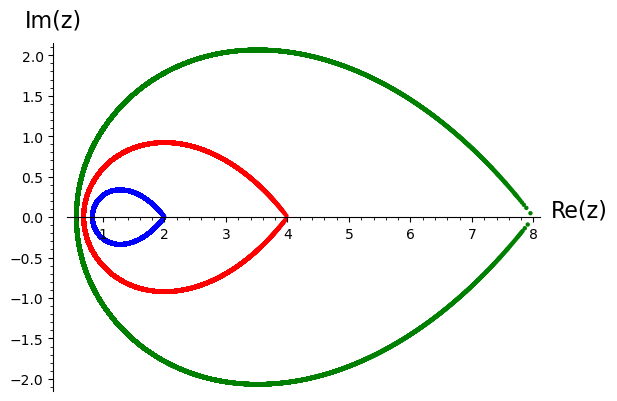
In the Figure 1, we plot the sets (σ(c)),(σ(b1))\partial(\sigma(c)),\partial(\sigma(b_{1})) and (σ(a2))\partial(\sigma(a_{2})).

Refer to caption
Figure 1. Sets (σ(c))\partial(\sigma(c)) in blue, (σ(b1))\partial(\sigma(b_{1})) in red and (σ(a2))\partial(\sigma(a_{2})) in green

Catalan polynomials are defined by the following linear recurrence relation

(3.3) 𝒫k+2(z)=𝒫k+1(z)z𝒫k(z),k2,{\mathcal{P}}_{k+2}(z)={\mathcal{P}}_{k+1}(z)-z{\mathcal{P}}_{k}(z),\qquad k\geq 2,

and the starting values 𝒫0(z)=𝒫1(z)=1\mathcal{P}_{0}(z)=\mathcal{P}_{1}(z)=1. The first values obtained are 𝒫2(z)=1z\mathcal{P}_{2}(z)=1-z, 𝒫3(z)=12z\mathcal{P}_{3}(z)=1-2z and 𝒫4(z)=13z+z2\mathcal{P}_{4}(z)=1-3z+z^{2}. The closed form of 𝒫k\mathcal{P}_{k} is given by the formula

𝒫k(z)=(1+14z)k+1(114z)k+12k+114z,\mathcal{P}_{k}(z)={(1+\sqrt{1-4z})^{k+1}-(1-\sqrt{1-4z})^{k+1}\over 2^{k+1}\sqrt{1-4z}},

for k0k\geq 0. The bivariate generating function is

11t+zt2=k0𝒫k(z)tk,{1\over 1-t+zt^{2}}=\sum_{k\geq 0}\mathcal{P}_{k}(z)t^{k},

see these and other properties in [6]. Other interesting property of Catalan polynomials is the following

d𝒫k(z)dz=12k1l=0k2(l+2)2l𝒫l(z),k2,{d\mathcal{P}_{k}(z)\over dz}={-1\over 2^{k-1}}\sum_{l=0}^{k-2}(l+2)2^{l}\mathcal{P}_{l}(z),\qquad k\geq 2,

([2, Identity II]). By induction method, we conclude that the coefficients of 𝒫k(z)\mathcal{P}_{k}(z) has alternative signs.

In the next results, we use the usual notation P(δ1)P(\delta_{1}) where

P(δ1):=k=0nakδ1k=k=0nakδkP(\delta_{1}):=\sum_{k=0}^{n}a_{k}\delta_{1}^{\ast k}=\sum_{k=0}^{n}a_{k}\delta_{k}

and PP is the polynomial, P(z)=k=0nakzkP(z)=\sum_{k=0}^{n}a_{k}z^{k}.

Lemma 3.5.

Take the Catalan sequence polynomials (𝒫k)k0(\mathcal{P}_{k})_{k\geq 0}. Then 𝒫k(δ1)1(0,14n)\mathcal{P}_{k}(\delta_{1})\in\ell^{1}(\mathbb{N}^{0},{1\over 4^{n}}), 𝒫0(δ1)1,14n=1\|\mathcal{P}_{0}(\delta_{1})\|_{1,{1\over 4^{n}}}=1 and

𝒫k(δ1)1,14n=𝒫k(14)=αk4k1,k1,\|\mathcal{P}_{k}(\delta_{1})\|_{1,{1\over 4^{n}}}=\mathcal{P}_{k}({-1\over 4})={\alpha_{k}\over 4^{k-1}},\qquad k\geq 1,

where α1=1\alpha_{1}=1, α2=5\alpha_{2}=5 and αk=4(αk1+αk2)\alpha_{k}=4(\alpha_{k-1}+\alpha_{k-2}) for k3k\geq 3.

Proof.

It is clear that 𝒫k(δ1)1(0,14n)\mathcal{P}_{k}(\delta_{1})\in\ell^{1}(\mathbb{N}^{0},{1\over 4^{n}}) and 𝒫0(δ1)1,14n=1\|\mathcal{P}_{0}(\delta_{1})\|_{1,{1\over 4^{n}}}=1. As the coefficients of polynomials (𝒫k)k0(\mathcal{P}_{k})_{k\geq 0} have alternative signs, we conclude that

𝒫k(δ1)1,14n\displaystyle\|\mathcal{P}_{k}(\delta_{1})\|_{1,{1\over 4^{n}}} =\displaystyle= j=0kaj(14)j=𝒫k(14)\displaystyle\sum_{j=0}^{k}a_{j}\left({-1\over 4}\right)^{j}=\mathcal{P}_{k}({-1\over 4})
=\displaystyle= (1+2)k+1(12)k+122k+1=αk4k1,\displaystyle{(1+\sqrt{2})^{k+1}-(1-\sqrt{2})^{k+1}\over\sqrt{2}2^{k+1}}={\alpha_{k}\over 4^{k-1}},

where the integer sequence (αk)k1(\alpha_{k})_{k\geq 1} is numbered as A086347 in [15] and treated in detail there. ∎

Remark 3.6.

The first values of the sequence (αk)k1(\alpha_{k})_{k\geq 1} are 1,1, 5,5, 24,24, 116,116, 560560.... This sequence is an example of generalized Fibonacci numbers g(k)=cg(k1)+dg(k2)g(k)=cg(k-1)+dg(k-2) for k2k\geq 2 and seed values g(0)=ag(0)=a and g(1)=bg(1)=b (a,b,c,da,b,c,d\in\mathbb{N}.)

Theorem 3.7.

For k1k\geq 1,

(ck)1=𝒫k+1(δ1)+(cδ1)𝒫k(δ1).(c^{\ast k})^{-1}=\mathcal{P}_{k+1}(\delta_{1})+(-c\ast\delta_{1})\ast\mathcal{P}_{k}(\delta_{1}).

Moreover (cc)11,14n=32\|(c\ast c)^{-1}\|_{1,{1\over 4^{n}}}={3\over 2} and (ck)11,14n14k(αk+1+2αk)\|(c^{\ast k})^{-1}\|_{1,{1\over 4^{n}}}\leq{1\over 4^{k}}\left(\alpha_{k+1}+2\alpha_{k}\right) for k1k\geq 1, where (αk)k1(\alpha_{k})_{k\geq 1} are defined in Lemma 3.5.

Proof.

Note that c1=δ0δ1cc^{-1}=\delta_{0}-\delta_{1}\ast c, see formula (3.2) and then

(cc)1\displaystyle(c\ast c)^{-1} =\displaystyle= c1c1=δ02δ1c+δ1(δ1cc)\displaystyle c^{-1}\ast c^{-1}=\delta_{0}-2\delta_{1}\ast c+\delta_{1}\ast(\delta_{1}\ast c\ast c)
=\displaystyle= δ0δ1δ1c=𝒫2(δ1)+(cδ1)𝒫1(δ1),\displaystyle\delta_{0}-\delta_{1}-\delta_{1}\ast c=\mathcal{P}_{2}(\delta_{1})+(-c\ast\delta_{1})\ast\mathcal{P}_{1}(\delta_{1}),

where we have applied that δ1c1=cδ0\delta_{1}\ast c^{\ast 1}=c-\delta_{0}. By induction, we have that

(c(k+1))1\displaystyle(c^{\ast(k+1)})^{-1} =\displaystyle= c1(ck)1=(δ0δ1c)(𝒫k+1(δ1)+(cδ1)𝒫k(δ1))\displaystyle c^{-1}\ast(c^{\ast k})^{-1}=(\delta_{0}-\delta_{1}\ast c)\ast(\mathcal{P}_{k+1}(\delta_{1})+(-c\ast\delta_{1})\ast\mathcal{P}_{k}(\delta_{1}))
=\displaystyle= 𝒫k+1(δ1)δ1c𝒫k+1(δ1)δ1𝒫k(δ1)\displaystyle\mathcal{P}_{k+1}(\delta_{1})-\delta_{1}\ast c\ast\mathcal{P}_{k+1}(\delta_{1})-\delta_{1}\ast\mathcal{P}_{k}(\delta_{1})
=\displaystyle= 𝒫k+2(δ1)+(cδ1)𝒫k+1(δ1),\displaystyle\mathcal{P}_{k+2}(\delta_{1})+(-c\ast\delta_{1})\ast\mathcal{P}_{k+1}(\delta_{1}),

where we have applied the recurrence relation (3.3).

Finally, we apply Lemma 3.5 to get

(ck)11,14n𝒫k+1(δ1)1,14n+12𝒫k(δ1)1,14n=14k(αk+1+2αk)\|(c^{\ast k})^{-1}\|_{1,{1\over 4^{n}}}\leq\|\mathcal{P}_{k+1}(\delta_{1})\|_{1,{1\over 4^{n}}}+{1\over 2}\|\mathcal{P}_{k}(\delta_{1})\|_{1,{1\over 4^{n}}}={1\over 4^{k}}\left(\alpha_{k+1}+2\alpha_{k}\right)

for k1k\geq 1. ∎

4. Powers of Catalan generating functions for bounded operators

In this section, we consider the particular case that TT is a linear and bounded operator on the Banach space XX, T(X)T\in{\mathcal{B}}(X), such that

(4.1) supn04nTn:=M<,\sup_{n\geq 0}{\|4^{n}T^{n}\|}:=M<\infty,

i.e., 4T{\displaystyle{4T}} is a power-bounded operator. In this case σ(T)D(0,14)¯\sigma(T)\subset\overline{D(0,{1\over 4})}. Under the condition (4.1), we define the Catalan generating function, C(T)C(T), by

(4.2) C(T):=n0CnTn,C(T):=\sum_{n\geq 0}C_{n}T^{n},

see [10, Section 5]. The bounded operator C(T)C(T) may be considered as the image of the Catalan sequence c=(Cn)n0c=(C_{n})_{n\geq 0} in the algebra homomorphism Φ:1(0,14n)(X)\Phi:\ell^{1}(\mathbb{N}^{0},{1\over 4^{n}})\to{\mathcal{B}}(X) where

Φ(a)x:=n0anTn(x),a=(an)n01(0,14n),xX,\Phi(a)x:=\sum_{n\geq 0}a_{n}T^{n}(x),\qquad a=(a_{n})_{n\geq 0}\in\ell^{1}(\mathbb{N}^{0},{1\over 4^{n}}),\quad x\in X,

i.e., Φ(c)=C(T)\Phi(c)=C(T). The Φ\Phi algebra homomorphism (also called functional calculus) is presented in some functional analysis textbooks, for example [11, Chapter 13 and 14].

Theorem 4.1.

Given T(X)T\in{\mathcal{B}}(X) such that 4T{4T} is power-bounded and c=(Cn)n0c=(C_{n})_{n\geq 0} the Catalan sequence. Then

  • (i)

    The powers (C(T))2k1=Φ(ak)(C(T))^{2k-1}=\Phi(a_{k}) and (C(T))2k=Φ(bk)(C(T))^{2k}=\Phi(b_{k}) for k1k\geq 1, and

    (C(T)j(C(T))j,j1.\|(C(T)^{j}\|\leq(C(\|T\|))^{j},\qquad j\geq 1.
  • (ii)

    The operator C(T)C(T) is invertible, (C(T))1=ITC(T)(C(T))^{-1}=I-TC(T),

    (C(T))(j+1)=𝒫j(T)TC(T)𝒫j1(T)j1,(C(T))^{-(j+1)}=\mathcal{P}_{j}(T)-TC(T)\mathcal{P}_{j-1}(T)\qquad j\geq 1,

    C(T)11+12supn04nTn\|C(T)^{-1}\|\leq 1+{1\over 2}\sup_{n\geq 0}{\|4^{n}T^{n}\|}, C(T)232supn04nTn\|C(T)^{-2}\|\leq{3\over 2}\sup_{n\geq 0}{\|4^{n}T^{n}\|} and

    (C(T))(j+1)14jsupn04nTn(αj+1+2αj),j1,\|(C(T))^{-(j+1)}\|\leq{1\over 4^{j}}\sup_{n\geq 0}{\|4^{n}T^{n}\|}\left(\alpha_{j+1}+2\alpha_{j}\right),\qquad j\geq 1,

    where (αj)j1(\alpha_{j})_{j\geq 1} are defined in Lemma 3.5.

  • (iii)

    Take (Pn)n0(P_{n})_{n\geq 0} and (Qn)n0(Q_{n})_{n\geq 0} polynomials given in Definition 2.4. Then

    n0Pn(z)Tn\displaystyle\sum_{n\geq 0}P_{n}(z)T^{n} =\displaystyle= C(T)(z+1)IT(1+z)2zI,\displaystyle{C(T)-(z+1)I\over T(1+z)^{2}-zI},
    n0Qn(z)Tn\displaystyle\sum_{n\geq 0}Q_{n}(z)T^{n} =\displaystyle= (C(T)(z+1)I)(z+1)T(1+z)2zI,\displaystyle{(C(T)-(z+1)I)(z+1)\over T(1+z)^{2}-zI},

    for |z|<1|z|<1.

  • (iv)

    The spectral mapping theorem holds for (C(T))n(C(T))^{n}, i.e, σ((C(T))n)=Cn(σ(T))\sigma((C(T))^{n})=C^{n}(\sigma(T)) for n.n\in\mathbb{Z}.

Proof.

(i) From (4.2), Φ(c)=C(T)(X)\Phi(c)=C(T)\in{\mathcal{B}}(X) as we have commented above. By Proposition 3.2 (iii), we have

(C(T))2k1\displaystyle(C(T))^{2k-1} =\displaystyle= (Φ(c))2k1=Φ(c(2k2))=Φ(ak),\displaystyle(\Phi(c))^{2k-1}=\Phi(c^{\ast(2k-2)})=\Phi(a_{k}),
(C(T))2k\displaystyle(C(T))^{2k} =\displaystyle= (Φ(c))2k=Φ(c(2k1))=Φ(bk),\displaystyle(\Phi(c))^{2k}=\Phi(c^{\ast(2k-1)})=\Phi(b_{k}),

for k1k\geq 1. By Proposition 3.2 (ii), we get

(C(T))2k1=Φ(ak)j0ak(j)Tj=(C(T))2k1,\displaystyle\|(C(T))^{2k-1}\|=\|\Phi(a_{k})\|\leq\sum_{j\geq 0}a_{k}(j)\|T\|^{j}=(C(\|T\|))^{2k-1},
(C(T))2k=Φ(bk)j0bk(j)Tj=(C(T))2k,\displaystyle\|(C(T))^{2k}\|=\|\Phi(b_{k})\|\leq\sum_{j\geq 0}b_{k}(j)\|T\|^{j}=(C(\|T\|))^{2k},

for k1k\geq 1 and we conclude the proof of (i).

(ii) As the homomorphism Φ\Phi is continuous, we apply the formula (3.2) to get

C(T)(ITC(T))=Φ(c)(Φ(δ0δ1c))=Φ(cδ1c1)=Φ(δ0)=I.C(T)(I-TC(T))=\Phi(c)(\Phi(\delta_{0}-\delta_{1}\ast c))=\Phi(c-\delta_{1}\ast c^{\ast 1})=\Phi(\delta_{0})=I.

In fact (C(T))1=Φ(c1)(C(T))^{-1}=\Phi(c^{-1}) and

(C(T))(j+1)=Φ((c1)j)=Φ(cj)1=𝒫j+1(T)TC(T)𝒫j(T),j1,(C(T))^{-(j+1)}=\Phi((c^{-1})^{\ast j})=\Phi(c^{\ast j})^{-1}=\mathcal{P}_{j+1}(T)-TC(T)\mathcal{P}_{j}(T),\qquad j\geq 1,

where we have applied Theorem 3.7 and Φ\Phi is an algebra homomorphism. The estimation of (C(T))(j+1)\|(C(T))^{-(j+1)}\| follows also from Theorem 3.7.

(iii) We follow similar ideas to those shown in Theorem 2.7 and we check

n0Pn(z)Tn=C(T)(z+1)IT(1+z)2zI,n0Qn(z)Tn=(C(T)(z+1)I)(z+1)T(1+z)2zI,\sum_{n\geq 0}P_{n}(z)T^{n}={C(T)-(z+1)I\over T(1+z)^{2}-zI},\qquad\displaystyle{\sum_{n\geq 0}Q_{n}(z)T^{n}={(C(T)-(z+1)I)(z+1)\over T(1+z)^{2}-zI}},

for |z|<1.|z|<1.

(iv) Since 4T{4T} is power bounded, the spectral mapping theorem for Cn(T)C^{n}(T) may found in [3, Theorem 2.1] and then σ((C(T))n)=Cn(σ(T))\sigma((C(T))^{n})=C^{n}(\sigma(T)) for n.n\in\mathbb{Z}.

Remark 4.2.

As σ(T)D(0,14)¯\sigma(T)\subset\overline{D(0,{1\over 4})}, we apply Proposition 3.3 to conclude that

σ(Cn(T))Cn(D(0,14)¯),n.\sigma(C^{n}(T))\subset C^{n}(\overline{D(0,{1\over 4})}),\qquad n\in\mathbb{Z}.

5. Examples, applications and final comments

In this section we present some particular examples of operators TT for which we solve the equation (1.3), calculate C(T)C(T) and (C(T))k(C(T))^{k} for kk\in\mathbb{Z}. In the subsection 5.1, we consider the Euclidean space 2\mathbb{C}^{2} and some matrices TT. To resolve this matrix equation, we need to solve a system of four quadratic equations. We also calculate (C(T))n(C(T))^{n} for these matrices. In subsection 5.2 we check C(a)C(a) for some a1(0,14n)a\in\ell^{1}(\mathbb{N}^{0},{1\over 4^{n}}). Finally we present some ideas to continue this research in subsection 5.3.

5.1. Matrices on 2\mathbb{C}^{2}

We consider the Euclidean space 2\mathbb{C}^{2} and the operator T=(λ00μ),T=\begin{pmatrix}\lambda&0\\ 0&\mu\end{pmatrix}, with 0λ,μ0\not=\lambda,\mu\in\mathbb{C}. For λ=μ\lambda=\mu, the solution is presented in [10, Subsection 6.1]. For λμ\lambda\not=\mu, the solution of (1.3) is given by

Y=(1±14λ2λ001±14μ2μ),Y=\begin{pmatrix}{1\pm\sqrt{1-4\lambda}\over 2\lambda}&0\\ 0&{1\pm\sqrt{1-4\mu}\over 2\mu}\end{pmatrix},\qquad

where the allowed signs are all four combinations. In the case that |λ|,|μ|14|\lambda|,|\mu|\leq{1\over 4}, note that

(C(T))j=((C(λ))j00(C(μ))j).(C(T))^{j}=\begin{pmatrix}(C(\lambda))^{j}&0\\ 0&(C(\mu))^{j}\end{pmatrix}.\qquad

for jj\in\mathbb{Z}.

Now we study the case T=(0λλ0)T=\begin{pmatrix}0&\lambda\\ \lambda&0\end{pmatrix} with λ\{0}\lambda\in\mathbb{C}\backslash\{0\}. When |λ|14|\lambda|\leq{1\over 4}, we get that

(5.1) C(T)=(Ce(λ)Co(λ)Co(λ)Ce(λ)),C(T)=\begin{pmatrix}C_{e}(\lambda)&C_{o}(\lambda)\\ C_{o}(\lambda)&C_{e}(\lambda)\end{pmatrix},

where functions CeC_{e} and CoC_{o} are functions given by

Ce(λ):=n=0C2nλ2n\displaystyle C_{e}(\lambda):=\sum_{n=0}^{\infty}C_{2n}\lambda^{2n} =\displaystyle= 1+4λ14λ4λ,\displaystyle{\sqrt{1+4\lambda}-\sqrt{1-4\lambda}\over 4\lambda},
Co(λ):=n=0C2n+1λ2n+1\displaystyle C_{o}(\lambda):=\sum_{n=0}^{\infty}C_{2n+1}\lambda^{2n+1} =\displaystyle= 21+4λ14λ4λ.\displaystyle{2-\sqrt{1+4\lambda}-\sqrt{1-4\lambda}\over 4\lambda}.

Note that C(T)C(T) is one of the four solutions of (1.3), see [10, Section 6.1]. As

(abba)2n\displaystyle\begin{pmatrix}a&b\\ b&a\end{pmatrix}^{2n} =\displaystyle= (a2n+(2n2)a2(n2)b2++b2n)(1001)\displaystyle\left(a^{2n}+{2n\choose 2}a^{2(n-2)}b^{2}+\dots...+b^{2n}\right)\begin{pmatrix}1&0\\ 0&1\end{pmatrix}
+\displaystyle+ ((2n1)a2n1b++(2n1)ab2n1)(0110),\displaystyle\left({2n\choose 1}a^{2n-1}b+\dots...+{2n\choose 1}ab^{2n-1}\right)\begin{pmatrix}0&1\\ 1&0\end{pmatrix},
(abba)2n+1\displaystyle\begin{pmatrix}a&b\\ b&a\end{pmatrix}^{2n+1} =\displaystyle= (a2n+1++(2n+12n)ab2n)(1001)\displaystyle\left(a^{2n+1}+\dots...+{2n+1\choose 2n}ab^{2n}\right)\begin{pmatrix}1&0\\ 0&1\end{pmatrix}
+\displaystyle+ ((2n+11)a2nb++b2n+1)(0110),\displaystyle\left({2n+1\choose 1}a^{2n}b+\dots...+b^{2n+1}\right)\begin{pmatrix}0&1\\ 1&0\end{pmatrix},

we use (5.1) to get new generating formulae for Catalan triangle numbers.

Theorem 5.1.

Take n0n\geq 0 and zD(0,14)¯z\in\overline{D(0,{1\over 4})}. Then

k=nB2kn,nz2k\displaystyle\sum_{k=n}^{\infty}B_{2k-n,n}z^{2k} =\displaystyle= z2n(Ce2n(z)+(2n2)Ce2(n2)(z)Co2(z)++Co2(z)),\displaystyle z^{2n}\left(C_{e}^{2n}(z)+{2n\choose 2}C_{e}^{2(n-2)}(z)C_{o}^{2}(z)+\dots...+C_{o}^{2}(z)\right),
k=nB2k+1n,nz2k+1\displaystyle\sum_{k=n}^{\infty}B_{2k+1-n,n}z^{2k+1} =\displaystyle= z2n((2n1)Ce2n1(z)Co(z)++(2n1)Ce(z)Co2n1(z)),\displaystyle z^{2n}\left({2n\choose 1}C_{e}^{2n-1}(z)C_{o}(z)+\dots...+{2n\choose 1}C_{e}(z)C_{o}^{2n-1}(z)\right),
k=nA2k1n,nz2k\displaystyle\sum_{k=n}^{\infty}A_{2k-1-n,n}z^{2k} =\displaystyle= z2n(Ce2n1(z)++(2n12n2)Ce(z)Co2n2(z)),\displaystyle z^{2n}\left(C_{e}^{2n-1}(z)+\dots...+{2n-1\choose 2n-2}C_{e}(z)C_{o}^{2n-2}(z)\right),
k=nA2kn,nz2k+1\displaystyle\sum_{k=n}^{\infty}A_{2k-n,n}z^{2k+1} =\displaystyle= z2n((2n11)Ce2n1(z)Co(z)++Co2n1(z)),\displaystyle z^{2n}\left({2n-1\choose 1}C_{e}^{2n-1}(z)C_{o}(z)+\dots...+C_{o}^{2n-1}(z)\right),
Proof.

Take |z|14|z|\leq{1\over 4} and we consider T=(0zz0)T=\begin{pmatrix}0&z\\ z&0\end{pmatrix}. We apply Theorem 4.1 to get

C(T)2n\displaystyle C(T)^{2n} =\displaystyle= j=0bn(j)Tj=l=0bn(2l)z2nI+l=0bn(2l+1)z2n+1(0110)\displaystyle\sum_{j=0}^{\infty}b_{n}(j)T^{j}=\sum_{l=0}^{\infty}b_{n}(2l)z^{2n}I+\sum_{l=0}^{\infty}b_{n}(2l+1)z^{2n+1}\begin{pmatrix}0&1\\ 1&0\end{pmatrix}
=\displaystyle= l=0B2l+n,nz2nI+l=0B2l+1+n,nz2n+1(0110)\displaystyle\sum_{l=0}^{\infty}B_{2l+n,n}z^{2n}I+\sum_{l=0}^{\infty}B_{2l+1+n,n}z^{2n+1}\begin{pmatrix}0&1\\ 1&0\end{pmatrix}
=\displaystyle= 1z2n(k=nB2kn,nz2kI+k=nB2k+1n,nz2k+1(0110)),\displaystyle{1\over z^{2n}}\left(\sum_{k=n}^{\infty}B_{2k-n,n}z^{2k}I+\sum_{k=n}^{\infty}B_{2k+1-n,n}z^{2k+1}\begin{pmatrix}0&1\\ 1&0\end{pmatrix}\right),

and we conclude the first two equalities. Similarly, we consider C(T)2n+1C(T)^{2n+1} and show the second two equalities. ∎

Finally we study the case T=(λμ0λ)T=\begin{pmatrix}\lambda&\mu\\ 0&\lambda\end{pmatrix} with λ,μ\{0}\lambda,\mu\in\mathbb{C}\backslash\{0\}. The solutions of (1.3) are given by

Y=(aμ(a1)λ(12λa)0a)Y=\begin{pmatrix}{a}&{\mu(a-1)\over\lambda(1-2\lambda a)}\\ 0&a\end{pmatrix}

where aa is any solution of the quadratic Catalan equation λa2a+1=0\lambda a^{2}-a+1=0. In the case that |λ|14|\lambda|\leq{1\over 4}, we get that

C(T)=(C(λ)μ((C(λ)1)λ(12λC(λ))0C(λ)),C(T)=\begin{pmatrix}C(\lambda)&{\mu((C(\lambda)-1)\over\lambda(1-2\lambda C(\lambda))}\\ 0&C(\lambda)\end{pmatrix},

and

(C(T))j=((C(λ))jn(C(λ))j1μ((C(λ)1)λ(12λC(λ))0(C(λ))j),(C(T))^{j}=\begin{pmatrix}(C(\lambda))^{j}&n(C(\lambda))^{j-1}{\mu((C(\lambda)-1)\over\lambda(1-2\lambda C(\lambda))}\\ 0&(C(\lambda))^{j}\end{pmatrix},

for j1j\geq 1. As (C(T))1=1(C(λ))2(C(λ)μ((C(λ)1)λ(12λC(λ))0C(λ))(C(T))^{-1}={1\over(C(\lambda))^{2}}\begin{pmatrix}C(\lambda)&-{\mu((C(\lambda)-1)\over\lambda(1-2\lambda C(\lambda))}\\ 0&C(\lambda)\end{pmatrix}, we get that

(C(T))j=1(C(λ))2j((C(λ))jn(C(λ))j1μ((C(λ)1)λ(12λC(λ))0(C(λ))j),(C(T))^{-j}={1\over(C(\lambda))^{2j}}\begin{pmatrix}(C(\lambda))^{j}&-n(C(\lambda))^{j-1}{\mu((C(\lambda)-1)\over\lambda(1-2\lambda C(\lambda))}\\ 0&(C(\lambda))^{j}\end{pmatrix},

for j1j\geq 1.

5.2. Catalan operators on p\ell^{p}

We consider the space of sequences p(0,14n)\ell^{p}(\mathbb{N}^{0},{1\over 4^{n}}) where

ap,14n:=(n=0|an|p4np)1p<,\|a\|_{p,{1\over 4^{n}}}:=\left(\sum_{n=0}^{\infty}{|a_{n}|^{p}\over 4^{np}}\right)^{1\over p}<\infty,

for 1p<1\leq p<\infty and (0,14n)\ell^{\infty}(\mathbb{N}^{0},{1\over 4^{n}}) the space of sequences embedded with the norm

a,14n:=supn0|an|4n<.\|a\|_{\infty,{1\over 4^{n}}}:=\sup_{n\geq 0}{|a_{n}|\over 4^{n}}<\infty.

Note that 1(0,14n)p(0,14n)(0,14n)\ell^{1}(\mathbb{N}^{0},{1\over 4^{n}})\hookrightarrow\ell^{p}(\mathbb{N}^{0},{1\over 4^{n}})\hookrightarrow\ell^{\infty}(\mathbb{N}^{0},{1\over 4^{n}}).

Now we consider sequences c,(ak),(bk)1(0,14n)c,(a_{k}),(b_{k})\in\ell^{1}(\mathbb{N}^{0},{1\over 4^{n}}), the Catalan triangle sequences given in Definition 3.1 and convolution operators C(f):=cfC(f):=c\ast f, C2k(f)=bkfC^{2k}(f)=b_{k}\ast f and C2k1(f)=akfC^{2k-1}(f)=a_{k}\ast f for fp(0,14n)f\in\ell^{p}(\mathbb{N}^{0},{1\over 4^{n}}) and k1k\geq 1 with 1p1\leq p\leq\infty. By Theorem 4.1 (iv), we get that

σ(Cn)=Cn(σ(δ1))=Cn(D(0,14)¯),n1.\sigma(C^{n})=C^{n}(\sigma(\delta_{1}))=C^{n}(\overline{D(0,{1\over 4})}),\qquad n\geq 1.

Note that the set σ(Cn)\sigma(C^{n}) independent on pp and coincides with the spectrum of the power of Catalan sequence cc in 1(0,14n)\ell^{1}(\mathbb{N}^{0},{1\over 4^{n}}) (Proposition 3.3).

5.3. A future research

Given a,b0a,b\not=0\ \in\mathbb{C}, the quadratic equation

(5.2) bz2y2y+a2b=0,{bz\over 2}y^{2}-y+{a\over 2b}=0,

has two solutions given by

y=1±1zabu.y={1\pm\sqrt{1-za}\over bu}.

We define Ca,b(z):=11zabz;\displaystyle{C^{a,b}(z):={1-\sqrt{1-za}\over bz}}; note that Ca,b(z)=a2bC(az4)\displaystyle{C^{a,b}(z)={a\over 2b}C({az\over 4})} and

Ca,b(z)=n0an+122n+1bCnzn.C^{a,b}(z)=\sum_{n\geq 0}{a^{n+1}\over 2^{2n+1}b}C_{n}z^{n}.

It would be natural to consider a vector-valued version of equation (5.2) for a,b,z(X)a,b,z\in{\mathcal{B}}(X).

Acknowledgment. We thank the referee for his/her very careful review of this paper, and for the comments, corrections and suggestions that ensued. A major version of the paper has been carried out to take them into account and the paper has been significantly improved.

. This work does not have any conflicts of interest.

References

  • [1] X. Chen and W. Chu, Moments on Catalan numbers, J. Math. Anal. Appl., 349 (2), (2009), 311–316.
  • [2] J.A. Clapperton, P.J. Larcombe and E.J. Fennessey Some new identities for Catalan polynomials, Utilitas Mathematica., 80 (2009), 1–8.
  • [3] N. Dungey, Subordinated discrete semigroups of operators, Trans. Amer. Math. Soc., 363 (4), (2011), 1721–1741.
  • [4] V. J. W. Guo and J. Zeng: Factors of binomial sums from Catalan triangle. J. Number Theory, 130 (2010), no. 1, 172–186.
  • [5] R. K. Guy: Catwalks, sandsteps and Pascal pyramids. J. of Integer Sequences, 3 (2000), Article 00.1.6.
  • [6] A.F. Jarvis, P.J. Larcombe and E.J. Fennessey Some Factorization and Divisibility Properties of Catalan Polynomials, Bulletin of the ICA. 71 (2014), 36–56.
  • [7] R. Larsen, Banach Algebras: An Introduction. Marcel Dekker, New York, 1973.
  • [8] P.J. Miana and N. Romero, Moments of combinatorial and Catalan numbers, J. Number Theory, 130 (8), (2010), 1876–1887.
  • [9] P.J. Miana and N. Romero, Moments of Catalan triangle numbers, in Number Theory and Its Applications, Intechopen, 2020.
  • [10] P.J. Miana and N. Romero, Catalan generating functions for bounded operators, Preprint, 2022.
  • [11] J. Muscat, Functional Analysis. An Introduction to Metric Spaces, Hilbert Spaces and Banach Algebras. Springer, Berlin, 2014.
  • [12] L. W. Shapiro, A Catalan triangle, Discrete Math., 14 (1976), 83–90.
  • [13] A. Slavík: Identities with squares of binomial coefficients, Ars Combinatoria, 113 (2014), 377–383.
  • [14] N. Sloane, A Handbook of Integer Sequences, Academic Press, New Jersey, 1973.
  • [15] N. Sloane, https://oeis.org/
  • [16] R. P. Stanley, Catalan Numbers, Cambridge University Press, Cambridge, 2015.