The Belle Collaboration
Precision measurement of charged pion and kaon differential cross sections in annihilation at GeV
Abstract
Measurements of inclusive differential cross sections for charged pion and kaon production in annihilation have been carried out at a center-of-mass energy of GeV. The measurements were performed with the Belle detector at the KEKB collider using a data sample containing events, where . We present charge-integrated differential cross sections for as a function of the relative hadron energy from to . The combined statistical and systematic uncertainties for () are () at and () at . The cross sections are the first measurements of the -dependence of pion and kaon production for as well as the first precision cross section measurements at a center-of-mass energy far below the resonance used by the experiments at LEP and SLC.
pacs:
13.66.BcThe fragmentation function (FF) parametrizes the transition of quarks , antiquarks and gluons into the color-neutral hadron in high-energy particle collisions as a function of the four-momentum transfer squared, , in the collision and the relative energy carried by the final state hadron, . FFs are assumed to be process-independent and are extracted through global analysis of inclusive hadron production in and reactions, and from semi-inclusive hadron production in reactions at various center-of-mass energies (see Refs. marcopaper ; kumanopaper ; akk ). Dokshitzer-Gribov-Lipatov-Altarelli-Parisi (DGLAP) evolution equations dglap derived from Quantum Chromodynamics (QCD) are used to jointly analyze data sets taken at different . The evolution mixes quark and gluon degrees of freedom and enables the extraction of quark and gluon FFs through the analysis of precise hadron cross section data sets. In annihilation, the availability of precision data sets was previously limited mostly to results from experiments (e.g., Refs. aleph ; delphi ; opal ; sld ) at LEP and SLC at the energy scale of the -boson mass. Recently, also the BaBar Collaboration reported inclusive hadron production cross sections at a center-of-mass energy of GeV babarpaper , however using a significantly smaller dataset compared to the Belle measurement. The large data samples available at Belle complement existing results on hadron production cross sections with precise measurements at . The differential cross sections reported here are expected to improve the precision of FFs and the QCD-based determination of the nucleon quark- and gluon-structure from semi-inclusive deeply inelastic measurements at CERN, DESY and Jefferson Laboratory and inclusive proton-proton measurements at CERN and BNL. In addition, the Belle data will allow first quantitative tests of higher-order QCD effects at werner .
This analysis is based on a fb-1 data sample collected with the Belle detector at the KEKB asymmetric-energy ( on GeV) collider kekb operating MeV below the resonance at GeV. The Belle detector is a large-solid-angle magnetic spectrometer that consists of a silicon vertex detector (SVD), a -layer central drift chamber (CDC) and an array of aerogel threshold Cherenkov counters (ACC). The ACC detector is surrounded by a barrel-like arrangement of time-of-flight scintillation counters (ToF) and an electromagnetic calorimeter (ECL) comprised of CsI(Tl) crystals, located inside a superconducting solenoid coil that provides a T magnetic field. The iron flux-return yoke surrounding the coil is instrumented to detect mesons and to identify muons (KLM). The detector is described in detail elsewhere belledetector . The Belle Monte Carlo (MC) simulations are performed with the PYTHIA Sjöstrand (1994) event generator and a GEANT Brun et al. (1984) detector simulation.
An event must have at least three charged tracks and a heavy-jet mass (the invariant mass of the summed four-momenta of all tracks and ECL clusters in the jet with the largest invariant mass) at least above GeV/ or above of the reconstructed visible energy. A reconstructed visible energy of more than GeV is required to reduce contamination from events. From these events, we retain tracks with a laboratory-frame momentum of more than MeV/, a scattering angle (relative to the beam axis) within the central detector acceptance (), at least three SVD hits, and a point of closest approach to the interaction point of under cm along the beam axis and under cm in the perpendicular plane.
Using likelihood ratios based on measurements of the CDC, signals from the ACC, ToF measurements, ECL cluster energies as well as KLM signals, charged particles are identified as pions, kaons, protons, electrons or muons. The initially-measured track yield for particle type is binned in with width , starting from ; negatively- and positively-charged tracks are treated separately. In order to obtain final cross sections, several corrections are applied, as described below. Statistical uncertainties are propagated through all corrections and systematic uncertainties from all corrections are added in quadrature.
The true yield for particle type is obtained from the measured yields via
| (1) |
where is the inverse of the particle identification (PID) probability matrix , whose diagonal and off-diagonal elements represent PID efficiencies and misidentification probabilities, respectively. As the elements of depend on the laboratory-frame momentum and polar angle, an matrix is constructed in each of the bins with boundaries GeV/ and boundaries . These values were chosen to obtain similar track yields in all bins. The elements of , called “efficiencies“ for the remainder of this letter, are obtained mostly from experimental data. For pions and kaons, the decay and its charge-conjugate are used. Similarly, proton PID efficiencies are extracted from and charge-conjugate decays and electron and muon efficiencies from decays. The procedures for calculating PID efficiencies from decays are rather similar and are described here for the pions in the channel. The reconstructed invariant mass distribution for candidate triplets of tracks is fitted with a threshold background function and combinations of asymmetric Gaussian and polynomial functions for the signal. The initial yield of true pions in the sample can be obtained from the fitted yield of ’s in the invariant mass distribution before applying any PID selection criteria. Performing the fit on the same track sample but with additional PID selection criteria for pions, kaons, protons and leptons, and dividing by the initial yield of true pions, gives pion PID efficiencies. All fit uncertainties are propagated through the efficiencies, accounting for correlations. Several matrix elements, especially the ones for leptons due to the high mass relative to the quark energy, cannot be filled only from data-driven decay studies. Missing efficiencies are estimated once by extrapolating the trend of extracted probabilities with MC information and a second time by utilizing MC probabilities only, which produces two alternative sets of PID matrices; both are used. Examples of pion efficiencies are shown in Fig. 1. Generally, the diagonal matrix elements have values around with the exception of kaon and proton efficiencies that drop at the highest momenta to about and , respectively. The most prominent misidentification probabilities are (up to ), (up to ) and (up to ).
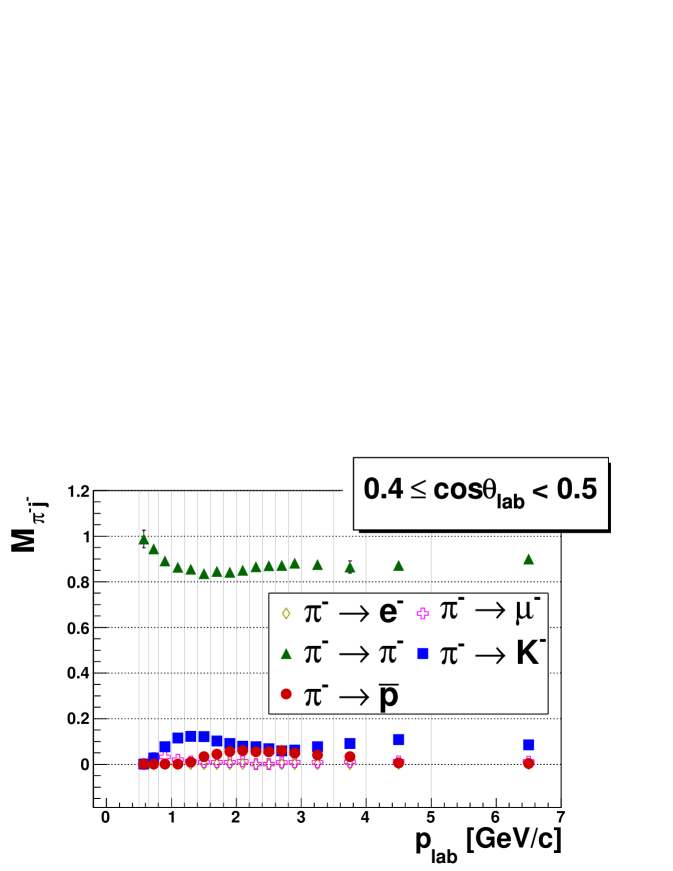
For the correction according to Eq. 1, both sets of PID matrices are inverted using singular value decomposition tools svdbook . Uncertainties on the elements of are obtained by statistical analysis of large samples of inverted PID matrices whose elements are varied before inversion according to their uncertainties. Finally, these uncertainties are propagated as systematic uncertainties to the PID-corrected track yields. Measured yields are corrected with each set of alternative matrices. The final PID-corrected yields are calculated from the average of the two corrections. The difference between the corrections is assigned as additional systematic uncertainty. The PID correction changes pion (kaon) yields by around () at and by around () at . The -dependence of the changes is due to the kinematic dependence of the extracted PID efficiencies.
After the basic hadronic event selection, experimental data still contain hadron contributions from events other than . A simulated sample containing all non- physically possible event topologies in annihilation at is assembled from dedicated QED (BHLUMI bhlumi generator for Bhabha-scattering, KKMC kk generator for and pair production) and two-photon MC data. Hadron yields from such non- events passing the hadronic event selection are scaled to the luminosity of the measurement sample and subtracted from the PID-corrected yields. Contributions from events other than are found not to be significant at . At , about of the reconstructed pions and of the reconstructed kaons are created in non-QCD and two-photon events. Statistical uncertainties are propagated as systematic uncertainties on the corrected yields.
The reconstructed values of are smeared around the true values because of the non-zero momentum resolution, which is smaller than half of the constant bin width of at and comparable to the bin width at . Similar to the particle misidentification correction, the -bin migration can be described by a matrix. While a cut-off of is applied to the final cross sections, the smearing matrix needs to be evaluated for to take into account smearing into or out of the selection region. Smearing matrices are extracted down to for pions and for kaons from the MC simulation. The matrices are inverted using a regularized unfolding procedure described in Ref. regularization . Due to limitations of the method, the correction is only applied to yields below for pions and kaons and so imposes an upper limit on for the final cross sections. All uncertainties are propagated through the unfolding procedure. Additional systematic uncertainties are assigned from tracks smearing out of and into the interval , the choice of the regularization weights and the difference in momentum resolution of the detector simulation compared to the resolution extracted from experimental cosmic ray data given in Ref. belledetector . The smearing correction causes no significant change in the measured yields because of the good momentum resolution, small bin width and mostly symmetric smearing to lower and higher values of .
Some hadrons are lost or gained through decays in flight. In addition, hadrons are lost due to interaction with detector material while others are created in such interactions. Finally, the track finding and fitting algorithm may find fake tracks or fail to reconstruct true tracks because of detector inefficiencies or occupancy effects. Limitations in the MC simulation do not allow us to distinguish these processes. Thus, a joint correction is performed for all processes in each bin, extracting ratios between reconstructed and generated particle yields. Concerning decay-in-flight (DIF), the QCD framework used by global analyses usually does not account for hadrons created in weak decays, which are nevertheless present in measured cross sections. Correction factors to remove pions and kaons produced in weak decays (e.g., from leptons, kaons and mesons, and heavier baryons) would be purely simulation-dependent. To be consistent, all weakly produced pions and kaons are included in the results, and all decayed pions and kaons are recovered. For the final cross sections, we provide supplementary fractions of pions and kaons originating from strong and weak decays archiveddata , extracted from MC data. For , the fraction of weakly-produced pions (kaons) is () but vanishes towards due to phase-space limitations. The implementation of DIF in the MC simulation is tested by analytical calculations and found to be consistent. Correlation effects between the PID and DIF corrections are studied; the observed correlations are applied as additional systematic uncertainties. The effect of hadronic interaction modeling on particle yields is estimated by comparing efficiencies from the default FLUKA fluka with the GEISHA geisha package and with no hadronic interactions. The small remaining differences are assigned as systematic uncertainties. Fake- and multiple-track reconstruction is found to be negligible. Track reconstruction inefficiencies are at the few-percent level and are corrected for. The most significant track quality cut is the requirement for three or more hits in the SVD, which also introduces most of the dependence of the efficiencies in this correction for . The overall efficiencies remain above for all . Statistical and systematic uncertainties on the efficiencies are propagated as systematic uncertainties on the corrected yields.
To obtain the best-measured reconstructed tracks, the analysis is limited to the barrel region of the detector. A correction is applied to recover the physical particle yield. Corresponding efficiencies from the MC simulation decrease from about at and level out around at . The behavior at is consistent with the assumption that hadrons with follow the known distribution of fragmenting quarks, where is the scattering angle in the center-of-mass frame. For , additional transverse hadron momentum causes the spectra to become constant and efficiencies to increase. The MC description of the dependence in the fragmentation process is tested with experimental data yields in a two-dimensional and binning. Consistency is found within statistical uncertainties and no additional systematic uncertainty is assigned. Statistical uncertainties on the efficiencies are propagated as systematic uncertainties on the corrected yields.
Hard initial-state and final-state photon radiation (ISR/FSR) processes reduce the fragmentation energy scale for both (ISR) or for one (FSR) final-state quark. Therefore, experimentally measured yields contain a variety of fragmentation scales . A theoretical deconvolution of ISR/FSR from measured yields is beyond the scope of this measurement. Instead, we keep the energy scales in the measurement sample within of the nominal in order to remain below the scale resolution of the state-of-the-art next-to-leading order DGLAP evolutions. Corresponding fractions of hadrons from events with summed ISR/FSR photon energies of less than are extracted from the MC simulation for each bin. These fractions rise from at to almost at maximum due to phase-space limitations for ISR/FSR. The fractions are applied bin-by-bin to the measured yields to exclude particles from events with large ISR/FSR contributions. According to MC simulations, of all events are excluded. Systematic uncertainties are assigned from the dependence of the hadron fractions on the chosen PYTHIA MC parameter sets and from accounting for the remaining scale variance in the sample.
Efficiencies for all applied event selections are extracted from MC simulations. Efficiencies for the hadronic event selection are close to unity at . They drop rapidly at larger since both the track multiplicity and heavy jet mass requirements disfavor events containing tracks with . In such events, the phase space for additional particles and substantial remaining transverse momentum is significantly reduced. The efficiencies drop to about at and to less than for . Conversely, efficiencies for the visible energy requirement are above at , but drop to about for particles with . This can be understood from the increased likelihood for events containing tracks with to deposit sufficient energy in the barrel part of the detector. The measured yields are corrected accordingly and statistical uncertainties are propagated as systematic uncertainties on the corrected yields. The distributions of event shape variables used in the event selection are compared between MC and experimental data. Differences in these distributions causing variations in event selection efficiencies are assigned as systematic uncertainties.
After all corrections, the measured yields are normalized to the time-integrated luminosity of the measurement sample, fb-1, with an uncertainty of . The resulting final charge-integrated differential pion and kaon cross sections for are displayed in Fig. 2. All cross section values and uncertainties are available in Ref. archiveddata . Combined relative statistical and systematic uncertainties remain below up to fractional hadron energies , then rise to about (pions) and (kaons) at and reach (pions) and more than (kaons) at maximum . As a test of all applied corrections, pion and kaon charge ratios are fitted with a constant. The results, and (with a combined statistical and systematic uncertainty), are consistent with within the extracted uncertainties and indicate consistency of the performed corrections.
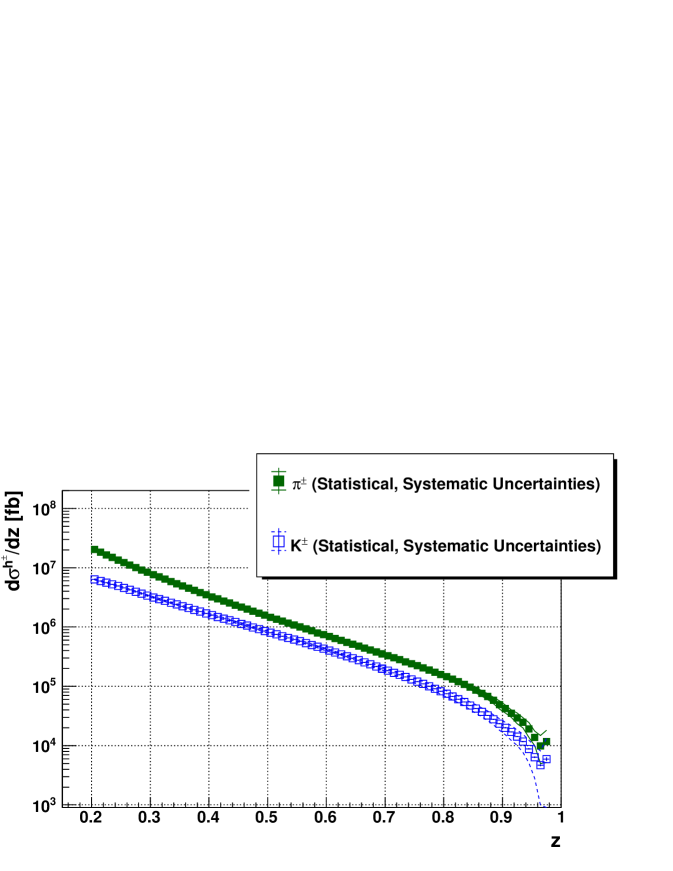
The precision of the present measurement is systematics-limited for all . For , the dominant systematic uncertainties arise from the initial/final state radiation correction. At , the momentum smearing, particle identification and DIF/reconstruction corrections represent the largest contributions to the systematic uncertainties. Figures showing different contributions to the systematic uncertainties for the final pion and kaon cross sections are given in Ref. archiveddata .
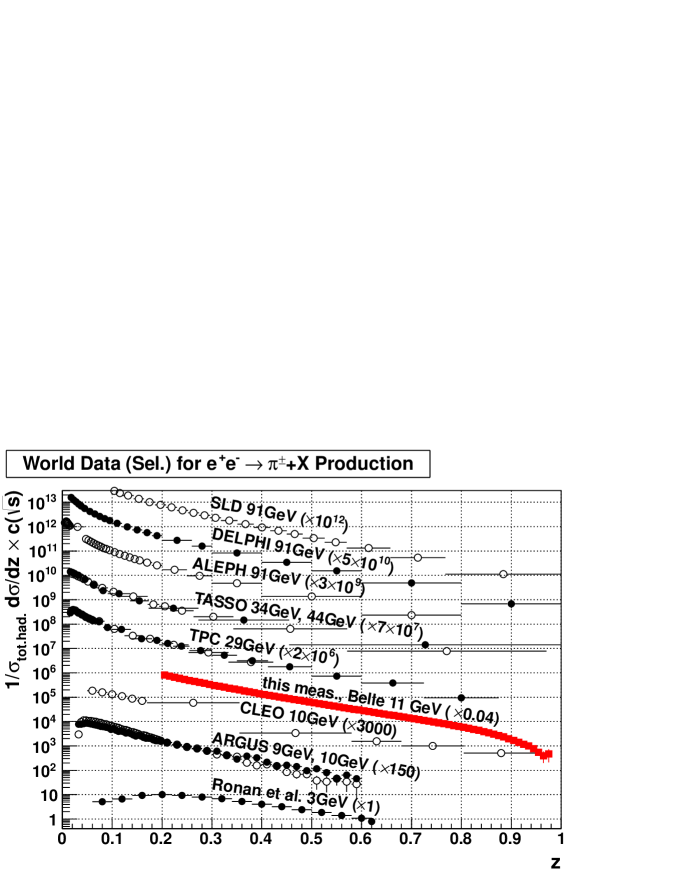
The final cross sections are compared with normalized cross section measurements from LEP and SLC experiments as well as from other, lower energy experiments. As an illustration, the pion cross section is compared to those from Refs. aleph ; delphi ; sld ; argus9and10 ; cleo10 ; slac3 ; tasso34and44 ; tpc29prl52 ; tpc29prl61 in Fig. 3. The corresponding plot for kaon cross sections can be found in Ref. archiveddata . The resolution in is significantly improved for all compared normalized cross sections over most of the range of this measurement. In addition, no other previous measurement probes the dependence of hadron production for . The total relative uncertainties of the previous measurements described above are larger or comparable to the uncertainties achieved in the results reported here. In particular, significantly better precision than previous measurements at low energy scales is reached. A comparison of the Belle results with simulated data shows agreement for , but exhibits a strong dependence on the chosen simulation parameter values at (see Ref. archiveddata ).
In conclusion, differential cross sections of identified charged pion and kaon production are measured over a broad range in with with high relative precision. The analyzed data sample of fb-1 has been accumulated at a center-of-mass energy of GeV, rendering this measurement the first precision measurement far from LEP/SLC center-of-mass energies. The high statistics and good control of systematic uncertainties will, for the first time, give constraints on the dependence of hadron FFs at and allow studies of higher order QCD effects at .
Acknowledgements.
The authors would like to thank M. Stratmann, D. de Florian, R. Sassot, S. Kumano, F. Jegerlehner, S. Jadach and H. Czyz for valuable discussions and suggestions. We thank the KEKB group for excellent operation of the accelerator; the KEK cryogenics group for efficient solenoid operations; and the KEK computer group, the NII, and PNNL/EMSL for valuable computing and SINET4 network support. We acknowledge support from MEXT, JSPS and Nagoya’s TLPRC (Japan); ARC and DIISR (Australia); NSFC (China); MSMT (Czechia); DST (India); INFN (Italy); MEST, NRF, GSDC of KISTI, and WCU (Korea); MNiSW and NCN (Poland); MES and RFAAE (Russia); ARRS (Slovenia); IKERBASQUE and UPV/EHU (Spain); SNSF (Switzerland); NSC and MOE (Taiwan); and DOE and NSF (USA).References
- (1) D. de Florian, R. Sassot, and M. Stratmann, Phys. Rev. D 75, ().
- (2) M. Hirai, S. Kumano, T. -H. Nagai, and K. Sudoh, Phys. Rev. D 75, ().
- (3) S. Albino, B. A. Kniehl, and G. Kramer, Nucl. Phys. B 803, ().
- (4) L. N. Lipatov, Sov. J. Nucl. Phys. 20, (); V. N. Gribov and L. N. Lipatov, Sov. J. Nucl. Phys. 15, (); G. Altarelli and G. Parisi, Nucl. Phys. B 126, (); Yu. L. Dokshitzer, Sov. Phys. JETP 46, ().
- (5) R. Barate et al. (ALEPH Collaboration), Phys. Rep. 294, ().
- (6) P. Abreu et al. (DELPHI Collaboration), Eur. Phys. J. C 5, ().
- (7) R. Akers et al. (OPAL Collaboration), Z. Phys. C 63, ().
- (8) K. Abe et al. (SLD Collaboration), Phys. Rev. D 69, ().
- (9) J. P. Lees et al. (BaBar Collaboration), arXiv: [hep-ex] (), submitted to Phys. Rev. D.
- (10) D. P. Anderle, F. Ringer, and W. Vogelsang, arXiv: [hep-ph] (), submitted to Phys. Rev. D.
- (11) S. Kurokawa and E. Kikutani, Nucl. Instrum. Meth. Phys. Res. Sect., A 499, (), and other papers included in this volume; T. Abe et al., Prog. Theor. Exp. Phys. () A and following articles up to A.
- (12) A. Abashian et al. (Belle Collaboration), Nucl. Instrum. Meth. Phys. Res. Sect. A 479, (); also see detector section in J. Brodzicka et al., Prog. Theor. Exp. Phys. () D.
- Sjöstrand (1994) T. Sjöstrand, Comput. Phys. Commun. 82, 74 (1994).
- Brun et al. (1984) R. Brun, F. Bruyant, M. Maire, A. C. McPherson and P. Zanarini (1984), CERN-DD/EE/84-1.
- (15) See, e.g., G.E. Forsythe, M.A. Malcolm and C.B. Moler, Computer Methods for Mathematical Computations, Prentice-Hall Inc., Englewood Cliffs, .
- (16) S. Jadach, W. Placzek, E. Richter-Was, B.F.L. Ward, and Z. Was, Comput. Phys. Commun. 102, ().
- (17) S. Jadach, B.F.L. Ward, and Z. Was, Comput. Phys. Commun. 130, ().
- (18) A. Höcker and V. Kartvelishvili, Nucl. Instrum. Meth. A 372, ().
- (19) All differential cross section values and uncertainties, together with the fractions of hadrons from strong and weak decays, are given in the attached supplemental data file.
- (20) A. Fass , A. Ferrari, J. Ranft, and P.R. Sala, Proc. IV Int. Conf. on Calorimetry in High Energy Physics, La Biodola, Italy, - Sept. ; Ed. A. Menzione and A. Scribano, World Scientific, p. .
- (21) H. Fesefeldt, RWTH Aachen Report PITHA, ().
- (22) H. Albrecht et al. (ARGUS Collaboration), Z. Phys. C 44, ().
- (23) S. Behrends, et al. (CLEO Collaboration), Phys. Rev. D 31, ().
- (24) M. T. Ronan et al., Phys. Rev. Lett. 44, ().
- (25) W. Braunschweig et al. (TASSO Collaboration), Z. Phys. C 42, ().
- (26) H. Aihara et al. (TPC/Two Gamma Collaboration), Phys. Rev. Lett. 52, ().
- (27) H. Aihara et al. (TPC/Two Gamma Collaboration), Phys. Rev. Lett. 61, ().
- (28) J. Beringer et al. (PDG), Phys. Rev. D 86, ().