Prospects of cold dark matter searches with an ultra-low-energy germanium detector
Abstract
The report describes the research program on the development of ultra-low-energy germanium detectors, with emphasis on WIMP dark matter searches. A threshold of 100 eV is achieved with a 20 g detector array, providing a unique probe to the low-mas WIMP. Present data at a surface laboratory is expected to give rise to comparable sensitivities with the existing limits at the WIMP-mass range. The projected parameter space to be probed with a full-scale, kilogram mass-range experiment is presented. Such a detector would also allow the studies of neutrino-nucleus coherent scattering and neutrino magnetic moments.
AS-TEXONO/07-05
September 17, 2025
Weakly Interacting Massive Particles (WIMP, denoted by ) are the leading candidates for cold dark matter (CDM) [1], and supersymmetric (SUSY) particles are the favored WIMP candidates. The popular SUSY models prefer WIMP mass () of the range of 100 GeV, though light neutralinos remain a possibility [2]. Simple extensions of the Standard Model with a singlet scalar favors light WIMPs [3]. Most CDM experiments optimize their design in the high-mass region, and have diminishing sensitivities for , where there is an allowed region if the DAMA annual modulation data are interpreted as WIMP signatures [4]. To probe this low-mass region, detectors with sub-keV threshold are necessary. These low-threshold detectors will also open the window to look for WIMPs bound in the solar system [5], as well as non-pointlike SUSY candidates like Q-balls [6]. Sensitivity to sub-keV energy presents a formidable challenge to detector technology and to background control. So far, only the CRESST-I experiment have derived exclusion limits [7] with sapphire()-based cryogenic detector at a threshold of 600 eV.
A research program in low energy neutrino and astroparticle physics is pursued [8] by the TEXONO Collaboration at the Kuo-Sheng(KS) Reactor Laboratory. A scientific goal is to develop advanced detectors with kg-size target mass, 100 eV-range threshold and low-background specifications for WIMP searches as well as for the studies of neutrino-nucleus coherent scatterings [9] and neutrino magnetic moments () [10]. The KS laboratory is located 28 m from a 2.9 GW reactor core and has an overburden of about 30 meter-water-equivalence (mwe). Its facilities are described in Ref. [11], where the -studies with a 1.06 kg germanium detector (HPGe) at a hardware threshold of 5 keV were reported. This HPGe has also been used for the studies of reactor electron neutrons [12] as well as searches for reactor axions [13]. The experimental procedures were well-established and the background above 12 keV were measured. In particular, a background level of about (cpd) comparable to those of other underground CDM experiments was achieved.
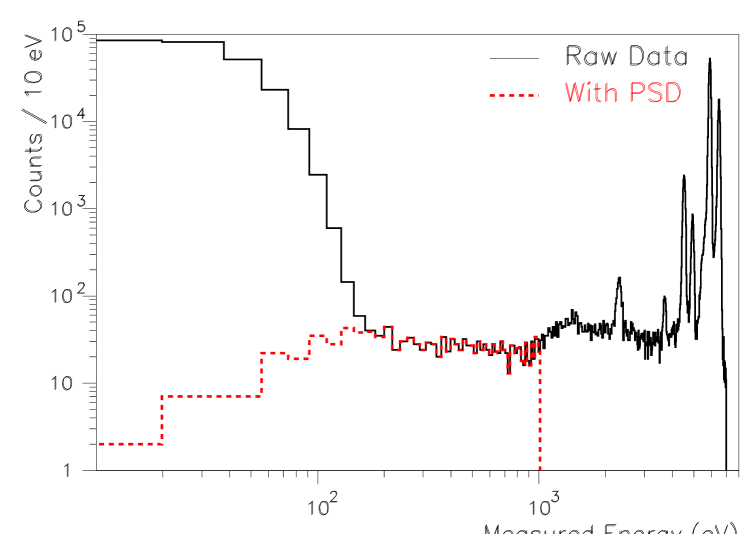
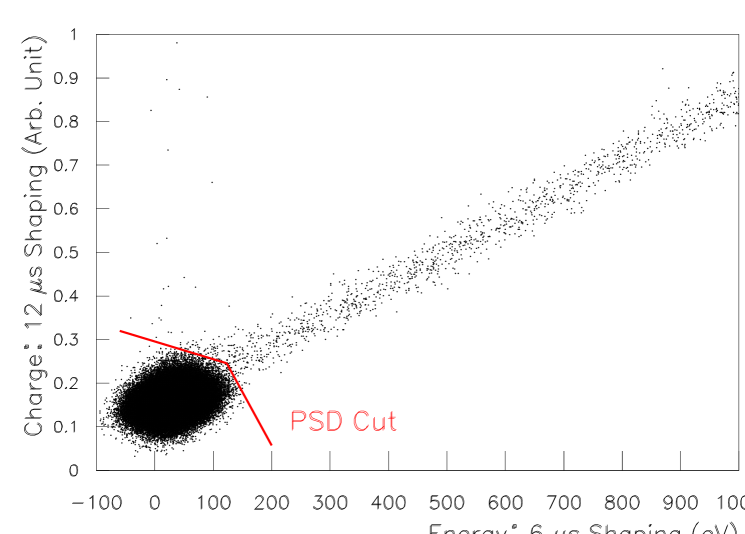
“Ultra-Low-Energy” germanium (ULEGe) detectors, developed originally for soft X-rays detection, are candidate technologies to meet the challenges of probing into the unexplored sub-keV energy domain [9]. These detectors typically have modular mass of 5-10 grams. Detector array of up to N=30 elements have been successfully built, while there are recent advances in developing single-element ULEGe of kg-size mass [14]. Various prototypes based on this detector technology have been constructed. Depicted in Figure 2 is the measured energy spectrum due to external 55Fe calibration sources (5.90 and 6.49 keV) together with X-rays from Ti (4.51 and 4.93 keV), Ca (4.01 keV), S (2.46 keV) and Al (1.55 keV). Random trigger events uncorrelated to the detector provided the zero-energy pedestals. Pulse shape discrimination (PSD) criteria were applied as illustrated in Figure 2 by correlating two output with different electronics amplifications and shaping times. The electronic noise edge was suppressed by PSD and a threshold of 100 eV was achieved. The deviations of the low energy spectra of the selected events from a flat distribution gave the efficiencies of the PSD cuts.
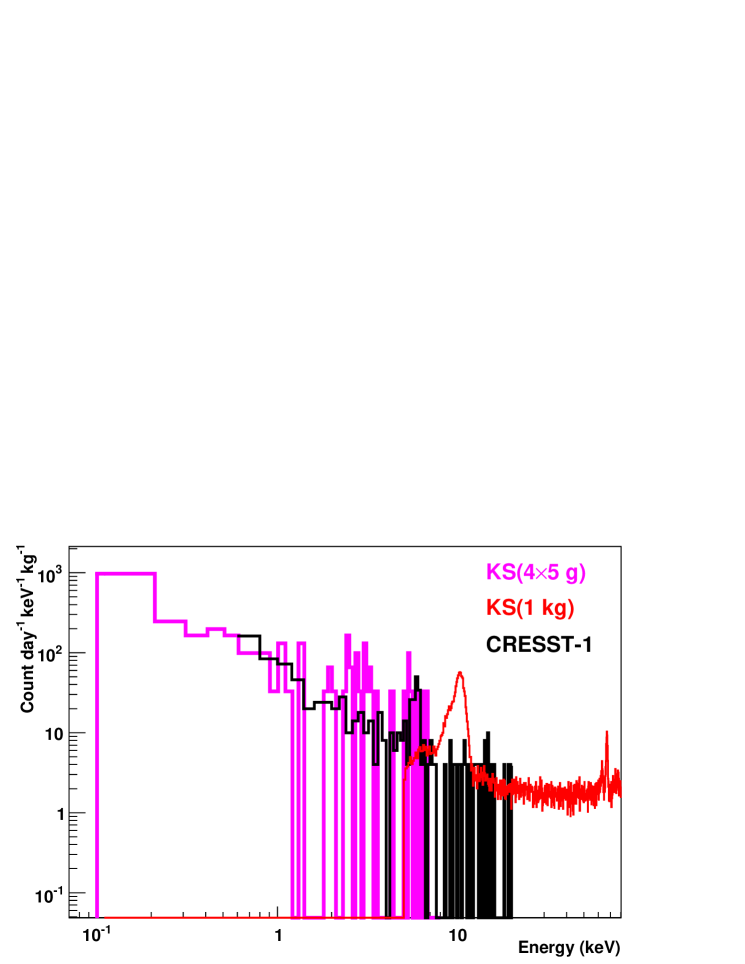
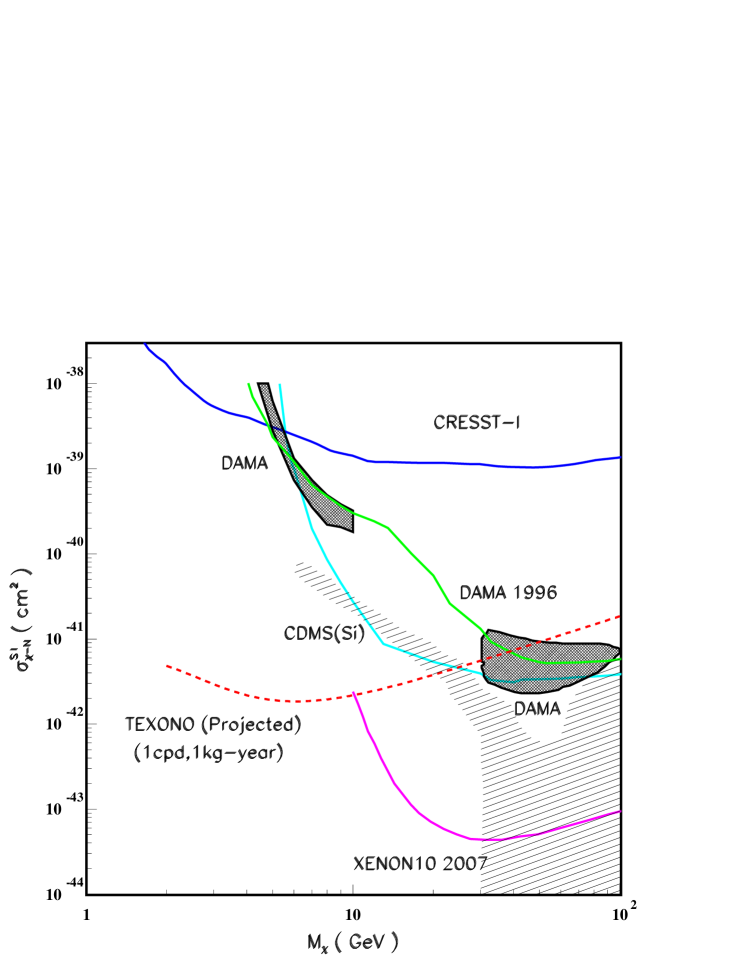
Low-background data were taken at KS under the same shielding configurations as the magnetic moment experiments [11], using a 4-channel ULEGe detector each having an active mass of 5 g. The recorded spectrum with 0.34 kg-day of data after cosmic-rays and anti-Compton vetos and PSD selection is displayed in Figure 4. It can be seen that comparable background level was achieved as the CRESST-I [7] experiment with 1.51 kg-day of data. A summary of the spin-independent exclusion plot is depicted in Figure 4. Comparable limits to CRESST-I can be expected from the current KS results. Intensive efforts on the data analysis are underway. The projected sensitivities with 1 kg-year of data at 100 eV threshold and a 1 cpd background level are shown.
An R&D program towards the realizations of a full-scale experiment is rigorously pursued. Quenching factor measurement for nuclear recoils in Ge with sub-keV ionization energy will be performed at a neutron beam facility. Background studies are conducted at both KS and the Yang-Yang Underground Laboratory (700 mwe) in South Korea with the various prototypes. Background understanding at the sub-keV range is a challenging and unexplored subject in its own right. External background is expected to be reduced due to self-shielding effects in a kg-mass detector, as well as by additional active veto Ge layers enclosing hermetically the ULEGe inner target [9]. Studies are under way with a 180-g segmented ULEGe prototype equipped with a veto ring and dual-readout channels from both the signal and high-voltage electrodes. A 500-g detector similar to the design demonstrated in Ref. [14] is being constructed.
References
References
- [1] Drees M and Gerbier G 2006 J. Phys. G 33 233, and references therein.
- [2] Bottino A et al. 2005 Phys. Rev. D 72 083521
- [3] He X G et al. 2007 Mod. Phys. Lett. A 22 2121
- [4] Gondolo P and Gelmini G 2005 Phys. Rev. D 71 123520
- [5] Damour T and L.M. Krauss 1998 Phys. Rev. Lett. 81 5726; Collar J I 1999 Phys. Rev. D 59 063514
- [6] Gelmini G, Kusenko A and Nussinov S 2002 Phys. Rev. Lett. 89 101302
- [7] Angloher G et al. 2002 Astropart. Phys. 18 43
- [8] Wong H T 2004 Mod. Phys. Lett. A 19 1207
- [9] Wong H T et al. 2006 J. Phys. Conf. Ser. 39 266
- [10] Wong H T and Li H B 2005 Mod. Phys. Lett. A 20 1103
- [11] Li H B et al. 2003 Phys. Rev. Lett. 90 131802; Wong H T et al. 2007 Phys. Rev. D 75 012001
- [12] Xin B et al. 2005 Phys. Rev. D 72 012006
- [13] Chang H M et al. 2007 Phys. Rev. D 75 052004
- [14] Barbeau P A, Collar J I and Tench O 2007 JCAP 09 009
- [15] These Proceedings, for complete references and latest updates.