Readout Of Singlet-Triplet Qubits At Large Magnetic Field Gradients
Abstract
Visibility of singlet-triplet qubit readout is reduced to almost zero in large magnetic field gradients due to relaxation processes. Here we present a new readout technique that is robust against relaxation and allows for measurement when previously studied methods fail. This technique maps the qubit onto spin states that are immune to relaxation using a spin dependent electron tunneling process between the qubit and the lead. We probe this readout’s performance as a function of magnetic field gradient and applied magnetic field, and optimize the pulse applied to the qubit through experiment and simulation.
pacs:
Electron spins in semiconductorsLoss and DiVincenzo (1998); Koppens et al. (2006); Pioro-Ladriere et al. (2008); Kim et al. (2014); Eng et al. (2015) are one promising path to quantum computing because of their scalability and long coherence timesVeldhorst et al. (2014); Muhonen et al. (2014a); Saeedi et al. (2013). Single qubit gate fidelities exceed 99.8 in single electron spin qubitsMuhonen et al. (2014b) and 99 in singlet-triplet(S-T) qubitsNichol et al. (2017). S-T qubits Petta et al. (2005); Folleti et al. (2009); Shulman et al. (2012) have recently demonstrated two qubit gate fidelities of 90 by using large magnetic field gradientsNichol et al. (2017), , to diminish the effects of charge noiseDial et al. (2013) and increase coherence times. However, in the presence of 400 MHz relaxation through coupling to other states reduces readout visibility to almost zeroBarthel et al. (2012).
Here we report a new readout scheme that provides readout contrast at large gradients and demonstrate that it has superior performance to previously published methods Petta et al. (2005); Studenikin et al. (2012) for 500 MHz. This method is robust up to at least = 900 MHz, the largest magnetic field we could generate, and should continue to function in much larger . S-T qubits have previously been read out by mapping the qubit states on different charge configurationsPetta et al. (2005). However, large gradients enable transitions between the qubit states during measurement, leaving both in the same charge configuration and diminishing contrast. Our technique adds a step before measurement that shelves the qubit states into alternate spin states that do not have relaxation pathways enabled by , restoring the ability to map each spin state onto a distinct charge configuration. This method relies on a spin-dependent tunneling between the qubit and the surrounding two dimensional electron gas (2DEG).
To optimize this process, we have measured the visibility of our readout as a function of , the voltage applied during shelving and its duration, and magnetic field, . We have also developed a simple model for this readout and used it to simulate our experiments, finding strong agreement with the data. The model we introduce is applicable to other varieties of spin qubits, including single spinElzerman et al. (2004); Morello et al. (2010), hybrid qubitKim et al. , and donor based S-T qubitBroome et al. (2017) and latched readout methodsHarvey-Collard et al. (2017); Nakajima et al. (2017) that also rely on tunneling between the qubit and a Fermi sea. This readout technique is general to any host material, and source of and to schemes that use S-T readout for single spin qubitsFogarty et al. (2017).
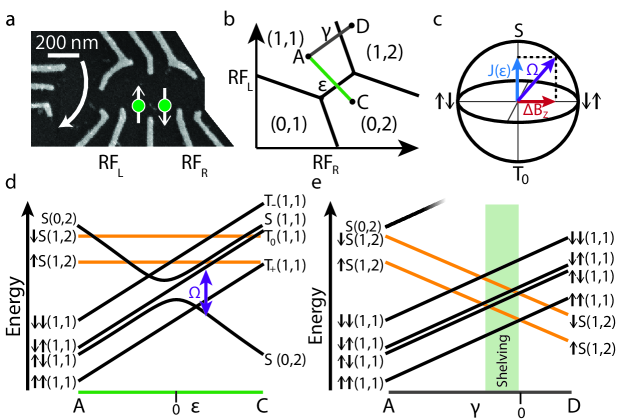
We study S-T qubits formed from two electrons trapped in an electrostatic gate defined double quantum dot in the 2DEG of GaAs shown in Figure 1a. We use the pair of numbers (L,R) to represent the number of electrons in the left and right dots respectively. The logical subspace for the qubit is made up of the singlet, , and triplet, , states where the arrows represent the electron spin in the left and right dot respectively. The Hamiltonian for this system is given by Petta et al. (2005). The exchange interaction, , splits S from T0 and is controlled by the detuning, , and the energy splitting between and is controlled by . We call the magnitude of the Hamiltonian , as shown in Figure 1c,d. We note that the nature of the qubit’s ground (excited) state changes from being S (T0) in (0,2) to () in (1,1).
For all experiments in this work, is produced by the hyperfine interaction with the nuclei, which is controlled through dynamic nuclear polarization (DNP)Bluhm et al. (2010) applied prior to every experimental run. The qubit is manipulated by applying voltage pulses to the gates labeled RFL and RFR in Figure 1a. The total number of electrons in the double dot is controlled by RFRF and the distribution of these between the right and left dot is controlled by RFRFR , shown in Figure 1b. We define to be the transition from the (1,1) to the (1,2) region, as shown in Figure 1e. The qubit’s charge state is measured using an additional neighboring quantum dotBarthel et al. (2009).
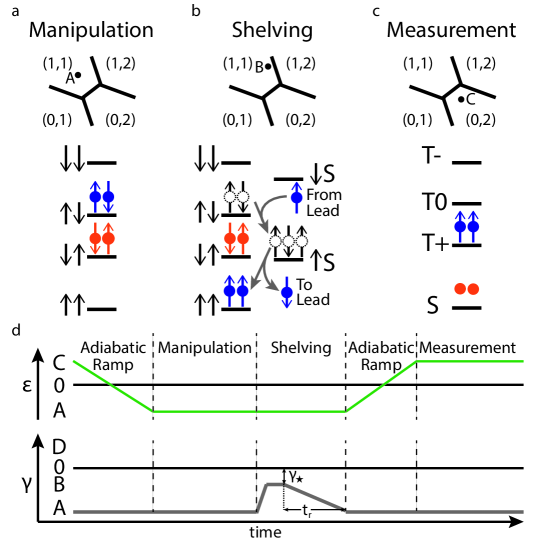
We manipulate our qubits deep at Position A, shown in Figure 2a, where the two spins are well isolated so that the ground state is (1,1) and the excited state is (1,1). In previous work S-T qubits were read out through spin blockade by adiabatically ramping the qubit from deep in (1,1) to the measurement point in the (0,2) region. This point is chosen so that S is in (0,2) but T0 is spin blockaded to remain in (1,1) because excited energy levels of the quantum dot are energetically inaccessible. This readout process maps (1,1) to S(0,2) and (1,1) to T0(1,1) so that the distinct charge configurations can be used to measure the qubit’s spin state. However, this style of readout is vulnerable because at the measurement point mixes T0(1,1) with the excited S(1,1) state, which decays to S(0,2) on time scales much shorter than the measurement timeBarthel et al. (2012). When this transition occurs, there is no readout contrast because both qubit states have the same charge configuration. The rate of transition from T0(1,1) to the excited S(1,1) state increases with , meaning that this method has a measurement fidelity that decreases with increasing .
To overcome readout failure at large we developed a new readout technique that shelves the qubit states into readout states which do not have relaxation pathways enabled by . This new method maps (1,1) to S(0,2) and (1,1) to T+(1,1). For the remainder of the work, we will refer to this as the the T+ readout method. We achieve the desired mapping by using tunneling between the right quantum dot and the 2DEG to change the qubit’s spin state. The qubit is tuned so that the left dot is isolated from the lead and the other dot. The shelving process is shown in Figure 2a-c and begins deep in (1,1), at Point A. After manipulation, the qubit is brought to Point B, where , which is chosen so the required transitions are energetically favorable, as shown in Figure 2b. At this point, electrons can only tunnel in and out of the right dot, enabling the transition from (1,1) to S(1,2) by a spin electron tunneling in. The transition from (1,1) to S(1,2) is blocked because there is no mechanism to change the spin in the left dot. S(1,2) decays to (1,1) by a spin electron tunneling from the right dot to the lead. After allowing the qubit to fully transition, the voltages are adiabatically changed back to Point A over a time tr and then brought to Point C, the same measurement point as in the spin blockade method. The charge state is then measured with S(0,2) corresponding to the ground state, (1,1), and T+(1,1) corresponding to the excited state, (1,1).
This technique also enables us to measure the direction of . We have described this mechanism assuming a specific directionality for but it functions with the opposite orientation as well. Flipping the direction of causes (1,1) to be the ground state and (1,1) to be the excited state. This readout still maps (1,1) to T+(1,1) while (1,1) is initially mapped to T0(1,1) and quickly decays to the S(0,2) charge state through the mechanism previously described. This inverts the charge signal we measure from the qubit ground state, allowing for a direct measurement of the direction of . In these experiments, is oriented as in the second regime because DNP is more effective when pumping with T+ than S, as detailed in the Supplementary Materials.
These readout techniques are sufficient for full qubit state tomography because we are able to pair them with high fidelity single qubit gates. We can measure along any axis by performing the proper rotations so that the states along the desired axis are mapped onto (1,1) and (1,1).
We have constructed a simple model for the T+ method that captures the experimental trends that we observe and offers intuition for this technique’s behavior. To determine the equilibrium populations of all the different quantum dot states, we have calculated the transition rates between all pairs of states using Fermi’s golden rule to compute the tunneling rates of electrons between the qubit and the 2DEG. We find the following transition rates, between the (1,1) states, , and the (1,2) states, , and the reverse, :
| (1) | ||||
| (2) |
Here is the reduced Planck constant, is the tunneling term between the right quantum dot and 2DEG, f is the Fermi-Dirac distribution, is energy difference between and , is the electron temperature, and and are the chemical potential and density of states of the 2DEG. Eij is controlled by , , , and . Transitioning between states with different numbers of electrons requires an electron tunneling to or from the lead with an energy that compensates for any change to the qubit’s energy. The Fermi-Dirac distribution dictates the number of electrons and holes available for and respectively, which governs the rates. This means that the transition rates from states with lower energy to higher energy are suppressed because they require an excited electron or hole to donate the energy difference. We note that many rates are 0 due to spin conservation, suppressing transitions between states with incompatible spin configurations. We use these rates to simulate the transitions that occur during T+ readout so that we can perform simulations while varying the same parameters as we do experimentally. Details are included in the Supplementary Materials.
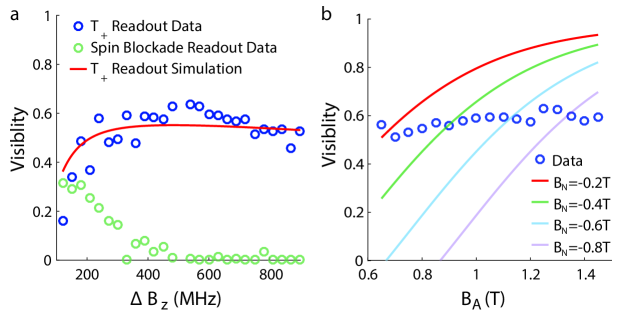
We determined the contrast of the readout methods that we tested by finding the measurement fidelityBarthel et al. (2009) for the ground, FG and excited states, FE, as detailed in the Supplementary Materials. We used these quantities to calculate the visibility, given by FG+FE-1. In Figure 3a we present the measured visibility of spin blockade and T+ readout techniques as a function of . In Figure 3a we also present a simulation for the visibility of the T+ readout and note the agreement with the data.
We see that the spin blockade readout visibility decreases very quickly with increasing as we expect from the increasing decay rate from T0(1,1) to S(0,2) at the measurement point. The T+ readout is poor at small because J is comparable to which gives both qubit states the ability to decay to S(1,2). However, the T+ method has large visibility for 200 MHz. We note also the slow fall off of visibility for 500 MHz. This is due to decreasing the energy splitting between the state and the state, decreasing the thermodynamic equilibrium occupation of , as can be seen from the energies given in the Supplementary Materials. Flipping the direction of would give a weak improvement instead because would increase the energy difference between and rather than decrease it. We compare the performance of the T+ and another previously published readout methodStudenikin et al. (2012) as a function of in the Supplementary Materials.
In Figure 3b we present the data for the T+ readout method visibility versus the applied magnetic field, . We find only a weak dependence on the while the model predicts a sharp increase. Past measurements have shown that DNP pumps both the difference field, , and sum field, experienced quantum dots due to the polarized nuclei. The magnetic field experienced by the qubit is . Pumping with T+ states flips nuclei such that 0 while pumping with S states yields 0. While measuring the data presented in Figure 3b, we observed increasing DNP times required for a given value of to the extent that it took 10 times longer to stabilize at =1.4 T than at =0.7 T. This suggests that nuclei are flipped more symmetrically between the dots with increasing , yielding larger magnitude , because DNP is less efficient at pumping . In Figure 3b we plot simulations at several different and see that the data transition between curves with increasingly negative , consistent with DNP becoming less effective at generating at larger . The magnetic field dependence of DNP pumping rates of and is a subject of current investigation.
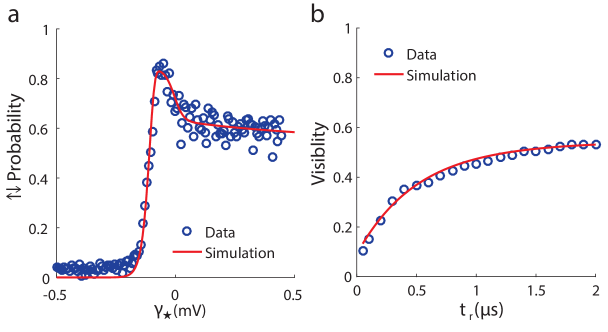
The fidelity of the T+ readout method depends strongly on the readout position because the technique relies on the desired transitions being energetically favorable while the undesired transitions remain unfavorable. The energy spectrum of available states as a function of is shown in Figure 1e. We select the optimal readout position by repeatedly preparing (1,1) and immediately attempting to measure at readout positions with different , as shown in Figure 2d. We plot data and a simulation of the probability that the measurement correctly identified the state in Figure 4a.
When 0 the S(1,2) state has far more energy than (1,1), preventing the first transition required for T+ readout. As approaches zero S(1,2) comes into resonance with (1,1) and we see a dramatic upturn in the probability of transitioning because there are thermally excited electrons that allow for the first transition. When 0 the probability drops again because the desired end state, (1,1) is not the lowest in energy during the readout process so it is not the most thermodynamically populated. All other measurements in this paper were performed at the optimal measured readout position.
To optimize the T+ readout, we also investigated the dependence of the visibility on tr. Our simulations and experiments showed little dependence on how quickly was increased to ramp the voltages from Point A to Point B, where , but a strong dependence on the time, tr, over which was varied to change the voltages back from Point B back to Point A. We present measurements and simulations for the visibility as a function of tr in Figure 4b. The visibility sharply improves with increasing tr because the qubit has time to equilibrate as is varied resulting in a higher occupation of T+. At very short times, (,S) is rapidly raised above state, allowing for undesirable transitions and reducing visibility.
The maximum visibility that we observe is approximately 0.6, corresponding to an average readout fidelity of 80. This is limited by the equilibrium thermodynamic occupation of the states that the qubit transitions through during the shelving process. This thermodynamic limit can be improved by decreasing the electron temperature or by using and to increase the energy splittings between the states used for shelving. As mentioned above, the direction of can be chosen so that it increases the relevant splittings. While the direction of in these experiments was governed by using DNP and decreased the relevant splittings, the direction is more flexible when generated by a micromagnetPioro-Ladriere et al. (2008); Takeda et al. (2016); Wu et al. (2014); Kawakami et al. (2014) so that visibility can instead be enhanced. Another benefit of using a micromagnet is that will remain fixed, so that we have direct control of through . We expect to observe the behavior predicted by the simulations in Figure 3b, allowing this method to achieve visibilities above 90 by increasing .
We demonstrated that the T+ readout method allows for measurements with large , a regime that was previously inaccessible due to low readout visibility. We have also demonstrated that calibrating tr and is critical to optimizing the visibility. Additionally, we have identified that using an external source of , such as a micromagnet, should enable higher fidelity readout by the application of larger and prudently selecting the direction of . We expect that these changes should enable visibilities in line with other high quality qubit readouts. The T+ readout technique is also applicable to scalable architectures that map a single spin qubit onto S-T states for readoutFogarty et al. (2017).
The concept of using a shelving step before measurement is relevant to any system where readout is limited by decay processes during measurement. We have demonstrated that visibilities can be increased by transferring the qubit into states that are immune to the decay pathway before measurement. We have also developed a method for simulating processes that rely on spin dependent tunneling between a quantum dot and a reservoir. This can be used to optimize the initialization and readout in a wide variety of qubits because they rely on these tunneling processes. Our demonstration of using experiments and simulations to develop the T+ readout method can serve as a guide for other researchers who need to develop readout schemes tailored to their specific experimental requirements.
Work at Harvard was funded by Army Research Office grants W911NF-15-1-0203 and W911NF-17-1-024. Samples were fabricated at the Harvard University Center for Nanoscale Systems (CNS), a member of the National Nanotechnology Infrastructure Network (NNIN), which is supported by the National Science Foundation under NSF award No. ECS0335765. Work at Purdue was supported by the Department of Energy, Office of Basic Energy Sciences, under Award number DE-SC0006671. Additional support for the MBE growth facility from the W. M. Keck Foundation and Nokia Bell Laboratories is gratefully acknowledged. S.P.H. was supported by the Department of Defense through the National Defense Science Engineering Graduate Fellowship Program. L.A.O. was supported by the Army Research Office through the Quantum Computing Graduate Research Fellowship Program.
References
- Loss and DiVincenzo (1998) D. Loss and D. P. DiVincenzo, Phys. Rev. A. 57, 120 (1998).
- Koppens et al. (2006) F. H. L. Koppens, C. Buizert, K. J. Tielrooij, I. T. Vink, K. C. Nowack, T. Meunier, L. P. Kouwenhoven, and L. M. K. Vandersypen, Nature 442, 766 (2006).
- Pioro-Ladriere et al. (2008) M. Pioro-Ladriere, T. Obata, Y. Tokura, Y. S. Shin, T. Kubo, K. Yoshida, T. Taniyama, and S. Tarucha, Nature Physics 4, 776 (2008).
- Kim et al. (2014) D. Kim, Z. Shi, C. B. Simmons, D. R. Ward, J. R. Prance, T. S. Koh, J. K. Gamble, D. E. Savage, M. G. Lagally, M. Friesen, S. N. Coppersmith, and M. A. Eriksson, Nature 511, 70 (2014).
- Eng et al. (2015) K. Eng, T. D. Ladd, A. Smith, M. G. Borselli, A. A. Kiselev, B. H. Fong, K. S. Holabird, T. M. Hazard, B. Huang, P. W. Deelman, I. Milosavljevic, A. E. Schmitz, R. S. Ross, M. F. Gyure, and A. T. Hunter, Science Advances 1, e1500214 (2015).
- Veldhorst et al. (2014) M. Veldhorst, J. C. C. Hwang, C. H. Yang, A. W. Leenstra, B. de Ronde, J. P. Dehollain, J. T. Muhonen, F. E. Hudson, K. M. Itoh, A. Morello, and A. S. Dzurak, Nature Nanotechnology 9, 981–985 (2014).
- Muhonen et al. (2014a) J. T. Muhonen, J. P. Dehollain, A. Laucht, F. E. Hudson, R. Kalra, T. Sekiguchi, K. M. Itoh, D. N. Jamieson, J. C. McCallum, A. S. Dzurak, and A. Morello, Nature Nanotechnology 9, 986 (2014a).
- Saeedi et al. (2013) K. Saeedi, S. Simmons, J. Z. Salvail, P. Dluhy, H. Riemann, N. V. Abrosimov, P. Becker, H.-J. Pohl, J. L. Morton, and M. L. W. Thewalt, Science 342, 830 (2013).
- Muhonen et al. (2014b) J. T. Muhonen, A. Laucht, S. Simmons, J. P. Dehollain, R. Kalra, F. E. Hudson, S. Freer, K. M. Itoh, D. N. Jamieson, J. C. McCallum, A. S. Dzurak, and A. Morello, arXiv (2014b).
- Nichol et al. (2017) J. M. Nichol, L. A. Orona, S. P. Harvey, S. Fallahi, G. C. Gardner, M. J. Manfra, and A. Yacoby, Nature Quantum Information 3 (2017).
- Petta et al. (2005) J. R. Petta, A. Johnson, J. M. Taylor, E. A. Laird, A. Yacoby, M. D. Lukin, C. Marcus, M.P.Hanson, and A.C.Gossard, Science 309, 2180 (2005).
- Folleti et al. (2009) S. Folleti, H. Bluhm, D. Mahalu, V. Umansky, and A. Yacoby, Nature Physics 5, 903 (2009).
- Shulman et al. (2012) M. D. Shulman, O. E. Dial, S. P. Harvey, H. Bluhm, V. Umansky, and A. Yacoby, Science 336, 202 (2012).
- Dial et al. (2013) O. E. Dial, M. D. Shulman, S. P. Harvey, H. Bluhm, V. Umansky, and A. Yacoby, Phys. Rev. Lett 110, 146804 (2013).
- Barthel et al. (2012) C. Barthel, J. Medford, H. Bluhm, A. Yacoby, C. M. Marcus, M. P. Hanson, and A. C. Gossard, Phys. Rev. B 85, 035306 (2012).
- Studenikin et al. (2012) S. A. Studenikin, J. Thorgrimson, G. C. Aers, A. Kam, P. Sawadski, Z. R. Wasilewski, A. Bogan, and A. S. Sachrajda, Appl. Phys. Lett 101, 233101 (2012).
- Elzerman et al. (2004) J. M. Elzerman, R. Hanson, L. H. W. van Beveren, B. Witkamp, L. M. K. Vandersypen, and L. P. Kouwenhoven, Nature (2004).
- Morello et al. (2010) A. Morello, J. J. Pla, F. A. Zwanenburg, K. W. Chan, K. Y. Tan, H. Huebl, M. Möttönen, C. D. Nugroho, C. Yang, J. A. van Donkelaar, A. D. C. Alves, D. N. Jamieson, C. C. Escott, L. C. L. Hollenberg, R. G. Clark, and A. S. Dzurak, Nature 467, 687 (2010).
- (19) D. Kim, D. R. Ward, C. B. Simmons, D. E. Savage, M. G. Lagally, M. Friesen, S. N. Coppersmith, and M. A. Eriksson, Nature Quantum Information 1, 70.
- Broome et al. (2017) M. A. Broome, T. F. Watson, D. Keith, S. K. Gorman, M. G. House, J. G. Keizer, S. J. Hile, W. Baker, and M. Y. Simmons, Phys. Rev. Letters 119, 046802 (2017).
- Harvey-Collard et al. (2017) P. Harvey-Collard, B. D’Anjou, M. Rudolph, N. T. Jacobson, J. Dominguez, G. A. T. Eyck, J. R. Wendt, T. Pluym, M. P. Lilly, W. A. Coish, M. Pioro-Ladrière, and M. S. Carroll, arxiv (2017).
- Nakajima et al. (2017) T. Nakajima, M. R. Delbecq, T. Otsuka, P. Stano, S. Amaha, J. Yoneda, A. Noiri, K. Kawasaki, K. Takeda, G. Allison, A. Ludwig, A. D. Wieck, D. Loss, and S. Tarucha, arxiv (2017).
- Bluhm et al. (2010) H. Bluhm, S. Foletti, D. Mahalu, V. Umansky, and A. Yacoby, Phys. Rev. Lett 105, 216803 (2010).
- Barthel et al. (2009) C. Barthel, D. J. Reilly, C. M. Marcus, M. P. Hanson, and A. C. Gossard, Phys. Rev. Letters 103, 160503 (2009).
- Takeda et al. (2016) K. Takeda, J. Kamioka, T. Otsuka, J. Yoneda, T. Nakajima, M. R. Delbecq, S. Amaha, G. Allison, T. Kodera, S. Oda, and S. Tarucha, Science Advances 2, e1600694 (2016).
- Wu et al. (2014) X. Wu, D. R. Ward, J. R. Prance, D. Kim, J. K. Gamble, R. T. Mohra, Z. Shia, D. E. Savage, M. G. Lagally, M. Friesen, S. N. Coppersmith, and M. A. Eriksson, PNAS 111, 11938–11942 (2014).
- Kawakami et al. (2014) E. Kawakami, P. Scarlino, D. R. Ward, F. R. Braakman, D. E. Savage, M. G. Lagally, M. Friesen, S. N. Coppersmith, M. A. Eriksson, and L. M. K. Vandersypen, Nature Nanotechnology 9, 666 (2014).
- Emerson et al. (2005) J. Emerson, R. Alicki, and K. Zyckowski, arXiv (2005).
- Danker et al. (2006) C. Danker, R. Cleve, J. Emerson, and E. Livine, arXiv (2006).
- Levi et al. (2006) B. Levi, C. C. Lopez, J. Emerson, and D. G. Cory, arXiv (2006).
- Fogarty et al. (2017) M. A. Fogarty, K. Chan, B. Hensen, W. Huang, T. Tanttu, C. Yang, A. Laucht, M. Veldhorst, F. Hudson, K. Itoh, D. Culcer, A. Morello, and A. Dzurak, arxiv (2017).
- Bardeen (1961) J. Bardeen, Phys. Rev. Lett 6, 57 (1961).
I Supplementary Materials
I.1 Experimental
Our devices were fabricated on GaAs/AlGaAs heterostructure with the 2DEG located 91 nm below the surface. At 4K the electron density n=1.5 cm-2 and mobility =2.5 cm2V-1s-1. Measurements presented in this work were taken in a dilution refrigerator with a base temperature of approximately 15 mK.
The direction of in these experiments was dictated by DNP’s ability to more strongly pump with T+ than with S. Pumping with T+ flips spins counter to the applied magnetic field, reducing the Zeeman splitting experienced by the qubits. This brings the avoided crossing between T+ and the ground state S deeper into the (1,1) region. The hyperfine term used for pumping only couples T+(1,1) to S(1,1), meaning that pumping is more effective when the ground state singlet branch has more weight in S(1,1) than S(0,2). Pumping with S achieves the opposite effect, increasing the Zeeman splitting and decreasing the coupling between the ground state singlet branch and T+ and reducing the ability to pump the gradient.
In order to measure the readout fidelity we need to prepare and measure both the excited and ground states. We prepare the ground state by loading two electrons into the double dot deep in (0,2), where S(0,2) is the ground state, and then adiabatically ramp into (1,1) where is the ground state. We prepare the excited state by first preparing the ground state in (1,1) and then rotating it by using a sinusoidally time varying to generate a Rabi pulse about J. We have previously reported 99 fidelity randomized benchmarkingEmerson et al. (2005); Danker et al. (2006); Levi et al. (2006) measurements of pulses of at =900 MHzNichol et al. (2017). While the pulse will become slightly worse at lower gradients, these state preparation errors are small compared to our readout errors and only negligibly affect our results. Figure S1a shows histograms of measurements of the excited and ground state of the qubit that were used to determine the readout visibility at = 900 MHz.
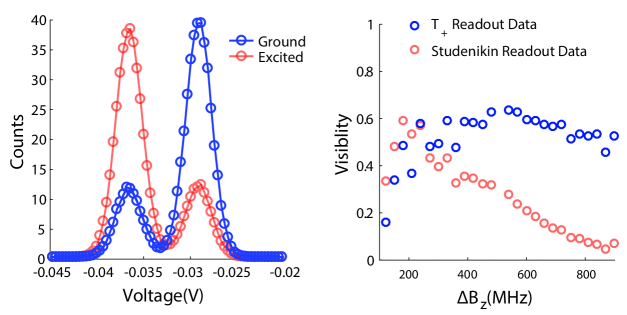
For thoroughness, we also discuss the readout method described by StudenikinStudenikin et al. (2012) that improves readout contrast by choosing the measurement point in (0,2) so that there is a (1,2) charge state with lower energy than the T0(1,1) state but still higher in energy than the S(0,2) state. The right dot of the double quantum dot is coupled to the lead, allowing a third electron to tunnel into double dot when the qubit is in T0(1,1) state because it is an energetically favorable transition but not for when the qubit is in S(0,2). This improves contrast because the charge sensor now detects different numbers of electrons for the two qubit states as opposed to just different positions of two electrons for both states like the spin blockade readout method. This method also suffers as increase because the transitions from T0(1,1) to the excited S(1,1) compete with the transitions of T0(1,1) to (1,2) and decrease measurement contrast as increases, as in the spin blockade readout technique. We note that the Studenikin readout method works up to larger gradients than spin blockade because there is a competition between the decays of T0 to the desired S(1,2) and S(0,2) but that the undesirable transitions dominates as surpasses 400 MHz, as shown in Figure S1b.
We also acknowledge two other recently published S-T readout mechanisms that, like the Studenikin method, rely on transitions through a (1,2) state in the region where (0,2) is the ground state. The Broome methodBroome et al. (2017) addresses how to readout a S-T qubit in which both quantum dots are equally coupled to the charge sensor while the Fogarty methodFogarty et al. (2017) maps a single electron spin in a large array onto the S-T basis for readout. While these methods solve the problems that they were intended to address, we expect that they should also suffer in large magnetic field gradients for the same reason as the Studenikin method.
I.2 Theoretical
The T+ readout technique relies on electrons entering and leaving the quantum dot so that the qubit can relax to lower energy states. To model this, we treat the tunneling term, , as a small perturbation to the Hamiltonian that confines the electrons in the quantum dots so that couples the (1,2) states to the (1,1) states. Because we only allow for tunneling into the right quantum dot, can only mix states which have the same spin in the left dot, as shown below:
Basis=,
The term controls the strength of the tunneling interaction and should be the same constant between all (1,1) and (1,2) statesBardeen (1961).
In the real experiment, the qubit eigenstates are not perfectly and because . This means that the ground and excited states take the following forms, where is defined as tan.
To simplify notation, we number the relevant states in the following way: =1, S=2, G=3, E=4, S=5 and =6. The states and the transitions, , are shown in Figure S2. The states have the following energies,
The (1,2) states, 2 and 5, have an additional energy the , the energy difference between the and S states, because controls the energy of the (1,2) states relative to the (1,1) states. It is defined so that because K is positive in (1,1) where is negative. Some care must be given when considering the energy difference between quantum dot states with numbers of electrons. Our choice of K()=0 at the charge transition allows us to set the chemical potential equal to zero because at this point an electron can tunnel from the fermi level into the quantum dot without paying an energy cost.
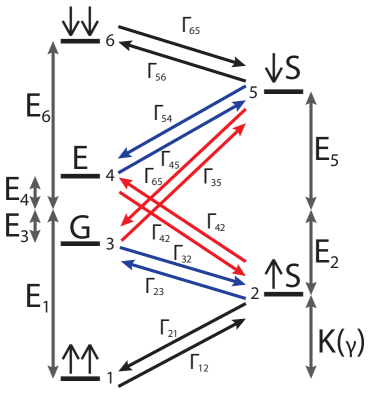
From Fermi’s Golden Rule we have equations (1) and (2) in the text. We can simplify these by using .
The terms are the overlap of the spin states and the nonzero terms are given below.
Knowing the transition rates allows us to calculate the probability, Pi (Pj), that the qubit is in state () by solving the following six coupled linear first order differential equations for all six states shown in Figure S2.
The first term on the right hand side states that the probability that the qubit remains in state i decreases because it can transition to state j at a rate that is proportional to how likely the qubit is in state i to begin with and the tunneling rate . The second term is the opposite, stating that the rate of transitioning to i increases when the other states, j, are more occupied.
We solve these coupled differential equations by turning them into a matrix equation which then has the form =R ̵⃑where is the vector of ’s and ’s and R is a matrix containing all the , shown at the top of the page. We project onto the eigenvectors of R, , with eigenvalues , whose time dependence is given by . The time evolution of is then just the sum of the time evolutions of the projections onto the eigenvectors. We note that one eigenvector will always be the thermal equilibrium because our rates are inherently thermodynamic due to their dependence on temperature through the Fermi-Dirac distribution. All other solutions will decay to zero with time scales that depend on the ’s.
In our experiment, , is a function of time because the qubit is biased from deep in (1,1) to the transition to (1,2). We simulate this by discretizing time and assuming that for each time step of length t, has a constant value and that this constant value controls the rates of decay. We make sure that t so that time evolution at each step is small. We initialize (0) with all the weight in either the ground or excited qubit state. At each time step we project (t) onto the eigenvectors of R(t) and evolve it for time t which yields (t+t). We repeat this for each time step to find the total time evolution of our qubit. We have performed these computations while varying the same parameters as have experimentally investigated by changing the state energies and (t).
All simulations were performed with T=90 mK, J=50 MHz, t=1 ns, = 7.143107 s-1 and =0 meV. Unless otherwise specified =900 MHz, =0.7 T, tr=2 s and =-.065 mV. For the simulations with and tr varied, =-.23 T. For the simulation with varied = -.12 T which is not unreasonable given that this data set was taken several months before the others when the tuning parameters were different. The individual curves are labeled in the figure for varied.