Relaxed MHD states of a multiple region plasma
Abstract
We calculate the stability of a multiple relaxation region MHD (MRXMHD) plasma, or stepped-Beltrami plasma, using both variational and tearing mode treatments. The configuration studied is a periodic cylinder. In the variational treatment, the problem reduces to an eigenvalue problem for the interface displacements. For the tearing mode treatment, analytic expressions for the tearing mode stability parameter , being the jump in the logarithm in the helical flux across the resonant surface, are found. The stability of these treatments is compared for displacements of an illustrative RFP-like configuration, comprising two distinct plasma regions. For pressure-less configurations, we find the marginal stability conclusions of each treatment to be identical, confirming analytic results in the literature. The tearing mode treatment also resolves ideal MHD unstable solutions for which : these correspond to displacement of a resonant interface. Wall stabilisation scans resolve the internal and external ideal kink. Scans with increasing pressure are also performed: these indicate that both variational and tearing mode treatments have the same stability trends with , and show pressure stabilisation in configurations with increasing edge pressure. Combined, our results suggest that MRXMHD configurations which are stable to ideal perturbations plus tearing modes are automatically in a stable state. Such configurations, and their stability properties, are of emerging importance in the quest to find mathematically rigorous solutions of ideal MHD force balance in 3D geometry.
pacs:
52.35.Bj,52.35.Py,52.55.-s,52.55.Hc,52.55.Lf,52.55.TnThis is an author-created, un-copyedited version of an article submitted for publication in Nuclear Fusion on 12/01/09.
1 Introduction
Recently, Hole et al [1] proposed a model for a partially relaxed plasma-vacuum system. The purpose of the model, which abandons all but a small number of flux surfaces, is to provide a mathematically rigorous foundation for ideal MHD equilibria in 3D configurations. The model appeals to both chaotic field lines, that flatten the pressure gradient in chaotic regions, and Taylor relaxation, which force the plasma gradient to be zero in Taylor-relaxed regions. The model consists of a stepped pressure profile, where the steps correspond to ideal MHD barriers across which can be supported a pressure or field jump, or a jump in rotational transform. Our overarching objective is the development of an equilibrium solver for 3D plasmas built on a stepped pressure profile model. In the 3D case, we envisage that the barriers can be chosen to be non-resonant KAM surfaces that survive the onset of field line chaos intrinsic to 3D equilibria. In between the interfaces, the field is Beltrami, such that . The boundary condition across the interfaces is the continuity of total pressure . Such a model, which we term a MRXMHD (multiple relaxation regions MHD) model, raises a number of questions. How should the equilibrium be constrained? How much jump in pressure and/or rotational transform - can each interface support? Are the interfaces stable to deformation? Can the class of stability shed information onto other quasi-relaxed phenomena?
Previous work has focused on the equilibrium constraints [2, 3], construction of a numerical algorithm for calculation of Beltrami fields between interfaces in 3D configurations [4], and a variational principle for the equilibrium and stability of the multiple interface configuration in cylindrical plasmas [1]. We have also explored the relationship between relaxed plasma equilibrium models discussed here, and entropy related plasma self-organisation principles [5]. The motivation of this paper is to understand the nature of MRXMHD modes identified from the variational principle. Our work complements a separate in-press publication [6] that unifies relaxed and ideal MHD principles for constructing global solutions comprising mixed relaxed and ideal regions.
Recently, Tassi et al [7], performed a tearing mode stability treatment on stepped force-free equilibria close to Taylor relaxed states. Their motivation was to develop a mechanism for the formation of cyclic Quasi-Single-Helicity (QSH) states observed in Reverse Field Pinches [8]. They consider a cylindrical plasma divided into two different Beltrami regions, and encased in a perfectly conducting shell, and compute the tearing mode stability parameter at a resonant radius for a helical flux perturbation . Here, is the radial coordinate, and and the poloidal and axial wave number. Tassi et al find critical values of the jump in , beyond which the RFP-like plasma is unstable. Based on these, they postulate the QSH state may be viewed as a small, cyclic departure from a Taylor-relaxed state.
In this work, we extend the tearing mode stability treatment of Tassi et al [7] to plasmas with finite pressure and a vacuum region, and compare stability conclusions of our variational treatment to that of a tearing mode stability analysis. Our paper is arranged as follows : Sec. 2 summarises the variational model of stepped pressure profile plasmas, presented in Hole et al [1], and introduces a tearing mode model. Section 3 treats MRXMHD plasmas in cylindrical geometry, yielding stability parameter expressions for both the variational and tearing mode treatments. In Sec. 4, we compute stability for an example configuration, draw comparisons between the stability conclusions based on variational and tearing mode treatments, and explore marginal stability limits in wave-number space as a function of pressure. Finally, Sec. 5 contains concluding remarks.
2 Multiple-interface plasma-vacuum model
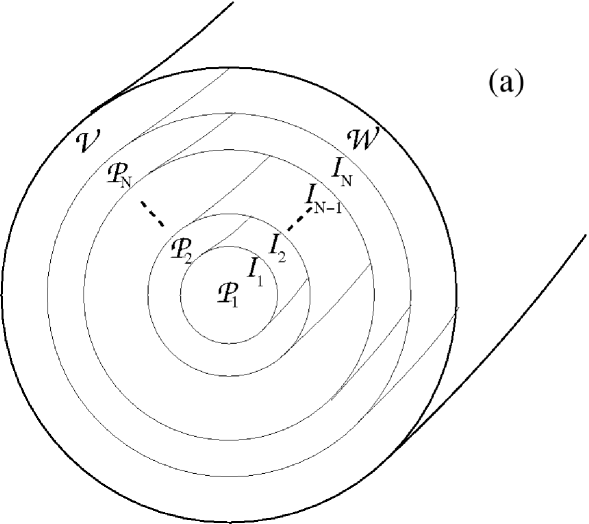
The system comprises Taylor-relaxed plasma regions, each separated by an ideal MHD barrier. The outermost plasma region is enclosed by a vacuum, and encased in a perfectly conducting wall. Figure 1(a) shows the geometry of the system, and introduces the nomenclature used to describe the region and interfaces. The regions comprise the plasma regions and the vacuum region . Each plasma region is bounded by the inner and outer ideal MHD interfaces , and respectively, whilst the vacuum is encased by the perfectly conducting wall .
2.1 A variational description
In previous work [1] we outlined our variational principle, which lies between that of Kruskal & Kulsrud [9] — minimization of total energy (where is plasma pressure and the ratio of specific heats) under the uncountable infinity of constraints provided by applying ideal MHD within each fluid element—and the relaxed MHD of Woltjer [10] and Taylor [11]—minimization of holding only the two global toroidal and poloidal magnetic fluxes, and the single global ideal-MHD helicity invariant , constant. In summary, the energy functional could be written
| (1) |
where and are Lagrange multipliers, and
| (2) | |||||
| (3) | |||||
| (4) |
The term is the potential energy, the plasma mass, and the magnetic helicity in each region . In Eqs. (2) - (4), is a volume element, the ratio of specific heats, and and the equilibrium pressure, magnetic field strength and vector potential respectively. The superscripts > and < denote clockwise and anti-clockwise rotation, respectively.
Setting the first variation to zero yields the following set of equations:
| (5) | |||||
| (6) | |||||
| (7) | |||||
| (8) |
where is a unit vector normal to the plasma interface , and denotes the change in quantity across the interface . The boundary conditions, , arise because each interface and the conducting wall is assumed to have infinite conductivity. In turn, these imply the toroidal flux in each plasma region (and the poloidal flux in the vacuum) is constant during relaxation. Given the vessel with boundary , the interfaces , and the magnetic field , Eqs. (5)-(8) constitute a boundary problem for the plasma pressure in each region .
Minimizing the second variation subject to the constraint of the positive definite normalization yields the following set of equations for the variation in the magnetic field :
| ; | (9) | ||||
| ; | (11) | ||||
| ; | (12) | ||||
| ; | (13) |
Here is the normal displacement of the interface , and the Lagrange multiplier of the stability treatment, such that indicates a lower energy state is available. Using Eqs. (9)-(13) the perturbed flux through each region can be found. With a suitable Fourier decomposition chosen, Eq. (11) solves for the unknown coefficients of the perturbed field in each region. With substitution, Eq. (11) then becomes a linear eigenvalue equation for .
2.2 Tearing mode treatment
A starting point for the treatment of tearing modes is the set of MHD equations:
| (14) | |||||
| (15) | |||||
| (16) | |||||
| (17) | |||||
| (18) | |||||
| (19) | |||||
| (20) |
being the fluid equation of motion, mass continuity, the adiabatic equation of state, Ohm’s law, Faraday’s law, Ampere’s law, and the magnetic mono-pole condition, respectively. The plasma parameters change across each interface, and across surfaces resonant with perturbations of a given helicity.
We solve for the plasma parameters for a zero flow plasma (i.e. ) in “outer” regions away from the resonant surfaces where the effects of resistivity are negligible. To solve, the field is written , where and are scalar functions of position and time and is the helical wave-field vector. Next, and are expanded as a Fourier perturbation, and solutions to the linearised Beltrami equation found. The ODE for , the radial envelope of the linear Fourier perturbation for , integrates to a jump condition in at each interface, expressed in terms of equilibrium parameters. The plasma growth rate, obtained by linearising Faraday’s law and substituting for as determined by Ohm’s law, is proportional to , such that denotes marginal stability, and instability. The final expression for is a function of the equilibrium parameters in the resonant region, as well as jumps in equilibrium parameters across the interfaces.
3 MRXMHD cylindrical plasmas
Solutions in an azimuthally-symmetric, axially-periodic cylinder (with axial periodicity length ) are available in Hole et al [1]. In the cylindrical co-ordinate system they are:
| (24) |
where , and and are Bessel functions of the first kind of order 0, 1, and second kind of order 0, 1, respectively. The terms and are constants. The constant is zero in the plasma core , because the Bessel functions and have a simple pole at . Radius is normalized to the plasma-vacuum boundary, located at . The equilibrium is constrained by the parameters:
| (25) |
where are the radial positions of the ideal MHD barriers, and is the radial position of the conducting wall. Equivalent representations, and the mapping between these solutions has been discussed in earlier work [1-3].
3.1 Stability from a variational principle
We have assessed stability using a Fourier decomposition in the poloidal and axial directions for the perturbed field and the displacements of each interface. That is,
| (26) |
where are the Fourier poloidal mode-number and axial wave-number, and and are complex Fourier amplitudes. Under these substitutions, and after solving for the field in each region, Eq. (11) reduces to an eigenvalue matrix equation with column eigenvector , eigenvalue , and a tridiagonal real matrix.
3.2 Tearing mode stability
In the helical coordinate , a divergence-less can be written
| (27) |
where is a the helical flux, and a helical field. The vector is defined by , where is a metric term. As in Tassi et al we search for helical perturbations of the form
| (28) |
In this representation, resonant surfaces are those for which . The equilibrium field satisfies the Beltrami equation, giving rise to , such that the rotational transform can be written
| (29) |
By writing the incompressible velocity field in a similar form to Eq. (27), and expanding continuity to first order, it is possible to show perturbations in the flow, pressure and mass density do not affect marginal stability.
In each of the plasma regions, projections of the linearised Beltrami equation along and yield
| (30) | |||
| (31) |
where vanishes everywhere except at , where it becomes singular. These are identical to Eqs. (27) and (29) of Tassi et al . Equation (31) reduces to a Bessel or modified Bessel equation in the transformed variables and . In the ’th region, and either side of the resonant surface, solutions are different combinations of Bessel or modified Bessel functions with undetermined coefficients , and , respectively. As only the ratio appears in , its value is unaffected by normalizing in each interval and region. The requirement of boundedness at , and the presence of perfectly conducting wall implies
| (32) |
Noting that the perturbed flux must be continuous across each interface, Eq. (31) can then be integrated about each interface to yield
| (33) |
The parametric dependence can also be examined by solving for and using Eq. (29) to eliminate . Solving equilibrium for gives
| (34) |
Finally, eliminating and , Eq. (33) can then be rewritten
| (35) |
where
| (36) |
With everywhere, the tearing mode parameter is a function of in each interval, which is uniquely determined by the set of constraints given by Eq. (35) at each interface. That is, the inner boundary condition (31) yields . If for instance the resonant surface lies in , Eq. (35) evaluated at interface and solves for in terms of and in terms of , respectively. The conducting wall boundary condition solves for .
Changes in the field strength at any interface enter Eq. (33) through the solution to , given by Eq. (34). Stability is hence a property of the rotational transform, the position of the barriers, the Lagrange multipliers, the rotational transform, and any jumps in the pressure or rotational transform across the interfaces. Our working reduces to Tassi et al in the limit of no pressure, field or rotational transform jumps across the interfaces, and no vacuum.
4 Stability for an RFP-like configuration
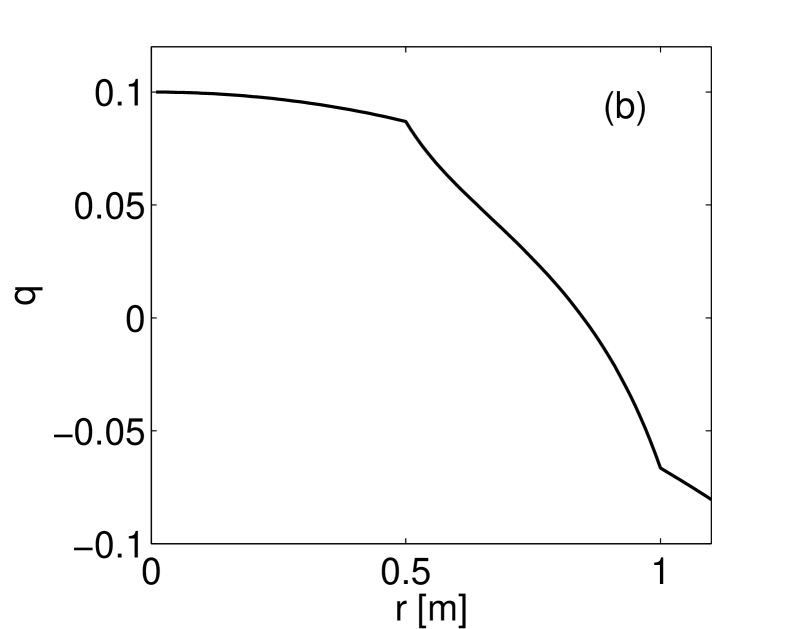
We have compared stability conclusions using variational and tearing mode treatments for an illustrative configuration. The example chosen is guided by earlier detailed working [1], where the core Lagrange multiplier was . The first interface is placed at , and the axial periodicity length chosen to be , such that the effective aspect ratio is small. The jump in safety factor between the internal interface and the plasma-vacuum boundary has been chosen to resemble Hole et al , subject to the different values used for the two treatments ( in Hole et al ). We have used , which requires for the rotational transform profile to be continuous. A second motivation for this choice is the similarity to profiles of high confinement reverse field pinches, such as the Madison Symmetric Torus [12] and RFX-mod [13], although the change in is greatly exaggerated in this work. The plasma pressure is selected by the parametrization . Except for the final scan over , a pressure-less plasma is assumed (i.e. ). Figure 1(b) shows the profile for the chosen equilibrium, where .
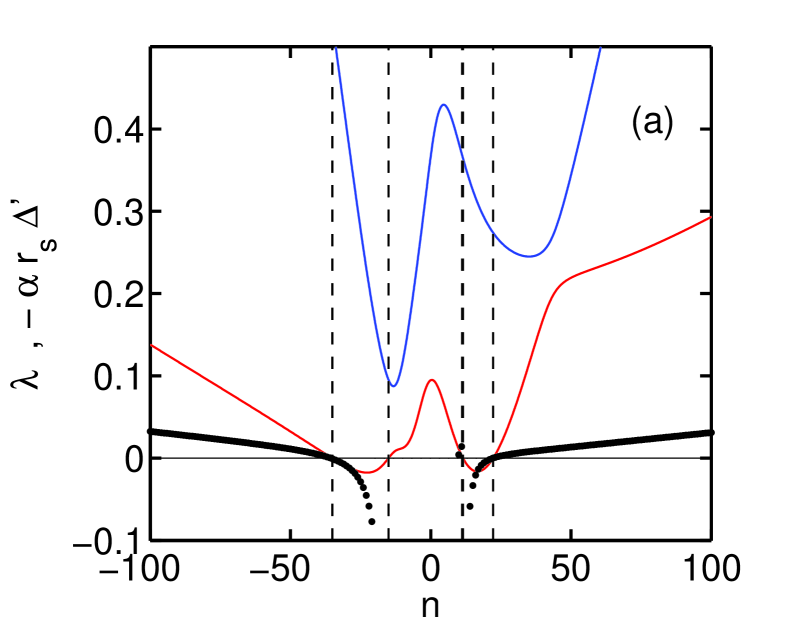
Figure 2(a) is a dispersion curve for modes, showing computed using the variational treatment, and computed for modes resonant within the plasma. Marginal stability corresponds to and : these overlap identically in Fig.2(a). Modes with and corresponds to a perturbation near-resonant with the outer and inner interfaces ( and ) respectively.
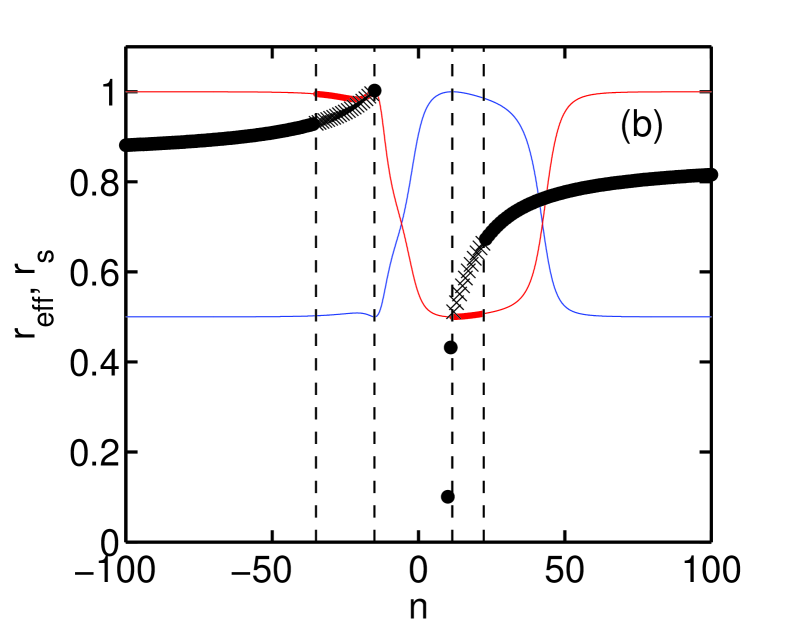
In our variational treatment, we have prescribed no relationship between and in the relaxed regions. As such, excepting at the ideal interfaces, field line resonance in such plasmas is not explicitly resolved. Expressions can however be constructed which provide an estimate of the localization of the mode , and a convenient choice is , where the eigenvectors are normalised such that , with the Hermitian.
Figure 2(b) shows a comparison of to , in which modes unstable to variational and tearing modes have been identified. Agreement between and is qualitatively good in the interval over which the plasma in unstable, and excellent near the interfaces. The and modes are near resonant with the outer and inner interface, respectively. As shown in Fig. 3(a), a stability scan with wall radius indicates that in the limit , modes for are wall-stabilized. In the limit that the outer interface is made resonant with the tearing mode (for example by changing ), . This mode is the current driven external kink of ideal MHD. Conversely, the unstable range for is only very weakly affected by the wall position. If the inner interface is mode resonant with the perturbation, , and the mode is ideal unstable. This is the internal kink of ideal MHD.
Recently, Mills et al [6] demonstrated that one can unify ideal and relaxed variational treatments by extending the relationship between and through the Newcomb gauge . If this variational treatment is followed, rational surfaces do explicitly enter the expression for as derived from , the variation in the radial part of the magnetic field, and so both relaxed and tearing modes become localised at the resonant surface .
The findings of Fig. 2, obtained for a pressure-less plasma, agree with that of Furth et al [14], who showed that for cylindrical pressure-less plasma with no vacuum, is linear with the second variation in the magnetic energy driving the tearing mode. We have also compared stability conclusions drawn from variational and tearing mode treatments as a function of . We find that while both variational and tearing mode treatments have the same stability trends with , the marginal stability limit of the variational treatment (for a given and ) is lower than that of tearing modes. A study is ongoing into the cause of this discrepancy, as well as formally relating to
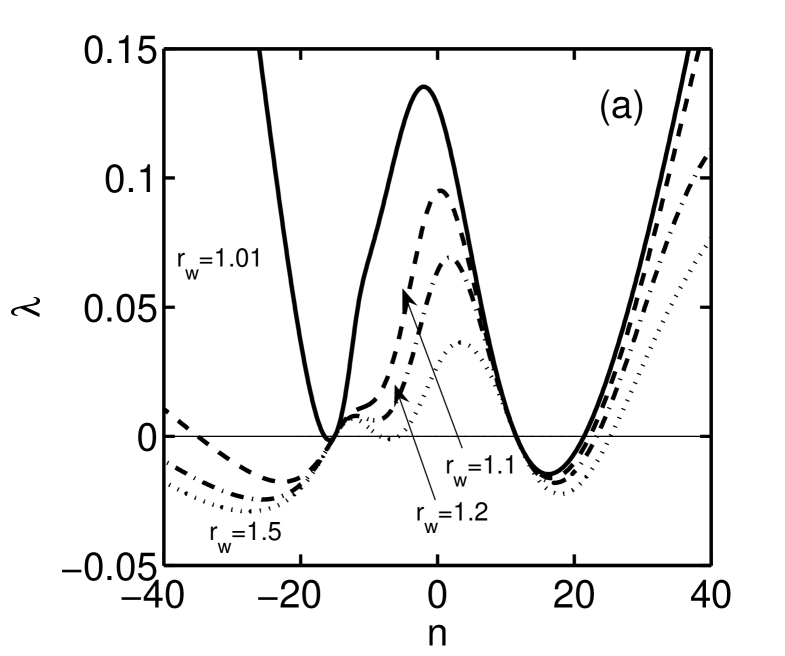
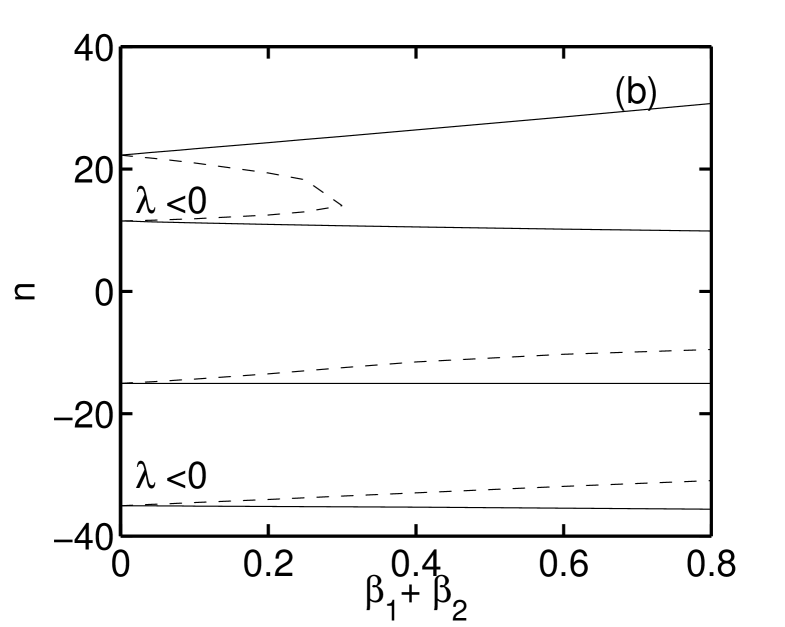
Finally, Fig. 3(b) is a plot of the marginal stability boundary () in space for eigenmodes of the variational treatment. The two pressure profile configurations that have been studied are and . Trends in the marginal stability boundary can be understood by relating the radial location of the mode resonant surface to the analog of radial pressure gradient in the MRXMHD model: the sign and magnitude of nearby pressure jumps. For modes resonant near the first interface, an increasing core pressure increases the pressure drop across the first interface, and so destabilises the plasma. Conversely, increasing the edge pressure leads to a pressure jump across the first interface, and so stabilises the internal modes. For all internal modes () are completely stabilised. For the modes resonant near the edge, changes in the core pressure have little effect, while increasing the edge pressure destabilises the plasma.
5 Conclusions
We have computed the stability of multiple relaxation region MHD (MRXMHD) plasmas using both a variational and a tearing mode treatment, evaluated in a periodic cylindrical configuration. The marginal stability conclusions of the two treatments for a zero plasma, as well as the trends with , appear to be identical, in agreement with earlier analytic working by Furth et al [14]. Some discrepancy exists between the marginal stability boundaries of variational and tearing mode treatments for nonzero , with the stability limit of variational plasmas lower than that of tearing modes. A study is underway to resolve this discrepancy.
The overarching aim of this work is to elucidate the nature of perturbations available to MRXMHD equilibria, which in turn, are motivated by our quest for mathematically rigorous solutions of ideal MHD force balance in 3D geometry. Our working builds of Tassi et al to nonzero multiple region relaxed plasmas with vacuum, and complements Mills et al , who demonstrated that that one can unify ideal and relaxed variational treatments through the Newcomb gauge. Combined, these results suggest that MRXMHD configurations which are stable to ideal perturbations plus tearing modes are automatically in a stable equilibrium state.
In ongoing work we are developing a faster numerical algorithm for the construction of 3D MRXMHD plasmas, and exploring the
maximum pressure jump an interface can support before it is destroyed by chaos.
Acknowledgments The authors would like to acknowledge the support of the Australian Research Council, through grant DP0452728.
References
References
- [1] M. J. Hole, S. R. Hudson, and R. L. Dewar. Equilibria and stability in partially relaxed plasma-vacuum systems. Nuc. Fus., 47:746–753, 2007.
- [2] M. J. Hole, S. R. Hudson, and R. L. Dewar. Stepped pressure profile equilibria in cylindrical plasmas via partial taylor relaxation. Journal Plas. Phys., 77(6):1167–1171, 2006.
- [3] A. B.Kukushkin and V. A. Rantsev-Kartinov. An extension of Relaxed State Principle to Tokamak Plasmas with ITBs. In 26th EPS Conf. on Con. Fus. Plas. Phys., Maastrict, volume 23J, pages 1737–1740, 1999.
- [4] S. R. Hudson, M. J. Hole, and R. L. Dewar. Rotational-transform boundary value problem for beltrami fiels in toroidal domains. Phys. Plasmas, 14:052505, 2007.
- [5] R. L. Dewar, M. J. Hole, M. McGann, R. Mills, and S. R. Hudson. Relaxed plasma equilibria and entropy-related plasma self-organisation principles. Entropy, pages 339–353, 2008.
- [6] R. Mills, M. J. Hole, and R. L. Dewar. Magnetohydrodynamic stability of plasmas with ideal and relaxed regions. J. Plasma Phys., 2008.
- [7] E. Tassi, R. J. Hastie, and F. Porcelli. Linear stability analysis of force-free equilibria close to taylor relaxed states. Phys. Plasmas, page 092109, 2007.
- [8] P Martin, L Marrelli, A Alfier, F Bonomo, D F Escande, P Franz, L Frassinetti, M Gobbin, R Pasqualotto, P Piovesan, D Terranova1, and RFX mod team. A new paradigm for RFP magnetic self-organization: results and challenges. Nuc. Fus., 49A:177–193, 2007.
- [9] M. D. Kruskal and R. M. Kulsrud. Phys. Fluids, 1(4):833, 1958.
- [10] L. Woltjer. A theorem on force-free magnetic fields. Proc. National Academy of Sciences, 44(6), 1958.
- [11] J. B. Taylor. Phys. Rev. Lett., 33:1139, 1974.
- [12] B. E. Chapman, A. F. Almagri, J. K. Anderson, and T. M. Biewer. High confinement plasmas in the madison symmetric torus reverse-field pinch.
- [13] S. Ortolani and the RFX team. Active MHD control experiments in RFX-mod. Plas. Phys. Con. Fus., 48:B371–B381, 2006.
- [14] H. P. Furth, P. H. Rutherford, and H. Selberg. Tearing mode in the cylindrical tokamak. Nuc. Fus., 16(7):1054–1063, 1973.