Restricted phase space thermodynamics of charged AdS black holes in conformal gravity
Abstract
The thermodynamics of charged spherically symmetric AdS black holes in conformal gravity is revisited using the recently proposed restricted phase space (RPS) formalism. This formalism avoids all the bizarreness that arose in the extended phase space formalism for this model. It is found that the charged AdS black holes in this model may belong to a new universality class which is different from all previously studied cases under the RPS formalism. Besides the distinguished isocharge and isothermal behaviors, the absence of Hawking-Page transition is another notable feature. On the other hand, in the high temperature limit, the thermodynamic behavior of the present model become exactly the same as that of the Einstein gravity and the black hole scan models, which add further evidence for the universality of the recently reported correspondence between high temperature AdS black holes and low temperature quantum phonon gases in nonmetallic crystals.
1 Introduction
After more than one hundred years from the date of its birth, Einstein gravity remains to be the most promising theory of relativistic gravity. However, there are several reasons to look at alternative theories of gravity, for instance, the need for a renormalizable quantum theory of gravity, the interpretation of the expanding universe and the galaxy rotation curves, etc. Among the numerous choices of extended theories of gravity, conformal gravity has attracted considerable interests, partly because of its on-shell equivalence to Einstein gravity and its power counting renormalizability [1], and partly because of the fact that its spherically symmetric solution contains a term linear in radial coordinate which may play some role in explaining the galaxy rotation curves as an alternative for dark matter [2, 3]. As a physically viable model of relativistic gravitation, it is natural to look into more detailed behaviors of conformal gravity, and the study of its black hole solutions and the corresponding thermodynamic properties [4, 5, 6] is of great importance in this regard.
There are several formalisms for studying black hole thermodynamics. The traditional formalism focuses on the initial establishment of the basic laws of black hole thermodynamics and the calculation of thermodynamic quantities [7, 8, 9, 10, 11]. A relatively modern formalism known as the extended phase space (EPS) formalism appeared about fifteen years ago [12], which takes the negative cosmological constant (hence only applicable to AdS black holes) as one of the thermodynamic quantities (proportional to the pressure) and thus extended the space of macro states. This formalism has attracted considerable interests because it revealed various critical behaviors and the possible existence of different types of phase transitions in black hole physics [13, 14, 15, 16, 24, 35, 27, 33, 36, 34, 17, 22, 23, 18, 19, 20, 25, 26, 28, 29, 21, 30, 31, 32]. There is a plethora of literature pertaining to this topic which seems to be impossible to present a full list. Thus we have only cited the few works that have made significant impacts on our line of thinking and researches. In particular, the critical phenomena of the charged spherically symmetric AdS black holes in conformal gravity, whose weird behavior has largely triggered the motivation of the present work, is analyzed in [37]. Further development of the EPS formalism includes the exploration of black hole microstructures [38, 40, 39], the inclusion of the central charge and its conjugate variable in the list of thermodynamic variables [41, 42, 43], which is inspired by the AdS/CFT correspondence, etc.
Although the study based on the EPS formalism proves to be very fruitful, it seems that several issues are inevitable in this formalism, as first pointed out in [44]. To name a few of them, the requirement of a variable cosmological constant leads to a theory-changing problem, which we called the ensemble of theories problem; the interpretation of the total energy as enthalpy instead of internal energy seems to be in contradiction with the thermodynamic understanding of total energy; some of the thermodynamic behaviors in various black hole solutions of different choices of gravity models are so bizarre that there is no precedent examples of macroscopic systems with similar behaviors. The charged spherically symmetric AdS black hole solution in conformal gravity is among the example cases which exhibits very strange behaviors in the EPS formalism [37], including the intersecting isotherms of different temperatures, the discontinuous change of Gibbs free energy in thermodynamic processes, the branched or multivalued thermal equations of states (EOS) and the appearance of a maximal specific thermodynamic volume (or radius of the event horizon) at a fixed temperature, etc.
Above all, the lack of complete Euler homogeneity in both the traditional and the EPS formalisms of black hole thermodynamics is considered to be the most severe problem which constitute a stumbling stone in understanding the zeroth law of black hole thermodynamics. In order to solve the problem of Euler homogeneity, we proposed a novel formalism for black hole thermodynamics called the restricted phase space (RPS) formalism by fixing the cosmological constant but including the effective number of microscopic degrees of freedom and its conjugate chemical potential in the list of thermodynamic variables. The application of the RPS formalism to the cases of RN-AdS [44] and Kerr-AdS [45] black holes in Einstein gravity indicated that this new formalism is free of all the issues mentioned above. Subsequent studies revealed that the RPS formalism works for non-AdS black holes as well [46, 47], and is also applicable to a large class of higher curvature gravity models known as black hole scan models [48]. According to the behaviors of the charged spherically symmetric AdS black holes in different black hole scan models, it appears that these models can be subdivided into two universality classes, i.e. the Einstein-Hilbert-Born-Infield class and the Chern-Simons class. Most recently, we found that the high temperature limit of the -dimension Tangherlini-AdS black holes can be precisely matched to the low temperature limit of the quantum phonon gases that appear in nonmetallic crystals residing in -dimensional flat space [49], and this AdS/phonon gas correspondence seems to be not limited to the cases of Tangherlini-AdS black holes, because the high temperature limit of the heat capacities of the charged AdS black holes in black hole scan models also behave similarly to the low temperature Debye heat capacities of the -dimensional quantum phonon gases [48]. More applications of the RPS formalism can be found in [50, 51, 52, 53].
The aim of the present work is two-folded. First we wish to show the applicability of the RPS formalism to the case of four dimensional conformal gravity, and resolve the bizarreness in the thermodynamic behaviors of the charged AdS black holes in this model that appeared in the EPS formalism. Second, we wish to take conformal gravity as yet another example case for the AdS/phonon gas correspondence. As will be clear in the main text, these two-folded aims are perfectly accomplished.
2 The model and the solution
The model which we consider in this work is best described by its classical action
| (1) |
where the unusual sign in front of the Maxwell term is inspired by critical gravity [4] and is necessary for the Einstein gravity to emerge in the infrared limit [1].
The static charged AdS black hole solution for this model is found in [5], with the metric
| (2) | |||
| (3) |
and the Maxwell field
| (4) |
The parameter can take three discrete values which correspond, respectively, to the hyperbolic, planar and spherical geometry of the 2-dimensional “internal space” characterized by the line element . The solutions with are known as topological black holes, which exist only in AdS backgrounds. The other parameters are all integration constant which need to obey an additional constraint
| (5) |
The above solution describes a charged AdS black hole provided and the equation
| (6) |
has a nonvanishing real positive root which corresponds to the radius of the event horizon. Notice that the function does not contain a term as in the usual RN-AdS black hole solution. The parameter (related to the electric charge) affects the geometry of the spacetime only implicitly through the constraint condition (5). Since appears only in squared form in eq.(5), the spacetime geometry does not discriminate positive and negative values of . Therefore, in this paper, we will consider exclusively the choice . The opposite choice is permitted but makes no difference regarding the geometry and thermodynamic behaviors.
In the absence of the parameter (which represents a massive spin-2 hair [5, 6]), the metric (2) looks very similar to that of the standard Schwarzschild-(A)dS black hole, provided takes a negative value. Let us stress that, unlike in most of the other gravity models, the cosmological constant arises purely as an integration constant, therefore, this model was once considered to be very appropriate for pursuing thermodynamic analysis following the extended phase space approach, because a variable cosmological constant in this model does not cause the ensemble of theories problem which appears in other theories of gravity.
3 EPS thermodynamics revisited
Before rushing into the RPS formalism for the thermodynamics of the above black hole solution, let us first make a brief review on the EPS description and point out some of its pathologies.
To begin with, let us present the relevant thermodynamic quantities in the EPS formalism. First, the total energy of the black hole spacetime, as calculated using the Noether charge associated with the timelike Killing vector [6], reads
| (7) |
which is regarded to be the enthalpy, where represents the radius of the event horizon of the black hole and is a real root of , and is the volume of the internal space designated by the line element . The pressure and its conjugate, the thermodynamic volume , are given respectively as
Next comes the black hole temperature and entropy, which are given by [5]
| (8) |
The electric charge (defined as the conserved charge associated with the gauge symmetry of the electromagnetic field) and the conjugate potential are given respectively
| (9) |
The parameter is a massive spin-2 hair which is also taken as one of the thermodynamic variables. This variable is denoted as , and its conjugate is given by
In the above expressions for thermodynamic quantities, the parameter is considered to be implicitly determined via the relation (5), and thus it cannot be taken as a simple constant while considering thermodynamic behaviors. On the contrary, the coupling constant is always kept as a real constant in the EPS formalism.
It can be checked that the energy obeys the following relations,
These relations are interpreted as the first law and the Smarr relation in the EPS formalism.
As mentioned in the introduction, the behavior of the EPS thermodynamics as outlined above appears to be very strange, and the problems may be attributed either to the gravity model itself or to the EPS formalism. We will see that, with new insights from the RPS formalism, the problems can be perfectly avoided, therefore, it is clear that the problems arise from the EPS formalism.
4 The RPS formalism
The whole logic of the RPS formalism stands as follows. First of all, we need to introduce a new pair of thermodynamic variables, i.e. the effective number of microscopic degrees of freedom (or dubbed black hole molecules) of the black hole and its conjugate, the chemical potential . These two objects are universally defined as
| (10) |
where is an arbitrarily chosen constant length scale, is the Newton constant, and is the on-shell Euclidean action which corresponds to the black hole solution. The arbitrariness of may be attributed to the fact that we do not actually know what a black hole molecule is, but this does not prevent us from describing the macroscopic properties of the black hole, just like in the studies of thermodynamics of ordinary matter systems in which the precise nature of individual molecules does not matter, and the total number of molecules can be taken as an arbitrary number as long as the whole system remains macroscopic, which means that should be sufficiently large in our present case.
In the present case, one has and [5],
| (11) |
Since the Newton constant does not explicitly appear in the action (1), we need to relate the coupling constant to in some way. Due to the fact that has dimension , while has dimension , This relationship could not be the naive choice but rather needs to be modified by a factor of dimension . Therefore, we assume that
| (12) |
thanks to the arbitrariness of . This assumption is not an absolutely necessary step. What actually matters is that the number of black hole molecules should be proportional to the overall factor in the action, in order to ensure that is the thermodynamic conjugate of the chemical potential (which in turn is defined in terms of the Euclidean action ). The assumption (12) is introduced simply for illustrating that the overall factor in Einstein gravity and the factor in conformal gravity play similar roles in the RPS formalism.
Before checking the thermodynamic relations in the RPS formalism, there is something more to be fixed in the solution (2), (3). In order to guarantee the existence of a reasonable weak field limit with attractive Newtonian potential, we need to require that
| (13) |
Moreover, in the extremal case with , the solution must fall back to that of the vacuum AdS background. Therefore, for each choice of , must always be equal to .
Let us remark that, in previous studies, was considered to be an implicit function in and . The present choice is more physically motivated, which makes a big difference. In fact, if and were kept independent besides the constraint (5), the first law in the RPS formalism to be introduced below would not hold.
In the following, we shall be working exclusively with the choice , which corresponds to the spherically symmetric case with . Inserting , and eq.(12) into eqs.(7), (8), (9) and eqs.(10), (11), we get
| (14) | ||||
| (15) | ||||
| (16) | ||||
| (17) |
It is now more transparent that, in order to ensure non-negativity of the entropy and the total energy, and must be both negative. That is why the solution is considered to be an AdS black hole solution from the very beginning.
In the above equations, and are considered to be implicit functions in the thermodynamic variables. However, these objects are not all independent due to the constraint condition (5) and the equation for the event horizon (6). The joint system of equations (5) and (6) has two different sets of solutions for and , among which only one ensures negativity of ,
| (18) | ||||
| (19) |
The other solution with reversed signs in front of the square roots corresponds to strictly non-negative values of , which results in a non-positive entropy, and therefore will be dropped henceforth.
Notice that, in the RPS formalism, we do not introduce the variables. The reason behind this choice is the symmetry principle. Let us quote C.N. Yang’s celebrated dictum: “Symmetry dictates dynamics.” Here we would like to extend this statement a little step further: Symmetry dictates thermodynamics, which means that different thermodynamic systems with the same underlying symmetries should be described by the same set of thermodynamic variables, although their detailed thermodynamic behaviors could differ from each other. The black hole solution under study bears the same spherical symmetry and the same gauge symmetry as the well-known RN black hole solution in Einstein gravity, thus the space of macro states for these two black hole systems need to be spanned by the same set of macroscopic variables. This may help for understanding why we exclude the variables from the list of allowed thermodynamic quantities in the RPS formalism. Let us stress that, it is the underlying symmetries, rather than the number of integration constants, that determine the dimension of the space of macro states. One may wonder why the conformal symmetry is not taken into account in our consideration. The reason is quite clear: any concrete choice of metric in conformal gravity automatically breaks the conformal symmetry. Therefore, no charges associated with the conformal symmetry could enter into the thermodynamic description for black holes in conformal gravity.
Using the results presented in eqs.(14)-(17), one can check by straightforward calculations that the first law
| (20) |
and the Euler relation
| (21) |
hold simultaneously, which ensures that is a first order homogeneous function in and that are zeroth order homogeneous functions in . The last two equations constitute the fundamental relations for the RPS formalism of black hole thermodynamics. As a direct consequence, the Gibbs-Duhem relation
| (22) |
also holds, where
both are zeroth order homogeneous functions in . The Gibbs-Duhem relation indicates that the intensive variables are not independent of each other, whereas each of them is independent on the size of the black hole.
5 Thermodynamic processes in the RPS formalism
The explicit values of the various thermodynamic quantities collected in the last section allow for a detailed analysis on the thermodynamic behavior of the black hole solution under consideration. To proceed, we first need to re-express the parameters in terms of the extensive variables or better in terms of and . The latter set of variables has the advantage that the EOS re-expressed in these variables are independent of , which is a characteristic property of standard extensive thermodynamic systems known as the law of corresponding states.
In order to rewrite as functions in , we need to solve the first equations in eqs.(15)-(17) as a system of algebraic equations for , which yields
| (23) |
where . The condition for to be real and positive reads
| (24) |
Since and (a macro state of zero entropy could not be understood as a black hole), we can deduce from the above inequality that . In other words, there is no black hole states with .
There is another, negative-valued, unphysical, solution for which is omitted.
Inserting eq.(23) into eq.(14) and the rest equations in eqs.(15)-(17), we have
| (25) | ||||
| (26) | ||||
| (27) | ||||
| (28) |
where, for convenience, we introduced the new variables
| (29) |
each has dimension . The first order homogeneity of and zeroth order homogeneity of are transparent in the above expressions. Notice that the condition (24) automatically ensures the non-negativity of , therefore, there is no further constraints over the parameters and .
Besides the above thermodynamic quantities, we also need the explicit expression for the Helmholtz free energy , which, in terms of the rescaled variable , is given as follows,
| (30) |
The first thing to be noticed from the above results is the absence of Hawking-Page (HP) transition in the present case. The HP transition is a phase transition from an AdS black hole to a pure thermal gas which occurs at the zero of the Gibbs free energy (or equivalently of the chemical potential) for neutral AdS black holes [54]. Such transition is known to exist in most AdS black hole solutions in 4 and higher spacetime dimensions. However, in the present case, the chemical potential is strictly negative in the neutral limit, as can be inferred from by eq.(28). This seems to indicate that the AdS black hole solution in conformal gravity belongs to a novel universality class which is different from the classes of AdS black holes either in the Einstein-Hilbert and Born-Infield like theories or in the Chern-Simons like theories.
The concrete thermodynamic behaviors of the black hole can be graphically illustrated by plotting the EOS (26)-(28).
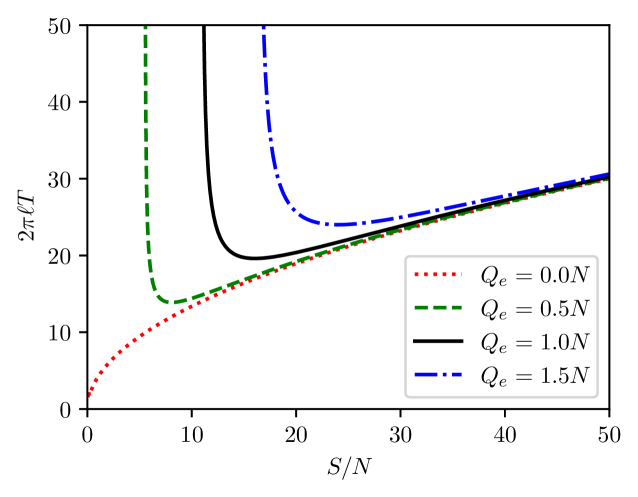
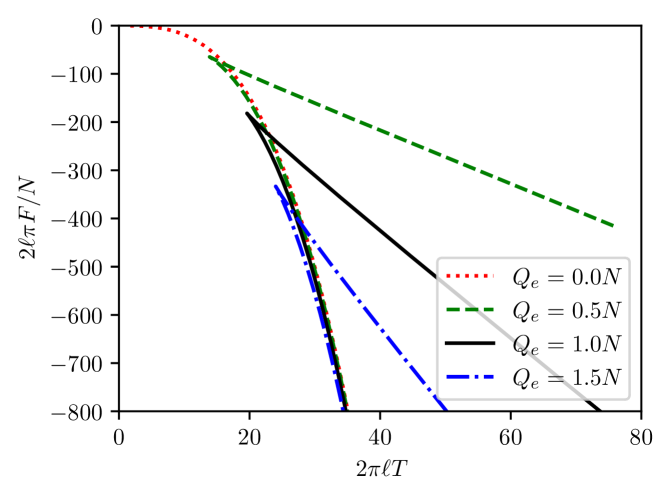
First let us look at the isocharge and curves presented in Fig.1. Each isocharge curve contains a single minimum which divides the black hole states of the same temperature and the same charge into two branches, i.e. unstable small black hole and stable large black hole. Correspondingly, the curves are also branched, with the lower branch corresponding to the stable large black hole states. Above the minimal temperature, the transition from the unstable small black hole state to the large stable black hole state should take place under small perturbations. There is no equilibrium condition for such transitions.
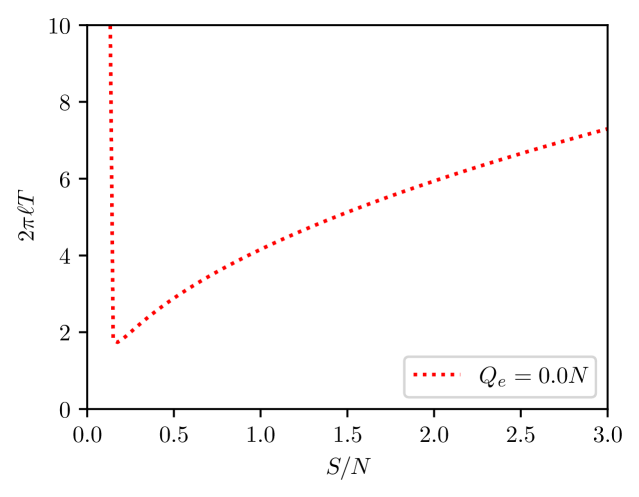
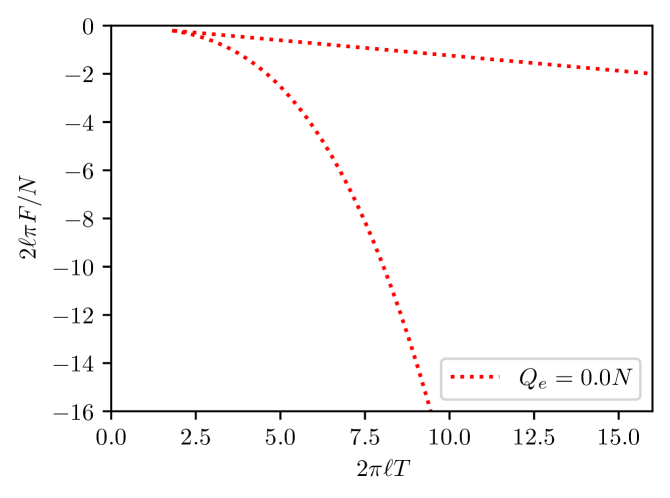
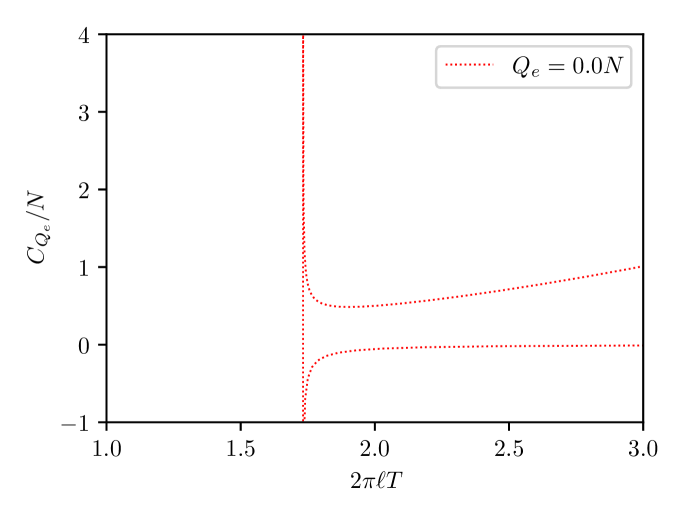
From the curves depicted in Fig.1 it appears that the description on the behavior of the isocharge and curves presented in the last paragraph does not work in the case with . This is not true. Fig.2 presents the zoomed-in plots for the isocharge and curves near the origin. It can be seen that the above branched behavior persists at .
The above isocharge behavior is in sharp contrast to the case of charged AdS black holes in Einstein-Hilbert, Born-Infield or Chern-Simons like theories of gravity. In the case of Einstein-Hilbert and Born-Infield like theories, the isocharge processes always contain an equilibrium phase transition which is of the first order above the critical temperature and becomes second order at the critical point, while in the case of Chern-Simons like theories, the isocharge curves are monotonic and there is only one stable black hole state at each fixed temperature and electric charge. It looks that the present model gives a third universality class which interpolate the Einstein-Hilbert-Born-Infield class and the Chern-Simons class.
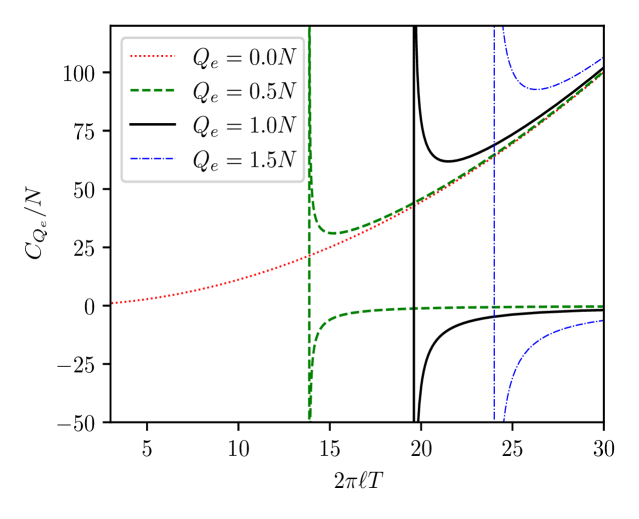
The branched behavior of the isocharge processes can also be revealed from the behavior of the isocharge heat capacity . In the present case, the isocharge specific heat capacity can be calculated explicitly using the EOS (26),
| (31) |
Based on this result, the isocharge heat capacity versus temperature curves are plotted in Fig.3, wherein the right figure is the zoomed-in plot of the curve with . The branched behavior is transparent, and only the large black hole branch has positive heat capacity which indicate its stability.
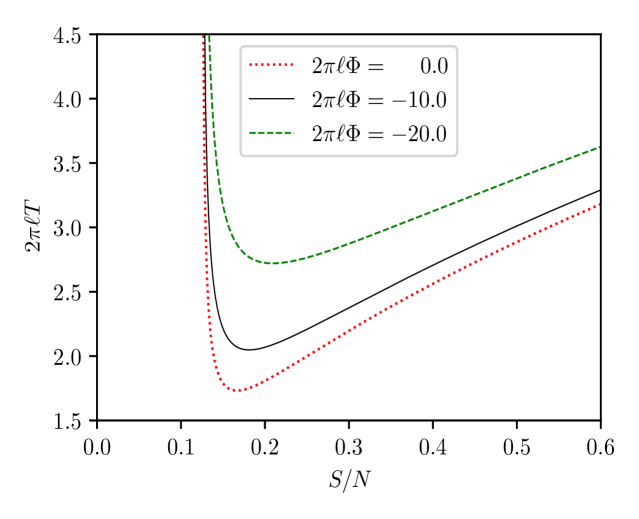
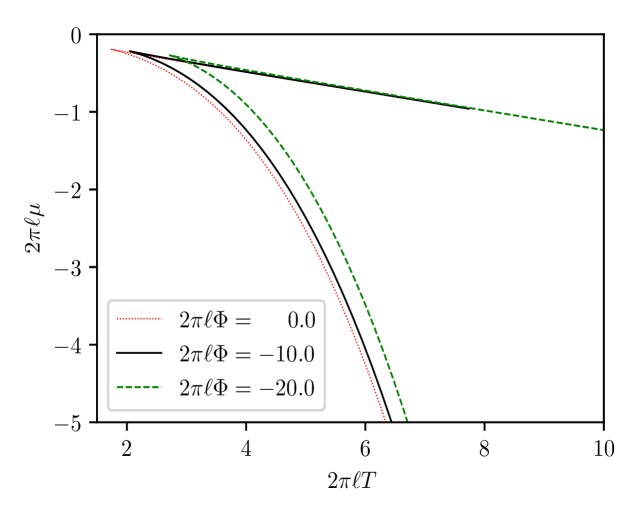
The branched behavior also appears in the isovoltage processes, as depicted in Fig.4 together with the isovoltage curves. The isovoltage curves are qualitatively similar to that of the charged AdS black holes in Einstein-Hilbert-Born-Infield class of theories. However, in the isovoltage processes, is strictly negative for any choice of , which is consistent with the earlier statement on the absence of HP transition.
Besides the processes, one may also be interested in the processes. There are two possible types of processes, i.e. adiabatic and isothermal. The corresponding curves are depicted in Fig.5. In the adiabatic processes, the electric potential decreases monotonically as the charge increases, and there is an upper bound for at each fixed as can be seen in eq.(24). The isothermal processes appear to be more involved. Besides the existence of an upper bound for at each fixed , it seems that, at each fixed , the black hole could experience a cyclic charging-discharging process, which makes the black hole as a potential battery. This kind of charge-potential process has not been found previously within the RPS formalism for the thermodynamics of charged AdS black holes.
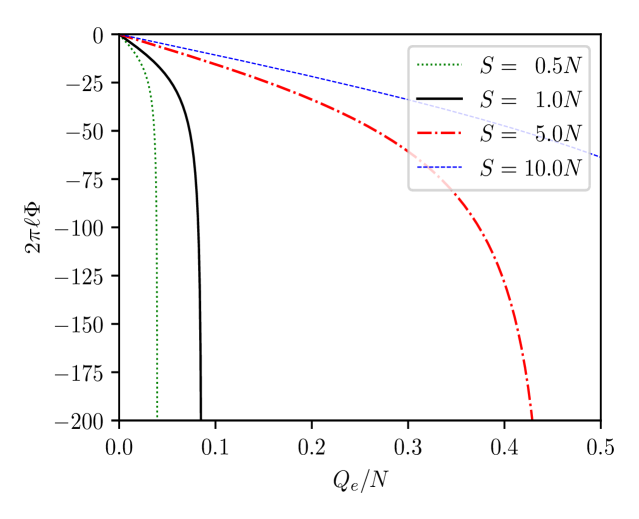
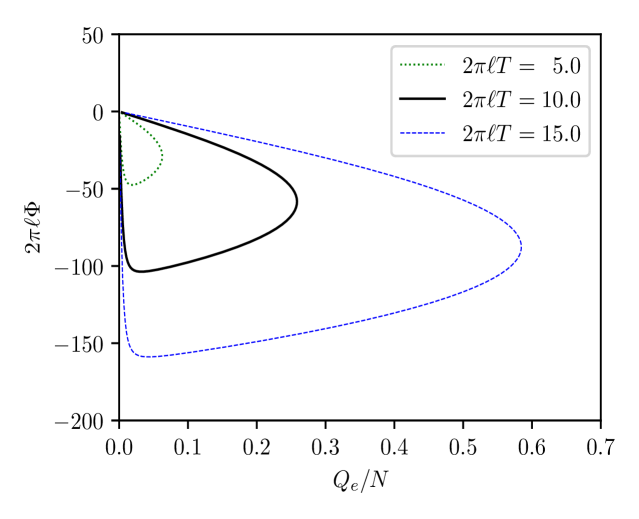
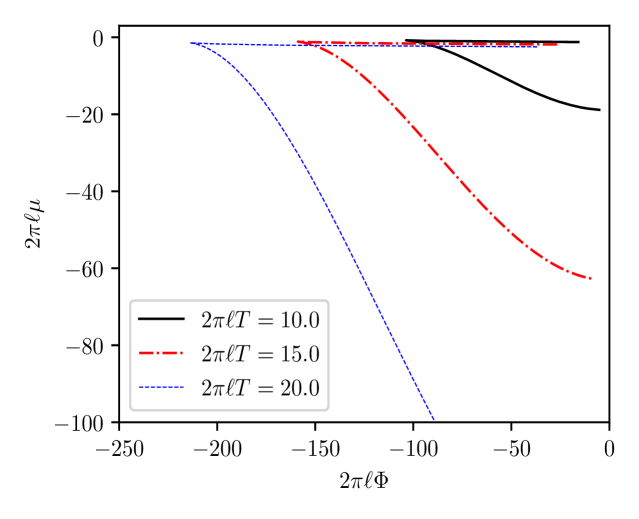
One may also look at the isothermal curves presented in Fig.6. As expected, the isothermal curves also possess a branched behavior at each fixed , with the lower branch being the stable large black hole branch.
As a final remark, let us consider the special case . The metric function now becomes
With negative , the corresponding metric takes the same form as that of the 4d Schwarzschild-AdS black hole solution in Einstein gravity. However, this similarity does not imply that the thermodynamic behaviors should also degenerate to that of the 4d Schwarzschild-AdS black hole solution in Einstein gravity, because only part of the thermodynamic quantities (e.g. the temperature and the electric potential ) of the black hole is determined solely by the solution, whilst the other part of the thermodynamic quantities , including the energy , the entropy , the charge and the chemical potential , is actually determined by the action of the underlying gravity model. Thus the same metric as solution of different gravity models does not necessarily have the same thermodynamic behavior. This final statement is justified by the absence of HP transition in the case of conformal gravity as illustrated in Fig.4 and the presence of HP transition in the case of neutral limit of RN-AdS black holes in Einstein gravity [44].
6 High temperature limit in the stable branch
Our recent study [49] on the case of Tangherlini-AdS black hole solution in Einstein gravity revealed a remarkable connection between the high temperature limit of AdS black holes and the low temperature limit of phonon gases in nonmetallic crystals. It is natural to test whether this AdS/phonon gas correspondence still holds in the case of charged spherically symmetric AdS black holes in conformal gravity.
Please be reminded that the AdS/phonon gas correspondence revealed in [49] holds only in the stable large black hole branch. Therefore, we also consider the high temperature limit of the stable large black hole branch. Using the results presented in eqs.(25)-(30), we can easily get
| (32) | |||
| (33) |
In the stable large black hole branch, implies . Therefore, the above limits can be easily translated into the following high temperature limits for the thermodynamic quantities,
| (34) | ||||
| (35) |
The high temperature limit means that the physical temperature is high above some constant characteristic temperature. In the present case, the characteristic temperature can be chosen as
| (36) |
With this choice, the above high temperature behaviors can be rewritten as
| (37) | ||||
| (38) |
under the condition . These behaviors coincide precisely with what we obtained for Tangherlini-AdS black holes in generic spacetime dimensions , even the numerical coefficients are the same if we set . As we have already pointed out in [49], such high temperature asymptotic behaviors also coincide with the low temperature behaviors of the quantum phonon gases in nonmetallic crystals. By the way, we also checked the cases of four dimensional Kerr-AdS and Kerr-Newman-AdS black holes and found that the high temperature asymptotic behaviors of the above thermodynamic quantities are exactly the same. For different choices of AdS black holes, the high temperature asymptotic behaviors differ from each other at most by the choice of different characteristic temperatures.
7 Concluding remarks
The thermodynamics of charged, spherically symmetric, AdS black holes in four dimensional conformal gravity theory is reconsidered using the RPS formalism. The strange thermodynamic behaviors found previously within the EPS formalism completely disappear, including the strange multivalued and intersecting isotherms, and the zeroth order phase transitions with discontinuities in the Gibbs free energies. Instead, the complete Euler homogeneity, which is known to be absent in the EPS formalism, is restored in the RPS formalism. Therefore, the results of the RPS formalism looks simpler and is physically more reasonable.
Detailed study on the thermodynamic processes seems to indicate that the RPS thermodynamics of charged spherically symmetric AdS black holes in conformal gravity theory may belong to a brand new universality class as opposed to the classes of charged spherically symmetric AdS black holes in Einstein-Hilbert/Born-Infield like theories and in Chern-Simons like theories of gravity.
Let us recall that the major difference between the latter two universality classes lies in that, in the case of Einstein-Hilbert/Born-Infield like theories, the isocharge processes contain a first order supercritical phase transition which becomes second order at the critical point, while in the case of Chern-Simons like theories, the isocharge processes contain no phase transitions at all. The common property of these two classes of theories lies in that, in both cases, each of the isovoltage curves contains a single minimum, indicating the existence of non-equilibrium and noncritical phase transition from the small unstable black hole branch to the large stable black hole branch, and that, in the high temperature limit, the thermodynamic behaviors of the black holes can be precisely matched to that of the low temperature limit of the quantum phonon gases residing in dimensional flat space, with being equal to the dimension of the bifurcation horizon of the black holes. Another common feature of the above two universality classes is the existence of HP transition in the neutral limit.
The results presented in the present work indicate that, the thermodynamic behavior of the present model is quite different from the above two universality classes. Here we can list three distinguished features of the present case. Firstly, each of isocharge curves contains a single minimum just like the isovoltage curves, and hence indicates the existence of the non-equilibrium and noncritical phase transitions even in the isocharge processes. Secondly, the adiabatic and isothermal behaviors are also distinct. Lastly, the present model does not allow for the HP transition in the neutral limit. There are also some features that are common to the present model and the other two universal classes, e.g. the isovoltage curves are all similar, and, more importantly, the high temperature limit of the present case agree precisely with the cases of the former two classes of theories, even up to constant numerical coefficients. With further evidences from the study on the cases of Kerr-AdS and Kerr-Newman-AdS black holes in Einstein gravity (details not presented here), it appears that the recently reported AdS/phonon gas correspondence [49] is universal, irrespective of the spacetime dimensions, the gravity models, the symmetry of the event horizons as well as the amount of charges carried by the black hole solutions.
In the course of our series of works on the RPS formalism for black hole thermodynamics, we have repeatedly encountered the question on what is meant by a variable gravitational coupling constant. The answer is two-folded. On the one hand, in a full theory of gravitation in which the quantum features of gravity is considered, the gravitational coupling constant can indeed be variable along the renormalization group orbit. In such setting, it is natural to consider the effect of variable gravitational coupling constant on the macroscopic behavior of black holes as macroscopic objects. On the other hand, a variable gravitational coupling constant is necessary to make the thermodynamic description of black holes extensive, i.e. to make the Euler homogeneity to hold [46]. Without Euler homogeneity, the thermodynamic properties would become scale dependent. In particular, the intensive properties of black holes would become dependent on the size or mass of the black hole, which contradicts to the meaning of the word “intensive”. This has long been a problem in black hole thermodynamics, which is also the underlying reason for us to propose the RPS formalism.
In spite of the necessity of considering gravitational coupling constant as a variable to make the thermodynamic description extensive, there is still a possibility to keep it fixed, such as in our observational universe. In such a scenario, the term in the first law could be removed, just like in the thermodynamic description of a closed thermodynamic system consisted of ordinary matter. Even in such cases, the Euler relation (21) must still contain the term, albeit it becomes a constant term. The only consequence of fixing the coupling constant is to consider the black holes as closed thermodynamic systems. In other word, in a universe with fixed gravitational coupling constant, all black holes as thermodynamic systems need to be closed.
Acknowledgement
This work is supported by the National Natural Science Foundation of China under the grant No. 12275138.
References
- [1] Maldacena, J. “Einstein Gravity from Conformal Gravity,” [arXiv:1105.5632].
- [2] Mannheim, P. D.; O’Brien, J. G. “Galactic rotation curves in conformal gravity,” J. Phys.: Conf. Ser. 437, 012002, 2013. [arXiv:1211.0188].
- [3] Nesbet,R.K. “Conformal Gravity: Dark Matter and Dark Energy,” Entropy 15, 162-176 (2013). [arXiv:1208.4972].
- [4] Lu, H.; Pope, C. N. “Critical Gravity in Four Dimensions,” Phys. Rev. Lett. 106, 181302, 2011. [arXiv:1101.1971].
- [5] Li, J.; Liu, H. -S.; Lu, H.; Wang, Z. -L. “Fermi Surfaces and Analytic Green’s Functions from Conformal Gravity,” JHEP 1302, 109, 2013. [arXiv:1210.5000].
- [6] Lu, H.; Pang, Y.; Pope, C. N.; Vazquez-Poritz, J. F. “AdS and Lifshitz Black Holes in Conformal and Einstein-Weyl Gravities,” Phys. Rev. D 86, 044011, 2012. [arXiv:1204.1062].
- [7] Bekenstein, J. D. “Black holes and the second law,” Lett. Nuovo Cim. 1972, 4(15):737–740.
- [8] Bekenstein, J. D. “Black holes and entropy,” Phys. Rev. D 7(8):2333–2346, 1973.
- [9] Bardeen, J. M.; Carter, B.; Hawking, S. W. “The four laws of black hole mechanics,” Comm. Math. Phys. 31(2):161–170, 1973.
- [10] Hawking, S. W. “Particle creation by black holes,” Comm. Math. Phys. 43:199-220, 1975.
- [11] Bekenstein, J. D. “Statistical black-hole thermodynamics,” Phys. Rev. D, 12(10):3077, 1975.
- [12] Kastor, D.; Ray, S.; Traschen, J. “Enthalpy and the mechanics of AdS black holes,” Class. Quant. Grav. 26(19):195011, 2009. [arXiv:0904.2765].
- [13] Dolan, B. P. “The cosmological constant and the black hole equation of state,” Class. Quant. Grav. 28(12):125020, 2010. [arXiv:1008.5023].
- [14] Dolan, B. P. “Pressure and volume in the first law of black hole thermodynamics,” Class. Quant. Grav. 28(23):235017, 2011. [arXiv:1106.6260].
- [15] Dolan, B. P. “Compressibility of rotating black holes,” Phys. Rev. D 84(12):127503, 2011. [arXiv:1109.0198].
- [16] Kubizňák, D.; Mann, R. B. “P-V criticality of charged AdS black holes,” JHEP 7:1–25, 2012. [arXiv:1205.0559].
- [17] Gunasekaran, S.; Mann, R. B.; Kubizňák, D. “Extended phase space thermodynamics for charged and rotating black holes and Born-Infeld vacuum polarization,” JHEP 1211, 110, 2012. [arXiv:1208.6251].
- [18] Belhaj, A.; Chabab, M.; Moumni, H. El; Sedra, M. B. “On Thermodynamics of AdS Black Holes in Arbitrary Dimensions,” Chin. Phys. Lett. 29, 100401, 2012. [arXiv:1210.4617].
- [19] Hendi, S. H.; Vahidinia, M. H. “P-V criticality of higher dimensional black holes with nonlinear source,” Phys. Rev. D 88, 084045, 2013. [arXiv:1212.6128].
- [20] Chen, S.; Liu, X.; Liu, C.; Jing, J. “ criticality of AdS black hole in gravity,” Chin. Phys. Lett. 30, 060401, 2013. [arXiv:1301.3234].
- [21] Zhao, R.; Zhao, H. H.; Ma, M. S.; Zhang, L. C. “On the critical phenomena and thermodynamics of charged topological dilaton AdS black holes,” Eur. Phys. J. C 73, 2645, 2013. [arXiv:1305.3725].
- [22] Poshteh, M. B. J.; Mirza, B.; Sherkatghanad, Z. “Phase transition, critical behavior, and critical exponents of Myers-Perry black holes,” Phys. Rev. D 88, no. 2, 024005, 2013. [arXiv:1306.4516].
- [23] Altamirano, N.; Kubizňák, D.; Mann, R. B. “Reentrant Phase Transitions in Rotating AdS Black Holes,” Phys. Rev. D 88, 101502, 2013. [arXiv:1306.5756].
- [24] Cai, R. G.; Cao, L. M.; Li, L.; Yang, R. Q. “P-V criticality in the extended phase space of Gauss-Bonnet black holes in AdS space,” JHEP 9:1–22, 2013. [arXiv:1306.6233].
- [25] Belhaj, A.; Chabab, M.; Moumni, H. El.; Sedra, M. B. “The Thermodynamical Behaviors of Kerr-Newman AdS Black Holes,” Chin. Phys. Lett. 30, 090402, 2013. [arXiv:1307.7421].
- [26] Altamirano, N.; Kubizňák, D.; Mann, R. B.; Sherkatghanad, Z. “Kerr-AdS analogue of triple point and solid/liquid/gas phase transition,” Class. Quant. Grav. 31, 042001, 2014. [arXiv:1308.2672].
- [27] Xu, W.; Xu, H.; Zhao, L. “Gauss–Bonnet coupling constant as a free thermodynamical variable and the associated criticality,” Euro. Phys. J. C 74(7):1–13, 2014. [arXiv:1311.3053].
- [28] Zou, D. -C.; Zhang, S. -J.; Wang, B. “Critical behavior of Born-Infeld AdS black holes in the extended phase space thermodynamics,” Phys. Rev. D 89, 044002, 2014. [arXiv:1311.7299].
- [29] Altamirano, N.; Kubizňák, D.; Mann, R. B.; Sherkatghanad, Z. “Thermodynamics of rotating black holes and black rings: phase transitions and thermodynamic volume,” Galaxies 2, 89, 2014. [arXiv:1401.2586].
- [30] Wei, S. -W.; Liu, Y. -X. “Triple points and phase diagrams in the extended phase space of charged Gauss-Bonnet black holes in AdS space,” Phys. Rev. D 90, 044057, 2014. [arXiv:1402.2837].
- [31] Kubizňák, D.; Mann, R. B. “Black Hole Chemistry,” [arXiv:1404.2126].
- [32] Zou, D. -C.; Liu, Y.; Wang, B. “Critical behavior of charged Gauss-Bonnet AdS black holes in the grand canonical ensemble,” Phys. Rev. D 90, 044063, 2014. [arXiv:1404.5194].
- [33] Xu, H.; Xu, W.; Zhao, L. “Extended phase space thermodynamics for third order Lovelock black holes in diverse dimensions,” Euro. Phys.J. C 74, 3074, 2014. [arXiv:1405.4143]
- [34] Zhang, J. L.; Cai, R. G.; Yu, H. “Phase transition and thermodynamical geometry of Reissner-Nordström-AdS black holes in extended phase space,” Phys. Rev. D 91(4): 044028, 2015. [arXiv:1502.01428].
- [35] Kubizňák, D.; Mann, R. B.; Teo, M. “Black hole chemistry: thermodynamics with Lambda,” Class. Quant. Grav. 34(6): 063001, 2017. [arXiv:1608.06147].
- [36] Lemos, J. P. S.; Zaslavskii, O. B. “Black hole thermodynamics with the cosmological constant as independent variable: Bridge between the enthalpy and the Euclidean path integral approaches,” Phys. Lett. B 786: 296–299, 2018. [arXiv:1806.07910].
- [37] Xu, W.; Zhao, L. “Critical phenomena of static charged AdS black holes in conformal gravity,” Phys. Lett. B 736: 214–220, 2014. [arXiv:1405.7665].
- [38] Wei, S. -W.; Liu, Y. -X. “Insight into the microscopic structure of an AdS black hole from a thermodynamical phase transition,” Phys. Rev. Lett., 115(11): 111302, 2015. [arXiv:1502.00386].
- [39] Dehyadegari, A.; Sheykhi, A.; Wei, S. -W. “Microstructure of charged AdS black hole via criticality,” Phys. Rev. D , 102(10): 104013, 2020. [arXiv:2006.12265].
- [40] Wei, S. -W.; Liu, Y. -X. “Extended thermodynamics and microstructures of four-dimensional charged gauss-bonnet black hole in AdS space,” Phys. Rev. D, 101(10):104018, 2020. [arXiv:2003.14275].
- [41] Visser, M. R. “Holographic thermodynamics requires a chemical potential for color,” Phys. Rev. D 105, 106014, 2022. [arXiv:2101.04145].
- [42] Cong, W.; Kubizňák, D.; Mann, R. B. “Thermodynamics of AdS black holes: central charge criticality,” Phys. Rev. Lett. 127, 091301, 2021., [arXiv:2105.02223]
- [43] Alfaia, R. B.; Lobo, I. P.; Brito, L. C. T. “Central charge criticality of charged AdS black hole surrounded by different fluids,” Eur. Phys. J. Plus 137, 402, 2022. [arXiv:2109.06599].
- [44] Gao, Z.; Zhao, L. “Restricted phase space thermodynamics for AdS black holes via holography,” Class. Quant. Grav. 39:075019, 2021. [arXiv:2112.02386].
- [45] Gao, Z.; Kong, X.; Zhao, L. “Thermodynamics of Kerr-AdS black holes in the restricted phase space,” Euro. Phys. J. C 82(2):1–10, 2022. [arXiv:2112.08672].
- [46] Wang, T.; Zhao, L. “Black hole thermodynamics is extensive with variable newton constant,” Phys. Lett. B 827:136935, 2022. [arXiv:2112.11236].
- [47] Zhao, L. “Thermodynamics for higher dimensional rotating black holes with variable Newton constant,” Chin. Phys. C 46(5):055105, 2022. [arXiv:2201.00521].
- [48] Kong, X.; Wang, T.; Gao, Z.; Zhao, L. “Restricted phase space thermodynamics for black holes in higher dimensions and higher curvature gravities,” Entropy, 24(8):1131, 2022. [arXiv:2208.07748].
- [49] Kong, X.; Wang, T.; Zhao, L. “High temperature AdS black holes are low temperature quantum phonon gases,” [arXiv:2209.12230].
- [50] Sadeghi, J.; Shokri, M.; Gashti, S. N.; Alipour, M. R. “RPS thermodynamics of Taub-NUT AdS black holes in the presence of central charge and the weak gravity conjecture,” Gen. Rel. Grav. 54, 129, 2022. [arXiv:2205.03648].
- [51] Bai, Y. Y.; Chen, X. R.; Xu, Z. M.; Wu, B. “Revisit on thermodynamics of BTZ black hole with variable Newton constant,” [arXiv:2208.11859].
- [52] Du, Y.-Z.; Li, H.-F.; Zhang, Y.; Zhou, X.-N.; Zhao, J.-X. “Restricted phase space thermodynamics of Einstein-power-Yang-Mills AdS black hole,” [arXiv:2210.02006].
- [53] Wang, C.; Yin, S. P.; Xu, Z. M.; Wu, B.; Yang, W. L. “Ruppeiner geometry and the fluctuation of the RN-AdS black hole in framework of the extensive thermodynamics,” [arXiv:2210.08822].
- [54] Hawking, S. W.; Page, D. N. “Thermodynamics of black holes in anti-de Sitter space,” Commun. Math. Phys. 87 (1983) 577.