Sharp stability estimate for the geodesic ray transform
Abstract.
We prove a sharp stability estimate for the geodesic X-ray transform of tensor fields of order , and on a simple Riemannian manifold with a suitable chosen norm. We show that such an estimate holds for a family of such norms, not topologically equivalent, but equivalent on the range of the transform. The reason for this is that the geodesic X-ray transform has a microlocally structured range.
1. Introduction
Let be a smooth compact -dimensional Riemannian manifold with boundary . We assume that is simple, meaning that is strictly convex and that any two points on are joined by a unique minimizing geodesic. The weighted geodesic ray transform of a smooth covariant symmetric -tensor field on is given by
| (1.1) |
where is a smooth weight, runs over the set of all unit speed geodesics connecting boundary points, and the integrand, written in local coordinates, is invariantly defined.
When , we drop the subscript and simply write . It is well known and can be checked easily that for every regular enough with on , we have . Similarly, for every regular enough covector field of order vanishing at , we have , where is the symmetrized covariant differential. Those differentials are called potential fields. Many works have studied injectivity of those transforms up to potential fields and stability estimates.
In the present paper, the bundle of symmetric covariant -tensors on will be denoted by . If is a notation for a function space (, , , etc.), then we denote by the corresponding space of sections of . Note that and in this case we simply write instead of .
The goal of this paper is to prove sharp stability estimates for those transforms when with an appropriate choice of an space on . The Sobolev exponents and are natural in view of the properties of as a Fourier Integral Operator in the interior of . The complications happen near the boundary. Before stating the main results, we will review the known estimates first.
If is Euclidean, a natural parameterization of the lines in is as follows:
| (1.2) |
One defines the Sobolev spaces by using derivatives w.r.t. only, see also (2.2). Then, with being the Euclidean X-ray transform on functions,
| (1.3) |
for every with a smooth bounded domain, see [17, Theorem II.5.1] with (the constant on the right depends on only). This implies the estimate for every , see the discussion of the Sobolev spaces in Section 2.1. It is straightforward to see that the estimate still holds if we define using all derivatives, including the ones.
Estimate (1.3) was recently proved by Boman and Sharafutdinov [5] for symmetric tensor fields of every order for and replaced by the solenoidal part of , which is the projection of to the orthogonal complement of its kernel in :
| (1.4) |
where is the Euclidean ray transform of tensor fields of order supported in .
In the Riemannian case, injectivity of up to potential fields (called s-injectivity) has been studied extensively, see, e.g., [9, 13, 14, 15, 19, 23, 22, 24, 31, 26, 27, 33, 32, 34]. The first proofs of injectivity/s-injectivity of and for simple metrics in [16, 2, 1] provide a stability estimate with a loss of an derivative. The ray transform there is parameterized by endpoins of geodesics. Another estimate with a loss of an derivative, conditional when , follows from Sharafutdinov’s estimate in [21] for , see (1.6) below. Stability estimates in terms of the normal operator are established in [26]:
| (1.5) |
where is some extension of with extended to as a simple metric. When , above. In [7], this estimate was extended to the weighted transform , with never vanishing, under the assumption that the latter is injective, and even to more general geodesic-like families of curves without conjugate points. An analogous estimate for the weighted version of , assuming injectivity, is proved in [8]. Those estimates are based on the fact that is a DO of order elliptic on solenoidal tensor fields (or just elliptic for ) and injective. The need to have there comes from the fact that the standard DO calculus is not suited for studying operators on domains with boundary. On the other hand, DOs satisfying the transmission condition can be used for such problems. In [14], it is showed that does not satisfy the transmission condition but satisfies a certain modified version of it. Then one can replace by in (1.5) for at the expense of replacing by a certain Hörmander type of space. A sharp stability estimate for on the orthogonal complement on the kernel is established in [9]; see next section for the Sobolev norms we use.
The case is harder and the one contains all the difficulties already. S-injectivity is known under an a priori upper bound of the curvature [23] and also for an open dense set of simple metrics, including real analytic ones [27] (and for a class of non-simple metrics, see [30]). It was shown in [18] that is s-injective on arbitrary simple surfaces for all . Under a curvature condition, Sharafutdinov [23] proved the stability estimate
| (1.6) |
, , where equals “shortened” by the unit normal and the spaces above are introduced in the next section. This estimate is of conditional type when since appears on the r.h.s. as well; and not sharp since one would expect to be in some form of an norm, as in (1.3). In terms of the normal operator, a non-sharp stability estimate for was established in [27]; and in [24], the second author proved the sharp stability estimate (1.5) for :
| (1.7) |
The new ingredient in [24] was to use the Korn inequality estimating in terms of .
The main result of this paper is a sharp estimate of the kind (1.3), (1.4) (but for non- necessarily Euclidean) for simple metrics and . Our starting point are the estimates (1.5) for and (1.7) for . As evident from (1.3), and the remark after it, there is some freedom in defining the Sobolev space for since its range is microlocally structured, see also Example 6. We show that if one defines a Sobolev space using, as derivatives, at least non-trivial Jacobi fields covering and pointwise linearly independent in , then an analog of (1.3) and (1.4) holds.
We define first the space in the following way. Let be close enough to so that extends as a simple metric to . We parameterize the maximal unit geodesics in by initial points on and incoming unit directions, i.e., by , see (2.1) below. This defines a smooth structure in the interior of and natural Sobolev spaces in that interior (see also next section). We define as the subspace consisting of the functions supported in ; the latter identified with their initial points and directions on (but the geodesics are restricted to ). While the dot product depends on the extension, the topology does not.
Clearly, if we try a similar parameterization by , we do not get a diffeomorphic relation at the boundary of consisting of geodesics tangent to (and having only one common point with ). One can still give an intrinsic definition of without extending . We parameterize the maximal unit geodesics in in some neighborhood of the boundary by a point on each one maximizing the distance to and a unit direction at that point, see also Figure 1 and section 2.4. One can view this as taking the strictly convex foliation , first and then taking geodesics tangent to each such hypersurface. For this reason, we call it the foliation parameterization. One can extend it smoothly to geodesic in , with extended as a simple metric there, in a natural way. Then we define as the subspace of consisting of functions supported in ; and this space is topologically equivalent to the previous definition. We refer to section 2.4 for more details. The resulting space is independent of the extension . In Theorem 1.1 below, we show that one can use prove sharp estimates with the norm of , as a special case.
The space is too large in the Euclidean case, at least, as evident from (1.3) and (1.4), where the derivatives used in the definition of are the -ones only. We show that a smaller space can be chosen in the Riemannian case, as well. As mentioned above, we define a space (a family of such, actually) in section 3, roughly speaking as but we use derivatives on having the properties that the corresponding Jacobi fields are pointwise linearly independent over every point of . If , we have but for , is a proper subspace of . Therefore, those spaces are not topologically equivalent, at least not when changes; but they are, on the range of .
Our main results is the following.
Theorem 1.1.
Let be a simple manifold. Let be any of the spaces defined in section 3. Then
(a) If is injective, then for all ,
(b) For all ,
(c) If is s-injective, then for all ,
Note that if is constant, or more generally related to an attenuation depending on the position only, then is injective [20] on surfaces, and is injective, too [1]. The transform is not injective for all, say non-zero, weights [4, 3] when and is Euclidean but it is injective for under some conditions on the metric, as it follows from [34, 32], for example. Injectivity and stability of has been studied in [8] and the estimate there implies an estimate of the type above which we do not formulate. Conditions for injectivity of can be found in [23, 21, 28, 27, 33].
Theorem 1.1 generalizes (1.3) and (1.4) to the Riemannian case, in particular. In section 3, we present several specific realizations of the norms with (strictly), i.e., Sobolev spaces defined with fewer derivatives. Whether one can define such spaces in the natural or parameterizations (see section 2.4) for which Theorem 1.1 would remain valid, is an open problem, see also Example 5.
Acknowledgments.
The authors thank Gabriel Paternain and François Monard for the discussion about the results in [14] and for their helpful comments.
2. Preliminaries
2.1. Sobolev spaces
Consider a simple manifold . Let be its unit sphere bundle and be the set of inward/outward unit vectors on ,
| (2.1) |
where is the inward unit normal to . By we denote the Liouville volume form on and by its induced volume form on . Following [21], the Sobolev spaces , , and , , , for , are the ones w.r.t. the measures and , respectively, defined in a standard way.
We recall that for , there are several “natural” ways to define a Sobolev space when is a domain (or a manifold) with a smooth boundary: is the restriction of distributions in to ; next, is the completion of in ; and is the space of all supported in , also equal to the completion of in , also the space of all which, extended as zero outside , belong to . We have for , and in general; and for . We have and , for all . Those definitions extend naturally to manifolds with boundary. We refer to [12] for more details.
In a similar way, we can define the weighted Sobolev spaces on , . More precisely, for integer, is the -Sobolev space on w.r.t. the measure . For arbitrary , is defined via complex interpolation. Restricted to distributions supported in the compact however, the factor is bounded by below (and above) by a positive constant and it can be removed from the definition.
2.2. Geodesics and the scattering relation
One way to parameterize the geodesics going from into is by the set , see also Section 2.4. More precisely, for , we write , , for the unique geodesic with and . Here and in what follows, we set for , i.e. the first positive time when exits . If is simple, then is smooth up to the boundary of ; more precisely, the extension as to (and extended by continuity on the common boundary) is smooth, see [21, Lemma 4.1.1]. Note that is not smooth when is not restricted to ; the normal derivative has a square root type of singularity at .
2.3. The weighted geodesic ray transform and its adjoint
Let be a smooth function on . Then the weighted geodesic ray transform of in (1.1) can be expressed in local coordinates as
see also (1.1). Using Santaló formula [6, Lemma A.8], one can see that is bounded from to . Its properties as a Fourier Integral Operator suggest that those norms are not sharp, see Proposition 2.3.
Consider the adjoint operator . Then again by Santaló’s formula [6, Lemma A.8],
where is the function on that is constant along geodesics and . Hence, we have
where is the measure on such that .
2.4. Parameterizations of the geodesic manifold
There are three main parameterizations of the set of the maximal directed unit speed geodesics on a simple manifold . We include geodesics generating to a point corresponding to initial directions tangent to to make compact; we call that set . We recall those three parameterizations below, and we include our foliation one for completeness. Note that the first three are global and their correctness is guaranteed by the simplicity assumption.
- parameterization:
-
by initial points and incoming directions. Each is parameterized by an initial point and initial unit direction at , i.e., by . We write , , where the latter is the length of the maximal geodesic issued from .
- parameterization:
-
by initial points and tangential projections of incoming directions. Each is parameterized by an initial point and the orthogonal tangential projection of its initial unit direction at , i.e., by , where stands for the unit ball bundle. We write somewhat incorrectly .
- parameterization:
-
by initial and end points. Each is parameterized by its endpoints and on . If we think of as a directed geodesic, then the direction is from to . We use the notation .
- foliation parameterization:
-
Near , let be the point where the maximum of is attained, and let be the direction at . We use the notation . Away from , we can use any of the other parameterizations. We give more details below.
Identifying with the corresponding set of parameters, each one of them being a manifold, introduces a natural manifold structure on it. While those differential structures are different (near ), the first two ones are homeomorphic but not diffeomorphic. In the and in the parameterizations, is a compact manifold with boundary . The boundary in the first one can be removed by allowing geodesics to propagate backwards. In the one, is a compact manifold without a boundary; then is an incorrect notation and it represents the diagonal. If we project the unit sphere bundle to the unit ball one in the standard way , the resulting map is not a diffeomorphism up to the boundary, i.e., at tangent to . The foliation parameterization makes a manifold with a boundary as well but it allows a natural smooth extension of to a smooth manifold of geodesic on an extended , as we show below.
We describe the foliation parameterization in more detail now. Fix a point and assume that is strictly convex at w.r.t. . Let be as above. We work in boundary normal coordinates near in which and is the signed distance to , non-negative in . We can always assume that is given locally by with some . Let be a small neighborhood of the geodesics tangent to at extended until they hit . Note that this includes geodesic segments which may lie outside of . We will choose a parameterization of in the following way. First, since any geodesic hits transversally at both ends when , we can parameterize by its initial point and incoming unit directions or their projections on . Denote this geodesic by . The foliation parameterization of is by , where is the point maximizing the signed distance form to (regardless of whether is entirely outside or hits ), and by the direction at which must be tangent to the hypersurface . In Figure 1 on the left, we illustrate this on an almost Euclidean looking example (which is more intuitive) and in the right, we do this in boundary normal coordinates. We call the corresponding geodesic .
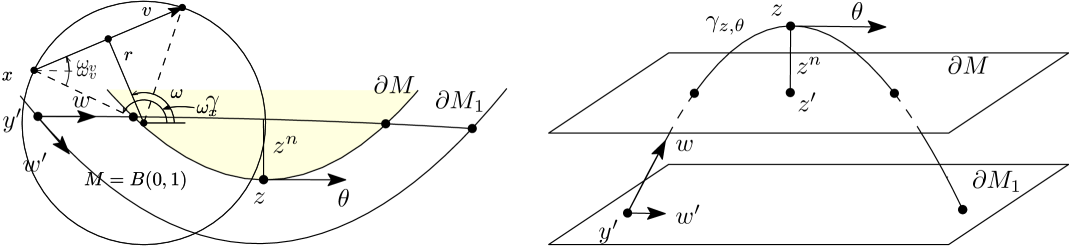
Another way to describe the foliation parameterization, which explains it name, is to think of the hyperplanes , , as a strictly convex foliation near . Then is the geodesic through tangent to it with unit direction . This defines a natural measure on the set of which we may identify with given by , where is the natural measure on . Then belongs locally to the foliation , with , .
Let us compare the parameterization by to the one by . As we emphasized above, they are related by a diffeomorphism which becomes singular when is tangent to . Such almost tangent geodesics (to ) however do not hit ; therefore when parameterizing with , those two parameterizations are diffeomorphic to each other.
Proposition 2.1.
Assume that is strictly convex at . Then the map is a local diffeomorphism.
Proof.
Let be the travel time of the unit speed geodesic issued from to , i.e., maximizes locally. Then is a critical point, i.e., . Let be a geodesic tangent to at with some . To solve for near , we apply the Implicit Function Theorem. Since and the latter equals twice the second fundamental form at , we get a unique smooth with .
Since and (the prime stands for the projection onto the first coordinates in boundary normal coordinates), we get that is smooth.
To verify that the inverse map is smooth, it is enough to show that the travel time at which reaches is a smooth function as well. This follows easily from the fact that geodesics tangent to hit transversely when . ∎
2.5. The space
As before, we embed in the interior of a simple manifold (the metric on is an extension of the metric on ). We also extend smoothly to and keep the same notation for the extension. We denote by the geodesic ray transform on . The set of the oriented geodesics through will be called as before. They are a subset of (the extensions to) all oriented geodesics in . The latter set is parameterized by ; and we identify with it. In particular, becomes a manifold with boundary and is a compact submanifold contained in its interior. On we have two natural measures, as above: one is and the other one is , the subscript indicating that they are on . They are equivalent (define equivalent Sobolev spaces) away from .
Note that the simplicity is not really needed and assuming non-trapping instead of no conjugate points is enough. The strict convexity of is convenient for parameterizing on but that assumption is not needed either, see e.g., [28].
In the coordinates, is given by . For supported in , we define the Sobolev space as above. In particular, when is a non-negative integer, identifying locally with some parameterization in , we have locally
| (2.2) |
This norm is not invariantly defined but under changes of variables, it transforms into equivalent norms. Note that above is considered as a function defined on but supported in , as in the definition of above.
We make this definition global now. Without changing the notation, let be the manifold of all geodesics with endpoints on , and let be those intersecting . We can choose an open cover of consisting of neighborhoods of geodesics tangent to as above, plus an open set of geodesics passing through interior points only, and having a positive lower bound of the angle they make with . In the latter, we take the classical norm w.r.t. the parameterization , for example. In the former neighborhood, we use the norms defined above. Then using a partition of unity, we extend the norm to functions defined in and supported in . This defines a Hilbert space which we call again.
On the other hand, we have the space of distributions on defined through the parameterization of given by in a similar way: we define the norm for functions supported in the interior of first (the behavior near the boundary of corresponding to tangent to does not matter in what follows), and then define as the subspace of those which are supported in . We define similarly, where is the interior of .
Proposition 2.1 then implies the following.
Proposition 2.2.
The Hilbert spaces and are topologically equivalent.
2.6. Mapping properties of and
We study the mapping properties of , restricted a priori to tensor fields/functions supported in fixed compact subsets. This avoids the more delicate question what happens near the boundaries of and but we do not need the latter.
Proposition 2.3.
Suppose that is simple, , and . Then, for ,
(a) is bounded,
(b) is bounded.
Proof.
Part (a) is proved in [29, Proposition 5.2] for and but the proof applies to as well (and it is actually simpler when ). Its tensor version is an immediate consequence.
To prove (b), it is enough to prove that
| (2.3) |
then (b) would follow by duality. Here, is considered as the operator acting on tensor fields supported in restricted to geodesics in . We can think of as an open subset of the geodesics , with defined as but related to an extension of . Then by (a), is bounded, which also proves (2.3) and therefore, (b).
∎
3. The spaces
Let , is a fixed unit speed geodesic on a Riemannian manifold and let be a hypersurface intersecting transversely. We are interested in integrals of functions supported in a compact set separated from the endpoints of . We parameterize geodesic (directed) segments close to (and that parameterization defines the topology) by initial points on and initial unit directions. Assume that is oriented; then we insist that increases on the positive side of . Then we can identify the unit directions with their projection on the unit ball bundle . We will apply this construction when is a piece of either or . Note that we exclude geodesics tangent to them in those cases.
Let be local coordinates near a fixed . Denote by the geodesics issued from parameterized by . For some fixed, denote with , with and non-existent if . Then we define the norm near by using -derivatives only; more precisely for supported near , we set
| (3.1) |
This is a special case of the spaces introduced in [10, Definition 10.1.6] and [11, Definition B.1.10].
Given a compact subset , and a finite cover of coordinate charts of that kind, we use a partition of unity to complete that norm to a global one, which we call an norm:
This norm depends on the cover. We are going to require the following non-degeneracy condition in each chart:
| (3.2) |
In other words, the differential of that map has full rank any time when the image is in . Another way to interpret (3.2) is to say that the Jacobi fields , , projected to , span the latter at every point. Clearly, condition (3.2) requires . When (no variables), (3.2) hold trivially.
Example 1.
If we use the parameterization of on and take , the space reduces to . The latter is equivalent to defined through the foliation parameterization, see Proposition 2.2.
Example 2.
The classical parameterizations of lines in the Euclidean case by , see (1.2), is an example of such a coordinate system. In this case, belongs to the hyperplane depending on but near a fixed , one can always construct a local diffeomorphism smoothly depending on allowing us to think of as a variable on a fixed hyperplane. If that diffeomorphism is a unitary map for each (which can be done), then this would not affect the definition of (3.1). Then we set and choose to be a local parameterization of . The map in (3.2) is given by which is a diffeomorphism. Then the resulting space is the one appearing in (1.5). Here, and in the examples below, .
Example 3.
Near a point on (or, equivalently, on ), we choose coordinates to parameterize points on and to parameterize incident unit directions. Then the map (3.2) is a submersion when its image is restricted to by the simplicity of , which can be guaranteed if the extension is close enough to . Note that we need the initial points of the geodesics to be outside since (3.2) is the exponential map in polar coordinates, rather than in the usual ones, and it is not an submersion when . The resulting space would involve derivatives w.r.t. the direction (but not w.r.t. the base point) only. While the specific definition of the norm depends on the coordinates used, a change would yield an equivalent norm. One can think of those coordinates as fan-beam ones on but we use the directions only to define .
Example 4.
With as above, we swap and . More precisely, near a point on (or, equivalently, on ), we choose coordinates to parameterize points on and to parameterize incident unit directions. The corresponding Sobolev space will include derivative w.r.t. initial points on only in the chosen coordinate system. A change of variables would include directional derivatives as well. For rays close enough to ones tangential to , (3.2) will hold by a perturbation argument. Then we use a partition of unity do define near the boundary of (consisting of geodesics tangent to generating to points). In the interior of , we can swap and (use derivatives w.r.t. the directions) or use all variables, as in Example 2.
Example 5.
One may wonder if one of the parameterizations on (rather than on ) would work as well. If we view the parameterization as an projected onto , then the natural measure would be , see section 2.1. The derivatives w.r.t. initial points on (see also Figure 1, with directions tangent to fixed in some coordinate system (or varying smoothly) would correspond to Jacobi fields which do not satisfy (3.2) at , as it is easy to see. The directional derivatives at every fixed generate Jacobi fields vanishing at . Therefore, (3.2) is not satisfied even if we take all possible derivatives. This shows that the space (here, stands for the measure) does not satisfy (3.2). Note that such a space can also be defined as an complex interpolation space between similar spaces with and , see [12, Theorem B.9], where one can use classical definitions of norms through derivatives. The fact that (3.2) fails in this case does not prove that we cannot use the norm in our main results yet however.
4. Proof of the main theorem
Proof.
The starting point are the stability estimates (1.5) for and (1.7) for , the latter due to the second author [24, Theorem 1], valid for all symmetric 2-tensor field . First we will estimate in the first inequality in (1.5), respectively (1.7), by , see (2.2), with the corresponding ray transform . We will take below and the proof is the same for .
By Proposition 2.3(a), applied to the extension of by zero to , we have and that map is continuous. This proves the second inequality in the theorem, part (c), because . We also have . Applying Proposition 2.3(b) with to the middle term of (1.7), we obtain
| (4.1) |
This completes the proof of the first inequality in the theorem with the norm, i.e., when (in all charts). Then the norm is equivalent to .
In the remainder of the proof, we consider the more interesting case when and (3.2) holds. Then the norm is not equivalent to anymore. The main idea is that in that case, locally, while is not elliptic (in ), it is elliptic on the Lagrangian of ; more precisely on the image of under the canonical relation , where lies.
We can view as a sum of several weighted geodesic X-ray transforms of the scalar components of the tensor (in a coordinate system near a fixed geodesic). It was shown in [15] that each such transform, and therefore itself, is an FIO with the following canonical relation . Let be the dual variables of , and be the dual of . Then , if and only if there exists so that
In particular, this shows that the dual variables along each geodesic are Jacobi fields projected to its conormal bundle. Passing to the variables, the last two equations become
where is the dual to . We can describe in the following way. For a fixed , choose any through normal to (that set is diffeomorphic to ); then is the union of all so that parameterizes some of those geodesics and is its Jacobi field corresponding to at projected to , see [15]. By our assumption, for every such fixed geodesic, at least one of those projections corresponding to , would not vanish. This means that is elliptic on the image of under (which is conically compact, and therefore, it is elliptic in a neighborhood of it), where lies. Therefore, given , one can build a left parametrix of order zero to get
| (4.2) |
with smoothing. Here the fractional powers are defined through the Fourier transform and is properly supported in some neighborhood of . Summing up, we get the estimate
| (4.3) |
with as large as we want. On the other hand, the estimate
| (4.4) |
is immediate.
Since we proved Theorem 1.1 with the norm (when ), by (4.3), (4.4), we can replace that norm by any norm of the ones at the expense of getting an error term; for (c) in Theorem 1.1, for example, we get
, since . Since , where is the projection onto the solenoidal tensors, is injective, a standard functional analysis argument implies that the last term can be removed at the expense of increasing . ∎
The estimate which we prove and even the Euclidean estimate (1.3) may look unexpected. The transform is overdetermined in the sense that it acts from an dimensional space to an dimensional one. One could expect that derivatives in the definition of the Sobolev spaces of the image would be enough but it turns out that suffice, under condition (3.2). In the next example, we demonstrate, in a simple situation, that not only the dimension of the Lagrangian projected on the image matters; its structure is the one allowing us to get away with one less variable.
Example 6.
We will demonstrate explicitly how this argument works for the Radon transform in with the “parallel geometry” paremeterization , , . We parameterize by its polar angle and denote by the dual variables to . It is well known, and also follows from the analysis above that is an FIO with a canonical relation which is a local diffeomorphism. A direct computation [25] shows that under the a priori assumption , we have
| (4.5) |
The symbol (corresponding to is not elliptic because it vanishes on the line , . On the other hand, that line is separated from the cone in the r.h.s. of (4.5). Using a partition of unity on the unit circle one can always modify away from that cone to make it elliptic of order (for example, by adding a suitable elliptic pure imaginary symbol away from the cone to ensure ellipticity in the transition region as well where the cutoff is neither nor ). This would result in a smoothing error applied to ; and will lead to an elliptic extension of . This shows that defining an Sobolev space for with the derivative only should work; and this is a partial case of (1.5) written in the coordinates.
We recall that the main argument in the proof of the main theorem was that was elliptic on the range of the canonical relation (away from the zero section). In Example 6, and clearly, the dual variable does not vanish on (4.5). In dimensions , that range has dimension , which is also the dimension of and also of , see also [15]. For general dimensions , this microlocal range has dimension as it follows from [15]; and when , this is strictly smaller than the dimension of the phase space of all geodesics.
References
- [1] Y. E. Anikonov and V. G. Romanov. On uniqueness of determination of a form of first degree by its integrals along geodesics. J. Inverse Ill-Posed Probl., 5(6):487–490 (1998), 1997.
- [2] I. N. Bernstein and M. L. Gerver. A problem of integral geometry for a family of geodesics and an inverse kinematic seismics problem. Dokl. Akad. Nauk SSSR, 243(2):302–305, 1978.
- [3] J. Boman. An example of nonuniqueness for a generalized Radon transform. J. Anal. Math., 61:395–401, 1993.
- [4] J. Boman. Local non-injectivity for weighted Radon transforms. In Tomography and inverse transport theory, volume 559 of Contemp. Math., pages 39–47. Amer. Math. Soc., Providence, RI, 2011.
- [5] J. Boman and V. Sharafutdinov. Stability estimates in tensor tomography. preprint, 2017.
- [6] N. S. Dairbekov, G. P. Paternain, P. Stefanov, and G. Uhlmann. The boundary rigidity problem in the presence of a magnetic field. Advances in Mathematics, 216(2):535–609, 2007.
- [7] B. Frigyik, P. Stefanov, and G. Uhlmann. The X-ray transform for a generic family of curves and weights. J. Geom. Anal., 18(1):89–108, 2008.
- [8] S. Holman and P. Stefanov. The weighted Doppler transform. Inverse Probl. Imaging, 4(1):111–130, 2010.
- [9] S. Holman and G. Uhlmann. On the microlocal analysis of the geodesic X-ray transform with conjugate points. J. Differential Geom., 108(3):459–494, 2018.
- [10] L. Hörmander. The analysis of linear partial differential operators. II, volume 257. Springer-Verlag, Berlin, 1983. Differential operators with constant coefficients.
- [11] L. Hörmander. The analysis of linear partial differential operators. III, volume 274. Springer-Verlag, Berlin, 1985. Pseudodifferential operators.
- [12] W. McLean. Strongly elliptic systems and boundary integral equations. Cambridge University Press, Cambridge, 2000.
- [13] F. Monard. Numerical implementation of geodesic X-ray transforms and their inversion. SIAM J. Imaging Sci., 7(2):1335–1357, 2014.
- [14] F. Monard, R. Nickl, and G. P. Paternain. Efficient nonparametric Bayesian inference for -ray transforms. Ann. Statist., 47(2):1113–1147, 04 2019.
- [15] F. Monard, P. Stefanov, and G. Uhlmann. The geodesic ray transform on Riemannian surfaces with conjugate points. Comm. Math. Phys., 337(3):1491–1513, 2015.
- [16] R. G. Muhometov. The reconstruction problem of a two-dimensional Riemannian metric, and integral geometry. Dokl. Akad. Nauk SSSR, 232(1):32–35, 1977.
- [17] F. Natterer. The mathematics of computerized tomography. B. G. Teubner, Stuttgart, 1986.
- [18] G. P. Paternain, M. Salo, and G. Uhlmann. Tensor tomography on surfaces. Inventiones Mathematicae, 193(1):229–247, 2013.
- [19] L. Pestov and G. Uhlmann. On characterization of the range and inversion formulas for the geodesic X-ray transform. Int. Math. Res. Not., (80):4331–4347, 2004.
- [20] M. Salo and G. Uhlmann. The attenuated ray transform on simple surfaces. J. Differential Geom., 88(1):161–187, 2011.
- [21] V. A. Sharafutdinov. Integral geometry of tensor fields. Inverse and Ill-posed Problems Series. VSP, Utrecht, 1994.
- [22] V. A. Sharafutdinov. A finiteness theorem for the ray transform on a Riemannian manifold. Dokl. Akad. Nauk, 355(2):167–169, 1997.
- [23] V. A. Sharafutdinov. Ray transform on Riemannian manifolds, lecture notes, UW–Seattle. available at: http://www.ima.umn.edu/talks/workshops/7-16-27.2001/sharafutdinov/, 1999.
- [24] P. Stefanov. A sharp stability estimate in tensor tomography. Journal of Physics: Conference Series, 124(1):012007, 2008.
- [25] P. Stefanov. Semiclassical sampling and discretization of certain linear inverse problems. arXiv:1811.01240, 2019.
- [26] P. Stefanov and G. Uhlmann. Stability estimates for the X-ray transform of tensor fields and boundary rigidity. Duke Math. J., 123(3):445–467, 2004.
- [27] P. Stefanov and G. Uhlmann. Boundary rigidity and stability for generic simple metrics. J. Amer. Math. Soc., 18(4):975–1003, 2005.
- [28] P. Stefanov and G. Uhlmann. Integral geometry on tensor fields on a class of non-simple Riemannian manifolds. Amer. J. Math., 130(1):239–268, 2008.
- [29] P. Stefanov and G. Uhlmann. An inverse source problem in optical molecular imaging. Anal. PDE, 1(1):115–126, 2008.
- [30] P. Stefanov and G. Uhlmann. Local lens rigidity with incomplete data for a class of non-simple Riemannian manifolds. J. Differential Geom., 82(2):383–409, 2009.
- [31] P. Stefanov and G. Uhlmann. The geodesic X-ray transform with fold caustics. Anal. PDE, 5(2):219–260, 2012.
- [32] P. Stefanov, G. Uhlmann, and A. Vasy. Local and global boundary rigidity and the geodesic X-ray transform in the normal gauge. arXiv:1702.03638, 2017.
- [33] P. Stefanov, G. Uhlmann, and A. Vasy. Inverting the local geodesic X-ray transform on tensors. Journal d’Analyse Mathématique, 136(1):151–208, 2018.
- [34] G. Uhlmann and A. Vasy. The inverse problem for the local geodesic ray transform. Invent. Math., 205(1):83–120, 2016.