This paper was converted on www.awesomepapers.org from LaTeX by an anonymous user.
Want to know more? Visit the Converter page.

Sparse random graphs: Eigenvalues and Eigenvectors

Linh V. Tran, Van H. Vu111V. Vu is supported by NSF grants DMS-0901216 and AFOSAR-FA-9550-09-1-0167.  and Ke Wang
Department of Mathematics, Rutgers, Piscataway, NJ 08854
Abstract

In this paper we prove the semi-circular law for the eigenvalues of regular random graph Gn,dG_{n,d} in the case dd\rightarrow\infty, complementing a previous result of McKay for fixed dd. We also obtain a upper bound on the infinity norm of eigenvectors of Erdős-Rényi random graph G(n,p)G(n,p), answering a question raised by Dekel-Lee-Linial.

1 Introduction

1.1 Overview

In this paper, we consider two models of random graphs, the Erdős-Rényi random graph G(n,p)G(n,p) and the random regular graph Gn,dG_{n,d}. Given a real number p=p(n)p=p(n),0p10\leq p\leq 1, the Erdős-Rényi graph on a vertex set of size nn is obtained by drawing an edge between each pair of vertices, randomly and independently, with probability pp. On the other hand, Gn,dG_{n,d}, where d=d(n)d=d(n) denotes the degree, is a random graph chosen uniformly from the set of all simple dd-regular graphs on nn vertices. These are basic models in the theory of random graphs. For further information, we refer the readers to the excellent monographs [4],[19]\cite[cite]{[\@@bibref{}{bollobas}{}{}]},\cite[cite]{[\@@bibref{}{janson}{}{}]} and survey [33].

Given a graph GG on nn vertices, the adjacency matrix AA of GG is an n×nn\times n matrix whose entry aija_{ij} equals one if there is an edge between the vertices ii and jj and zero otherwise. All diagonal entries aiia_{ii} are defined to be zero. The eigenvalues and eigenvectors of AA carry valuable information about the structure of the graph and have been studied by many researchers for quite some time, with both theoretical and practical motivations (see, for example, [2],[3],[12],[25]\cite[cite]{[\@@bibref{}{bauer}{}{}]},\cite[cite]{[\@@bibref{}{bhamidi}{}{}]},\cite[cite]{[\@@bibref{}{feige}{}{}]},\cite[cite]{[\@@bibref{}{semerjian}{}{}]} [16],[13],[15]\cite[cite]{[\@@bibref{}{FK1981}{}{}]},\cite[cite]{[\@@bibref{}{fried1991}{}{}]},\cite[cite]{[\@@bibref{}{fried2003}{}{}]}, [14],[30],[10]\cite[cite]{[\@@bibref{}{fried1993}{}{}]},\cite[cite]{[\@@bibref{}{tvrandom}{}{}]},\cite[cite]{[\@@bibref{}{erdos2009semi}{}{}]}, [27],[24]\cite[cite]{[\@@bibref{}{shi2000}{}{}]},\cite[cite]{[\@@bibref{}{pothen1990}{}{}]}).

The goal of this paper is to study the eigenvalues and eigenvectors of G(n,p)G(n,p) and Gn,dG_{n,d}. We are going to consider:

  • The global law for the limit of the empirical spectral distribution (ESD) of adjacency matrices of G(n,p)G(n,p) and Gn,dG_{n,d}. For p=ω(1/n)p=\omega(1/n), it is well-known that eigenvalues of G(n,p)G(n,p) (after a proper scaling) follows Wigner’s semicircle law (we include a short proof in the Appendix A for completeness). Our main new result shows that the same law holds for random regular graph with dd\rightarrow\infty with nn. This complements the well known result of McKay for the case when dd is an absolute constant (McKay’s law) and extends recent results of Dumitriu and Pal [9] (see Section 1.2 for more discussion).

  • Bound on the infinity norm of the eigenvectors. We first prove that the infinity norm of any (unit) eigenvector vv of G(n,p)G(n,p) is almost surely o(1)o(1) for p=ω(logn/n)p=\omega(\log n/n). This gives a positive answer to a question raised by Dekel, Lee and Linial [7]. Furthermore, we can show that vv satisfies the bound v=O(log2.2g(n)logn/np)\|v\|_{\infty}=O\left(\sqrt{\log^{2.2}g(n){\log n}/{np}}\right) for p=ω(logn/n)=g(n)logn/np=\omega(\log n/n)=g(n)\log n/n, as long as the corresponding eigenvalue is bounded away from the (normalized) extremal values 2-2 and 22.

We finish this section with some notation and conventions.

Given an n×nn\times n symmetric matrix MM, we denote its nn eigenvalues as

λ1(M)λ2(M)λn(M),{\lambda}_{1}{(M)}\leq{\lambda}_{2}{(M)}\leq\ldots\leq{\lambda}_{n}{(M)},

and let u1(M),,un(M)nu_{1}(M),\ldots,u_{n}(M)\in\mathbb{R}^{n} be an orthonormal basis of eigenvectors of MM with

Mui(M)=λiui(M).Mu_{i}(M)={\lambda}_{i}u_{i}(M).

The empirical spectral distribution (ESD) of the matrix MM is a one-dimensional function

Fn𝐌(x)=1n|{1jn:λj(M)x}|,F^{\bf M}_{n}(x)=\frac{1}{n}|\{1\leq j\leq n:\lambda_{j}(M)\leq x\}|,

where we use |𝐈||\mathbf{I}| to denote the cardinality of a set 𝐈\mathbf{I}.

Let AnA_{n} be the adjacency matrix of G(n,p)G(n,p). Thus AnA_{n} is a random symmetric n×nn\times n matrix whose upper triangular entries are iid copies of a real random variable ξ\xi and diagonal entries are 0. ξ\xi is a Bernoulli random variable that takes values 11 with probability pp and 0 with probability 1p1-p.

𝔼ξ=p,𝕍arξ=p(1p)=σ2.\mathbb{E}\xi=p,\mathbb{V}ar{\xi}=p(1-p)={\sigma}^{2}.

Usually it is more convenient to study the normalized matrix

Mn=1σ(AnpJn)M_{n}=\frac{1}{\sigma}(A_{n}-pJ_{n})

where JnJ_{n} is the n×nn\times n matrix all of whose entries are 1. MnM_{n} has entries with mean zero and variance one. The global properties of the eigenvalues of AnA_{n} and MnM_{n} are essentially the same (after proper scaling), thanks to the following lemma

Lemma 1.1.

(Lemma 36, [30]) Let A,BA,B be symmetric matrices of the same size where BB has rank one. Then for any interval II,

|NI(A+B)NI(A)|1,|N_{I}(A+B)-N_{I}(A)|\leq 1,

where NI(M)N_{I}(M) is the number of eigenvalues of MM in II.

Definition 1.2.

Let EE be an event depending on nn. Then EE holds with overwhelming probability if P(E)1exp(ω(logn)){\hbox{\bf P}}(E)\geq 1-\exp(-\omega(\log n)).

The main advantage of this definition is that if we have a polynomial number of events, each of which holds with overwhelming probability, then their intersection also holds with overwhelming probability.

Asymptotic notation is used under the assumption that nn\rightarrow\infty. For functions ff and gg of parameter nn, we use the following notation as nn\rightarrow\infty: f=O(g)f=O(g) if |f|/|g||f|/|g| is bounded from above; f=o(g)f=o(g) if f/g0f/g\rightarrow 0; f=ω(g)f=\omega(g) if |f|/|g||f|/|g|\rightarrow\infty, or equivalently, g=o(f)g=o(f); f=Ω(g)f=\Omega(g) if g=O(f)g=O(f); f=Θ(g)f=\Theta(g) if f=O(g)f=O(g) and g=O(f)g=O(f).

1.2 The semicircle law

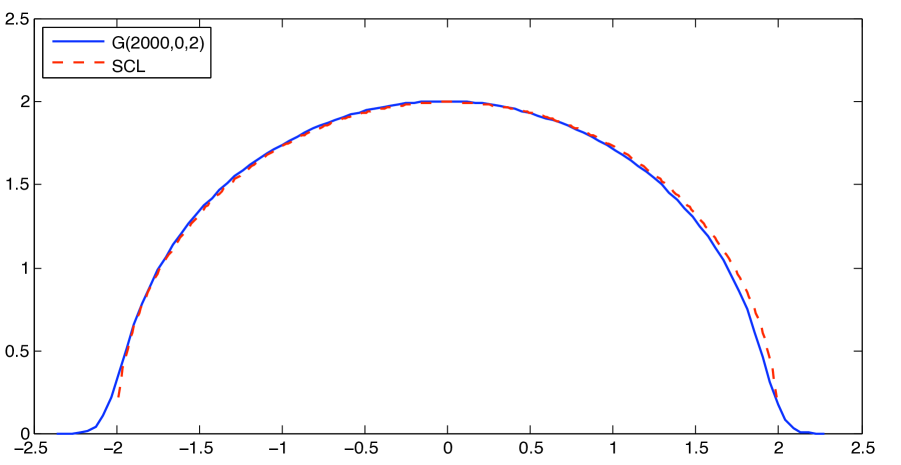
In 1950s, Wigner [32] discovered the famous semi-circle for the limiting distribution of the eigenvalues of random matrices. His proof extends, without difficulty, to the adjacency matrix of G(n,p)G(n,p), given that npnp\rightarrow\infty with nn. (See Figure 1 for a numerical simulation)

Theorem 1.3.

For p=ω(1n)p=\omega(\frac{1}{n}), the empirical spectral distribution (ESD) of the matrix 1nσAn\frac{1}{\sqrt{n}\sigma}A_{n} converges in distribution to the semicircle distribution which has a density ρsc(x){{}\rho}_{sc}(x) with support on [2,2][-2,2],

ρsc(x):=12π4x2.{{\rho}}_{sc}(x):=\frac{1}{2\pi}\sqrt{4-x^{2}}.
Refer to caption\captionstyle

center \onelinecaptionsfalse

Figure 1: The probability density function of the ESD of G(2000,0.2)G(2000,0.2)

If np=O(1)np=O(1), the semicircle law no longer holds. In this case, the graph almost surely has Θ(n)\Theta(n) isolated vertices, so in the limiting distribution, the point 0 will have positive constant mass.

The case of random regular graph, Gn,dG_{n,d}, was considered by McKay [21] about 30 years ago. He proved that if dd is fixed, and nn\rightarrow\infty, then the limiting density function is

fd(x)={d4(d1)x22π(d2x2),if |x|2d1;0otherwise.\displaystyle f_{d}(x)=\left\{\begin{array}[]{ll}\frac{d\sqrt{4(d-1)-x^{2}}}{2\pi(d^{2}-x^{2})},&\mbox{if $|x|\leq 2\sqrt{d-1}$};\\ \\ 0&\mbox{otherwise}.\end{array}\right.

This is usually referred to as McKay or Kesten-McKay law.

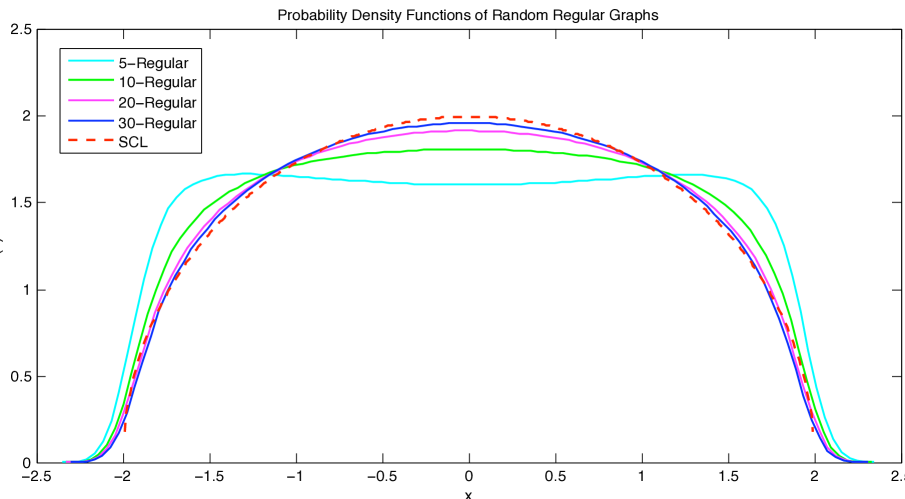
It is easy to verify that as dd\rightarrow\infty, if we normalize the variable xx by d1\sqrt{d-1}, then the above density converges to the semicircle distribution on [2,2][-2,2]. In fact, a numerical simulation shows the convergence is quite fast(see Figure 2).
Refer to caption\captionstyle

center \onelinecaptionsfalse

Figure 2: The probability density function of the ESD of
Random dd-regular graphs with 1000 vertices

It is thus natural to conjecture that Theorem 1.3 holds for Gn,dG_{n,d} with dd\rightarrow\infty. Let AnA^{\prime}_{n} be the adjacency matrix of Gn,dG_{n,d}, and set

Mn=1dn(1dn)(AndnJ).M^{\prime}_{n}=\frac{1}{\sqrt{\frac{d}{n}(1-\frac{d}{n})}}(A^{\prime}_{n}-\frac{d}{n}J).
Conjecture 1.4.

If dd\rightarrow\infty then the ESD of 1nMn\frac{1}{\sqrt{n}}M^{\prime}_{n} converges to the standard semicircle distribution.

Nothing has been proved about this conjecture, until recently. In [9], Dimitriu and Pal showed that the conjecture holds for dd tending to infinity slowly, d=no(1)d=n^{o(1)}. Their method does not extend to larger dd.

We are going to establish Conjecture 1.4 in full generality. Our method is very different from that of [9].

Without loss of generality we may assume dn/2d\leq n/2, since the adjacency matrix of the complement graph of Gn,dG_{n,d} may be written as JnAnJ_{n}-A^{\prime}_{n}, thus by Lemma 1.1 will have the spectrum interlacing between the set {λn(An),,λ1(An)}\{-\lambda_{n}(A^{\prime}_{n}),\dots,-\lambda_{1}(A^{\prime}_{n})\}. Since the semi-circular distribution is symmetric, the ESD of Gn,dG_{n,d} will converges to semi-circular law if and only if the ESD of its complement does.

Theorem 1.5.

If dd tends to infinity with nn, then the empirical spectral distribution of 1nMn\frac{1}{\sqrt{n}}M^{\prime}_{n} converges in distribution to the semicircle distribution.

Theorem 1.5 is a direct consequence of the following stronger result, which shows convergence at small scales. For an interval II let NIN^{\prime}_{I} be the number of eigenvalues of MnM^{\prime}_{n} in II.

Theorem 1.6.

(Concentration for ESD of Gn,dG_{n,d}). Let δ>0\delta>0 and consider the model Gn,dG_{n,d}. If dd tends to \infty as nn\rightarrow\infty then for any interval I[2,2]I\subset[-2,2] with length at least δ4/5d1/10log1/5d\delta^{-4/5}d^{-1/10}\log^{1/5}d, we have

|NInIρsc(x)𝑑x|<δnIρsc(x)𝑑x|N^{\prime}_{I}-n\int_{I}\rho_{sc}(x)dx|<\delta n\int_{I}\rho_{sc}(x)dx

with probability at least 1O(exp(cndlogd))1-O(\exp(-cn\sqrt{d}\log d)).

Remark 1.7.

Theorem 1.6 implies that with probability 1o(1)1-o(1), for d=nΘ(1)d=n^{\Theta(1)}, the rank of Gn,dG_{n,d} is at least nncn-n^{c} for some constant 0<c<10<c<1 (which can be computed explicitly from the lemmas). This is a partial result toward the conjecture by the second author that Gn,dG_{n,d} almost surely has full rank (see [31]).

1.3 Infinity norm of the eigenvectors

Relatively little is known for eigenvectors in both random graph models under study. In [7], Dekel, Lee and Linial, motivated by the study of nodal domains, raised the following question.

Question 1.8.

Is it true that almost surely every eigenvector uu of G(n,p)G(n,p) has u=o(1)||u||_{\infty}=o(1)?

Later, in their journal paper [8], the authors added one sharper question.

Question 1.9.

Is it true that almost surely every eigenvector uu of G(n,p)G(n,p) has u=n1/2+o(1)||u||_{\infty}=n^{-1/2+o(1)}?

The bound n1/2+o(1)n^{-1/2+o(1)} was also conjectured by the second author of this paper in an NSF proposal (submitted Oct 2008). He and Tao [30] proved this bound for eigenvectors corresponding to the eigenvalues in the bulk of the spectrum for the case p=1/2p=1/2. If one defines the adjacency matrix by writting 1-1 for non-edges, then this bound holds for all eigenvectors [30, 29].

The above two questions were raised under the assumption that pp is a constant in the interval (0,1)(0,1). For pp depending on nn, the statements may fail. If p(1ϵ)lognnp\leq\frac{(1-\epsilon)\log n}{n}, then the graph has (with high probability) isolated vertices and so one cannot expect that u=o(1)\|u\|_{\infty}=o(1) for every eigenvector uu. We raise the following questions:

Question 1.10.

Assume p(1+ϵ)lognnp\geq\frac{(1+\epsilon)\log n}{n} for some constant ϵ>0\epsilon>0. Is it true that almost surely every eigenvector uu of G(n,p)G(n,p) has u=o(1)||u||_{\infty}=o(1)?

Question 1.11.

Assume p(1+ϵ)lognnp\geq\frac{(1+\epsilon)\log n}{n} for some constant ϵ>0\epsilon>0. Is it true that almost surely every eigenvector uu of G(n,p)G(n,p) has u=n1/2+o(1)||u||_{\infty}=n^{-1/2+o(1)}?

Similarly, we can ask the above questions for Gn,dG_{n,d}:

Question 1.12.

Assume d(1+ϵ)lognd\geq(1+\epsilon)\log n for some constant ϵ>0\epsilon>0. Is it true that almost surely every eigenvector uu of Gn,dG_{n,d} has u=o(1)||u||_{\infty}=o(1)?

Question 1.13.

Assume d(1+ϵ)lognd\geq(1+\epsilon)\log n for some constant ϵ>0\epsilon>0. Is it true that almost surely every eigenvector uu of Gn,dG_{n,d} has u=n1/2+o(1)||u||_{\infty}=n^{-1/2+o(1)}?

As far as random regular graphs is concerned, Dumitriu and Pal [9] and Brook and Lindenstrauss [5] showed that for any normalized eigenvector of a sparse random regular graph is delocalized in the sense that one can not have too much mass on a small set of coordinates. The readers may want to consult their papers for explicit statements.

We generalize our questions by the following conjectures:

Conjecture 1.14.

Assume p(1+ϵ)lognnp\geq\frac{(1+\epsilon)\log n}{n} for some constant ϵ>0\epsilon>0. Let vv be a random unit vector whose distribution is uniform in the (n1)(n-1)-dimensional unit sphere. Let uu be a unit eigenvector of G(n,p)G(n,p) and ww be any fixed nn-dimensional vector. Then for any δ>0\delta>0

P(|wuwv|>δ)=o(1).{\hbox{\bf P}}(|w\cdot u-w\cdot v|>\delta)=o(1).
Conjecture 1.15.

Assume d(1+ϵ)lognd\geq(1+\epsilon)\log n for some constant ϵ>0\epsilon>0. Let vv be a random unit vector whose distribution is uniform in the (n1)(n-1)-dimensional unit sphere. Let uu be a unit eigenvector of Gn,dG_{n,d} and ww be any fixed nn-dimensional vector. Then for any δ>0\delta>0

P(|wuwv|>δ)=o(1).{\hbox{\bf P}}(|w\cdot u-w\cdot v|>\delta)=o(1).

In this paper, we focus on G(n,p)G(n,p). Our main result settles (positively) Question 1.8 and almost Question 1.10 . This result follows from Corollary 2.3 obtained in Section 2.

Theorem 1.16.

(Infinity norm of eigenvectors) Let p=ω(logn/n)p=\omega(\log n/n) and let AnA_{n} be the adjacency matrix of G(n,p)G(n,p). Then there exists an orthonormal basis of eigenvectors of AnA_{n}, {u1,,un}\{u_{1},\ldots,u_{n}\}, such that for every 1in1\leq i\leq n, ui=o(1)||u_{i}||_{\infty}=o(1) almost surely.

For Questions 1.9 and 1.11, we obtain a good quantitative bound for those eigenvectors which correspond to eigenvalues bounded away from the edge of the spectrum.

For convenience, in the case when p=ω(logn/n)(0,1)p=\omega(\log n/n)\in(0,1), we write

p=g(n)lognn,p=\frac{g(n)\log n}{n},

where g(n)g(n) is a positive function such that g(n)g(n)\rightarrow\infty as nn\rightarrow\infty (g(n)g(n) can tend to \infty arbitrarily slowly).

Theorem 1.17.

Assume p=g(n)logn/n(0,1)p={g(n)\log n}/{n}\in(0,1), where g(n)g(n) is defined as above. Let Bn=1nσAnB_{n}=\frac{1}{\sqrt{n}\sigma}A_{n}. For any κ>0\kappa>0, and any 1in1\leq i\leq n with λi(Bn)[2+κ,2κ]\lambda_{i}(B_{n})\in[-2+\kappa,2-\kappa], there exists a corresponding eigenvector uiu_{i} such that ui=Oκ(log2.2g(n)lognnp)||u_{i}||_{\infty}=O_{\kappa}(\sqrt{\frac{\log^{2.2}g(n)\log n}{np}})with overwhelming probability.

The proofs are adaptations of a recent approach developed in random matrix theory (as in [30],[29],[10], [11]). The main technical lemma is a concentration theorem about the number of eigenvalues on a finer scale for p=ω(logn/n)p=\omega(\log n/n).

2 Semicircle law for regular random graphs

2.1 Proof of Theorem 1.6

We use the method of comparison. An important lemma is the following

Lemma 2.1.

If npnp\rightarrow\infty then G(n,p)G(n,p) is npnp-regular with probability at least exp(O(n(np)1/2)\exp(-O(n(np)^{1/2}).

For the range plog2n/np\geq\log^{2}n/n, Lemma 2.1 is a consequence of a result of Shamir and Upfal [26] (see also [20]). For smaller values of npnp, McKay and Wormald [23] calculated precisely the probability that G(n,p)G(n,p) is npnp-regular, using the fact that the joint distribution of the degree sequence of G(n,p)G(n,p) can be approximated by a simple model derived from independent random variables with binomial distribution. Alternatively, one may calculate the same probability directly using the asymptotic formula for the number of dd-regular graphs on nn vertices (again by McKay and Wormald [22]). Either way, for p=o(1/n)p=o(1/\sqrt{n}), we know that

P(G(n,p) is np-regular)Θ(exp(nlog(np)).{\hbox{\bf P}}(G(n,p)\text{ is }np\text{-regular})\geq\Theta(\exp(-n\log(\sqrt{np})).

which is better than claimed in Lemma 2.1.

Another key ingredient is the following concentration lemma, which may be of independent interest.

Lemma 2.2.

Let MM be a n×nn\times n Hermitian random matrix whose off-diagonal entries ξij\xi_{ij} are i.i.d. random variables with mean zero, variance 1 and |ξij|<K|\xi_{ij}|<K for some common constant KK. Fix δ>0\delta>0 and assume that the forth moment M4:=supi,jE(|ωij|4)=o(n)M_{4}:=\sup_{i,j}{\hbox{\bf E}}(|\omega_{ij}|^{4})=o(n). Then for any interval I[2,2]I\subset[-2,2] whose length is at least Ω(δ2/3(M4/n)1/3)\Omega(\delta^{-2/3}(M_{4}/n)^{1/3}), the number NIN_{I} of the eigenvalues of 1nM\frac{1}{\sqrt{n}}M which belong to II satisfies the following concentration inequality

P(|NInIρsc(t)𝑑t|>δnIρsc(t)𝑑t)4exp(cδ4n2|I|5K2).{\hbox{\bf P}}(|N_{I}-n\int_{I}\rho_{sc}(t)dt|>\delta n\int_{I}\rho_{sc}(t)dt)\leq 4\exp(-c\frac{\delta^{4}n^{2}|I|^{5}}{K^{2}}).

Apply Lemma 2.2 for the normalized adjacency matrix MnM_{n} of G(n,p)G(n,p) with K=1/pK=1/\sqrt{p} we obtain

Corollary 2.3.

Consider the model G(n,p)G(n,p) with npnp\rightarrow\infty as nn\rightarrow\infty and let δ>0\delta>0. Then for any interval I[2,2]I\subset[-2,2] with length at least (log(np)δ4(np)1/2)1/5\big{(}\frac{\log(np)}{\delta^{4}(np)^{1/2}}\big{)}^{1/5}, we have

|NInIρsc(x)𝑑x|δnIρsc(x)𝑑x|N_{I}-n\int_{I}\rho_{sc}(x)dx|\geq\delta n\int_{I}\rho_{sc}(x)dx

with probability at most exp(cn(np)1/2log(np))\exp(-cn(np)^{1/2}\log(np)).

Remark 2.4.

If one only needs the result for the bulk case I[2+ϵ,2ϵ]I\subset[-2+\epsilon,2-\epsilon] for an absolute constant ϵ>0\epsilon>0 then the minimum length of II can be improved to (log(np)δ4(np)1/2)1/4\big{(}\frac{\log(np)}{\delta^{4}(np)^{1/2}}\big{)}^{1/4}.

By Corollary 2.3 and Lemma 2.1, the probability that NIN_{I} fails to be close to the expected value in the model G(n,p)G(n,p) is much smaller than the probability that G(n,p)G(n,p) is npnp-regular. Thus the probability that NIN_{I} fails to be close to the expected value in the model Gn,dG_{n,d} where d=npd=np is the ratio of the two former probabilities, which is O(exp(cnnplognp))O(\exp(-cn\sqrt{np}\log np)) for some small positive constant cc. Thus, Theorem 1.6 is proved, depending on Lemma 2.2 which we turn to next.

2.2 Proof of Lemma 2.2

Assume I=[a,b]I=[a,b] and a(2)<2ba-(-2)<2-b.

We will use the approach of Guionnet and Zeitouni in [18]. Consider a random Hermitian matrix WnW_{n} with independent entries wijw_{ij} with support in a compact region SS. Let ff be a real convex LL-Lipschitz function and define

Z:=i=1nf(λi)Z:=\sum_{i=1}^{n}f(\lambda_{i})

where λi\lambda_{i}’s are the eigenvalues of 1nWn\frac{1}{\sqrt{n}}W_{n}. We are going to view ZZ as the function of the atom variables wijw_{ij}. For our application we need wijw_{ij} to be random variables with mean zero and variance 1, whose absolute values are bounded by a common constant KK.

The following concentration inequality is from [18]

Lemma 2.5.

Let Wn,f,ZW_{n},f,Z be as above. Then there is a constant c>0c>0 such that for any T>0T>0

P(|ZE(Z)|T)4exp(cT2K2L2).{\hbox{\bf P}}(|Z-{\hbox{\bf E}}(Z)|\geq T)\leq 4\exp(-c\frac{T^{2}}{K^{2}L^{2}}).

In order to apply Lemma 2.5 for NIN_{I} and MM, it is natural to consider

Z:=NI=i=1nχI(λi)Z:=N_{I}=\sum_{i=1}^{n}\chi_{I}(\lambda_{i})

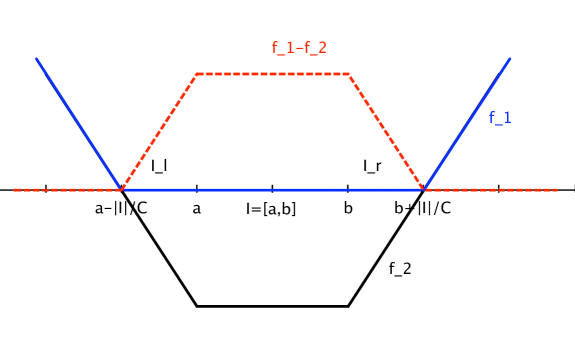
where χI\chi_{I} is the indicator function of II and λi\lambda_{i} are the eigenvalues of 1nMn\frac{1}{\sqrt{n}}M_{n}. However, this function is neither convex nor Lipschitz. As suggested in [18], one can overcome this problem by a proper approximation. Define Il=[a|I|C,a]I_{l}=[a-\frac{|I|}{C},a], Ir=[b,b+|I|C]I_{r}=[b,b+\frac{|I|}{C}] and construct two real functions f1,f2f_{1},f_{2} as follows(see Figure 3):

f1(x)={C|I|(xa)1if x(,a|I|C)0if xIIlIrC|I|(xb)1if x(b+|I|C,)f_{1}(x)=\Bigg{\{}\begin{array}[]{ll}-\frac{C}{|I|}(x-a)-1&\text{if }x\in(-\infty,a-\frac{|I|}{C})\\ 0&\text{if }x\in I\cup I_{l}\cup I_{r}\\ \frac{C}{|I|}(x-b)-1&\text{if }x\in(b+\frac{|I|}{C},\infty)\end{array}
f2(x)={C|I|(xa)1if x(,a)1if xIC|I|(xb)1if x(b,)f_{2}(x)=\Bigg{\{}\begin{array}[]{ll}-\frac{C}{|I|}(x-a)-1&\text{if }x\in(-\infty,a)\\ -1&\text{if }x\in I\\ \frac{C}{|I|}(x-b)-1&\text{if }x\in(b,\infty)\end{array}

where CC is a constant to be chosen later. Note that fjf_{j}’s are convex and C|I|\frac{C}{|I|}-Lipschitz. Define

X1=i=1nf1(λi),X2=i=1nf2(λi)X_{1}=\sum_{i=1}^{n}f_{1}(\lambda_{i}),\ X_{2}=\sum_{i=1}^{n}f_{2}(\lambda_{i})

and apply Lemma 2.5 with T=δ8nIρsc(t)𝑑tT=\frac{\delta}{8}n\int_{I}\rho_{sc}(t)dt for X1X_{1} and X2X_{2}. Thus, we have

P(|XjE(Xj)|δ8nIρsc(t)𝑑t)\displaystyle{\hbox{\bf P}}(|X_{j}-{\hbox{\bf E}}(X_{j})|\geq\frac{\delta}{8}n\int_{I}\rho_{sc}(t)dt) 4exp(cδ2n2|I|2(Iρsc(t)𝑑t)2K2C2).\displaystyle\leq 4\exp(-c\frac{\delta^{2}n^{2}|I|^{2}(\int_{I}\rho_{sc}(t)dt)^{2}}{K^{2}C^{2}}).

At this point we need to estimate the value of Iρsc(t)𝑑t\int_{I}\rho_{sc}(t)dt. There are two cases: if II is in the “bulk” i.e. I[2+ϵ,2ϵ]I\subset[-2+\epsilon,2-\epsilon] for some positive absolute constant ϵ\epsilon, then Iρsc(t)𝑑t=α|I|\int_{I}\rho_{sc}(t)dt=\alpha|I| where α\alpha is a constant depending on ϵ\epsilon. But if II is very near the edge of [2,2][-2,2] i.e. a(2)<|I|=o(1)a-(-2)<|I|=o(1), then Iρsc(t)𝑑t=α|I|3/2\int_{I}\rho_{sc}(t)dt=\alpha^{\prime}|I|^{3/2} for some absolute constant α\alpha^{\prime}. Thus in both case we have

P(|XjE(Xj)|δ8nIρsc(t)𝑑t)4exp(c1δ2n2|I|5K2C2){\hbox{\bf P}}(|X_{j}-{\hbox{\bf E}}(X_{j})|\geq\frac{\delta}{8}n\int_{I}\rho_{sc}(t)dt)\leq 4\exp(-c_{1}\frac{\delta^{2}n^{2}|I|^{5}}{K^{2}C^{2}})

Let X=X1X2X=X_{1}-X_{2}, then

P(|XE(X)|δ4nIρsc(t)𝑑t)O(exp(c1δ2n2|I|5K2C2)).{\hbox{\bf P}}(|X-{\hbox{\bf E}}(X)|\geq\frac{\delta}{4}n\int_{I}\rho_{sc}(t)dt)\leq O(\exp(-c_{1}\frac{\delta^{2}n^{2}|I|^{5}}{K^{2}C^{2}})).

Now we compare XX to ZZ, making use of a result of Götze and Tikhomirov [17]. We have E(XZ)E(NIl+NIr){\hbox{\bf E}}(X-Z)\leq{\hbox{\bf E}}(N_{I_{l}}+N_{I_{r}}). In [17], Götze and Tikhomirov obtained a convergence rate for ESD of Hermitian random matrices whose entries have mean zero and variance one, which implies that for any I[2,2]I\subset[-2,2]

|E(NI)nIρsc(t)𝑑t|<βnM4n,|{\hbox{\bf E}}(N_{I})-n\int_{I}\rho_{sc}(t)dt|<\beta n\sqrt{\frac{M_{4}}{n}},

where β\beta is an absolute constant, M4=supi,jE(|ωij|4)M_{4}=\sup_{i,j}{\hbox{\bf E}}(|\omega_{ij}|^{4}). Thus

E(X)E(Z)+nIlIrρsc(t)𝑑t+βnM4n.{\hbox{\bf E}}(X)\leq{\hbox{\bf E}}(Z)+n\int_{I_{l}\cup I_{r}}\rho_{sc}(t)dt+\beta n\sqrt{\frac{M_{4}}{n}}.

In the “edge” case we can choose C=(4/δ)2/3C=(4/\delta)^{2/3}, then because |I|Ω(δ2/3(M4/n)1/3)|I|\geq\Omega(\delta^{-2/3}(M_{4}/n)^{1/3}), we have

nIlIrρsc(t)𝑑t=Θ(n(|I|C)3/2)>Ω(nM4n)n\int_{I_{l}\cup I_{r}}\rho_{sc}(t)dt=\Theta(n(\frac{|I|}{C})^{3/2})>\Omega(n\sqrt{\frac{M_{4}}{n}})

and

nIlIrρsc(t)𝑑t+βnM4n=Θ(n(|I|C)3/2)=Θ(δ4nIρsc(t)𝑑t).n\int_{I_{l}\cup I_{r}}\rho_{sc}(t)dt+\beta n\sqrt{\frac{M_{4}}{n}}=\Theta(n(\frac{|I|}{C})^{3/2})=\Theta(\frac{\delta}{4}n\int_{I}\rho_{sc}(t)dt).

In the “bulk” case we choose C=4/δC=4/\delta, then

nIlIrρsc(t)𝑑t+βnM4n=Θ(n|I|C)=Θ(δ4nIρsc(t)𝑑t).n\int_{I_{l}\cup I_{r}}\rho_{sc}(t)dt+\beta n\sqrt{\frac{M_{4}}{n}}=\Theta(n\frac{|I|}{C})=\Theta(\frac{\delta}{4}n\int_{I}\rho_{sc}(t)dt).

Therefore in both cases, with probability at least 1O(exp(c1δ4n2|I|5K2))1-O(\exp(-c_{1}\frac{\delta^{4}n^{2}|I|^{5}}{K^{2}})), we have

ZXE(X)+δ4nIρsc(t)𝑑t<E(Z)+δ2nIρsc(t)𝑑t.Z\leq X\leq{\hbox{\bf E}}(X)+\frac{\delta}{4}n\int_{I}\rho_{sc}(t)dt<{\hbox{\bf E}}(Z)+\frac{\delta}{2}n\int_{I}\rho_{sc}(t)dt.

The convergence rate result of Götze and Tikhomirov again gives

E(NI)<nIρsc(t)𝑑t+βnM4n<(1+δ2)nIρsc(t)𝑑t,{\hbox{\bf E}}(N_{I})<n\int_{I}\rho_{sc}(t)dt+\beta n\sqrt{\frac{M_{4}}{n}}<(1+\frac{\delta}{2})n\int_{I}\rho_{sc}(t)dt,

hence with probability at least 1O(exp(c1δ4n2|I|5K2))1-O(\exp(-c_{1}\frac{\delta^{4}n^{2}|I|^{5}}{K^{2}}))

Z<(1+δ)nIρsc(t)𝑑t,Z<(1+\delta)n\int_{I}\rho_{sc}(t)dt,

which is the desires upper bound.

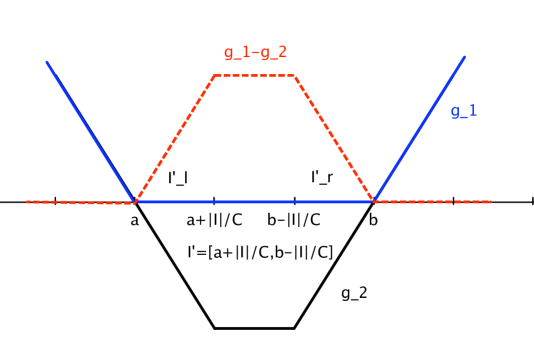
The lower bound is proved using a similar argument. Let I=[a+|I|C,b|I|C]I^{\prime}=[a+\frac{|I|}{C},b-\frac{|I|}{C}], Il=[a,a+|I|C]I^{\prime}_{l}=[a,a+\frac{|I|}{C}], Ir=[b|I|C,b]I^{\prime}_{r}=[b-\frac{|I|}{C},b] where CC is to be chosen later and define two functions g1g_{1}, g2g_{2} as follows (see Figure 3):

g1(x)={C|I|(xa)if x(,a)0if xIIlIrC|I|(xb)if x(b,)g_{1}(x)=\Bigg{\{}\begin{array}[]{ll}-\frac{C}{|I|}(x-a)&\text{if }x\in(-\infty,a)\\ 0&\text{if }x\in I^{\prime}\cup I^{\prime}_{l}\cup I^{\prime}_{r}\\ \frac{C}{|I|}(x-b)&\text{if }x\in(b,\infty)\end{array}
g2(x)={C|I|(xa)if x(,a+|I|C)1if xIC|I|(xb)if x(b|I|C,)g_{2}(x)=\Bigg{\{}\begin{array}[]{ll}-\frac{C}{|I|}(x-a)&\text{if }x\in(-\infty,a+\frac{|I|}{C})\\ -1&\text{if }x\in I^{\prime}\\ \frac{C}{|I|}(x-b)&\text{if }x\in(b-\frac{|I|}{C},\infty)\end{array}

Define

Y1=i=1g1(λi),Y2=i=1g2(λi).Y_{1}=\sum_{i=1}g_{1}(\lambda_{i}),\ Y_{2}=\sum_{i=1}g_{2}(\lambda_{i}).

Applying Lemma 2.5 with T=δ8nIρsc(t)𝑑tT=\frac{\delta}{8}n\int_{I}\rho_{sc}(t)dt for YjY_{j} and using the estimation for Iρ(t)𝑑t\int_{I}\rho(t)dt as above, we have

P(|YjE(Yj)|δ8nIρsc(t)𝑑t)4exp(c2δ2n2|I|5K2C2).{\hbox{\bf P}}(|Y_{j}-{\hbox{\bf E}}(Y_{j})|\geq\frac{\delta}{8}n\int_{I}\rho_{sc}(t)dt)\leq 4\exp(-c_{2}\frac{\delta^{2}n^{2}|I|^{5}}{K^{2}C^{2}}).

Let Y=Y1Y2Y=Y_{1}-Y_{2}, then

P(|YE(Y)|δ4nIρsc(t)𝑑t)O(exp(c2δ2n2|I|5K2C2)).{\hbox{\bf P}}(|Y-{\hbox{\bf E}}(Y)|\geq\frac{\delta}{4}n\int_{I}\rho_{sc}(t)dt)\leq O(\exp(-c_{2}\frac{\delta^{2}n^{2}|I|^{5}}{K^{2}C^{2}})).

We have E(ZY)E(NIl+NIr){\hbox{\bf E}}(Z-Y)\leq{\hbox{\bf E}}(N_{I^{\prime}_{l}}+N_{I^{\prime}_{r}}). A similar argument as in the proof of the upper bound (using the convergence rate of Götze and Tikhomirov) shows

E(Y)E(Z)nIlIrρsc(t)𝑑tβnM4n>E(Z)δ4nIρsc(t)𝑑t.{\hbox{\bf E}}(Y)\geq{\hbox{\bf E}}(Z)-n\int_{I^{\prime}_{l}\cup I^{\prime}_{r}}\rho_{sc}(t)dt-\beta n\sqrt{\frac{M_{4}}{n}}>E(Z)-\frac{\delta}{4}n\int_{I}\rho_{sc}(t)dt.

Therefore with probability at least 1O(exp(c2δ2n2|I|5K2C2))1-O(\exp(-c_{2}\frac{\delta^{2}n^{2}|I|^{5}}{K^{2}C^{2}})), we have

ZYE(Y)δ4nIρsc(t)𝑑t>E(Z)δ2nIρsc(t)𝑑t,Z\geq Y\geq{\hbox{\bf E}}(Y)-\frac{\delta}{4}n\int_{I}\rho_{sc}(t)dt>{\hbox{\bf E}}(Z)-\frac{\delta}{2}n\int_{I}\rho_{sc}(t)dt,

and by the convergence rate, with probability at least 1O(exp(c2δ2n2|I|5K2C2))1-O(\exp(-c2\frac{\delta^{2}n^{2}|I|^{5}}{K^{2}C^{2}}))

Z>(1δ)nIρsc(t)𝑑t.Z>(1-\delta)n\int_{I}\rho_{sc}(t)dt.

Thus, Theorem 2.2 is proved.

Refer to caption
Refer to caption
Figure 3: Auxiliary functions used in the proof

3 Infinity norm of the eigenvectors

3.1 Small perturbation lemma

AnA_{n} is the adjacency matrix of G(n,p)G(n,p). In the proofs of Theorem 1.16 and Theorem 1.17, we actually work with the eigenvectors of a perturbed matrix

An+ϵNn,A_{n}+\epsilon N_{n},

where ϵ=ϵ(n)>0\epsilon=\epsilon(n)>0 can be arbitrarily small and NnN_{n} is a symmetric random matrix whose upper triangular elements are independent with a standard Gaussian distribution.

The entries of An+ϵNnA_{n}+\epsilon N_{n} are continuous and thus with probability 1, the eigenvalues of An+ϵNnA_{n}+\epsilon N_{n} are simple. Let

μ1<<μn\mu_{1}<\ldots<\mu_{n}

be the ordered eigenvalues of An+ϵNnA_{n}+\epsilon N_{n}, which have a unique orthonormal system of eigenvectors {w1,,wn}\{w_{1},\ldots,w_{n}\}. By the Cauchy interlacing principle, the eigenvalues of An+ϵNnA_{n}+\epsilon N_{n} are different from those of its principle minors, which satisfies a condition of Lemma 3.2.

Let λi\lambda_{i}’s be the eigenvalue of AnA_{n} with multiplicity kik_{i} defined as follows:

λi1<λi=λi+1==λi+ki<λi+ki+1\ldots\lambda_{i-1}<\lambda_{i}=\lambda_{i+1}=\ldots=\lambda_{i+k_{i}}<\lambda_{i+k_{i}+1}\ldots

By Weyl’s theorem, one has for every 1jn1\leq j\leq n,

|λjμj|ϵNnop=O(ϵn)|\lambda_{j}-\mu_{j}|\leq\epsilon||N_{n}||_{\text{op}}=O(\epsilon\sqrt{n}) (3.1)

Thus the behaviors of eigenvalues of AnA_{n} and An+ϵNnA_{n}+\epsilon N_{n} are essentially the same by choosing ϵ\epsilon sufficiently small. And everything (except Lemma 3.2) we used in the proofs of Theorem 1.16 and Theorem 1.17 for AnA_{n} also applies for An+ϵNnA_{n}+\epsilon N_{n} by a continuity argument. We will not distinguish AnA_{n} from An+ϵNnA_{n}+\epsilon N_{n} in the proofs.

The following lemma will allow us to transfer the eigenvector delocaliztion results of An+ϵNnA_{n}+\epsilon N_{n} to those of AnA_{n} at some expense.

Lemma 3.1.

In the notations of above, there exists an orthonormal basis of eigenvectors of AnA_{n}, denoted by {u1,,un}\{u_{1},\ldots,u_{n}\}, such that for every 1jn1\leq j\leq n,

ujwj+α(n),||u_{j}||_{\infty}\leq||w_{j}||_{\infty}+\alpha(n),

where α(n)\alpha(n) can be arbitrarily small provided ϵ(n)\epsilon(n) is small enough.

Proof.

First, since the coefficients of the characteristic polynomial of AnA_{n} are integers, there exists a positive function l(n)l(n) such that either |λsλt|=0|\lambda_{s}-\lambda_{t}|=0 or |λsλt|l(n)|\lambda_{s}-\lambda_{t}|\geq l(n) for any 1s,tn1\leq s,t\leq n.

By (3.1) and choosing ϵ\epsilon sufficiently small, one can get

|μiλi1|>l(n)and|μi+kiλi+ki+1|>l(n)|\mu_{i}-\lambda_{i-1}|>l(n)~~\text{and}~~|\mu_{i+k_{i}}-\lambda_{i+k_{i}+1}|>l(n)

For a fixed index ii, let EE be the eigenspace corresponding to the eigenvalue λi\lambda_{i} and FF be the subspace spanned by {wi,,wi+ki}\{w_{i},\ldots,w_{i+k_{i}}\}. Both of EE and FF have dimension kik_{i}. Let PEP_{E} and PFP_{F} be the orthogonal projection matrices onto EE and FF separately.

Applying the well-known Davis-Kahan theorem (see [28] Section IV, Theorem 3.6) to AnA_{n} and An+ϵNnA_{n}+\epsilon N_{n}, one gets

PEPFopϵNnopl(n):=α(n),||P_{E}-P_{F}||_{\text{op}}\leq\frac{\epsilon||N_{n}||_{\text{op}}}{l(n)}:=\alpha(n),

where α(n)\alpha(n) can be arbitrarily small depending on ϵ.\epsilon.

Define vj=PFwjEv_{j}=P_{F}w_{j}\in E for iji+kii\leq j\leq i+k_{i}, then we have vjwj2α(n)||v_{j}-w_{j}||_{2}\leq\alpha(n). It is clear that {vi,,vki}\{v_{i},\ldots,v_{k_{i}}\} are eigenvectors of AnA_{n} and

vjwj+vjwj2wj+α(n).||v_{j}||_{\infty}\leq||w_{j}||_{\infty}+||v_{j}-w_{j}||_{2}\leq||w_{j}||_{\infty}+\alpha(n).

By choosing ϵ\epsilon small enough such that nα(n)<1/2n\alpha(n)<1/2, {vi,,vki}\{v_{i},\ldots,v_{k_{i}}\} are linearly independent. Indeed, if j=ikicjvj=0\sum_{j=i}^{k_{i}}c_{j}v_{j}=0, one has for every isi+kii\leq s\leq i+k_{i}, j=ikicjPFwj,ws=0\sum_{j=i}^{k_{i}}c_{j}\langle P_{F}w_{j},w_{s}\rangle=0, which implies cs=j=ikicjPFwjwj,wsc_{s}=-\sum_{j=i}^{k_{i}}c_{j}\langle P_{F}w_{j}-w_{j},w_{s}\rangle. Thus |cs|α(n)j=iki|cj|,|c_{s}|\leq\alpha(n)\sum_{j=i}^{k_{i}}|c_{j}|, summing over all ss, we can get j=iki|cj|kα(n)j=iki|cj|\sum_{j=i}^{k_{i}}|c_{j}|\leq k\alpha(n)\sum_{j=i}^{k_{i}}|c_{j}| and therefore cj=0c_{j}=0.

Furthermore the set {vi,,vki}\{v_{i},\ldots,v_{k_{i}}\} is ’almost’ an orthonormal basis of EE in the sense that

|vs21|vsws2α(n)for any isi+ki |vs,vt|=|PFws,PFwt|=|PFwsws,PFwt+ws,PFwtwt|=O(α(n))for any isti+ki \begin{split}|~||v_{s}||_{2}-1~|&\leq||v_{s}-w_{s}||_{2}\leq\alpha(n)~~~~~\text{for any $i\leq s\leq i+k_{i}$ }\\ \\ |\langle v_{s},v_{t}\rangle|&=|\langle P_{F}w_{s},P_{F}w_{t}\rangle|\\ &=|\langle P_{F}w_{s}-w_{s},P_{F}w_{t}\rangle+\langle w_{s},P_{F}w_{t}-w_{t}\rangle|\\ &=O(\alpha(n))~~~~~~~~\text{for any $i\leq s\neq t\leq i+k_{i}$ }\\ \end{split}

We can perform a Gram-Schmidt process on {vi,,vki}\{v_{i},\ldots,v_{k_{i}}\} to get an orthonormal system of eigenvectors {ui,,uki}\{u_{i},\ldots,u_{k_{i}}\} on EE such that

ujwj+α(n),||u_{j}||_{\infty}\leq||w_{j}||_{\infty}+\alpha(n),

for every iji+kii\leq j\leq i+k_{i}.

We iterate the above argument for every distinct eigenvalue of AnA_{n} to obtain an orthonormal basis of eigenvectors of AnA_{n}.

3.2 Auxiliary lemmas

Lemma 3.2.

(Lemma 41, [30]) Let

Bn=(aXXBn1)B_{n}=\left(\begin{array}[]{cc}a&X^{*}\\ X&B_{n-1}\end{array}\right)

be a n×nn\times n symmetric matrix for some aa\in\mathbb{C} and Xn1X\in\mathbb{C}^{n-1}, and let (xv)\left(\begin{array}[]{cc}x\\ v\end{array}\right) be a eigenvector of BnB_{n} with eigenvalue λi(Bn)\lambda_{i}(B_{n}), where xx\in\mathbb{C} and vn1v\in\mathbb{C}^{n-1}. Suppose that none of the eigenvalues of Bn1B_{n-1} are equal to λi(Bn)\lambda_{i}(B_{n}). Then

|x|2=11+j=1n1(λj(Bn1)λi(Bn))2|uj(Bn1)X|2,|x|^{2}=\frac{1}{1+\sum_{j=1}^{n-1}(\lambda_{j}(B_{n-1})-\lambda_{i}(B_{n}))^{-2}|u_{j}(B_{n-1})^{*}X|^{2}},

where uj(Bn1)u_{j}(B_{n-1}) is a unit eigenvector corresponding to the eigenvalue λj(Bn1).\lambda_{j}(B_{n-1}).

The Stieltjes transform sn(z)s_{n}(z) of a symmetric matrix WW is defined for zz\in\mathbb{C} by the formula

sn(z):=1ni=1n1λi(W)z.s_{n}(z):=\frac{1}{n}\displaystyle\sum_{i=1}^{n}\frac{1}{\lambda_{i}(W)-z}.

It has the following alternate representation:

Lemma 3.3.

(Lemma 39, [30]) Let W=(ζij)1i,jnW=(\zeta_{ij})_{1\leq i,j\leq n} be a symmetrix matrix, and let zz be a complex number not in the spectrum of WW. Then we have

sn(z)=1nk=1n1ζkkzak(WkzI)1aks_{n}(z)=\frac{1}{n}\displaystyle\sum_{k=1}^{n}\frac{1}{\zeta_{kk}-z-a^{*}_{k}(W_{k}-zI)^{-1}a_{k}}

where WkW_{k} is the (n1)×(n1)(n-1)\times(n-1) matrix with the kthk^{\text{th}} row and column of WW removed, and akn1a_{k}\in\mathbb{C}^{n-1} is the kthk^{\text{th}} column of WW with the kthk^{\text{th}} entry removed.

We begin with two lemmas that will be needed to prove the main results. The first lemma, following the paper [30] in Appendix B, uses Talagrand’s inequality. Its proof is presented in the Appendix B.

Lemma 3.4.

Let Y=(ζ1,,ζn)nY=(\zeta_{1},\ldots,\zeta_{n})\in\mathbb{C}^{n} be a random vector whose entries are i.i.d. copies of the random variable ζ=ξp\zeta=\xi-p (with mean 0 and variance σ2\sigma^{2}). Let HH be a subspace of dimension dd and πH\pi_{H} the orthogonal projection onto H. Then

𝐏(|πH(Y)σd|t)10exp(t24).{\bf P}(|\parallel\pi_{H}(Y)\parallel-\sigma\sqrt{d}|\geq t)\leq 10\exp(-\frac{t^{2}}{4}).

In particular,

πH(Y)=σd+O(ω(logn))\parallel\pi_{H}(Y)\parallel=\sigma\sqrt{d}+O(\omega(\sqrt{\log n})) (3.2)

with overwhelming probability.

The following concentration lemma for G(n,p)G(n,p) will be a key input to prove Theorem 1.17. Let Bn=1nσAnB_{n}=\frac{1}{\sqrt{n}\sigma}A_{n}

Lemma 3.5 (Concentration for ESD in the bulk).

(Concentration for ESD in the bulk) Assume p=g(n)logn/np={g(n)\log n}/{n}. For any constants ε,δ>0\varepsilon,\delta>0 and any interval II in [2+ε,2ε][-2+\varepsilon,2-\varepsilon] of width |I|=Ω(log2.2g(n)logn/np)|I|=\Omega({\log^{2.2}g(n)\log n}/{np}), the number of eigenvalues NIN_{I} of BnB_{n} in II obeys the concentration estimate

|NI(Bn)nIρsc(x)𝑑x|δn|I||N_{I}(B_{n})-n\displaystyle\int_{I}{{}\rho}_{sc}(x)\,dx|\leq{\delta}n|I|

with overwhelming probability.

The above lemma is a variant of Corollary 2.3. This lemma allows us to control the ESD on a smaller interval and the proof, relying on a projection lemma (Lemma 3.4), is a different approach. The proof is presented in Appendix C.

3.3 Proof of Theorem 1.16:

Let λn(An)\lambda_{n}(A_{n}) be the largest eigenvalue of AnA_{n} and u=(u1,,un)u=(u_{1},\ldots,u_{n}) be the corresponding unit eigenvector. We have the lower bound λn(An)np\lambda_{n}(A_{n})\geq np. And if np=ω(logn)np=\omega(\log n), then the maximum degree Δ=(1+o(1))np\Delta=(1+o(1))np almost surely (See Corollary 3.14, [4]).

For every 1in1\leq i\leq n,

λn(An)ui=jN(i)uj,\lambda_{n}(A_{n})u_{i}=\sum_{j\in N(i)}u_{j},

where N(i)N(i) is the neighborhood of vertex ii. Thus, by Cauchy-Schwarz inequality,

u=maxi|jN(i)uj|λn(An)Δλn(An)=O(1np).||u||_{\infty}=\text{max}_{i}\frac{|\sum_{j\in N(i)}u_{j}|}{\lambda_{n}(A_{n})}\leq\frac{\sqrt{\Delta}}{\lambda_{n}(A_{n})}=O(\frac{1}{\sqrt{np}}).

Let Bn=1nσAnB_{n}=\frac{1}{\sqrt{n}\sigma}A_{n}. Since the eigenvalues of Wn=1nσ(AnpJn)W_{n}=\frac{1}{\sqrt{n}\sigma}(A_{n}-pJ_{n}) are on the interval [2,2][-2,2], by Lemma 1.1, {λ1(Bn),,λn1(Bn)}[2,2]\{\lambda_{1}(B_{n}),\ldots,\lambda_{n-1}(B_{n})\}\subset[-2,2].

Recall that np=g(n)lognnp=g(n)\log n. By Corollary 2.3, for any interval II with length at least (log(np)δ4(np)1/2)1/5(\frac{\log(np)}{{\delta}^{4}(np)^{1/2}})^{1/5}(say δ=0.5\delta=0.5),with overwhelming probability, if I[2+κ,2κ]I\subset[-2+\kappa,2-\kappa] for some positive constant κ\kappa, one has NI(Bn)=Θ(nIρsc(x)𝑑x)=Θ(n|I|)N_{I}(B_{n})=\Theta(n\int_{I}\rho_{sc}(x)dx)=\Theta(n|I|); if II is at the edge of [2,2][-2,2], with length o(1)o(1), one has NI(Bn)=Θ(nIρsc(x)𝑑x)=Θ(n|I|3/2)N_{I}(B_{n})=\Theta(n\int_{I}\rho_{sc}(x)dx)=\Theta(n|I|^{3/2}). Thus we can find a set J{1,,n1}J\subset\{1,\ldots,n-1\} with |J|=Ω(n|I0||J|=\Omega(n|I_{0}|) or |J|=Ω(n|I0|3/2)|J|=\Omega(n|I_{0}|^{3/2}) such that |λj(Bn1)λi(Bn)||I0||\lambda_{j}(B_{n-1})-\lambda_{i}(B_{n})|\ll|I_{0}| for all jJj\in J, where Bn1B_{n-1} is the bottom right (n1)×(n1)(n-1)\times(n-1) minor of BnB_{n}. Here we take |I0|=(1/g(n)1/20)2/3|I_{0}|=(1/g(n)^{1/20})^{2/3}. It is easy to check that |I0|(log(np)δ4(np)1/2)1/5|I_{0}|\geq(\frac{\log(np)}{{\delta}^{4}(np)^{1/2}})^{1/5}.

By the formula in Lemma 3.2, the entry of the eigenvector of BnB_{n} can be expressed as

|x|2=11+j=1n1(λj(Bn1)λi(Bn))2|uj(Bn1)1nσX|211+jJ(λj(Bn1)λi(Bn))2|uj(Bn1)1nσX|211+jJn1|I0|2|uj(Bn1)1σX|2=11+n1|I0|2πH(Xσ)211+n1|I0|2|J|\begin{split}|x|^{2}&=\displaystyle\frac{1}{1+\sum_{j=1}^{n-1}(\lambda_{j}(B_{n-1})-\lambda_{i}(B_{n}))^{-2}|u_{j}(B_{n-1})^{*}\frac{1}{\sqrt{n}\sigma}X|^{2}}\\ &\leq\frac{1}{1+\sum_{j\in J}(\lambda_{j}(B_{n-1})-\lambda_{i}(B_{n}))^{-2}|u_{j}(B_{n-1})^{*}\frac{1}{\sqrt{n}\sigma}X|^{2}}\\ &\leq\frac{1}{1+\sum_{j\in J}n^{-1}|I_{0}|^{-2}|u_{j}(B_{n-1})^{*}\frac{1}{\sigma}X|^{2}}=\frac{1}{1+n^{-1}|I_{0}|^{-2}||\pi_{H}(\frac{X}{\sigma})||^{2}}\\ &\leq\frac{1}{1+{n^{-1}|I_{0}|^{-2}}{|J|}}\end{split} (3.3)

with overwhelming probability, where HH is the span of all the eigenvectors associated to JJ with dimension dim(H)=Θ(|J|)\text{dim}(H)=\Theta(|J|), πH\pi_{H} is the orthogonal projection onto HH and Xn1X\in\mathbb{C}^{n-1} has entries that are iid copies of ξ\xi. The last inequality in (3.3) follows from Lemma 3.4 (by taking t=g(n)1/10lognt=g(n)^{1/10}\sqrt{\log n}) and the relations

πH(X)=πH(Y+p𝟙n)πH1(Y+p𝟙n)πH1(Y).||\pi_{H}(X)||=||\pi_{H}(Y+p\mathbb{1}_{n})||\geq||\pi_{H_{1}}(Y+p\mathbb{1}_{n})||\geq||\pi_{H_{1}}(Y)||.

Here Y=Xp𝟙nY=X-p\mathbb{1}_{n} and H1=HH2H_{1}=H\cap H_{2}, where H2H_{2} is the space orthogonal to the all 1 vector 𝟙n\mathbb{1}_{n}. For the dimension of H1H_{1}, dim(H1)dim(H)1\text{dim}(H_{1})\geq\text{dim}(H)-1 .

Since either |J|=Ω(n|I0||J|=\Omega(n|I_{0}|) or |J|=Ω(n|I0|3/2)|J|=\Omega(n|I_{0}|^{3/2}), we have n1|I0|2|J|=Ω(|I0|1{n^{-1}|I_{0}|^{-2}}{|J|}=\Omega({|I_{0}|}^{-1}) or n1|I0|2|J|=Ω(|I0|1/2{n^{-1}|I_{0}|^{-2}}{|J|}=\Omega({|I_{0}|}^{-1/2}). Thus |x|2=O(|I0|)|x|^{2}=O(|I_{0}|) or |x|2=O(|I0|)|x|^{2}=O(\sqrt{|I_{0}|}). In both cases, since |I0|0|I_{0}|\rightarrow 0, it follows that |x|=o(1)|x|=o(1). \Box

3.4 Proof of Theorem 1.17

With the formula in Lemma 3.2, it suffices to show the following lower bound

j=1n1(λj(Bn1)λi(Bn))2|uj(Bn1)1nσX|2nplog2.2g(n)logn\sum_{j=1}^{n-1}(\lambda_{j}(B_{n-1})-\lambda_{i}(B_{n}))^{-2}|u_{j}(B_{n-1})^{*}\frac{1}{\sqrt{n}\sigma}X|^{2}\gg\frac{np}{\log^{2.2}g(n)\log n} (3.4)

with overwhelming probability, where Bn1B_{n-1} is the bottom right n1×n1n-1\times n-1 minor of BnB_{n} and Xn1X\in\mathbb{C}^{n-1} has entries that are iid copies of ξ\xi. Recall that ξ\xi takes values 11 with probability pp and 0 with probability 1p1-p, thus 𝔼ξ=p,𝕍arξ=p(1p)=σ2\mathbb{E}\xi=p,\mathbb{V}ar{\xi}=p(1-p)={\sigma}^{2}.

By Theorem 3.5, we can find a set J{1,,n1}J\subset\{1,\ldots,n-1\} with |J|log2.2g(n)lognp|J|\gg\frac{\log^{2.2}g(n)\log n}{p} such that |λj(Bn1)λi(Bn)|=O(log2.2g(n)logn/np)|\lambda_{j}(B_{n-1})-\lambda_{i}(B_{n})|=O(\log^{2.2}g(n)\log n/{np}) for all jJj\in J. Thus in (3.4), it is enough to prove

jJ|uj(Bn1)T1σX|2=πH(Xσ)2|J|\displaystyle\sum_{j\in J}|u_{j}(B_{n-1})^{T}\frac{1}{\sigma}X|^{2}=||\pi_{H}(\frac{X}{\sigma})||^{2}\gg|J|

or equivalently

πH(X)2σ2|J|||\pi_{H}(X)||^{2}\gg{\sigma}^{2}|J| (3.5)

with overwhelming probability, where HH is the span of all the eigenvectors associated to JJ with dimension dim(H)=Θ(|J|)\text{dim}(H)=\Theta(|J|).

Let H1=HH2H_{1}=H\cap H_{2}, where H2H_{2} is the space orthogonal to 𝟙n\mathbb{1}_{n}. The dimension of H1H_{1} is at least dim(H)1\text{dim}(H)-1. Denote Y=Xp𝟙nY=X-p\mathbb{1}_{n}. Then the entries of YY are iid copies of ζ\zeta. By Lemma 3.4,

πH1(Y)2σ2|J|||\pi_{H_{1}}(Y)||^{2}\gg{\sigma}^{2}|J|

with overwhelming probability.

Hence, our claim follows from the relations

πH(X)=πH(Y+p𝟙n)πH1(Y+p𝟙n)=πH1(Y).||\pi_{H}(X)||=||\pi_{H}(Y+p\mathbb{1}_{n})||\geq||\pi_{H_{1}}(Y+p\mathbb{1}_{n})||=||\pi_{H_{1}}(Y)||.

\Box

In this appendix, we complete the proofs of Theorem 1.3, Lemma 3.4 and Lemma 3.5.

Appendix A Proof of Theorem 1.3

We will show that the semicircle law holds for MnM_{n}. With Lemma 1.1, it is clear that Theorem 1.3 follows Lemma A.1 directly. The claim actually follows as a special case discussed in the paper [6]. Our proof here uses a standard moment method.

Lemma A.1.

For p=ω(1n)p=\omega(\frac{1}{n}), the empirical spectral distribution (ESD) of the matrix Wn=1nMnW_{n}=\frac{1}{\sqrt{n}}M_{n} converges in distribution to the semicircle law which has a density ρsc(x){{}\rho}_{sc}(x) with support on [2,2][-2,2],

ρsc(x):=12π4x2.{{\rho}}_{sc}(x):=\frac{1}{2\pi}\sqrt{4-x^{2}}.

Let ηij{\eta}_{ij} be the entries of Mn=σ1(AnpJn)M_{n}={\sigma}^{-1}(A_{n}-pJ_{n}). For i=ji=j, ηij=p/σ\eta_{ij}=-p/\sigma; and for iji\not=j, ηij\eta_{ij} are iid copies of random variable η\eta, which takes value (1p)/σ(1-p)/\sigma with probability pp and takes value p/σ-p/\sigma with probability 1p1-p.

𝐄η=0,𝐄η2=1,𝐄ηs=O(1(p)s2)fors2.{\bf E}\eta=0,{\bf E}\eta^{2}=1,{\bf E}\eta^{s}=O\left(\frac{1}{(\sqrt{p})^{s-2}}\right)~\text{for}~s\geq 2.

For a positive integer kk, the kthk^{\text{th}} moment of ESD of the matrix WnW_{n} is

xk𝑑FnW(x)=1n𝐄(Trace(Wnk)),\displaystyle\int x^{k}dF_{n}^{W}(x)=\frac{1}{n}{\bf E}(\text{Trace}({W_{n}}^{k})),

and the kthk^{\text{th}} moment of the semicircle distribution is

22xkρsc(x)𝑑x.\displaystyle\int_{-2}^{2}x^{k}\rho_{\text{sc}}(x)dx.

On a compact set, convergence in distribution is the same as convergence of moments. To prove the theorem, we need to show, for every fixed number kk,

1n𝐄(Trace(Wnk))22xkρsc(x)𝑑x,asn.\frac{1}{n}{\bf E}(\text{Trace}({W_{n}}^{k}))\rightarrow\displaystyle\int_{-2}^{2}x^{k}\rho_{\text{sc}}(x)dx,\ \text{as}~n\rightarrow\infty. (A.1)

For k=2m+1k=2m+1, by symmetry, 22xkρsc(x)𝑑x=0\displaystyle\int_{-2}^{2}x^{k}\rho_{\text{sc}}(x)dx=0.

For k=2mk=2m,

22xkρsc(x)𝑑x=1π02xk4x2𝑑x=2k+2π0π/2sinkθcos2θdx=2k+2πΓ(k+12)Γ(32)Γ(k+42)=1m+1(2mm)\begin{split}\displaystyle\int_{-2}^{2}x^{k}\rho_{\text{sc}}(x)dx&=\frac{1}{\pi}\int_{0}^{2}x^{k}\sqrt{4-x^{2}}dx=\frac{2^{k+2}}{\pi}\int_{0}^{\pi/2}{\sin^{k}{\theta}}{\cos^{2}{\theta}}dx\\ &=\frac{2^{k+2}}{\pi}\frac{\Gamma(\frac{k+1}{2})\Gamma(\frac{3}{2})}{\Gamma(\frac{k+4}{2})}=\frac{1}{m+1}\dbinom{2m}{m}\end{split}

Thus our claim (A.1) follows by showing that

1n𝐄(Trace(Wnk))={O(1np)if k=2m+1;1m+1(2mm)+O(1np)if k=2m.\displaystyle\frac{1}{n}{\bf E}(\text{Trace}({W_{n}}^{k}))=\left\{\begin{array}[]{ll}O(\frac{1}{\sqrt{np}})&\mbox{if $k=2m+1$};\\ \\ \frac{1}{m+1}{{2m}\choose{m}}+O(\frac{1}{np})&\mbox{if $k=2m$}.\end{array}\right. (A.2)

We have the expansion for the trace of Wnk{W_{n}}^{k},

1n𝐄(Trace(Wnk))=1n1+k/2𝐄(Trace(σ1Mn)k)=1n1+k/21i1,,ikn𝐄ηi1i2ηi2i3ηiki1\begin{split}\displaystyle\frac{1}{n}{\bf E}(\text{Trace}({W_{n}}^{k}))&=\frac{1}{n^{1+k/2}}{\bf E}(\text{Trace}({\sigma}^{-1}M_{n})^{k})\\ &=\frac{1}{n^{1+k/2}}\sum_{1\leq i_{1},\ldots,i_{k}\leq n}{\bf E}\eta_{i_{1}i_{2}}\eta_{i_{2}i_{3}}\cdots\eta_{i_{k}i_{1}}\end{split} (A.3)

Each term in the above sum corresponds to a closed walk of length kk on the complete graph KnK_{n} on {1,2,,n}\{1,2,\ldots,n\}. On the other hand, ηij\eta_{ij} are independent with mean 0. Thus the term is nonzero if and only if every edge in this closed walk appears at least twice. And we call such a walk a good walk. Consider a good walk that uses ll different edges e1,,ele_{1},\ldots,e_{l} with corresponding multiplicities m1,,mlm_{1},\ldots,m_{l}, where lml\leq m, each mh2m_{h}\geq 2 and m1++ml=km_{1}+\ldots+m_{l}=k. Now the corresponding term to this good walk has form

𝐄ηe1m1ηelml.{\bf E}\eta_{e_{1}}^{m_{1}}\cdots\eta_{e_{l}}^{m_{l}}.

Since such a walk uses at most l+1l+1 vertices, a naive upper bound for the number of good walks of this type is nl+1×lkn^{l+1}\times l^{k}.

When k=2m+1k=2m+1, recall 𝐄ηs=Θ((p)2s)fors2{\bf E}\eta^{s}=\Theta\left({(\sqrt{p})^{2-s}}\right)~\text{for}~s\geq 2, and so

1n𝐄(Trace(Wnk))=1n1+k/2l=1mgood walk of l edges𝐄ηe1m1ηelml1nm+3/2l=1mnl+1lk(1p)m12(1p)ml2=O(1np).\begin{split}\displaystyle\frac{1}{n}{\bf E}(\text{Trace}({W_{n}}^{k}))&=\frac{1}{n^{1+k/2}}\sum_{l=1}^{m}\sum_{\text{{\it good} walk of l edges}}{\bf E}\eta_{e_{1}}^{m_{1}}\cdots\eta_{e_{l}}^{m_{l}}\\ &\leq\frac{1}{n^{m+3/2}}\sum_{l=1}^{m}n^{l+1}l^{k}(\frac{1}{\sqrt{p}})^{m_{1}-2}\ldots(\frac{1}{\sqrt{p}})^{m_{l}-2}\\ &=O(\frac{1}{\sqrt{np}}).\end{split}

When k=2mk=2m, we classify the good walks into two types. The first kind uses lm1l\leq m-1 different edges. The contribution of these terms will be

1n1+k/2l=1m11st kind of good walk of l edges𝐄ηe1m1ηelml1n1+ml=1mnl+1lk(1p)m12(1p)ml2=O(1np).\begin{split}\frac{1}{n^{1+k/2}}\sum_{l=1}^{m-1}\sum_{\text{1st kind of {\it good} walk of l edges}}{\bf E}\eta_{e_{1}}^{m_{1}}\cdots\eta_{e_{l}}^{m_{l}}&\leq\frac{1}{n^{1+m}}\sum_{l=1}^{m}n^{l+1}l^{k}(\frac{1}{\sqrt{p}})^{m_{1}-2}\ldots(\frac{1}{\sqrt{p}})^{m_{l}-2}\\ &=O(\frac{1}{{np}}).\end{split}

The second kind of good walk uses exactly l=ml=m different edges and thus m+1m+1 different vertices. And the corresponding term for each walk has form

𝐄ηe12ηel2=1.{\bf E}\eta_{e_{1}}^{2}\cdots\eta_{e_{l}}^{2}=1.

The number of this kind of good walk is given by the following result in the paper ([1], Page 617–618):

Lemma A.2.

The number of the second kind of good walk is

nm+1(1+O(n1))m+1(2mm).\displaystyle\frac{n^{m+1}(1+O(n^{-1}))}{m+1}\dbinom{2m}{m}.

Then the second conclusion of (A.1) follows.

Appendix B Proof of Lemma 3.4:

The coordinates of YY are bounded in magnitude by 11. Apply Talagrand’s inequality to the map YπH(Y)Y\rightarrow||\pi_{H}(Y)||, which is convex and 11-Lipschitz. We can conclude

𝐏(|πH(Y)M(πH(Y))|t)4exp(t216){\bf P}(|\parallel\pi_{H}(Y)\parallel-M(\parallel\pi_{H}(Y)\parallel)|\geq t)\leq 4\exp(-\frac{t^{2}}{16}) (B.1)

where M(πH(Y))M(\parallel\pi_{H}(Y)\parallel) is the median of πH(Y)\parallel\pi_{H}(Y)\parallel.

Let P=(pij)1i,jnP=(p_{ij})_{1\leq i,j\leq n} be the orthogonal projection matrix onto HH. One has traceP2=P^{2}=traceP=ipii=dP=\sum_{i}p_{ii}=d and |pii|1|p_{ii}|\leq 1, as well as,

πH(Y)2=1i,jnpijζiζj=i=1npiiζi2+ijpijζiζj{\parallel\pi_{H}(Y)\parallel}^{2}=\sum_{1\leq i,j\leq n}p_{ij}\zeta_{i}\zeta_{j}=\sum_{i=1}^{n}p_{ii}\zeta_{i}^{2}+\sum_{i\neq j}p_{ij}\zeta_{i}\zeta_{j}

and

𝐄πH(Y)2=𝐄(i=1npiiζi2)+𝐄(ijpijζiζj)=σ2d.\mathbf{E}{\parallel\pi_{H}(Y)\parallel}^{2}=\mathbf{E}(\sum_{i=1}^{n}p_{ii}\zeta_{i}^{2})+\mathbf{E}(\sum_{i\neq j}p_{ij}\zeta_{i}\zeta_{j})=\sigma^{2}d.

Take L=4/σL=4/\sigma. To complete the proof, it suffices to show

|M(πH(Y))σd|Lσ.|M(\parallel\pi_{H}(Y)\parallel)-\sigma\sqrt{d}|\leq L\sigma. (B.2)

Consider the event +\mathcal{E}_{+} that πH(Y)σL+σd\parallel\pi_{H}(Y)\parallel\geq\sigma L+\sigma\sqrt{d}, which implies that πH(Y)2σ2(L2+2Ld+d2).{\parallel\pi_{H}(Y)\parallel}^{2}\geq\sigma^{2}(L^{2}+2L\sqrt{d}+d^{2}).

Let S1=i=1npii(ζi2σ2)S_{1}=\sum_{i=1}^{n}p_{ii}(\zeta_{i}^{2}-\sigma^{2}) and S2=ijpijζiζjS_{2}=\sum_{i\neq j}p_{ij}\zeta_{i}\zeta_{j}.

Now we have

𝐏(+)𝐏(i=1npiiζi2σ2d+Ldσ2)+𝐏(ijpijζiζjσ2Ld).{\bf P}(\mathcal{E}_{+})\leq{\bf P}(\sum_{i=1}^{n}p_{ii}\zeta_{i}^{2}\geq\sigma^{2}d+L\sqrt{d}\sigma^{2})+{\bf P}(\sum_{i\neq j}p_{ij}\zeta_{i}\zeta_{j}\geq\sigma^{2}L\sqrt{d}).

By Chebyshev’s inequality,

𝐏(i=1npiiζi2σ2d+Ldσ2)=𝐏(S1Ldσ2))𝐄(|S1|2)L2dσ4,{\bf P}(\sum_{i=1}^{n}p_{ii}\zeta_{i}^{2}\geq\sigma^{2}d+L\sqrt{d}\sigma^{2})={\bf P}(S_{1}\geq L\sqrt{d}\sigma^{2}))\leq\frac{{\bf E}(|S_{1}|^{2})}{L^{2}d\sigma^{4}},

where 𝐄(|S1|2)=𝐄(ipii(ζi2σ2))2=ipii2𝐄(ζi4σ4)dσ2(12σ2){\bf E}(|S_{1}|^{2})={\bf E}(\sum_{i}p_{ii}(\zeta_{i}^{2}-\sigma^{2}))^{2}=\sum_{i}p_{ii}^{2}{\bf E}(\zeta_{i}^{4}-\sigma^{4})\leq d\sigma^{2}(1-2\sigma^{2}).

Therefore, 𝐏(S1Ldσ4)dσ2(12σ2)L2dσ4<116.{\bf P}(S_{1}\geq L\sqrt{d}\sigma^{4})\leq\displaystyle\frac{d\sigma^{2}(1-2\sigma^{2})}{L^{2}d\sigma^{4}}<\frac{1}{16}.

On the other hand, we have 𝐄(|S2|2)=𝐄(ijpij2ζi2ζj2)σ4d{\bf E}(|S_{2}|^{2})={\bf E}(\sum_{i\neq j}p_{ij}^{2}\zeta_{i}^{2}\zeta_{j}^{2})\leq\sigma^{4}d and

𝐏(ijpijζiζjσ2Ld)=𝐏(S2Ldσ2)𝐄(|S2|2)L2dσ4<110{\bf P}(\sum_{i\neq j}p_{ij}\zeta_{i}\zeta_{j}\geq\sigma^{2}L\sqrt{d})={\bf P}(S_{2}\geq L\sqrt{d}\sigma^{2})\leq\frac{{\bf E}(|S_{2}|^{2})}{L^{2}d\sigma^{4}}<\frac{1}{10}

It follows that 𝐄(+)<1/4{\bf E}(\mathcal{E}_{+})<1/4 and hence M(πH(Y))Lσ+dσ.M(\parallel\pi_{H}(Y)\parallel)\leq L\sigma+\sqrt{d}\sigma.

For the lower bound, consider the event \mathcal{E}_{-} that πH(Y)dσLσ\parallel\pi_{H}(Y)\parallel\leq\sqrt{d}\sigma-L\sigma and notice that

𝐏()𝐏(S1Ldσ2)+𝐏(S2Ldσ2).{\bf P}(\mathcal{E}_{-})\leq{\bf P}(S_{1}\leq-L\sqrt{d}\sigma^{2})+{\bf P}(S_{2}\leq-L\sqrt{d}\sigma^{2}).

The same argument applies to get M(πH(Y))dσLσM(\parallel\pi_{H}(Y)\parallel)\geq\sqrt{d}\sigma-L\sigma. Now the relations (B.1) and (B.2) together imply (3.2).

Appendix C Proof of Lemma 3.5:

Recall the normalized adjacency matrix

Mn=1σ(AnpJn),M_{n}=\frac{1}{\sigma}(A_{n}-pJ_{n}),

where Jn=𝟙n𝟙nTJ_{n}=\mathbb{1}_{n}\mathbb{1}^{T}_{n} is the n×nn\times n matrix of all 11’s, and let Wn=1nMnW_{n}=\frac{1}{\sqrt{n}}M_{n}.

Lemma C.1.

For all intervals II\subset\mathbb{R} with |I|=ω(logn)/np|I|=\omega{(\log n)}/{np}, one has

NI(Wn)=O(n|I|)N_{I}(W_{n})=O(n|I|)

with overwhelming probability.

The proof of Lemma C.1 uses the same proof as in the paper [30] with the relation (3.2).

Actually we will prove the following concentration theorem for MnM_{n}. By Lemma 1.1, |NI(Wn)NI(Bn)|1|N_{I}(W_{n})-N_{I}(B_{n})|\leq 1, therefore Lemma C.2 implies Lemma 3.5.

Lemma C.2.

(Concentration for ESD in the bulk) Assume p=g(n)logn/np={g(n)\log n}/{n}. For any constants ε,δ>0\varepsilon,\delta>0 and any interval II in [2+ε,2ε][-2+\varepsilon,2-\varepsilon] of width |I|=Ω(g(n)0.6logn/np)|I|=\Omega(g(n)^{0.6}\log n/{np}), the number of eigenvalues NIN_{I} of Wn=1nMnW_{n}=\frac{1}{\sqrt{n}}M_{n} in II obeys the concentration estimate

|NI(Wn)nIρsc(x)𝑑x|δn|I||N_{I}(W_{n})-n\displaystyle\int_{I}{{}\rho}_{sc}(x)\,dx|\leq{\delta}n|I|

with overwhelming probability.

To prove Theorem C.2, following the proof in [30], we consider the Stieltjes transform

sn(z):=1ni=1n1λi(Wn)z,s_{n}(z):=\frac{1}{n}\displaystyle\sum_{i=1}^{n}\frac{1}{\lambda_{i}(W_{n})-z},

whose imaginary part

Imsn(x+1η)=1ni=1nηη2+(λi(Wn)x)2>0\text{Im}s_{n}(x+\sqrt{-1}\eta)=\frac{1}{n}\displaystyle\sum_{i=1}^{n}\frac{\eta}{\eta^{2}+(\lambda_{i}(W_{n})-x)^{2}}>0

in the upper half-plane η>0\eta>0.

The semicircle counterpart

s(z):=221xzρsc(x)𝑑x=12π221xz4x2𝑑x,s(z):=\displaystyle\int_{-2}^{2}\frac{1}{x-z}\rho_{sc}(x)\,dx=\frac{1}{2\pi}\displaystyle\int_{-2}^{2}\frac{1}{x-z}\sqrt{4-x^{2}}\,dx,

is the unique solution to the equation

s(z)+1s(z)+z=0s(z)+\frac{1}{s(z)+z}=0

with Ims(z)>0\text{Im}s(z)>0.

The next proposition gives control of ESD through control of Stieltjes transform (we will take L=2L=2 in the proof):

Proposition C.3.

(Lemma 60, [30]) Let L,ε,δ>0L,\varepsilon,\delta>0. Suppose that one has the bound

|sn(z)s(z)|δ|s_{n}(z)-s(z)|\leq\delta

with (uniformly) overwhelming probability for all zz with |Re(z)|L|\text{Re}(z)|\leq L and Im(z)η\text{Im}(z)\geq\eta. Then for any interval II in [L+ε,Lε][-L+\varepsilon,L-\varepsilon] with |I|max(2η,ηδlog1δ)|I|\geq\text{max}(2\eta,\frac{\eta}{\delta}\log\frac{1}{\delta}), one has

|NInIρsc(x)𝑑x|δn|I||N_{I}-n\displaystyle\int_{I}{\rho}_{sc}(x)\,dx|\leq\delta n|I|

with overwhelming probability.

By Proposition C.3, our objective is to show

|sn(z)s(z)|δ|s_{n}(z)-{s}(z)|\leq{\delta} (C.1)

with (uniformly) overwhelming probability for all zz with |Re(z)|2|\text{Re}(z)|\leq 2 and Im(z)η\text{Im}(z)\geq{\eta}, where

η=log2g(n)lognnp.\eta=\frac{\log^{2}g(n)\log n}{np}.

In Lemma 3.3, we write

sn(z)=1nk=1n1ζkknσzYks_{n}(z)=\frac{1}{n}\displaystyle{\sum_{k=1}^{n}\frac{1}{-\frac{{\zeta}_{kk}}{\sqrt{n}\sigma}-z-Y_{k}}} (C.2)

where

Yk=ak(Wn,kzI)1ak,Y_{k}=a^{*}_{k}(W_{n,k}-zI)^{-1}a_{k},

Wn,kW_{n,k} is the matrix WnW_{n} with the kthk^{\text{th}} row and column removed, and aka_{k} is the kthk^{\text{th}} row of WnW_{n} with the kthk^{\text{th}} element removed.

The entries of aka_{k} are independent of each other and of Wn,kW_{n,k}, and have mean zero and variance 1/n1/n. By linearity of expectation we have

𝐄(Yk|Wn,k)=1nTrace(Wn,kzI)1=(11n)sn,k(z)\mathbf{E}(Y_{k}|W_{n,k})=\frac{1}{n}\text{Trace}(W_{n,k}-zI)^{-1}=(1-\frac{1}{n})s_{n,k}(z)

where

sn,k(z)=1n1i=1n11λi(Wn,k)zs_{n,k}(z)=\frac{1}{n-1}\displaystyle{\sum_{i=1}^{n-1}\frac{1}{\lambda_{i}(W_{n,k})-z}}

is the Stieltjes transform of Wn,kW_{n,k}. From the Cauchy interlacing law, we get

|sn(z)(11n)sn,k(z)|=O(1n1|xz|2𝑑x)=O(1nη)=o(1),\displaystyle{|{}s_{n}(z)-(1-\frac{1}{n}){}s_{n,k}(z)|=O(\frac{1}{n}\int_{\mathbb{R}}\frac{1}{|x-z|^{2}}\,dx)=O(\frac{1}{n\eta})}=o(1),

and thus

𝐄(Yk|Wn,k)=sn(z)+o(1).\mathbf{E}(Y_{k}|W_{n,k})=s_{n}(z)+o(1).

In fact a similar estimate holds for YkY_{k} itself:

Proposition C.4.

For 1kn1\leq k\leq n, Yk=𝐄(Yk|Wn,k)+o(1)Y_{k}=\mathbf{E}(Y_{k}|W_{n,k})+o(1) holds with (uniformly) overwhelming probability for all zz with |Re(z)|2|\text{Re}(z)|\leq 2 and Im(z)η\text{Im}(z)\geq{\eta}.

Assume this proposition for the moment. By hypothesis, |ζkknσ|=|pnσ|=o(1)|\frac{{\zeta}_{kk}}{\sqrt{n}\sigma}|=|\frac{-p}{\sqrt{n}\sigma}|=o(1). Thus in (C.2), we actually get

sn(z)+1nk=1n1sn(z)+z+o(1)=0{}s_{n}(z)+\frac{1}{n}\displaystyle{\sum_{k=1}^{n}\frac{1}{s_{n}(z)+z+o(1)}}=0 (C.3)

with overwhelming probability. This implies that with overwhelming probability either sn(z)=s(z)+o(1)s_{n}(z)=s(z)+o(1) or that sn(z)=z+o(1)s_{n}(z)=-z+o(1). On the other hand, as Imsn(z)s_{n}(z) is necessarily positive, the second possibility can only occur when Imz=o(1)z=o(1). A continuity argument (as in [11]) then shows that the second possibility cannot occur at all and the claim follows.

Now it remains to prove Proposition C.4.

Proof of Proposition C.4. Decompose

Yk=j=1n1|uj(Wn,k)ak|2λj(Wn,k)zY_{k}=\displaystyle{\sum_{j=1}^{n-1}\frac{|u_{j}(W_{n,k})^{*}a_{k}|^{2}}{\lambda_{j}(W_{n,k})-z}}

and evaluate

Yk𝐄(Yk|Wn,k)=Yk(11n)sn,k(z)+o(1)=j=1n1|uj(Wn,k)ak|21nλj(Wn,k)z+o(1)=j=1n1Rjλj(Wn,k)z+o(1),\begin{split}Y_{k}-\mathbf{E}(Y_{k}|W_{n,k})&=Y_{k}-\displaystyle{(1-\frac{1}{n}){}s_{n,k}(z)}+o(1)\\ &=\displaystyle{\sum_{j=1}^{n-1}\frac{|u_{j}(W_{n,k})^{*}a_{k}|^{2}-\frac{1}{n}}{\lambda_{j}(W_{n,k})-z}}+o(1)\\ &=\displaystyle{\sum_{j=1}^{n-1}\frac{R_{j}}{\lambda_{j}(W_{n,k})-z}}+o(1),\end{split} (C.4)

where we denote Rj=|uj(Wn,k)ak|21nR_{j}=\displaystyle|u_{j}(W_{n,k})^{*}a_{k}|^{2}-\frac{1}{n}, {uj(Wn,k)}\{u_{j}(W_{n,k})\} are orthonormal eigenvectors of Wn,kW_{n,k}.

Let J{1,,n1}J\subset\{1,\ldots,n-1\}, then

jJRj=PH(ak)2dim(H)n\displaystyle\sum_{j\in J}R_{j}=||P_{H}(a_{k})||^{2}-\frac{\text{dim}(H)}{n}

where HH is the space spanned by {uj(Wn,k)}\{u_{j}(W_{n,k})\} for jJj\in J and PHP_{H} is the orthogonal projection onto HH.

In Lemma 3.4, by taking t=h(n)lognt=h(n)\sqrt{\log n}, where h(n)=log0.001g(n)h(n)=\log^{0.001}g(n), one can conclude with overwhelming probability

|jJRj|1n(h(n)|J|lognp+h(n)2lognp).|\displaystyle\sum_{j\in J}R_{j}|\ll\frac{1}{n}\left(\frac{h(n)\sqrt{|J|\log n}}{\sqrt{p}}+\frac{h(n)^{2}\log n}{p}\right). (C.5)

Using the triangle inequality,

jJ|Rj|1n(|J|+h(n)2lognp)\displaystyle\sum_{j\in J}|R_{j}|\ll\frac{1}{n}\left(|J|+\frac{h(n)^{2}\log n}{p}\right) (C.6)

with overwhelming probability.

Let z=x+1ηz=x+\sqrt{-1}{}\eta, where η=log2g(n)logn/np\eta=\log^{2}g(n)\log n/{np} and |x|2ε|x|\leq 2-\varepsilon, define two parameters

α=1log4/3g(n)andβ=1log1/3g(n).\alpha=\frac{1}{\log^{4/3}g(n)}~~~~~~~\text{and}~~~~~~~\beta=\frac{1}{\log^{1/3}g(n)}.

First, for those jJj\in J such that |λj(Wn,k)x|βη|\lambda_{j}(W_{n,k})-x|\leq\beta\eta, the function 1λj(Wn,k)x1η\frac{1}{\lambda_{j}(W_{n,k})-x-\sqrt{-1}{}\eta} has magnitude O(1η)O(\frac{1}{{}\eta}). From Lemma C.1, |J|nβη|J|\ll n\beta\eta, and so the contribution for these jJj\in J is,

|jJRjλj(Wn,k)z|1nη(nβη+h(n)2log2g(n))=O(1log1/3g(n))=o(1).\displaystyle{|\sum_{j\in J}\frac{R_{j}}{\lambda_{j}(W_{n,k})-z}|}\ll\frac{1}{n\eta}\left(n\beta\eta+\frac{h(n)^{2}}{\log^{2}g(n)}\right)=O(\frac{1}{\log^{1/3}g(n)})=o(1).

For the contribution of the remaining jJj\in J, we subdivide the indices as

a|λj(Wn,k)x|(1+α)aa\leq|\lambda_{j}(W_{n,k})-x|\leq(1+\alpha)a

where a=(1+α)lβηa=(1+\alpha)^{l}\beta\eta, for 0lL0\leq l\leq L, and then sum over ll.

For each such interval, the function 1λj(Wn,k)x1η\frac{1}{\lambda_{j}(W_{n,k})-x-\sqrt{-1}{}\eta} has magnitude O(1a)O(\frac{1}{a}) and fluctuates by at most O(αa)O(\frac{\alpha}{a}). Say JJ is the set of all jj’s in this interval, thus by Lemma C.1, |J|=O(nαa)|J|=O(n\alpha a). Together with bounds (C.5), (C.6), the contribution for these jj on such an interval,

|jJRjλj(Wn,k)z|1an(h(n)|J|lognp+h(n)2lognp)+αan(|J|+h(n)2lognp)=O(α(1+α)lh(n)βlogg(n)+h2(n)(1+α)lβlog2g(n)+α2)=O(1αβh(n)logg(n)+αlog1βη)\begin{split}\displaystyle{|\sum_{j\in J}\frac{R_{j}}{\lambda_{j}(W_{n,k})-z}|}&\ll\frac{1}{an}\left(\frac{h(n)\sqrt{|J|\log n}}{\sqrt{p}}+\frac{h(n)^{2}\log n}{p}\right)+\frac{\alpha}{an}\left(|J|+\frac{h(n)^{2}\log n}{p}\right)\\ &=O\left(\frac{\sqrt{\alpha}}{\sqrt{(1+\alpha)^{l}}}\frac{h(n)}{\sqrt{\beta}\log g(n)}+\frac{h^{2}(n)}{(1+\alpha)^{l}\beta\log^{2}g(n)}+\alpha^{2}\right)\\ &=O\left(\frac{1}{\sqrt{\alpha\beta}}\frac{h(n)}{\log g(n)}+\alpha\log\frac{1}{\beta\eta}\right)\end{split}

Summing over ll and noticing that (1+α)Lη/g(n)1/43(1+\alpha)^{L}\eta/g(n)^{1/4}\leq 3, we get

|jJ,allJRjλj(Wn,k)z|=O(1αβh(n)logg(n)+αlog1βη)=O(h(n)log1/6g(n))=o(1).\begin{split}\displaystyle{|\sum_{j\in J,\text{all}J}\frac{R_{j}}{\lambda_{j}(W_{n,k})-z}|}&=O\left(\frac{1}{\sqrt{\alpha\beta}}\frac{h(n)}{\log g(n)}+\alpha\log\frac{1}{\beta\eta}\right)\\ &=O\left(\frac{h(n)}{\log^{1/6}g(n)}\right)=o(1).\end{split}

\Box

Acknowledgement. The authors thank Terence Tao for useful conversations.

References

  • [1] Z.D. Bai. Methodologies in spectral analysis of large dimensional random matrices, a review. In Advances in statistics: proceedings of the conference in honor of Professor Zhidong Bai on his 65th birthday, National University of Singapore, 20 July 2008, volume 9, page 174. World Scientific Pub Co Inc, 2008.
  • [2] M. Bauer and O. Golinelli. Random incidence matrices: moments of the spectral density. Journal of Statistical Physics, 103(1):301–337, 2001.
  • [3] S. Bhamidi, S.N. Evans, and A. Sen. Spectra of large random trees. Arxiv preprint arXiv:0903.3589, 2009.
  • [4] B. Bollobás. Random graphs. Cambridge Univ Pr, 2001.
  • [5] S. Brooks and E. Lindenstrauss. Non-localization of eigenfunctions on large regular graphs. Arxiv preprint arXiv:0912.3239, 2009.
  • [6] F. Chung, L. Lu, and V. Vu. The spectra of random graphs with given expected degrees. Internet Mathematics, 1(3):257–275, 2004.
  • [7] Y. Dekel, J. Lee, and N. Linial. Eigenvectors of random graphs: Nodal domains. In APPROX ’07/RANDOM ’07: Proceedings of the 10th International Workshop on Approximation and the 11th International Workshop on Randomization, and Combinatorial Optimization. Algorithms and Techniques, pages 436–448, Berlin, Heidelberg, 2007. Springer-Verlag.
  • [8] Y. Dekel, J. Lee, and N. Linial. Eigenvectors of random graphs: Nodal domains. Approximation, Randomization, and Combinatorial Optimization. Algorithms and Techniques, pages 436–448, 2008.
  • [9] I. Dumitriu and S. Pal. Sparse regular random graphs: spectral density and eigenvectors. Arxiv preprint arXiv:0910.5306, 2009.
  • [10] L. Erdos, B. Schlein, and H.T. Yau. Semicircle law on short scales and delocalization of eigenvectors for Wigner random matrices. Ann. Probab, 37(3):815–852, 2009.
  • [11] L. Erdos, B. Schlein, and H.T. Yau. Local semicircle law and complete delocalization for Wigner random matrices. Accepted in Comm. Math. Phys. Communications in Mathematical Physics, 287(2):641–655, 2010.
  • [12] U. Feige and E. Ofek. Spectral techniques applied to sparse random graphs. Random Structures and Algorithms, 27(2):251, 2005.
  • [13] J. Friedman. On the second eigenvalue and random walks in random dd-regular graphs. Combinatorica, 11(4):331–362, 1991.
  • [14] J. Friedman. Some geometric aspects of graphs and their eigenfunctions. Duke Math. J, 69(3):487–525, 1993.
  • [15] J. Friedman. A proof of Alon’s second eigenvalue conjecture. In Proceedings of the thirty-fifth annual ACM symposium on Theory of computing, pages 720–724. ACM, 2003.
  • [16] Z Füredi and J. Komlós. The eigenvalues of random symmetric matrices. Combinatorica, 1(3):233–241, 1981.
  • [17] F. Götze and A. Tikhomirov. Rate of convergence to the semi-circular law. Probability Theory and Related Fields, 127(2):228–276, 2003.
  • [18] A. Guionnet and O. Zeitouni. Concentration of the spectral measure for large matrices. Electron. Comm. Probab, 5:119–136, 2000.
  • [19] S. Janson, T. Łuczak, and A. Ruciński. Random graphs. Citeseer, 2000.
  • [20] M. Krivelevich, B. Sudakov, V.H. Vu, and N.C. Wormald. Random regular graphs of high degree. Random Structures and Algorithms, 18(4):346–363, 2001.
  • [21] B.D. McKay. The expected eigenvalue distribution of a large regular graph. Linear Algebra and its Applications, 40:203–216, 1981.
  • [22] B.D. McKay and N.C. Wormald. Asymptotic enumeration by degree sequence of graphs with degrees o(n1/2)o(n^{1/2}). Combinatorica 11 , no. 4, 369–382., 1991.
  • [23] B.D. McKay and N.C. Wormald. The degree sequence of a random graph. I. The models. Random Structures Algorithms 11, no. 2, 97–117, 1997.
  • [24] A. Pothen, H.D. Simon, and K.P. Liou. Partitioning sparse matrices with eigenvectors of graphs. SIAM Journal on Matrix Analysis and Applications, 11:430, 1990.
  • [25] G. Semerjian and L.F. Cugliandolo. Sparse random matrices: the eigenvalue spectrum revisited. Journal of Physics A: Mathematical and General, 35:4837–4851, 2002.
  • [26] E Shamir and E Upfal. Large regular factors in random graphs. Convexity and graph theory (Jerusalem, 1981), 1981.
  • [27] J. Shi and J. Malik. Normalized cuts and image segmentation. IEEE Transactions on pattern analysis and machine intelligence, 22(8):888–905, 2000.
  • [28] G.W. Stewart and Ji-guang. Sun. Matrix perturbation theory. Academic press New York, 1990.
  • [29] T. Tao and V. Vu. Random matrices: Universality of local eigenvalue statistics up to the edge. Communications in Mathematical Physics, pages 1–24, 2010.
  • [30] T. Tao and V. Vu. Random matrices: Universality of the local eigenvalue statistics, submitted. Institute of Mathematics, University of Munich, Theresienstr, 39, 2010.
  • [31] V. Vu. Random discrete matrices. Horizons of Combinatorics, pages 257–280, 2008.
  • [32] E.P. Wigner. On the distribution of the roots of certain symmetric matrices. Annals of Mathematics, 67(2):325–327, 1958.
  • [33] N.C. Wormald. Models of random regular graphs. London Mathematical Society Lecture Note Series, pages 239–298, 1999.