This paper was converted on www.awesomepapers.org from LaTeX by an anonymous user.
Want to know more? Visit the Converter page.

Systematic construction of topological-nontopological hybrid universal quantum gates
based on many-body Majorana fermion interactions

Motohiko Ezawa Department of Applied Physics, The University of Tokyo, 7-3-1 Hongo, Tokyo 113-8656, Japan
Abstract

Topological quantum computation by way of braiding of Majorana fermions is not universal quantum computation. There are several attempts to make universal quantum computation by introducing some additional quantum gates or quantum states. However, there is an embedding problem that MM-qubit gates cannot be embedded straightforwardly in NN qubits for N>MN>M. This problem is inherent to the Majorana system, where logical qubits are different from physical qubits because braiding operations preserve the fermion parity. By introducing 2N2N-body interactions of Majorana fermions, topological-nontopological hybrid universal quantum computation is shown to be possible. Especially, we make a systematic construction of the CnZ gate, CnNOT gate and the CnSWAP gate.

A quantum computer is a promising next generation computer[1, 2, 3]. In order to execute any quantum algorithms, universal quantum computation is necessary[4, 5, 6]. There are various approaches to realize universal computation including superconductors[7], photonic systems[8], quantum dots[9], trapped ions[10] and nuclear magnetic resonance[11, 12]. The Solovay-Kitaev theorem dictates that only the Hadamard gate, the π/4\pi/4 phase-shift gate and the CNOT gate are enough for universal quantum computation. These one and two-qubit quantum gates can be embedded to larger qubits straightforwardly in these approaches.

Braiding of Majorana fermions is the most promising method for topological quantum computation[13, 14, 15, 16, 17]. There are various approaches to materialize Majorana fermions such as fractional quantum Hall effects[18, 19, 16, 20], topological superconductors[21, 22, 23, 24, 25, 26, 27] and Kitaev spin liquids[28, 29]. However, it can generate only a part of Clifford gate[30, 31]. The entire Clifford gates are generated for two qubits but not for more than three qubits[31]. Furthermore, only the Clifford gates are not enough to exceed classical computers, which is known as the Gottesman-Knill theorem[32, 33, 34].

There are several attempts to make universal quantum computation based on Majorana fermions[30, 20, 35, 36, 24, 37, 38, 39, 40, 41]. In the Majorana system, it is necessary to construct logical qubits from physical qubits by taking a parity definite basis, because braiding preserves the fermion parity. It makes logical qubits nonlocal. It is a nontrivial problem to embed a nonlocal MM-qubit quantum gate in the NN-qubit system with N>MN>M. Hence, even if the Hadamard gate, the π/4\pi/4 phase-shift gate and the CNOT gate are constructed, it is not enough for universal quantum computation in the NN-qubit system unless this embedding problem is resolved.

In this paper, we systematically construct various quantum gates for universal quantum computation by introducing 2N2N-body interactions of Majorana fermions preserving the fermion parity. We have required the fermion parity preservation because it is beneficial to use the standard braiding process as much as possible due to its topological protection. By combining topological quantum gates generated by braiding and additional quantum gates generated by many-body interactions of Majorana fermions, topological-nontopological hybrid universal quantum computation is possible. It would be more robust than conventional universal quantum computation because the quantum gates generated by braiding are topologically protected. We systematically construct arbitrary Cn-phase shift gates, the Hadamard gate, CnNOT gates and CnSWAP gates in the NN-qubit system by this generalization.

Supplementary Materials are prepared for detailed analysis in the case of small qubits to make clear a general analysis for the NN-qubit system.

Physical qubits and logical qubits: Majorana fermions are described by operators γα\gamma_{\alpha} satisfying the anticommutation relations

{γα,γβ}=2δαβ.\left\{\gamma_{\alpha},\gamma_{\beta}\right\}=2\delta_{\alpha\beta}. (1)

The braid operator is defined by[14]

αβ=exp[π4γβγα]=12(1+γβγα).\mathcal{B}_{\alpha\beta}=\exp\left[\frac{\pi}{4}\gamma_{\beta}\gamma_{\alpha}\right]=\frac{1}{\sqrt{2}}\left(1+\gamma_{\beta}\gamma_{\alpha}\right). (2)

It satisfies αβ4=1\mathcal{B}_{\alpha\beta}^{4}=1 and there is a corresponding anti-braiding operator αβ1=αβ3\mathcal{B}_{\alpha\beta}^{-1}=\mathcal{B}_{\alpha\beta}^{3}.

The qubit basis is defined by[14]

|nN+1nNn2n1physical\displaystyle\left|n_{N+1}n_{N}\cdots n_{2}n_{1}\right\rangle_{\text{physical}} (3)
\displaystyle\equiv (c1)n1(c2)n2(cN)nN(cN+1)nN+1|0,\displaystyle\left(c_{1}^{\dagger}\right)^{n_{1}}\left(c_{2}^{\dagger}\right)^{n_{2}}\cdots\left(c_{N}^{\dagger}\right)^{n_{N}}\left(c_{N+1}^{\dagger}\right)^{n_{N+1}}\left|0\right\rangle,

with nα=0n_{\alpha}=0 or 11, where ordinary fermion operators are constructed from two Majorana fermions as

cα=12(γ2α1+iγ2α).c_{\alpha}=\frac{1}{2}\left(\gamma_{2\alpha-1}+i\gamma_{2\alpha}\right). (4)

2N+42N+4 Majorana fermions constitute N+1N+1 physical qubits.

The braiding operation preserves the fermion parity PαβiγβγαP_{\alpha\beta}\equiv i\gamma_{\beta}\gamma_{\alpha}, where it commutes with the braid operator αβ\mathcal{B}_{\alpha\beta},

[αβ,Pαβ]=0.\left[\mathcal{B}_{\alpha\beta},P_{\alpha\beta}\right]=0. (5)

It means that if we start with the even parity state |000physical\left|00\cdots 0\right\rangle_{\text{physical}}, the states after any braiding process should have even fermion parity. Therefore, in order to construct NN logical qubits |nNn2n1logical\left|n_{N}\cdots n_{2}n_{1}\right\rangle_{\text{logical}}, N+1N+1 physical qubits |nN+1n2n1physical\left|n_{N+1}^{\prime}\cdots n_{2}^{\prime}n_{1}^{\prime}\right\rangle_{\text{physical}} are necessary[42, 43, 44]. There are N!N! correspondences between the logical and physical qubits in general. However, we adopt the following unique correspondence. When the logical qubit |nNn2n1logical\left|n_{N}\cdots n_{2}n_{1}\right\rangle_{\text{logical}} is given, we associate to it a physical qubit |nNn2n1n0physical\left|n_{N}\cdots n_{2}n_{1}n_{0}\right\rangle_{\text{physical}} by adding one qubit n0n_{0} uniquely so that α=0Nnα=0\sum_{\alpha=0}^{N}n_{\alpha}=0 mod 22. Alternatively, when a physical qubit |nNn2n1n0logical\left|n_{N}\cdots n_{2}n_{1}n_{0}\right\rangle_{\text{logical}} is given, we associate to it a logical qubit |nNn2n1physical\left|n_{N}\cdots n_{2}n_{1}\right\rangle_{\text{physical}} just by eliminating the qubit n0n_{0}. An example reads as follows,

(|0,,0,0,0|0,,0,0,1|0,,0,1,0|0,,0,1,1|0,,1,0,0|0,,1,0,1N)logical=(|0,,0,0,0,0|0,,0,0,1,1|0,,0,1,0,1|0,,0,1,1,0|0,,1,0,0,1|0,,1,0,1,0N+1)physical.\left(\overbrace{\begin{array}[]{c}\left|0,\cdots,0,0,0\right\rangle\\ \left|0,\cdots,0,0,1\right\rangle\\ \left|0,\cdots,0,1,0\right\rangle\\ \left|0,\cdots,0,1,1\right\rangle\\ \left|0,\cdots,1,0,0\right\rangle\\ \left|0,\cdots,1,0,1\right\rangle\\ \cdots\end{array}}^{N}\right)_{\text{logical}}=\left(\overbrace{\begin{array}[]{c}\left|0,\cdots,0,0,0,0\right\rangle\\ \left|0,\cdots,0,0,1,1\right\rangle\\ \left|0,\cdots,0,1,0,1\right\rangle\\ \left|0,\cdots,0,1,1,0\right\rangle\\ \left|0,\cdots,1,0,0,1\right\rangle\\ \left|0,\cdots,1,0,1,0\right\rangle\\ \cdots\end{array}}^{N+1}\right)_{\text{physical}}. (6)

This correspondence is different from those in the previous works[13, 43, 44, 45, 46, 47]. Accordingly, the detailed braiding process for quantum gates are slightly different from the previous ones[43, 44, 45, 46, 47].

2N2N-body interactions: A generic operator involving two Majorana fermions γα\gamma_{\alpha} and γβ\gamma_{\beta} is expressed as Uαβ=a1+a2γα+a3γβ+a4γβγαU_{\alpha\beta}=a_{1}+a_{2}\gamma_{\alpha}+a_{3}\gamma_{\beta}+a_{4}\gamma_{\beta}\gamma_{\alpha}, since higher-order terms γαpγβq\gamma_{\alpha}^{p}\gamma_{\beta}^{q} are absent for p2p\geq 2 and q2q\geq 2 because of the relations γα2=γβ2=1\gamma_{\alpha}^{2}=\gamma_{\beta}^{2}=1. Then, by imposing the parity conservation condition [Uαβ,Pαβ]=0\left[U_{\alpha\beta},P_{\alpha\beta}\right]=0 with the fermion-parity operator Pαβ=γβγαP_{\alpha\beta}=\gamma_{\beta}\gamma\alpha, it is restricted to Uαβ=a1+a4γβγαU_{\alpha\beta}=a_{1}+a_{4}\gamma_{\beta}\gamma_{\alpha}. Furthermore, the unitary condition UαβUαβ=UαβUαβ=1U_{\alpha\beta}U_{\alpha\beta}=U_{\alpha\beta}^{\dagger}U_{\alpha\beta}=1 leads to the representation of UαβU_{\alpha\beta} in the form of

Uαβ(θ)\displaystyle U_{\alpha\beta}\left(\theta\right) =exp(θγβγα)=cosθ+γβγαsinθ,\displaystyle=\exp(\theta\gamma_{\beta}\gamma_{\alpha})=\cos\theta+\gamma_{\beta}\gamma_{\alpha}\sin\theta, (7)
(Uαβ(θ))1\displaystyle(U_{\alpha\beta}\left(\theta\right))^{-1} =exp(θγβγα)=cosθγβγαsinθ.\displaystyle=\exp(-\theta\gamma_{\beta}\gamma_{\alpha})=\cos\theta-\gamma_{\beta}\gamma_{\alpha}\sin\theta. (8)

The choice θ=π/4\theta=\pi/4 corresponds to the braiding operation. In general, θ\theta can take an arbitrary value.

This operator transforms the Majorana operators as

Uαβ(θ)γα(Uαβ(θ))1\displaystyle U_{\alpha\beta}\left(\theta\right)\gamma_{\alpha}(U_{\alpha\beta}\left(\theta\right))^{-1} =γαcos2θ+γβsin2θ,\displaystyle=\gamma_{\alpha}\cos 2\theta+\gamma_{\beta}\sin 2\theta,
Uαβ(θ)γβ(Uαβ(θ))1\displaystyle U_{\alpha\beta}\left(\theta\right)\gamma_{\beta}(U_{\alpha\beta}\left(\theta\right))^{-1} =γαsin2θ+γβcos2θ.\displaystyle=-\gamma_{\alpha}\sin 2\theta+\gamma_{\beta}\cos 2\theta. (9)

We show that non-Clifford gates are constructed based on them.

The two-body operation is realized by the unitary dynamics,

αβ(θ)=exp[θγβγα]=exp[iHt/],\mathcal{B}_{\alpha\beta}\left(\theta\right)=\exp\left[\theta\gamma_{\beta}\gamma_{\alpha}\right]=\exp\left[iHt/\hbar\right], (10)

with

H=θtγβγα.H=\frac{\hbar\theta}{t}\gamma_{\beta}\gamma_{\alpha}. (11)

The four-body operation

1234(4)exp[iπ4γ4γ3γ2γ1]\mathcal{B}_{1234}^{(4)}\equiv\exp\left[i\frac{\pi}{4}\gamma_{4}\gamma_{3}\gamma_{2}\gamma_{1}\right] (12)

is introduced[13] as an essential ingredient of universal quantum computation. We generalize it to the four-body operation αβγδ(4)(θ)\mathcal{B}_{\alpha\beta\gamma\delta}^{\left(4\right)}\left(\theta\right) defined by

αβγδ(4)(θ)\displaystyle\mathcal{B}_{\alpha\beta\gamma\delta}^{(4)}\left(\theta\right) \displaystyle\equiv exp[iθγδγγγβγα]\displaystyle\exp\left[i\theta\gamma_{\delta}\gamma_{\gamma}\gamma_{\beta}\gamma_{\alpha}\right] (13)
=\displaystyle= cosθ+iγδγγγβγαsinθ,\displaystyle\cos\theta+i\gamma_{\delta}\gamma_{\gamma}\gamma_{\beta}\gamma_{\alpha}\sin\theta,

which keeps the parity

[αβγδ(4)(θ),Pαβ]=0.\left[\mathcal{B}_{\alpha\beta\gamma\delta}^{\left(4\right)}\left(\theta\right),P_{\alpha\beta}\right]=0. (14)

We use an abbreviation,

α(4)(θ)α,α+1.α+2,α+3(4)(θ).\mathcal{B}_{\alpha}^{\left(4\right)}\left(\theta\right)\equiv\mathcal{B}_{\alpha,\alpha+1.\alpha+2,\alpha+3}^{(4)}\left(\theta\right). (15)

The relation

(1(4)(θ))1(4)(θ)=I\left(\mathcal{B}_{1}^{\left(4\right)}\left(\theta\right)\right)^{\dagger}\mathcal{B}_{1}^{\left(4\right)}\left(\theta\right)=I (16)

holds because of the coefficient ii in Eq.(13).

It is realized by the unitary dynamics,

αβγδ(4)(θ)=exp[iHt/],\mathcal{B}_{\alpha\beta\gamma\delta}^{\left(4\right)}\left(\theta\right)=\exp\left[iHt/\hbar\right], (17)

with

H=iθtγδγγγβγα.H=\frac{i\hbar\theta}{t}\gamma_{\delta}\gamma_{\gamma}\gamma_{\beta}\gamma_{\alpha}. (18)

Similary, we may define the 2N2N-body operation by

1(2N)(θ)\displaystyle\mathcal{B}_{1}^{\left(2N\right)}\left(\theta\right) \displaystyle\equiv 12N(2N)(θ)exp[i(N1)θγ2Nγ2N1γ2γ1]\displaystyle\mathcal{B}_{1\sim 2N}^{(2N)}\left(\theta\right)\equiv\exp\left[i^{(N-1)\theta}\gamma_{2N}\gamma_{2N-1}\cdots\gamma_{2}\gamma_{1}\right] (19)
=\displaystyle= cosθ+iN1γ2Nγ2N1γ2γ1sinθ.\displaystyle\cos\theta+i^{N-1}\gamma_{2N}\gamma_{2N-1}\cdots\gamma_{2}\gamma_{1}\sin\theta.

It satisfies the unitary condition,

(1(2N)(θ))1(2N)(θ)=I.\left(\mathcal{B}_{1}^{\left(2N\right)}\left(\theta\right)\right)^{\dagger}\mathcal{B}_{1}^{\left(2N\right)}\left(\theta\right)=I. (20)

We also define

α(2N)(θ)α,α+1.α+2N2,α+2N1(θ).\mathcal{B}_{\alpha}^{\left(2N\right)}\left(\theta\right)\equiv\mathcal{B}_{\alpha,\alpha+1.\cdots\alpha+2N-2,\alpha+2N-1}\left(\theta\right). (21)

It is realized by the 2N2N-body interaction of Majorana fermions

H=iN1θtγ2Nγ2N1γ2γ1.H=\frac{i^{N-1}\hbar\theta}{t}\gamma_{2N}\gamma_{2N-1}\cdots\gamma_{2}\gamma_{1}. (22)

NN physical qubits: We consider the 2N2N Majorana fermion system. The explicit actions on 2N2N physical qubits are given by

1(θ)\displaystyle\mathcal{B}_{1}\left(\theta\right) =\displaystyle= I2N2Rz(2θ),\displaystyle I_{2N-2}\otimes R_{z}\left(2\theta\right),
3(θ)\displaystyle\mathcal{B}_{3}\left(\theta\right) =\displaystyle= I2N4Rz(2θ)I2,\displaystyle I_{2N-4}\otimes R_{z}\left(2\theta\right)\otimes I_{2},
\displaystyle\cdots
2n1(θ)\displaystyle\mathcal{B}_{2n-1}\left(\theta\right) =\displaystyle= I2N2nRz(2θ)I2n2,\displaystyle I_{2N-2n}\otimes R_{z}\left(2\theta\right)\otimes I_{2n-2},
\displaystyle\cdots
2N1(θ)\displaystyle\mathcal{B}_{2N-1}\left(\theta\right) =\displaystyle= Rz(2θ)I2N2\displaystyle R_{z}\left(2\theta\right)\otimes I_{2N-2} (23)

for odd numbers and

2(θ)\displaystyle\mathcal{B}_{2}\left(\theta\right) =I2N4Uxx(θ),\displaystyle=I_{2N-4}\otimes U_{xx}\left(\theta\right),
\displaystyle\cdots
2n(θ)\displaystyle\mathcal{B}_{2n}\left(\theta\right) =I2N22nUxx(θ)I2n2,\displaystyle=I_{2N-2-2n}\otimes U_{xx}\left(\theta\right)\otimes I_{2n-2},
\displaystyle\cdots
2N2(θ)\displaystyle\mathcal{B}_{2N-2}\left(\theta\right) =Uxx(θ)I2N4\displaystyle=U_{xx}\left(\theta\right)\otimes I_{2N-4} (24)

for even numbers, where we have defined the rotation along the zz axis by

Rz(θ)exp[iθ2σz]=diag.(eiθ/2,eiθ/2),R_{z}\left(\theta\right)\equiv\exp\left[-i\frac{\theta}{2}\sigma_{z}\right]=\text{diag.}\left(e^{-i\theta/2},e^{i\theta/2}\right), (25)

and

Uxx(θ)exp[iθσxσx].U_{xx}\left(\theta\right)\equiv\exp\left[-i\theta\sigma_{x}\otimes\sigma_{x}\right]. (26)

N1N-1 logical qubits: N1N-1 logical qubits are constructed from NN physical qubits based on the correspondence (6).

Local zz rotation is possible for any qubits as in

1(θ)\displaystyle\mathcal{B}_{1}\left(\theta\right) =\displaystyle= exp[iθj=1N1σz],\displaystyle\exp\left[-i\theta\bigotimes_{j=1}^{N-1}\sigma_{z}\right],
3(θ)\displaystyle\mathcal{B}_{3}\left(\theta\right) =\displaystyle= I2N4Rz(2θ)\displaystyle I_{2N-4}\otimes R_{z}\left(2\theta\right)
=\displaystyle= exp[iθI2I2σz],\displaystyle\exp\left[-i\theta I_{2}\otimes I_{2}\otimes\sigma_{z}\right],
\displaystyle\cdots
2n1(θ)\displaystyle\mathcal{B}_{2n-1}\left(\theta\right) =\displaystyle= I2N2nRz(2θ)I2n4\displaystyle I_{2N-2n}\otimes R_{z}\left(2\theta\right)\otimes I_{2n-4}
=\displaystyle= exp[iθI2N2nσzI2n4],\displaystyle\exp\left[-i\theta I_{2N-2n}\otimes\sigma_{z}\otimes I_{2n-4}\right],
\displaystyle\cdots
2N3(θ)\displaystyle\mathcal{B}_{2N-3}\left(\theta\right) =\displaystyle= I2Rz(2θ)I2N2n6\displaystyle I_{2}\otimes R_{z}\left(2\theta\right)\otimes I_{2N-2n-6} (27)
=\displaystyle= exp[iθI2σzI2N2n6].\displaystyle\exp\left[-i\theta I_{2}\otimes\sigma_{z}\otimes I_{2N-2n-6}\right].

Local xx rotation is possible for any qubits as in

23(θ)\displaystyle\mathcal{B}_{23}\left(\theta\right) =\displaystyle= I2N4Rx(2θ),\displaystyle I_{2N-4}\otimes R_{x}\left(2\theta\right),
25(4)(θ)\displaystyle\mathcal{B}_{2\sim 5}^{\left(4\right)}\left(\theta\right) =\displaystyle= I2N6Rx(2θ)I2,\displaystyle I_{2N-6}\otimes R_{x}\left(2\theta\right)\otimes I_{2},
27(6)(θ)\displaystyle\mathcal{B}_{2\sim 7}^{\left(6\right)}\left(\theta\right) =\displaystyle= I2N8Rx(2θ)I4,\displaystyle I_{2N-8}\otimes R_{x}\left(2\theta\right)\otimes I_{4},
\displaystyle\cdots
22N3(2N4)(θ)\displaystyle\mathcal{B}_{2\sim 2N-3}^{\left(2N-4\right)}\left(\theta\right) =\displaystyle= I2Rx(2θ)I2N6,\displaystyle I_{2}\otimes R_{x}\left(2\theta\right)\otimes I_{2N-6},
22N1(2N2)(θ)\displaystyle\mathcal{B}_{2\sim 2N-1}^{\left(2N-2\right)}\left(\theta\right) =\displaystyle= Rx(2θ)I2N4,\displaystyle R_{x}\left(2\theta\right)\otimes I_{2N-4}, (28)

where we have defined the rotation along the xx axis by

Rx(θ)exp[iθ2σx]=(cosθ2isinθ2isinθ2cosθ2),R_{x}\left(\theta\right)\equiv\exp\left[-i\frac{\theta}{2}\sigma_{x}\right]=\left(\begin{array}[]{cc}\cos\frac{\theta}{2}&-i\sin\frac{\theta}{2}\\ -i\sin\frac{\theta}{2}&\cos\frac{\theta}{2}\end{array}\right), (29)

and αβ(θ)α,α+1,β1,β(θ)\mathcal{B}_{\alpha\sim\beta}\left(\theta\right)\equiv\mathcal{B}_{\alpha,\alpha+1,\cdots\beta-1,\beta}\left(\theta\right). Accordingly, the Hadamard gate is embedded in arbitrary NN qubits by using the decomposition formula,

UH=Rz(π4)Rx(π4)Rz(π4).U_{\text{H}}=R_{z}\left(\frac{\pi}{4}\right)R_{x}\left(\frac{\pi}{4}\right)R_{z}\left(\frac{\pi}{4}\right). (30)

Next, we show that it is possible to construct any 2N2^{N} diagonal operators based on many-body Majorana interactions, and hence, an arbitrary Cn-phase-shift gate is constructed. By applying the Hadamard gate, it is possible to construct the CnNOT gate. There are CMN{}_{N}C_{M} patterns of 2M2M-body unitary evolutions in 2N2N physical qubits. By taking a sum, we have M=1NNCM=2N\sum_{M=1N}^{N}C_{M}=2^{N} independent physical qubits. They produce 2N12^{N-1} independent logical qubits because there are complementary operators α(θ)\mathcal{B}_{\alpha}\left(\theta\right) and α¯(θ)\mathcal{B}_{\overline{\alpha}}\left(\theta\right) which produce the same logical qubits. The complementary operators are denoted as

α¯(θ)α(θ),\mathcal{B}_{\overline{\alpha}}\left(\theta\right)\simeq\mathcal{B}_{\alpha}\left(\theta\right), (31)

where α¯\overline{\alpha} indicates a set of indices which is the complementary set of α\alpha in the indices 12N1\sim 2N. For example, we consider the case for four qubits N=4N=4, where eight Majorana fermions exists. The following different braiding operators 56\mathcal{B}_{56} and 123478\mathcal{B}_{123478} give an identical logical quantum gate

12347856,\mathcal{B}_{123478}\simeq\mathcal{B}_{56}, (32)

where α=56\alpha=56 and α¯=123478\overline{\alpha}=123478 with N=4N=4. See the full list of the complementary braiding operators for four physical qubits in Eq.(S143) in Supplementary Material.

There are 2N12^{N-1} independent components in N1N-1 logical qubits. On the other hand, there are 2N12^{N-1} independent many-body Majorana operators. Hence, it is possible to construct arbitrary diagonal operators by solving the linear equation. They include the Cn-phase shift gates. Using the relation

UCnϕ=eiϕ2n+1q=12n+11exp[(1)Mod2p=1n+1pn2n+1p=1n+1(σz)qp]U_{\text{C}^{n}\phi}=e^{\frac{i\phi}{2^{n+1}}}\prod_{q=1}^{{2}^{n+1}-1}\exp\left[\frac{\left(-1\right)^{\text{Mod}_{2}\sum_{p=1}^{n+1}p_{n}}}{2^{n+1}}\bigotimes_{p=1}^{n+1}\left(\sigma_{z}\right)^{q_{p}}\right] (33)

with qp=0,1q_{p}=0,1, the Cn-phase shift gate is constructed as

UCnϕ=eiϕ2n+1q=12nodd,q(ϕ2n+1)r=12n1even,r(ϕ2n+1),U_{\text{C}^{n}\phi}=e^{\frac{i\phi}{2^{n+1}}}\prod_{q=1}^{{2}^{n}}\mathcal{B}_{\text{odd},q}\left(\frac{\phi}{2^{n+1}}\right)\prod_{r=1}^{{2}^{n}-1}\mathcal{B}_{\text{even},r}\left(-\frac{\phi}{2^{n+1}}\right), (34)

where odd\mathcal{B}_{\text{odd}} contains odd number of σz\sigma_{z} operators for logical qubits, while even\mathcal{B}_{\text{even}} contains even number of σz\sigma_{z} operators for logical qubits. By setting ϕ=π\phi=\pi, we obtain the CnZ gate.

For example, the CZ gate in three qubits are embedded as

UCZ32\displaystyle U_{\text{CZ}}^{3\rightarrow 2} =UCZI2=eiπ/456(π4)78(π4)1234(4)(π4),\displaystyle=U_{\text{CZ}}\otimes I_{2}=e^{i\pi/4}\mathcal{B}_{56}\left(\frac{\pi}{4}\right)\mathcal{B}_{78}\left(\frac{\pi}{4}\right)\mathcal{B}_{1234}^{\left(4\right)}\left(-\frac{\pi}{4}\right),
UCZ31\displaystyle U_{\text{CZ}}^{3\rightarrow 1} =eiπ/434(π4)78(π4)1256(4)(π4),\displaystyle=e^{i\pi/4}\mathcal{B}_{34}\left(\frac{\pi}{4}\right)\mathcal{B}_{78}\left(\frac{\pi}{4}\right)\mathcal{B}_{1256}^{\left(4\right)}\left(-\frac{\pi}{4}\right),
UCZ21\displaystyle U_{\text{CZ}}^{2\rightarrow 1} =I2UCZ=eiπ/434(π4)56(π4)1278(4)(π4),\displaystyle=I_{2}\otimes U_{\text{CZ}}=e^{i\pi/4}\mathcal{B}_{34}\left(\frac{\pi}{4}\right)\mathcal{B}_{56}\left(\frac{\pi}{4}\right)\mathcal{B}_{1278}^{\left(4\right)}\left(-\frac{\pi}{4}\right), (35)

where UCZpqU_{\text{CZ}}^{p\rightarrow q} indicates that the controlloed qubit is pp and the target qubit is qq. The CCϕ\phi phase-shift gate acting on three logical qubits in given by

UCCϕ\displaystyle U_{\text{CC}\phi} =\displaystyle= eiϕ/812(ϕ8)34(ϕ8)56(ϕ8)78(ϕ8)\displaystyle e^{i\phi/8}\mathcal{B}_{12}\left(\frac{\phi}{8}\right)\mathcal{B}_{34}\left(\frac{\phi}{8}\right)\mathcal{B}_{56}\left(\frac{\phi}{8}\right)\mathcal{B}_{78}\left(\frac{\phi}{8}\right) (36)
1234(4)(ϕ8)1278(4)(ϕ8)1256(4)(ϕ8).\displaystyle\mathcal{B}_{1234}^{\left(4\right)}\left(-\frac{\phi}{8}\right)\mathcal{B}_{1278}^{\left(4\right)}\left(-\frac{\phi}{8}\right)\mathcal{B}_{1256}^{\left(4\right)}\left(-\frac{\phi}{8}\right).

Especially, the CCZ gate is constructed as follows,

UCCZ\displaystyle U_{\text{CCZ}} =\displaystyle= eiπ/812(π8)34(π8)56(π8)78(π8)\displaystyle e^{i\pi/8}\mathcal{B}_{12}\left(\frac{\pi}{8}\right)\mathcal{B}_{34}\left(\frac{\pi}{8}\right)\mathcal{B}_{56}\left(\frac{\pi}{8}\right)\mathcal{B}_{78}\left(\frac{\pi}{8}\right) (37)
1234(4)(π8)1256(4)(π8)1278(4)(π8).\displaystyle\mathcal{B}_{1234}^{\left(4\right)}\left(-\frac{\pi}{8}\right)\mathcal{B}_{1256}^{\left(4\right)}\left(-\frac{\pi}{8}\right)\mathcal{B}_{1278}^{\left(4\right)}\left(-\frac{\pi}{8}\right).

The Toffoli gate is constructed by applying the Hadamard gate to the CCZ gate as in

UToffloi=(I4UH)UCCZ(I4UH).U_{\text{Toffloi}}=\left(I_{4}\otimes U_{\text{H}}\right)U_{\text{CCZ}}\left(I_{4}\otimes U_{\text{H}}\right). (38)

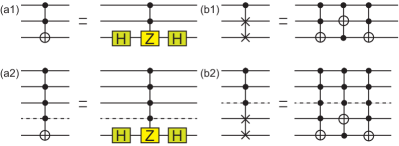
See Fig.1(a1). The Fredkin gate is constructed by sequential applications of three Toffoli gates as in

UFredkin=UToffoli(3,2)1UToffoli(3,1)2UToffoli(3,2)1,U_{\text{Fredkin}}=U_{\text{Toffoli}}^{\left(3,2\right)\rightarrow 1}U_{\text{Toffoli}}^{\left(3,1\right)\rightarrow 2}U_{\text{Toffoli}}^{\left(3,2\right)\rightarrow 1}, (39)

where UCZ(p,q)rU_{\text{CZ}}^{\left(p,q\right)\rightarrow r} indicates that the controlloed qubits are pp and qq while the target qubit is rr. See Fig.1(b1).

The CnNOT gate is constructed from CnZ gate as

UCnNOT=(I2n2UH)UCnZ(I2n2UH),U_{\text{C}^{n}\text{NOT}}=\left(I_{2n-2}\otimes U_{\text{H}}\right)U_{\text{C}^{n}\text{Z}}\left(I_{2n-2}\otimes U_{\text{H}}\right), (40)

where the Hadamard gate is applied to nnth qubit. See Fig.1(a2).

The CnSWAP gate is constructed from the CnZ gate as

UCnSWAP=UCnNOT1¯1UCnNOT2¯2UCnNOT1¯1,U_{\text{C}^{n}\text{SWAP}}=U_{\text{C}^{n}\text{NOT}}^{\overline{1}\rightarrow 1}U_{\text{C}^{n}\text{NOT}}^{\overline{2}\rightarrow 2}U_{\text{C}^{n}\text{NOT}}^{\overline{1}\rightarrow 1}, (41)

where UCnNOTp¯pU_{\text{C}^{n}\text{NOT}}^{\overline{p}\rightarrow p} indicates that the target qubit is pp and the others are controlled qubits, where p¯\overline{p} indicates the complementary qubits of the qubit pp. See Fig.1(b2).

Refer to caption


Figure 1: (a1) Construction of the CCNOT gate from the CCZ gate and the Hadamard gates. (a2) Construction of the CnNOT gate from the CnZ gate and the Hadamard gates. (b1) Construction of the Fredkin gate from three Toffoli gates. (b2) Construction of the CnSWAP gate from the CnNOT gates.

As a result, an arbitrary phase-shift gate, the CnNOT gate and the Hadamard gate are constructed in any logical qubits, and hence, the universal quantum computation is possible based on many-body interactions.

Discussions: We have analyzed the embedding problem inherent to the Majorana system, and shown that universal quantum computation is possible by introducing many-body interactions of Majorana fermions. Especially, the Cn-phase shift gate, the CnNOT and the CnSWAP gate are systematically constructed, which are the basic ingredients of universal quantum computation based on the Solovay-Kitaev theorem. Although it was previously pointed out that four-body interactions of Majorana fermions are enough for universal quantum computation[13], we have shown that the four-body interactions are not enough but 2N2N-body interactions are necessary.

The proposed quantum gates based on many-body interactions of Majorana fermions are not topologically protected because they are not generated by the standard braiding operations. By combining topological quantum computation based on braiding of Majorana fermions and nontopological quantum computation based on many-body interaction of Majorana fermions, topological-nontopological hybrid universal quantum computation is possible. It would be more robust than conventional universal quantum computation because many of quantum gates generated by braiding are topologically protected.

Recently, quantum simulation on Majorana fermions is studied in superconducting qubits[48, 49, 50]. It will be possible to realize many-body interactions of Majorana fermions in near future.

This work is supported by CREST, JST (Grants No. JPMJCR20T2) and Grants-in-Aid for Scientific Research from MEXT KAKENHI (Grant No. 23H00171).

References

  • [1] R. Feynman, Simulating physics with computers, Int. J. Theor. Phys. 21, 467 (1982).
  • [2] D. P. DiVincenzo, Quantum Computation, Science 270, 255 (1995).
  • [3] M. Nielsen and I. Chuang, Quantum Computation and Quantum Information, Cambridge University Press, (2016); ISBN 978-1-107-00217-3.
  • [4] D. Deutsch, Quantum Theory, the Church-Turing Principle and the Universal Quantum Computer, Proceedings of the Royal Society A. 400, 97 (1985).
  • [5] C. M. Dawson and M. A. Nielsen, The Solovay-Kitaev algorithm, Quantum Information and Computation 6, 81 (2006).
  • [6] M. Nielsen and I. Chuang, Quantum Computation and Quantum Information, Cambridge University Press, Cambridge, UK (2010).
  • [7] Y. Nakamura, Yu. A. Pashkin and J. S. Tsai, Coherent control of macroscopic quantum states in a single-Cooper-pair box, Nature 398, 786 (1999).
  • [8] E. Knill, R. Laflamme and G. J. Milburn, A scheme for efficient quantum computation with linear optics, Nature, 409, 46 (2001).
  • [9] D. Loss and D. P. DiVincenzo, Quantum computation with quantum dots, Phys. Rev. A 57, 120 (1998).
  • [10] J. I. Cirac and P. Zoller, Quantum computations with cold trapped ions, Phys. Rev. Lett. 74, 4091 (1995).
  • [11] L. M.K. Vandersypen, M. Steffen, G. Breyta, C. S. Yannoni, M. H. Sherwood, I. L. Chuang, Experimental realization of Shor’s quantum factoring algorithm using nuclear magnetic resonance, Nature 414, 883 (2001).
  • [12] B. E. Kane, Nature A silicon-based nuclear spin quantum computer, 393, 133 (1998).
  • [13] S. B. Bravyi and A. Yu. Kitaev, Fermionic Quantum Computation, Annals of Physics 298, 210 (2002)
  • [14] D. A. Ivanov, Non-Abelian statistics of half-quantum vortices in p-wave superconductors, Phys. Rev. Lett. 86, 268 (2001).
  • [15] A. Kitaev, Fault-tolerant quantum computation by anyons, Ann. Phys. 303, 2 (2003).
  • [16] S. Das Sarma, M. Freedman, and C. Nayak, Topologically protected qubits from a possible non-Abelian fractional quantum Hall state, Phys. Rev. Lett. 94, 166802 (2005).
  • [17] C. Nayak, S. H. Simon, A. Stern, M. Freedman, and S. Das Sarma, Non-Abelian anyons and topological quantum computation, Rev. Mod. Phys. 80, 1083 (2008).
  • [18] N. Read and D. Green, Paired states of fermions in two dimensions with breaking of parity and time-reversal symmetries and the fractional quantum Hall effect, Phys. Rev. B 61, 10267 (2000).
  • [19] N. Read, Non-Abelian braid statistics versus projective permutation statistics, J. Math. Phys. 44, 558 (2003).
  • [20] M. Freedman, C. Nayak and K. Walker, Towards universal topological quantum computation in the ν=5/2\nu=5/2 fractional quantum Hall state, Phys. Rev. B 73, 245307 (2006).
  • [21] X.-L. Qi, S.-C. Zhang, Topological insulators and superconductors, Rev. Mod. Phys. 83, 1057 (2011).
  • [22] M. Sato and Y. Ando, Topological superconductors: a review, Rep. Prog. Phys. 80, 076501 (2017).
  • [23] S.R. Elliott and M. Franz, Majorana fermions in nuclear, particle, and solid-state physics, Rev. Mod. Phys. 87, 137 (2015).
  • [24] S. Das Sarma, M. Freedman and C. Nayak, Majorana Zero Modes and Topological Quantum Computation, npj Quantum Information 1, 15001 (2015).
  • [25] J. Alicea, Y. Oreg, G. Refael, F. von Oppen and M.P.A. Fisher, Non-Abelian statistics and topological quantum information processing in 1D wire networks, Nat. Phys. 7, 412 (2011).
  • [26] J. Alicea, New directions in the pursuit of Majorana fermions in solid state systems, Rep. Prog. Phys. 75, 076501 (2012).
  • [27] C. W.J. Beenakker, Search for Majorana fermions in superconductors, Annu. Rev. Condens. Matter Phys. 4, 113 (2013).
  • [28] A. Kitaev, Anyons in an exactly solved model and beyond, Annals of Physics 321, 2 (2006).
  • [29] Y. Kasahara, T. Ohnishi, Y. Mizukami, O. Tanaka, Sixiao Ma, K. Sugii, N. Kurita, H. Tanaka, J. Nasu, Y. Motome, T. Shibauchi, Y. Matsuda, Majorana quantization and half-integer thermal quantum Hall effect in a Kitaev spin liquid, Nature 559, 227 (2018).
  • [30] S. Bravyi, A. Kitaev, Universal quantum computation with ideal Clifford gates and noisy ancillas, Phys. Rev. A 71, 022316 (2005).
  • [31] A. Ahlbrecht, L. S. Georgiev and R. F. Werner, Implementation of Clifford gates in the Ising-anyon topological quantum computer, Phys. Rev. A 79, 032311 (2009).
  • [32] D. Gottesman, Stabilizer Codes and Quantum Error Correction, quant-ph/9705052;
  • [33] D. Gottesman, The Heisenberg Representation of Quantum Computers, quant-ph/9807006.
  • [34] S. Aaronson and D. Gottesman, Improved simulation of stabilizer circuits, Phys. Rev. A 70, 052328 (2004).
  • [35] Universal quantum computation with the ν\nu=5/2 fractional quantum Hall state, Phys. Rev. A 73, 042313 (2006).
  • [36] J. D. Sau, S. Tewari and S. Das Sarma, Universal quantum computation in a semiconductor quantum wire network, Phys. Rev. A 82, 052322 (2010)
  • [37] T. E. O’Brien, P. Rożek, A. R. Akhmerov, Majorana-based fermionic quantum computation, Phys. Rev. Lett. 120, 220504 (2018).
  • [38] P. Bonderson, S. Das Sarma, M. Freedman, and C. Nayak, A Blueprint for a Topologically Fault-Tolerant Quantum Computer, arXiv:1003.2856.
  • [39] P. Bonderson, L. Fidkowski, M. Freedman, and K. Walker, Twisted Interferometry, arXiv:1306.2379.
  • [40] M. Barkeshli and J. D. Sau, Physical Architecture for a Universal Topological Quantum Computer based on a Network of Majorana Nanowires, arXiv:1509.07135
  • [41] Torsten Karzig, Yuval Oreg, Gil Refael, and Michael H. Freedman Phys. Rev. X 6, 031019 (2016).
  • [42] C. Nayak and F. Wilczek, 2n2n-quasihole states realize 2n12^{n-1}-dimensional spinor braiding statistics in paired quantum Hall states, Nucl. Phys. B 479, 529 (1996).
  • [43] L. S. Georgiev, Computational equivalence of the two inequivalent spinor representations of the braid group in the Ising topological quantum computer, J. Stat. Mech. P12013 (2009)
  • [44] L. S. Georgiev, Ultimate braid-group generators for coordinate exchanges of Ising anyons from the multi-anyon Pfaffian wavefunctions, J. Phys. A: Math. Theor. 42, 225203 (2009).
  • [45] L. S. Georgiev, Topologically protected gates for quantum computation with non-Abelian anyons in the Pfaffian quantum Hall state, Phys. Rev. B 74, 235112 (2006).
  • [46] L. S. Georgiev, Towards a universal set of topologically protected gates for quantum computation with Pfaffian qubits, Nucl. Phys. B 789, 552 (2008).
  • [47] C. V. Kraus, P. Zoller and M. A. Baranov, Braiding of atomic Majorana fermions in wire networks and implementation of the Deutsch-Jozsa algorithm, Phys. Rev. Lett. 111, 203001 (2013).
  • [48] Huang, et.al. Emulating Quantum Teleportation of a Majorana Zero Mode Qubit, Phys. Rev. Lett. 126, 090502 (2021).
  • [49] Nikhil Harle, Oles Shtanko and Ramis Movassagh, Observing and braiding topological Majorana modes on programmable quantum simulators, Nature Communications 14, 2286 (2023).
  • [50] M. J. Rancic, Exactly solving the Kitaev chain and generating Majorana zero modes out of noisy qubits, Scientific Reports volume 12, 19882 (2022).

Supplemental Material

Systematic construction of topological-nontopological hybrid universal quantum gates
based on many-body Majorana fermion interactions

Motohiko Ezawa

Department of Applied Physics, The University of Tokyo, 7-3-1 Hongo, Tokyo 113-8656, Japan


I Results on conventional braiding

S1 Embedding

We consider a one-dimensional chain of Majorana fermions and only consider the braiding between adjacent Majorana fermions. We denote αα,α+1\mathcal{B}_{\alpha}\equiv\mathcal{B}_{\alpha,\alpha+1}. The braid operators α\mathcal{B}_{\alpha} satisfies the Artin braid group relation[1]

αβ\displaystyle\mathcal{B}_{\alpha}\mathcal{B}_{\beta} =βαfor |αβ|2,\displaystyle=\mathcal{B}_{\beta}\mathcal{B}_{\alpha}\qquad\text{for\quad}\left|\alpha-\beta\right|\geq 2,
αα+1α\displaystyle\mathcal{B}_{\alpha}\mathcal{B}_{\alpha+1}\mathcal{B}_{\alpha} =α+1αα+1.\displaystyle=\mathcal{B}_{\alpha+1}\mathcal{B}_{\alpha}\mathcal{B}_{\alpha+1}. (S1)

The embedding of an MM-qubit quantum gate to an NN-qubit system with M<NM<N is a nontrivial problem in braiding of Majorana fermions. There are two partial solutions. One is setting additional qubits to be 0 as ancilla qubits, where every quantum gates can be embedded. The other is not to use the braiding 1\mathcal{B}_{1}. We discuss both of these in what follows.

S1.1 Ancilla embedding

N1N-1 logical qubits are embedded in NN logical qubits if the additional qubit is 0,

|0nN1n2n1logical.\left|0n_{N-1}\cdots n_{2}n_{1}\right\rangle_{\text{logical}}. (S2)

This is because the correspondence between the physical and logical qubits are identical if the NN-th qubit is 0. It is assured by the fact that we can use the same even parity basis in (N1)(N-1) qubits because the NNth qubit is 0. On the other hand, the action is different if the additional qubit is 11,

|1nN1n2n1logical.\left|1n_{N-1}\cdots n_{2}n_{1}\right\rangle_{\text{logical}}. (S3)

This is because it is necessary to use the odd parity basis in physical N1N-1 qubits so that total parity is even in the presence of the NNth qubit. It is still useful because there are many quantum algorithms where ancilla qubits are 0.

S1.2 Braid construction

We study what MM-qubit quantum gates can be embedded to an NN-qubit quantum gate with M<NM<N. First, we examine the case for one logical qubit as a simplest example. The braiding 1\mathcal{B}_{1} acts differently on the even and odd bases,

1even1odd,\mathcal{B}_{1}^{\text{even}}\neq\mathcal{B}_{1}^{\text{odd}}, (S4)

where

1even=eiπ/4(100i),1odd=eiπ/4(i001).\mathcal{B}_{1}^{\text{even}}=e^{-i\pi/4}\left(\begin{array}[]{cc}1&0\\ 0&i\end{array}\right),\qquad\mathcal{B}_{1}^{\text{odd}}=e^{-i\pi/4}\left(\begin{array}[]{cc}i&0\\ 0&1\end{array}\right). (S5)

On the other hand, 2\mathcal{B}_{2} and 3\mathcal{B}_{3} act on even and odd bases in the same way,

2even=2odd=12(1ii1),3even=3odd=eiπ/4(100i).\mathcal{B}_{2}^{\text{even}}=\mathcal{B}_{2}^{\text{odd}}=\frac{1}{\sqrt{2}}\left(\begin{array}[]{cc}1&-i\\ -i&1\end{array}\right),\qquad\mathcal{B}_{3}^{\text{even}}=\mathcal{B}_{3}^{\text{odd}}=e^{-i\pi/4}\left(\begin{array}[]{cc}1&0\\ 0&i\end{array}\right). (S6)

Similarly, k\mathcal{B}_{k} for k4k\geq 4 has the same action on the even and odd bases. We find that embedding is possible if we do not use the braiding 1\mathcal{B}_{1}. Hence, all of the Pauli gates, the Hadamard transformation, the iiSWAP gate can be embedded to the NN-qubit quantum gates.

On the other hand, the quantum gates which use braiding 1\mathcal{B}_{1} cannot be embedded to larger qubit as it is. For example, the CZ gate is given by the braiding eiπ/451(3)11e^{-i\pi/4}\mathcal{B}_{5}^{-1}\left(\mathcal{B}_{3}\right)^{-1}\mathcal{B}_{1}, whose matrix representation is

diag.(1,1,1,1,i,i,i,i),\text{diag.}\left(1,1,1,-1,i,-i,-i,-i\right), (S7)

once it is embedded to three logical qubits. They are different,

eiπ/451(3)11I2UCZ=diag.(1,1,1,1,1,1,1,1),e^{-i\pi/4}\mathcal{B}_{5}^{-1}\left(\mathcal{B}_{3}\right)^{-1}\mathcal{B}_{1}\neq I_{2}\otimes U_{\text{CZ}}=\text{diag.}\left(1,1,1,-1,1,1,1,-1\right), (S8)

In general, MM-quantum gates cannot be embedded in NN qubit. We solve the problem by introducing many-body interaction of Majorana fermions in Eq.(35).

S2 Single logical qubit

We discuss how to construct single logical qubit[2]. Two ordinary fermions c1c_{1} and c2c_{2} are introduced from four Majorana fermions as

c1=12(γ1+iγ2),c2=12(γ3+iγ4).c_{1}=\frac{1}{2}\left(\gamma_{1}+i\gamma_{2}\right),\qquad c_{2}=\frac{1}{2}\left(\gamma_{3}+i\gamma_{4}\right). (S9)

The basis of physical qubits is given by

Ψphysical=(|0,c1|0,c2|0,c1c2|0)t(|0,0physical,|0,1physical,|1,0physical,|1,1physical)t.\Psi_{\text{physical}}=\left(\left|0\right\rangle,c_{1}^{\dagger}\left|0\right\rangle,c_{2}^{\dagger}\left|0\right\rangle,c_{1}^{\dagger}c_{2}^{\dagger}\left|0\right\rangle\right)^{t}\equiv\left(\left|0,0\right\rangle_{\text{physical}},\left|0,1\right\rangle_{\text{physical}},\left|1,0\right\rangle_{\text{physical}},\left|1,1\right\rangle_{\text{physical}}\right)^{t}. (S10)

By taking the even parity basis as

(|0|1)logical=(|0,0|1,1)physical,\left(\begin{array}[]{c}\left|0\right\rangle\\ \left|1\right\rangle\end{array}\right)_{\text{logical}}=\left(\begin{array}[]{c}\left|0,0\right\rangle\\ \left|1,1\right\rangle\end{array}\right)_{\text{physical}}, (S11)

single logical qubit is constructed from two physical qubits.

S3 Quantum gates for one logical qubit

The braid operator 1\mathcal{B}_{1} is written in terms of fermion operators,

1=12(1+γ2γ1)=12(1+ic1c1ic1c1),\mathcal{B}_{1}=\frac{1}{\sqrt{2}}\left(1+\gamma_{2}\gamma_{1}\right)=\frac{1}{\sqrt{2}}\left(1+ic_{1}^{\dagger}c_{1}-ic_{1}c_{1}^{\dagger}\right), (S12)

which operates on two physical qubits (S10) as[2]

1Ψphysical=eiπ/4(10000i000010000i)(|0,0|0,1|1,0|1,1)physical.\mathcal{B}_{1}\Psi_{\text{physical}}=e^{-i\pi/4}\left(\begin{array}[]{cccc}1&0&0&0\\ 0&i&0&0\\ 0&0&1&0\\ 0&0&0&i\end{array}\right)\left(\begin{array}[]{c}\left|0,0\right\rangle\\ \left|0,1\right\rangle\\ \left|1,0\right\rangle\\ \left|1,1\right\rangle\end{array}\right)_{\text{physical}}. (S13)

Taking the even parity basis, the action is

1Ψlogical=eiπ/4(100i)(|0|1)logical,\mathcal{B}_{1}\Psi_{\text{logical}}=e^{-i\pi/4}\left(\begin{array}[]{cc}1&0\\ 0&i\end{array}\right)\left(\begin{array}[]{c}\left|0\right\rangle\\ \left|1\right\rangle\end{array}\right)_{\text{logical}}, (S14)

where the basis for the logical qubit is defined by

Ψlogical(|0,c1c2|0)t.\Psi_{\text{logical}}\equiv\left(\left|0\right\rangle,c_{1}^{\dagger}c_{2}^{\dagger}\left|0\right\rangle\right)^{t}. (S15)

The braid operation is written as

1=eiπ/4US,\mathcal{B}_{1}=e^{-i\pi/4}U_{\text{S}}, (S16)

in terms of the S gate defined by

USdiag.(1,i).U_{\text{S}}\equiv\text{diag.}\left(1,i\right). (S17)

The braid operator 2\mathcal{B}_{2} is written in terms of fermion operators,

2=12(1+γ3γ2)=12(1+ic2c1+ic2c1ic2c1ic2c1).\mathcal{B}_{2}=\frac{1}{\sqrt{2}}\left(1+\gamma_{3}\gamma_{2}\right)=\frac{1}{\sqrt{2}}\left(1+ic_{2}c_{1}^{\dagger}+ic_{2}^{\dagger}c_{1}^{\dagger}-ic_{2}c_{1}-ic_{2}^{\dagger}c_{1}\right). (S18)

It operates on two physical qubits (S10) as[2],

2Ψphysical=12(100i01i00i10i001)(|0,0|0,1|1,0|1,1)physical=Uxx(|0,0|0,1|1,0|1,1)physical,\mathcal{B}_{2}\Psi_{\text{physical}}=\frac{1}{\sqrt{2}}\left(\begin{array}[]{cccc}1&0&0&-i\\ 0&1&-i&0\\ 0&-i&1&0\\ -i&0&0&1\end{array}\right)\left(\begin{array}[]{c}\left|0,0\right\rangle\\ \left|0,1\right\rangle\\ \left|1,0\right\rangle\\ \left|1,1\right\rangle\end{array}\right)_{\text{physical}}=U_{xx}\left(\begin{array}[]{c}\left|0,0\right\rangle\\ \left|0,1\right\rangle\\ \left|1,0\right\rangle\\ \left|1,1\right\rangle\end{array}\right)_{\text{physical}}, (S19)

where

Uxx12(100i01i00i10i001)=exp[iπ4σxσx].U_{xx}\equiv\frac{1}{\sqrt{2}}\left(\begin{array}[]{cccc}1&0&0&-i\\ 0&1&-i&0\\ 0&-i&1&0\\ -i&0&0&1\end{array}\right)=\exp\left[-i\frac{\pi}{4}\sigma_{x}\otimes\sigma_{x}\right]. (S20)

In the even parity basis, the action is

2=12(1ii1)=exp[iπ4σx]Rx.\mathcal{B}_{2}=\frac{1}{\sqrt{2}}\left(\begin{array}[]{cc}1&-i\\ -i&1\end{array}\right)=\exp\left[-i\frac{\pi}{4}\sigma_{x}\right]\equiv R_{x}. (S21)

It has the relation

2=eiπ/4UX,\mathcal{B}_{2}=e^{-i\pi/4}U_{\sqrt{\text{X}}}, (S22)

where UXU_{\sqrt{\text{X}}} is the square-root of X gate defined by

UX12(1+i1i1i1+i).U_{\sqrt{\text{X}}}\equiv\frac{1}{2}\left(\begin{array}[]{cc}1+i&1-i\\ 1-i&1+i\end{array}\right). (S23)

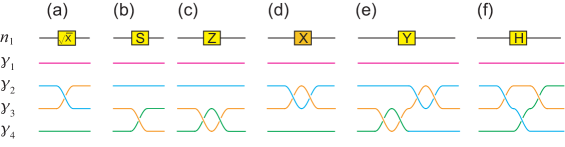
The corresponding braiding is shown in Fig.S1(a).

Refer to caption


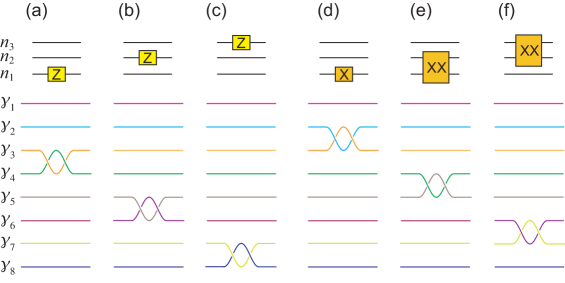
Figure S1: (a) Square-root of NOT gate, (b) S gate, (c) Pauli Z gate, (d) Pauli X gate, (e) Pauli Y gate and (f) Hadamard gate.

The braiding operator 3\mathcal{B}_{3} is written in terms of fermion operators

3=12(1+γ4γ3)=12(1+ic2c2ic2c2),\mathcal{B}_{3}=\frac{1}{\sqrt{2}}\left(1+\gamma_{4}\gamma_{3}\right)=\frac{1}{\sqrt{2}}\left(1+ic_{2}^{\dagger}c_{2}-ic_{2}c_{2}^{\dagger}\right), (S24)

which operates on two physical qubits (S10) as[2]

3Ψphysical=eiπ/4(1000010000i0000i)(|0,0|0,1|1,0|1,1)physical.\mathcal{B}_{3}\Psi_{\text{physical}}=e^{-i\pi/4}\left(\begin{array}[]{cccc}1&0&0&0\\ 0&1&0&0\\ 0&0&i&0\\ 0&0&0&i\end{array}\right)\left(\begin{array}[]{c}\left|0,0\right\rangle\\ \left|0,1\right\rangle\\ \left|1,0\right\rangle\\ \left|1,1\right\rangle\end{array}\right)_{\text{physical}}. (S25)

In the even parity basis, the action is the same as (S16),

3=eiπ/4US,\mathcal{B}_{3}=e^{-i\pi/4}U_{\text{S}}, (S26)

where the S gate is defined by (S17). The corresponding braiding is shown in Fig.S1(b).

The Pauli Z gate is given by double braiding of 3\mathcal{B}_{3},

UZdiag.(1,1)=US2=i32.U_{\text{Z}}\equiv\text{diag.}\left(1,-1\right)=U_{\text{S}}^{2}=i\mathcal{B}_{3}^{2}. (S27)

The corresponding braiding is shown in Fig.S1(c).

The Pauli X gate (NOT gate) is given[3] by double braiding of 2\mathcal{B}_{2},

UX(0110)=i22.U_{\text{X}}\equiv\left(\begin{array}[]{cc}0&1\\ 1&0\end{array}\right)=i\mathcal{B}_{2}^{2}. (S28)

The corresponding braiding is shown in Fig.S1(d).

Then, the Pauli Y gate is given by sequential applications of 2\mathcal{B}_{2} and 3\mathcal{B}_{3},

UY(0ii0)=iUXUZ=2232.U_{\text{Y}}\equiv\left(\begin{array}[]{cc}0&-i\\ i&0\end{array}\right)=iU_{\text{X}}U_{\text{Z}}=-\mathcal{B}_{2}^{2}\mathcal{B}_{3}^{2}. (S29)

The corresponding braiding is shown in Fig.S1(e).

The Hadamard gate is defined by

UH12(1111).U_{\text{H}}\equiv\frac{1}{\sqrt{2}}\left(\begin{array}[]{cc}1&1\\ 1&-1\end{array}\right). (S30)

It is known to be generated by triple braids as[4, 5]

UH=i232.U_{\text{H}}=i\mathcal{B}_{2}\mathcal{B}_{3}\mathcal{B}_{2}. (S31)

The corresponding braiding is shown in Fig.S1(f).

S4 One Logical qubit entangled states

The even cat state is made by applying the Hadamard gate (S30) as

UH|0logical=i232|0logical=12(|0logical+|1logical).U_{\text{H}}\left|0\right\rangle_{\text{logical}}=i\mathcal{B}_{2}\mathcal{B}_{3}\mathcal{B}_{2}\left|0\right\rangle_{\text{logical}}=\frac{1}{\sqrt{2}}\left(\left|0\right\rangle_{\text{logical}}+\left|1\right\rangle_{\text{logical}}\right). (S32)

However, a double braiding is enough for the construction of the even cat state |ψeven-cat\left|\psi\right\rangle_{\text{even-cat}},

e1iπ/412|0logical=12(|0logical+|1logical)|ψeven-cat.e_{1}^{i\pi/4}\mathcal{B}_{1}\mathcal{B}_{2}\left|0\right\rangle_{\text{logical}}=\frac{1}{\sqrt{2}}\left(\left|0\right\rangle_{\text{logical}}+\left|1\right\rangle_{\text{logical}}\right)\equiv\left|\psi\right\rangle_{\text{even-cat}}. (S33)

On the other hand, the odd cat state |ψodd-cat\left|\psi\right\rangle_{\text{odd-cat}} is made as

eiπ/4112|0logical=12(|0logical|1logical)|ψodd-cat.e^{-i\pi/4}\mathcal{B}_{1}^{-1}\mathcal{B}_{2}\left|0\right\rangle_{\text{logical}}=\frac{1}{\sqrt{2}}\left(\left|0\right\rangle_{\text{logical}}-\left|1\right\rangle_{\text{logical}}\right)\equiv\left|\psi\right\rangle_{\text{odd-cat}}. (S34)

Only 6 states can be constructed by braiding in one qubit. The state (|0logical±i|1logical)/2\left(\left|0\right\rangle_{\text{logical}}\pm i\left|1\right\rangle_{\text{logical}}\right)/\sqrt{2} is constructed by single braiding, while the states |1logical\left|1\right\rangle_{\text{logical}} and (|0logical±|1logical)/2\left(\left|0\right\rangle_{\text{logical}}\pm\left|1\right\rangle_{\text{logical}}\right)/\sqrt{2} are constructed by double braiding. No further states can be constructed by further braiding.

S5 Two logical qubits

In order to construct two logical qubits, we use six Majorana fermions γ1\gamma_{1}, γ2\gamma_{2}, γ3\gamma_{3}, γ4\gamma_{4}, γ5\gamma_{5} and γ6\gamma_{6}. Three ordinary fermion operators are given by

c1=12(γ1+iγ2),c2=12(γ3+iγ4),c3=12(γ5+iγ6).c_{1}=\frac{1}{2}\left(\gamma_{1}+i\gamma_{2}\right),\quad c_{2}=\frac{1}{2}\left(\gamma_{3}+i\gamma_{4}\right),\quad c_{3}=\frac{1}{2}\left(\gamma_{5}+i\gamma_{6}\right). (S35)

The basis of phycial qubits are given by

Ψphysical\displaystyle\Psi_{\text{physical}} =(|0,c1|0,c2|0,c1c2|0,c3|0,c1c3|0,c2c3|0,c1c2c3|0)t\displaystyle=(\left|0\right\rangle,c_{1}^{\dagger}\left|0\right\rangle,c_{2}^{\dagger}\left|0\right\rangle,c_{1}^{\dagger}c_{2}^{\dagger}\left|0\right\rangle,c_{3}^{\dagger}\left|0\right\rangle,c_{1}^{\dagger}c_{3}^{\dagger}\left|0\right\rangle,c_{2}^{\dagger}c_{3}^{\dagger}\left|0\right\rangle,c_{1}^{\dagger}c_{2}^{\dagger}c_{3}^{\dagger}\left|0\right\rangle)^{t}
(|0,0,0physical,|0,0,1physical,|0,1,0physical,|0,1,1physical,|1,0,0physical,\displaystyle\equiv(\left|0,0,0\right\rangle_{\text{physical}},\left|0,0,1\right\rangle_{\text{physical}},\left|0,1,0\right\rangle_{\text{physical}},\left|0,1,1\right\rangle_{\text{physical}},\left|1,0,0\right\rangle_{\text{physical}},
|1,0,1physical,|1,1,0physical,|1,1,1physical)t.\displaystyle\quad\quad\quad\quad\quad\quad\left|1,0,1\right\rangle_{\text{physical}},\left|1,1,0\right\rangle_{\text{physical}},\left|1,1,1\right\rangle_{\text{physical}})^{t}. (S36)

The explicit braid operators on the physical qubits are

1\displaystyle\mathcal{B}_{1} =I2I2US,\displaystyle=I_{2}\otimes I_{2}\otimes U_{\text{S}},
2\displaystyle\mathcal{B}_{2} =I2Uxx,\displaystyle=I_{2}\otimes U_{xx},
3\displaystyle\mathcal{B}_{3} =I2USI2,\displaystyle=I_{2}\otimes U_{\text{S}}\otimes I_{2},
4\displaystyle\mathcal{B}_{4} =UxxI2,\displaystyle=U_{xx}\otimes I_{2},
5\displaystyle\mathcal{B}_{5} =USI2I2.\displaystyle=U_{\text{S}}\otimes I_{2}\otimes I_{2}. (S37)

Two logical qubits are constructed from three physical qubits as

(|0,0|0,1|1,0|1,1)logical=(|0,0,0|0,1,1|1,0,1|1,1,0)physical.\left(\begin{array}[]{c}\left|0,0\right\rangle\\ \left|0,1\right\rangle\\ \left|1,0\right\rangle\\ \left|1,1\right\rangle\end{array}\right)_{\text{logical}}=\left(\begin{array}[]{c}\left|0,0,0\right\rangle\\ \left|0,1,1\right\rangle\\ \left|1,0,1\right\rangle\\ \left|1,1,0\right\rangle\end{array}\right)_{\text{physical}}. (S38)

In the logical qubit basis, the braiding operators are

1\displaystyle\mathcal{B}_{1} =eiπ/4diag.(1,i,i,1),\displaystyle=e^{-i\pi/4}\text{diag.}\left(1,i,i,1\right),
2\displaystyle\mathcal{B}_{2} =I2Rx,\displaystyle=I_{2}\otimes R_{x},
3\displaystyle\mathcal{B}_{3} =eiπ/4diag.(1,i,1,i),\displaystyle=e^{-i\pi/4}\text{diag.}\left(1,i,1,i\right),
4\displaystyle\mathcal{B}_{4} =Uxx,\displaystyle=U_{xx},
5\displaystyle\mathcal{B}_{5} =eiπ/4diag.(1,1,i,i).\displaystyle=e^{-i\pi/4}\text{diag.}\left(1,1,i,i\right). (S39)

where RxR_{x} is defined by (S21) and UxxU_{xx} is defined by (S20).

Refer to caption

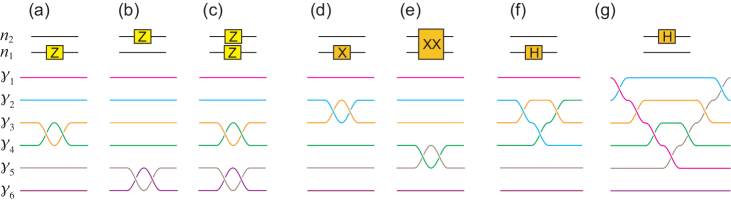
Figure S2: The braiding process for Pauli gates. (a) Pauli Z gate embedded to the first qubit, (b) Pauli Z gate embedded to the second qubit, (c) Two Pauli Z gates are embedded to the first and the second qubits, (d) Pauli X gate embedded to the first qubit, (e) Two Pauli X gates are embedded to the first and the second qubits, (f) Hadamard gate embedded to the first qubit and (g) Hadamard gate embedded to the second qubit.

S6 Pauli gates

The two-qubit Pauli gates are defined by

σk2σk1,\sigma_{k_{2}}\otimes\sigma_{k_{1}}, (S40)

where k1k_{1} and k2k_{2} take 0,x,y0,x,y and zz. The Pauli Z gates are generated by braiding 2k+1\mathcal{B}_{2k+1} with odd indices,

I2σZ=i32,σZI2=i52,σZσZ=5232.I_{2}\otimes\sigma_{\text{Z}}=i\mathcal{B}_{3}^{2},\quad\sigma_{\text{Z}}\otimes I_{2}=i\mathcal{B}_{5}^{2},\quad\sigma_{\text{Z}}\otimes\sigma_{\text{Z}}=-\mathcal{B}_{5}^{2}\mathcal{B}_{3}^{2}. (S41)

They are summarized as

(σZ)n2(σZ)n1=(i52)n2(i32)n1,\left(\sigma_{\text{Z}}\right)^{n_{2}}\otimes\left(\sigma_{\text{Z}}\right)^{n_{1}}=\left(i\mathcal{B}_{5}^{2}\right)^{n_{2}}\left(i\mathcal{B}_{3}^{2}\right)^{n_{1}}, (S42)

where n1n_{1} and n2n_{2} take 0 or 11.

The Pauli X gates are generated by braiding with even indices 2k\mathcal{B}_{2k},

I2σX=i22,σXσX=i42,I2σX=4222.I_{2}\otimes\sigma_{\text{X}}=i\mathcal{B}_{2}^{2},\quad\sigma_{\text{X}}\otimes\sigma_{\text{X}}=i\mathcal{B}_{4}^{2},\quad I_{2}\otimes\sigma_{\text{X}}=-\mathcal{B}_{4}^{2}\mathcal{B}_{2}^{2}. (S43)

It should be noted that 42\mathcal{B}_{4}^{2} does not generate I2σXI_{2}\otimes\sigma_{\text{X}} but generate σXσX\sigma_{\text{X}}\otimes\sigma_{\text{X}}. We show the braiding for Pauli gates in Fig.S2.

Pauli Y gates are generated by sequential applications of Pauli X gates and Pauli Z gates based on the relation UY=iUXUZU_{\text{Y}}=iU_{\text{X}}U_{\text{Z}}. Thus, all of Pauli gates for two qubits can be generated by braiding.

S7 Hadamard gates

The Hadamard gate acting on the first qubit can be embedded as

I2UH=i232.I_{2}\otimes U_{\text{H}}=i\mathcal{B}_{2}\mathcal{B}_{3}\mathcal{B}_{2}. (S44)

The Hadamard gate acting on the second qubit can be embedded as

UHI2=1234321.U_{\text{H}}\otimes I_{2}=-\mathcal{B}_{1}\mathcal{B}_{2}\mathcal{B}_{3}\mathcal{B}_{4}\mathcal{B}_{3}\mathcal{B}_{2}\mathcal{B}_{1}. (S45)

It requires more braiding than the previous results[6, 5], where three braiding are enough. It is due to the choice of the correspondence between the physical and logical qubits.

Refer to caption

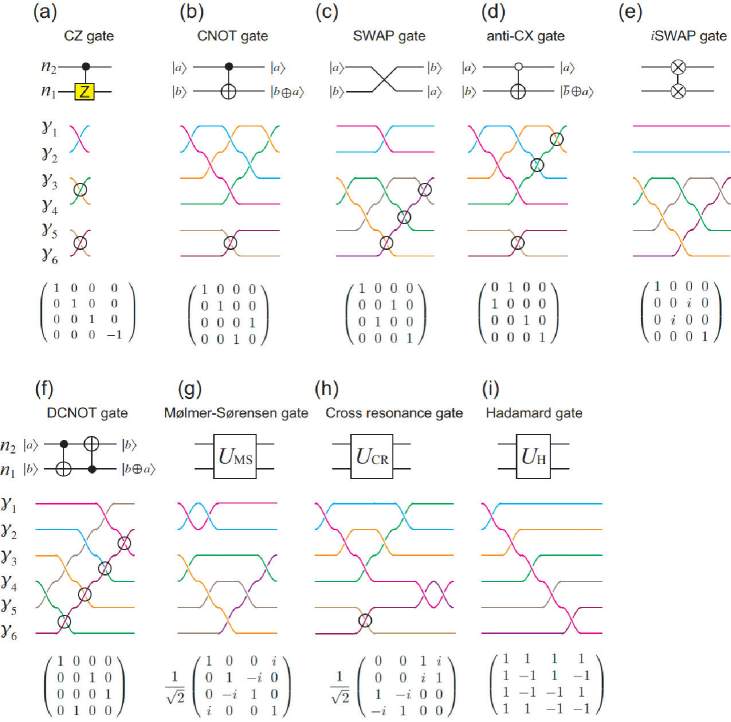
Figure S3: Braiding process for various two-qubit quantum gates. (a) CZ gate, (b) CNOT gate, (c) SWAP gate, (d) anti-CX gate, (e) iiSWAP gate, (f) DCNOT gate, (g) Molmer-Sorensen gate, (h) cross-resonance gate (i) Hadamard gate.

S8 Quantum gates for two logical qubits

It is known that the controlled-Z (CZ) gate

UCZ=diag.(1,1,1,1)U_{\text{CZ}}=\text{diag.}\left(1,1,1,-1\right) (S46)

is generated as[6]

UCZ=eiπ/451(3)11.U_{\text{CZ}}=e^{-i\pi/4}\mathcal{B}_{5}^{-1}\left(\mathcal{B}_{3}\right)^{-1}\mathcal{B}_{1}. (S47)

See Fig.S3(a).

It is also known that the controlled-NOT (CNOT) gate

UCNOT=(1000010000010010)U_{\text{CNOT}}=\left(\begin{array}[]{cccc}1&0&0&0\\ 0&1&0&0\\ 0&0&0&1\\ 0&0&1&0\end{array}\right) (S48)

is generated by 7 braiding[4, 6, 7], wher braiding are given by

UCNOT=eiπ/451123121.U_{\text{CNOT}}=-e^{-i\pi/4}\mathcal{B}_{5}^{-1}\mathcal{B}_{1}\mathcal{B}_{2}\mathcal{B}_{3}\mathcal{B}_{1}\mathcal{B}_{2}\mathcal{B}_{1}. (S49)

See Fig.S3(b). On the other hand, there is a quantum circuit decomposition formula

UCNOT=(I2UH)UCZ(I2UH),U_{\text{CNOT}}=\left(I_{2}\otimes U_{\text{H}}\right)U_{\text{CZ}}\left(I_{2}\otimes U_{\text{H}}\right), (S50)

which involves 9 braiding.

The SWAP gate is defined by

USWAP(1000001001000001),U_{\text{SWAP}}\equiv\left(\begin{array}[]{cccc}1&0&0&0\\ 0&0&1&0\\ 0&1&0&0\\ 0&0&0&1\end{array}\right), (S51)

which is realized by 7 braiding as

USWAP=eiπ/4(3)1(4)1(5)13431.U_{\text{SWAP}}=e^{i\pi/4}\left(\mathcal{B}_{3}\right)^{-1}\left(\mathcal{B}_{4}\right)^{-1}\left(\mathcal{B}_{5}\right)^{-1}\mathcal{B}_{3}\mathcal{B}_{4}\mathcal{B}_{3}\mathcal{B}_{1}. (S52)

See Fig.S3(c). This is smaller than the previous result using 15 braiding[6] based on the quantum circuit decomposition

USWAP=(I2UH)UCZ(I2UH)(UHI2)UCZ(UHI2)(I2UH)UCZ(I2UH).U_{\text{SWAP}}=\left(I_{2}\otimes U_{\text{H}}\right)U_{\text{CZ}}\left(I_{2}\otimes U_{\text{H}}\right)\left(U_{\text{H}}\otimes I_{2}\right)U_{\text{CZ}}\left(U_{\text{H}}\otimes I_{2}\right)\left(I_{2}\otimes U_{\text{H}}\right)U_{\text{CZ}}\left(I_{2}\otimes U_{\text{H}}\right). (S53)

We list up various quantum gates generated by braiding.

The anti-CNOT gate is defined by[8]

UC̄X(0100100000100001),U_{\text{\={C}X}}\equiv\left(\begin{array}[]{cccc}0&1&0&0\\ 1&0&0&0\\ 0&0&1&0\\ 0&0&0&1\end{array}\right), (S54)

which is generated by 7 braiding

UC̄X=eiπ/45111213121.U_{\text{\={C}X}}=e^{i\pi/4}\mathcal{B}_{5}^{-1}\mathcal{B}_{1}^{-1}\mathcal{B}_{2}^{-1}\mathcal{B}_{3}\mathcal{B}_{1}\mathcal{B}_{2}\mathcal{B}_{1}. (S55)

It can be decomposed into UC̄X=(I2UX)UCNOTU_{\text{\={C}X}}=\left(I_{2}\otimes U_{\text{X}}\right)U_{\text{CNOT}}. If we use this relation, 9 braiding are necessary. See Fig.S3(d).

The iiSWAP gate is defined by

UiSWAP(100000i00i000001),U_{i\text{SWAP}}\equiv\left(\begin{array}[]{cccc}1&0&0&0\\ 0&0&i&0\\ 0&i&0&0\\ 0&0&0&1\end{array}\right), (S56)

which is realized by the six braiding

UiSWAP=345343.U_{i\text{SWAP}}=-\mathcal{B}_{3}\mathcal{B}_{4}\mathcal{B}_{5}\mathcal{B}_{3}\mathcal{B}_{4}\mathcal{B}_{3}. (S57)

See Fig.S3(e).

The double CNOT gate is defined by[9]

UDCNOT(1000001000010100),U_{\text{DCNOT}}\equiv\left(\begin{array}[]{cccc}1&0&0&0\\ 0&0&1&0\\ 0&0&0&1\\ 0&1&0&0\end{array}\right), (S58)

which is realized by

UDCNOT=213141511234.U_{\text{DCNOT}}=\mathcal{B}_{2}^{-1}\mathcal{B}_{3}^{-1}\mathcal{B}_{4}^{-1}\mathcal{B}_{5}^{-1}\mathcal{B}_{1}\mathcal{B}_{2}\mathcal{B}_{3}\mathcal{B}_{4}. (S59)

See Fig.S3(f).

The Mølmer-Sørensen gate is defined by[10]

UMS12(100i01i00i10i001),U_{\text{MS}}\equiv\frac{1}{\sqrt{2}}\left(\begin{array}[]{cccc}1&0&0&i\\ 0&1&-i&0\\ 0&-i&1&0\\ i&0&0&1\end{array}\right), (S60)

which is realized by

UMS=i3454311.U_{\text{MS}}=-i\mathcal{B}_{3}\mathcal{B}_{4}\mathcal{B}_{5}\mathcal{B}_{4}\mathcal{B}_{3}\mathcal{B}_{1}\mathcal{B}_{1}. (S61)

See Fig.S3(g).

The cross-resonance gate is defined by[11]

UCR12(001i00i11i00i100),U_{\text{CR}}\equiv\frac{1}{\sqrt{2}}\left(\begin{array}[]{cccc}0&0&1&i\\ 0&0&i&1\\ 1&-i&0&0\\ -i&1&0&0\end{array}\right), (S62)

which is realized by

UCR=4412321.U_{\text{CR}}=-\mathcal{B}_{4}\mathcal{B}_{4}\mathcal{B}_{1}\mathcal{B}_{2}\mathcal{B}_{3}\mathcal{B}_{2}\mathcal{B}_{1}. (S63)

See Fig.S3(h).

We define the entangled Hadamard gate by

UH(2)=(1111111111111111),U_{\text{H}}^{\left(2\right)}=\left(\begin{array}[]{cccc}1&1&1&1\\ 1&-1&1&-1\\ 1&-1&-1&1\\ 1&1&-1&-1\end{array}\right), (S64)

which is realized by

UH(2)=eiπ/454321.U_{\text{H}}^{\left(2\right)}=-e^{-i\pi/4}\mathcal{B}_{5}\mathcal{B}_{4}\mathcal{B}_{3}\mathcal{B}_{2}\mathcal{B}_{1}. (S65)

See Fig.S3(i). It is different from the cross product of the Hadamard gates

UH(2)UHUH.U_{\text{H}}^{\left(2\right)}\neq U_{\text{H}}\otimes U_{\text{H}}. (S66)

We note that it is obtained by a permutation of the third and fourth columns of the cross product of the Hadamard gates given by

UHUH=(1111111111111111),U_{\text{H}}\otimes U_{\text{H}}=\left(\begin{array}[]{cccc}1&1&1&1\\ 1&-1&1&-1\\ 1&1&-1&-1\\ 1&-1&-1&1\end{array}\right), (S67)

which leads to a relation

UHUH=UCNOTUH(2).U_{\text{H}}\otimes U_{\text{H}}=U_{\text{CNOT}}U_{\text{H}}^{\left(2\right)}. (S68)

Hence, it is realized by

UHUH=5112312154321.U_{\text{H}}\otimes U_{\text{H}}=-\mathcal{B}_{5}^{-1}\mathcal{B}_{1}\mathcal{B}_{2}\mathcal{B}_{3}\mathcal{B}_{1}\mathcal{B}_{2}\mathcal{B}_{1}\mathcal{B}_{5}\mathcal{B}_{4}\mathcal{B}_{3}\mathcal{B}_{2}\mathcal{B}_{1}. (S69)

Both UH(2)U_{\text{H}}^{\left(2\right)} and UHUHU_{\text{H}}\otimes U_{\text{H}} are the Hadamard gates and they are useful for various quantum algorithms.

S9 Equal-coefficient states

The equal-coefficient state is constructed as

i12345|0,0logical\displaystyle i\mathcal{B}_{1}\mathcal{B}_{2}\mathcal{B}_{3}\mathcal{B}_{4}\mathcal{B}_{5}\left|0,0\right\rangle_{\text{logical}} =12(|0,0logical+|0,1logical+|1,0logical+|1,1logical)\displaystyle=\frac{1}{2}\left(\left|0,0\right\rangle_{\text{logical}}+\left|0,1\right\rangle_{\text{logical}}+\left|1,0\right\rangle_{\text{logical}}+\left|1,1\right\rangle_{\text{logical}}\right)
12(|0logicaldecimal+|1logicaldecimal+|2logicaldecimal+|3logicaldecimal),\displaystyle\equiv\frac{1}{2}\left(\left|0\right\rangle_{\text{logical}}^{\text{decimal}}+\left|1\right\rangle_{\text{logical}}^{\text{decimal}}+\left|2\right\rangle_{\text{logical}}^{\text{decimal}}+\left|3\right\rangle_{\text{logical}}^{\text{decimal}}\right), (S70)

where |jlogicaldecimal\left|j\right\rangle_{\text{logical}}^{\text{decimal}} is a decimal representation of qubits. It is a fundamental entangled state for two qubits.

S10 Three logical qubits

We use eight Majorana fermions in order to construct three logical qubits,

c1=12(γ1+iγ2),c2=12(γ3+iγ4),c3=12(γ5+iγ6).c4=12(γ7+iγ8).c_{1}=\frac{1}{2}\left(\gamma_{1}+i\gamma_{2}\right),\quad c_{2}=\frac{1}{2}\left(\gamma_{3}+i\gamma_{4}\right),\quad c_{3}=\frac{1}{2}\left(\gamma_{5}+i\gamma_{6}\right).\quad c_{4}=\frac{1}{2}\left(\gamma_{7}+i\gamma_{8}\right). (S71)

The explicit braid actions on the physical qubits are

1\displaystyle\mathcal{B}_{1} =I2I2I2US,\displaystyle=I_{2}\otimes I_{2}\otimes I_{2}\otimes U_{\text{S}},
2\displaystyle\mathcal{B}_{2} =I2I2Uxx,\displaystyle=I_{2}\otimes I_{2}\otimes U_{xx},
3\displaystyle\mathcal{B}_{3} =I2I2USI2,\displaystyle=I_{2}\otimes I_{2}\otimes U_{\text{S}}\otimes I_{2},
4\displaystyle\mathcal{B}_{4} =I2UxxI2,\displaystyle=I_{2}\otimes U_{xx}\otimes I_{2},
5\displaystyle\mathcal{B}_{5} =I2USI2I2,\displaystyle=I_{2}\otimes U_{\text{S}}\otimes I_{2}\otimes I_{2},
6\displaystyle\mathcal{B}_{6} =UxxI2I2,\displaystyle=U_{xx}\otimes I_{2}\otimes I_{2},
7\displaystyle\mathcal{B}_{7} =USI2I2I2.\displaystyle=U_{\text{S}}\otimes I_{2}\otimes I_{2}\otimes I_{2}. (S72)

Three logical qubits are constructed from four physical qubits as

(|0,0,0|0,0,1|0,1,0|0,1,1|1,0,0|1,0,1|1,1,0|1,1,1)logical=(|0,0,0,0|0,0,1,1|0,1,0,1|0,1,1,0|1,0,0,1|1,0,1,0|1,1,0,0|1,1,1,1)physical.\left(\begin{array}[]{c}\left|0,0,0\right\rangle\\ \left|0,0,1\right\rangle\\ \left|0,1,0\right\rangle\\ \left|0,1,1\right\rangle\\ \left|1,0,0\right\rangle\\ \left|1,0,1\right\rangle\\ \left|1,1,0\right\rangle\\ \left|1,1,1\right\rangle\end{array}\right)_{\text{logical}}=\left(\begin{array}[]{c}\left|0,0,0,0\right\rangle\\ \left|0,0,1,1\right\rangle\\ \left|0,1,0,1\right\rangle\\ \left|0,1,1,0\right\rangle\\ \left|1,0,0,1\right\rangle\\ \left|1,0,1,0\right\rangle\\ \left|1,1,0,0\right\rangle\\ \left|1,1,1,1\right\rangle\end{array}\right)_{\text{physical}}. (S73)

Explicit matrix representations for the braiding operator are

1\displaystyle\mathcal{B}_{1} =eiπ/4diag.(1,i,i,1,i,1,1,i)=exp[iπ4σzσzσz],\displaystyle=e^{-i\pi/4}\text{diag.}\left(1,i,i,1,i,1,1,i\right)=\exp\left[-\frac{i\pi}{4}\sigma_{z}\otimes\sigma_{z}\otimes\sigma_{z}\right],
2\displaystyle\mathcal{B}_{2} =I4Rx,\displaystyle=I_{4}\otimes R_{x},
3\displaystyle\mathcal{B}_{3} =eiπ/4diag.(1,i,1,i,1,i,1,i)=eiπ/4I4US,\displaystyle=e^{-i\pi/4}\text{diag.}\left(1,i,1,i,1,i,1,i\right)=e^{-i\pi/4}I_{4}\otimes U_{\text{S}},
4\displaystyle\mathcal{B}_{4} =I2Uxx,\displaystyle=I_{2}\otimes U_{xx},
5\displaystyle\mathcal{B}_{5} =eiπ/4diag.(1,1,i,i,1,1,i,i)=eiπ/4I2USI2,\displaystyle=e^{-i\pi/4}\text{diag.}\left(1,1,i,i,1,1,i,i\right)=e^{-i\pi/4}I_{2}\otimes U_{\text{S}}\otimes I_{2},
6\displaystyle\mathcal{B}_{6} =UxxI2,\displaystyle=U_{xx}\otimes I_{2},
7\displaystyle\mathcal{B}_{7} =eiπ/4diag.(1,1,1,1,i,i,i,i)=eiπ/4USI4.\displaystyle=e^{-i\pi/4}\text{diag.}\left(1,1,1,1,i,i,i,i\right)=e^{-i\pi/4}U_{\text{S}}\otimes I_{4}. (S74)

S11 Pauli gates

The three-qubit Pauli gates are defined by

σk3σk2σk1,\sigma_{k_{3}}\otimes\sigma_{k_{2}}\otimes\sigma_{k_{1}}, (S75)

where k1k_{1}, k2k_{2} and k3k_{3} take 0,x,y0,x,y and zz. The Pauli Z gates are generated by braiding operators 2k+1\mathcal{B}_{2k+1} with odd indices

I2I2σZ=i32,I2σZI2=i52,σZI2I2=i72,I_{2}\otimes I_{2}\otimes\sigma_{\text{Z}}=i\mathcal{B}_{3}^{2},\quad I_{2}\otimes\sigma_{\text{Z}}\otimes I_{2}=i\mathcal{B}_{5}^{2},\quad\sigma_{\text{Z}}\otimes I_{2}\otimes I_{2}=i\mathcal{B}_{7}^{2}, (S76)

They are summarized as

(σZ)n3(σZ)n2(σZ)n1=(i72)n3(i52)n2(i32)n1,\left(\sigma_{\text{Z}}\right)^{n_{3}}\otimes\left(\sigma_{\text{Z}}\right)^{n_{2}}\otimes\left(\sigma_{\text{Z}}\right)^{n_{1}}=\left(i\mathcal{B}_{7}^{2}\right)^{n_{3}}\left(i\mathcal{B}_{5}^{2}\right)^{n_{2}}\left(i\mathcal{B}_{3}^{2}\right)^{n_{1}}, (S77)

where n1n_{1} n2n_{2} and n3n_{3} take 0 or 11.

Refer to caption

Figure S4: Pauli gates embedded in three qubits. (a) Pauli Z gate embedded to the first qubit, (b) Pauli Z gate embedded to the second qubit, (c) Pauli Z gate embedded to the third qubit, (d) Pauli X gate embedded to the first qubit, (e) Two Pauli X gates are embedded to the first and second qubits and (f) Two Pauli X gates are embedded to the second third qubits.

The Pauli X gates are generated by braiding operators with even numbers,

I2I2σX=i22,I2σXσX=i42,σXσXI2=i62.I_{2}\otimes I_{2}\otimes\sigma_{\text{X}}=i\mathcal{B}_{2}^{2},\quad I_{2}\otimes\sigma_{\text{X}}\otimes\sigma_{\text{X}}=i\mathcal{B}_{4}^{2},\quad\sigma_{\text{X}}\otimes\sigma_{\text{X}}\otimes I_{2}=i\mathcal{B}_{6}^{2}. (S78)

We show the corresponding braiding in Fig.S4. It is impossible to construct logical gates corresponding to

I2σXI2 and σXI2I2I_{2}\otimes\sigma_{\text{X}}\otimes I_{2}\text{ and }\sigma_{\text{X}}\otimes I_{2}\otimes I_{2} (S79)

solely by braiding. This problem is solved by introducing many-body interactions of Majorana fermions as in Eq.(S142).

The other Pauli gates can be generated by sequential applications of the above Pauli gates.

S12 Diagonal braiding

We first search braiding operators for the quantum gates generated by odd double braiding,

Udiag=(72)n3(52)n2(32)n1.U_{\text{diag}}=\left(\mathcal{B}_{7}^{2}\right)^{n_{3}}\left(\mathcal{B}_{5}^{2}\right)^{n_{2}}\left(\mathcal{B}_{3}^{2}\right)^{n_{1}}. (S80)

There are eight patterns represented by the Pauli Z gates

diag.(1,1,1,1,1,1,1,1)\displaystyle\text{diag.}\left(1,1,1,1,1,1,1,1\right) =I2I2I2,\displaystyle=I_{2}\otimes I_{2}\otimes I_{2},
diag.(1,1,1,1,1,1,1,1)\displaystyle\text{diag.}\left(1,-1,1,-1,1,-1,1,-1\right) =I2I2σZ=i32,\displaystyle=I_{2}\otimes I_{2}\otimes\sigma_{\text{Z}}=i\mathcal{B}_{3}^{2},
diag.(1,1,1,1,1,1,1,1)\displaystyle\text{diag.}\left(1,1,-1,-1,1,1,-1,-1\right) =I2σZI2=i52,\displaystyle=I_{2}\otimes\sigma_{\text{Z}}\otimes I_{2}=i\mathcal{B}_{5}^{2},
diag.(1,1,1,1,1,1,1,1)\displaystyle\text{diag.}\left(1,1,1,1,-1,-1,-1,-1\right) =σZI2I2=i72,\displaystyle=\sigma_{\text{Z}}\otimes I_{2}\otimes I_{2}=i\mathcal{B}_{7}^{2},
diag.(1,1,1,1,1,1,1,1)\displaystyle\text{diag.}\left(1,-1,-1,1,1,-1,-1,1\right) =I2σZσZ=5232,\displaystyle=I_{2}\otimes\sigma_{\text{Z}}\otimes\sigma_{\text{Z}}=-\mathcal{B}_{5}^{2}\mathcal{B}_{3}^{2},
diag.(1,1,1,1,1,1,1,1)\displaystyle\text{diag.}\left(1,1,-1,-1,-1,-1,1,1\right) =σZσZI2=7252,\displaystyle=\sigma_{\text{Z}}\otimes\sigma_{\text{Z}}\otimes I_{2}=-\mathcal{B}_{7}^{2}\mathcal{B}_{5}^{2},
diag.(1,1,1,1,1,1,1,1)\displaystyle\text{diag.}\left(1,-1,1,-1,-1,1,-1,1\right) =σZI2σZ=7232,\displaystyle=\sigma_{\text{Z}}\otimes I_{2}\otimes\sigma_{\text{Z}}=-\mathcal{B}_{7}^{2}\mathcal{B}_{3}^{2},
diag.(1,1,1,1,1,1,1,1)\displaystyle\text{diag.}\left(1,-1,-1,1,-1,1,1,-1\right) =σZσZσZ=i725232.\displaystyle=\sigma_{\text{Z}}\otimes\sigma_{\text{Z}}\otimes\sigma_{\text{Z}}=-i\mathcal{B}_{7}^{2}\mathcal{B}_{5}^{2}\mathcal{B}_{3}^{2}. (S81)

Next, we search real and diagonal gates obtained by the following odd braiding

(7)n3(5)n2(3)n1.\left(\mathcal{B}_{7}\right)^{n_{3}}\left(\mathcal{B}_{5}\right)^{n_{2}}\left(\mathcal{B}_{3}\right)^{n_{1}}. (S82)

We search states whose components are ±1\pm 1. There are four additional quantum gates, whose traces are zero TrUdiag=0U_{\text{diag}}=0,

diag.(1,1,1,1,1,1,1,1)=i41321,\displaystyle\text{diag.}\left(1,-1,-1,-1,1,1,1,-1\right)=i\mathcal{B}_{4}^{-1}\mathcal{B}_{3}\mathcal{B}_{2}\mathcal{B}_{1},
diag.(1,1,1,1,1,1,1,1)=i31421,\displaystyle\text{diag.}\left(1,-1,1,1,-1,-1,1,-1\right)=i\mathcal{B}_{3}^{-1}\mathcal{B}_{4}\mathcal{B}_{2}\mathcal{B}_{1},
diag.(1,1,1,1,1,1,1,1)=i21341,\displaystyle\text{diag.}\left(1,1,-1,1,-1,1,-1,-1\right)=i\mathcal{B}_{2}^{-1}\mathcal{B}_{3}\mathcal{B}_{4}\mathcal{B}_{1},
diag.(1,1,1,1,1,1,1,1)=i4131211.\displaystyle\text{diag.}\left(1,1,1,-1,1,-1,-1,-1\right)=-i\mathcal{B}_{4}^{-1}\mathcal{B}_{3}^{-1}\mathcal{B}_{2}^{-1}\mathcal{B}_{1}. (S83)

In addition, there are additional quantum gates, whose traces are nonzero TrUdiag0U_{\text{diag}}\neq 0,

diag.(1,1,1,1,1,1,1,1)=4321,\displaystyle\text{diag.}\left(1,-1,-1,-1,-1,-1,-1,1\right)=-\mathcal{B}_{4}\mathcal{B}_{3}\mathcal{B}_{2}\mathcal{B}_{1},
diag.(1,1,1,1,1,1,1,1)=413121,\displaystyle\text{diag.}\left(1,-1,1,1,1,1,-1,1\right)=\mathcal{B}_{4}^{-1}\mathcal{B}_{3}^{-1}\mathcal{B}_{2}\mathcal{B}_{1},
diag.(1,1,1,1,1,1,1,1)=412131,\displaystyle\text{diag.}\left(1,1,-1,1,1,-1,1,1\right)=\mathcal{B}_{4}^{-1}\mathcal{B}_{2}^{-1}\mathcal{B}_{3}\mathcal{B}_{1},
diag.(1,1,1,1,1,1,1,1)=312141.\displaystyle\text{diag.}\left(1,1,1,-1,-1,1,1,1\right)=\mathcal{B}_{3}^{-1}\mathcal{B}_{2}^{-1}\mathcal{B}_{4}\mathcal{B}_{1}. (S84)

It is natural to anticipate that the CZ gate and the CCZ gate are generated by even braiding because they are diagonal gates. However, this is not the case by checking all 434^{3} patterns of braiding. As a result, the even braiding do not generate the CZ gates

I2UCZ\displaystyle I_{2}\otimes U_{\text{CZ}} =diag.(1,1,1,1,1,1,1,1),\displaystyle=\text{diag.}\left(1,1,1,-1,1,1,1,-1\right),
UCZI2\displaystyle U_{\text{CZ}}\otimes I_{2} =diag.(1,1,1,1,1,1,1,1),\displaystyle=\text{diag.}\left(1,1,1,1,1,1,-1,-1\right), (S85)

and the CCZ gate

UCCZ=diag.(1,1,1,1,1,1,1,1).U_{\text{CCZ}}=\text{diag.}\left(1,1,1,1,1,1,1,-1\right). (S86)

This problem is solved by introducing many-body interactions of Majorana fermions as shown in the main text.

S13 Hadamard gates

The Hadamard gate can be embedded in the first qubit as

I2I2UH=i232,I_{2}\otimes I_{2}\otimes U_{\text{H}}=i\mathcal{B}_{2}\mathcal{B}_{3}\mathcal{B}_{2}, (S87)

as in the case of (S44). We also find that the Hadamard gate can be embedded in the third qubit as

UHI2I2=i12345654321.U_{\text{H}}\otimes I_{2}\otimes I_{2}=-i\mathcal{B}_{1}\mathcal{B}_{2}\mathcal{B}_{3}\mathcal{B}_{4}\mathcal{B}_{5}\mathcal{B}_{6}\mathcal{B}_{5}\mathcal{B}_{4}\mathcal{B}_{3}\mathcal{B}_{2}\mathcal{B}_{1}. (S88)

On the other hand, it is very hard to embed the Hadamard gate in the second qubit I2UHI2I_{2}\otimes U_{\text{H}}\otimes I_{2}. It is possible by introducing many-body interactions of Majorana fermions. The Hadamard gate for the NN-th qubit is given by

UHI2N2122N12N2N121.U_{\text{H}}\otimes I_{2N-2}\propto\mathcal{B}_{1}\mathcal{B}_{2}\cdots\mathcal{B}_{2N-1}\mathcal{B}_{2N}\mathcal{B}_{2N-1}\cdots\mathcal{B}_{2}\mathcal{B}_{1}. (S89)

S14 Two-qubit quantum gates embedded in three-qubit quantum gates

The iiSWAP gate can be embedded to a three-qubit topological gate because it does not involve 1\mathcal{B}_{1} and is given by

I2UiSWAP=345343.I_{2}\otimes U_{i\text{SWAP}}=-\mathcal{B}_{3}\mathcal{B}_{4}\mathcal{B}_{5}\mathcal{B}_{3}\mathcal{B}_{4}\mathcal{B}_{3}. (S90)

See Fig.S5(a). We also find the iiSWAP gate can be embedded as

UiSWAPI2=567565.U_{i\text{SWAP}}\otimes I_{2}=-\mathcal{B}_{5}\mathcal{B}_{6}\mathcal{B}_{7}\mathcal{B}_{5}\mathcal{B}_{6}\mathcal{B}_{5}. (S91)

See Fig.S5(b).

S15 Three-qubit quantum gates

We find that the three-qubit Hadamard transformation is generated as

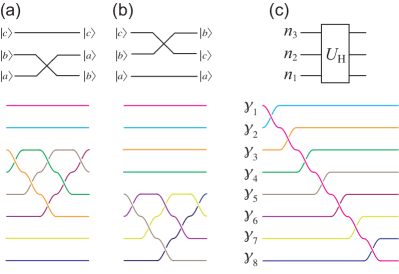
UH(3)=7654321=(1111111111111111111111111111111111111111111111111111111111111111).U_{\text{H}}^{\left(3\right)}=-\mathcal{B}_{7}\mathcal{B}_{6}\mathcal{B}_{5}\mathcal{B}_{4}\mathcal{B}_{3}\mathcal{B}_{2}\mathcal{B}_{1}=\left(\begin{array}[]{cccccccc}1&1&1&1&1&1&1&1\\ 1&-1&1&-1&1&-1&1&-1\\ 1&-1&-1&1&1&-1&-1&1\\ 1&1&-1&-1&1&1&-1&-1\\ 1&-1&-1&1&-1&1&1&-1\\ 1&1&-1&-1&-1&-1&1&1\\ 1&1&1&1&-1&-1&-1&-1\\ 1&-1&1&-1&-1&1&-1&1\end{array}\right). (S92)

See Fig.S5(b). It is different from the cross-product of the Hadamard gate

UHUHUH=(1111111111111111111111111111111111111111111111111111111111111111).U_{\text{H}}\otimes U_{\text{H}}\otimes U_{\text{H}}=\left(\begin{array}[]{cccccccc}1&1&1&1&1&1&1&1\\ 1&-1&1&-1&1&-1&1&-1\\ 1&1&-1&-1&1&1&-1&-1\\ 1&-1&-1&1&1&-1&-1&1\\ 1&1&1&1&-1&-1&-1&-1\\ 1&-1&1&-1&-1&1&-1&1\\ 1&1&-1&-1&-1&-1&1&1\\ 1&-1&-1&1&-1&1&1&-1\end{array}\right). (S93)

There is a relation

UHUHUH=U3PUH(3),U_{\text{H}}\otimes U_{\text{H}}\otimes U_{\text{H}}=-U_{3\text{P}}U_{\text{H}}^{\left(3\right)}, (S94)

where U3PU_{3\text{P}} is defined by

U(1000000001000000000100000010000000000010000000010000010000001000).U\equiv\left(\begin{array}[]{cccccccc}1&0&0&0&0&0&0&0\\ 0&1&0&0&0&0&0&0\\ 0&0&0&1&0&0&0&0\\ 0&0&1&0&0&0&0&0\\ 0&0&0&0&0&0&1&0\\ 0&0&0&0&0&0&0&1\\ 0&0&0&0&0&1&0&0\\ 0&0&0&0&1&0&0&0\end{array}\right). (S95)

It is impossible to generate the W state by braiding

|Wlogical=13(|000logical+|010logical+|100logical),\left|\text{W}\right\rangle_{\text{logical}}=\frac{1}{\sqrt{3}}\left(\left|000\right\rangle_{\text{logical}}+\left|010\right\rangle_{\text{logical}}+\left|100\right\rangle_{\text{logical}}\right), (S96)

because the number of the nonzero terms of the W state is 3, which contradicts the fact that the number of the nonzero terms must be 11, 22, 44 and 88 for three qubit states generated by braiding.

Refer to caption

Figure S5: (a) and (b) iiSWAP gate embedded to three qubit systems. (c) Three-qubit Hadamard transformation.

S16 NN logical qubits

The braid representation of 2N+22N+2 Majorana fermions is equivalent to the π/2\pi/2 rotation in SO(2N+2)\left(2N+2\right), suggested by the fact that braid operators are represented by the Gamma matrices[12, 13]. The number of the braid group is given by[14]

|Image(2n)|={22n1(2n)!forn=even22n(2n)!forn=odd.\left|\text{Image}\left(\mathcal{B}_{2n}\right)\right|=\left\{\begin{array}[]{ccc}2^{2n-1}\left(2n\right)!&\text{for}&n\text{=even}\\ 2^{2n}\left(2n\right)!&\text{for}&n\text{=odd}\end{array}\right.. (S97)

The iiSWAP gate is embedded as

I2k2UiSWAPI2Nk2k+12k+22k+32k+12k+22k+1.I_{2}^{k-2}\otimes U_{i\text{SWAP}}\otimes I_{2}^{N-k}\propto\mathcal{B}_{2k+1}\mathcal{B}_{2k+2}\mathcal{B}_{2k+3}\mathcal{B}_{2k+1}\mathcal{B}_{2k+2}\mathcal{B}_{2k+1}. (S98)

S16.1 Diagonal braiding

We consider odd braiding defined by

odd(n1,n2,,nk)2nk12nk112n11,\mathcal{B}_{\text{odd}}\left(n_{1},n_{2},\cdots,n_{k}\right)\equiv\mathcal{B}_{2n_{k}-1}\mathcal{B}_{2n_{k-1}-1}\cdots\mathcal{B}_{2n_{1}-1}, (S99)

where nkn_{k} is an integer satisfying 1nkN+11\leq n_{k}\leq N+1. They are Abelian braiding because there are no adjacent braiding. Then, there are only 4k4^{k} patterns. Especially, we consider odd double braiding defined by

(odd)2(i2nk12)(i2nk112)(i2n112)\left(\mathcal{B}_{\text{odd}}\right)^{2}\equiv\left(i\mathcal{B}_{2n_{k}-1}^{2}\right)\left(i\mathcal{B}_{2n_{k-1}-1}^{2}\right)\cdots\left(i\mathcal{B}_{2n_{1}-1}^{2}\right) (S100)

are interesting because they are identical to

(odd)2=(σZ)mk(σZ)m2(σZ)m1,\left(\mathcal{B}_{\text{odd}}\right)^{2}=\left(\sigma_{\text{Z}}\right)^{m_{k}}\left(\sigma_{\text{Z}}\right)^{m_{2}}\cdots\left(\sigma_{\text{Z}}\right)^{m_{1}}, (S101)

where mk=0,1m_{k}=0,1. Namely, every Pauli gates constructing from the Pauli Z gate can be generated.

Next, we consider even braiding defined by

even(n1,n2,,nk)2nk2nk12n1.\mathcal{B}_{\text{even}}\left(n_{1},n_{2},\cdots,n_{k}\right)\equiv\mathcal{B}_{2n_{k}}\mathcal{B}_{2n_{k-1}}\cdots\mathcal{B}_{2n_{1}}. (S102)

They are also the Abelian braiding, where each braiding commutes each other. We also consider even double braiding defined by

(even)2(i2nk2)(i2nk12)(i2n12).\left(\mathcal{B}_{\text{even}}\right)^{2}\equiv\left(i\mathcal{B}_{2n_{k}}^{2}\right)\left(i\mathcal{B}_{2n_{k-1}}^{2}\right)\cdots\left(i\mathcal{B}_{2n_{1}}^{2}\right). (S103)

On the other hand, it is impossible to construct the Pauli X gate except for the first qubit. See Eq.(24) in the main text.

S16.2 Hadamard transformation

The Hadamard transformation is used for the initial process of various quantum algorithm such as the Kitaev phase estimation algorithm, the Deutsch algorithm, the Deutsch-Jozsa algorithm, the Simon algorithm, the Bernstein-Vazirani algorithm, the Grover algorithm and the Shor algorithm. It is generated by the braiding

UH(N)2N+12N21.U_{\text{H}}^{\left(N\right)}\propto\mathcal{B}_{2N+1}\mathcal{B}_{2N}\cdots\mathcal{B}_{2}\mathcal{B}_{1}. (S104)

The equal-coefficient state is generated as

UH(N)|0,0logicalj=12N|jlogical,U_{\text{H}}^{\left(N\right)}\left|0,0\right\rangle_{\text{logical}}\propto\sum_{j=1}^{2^{N}}\left|j\right\rangle_{\text{logical}}, (S105)

where |jlogical\left|j\right\rangle_{\text{logical}} is the decimal representation of the qubit.

II 2N2N-body unitary evolution

S1 Quantum gates for one logical qubit

The 22-body Majorana operator 1(θ)\mathcal{B}_{1}\left(\theta\right) is written in terms of fermion operators,

1(θ)=cosθ+γ2γ1sinθ=(cosθ+(ic1c1ic1c1)sinθ),\mathcal{B}_{1}\left(\theta\right)=\cos\theta+\gamma_{2}\gamma_{1}\sin\theta=\left(\cos\theta+\left(ic_{1}^{\dagger}c_{1}-ic_{1}c_{1}^{\dagger}\right)\sin\theta\right), (S106)

which operates on two physical qubits (S10) as

1(θ)Ψphysical=(eiθ0000eiθ0000eiθ0000eiθ)(|0,0|0,1|1,0|1,1)physical.\mathcal{B}_{1}\left(\theta\right)\Psi_{\text{physical}}=\left(\begin{array}[]{cccc}e^{-i\theta}&0&0&0\\ 0&e^{i\theta}&0&0\\ 0&0&e^{-i\theta}&0\\ 0&0&0&e^{i\theta}\end{array}\right)\left(\begin{array}[]{c}\left|0,0\right\rangle\\ \left|0,1\right\rangle\\ \left|1,0\right\rangle\\ \left|1,1\right\rangle\end{array}\right)_{\text{physical}}. (S107)

Taking the even parity basis, the action is

1(θ)Ψlogical=eiθ(100e2iθ)(|0|1)logical.\mathcal{B}_{1}\left(\theta\right)\Psi_{\text{logical}}=e^{-i\theta}\left(\begin{array}[]{cc}1&0\\ 0&e^{2i\theta}\end{array}\right)\left(\begin{array}[]{c}\left|0\right\rangle\\ \left|1\right\rangle\end{array}\right)_{\text{logical}}. (S108)

It is the arbitrary phase-shift gate. Especially, by setting θ=π/8\theta=\pi/8, the T gate is constructed

UTdiag.(1,eiπ/4).U_{\text{T}}\equiv\text{diag.}\left(1,e^{i\pi/4}\right). (S109)

It is identical to the rotation along the zz axis

1(θ)=Rz(2θ),\mathcal{B}_{1}\left(\theta\right)=R_{z}\left(2\theta\right), (S110)

with

Rz(θ)exp[iθ2σz]=(eiθ/200eiθ/2).R_{z}\left(\theta\right)\equiv\exp\left[-i\frac{\theta}{2}\sigma_{z}\right]=\left(\begin{array}[]{cc}e^{-i\theta/2}&0\\ 0&e^{i\theta/2}\end{array}\right). (S111)

The operator 2\mathcal{B}_{2} is written in terms of fermion operators,

2(θ)=cosθ+γ3γ2sinθ=cosθ+(ic2c1+ic2c1ic2c1ic2c1)sinθ,\mathcal{B}_{2}\left(\theta\right)=\cos\theta+\gamma_{3}\gamma_{2}\sin\theta=\cos\theta+\left(ic_{2}c_{1}^{\dagger}+ic_{2}^{\dagger}c_{1}^{\dagger}-ic_{2}c_{1}-ic_{2}^{\dagger}c_{1}\right)\sin\theta, (S112)

which operates on two physical qubits (S10) as[2],

2(θ)Ψphysical=(cosθ00isinθ0cosθisinθ00isinθcosθ0isinθ00cosθ)(|0,0|0,1|1,0|1,1)physical.\mathcal{B}_{2}\left(\theta\right)\Psi_{\text{physical}}=\left(\begin{array}[]{cccc}\cos\theta&0&0&-i\sin\theta\\ 0&\cos\theta&-i\sin\theta&0\\ 0&-i\sin\theta&\cos\theta&0\\ -i\sin\theta&0&0&\cos\theta\end{array}\right)\left(\begin{array}[]{c}\left|0,0\right\rangle\\ \left|0,1\right\rangle\\ \left|1,0\right\rangle\\ \left|1,1\right\rangle\end{array}\right)_{\text{physical}}. (S113)

In the even parity basis, the action is

2(θ)=(cosθisinθisinθcosθ)Rx(2θ),\mathcal{B}_{2}\left(\theta\right)=\left(\begin{array}[]{cc}\cos\theta&-i\sin\theta\\ -i\sin\theta&\cos\theta\end{array}\right)\equiv R_{x}\left(2\theta\right), (S114)

which is identical to the rotation along the xx axis

2(θ)=Rx(2θ),\mathcal{B}_{2}\left(\theta\right)=R_{x}\left(2\theta\right), (S115)

with

Rx(θ)exp[iθ2σx]=(cosθ2isinθ2isinθ2cosθ2).R_{x}\left(\theta\right)\equiv\exp\left[-i\frac{\theta}{2}\sigma_{x}\right]=\left(\begin{array}[]{cc}\cos\frac{\theta}{2}&-i\sin\frac{\theta}{2}\\ -i\sin\frac{\theta}{2}&\cos\frac{\theta}{2}\end{array}\right). (S116)

The operator 3(θ)\mathcal{B}_{3}\left(\theta\right) is written in terms of fermion operators

3(θ)=cosθ+γ4γ3sinθ=cosθ+(ic2c2ic2c2)sinθ,\mathcal{B}_{3}\left(\theta\right)=\cos\theta+\gamma_{4}\gamma_{3}\sin\theta=\cos\theta+\left(ic_{2}^{\dagger}c_{2}-ic_{2}c_{2}^{\dagger}\right)\sin\theta, (S117)

which operates on two physical qubits (S10) as[2]

3(θ)Ψphysical=(eiθ0000eiθ0000eiθ0000eiθ)(|0,0|0,1|1,0|1,1)physical.\mathcal{B}_{3}\left(\theta\right)\Psi_{\text{physical}}=\left(\begin{array}[]{cccc}e^{-i\theta}&0&0&0\\ 0&e^{-i\theta}&0&0\\ 0&0&e^{i\theta}&0\\ 0&0&0&e^{i\theta}\end{array}\right)\left(\begin{array}[]{c}\left|0,0\right\rangle\\ \left|0,1\right\rangle\\ \left|1,0\right\rangle\\ \left|1,1\right\rangle\end{array}\right)_{\text{physical}}. (S118)

In the even parity basis, the action is the same as (S108),

3(θ)=eiθ(100e2iθ)(|0|1)logical.\mathcal{B}_{3}\left(\theta\right)=e^{-i\theta}\left(\begin{array}[]{cc}1&0\\ 0&e^{2i\theta}\end{array}\right)\left(\begin{array}[]{c}\left|0\right\rangle\\ \left|1\right\rangle\end{array}\right)_{\text{logical}}. (S119)

The rotation along the yy axis defined by

Ry(θ)exp[iθ2σy]R_{y}\left(\theta\right)\equiv\exp\left[-i\frac{\theta}{2}\sigma_{y}\right] (S120)

is realized by the sequential operations

Ry(θ)=Rz(π2)Rx(θ)Rz(π2).R_{y}\left(\theta\right)=R_{z}\left(\frac{\pi}{2}\right)R_{x}\left(\theta\right)R_{z}\left(-\frac{\pi}{2}\right). (S121)

S2 Three physical qubits

Next, we study the six Majorana fermion system. The explicit actions on the physical qubits are

1(θ)\displaystyle\mathcal{B}_{1}\left(\theta\right) =I2I2Rz(2θ),\displaystyle=I_{2}\otimes I_{2}\otimes R_{z}\left(2\theta\right),
2(θ)\displaystyle\mathcal{B}_{2}\left(\theta\right) =I2Uxx(θ),\displaystyle=I_{2}\otimes U_{xx}\left(\theta\right),
3(θ)\displaystyle\mathcal{B}_{3}\left(\theta\right) =I2Rz(2θ)I2,\displaystyle=I_{2}\otimes R_{z}\left(2\theta\right)\otimes I_{2},
4(θ)\displaystyle\mathcal{B}_{4}\left(\theta\right) =UxxI2,\displaystyle=U_{xx}\otimes I_{2},
5(θ)\displaystyle\mathcal{B}_{5}\left(\theta\right) =Rz(2θ)I2I2.\displaystyle=R_{z}\left(2\theta\right)\otimes I_{2}\otimes I_{2}. (S122)

S3 Two logical qubits

Two logical qubits are constructed from three physical qubits by taking the even parity basis. The action of 1(θ)\mathcal{B}_{1}\left(\theta\right) to the logical qubit is

1(θ)=diag.(eiθ,eiθ,eiθ,eiθ),\mathcal{B}_{1}\left(\theta\right)=\text{diag.}\left(e^{-i\theta},e^{i\theta},e^{i\theta},e^{-i\theta}\right), (S123)

which is identical to the ZZ interaction

1(θ)=Uzz(2θ),\mathcal{B}_{1}\left(\theta\right)=U_{zz}\left(2\theta\right), (S124)

with

Uzz(θ)exp[iθ2σzσz].U_{zz}\left(\theta\right)\equiv\exp\left[-i\frac{\theta}{2}\sigma_{z}\otimes\sigma_{z}\right]. (S125)

The action of 4(θ)\mathcal{B}_{4}\left(\theta\right) to the logical qubit is

4(θ)=(cosθ00isinθ0cosθisinθ00isinθcosθ0isinθ00cosθ),\mathcal{B}_{4}\left(\theta\right)=\left(\begin{array}[]{cccc}\cos\theta&0&0&-i\sin\theta\\ 0&\cos\theta&-i\sin\theta&0\\ 0&-i\sin\theta&\cos\theta&0\\ -i\sin\theta&0&0&\cos\theta\end{array}\right), (S126)

which is identical to the xx interaction

4(θ)=Uxx(2θ),\mathcal{B}_{4}\left(\theta\right)=U_{xx}\left(2\theta\right), (S127)

with

Uxx(θ)exp[iθ2σxσx].U_{xx}\left(\theta\right)\equiv\exp\left[-i\frac{\theta}{2}\sigma_{x}\otimes\sigma_{x}\right]. (S128)

The action of 3(θ)\mathcal{B}_{3}\left(\theta\right) and 5(θ)\mathcal{B}_{5}\left(\theta\right) to the logical qubit is

3(θ)\displaystyle\mathcal{B}_{3}\left(\theta\right) =\displaystyle= diag.(eiθ,eiθ,eiθ,eiθ)=I2Uz(θ),\displaystyle\text{diag.}\left(e^{-i\theta},e^{i\theta},e^{-i\theta},e^{i\theta}\right)=I_{2}\otimes U_{z}\left(\theta\right),
5(θ)\displaystyle\mathcal{B}_{5}\left(\theta\right) =\displaystyle= diag.(eiθ,eiθ,eiθ,eiθ)=Uz(θ)I2.\displaystyle\text{diag.}\left(e^{-i\theta},e^{-i\theta},e^{i\theta},e^{i\theta}\right)=U_{z}\left(\theta\right)\otimes I_{2}. (S129)

The action of 2(θ)\mathcal{B}_{2}\left(\theta\right) to the logical qubit is

2(θ)=(cosθisinθ00isinθcosθ0000cosθisinθ00isinθcosθ),\mathcal{B}_{2}\left(\theta\right)=\left(\begin{array}[]{cccc}\cos\theta&-i\sin\theta&0&0\\ -i\sin\theta&\cos\theta&0&0\\ 0&0&\cos\theta&-i\sin\theta\\ 0&0&-i\sin\theta&\cos\theta\end{array}\right), (S130)

which is rewritten in the form of

2(θ)\displaystyle\mathcal{B}_{2}\left(\theta\right) =\displaystyle= I2Rx(2θ),\displaystyle I_{2}\otimes R_{x}\left(2\theta\right),
2345(θ)\displaystyle\mathcal{B}_{2345}\left(\theta\right) =\displaystyle= Rx(2θ)I2.\displaystyle R_{x}\left(2\theta\right)\otimes I_{2}. (S131)

S4 Controlled phase-shift gate

We find

6(θ3)3(θ2)1(θ1)=diag.(ei(θ1+θ2+θ3),ei(θ1+θ2θ3),ei(θ1θ2+θ3),ei(θ1+θ2+θ3)).\mathcal{B}_{6}\left(\theta_{3}\right)\mathcal{B}_{3}\left(\theta_{2}\right)\mathcal{B}_{1}\left(\theta_{1}\right)=\text{diag.}\left(e^{-i\left(\theta_{1}+\theta_{2}+\theta_{3}\right)},e^{i\left(\theta_{1}+\theta_{2}-\theta_{3}\right)},e^{i\left(\theta_{1}-\theta_{2}+\theta_{3}\right)},e^{i\left(-\theta_{1}+\theta_{2}+\theta_{3}\right)}\right). (S132)

The controlled phase-shift gate with arbitrary phase is constructed by setting θ1=θ2=θ3=θ\theta_{1}=-\theta_{2}=-\theta_{3}=-\theta,

5(θ)3(θ)1(θ)=diag.(eiθ,eiθ,eiθ,e3iθ)=eiθdiag.(1,1,1,e4iθ).\mathcal{B}_{5}\left(-\theta\right)\mathcal{B}_{3}\left(\theta\right)\mathcal{B}_{1}\left(\theta\right)=\text{diag.}\left(e^{-i\theta},e^{-i\theta},e^{-i\theta},e^{3i\theta}\right)=e^{-i\theta}\text{diag.}\left(1,1,1,e^{4i\theta}\right). (S133)

Especially, the CZ gate is constructed by setting θ=π/4.\theta=\pi/4.

S5 Controlled-unitary gate

It is known that the controlled unitary gate is constructed as[22]

UC-U=(I2UA)UCNOT(I2UB)UCNOT(I2UC)U_{\text{C-}U}=\left(I_{2}\otimes U_{A}\right)U_{\text{CNOT}}\left(I_{2}\otimes U_{B}\right)U_{\text{CNOT}}\left(I_{2}\otimes U_{C}\right) (S134)

with

UARz(β)Ry(γ2),UBRy(γ2)Rz(β+δ2),UCRz(δβ2),U_{A}\equiv R_{z}\left(\beta\right)R_{y}\left(\frac{\gamma}{2}\right),\qquad U_{B}\equiv R_{y}\left(-\frac{\gamma}{2}\right)R_{z}\left(-\frac{\beta+\delta}{2}\right),\qquad U_{C}\equiv R_{z}\left(\frac{\delta-\beta}{2}\right), (S135)

because

UAUBUC=I4U_{A}U_{B}U_{C}=I_{4} (S136)

and

UAXUBXUC=Rz(β)Ry(γ)Rz(δ)=U1bit.U_{A}XU_{B}XU_{C}=R_{z}\left(\beta\right)R_{y}\left(\gamma\right)R_{z}\left(\delta\right)=U_{\text{1bit}}. (S137)

In the Majorana system, the basic rotations are not along the yy axis but the xx axis. The similar decomposition is possible only by using the rotations along the zz and xx axes as

UA=Rz(β+π2)Rx(γ2),UB=Rx(γ2)Rz(β+δ2),UC=Rz(δβπ2).U_{A}=R_{z}\left(\beta+\frac{\pi}{2}\right)R_{x}\left(\frac{\gamma}{2}\right),\qquad U_{B}=R_{x}\left(-\frac{\gamma}{2}\right)R_{z}\left(-\frac{\beta+\delta}{2}\right),\qquad U_{C}=R_{z}\left(\frac{\delta-\beta-\pi}{2}\right). (S138)

The proof is similar. First, we have

UAUBUC=1,U_{A}U_{B}U_{C}=1,

where we have used the relation

Rj(θ1)Rj(θ2)=Rj(θ1+θ2)R_{j}\left(\theta_{1}\right)R_{j}\left(\theta_{2}\right)=R_{j}\left(\theta_{1}+\theta_{2}\right) (S139)

for j=x,yj=x,y and zz. Next, we have

UAXUBXUC=U1bit,U_{A}XU_{B}XU_{C}=U_{\text{1bit}},

where we have used the relation

R(θ)X=XR(θ).R\left(\theta\right)X=XR\left(-\theta\right). (S140)

Hence, the controlled unitary gate is implemented by 22-body Majorana interaction.

S6 Four physical qubits

We consider eight Majorana fermion system The explicit actions on four physical qubits are given by

1\displaystyle\mathcal{B}_{1} =I8Rz(2θ),\displaystyle=I_{8}\otimes R_{z}\left(2\theta\right),
2\displaystyle\mathcal{B}_{2} =I4Uxx(θ),\displaystyle=I_{4}\otimes U_{xx}\left(\theta\right),
3\displaystyle\mathcal{B}_{3} =I4Rz(2θ)I2,\displaystyle=I_{4}\otimes R_{z}\left(2\theta\right)\otimes I_{2},
4\displaystyle\mathcal{B}_{4} =I2Uxx(θ)I2,\displaystyle=I_{2}\otimes U_{xx}\left(\theta\right)\otimes I_{2},
5\displaystyle\mathcal{B}_{5} =I2Rz(2θ)I4,\displaystyle=I_{2}\otimes R_{z}\left(2\theta\right)\otimes I_{4},
6\displaystyle\mathcal{B}_{6} =Uxx(θ)I4,\displaystyle=U_{xx}\left(\theta\right)\otimes I_{4},
7\displaystyle\mathcal{B}_{7} =Rz(2θ)I8.\displaystyle=R_{z}\left(2\theta\right)\otimes I_{8}. (S141)

We summarize results on constructing full set of Pauli Z gate for three logical qubits in  the following table:

4 physical qubits 3 logical qubits
12(θ)\quad\mathcal{B}_{12}\left(\theta\right) exp[iθI8σz]\quad\exp\left[-i\theta I_{8}\otimes\sigma_{z}\right] exp[iθσzσzσz]\quad\exp\left[-i\theta\sigma_{z}\otimes\sigma_{z}\otimes\sigma_{z}\right]\quad
34(θ)\quad\mathcal{B}_{34}\left(\theta\right) exp[iθI4σzI2]\quad\exp\left[-i\theta I_{4}\otimes\sigma_{z}\otimes I_{2}\right] exp[iθI4σz]\quad\exp\left[-i\theta I_{4}\otimes\sigma_{z}\right]
56(θ)\quad\mathcal{B}_{56}\left(\theta\right) exp[iθI2σzI4]\quad\exp\left[-i\theta I_{2}\otimes\sigma_{z}\otimes I_{4}\right] exp[iθI2σzI2]\quad\exp\left[-i\theta I_{2}\otimes\sigma_{z}\otimes I_{2}\right]
78(θ)\quad\mathcal{B}_{78}\left(\theta\right) exp[iθσzI8]\quad\exp\left[-i\theta\sigma_{z}\otimes I_{8}\right] exp[iθσzI4]\quad\exp\left[-i\theta\sigma_{z}\otimes I_{4}\right]
1234(4)(θ)\quad\mathcal{B}_{1234}^{\left(4\right)}\left(\theta\right) exp[iθI4σzσz]\quad\exp\left[-i\theta I_{4}\otimes\sigma_{z}\otimes\sigma_{z}\right] exp[iθσzσzI2]\quad\exp\left[-i\theta\sigma_{z}\otimes\sigma_{z}\otimes I_{2}\right]
1256(4)(θ)\quad\mathcal{B}_{1256}^{\left(4\right)}\left(\theta\right) exp[iθI2σzI2σz]\quad\exp\left[-i\theta I_{2}\otimes\sigma_{z}\otimes I_{2}\otimes\sigma_{z}\right] exp[iθσzI2σz]\quad\exp\left[-i\theta\sigma_{z}\otimes I_{2}\otimes\sigma_{z}\right]
1278(4)(θ)\quad\mathcal{B}_{1278}^{\left(4\right)}\left(\theta\right) exp[iθσzI2I2σz]\quad\exp\left[-i\theta\sigma_{z}\otimes I_{2}\otimes I_{2}\otimes\sigma_{z}\right] exp[iθI2σzσz]\quad\exp\left[-i\theta I_{2}\otimes\sigma_{z}\otimes\sigma_{z}\right]
3456(4)(θ)\quad\mathcal{B}_{3456}^{\left(4\right)}\left(\theta\right) exp[iθI2σzσzI2]\quad\exp\left[-i\theta I_{2}\otimes\sigma_{z}\otimes\sigma_{z}\otimes I_{2}\right] exp[iθI2σzσz]\quad\exp\left[-i\theta I_{2}\otimes\sigma_{z}\otimes\sigma_{z}\right]
3478(4)(θ)\quad\mathcal{B}_{3478}^{\left(4\right)}\left(\theta\right) exp[iθσzI2σzI2]\quad\exp\left[-i\theta\sigma_{z}\otimes I_{2}\otimes\sigma_{z}\otimes I_{2}\right] exp[iθσzI2σz]\quad\exp\left[-i\theta\sigma_{z}\otimes I_{2}\otimes\sigma_{z}\right]
5678(4)(θ)\quad\mathcal{B}_{5678}^{\left(4\right)}\left(\theta\right) exp[iθσzσzI2I2]\quad\exp\left[-i\theta\sigma_{z}\otimes\sigma_{z}\otimes I_{2}\otimes I_{2}\right] exp[iθσzσzI2]\quad\exp\left[-i\theta\sigma_{z}\otimes\sigma_{z}\otimes I_{2}\right]
123456(6)(θ)\quad\mathcal{B}_{123456}^{\left(6\right)}\left(\theta\right) exp[iθI2σzσzσz]\quad\exp\left[-i\theta I_{2}\otimes\sigma_{z}\otimes\sigma_{z}\otimes\sigma_{z}\right] exp[iθσzI4]\quad\exp\left[-i\theta\sigma_{z}\otimes I_{4}\right]
123478(6)(θ)\quad\mathcal{B}_{123478}^{\left(6\right)}\left(\theta\right) exp[iθσzI2σzσz]\quad\exp\left[-i\theta\sigma_{z}\otimes I_{2}\otimes\sigma_{z}\otimes\sigma_{z}\right] exp[iθI2σzI2]\quad\exp\left[-i\theta I_{2}\otimes\sigma_{z}\otimes I_{2}\right]
125678(6)(θ)\quad\mathcal{B}_{125678}^{\left(6\right)}\left(\theta\right) exp[iθσzσzI2σz]\quad\exp\left[-i\theta\sigma_{z}\otimes\sigma_{z}\otimes I_{2}\otimes\sigma_{z}\right] exp[iθI4σz]\quad\exp\left[-i\theta I_{4}\otimes\sigma_{z}\right]
345678(6)(θ)\quad\mathcal{B}_{345678}^{\left(6\right)}\left(\theta\right) exp[iθσzσzσzI2]\quad\exp\left[-i\theta\sigma_{z}\otimes\sigma_{z}\otimes\sigma_{z}\otimes I_{2}\right] exp[iθσzσzσz]\quad\exp\left[-i\theta\sigma_{z}\otimes\sigma_{z}\otimes\sigma_{z}\right]
12345678(8)(θ)\quad\mathcal{B}_{12345678}^{\left(8\right)}\left(\theta\right)\quad exp[iθσzσzσzσz]\quad\exp\left[-i\theta\sigma_{z}\otimes\sigma_{z}\otimes\sigma_{z}\otimes\sigma_{z}\right]\quad exp[iθI8]\quad\exp\left[-i\theta I_{8}\right]
(S142)

We have the identical logical qubits:

12(θ)\displaystyle\mathcal{B}_{12}\left(\theta\right) \displaystyle\simeq 345678(θ),34(θ)125678(θ),56(θ)123478(θ),78(θ)123456(θ),\displaystyle\mathcal{B}_{345678}\left(\theta\right),\qquad\mathcal{B}_{34}\left(\theta\right)\simeq\mathcal{B}_{125678}\left(\theta\right),\qquad\mathcal{B}_{56}\left(\theta\right)\simeq\mathcal{B}_{123478}\left(\theta\right),\qquad\mathcal{B}_{78}\left(\theta\right)\simeq\mathcal{B}_{123456}\left(\theta\right),
1234(θ)\displaystyle\mathcal{B}_{1234}\left(\theta\right) \displaystyle\simeq 5678(θ),1256(θ)3478(θ),1278(θ)3456(θ).\displaystyle\mathcal{B}_{5678}\left(\theta\right),\qquad\mathcal{B}_{1256}\left(\theta\right)\simeq\mathcal{B}_{3478}\left(\theta\right),\qquad\mathcal{B}_{1278}\left(\theta\right)\simeq\mathcal{B}_{3456}\left(\theta\right). (S143)

S7 Three logical qubits

Three logical qubits are constructed from four physical qubits by taking the even parity basis.

12\displaystyle\mathcal{B}_{12} =\displaystyle= diag.(eiθ,eiθ,eiθ,eiθ,eiθ,eiθ,eiθ,eiθ)=exp[iθσzσzσz],\displaystyle\text{diag.}\left(e^{-i\theta},e^{i\theta},e^{i\theta},e^{-i\theta},e^{i\theta},e^{-i\theta},e^{-i\theta},e^{i\theta}\right)=\exp\left[-i\theta\sigma_{z}\otimes\sigma_{z}\otimes\sigma_{z}\right],
23\displaystyle\mathcal{B}_{23} =\displaystyle= I2I2Rx(2θ),\displaystyle I_{2}\otimes I_{2}\otimes R_{x}\left(2\theta\right),
34\displaystyle\mathcal{B}_{34} =\displaystyle= I2I2Rz(2θ)=exp[iθI2I2σz],\displaystyle I_{2}\otimes I_{2}\otimes R_{z}\left(2\theta\right)=\exp\left[-i\theta I_{2}\otimes I_{2}\otimes\sigma_{z}\right],
45\displaystyle\mathcal{B}_{45} =\displaystyle= I2Uxx(2θ),\displaystyle I_{2}\otimes U_{xx}\left(2\theta\right),
56\displaystyle\mathcal{B}_{56} =\displaystyle= I2Rz(2θ)I2=exp[iθI2σzI2],\displaystyle I_{2}\otimes R_{z}\left(2\theta\right)\otimes I_{2}=\exp\left[-i\theta I_{2}\otimes\sigma_{z}\otimes I_{2}\right],
67\displaystyle\mathcal{B}_{67} =\displaystyle= Uxx(2θ)I2,\displaystyle U_{xx}\left(2\theta\right)\otimes I_{2},
78\displaystyle\mathcal{B}_{78} =\displaystyle= Rz(2θ)I4.\displaystyle R_{z}\left(2\theta\right)\otimes I_{4}. (S144)

We find that controlled-controlled phase shift gate cannot be implemented only by diagonal braiding. It is proved by counting the number of the degrees of freedom. We need to tune 7 parameters for the diagonal quantum gates. On the other hand, there are only three independent angle because the diagonal operators are 1\mathcal{B}_{1}, 3\mathcal{B}_{3} and 5\mathcal{B}_{5}. Hence, it is impossible to construct controlled-controlled phase shift gate in general. However, this problem is solved by introducing many-body Majorana interaction,

UCCϕ=12(ϕ8)34(ϕ8)56(ϕ8)78(ϕ8)1234(4)(ϕ8)1278(4)(ϕ8)1256(4)(ϕ8).U_{\text{CC}\phi}=\mathcal{B}_{12}\left(\frac{\phi}{8}\right)\mathcal{B}_{34}\left(\frac{\phi}{8}\right)\mathcal{B}_{56}\left(\frac{\phi}{8}\right)\mathcal{B}_{78}\left(\frac{\phi}{8}\right)\mathcal{B}_{1234}^{\left(4\right)}\left(-\frac{\phi}{8}\right)\mathcal{B}_{1278}^{\left(4\right)}\left(-\frac{\phi}{8}\right)\mathcal{B}_{1256}^{\left(4\right)}\left(-\frac{\phi}{8}\right). (S145)

Especially, the CCZ gate is constructed as follows

UCCZ=12(π8)34(π8)56(π8)78(π8)1234(4)(π8)1278(4)(π8)1256(4)(π8).U_{\text{CCZ}}=\mathcal{B}_{12}\left(\frac{\pi}{8}\right)\mathcal{B}_{34}\left(\frac{\pi}{8}\right)\mathcal{B}_{56}\left(\frac{\pi}{8}\right)\mathcal{B}_{78}\left(\frac{\pi}{8}\right)\mathcal{B}_{1234}^{\left(4\right)}\left(-\frac{\pi}{8}\right)\mathcal{B}_{1278}^{\left(4\right)}\left(-\frac{\pi}{8}\right)\mathcal{B}_{1256}^{\left(4\right)}\left(-\frac{\pi}{8}\right). (S146)

The Toffoli gate is constructed by applying the Hadamard gate to the CCZ gate as in

UToffloi=(I4UH)UCCZ(I4UH).U_{\text{Toffloi}}=\left(I_{4}\otimes U_{\text{H}}\right)U_{\text{CCZ}}\left(I_{4}\otimes U_{\text{H}}\right). (S147)

See Fig.1(a).

The Fredkin gate is constructed by sequential applications of three Toffoli gates as in

UFredkin=UToffoli(3,2)1UToffoli(3,1)2UToffoli(3,2)1.U_{\text{Fredkin}}=U_{\text{Toffoli}}^{\left(3,2\right)\rightarrow 1}U_{\text{Toffoli}}^{\left(3,1\right)\rightarrow 2}U_{\text{Toffoli}}^{\left(3,2\right)\rightarrow 1}. (S148)

See Fig.1(b).

The CZ gate in three qubits are embedded as

UCZ32\displaystyle U_{\text{CZ}}^{3\rightarrow 2} =\displaystyle= 56(π4)78(π4)1234(4)(π4),\displaystyle\mathcal{B}_{56}\left(\frac{\pi}{4}\right)\mathcal{B}_{78}\left(\frac{\pi}{4}\right)\mathcal{B}_{1234}^{\left(4\right)}\left(-\frac{\pi}{4}\right),
UCZ31\displaystyle U_{\text{CZ}}^{3\rightarrow 1} =\displaystyle= 34(π4)78(π4)1234(4)(π4),\displaystyle\mathcal{B}_{34}\left(\frac{\pi}{4}\right)\mathcal{B}_{78}\left(\frac{\pi}{4}\right)\mathcal{B}_{1234}^{\left(4\right)}\left(-\frac{\pi}{4}\right),
UCZ21\displaystyle U_{\text{CZ}}^{2\rightarrow 1} =\displaystyle= 34(π4)56(π4)1278(4)(π4).\displaystyle\mathcal{B}_{34}\left(\frac{\pi}{4}\right)\mathcal{B}_{56}\left(\frac{\pi}{4}\right)\mathcal{B}_{1278}^{\left(4\right)}\left(-\frac{\pi}{4}\right). (S149)

S8 Logical 4 qubits

We summarize results on constructing full set of Pauli Z gate for four logical qubits in  the following table:

4 logical qubits
12(θ)\quad\mathcal{B}_{12}\left(\theta\right) exp[iθσzσzσzσz]\quad\exp\left[-i\theta\sigma_{z}\otimes\sigma_{z}\otimes\sigma_{z}\otimes\sigma_{z}\right]\quad
34(θ)\quad\mathcal{B}_{34}\left(\theta\right) exp[iθI8σz]\quad\exp\left[-i\theta I_{8}\otimes\sigma_{z}\right]
56(θ)\quad\mathcal{B}_{56}\left(\theta\right) exp[iθI4σzI2]\quad\exp\left[-i\theta I_{4}\otimes\sigma_{z}\otimes I_{2}\right]
78(θ)\quad\mathcal{B}_{78}\left(\theta\right) exp[iθI2σzI4]\quad\exp\left[-i\theta I_{2}\otimes\sigma_{z}\otimes I_{4}\right]
90(θ)\quad\mathcal{B}_{90}\left(\theta\right) exp[iθσzI8]\quad\exp\left[-i\theta\sigma_{z}\otimes I_{8}\right]
1234(4)(θ)\quad\mathcal{B}_{1234}^{\left(4\right)}\left(\theta\right) exp[iθσzσzσzI2]\quad\exp\left[-i\theta\sigma_{z}\otimes\sigma_{z}\otimes\sigma_{z}\otimes I_{2}\right]
1256(4)(θ)\quad\mathcal{B}_{1256}^{\left(4\right)}\left(\theta\right) exp[iθσzσzI2σz]\quad\exp\left[-i\theta\sigma_{z}\otimes\sigma_{z}\otimes I_{2}\otimes\sigma_{z}\right]
1278(4)(θ)\quad\mathcal{B}_{1278}^{\left(4\right)}\left(\theta\right) exp[iθσzI2σzσz]\quad\exp\left[-i\theta\sigma_{z}\otimes I_{2}\otimes\sigma_{z}\otimes\sigma_{z}\right]
1290(4)(θ)\quad\mathcal{B}_{1290}^{\left(4\right)}\left(\theta\right) exp[iθI2σzσzσz]\quad\exp\left[-i\theta I_{2}\otimes\sigma_{z}\otimes\sigma_{z}\otimes\sigma_{z}\right]
3456(4)(θ)\quad\mathcal{B}_{3456}^{\left(4\right)}\left(\theta\right) exp[iθI2I2σzσz]\quad\exp\left[-i\theta I_{2}\otimes I_{2}\otimes\sigma_{z}\otimes\sigma_{z}\right]
3478(4)(θ)\quad\mathcal{B}_{3478}^{\left(4\right)}\left(\theta\right) exp[iθI2σzI2σz]\quad\exp\left[-i\theta I_{2}\otimes\sigma_{z}\otimes I_{2}\otimes\sigma_{z}\right]
3490(4)(θ)\quad\mathcal{B}_{3490}^{\left(4\right)}\left(\theta\right) exp[iθσzI4σz]\quad\exp\left[-i\theta\sigma_{z}\otimes I_{4}\otimes\sigma_{z}\right]
5678(4)(θ)\quad\mathcal{B}_{5678}^{\left(4\right)}\left(\theta\right) exp[iθI2σzσzI2]\quad\exp\left[-i\theta I_{2}\otimes\sigma_{z}\otimes\sigma_{z}\otimes I_{2}\right]
5690(4)(θ)\quad\mathcal{B}_{5690}^{\left(4\right)}\left(\theta\right) exp[iθσzI2σzI2]\quad\exp\left[-i\theta\sigma_{z}\otimes I_{2}\otimes\sigma_{z}\otimes I_{2}\right]
7890(4)(θ)\quad\mathcal{B}_{7890}^{\left(4\right)}\left(\theta\right)\quad exp[iθσzσzI4]\quad\exp\left[-i\theta\sigma_{z}\otimes\sigma_{z}\otimes I_{4}\right]
(S150)

where 0 is an abbreviation of 1010. The CCCϕ\phi gate is explicitly constructed as

UC3ϕ=34(ϕ16)56(ϕ16)78(ϕ16)90(ϕ16)1234(4)(ϕ16)1256(4)(ϕ16)1278(4)(ϕ16)1290(4)(ϕ16)\displaystyle U_{\text{C}^{3}\phi}=\mathcal{B}_{34}\left(\frac{\phi}{16}\right)\mathcal{B}_{56}\left(\frac{\phi}{16}\right)\mathcal{B}_{78}\left(\frac{\phi}{16}\right)\mathcal{B}_{90}\left(\frac{\phi}{16}\right)\mathcal{B}_{1234}^{\left(4\right)}\left(\frac{\phi}{16}\right)\mathcal{B}_{1256}^{\left(4\right)}\left(\frac{\phi}{16}\right)\mathcal{B}_{1278}^{\left(4\right)}\left(\frac{\phi}{16}\right)\mathcal{B}_{1290}^{\left(4\right)}\left(\frac{\phi}{16}\right)
3456(4)(ϕ16)3478(4)(ϕ16)3490(4)(ϕ16)5678(4)(ϕ16)5690(4)(ϕ16)7890(4)(ϕ16)12(4)(ϕ16).\displaystyle\mathcal{B}_{3456}^{\left(4\right)}\left(-\frac{\phi}{16}\right)\mathcal{B}_{3478}^{\left(4\right)}\left(-\frac{\phi}{16}\right)\mathcal{B}_{3490}^{\left(4\right)}\left(-\frac{\phi}{16}\right)\mathcal{B}_{5678}^{\left(4\right)}\left(\frac{\phi}{16}\right)\mathcal{B}_{5690}^{\left(4\right)}\left(-\frac{\phi}{16}\right)\mathcal{B}_{7890}^{\left(4\right)}\left(-\frac{\phi}{16}\right)\mathcal{B}_{12}^{\left(4\right)}\left(-\frac{\phi}{16}\right). (S151)

S9 Generalized braid group relation

We consider the case θ=π/4\theta=\pi/4. The Artin braid group relation reads[1],

αβ=βαfor |αβ|2,αα+1α=α+1αα+1.\mathcal{B}_{\alpha}\mathcal{B}_{\beta}=\mathcal{B}_{\beta}\mathcal{B}_{\alpha}\qquad\text{for\quad}\left|\alpha-\beta\right|\geq 2,\qquad\mathcal{B}_{\alpha}\mathcal{B}_{\alpha+1}\mathcal{B}_{\alpha}=\mathcal{B}_{\alpha+1}\mathcal{B}_{\alpha}\mathcal{B}_{\alpha+1}. (S152)

It is identical to the extraspecial 2 group[23]

Mα2\displaystyle M_{\alpha}^{2} =\displaystyle= 1,MαMα+1=Mα+1Mα,\displaystyle-1,\qquad M_{\alpha}M_{\alpha+1}=-M_{\alpha+1}M_{\alpha},
MaMβ\displaystyle M_{a}M_{\beta} =\displaystyle= MβMα,for |αβ|2,\displaystyle M_{\beta}M_{\alpha},\qquad\text{for\quad}\left|\alpha-\beta\right|\geq 2, (S153)

by setting

α(4)=12(1+Mα).\mathcal{B}_{\alpha}^{\left(4\right)}=\frac{1}{\sqrt{2}}\left(1+M_{\alpha}\right). (S154)

It is straightforward to show that

(Mα(4))2\displaystyle\left(M_{\alpha}^{\left(4\right)}\right)^{2} =\displaystyle= 1,\displaystyle-1,
Mα(4)Mα+1(4)\displaystyle M_{\alpha}^{\left(4\right)}M_{\alpha+1}^{\left(4\right)} =\displaystyle= Mα+1(4)Mα(4),\displaystyle-M_{\alpha+1}^{\left(4\right)}M_{\alpha}^{\left(4\right)},
Mα(4)Mα+2(4)\displaystyle M_{\alpha}^{\left(4\right)}M_{\alpha+2}^{\left(4\right)} =\displaystyle= Mα+2(4)Mα(4),\displaystyle M_{\alpha+2}^{\left(4\right)}M_{\alpha}^{\left(4\right)},
Mα(4)Mα+3(4)\displaystyle M_{\alpha}^{\left(4\right)}M_{\alpha+3}^{\left(4\right)} =\displaystyle= Mα+3(4)Mα(4),\displaystyle-M_{\alpha+3}^{\left(4\right)}M_{\alpha}^{\left(4\right)},
Ma(4)Mβ(4)\displaystyle M_{a}^{\left(4\right)}M_{\beta}^{\left(4\right)} =\displaystyle= Mβ(4)Mα(4)for|αβ|4,\displaystyle M_{\beta}^{\left(4\right)}M_{\alpha}^{\left(4\right)}\quad\text{for}\quad\left|\alpha-\beta\right|\geq 4, (S155)

when we set

Mα(4)iγ4γ3γ2γ1.M_{\alpha}^{\left(4\right)}\equiv i\gamma_{4}\gamma_{3}\gamma_{2}\gamma_{1}. (S156)

It is a generalization of the extraspecial 2 group. Correspondingly, we obtain a generalized braiding group relation

α(4)α+1(4)α(4)=α+1(4)α(4)α+1(4),α(4)α+3(4)α(4)=α+3(4)α(4)α+3(4),\mathcal{B}_{\alpha}^{\left(4\right)}\mathcal{B}_{\alpha+1}^{\left(4\right)}\mathcal{B}_{\alpha}^{\left(4\right)}=\mathcal{B}_{\alpha+1}^{\left(4\right)}\mathcal{B}_{\alpha}^{\left(4\right)}\mathcal{B}_{\alpha+1}^{\left(4\right)},\qquad\mathcal{B}_{\alpha}^{\left(4\right)}\mathcal{B}_{\alpha+3}^{\left(4\right)}\mathcal{B}_{\alpha}^{\left(4\right)}=\mathcal{B}_{\alpha+3}^{\left(4\right)}\mathcal{B}_{\alpha}^{\left(4\right)}\mathcal{B}_{\alpha+3}^{\left(4\right)}, (S157)

and

α(4)β(4)=β(4)α(4)\mathcal{B}_{\alpha}^{\left(4\right)}\mathcal{B}_{\beta}^{\left(4\right)}=\mathcal{B}_{\beta}^{\left(4\right)}\mathcal{B}_{\alpha}^{\left(4\right)} (S158)

for |αβ|=2\left|\alpha-\beta\right|=2 and |αβ|4\left|\alpha-\beta\right|\geq 4. In the similar way, we find

(Mα(2N))2\displaystyle\left(M_{\alpha}^{\left(2N\right)}\right)^{2} =\displaystyle= 1,Mα(4)Mα+2n1(4)=Mα+2n1(4)Mα(4),Mα(4)Mα+2n(4)=Mα+2n(4)Mα(4),\displaystyle-1,\qquad M_{\alpha}^{\left(4\right)}M_{\alpha+2n-1}^{\left(4\right)}=-M_{\alpha+2n-1}^{\left(4\right)}M_{\alpha}^{\left(4\right)},\qquad M_{\alpha}^{\left(4\right)}M_{\alpha+2n}^{\left(4\right)}=M_{\alpha+2n}^{\left(4\right)}M_{\alpha}^{\left(4\right)},
Ma(4)Mβ(4)\displaystyle M_{a}^{\left(4\right)}M_{\beta}^{\left(4\right)} =\displaystyle= Mβ(4)Mα(4),for|αβ|2N\displaystyle M_{\beta}^{\left(4\right)}M_{\alpha}^{\left(4\right)},\quad\text{for}\quad\left|\alpha-\beta\right|\geq 2N (S159)

for 1nN1\leq n\leq N. Hence, the 2N2N-body Majorana operators satisfy a genelized braiding group relation.

α(2N)α+2n1(2N)α(2N)=α+2n1(2N)α(2N)α+2n1(2N),\mathcal{B}_{\alpha}^{\left(2N\right)}\mathcal{B}_{\alpha+2n-1}^{\left(2N\right)}\mathcal{B}_{\alpha}^{\left(2N\right)}=\mathcal{B}_{\alpha+2n-1}^{\left(2N\right)}\mathcal{B}_{\alpha}^{\left(2N\right)}\mathcal{B}_{\alpha+2n-1}^{\left(2N\right)}, (S160)

and

α(2N)β(2N)=β(2N)α(2N)for |αβ|=2n and |αβ|2N,\mathcal{B}_{\alpha}^{\left(2N\right)}\mathcal{B}_{\beta}^{\left(2N\right)}=\mathcal{B}_{\beta}^{\left(2N\right)}\mathcal{B}_{\alpha}^{\left(2N\right)}\quad\text{for\quad}\left|\alpha-\beta\right|=2n\text{ and }\left|\alpha-\beta\right|\geq 2N, (S161)

for 1nN1\leq n\leq N.

References

  • [1] E. Artin, Theorie der z̈opfe, Abhandlungen Hamburg 4, 47 (1925); Theory of braids, Ann. of Math. (2) 48, 101 (1947).
  • [2] D. A. Ivanov, Non-Abelian statistics of half-quantum vortices in p-wave superconductors, Phys. Rev. Lett. 86, 268 (2001).
  • [3] S. Das Sarma, M. Freedman, and C. Nayak, Topologically protected qubits from a possible non-Abelian fractional quantum Hall state, Phys. Rev. Lett. 94, 166802 (2005).
  • [4] L. S. Georgiev, Topologically protected gates for quantum computation with non-Abelian anyons in the Pfaffian quantum Hall state, Phys. Rev. B 74, 235112 (2006).
  • [5] C. V. Kraus, P. Zoller and M. A. Baranov, Braiding of atomic Majorana fermions in wire networks and implementation of the Deutsch-Jozsa algorithm, Phys. Rev. Lett. 111, 203001 (2013).
  • [6] L. S. Georgiev, Towards a universal set of topologically protected gates for quantum computation with Pfaffian qubits, Nucl. Phys. B 789, 552 (2008).
  • [7] A. Ahlbrecht, L. S. Georgiev and R. F. Werner, Implementation of Clifford gates in the Ising-anyon topological quantum computer, Phys. Rev. A 79, 032311 (2009).
  • [8] C. P. Williams, Explorations in Quantum Computing (Texts in Computer Science), Springer; 2nd edition (2011).
  • [9] D. Collins, N. Linden and S. Popescu, Nonlocal content of quantum operations, Phys. Rev. A 64, 032302 (2001).
  • [10] A. Sorensen and K. Molmer, Quantum computation with Ions in thermal motion, Phys. Rev. Lett. 82, 1971 (1999); Multiparticle Entanglement of Hot Trapped Ions, Klaus Molmer and Anders Sorensen, Phys. Rev. Lett. 82, 1835 (1999).
  • [11] A. D. Corcoles, E. Magesan, S. J. Srinivasan, A. W. Cross, M. Steffen, J. M. Gambetta and J. M. Chow, Demonstration of a quantum error detection code using a square lattice of four superconducting qubits, Nat. Com. 6, 6979 (2015).
  • [12] C. Nayak and F. Wilczek, 2n2n-quasihole states realize 2n12^{n-1}-dimensional spinor braiding statistics in paired quantum Hall states, Nucl. Phys. B 479, 529 (1996).
  • [13] L. S. Georgiev, Computational equivalence of the two inequivalent spinor representations of the braid group in the Ising topological quantum computer, J. Stat. Mech. P12013 (2009).
  • [14] N. Read, Non-Abelian braid statistics versus projective permutation statistics, J. Math. Phys. 44, 558 (2003).
  • [15] A. Y. Kitaev, Quantum measurements and the Abelian Stabilizer Problem, arXiv:quant-ph/9511026.
  • [16] D. Deutsch, Quantum Theory, the Church-Turing Principle and the Universal Quantum Computer, Proceedings of the Royal Society A. 400, 97 (1985).
  • [17] D. Deutsch and R. Jozsa, Rapid solution of problems by quantum computation, Proc. R. Soc. Lond. A 439, 553 (1992).
  • [18] D. Simon, On the power of quantum computation, SIAM Journal on Computing, 26, 1474 (1997).
  • [19] E. Bernstein and U. Vazirani, Quantum Complexity Theory, SIAM Journal on Computing, 26, 1411 (1997).
  • [20] L. K. Grover, A fast quantum mechanical algorithm for database search, Proceedings of the 28th Annual ACM Symposium on the Theory of Computing (STOC 1996).
  • [21] P.W. Shor,. Algorithms for quantum computation: discrete logarithms and factoring, Proceedings 35th Annual Symposium on Foundations of Computer Science. IEEE Comput. Soc. Press: 124 (1994).
  • [22] A. Barenco, C. H. Bennett, R. Cleve, D. P. DiVincenzo, N. Margolus, Peter Shor, Tycho Sleator, John A. Smolin, and Harald Weinfurter, Elementary gates for quantum computation, Phys. Rev. A 52, 3457 (1995).
  • [23] J. Franko, E. C. Rowell and Z. Wang, Extraspecial 2-groups and images of braid group representations, J. Knot Theory Ramifications, 15, 413 (2006).