THE ‘‘RELATIVISTIC’’ MUG
Abstract
This note is an attempt to explain in simple words why the famous relation misrepresents the essence of Einstein’s relativity theory. The note is addressed to high-school teachers, and a part of it – to those university professors who permit themselves to say that the mass of a body increases with its velocity or momentum and thus mislead the teachers and their students.
1 Introduction
The moral health of the modern society and its material well-being are unthinkable without high status of science in the country. This status in a certain degree depends on how adequate is the image of science in the mirror of mass culture. For more than twenty years I have been collecting artifacts of mass culture (from postcards and T-shirts to popular articles and books) sporting ‘‘the famous Einstein’s formula’’.
Recently my friends added to my collection a Relativity Floxy Noxy mug. You can google (typing these four words in the search line of your computer) and see it:
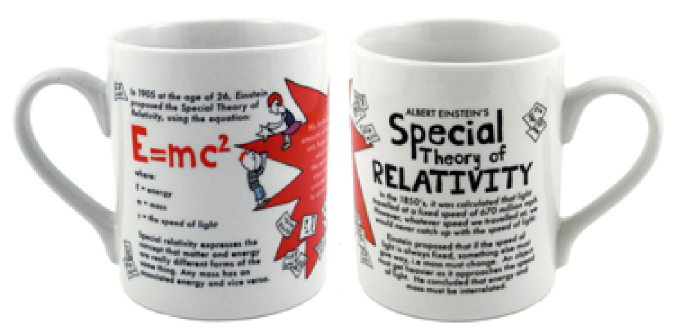
In a certain sense it contains the quintessence of my collection presenting the main popular science clichès and misconceptions. As they are quite often repeated in newspapers and textbooks, I decided to reproduce the text on the mug and to explain briefly what is wrong with it. I believe that it may be useful to many people.
2 The text on the mug
There are three columns of text on the mug – to the right of the handle (1), to the left of the handle (2), opposite the handle (3):
Column 1. In 1905 at the age of 26, Einstein
proposed the Special Theory
of Relativity, using the equation:
where
=energy,
=mass,
=the speed of light.
Special relativity expresses the
concept that matter and energy
are really different forms of the
same thing. Any mass has
an associated energy and vice versa.
Column 2. Albert Einstein’s
SPECIAL
Theory of
RELATIVITY
In the 1850’s it was calculated that light
traveled at a fixed speed of 670 million mph.
However, whatever speed we traveled at, we
would never catch up with the speed of light.
Einstein proposed that if the speed of
light is always fixed, something else must
give way, i. e. mass must change. An object
must get heavier as it approaches the speed
of light. He concluded that energy and
mass must be interrelated.
Column 3. His formula suggested that tiny
amounts of mass can be converted
into huge amounts of energy…
… which revealed the secret of how
stars shine and
unlocked the key
to atomic energy.
3 My clarifications and comments
Column 1. As is well known, Maxwell in 1860-70’s united optics with electricity and magnetism by establishing equations describing not only static fields, but also alternating electromagnetic fields propagating in a vacuum with velocity of light. Several physicists in the 1880-90’s after realizing that Maxwell equations are incompatible with equations of Newton mechanics have attempted to preserve the latter at velocities comparable to that of light by postulating that all new physics can be reduced to the increase of mass of a body with its velocity. These attempts were continued in the 20th century; they are briefly described in the articles [1], [2]. However it became clear rather soon that some of the Newton equations cannot be preserved, for instance the famous equation , where is force and is acceleration. It turned out that the equations themselves should be changed in such a way that mass would not depend on velocity, but there would exist an important new link between mass and energy. Let us note that relation between force and momentum remained the same: , but, as we will see below, the relation between momentum and velocity has changed. This had serious impact on the language and philosophy of physics.
In summer of 1905 Einstein published a detailed article [3] in which he presented his theory which later got the name Einstein’s theory of relativity. This theory extended to electromagnetic phenomena the principle of relativity formulated by Galileo and Newton. According to it, it is impossible by any experiment to find out whether a closed space (say, a cabin of a ship) is at rest or in a uniform and rectilinear motion. Soon the theory was extended to the newly discovered nuclear phenomena and got the name Special Relativity (SR). This theory describes the motion and interaction of fast particles whose velocities are comparable with the speed of light. Such particles are called relativistic. (In 1915 Einstein proposed General Relativity (GR) to describe gravity. But in this note we will not consider it.)
In autumn of 1905 Einstein published a short note [4] in which he stated that in the framework of his theory the mass of a body is a measure of its energy content. The total energy of a free body is equal, according to the theory of relativity, to the sum of its kinetic energy (of the motion as a whole) and its energy at rest – rest energy :
| (1) |
Of course, the concept of a free (isolated from any external influence) body is an idealization. But idealization (abstraction) lies at the basis of scientific method and is extremely fruitful.
The realization that any body at rest possesses energy was the greatest discovery of the 20th century. The amount of this energy is given by Einstein’s equation:
| (2) |
where is the mass of the body and is the speed of light. (It was exactly in this form that Einstein had written equation (44) in 1921 in his lectures ‘‘The meaning of relativity’’ [5], though the notion of the rest energy appeared already in the note [4].)
The kinetic energy of ordinary bodies is given by the well known equation of Newton’s mechanics . As the velocity of an ordinary body is much less than , the rest energy of a body is huge in comparison with its kinetic energy. But in the ordinary life the rest energy does not manifest itself. Einstein pointed out that part of it is liberated in the radioactive decays.
Unfortunately, many famous physicists during the last century have formulated the Einstein equation in a ‘‘simplified form’’ by omitting the index zero:
| (3) |
and treating this relation as increase of mass not only with energy but also with velocity and momentum of the body.
In 1948 Einstein warned Barnett – the author of the book ‘‘Universe of Dr. Einstein’’ – against using the concept of mass depending on velocity. (A copy of this handwritten letter is reproduced in ref [1].) But sometimes, especially in his popular writings, he himself did not care about the index zero. This semantic kink was caused by the clash of two languages – the old non-relativistic and the new, consistently relativistic one.
Column 2. The assertion that the speed of light is always fixed at a value of 670 million mph is correct, but the dating (1850’s) is not quite correct. That the speed of light is finite (not infinite), was established in 1676 by Römer who deduced this from observations of Jupiter’s satellite. It followed from them that the speed is around 200 000 km/s. The first and more precise measurements of on the Earth were performed by Fizeau in 1849. But the fact that the speed about 300 000 km/s is fixed and does not depend on the velocities of the source and the observer, was discovered in 1887 by Michelson and Morely.
The statement that energy and mass are interrelated is correct: , while that the mass changes with velocity is definitely wrong. In the theory of relativity (unlike the mechanics of Newton) the measure of inertia is not mass but the total energy of the body. The momentum of a body is connected with its velocity not by the Newton’s relation but by the relation
| (4) |
As a result it is the more difficult to change the momentum of a body, the higher its total energy . And only at zero momentum, when the total energy equals the rest energy .
One can feel more deeply that the measure of inertia is energy by considering the example of the Large Electron-Positron collider LEP which operated at CERN during the last decade of the 20th century. Particles with energy 50 GeV were kept in its 27 km ring tunnel by a rather weak field of iron magnets. (Without this field particles would fly along a strait line.) Exactly the same field would maintain the circulation of protons with the same momentum (and almost the same energy), though the mass of the proton is 2000 times larger than the mass of the electron. In the year 2010 the Large Hadron Collider LHC started to operate in the same tunnel. To circulate protons with energy 3500 GeV, the magnetic field of superconducting magnets in it is 70 times stronger.
Thus, the measure of inertia of a particle is its total energy
Column 3. Here everything is correct if one uses the equation and takes into account that in nuclear reactions in the stars, in the Sun and on the Earth a part of the rest energy of the particles which are burned is transformed into kinetic energy of the products of burning. The same is valid for any process of burning.
4 Four dimensions of the world
Now I would like to address a few words to those who are more or less familiar with the concept of four-dimensional world (4-world) introduced in the relativity theory in 1908 by Minkowski [6]. In the 4-world the time coordinate of an event and its position coordinates form a 4-vector. Similarly the energy of a free (isolated) body (more precisely, ) and three components of its momentum (more precisely, ) form four components of the pseudo-euclidean 4-vector. The scalar length of this 4-vector is given by the mass of the body according to the equation
| (5) |
(The words ‘‘pseudo euclidean’’ indicate that the square of the length of the 4-vector is equal not to the sum but to the difference of squares of its - and -components.)
Taylor and Wheeler in the book [8] put energy and momentum on the orthogonal axes, then on the hypotenuse they depict mass by a short and thick segment. But it is possible to present equation (5) simply as a right triangle if one rewrites it in the form and puts mass and momentum on the orthogonal axes (see article [7]). Then energy is the hypotenuse, while mass and momentum are the other two legs. For any value of momentum the kinetic energy is
| (6) |
The main equation (5) of relativity theory has been tested in thousands of experiments with the accuracy of up to ten digits. For a massive body whose momentum is zero it implies . For a non-vanishing momentum one can rewrite it as and at derive from it the non-relativistic expression for kinetic energy without developing the square root. Similarly, for relativistic particles . (This equation is essential for neutrino oscillations.) It follows also from equation (5) and from the formula (4) for velocity that for a massless particle of light – the photon – the speed is always equal to .
The special theory of relativity is impeccable. One cannot say the same about its image in the mass culture.
Unfortunately, the sudden illness and death of Minkowski did not allow him to persuade his contemporaries to switch to the language of the four-dimensional world, and they continued futile attempts to explain the meaning of relativity theory in terms of Newton’s three-dimensional mechanics. Though Einstein used the four-dimensional mathematical apparatus in deriving the equations of his general theory of relativity for gravitational interaction, I failed to find the equation on the pages of his writings.
It appeared first in the articles of Klein [9], Fock[10], Gordon[11] (1926) and especially in the works of Dirac [12] (1930) in which relativistic quantum mechanics was constructed (as is well known, Einstein, a co-founder of the concept of quantum, did not accept quantum mechanics). The equation appeared in the framework of not quantum but classical field theory much later, in the book ‘‘The classical theory of fields’’ by Landau and Lifshitz in 1941 (in Russian) [13].
Four-dimensional description is equally good for massive and massless particles of matter. It shows that mass and matter are not the same thing, that energy and momentum are the measures of all processes and motions in nature. As for the mass of the particles, it becomes non-essential for processes at high energies .
5 The speed of light as the unit of velocity
The correct equations must be correct regardless of the choice of units. The existence of the universal maximal velocity allows one to express any velocity in units of as a dimensionless number . It is evident that in these units for . As a result one can get rid of in the equations of relativity theory by rewriting equations (2), (4), (6) in the form
| (7) |
As for equation (3) , it is reduced to , which evidently contradicts equation (1) and hence is wrong.
6 Conclusion
Volodya Gribov, whose attitude concerning was the same as mine, gave me a friendly advice in 1980s not to struggle against the famous and false equation because this fight just cannot be won. It was with a feeling of permanent defeat that I was writing the text above for the forthcoming volume ‘‘Gribov-80’’ in the summer 2010, amidst the unprecedented heat and smog in Moscow, which could but adversely affect the quality of the text. In autumn, a few weeks ago, Julia Nyiri reminded me that this text is a continuation of my contribution to the volume ‘‘Gribov-75’’ [14] in which I compared the equation with a virus. Indeed, the concept of relativistic mass hidden in the equation is a semantic virus similar to computer viruses. People infected by this virus (they often call themselves relativists) believe that Relativistic Mass is the main portal to Relativity Theory because mass is the measure of inertia. They ignore the fact that mass is the measure of inertia only for very slowly moving bodies and particles for which the rest energy is much larger than the kinetic energy . When velocities are not very low, mass is only an approximate measure of inertia. For fast particles for which (photons, neutrinos, protons in LHC) the measure of inertia is the total energy .
It is well known that formulas in physics are a continuation of the ordinary language: equations are encoded sentences, while mathematical symbols in these equations are encoded words or terms. To prevent confusion, each symbol must be unambiguously connected with a corresponding term. Is it possible to introduce in Special Relativity the concept of relativistic mass? Yes, it is possible: , though it will be just another symbol for energy because is a universal constant. Is it possible then to introduce the term relativistic rest mass ? Yes, it is possible. Of course, it is equally possible to introduce both terms and both symbols. Although they are not needed in Special Relativity as it is a complete, self consistent theory without them, their introduction is possible. What is not good is to denote the relativistic rest mass by and then call it simply rest mass, because this presumes that mass depends on velocity in Special Relativity (SR), while we all know that in SR is Lorentz invariant: it is the same at rest and in motion, and hence, there is no sense in supplying it with indices.
But the real trouble begins when is called the mass, is denoted by and at the same time the ordinary Newtonian mass is renamed into . Then the mixing of two languages (‘‘French and Nizhegorodsky’’) mutilates the beautiful theory, leads to unbelievable confusion and thwarts its understanding. To top it all, some ‘‘ philosophers-relativists’’ then allege that the mechanics of Newton is not a limiting case of mechanics of Einstein, and that these two theories are incommensurate.
As a result of the reverse action of mass culture on the scientific culture, many chapters in the best text-book on physics of the 20th century published in 1960s – ‘‘The Feynman Lectures on Physics’’[15] – repeat the statement that mass changes with velocity. The little book ‘‘What is relativity?’’[16] by Landau and Rumer also claims that mass increases with velocity. (The book was written in the 1930s, before the arrest of both authors, and published in the 1950s after Rumer was released from exile. (Landau remained in jail for one year.)) ‘‘The classical theory of fields’’ by Landau and Lifshitz published in 1940s was the first text-book in the world in which mass was velocity-independent. But even in it the concept of rest energy was missing and the Einstein’s formula was mentioned in the form . This discrepancy is kept in the latest edition of the book in the 21st century.Indeed, nobody is perfect. Our language is not perfect: ‘‘a spoken thought is a lie’’.
It is impossible in this short note to refer to the articles and books of the creators of relativity theory, but it is easy to find them by clicking the hyper references [1], [2], [7],[14], [17], [18] listed below. The seventh hyper reference [19] contains slides of the talk which explained why the teaching of physics must be based on two fundamental constants of nature: and . By operating with these two constants I plan to present the foundations of physics in a little book (100 pages) ‘‘The ABC of Physics’’.
Acknowledgments
I am grateful to Erica Gulyaeva, Marek Karliner, Elya and Vitaly Kisin, Olga Milyaeva, Boris Okun and Zurab Silagadze whose remarks helped me write this note.
The work is supported by grant of the President of RF NSh-4172.2010.2
References
- [1] The concept of mass. Physics Today. June 1989, 31-36. http://www.itep.ru/theor/persons/lab180/okun/em_3.pdf
- [2] The Einstein formula: . ‘‘Isn’t the Lord laughing’’?. Physics – Uspekhi 51, (5), 513 - 527 (2008). http://www.itep.ru/theor/persons/lab180/okun/em_29.pdf
- [3] Einstein A/ Zur Electrodynamik bewegter Körper. Ann Phys 17, 891-921 (1905).
- [4] Einstein A. Ist die Tragheit eines Körpers von seinem Energieinhalt abhänging? Ann Phys 18, 639-641 (1905).
- [5] Einstein A. Four lectures on the theory of relativity, held at Princeton University in May 1921. Сollected papers of Albert Einstein v 7, doc 71, Princeton (1997).
- [6] Minkowski H. Raum und Zeit. Phys Zeit 10, 104-111 (1909).
- [7] The theory of relativity and the Pythagorean theorem. Physics - Uspekhi 51, (6), 622 - 631 (2008). http://www.itep.ru/theor/persons/lab180/okun/em_30.pdf
- [8] Taylor E F, Wheeler J A. Spacetime physics. New York (1992) (pp 246-252 Dialog: Use and Abuse of the concept of mass).
- [9] Klein O. Quantum Theorie und fünfdimensionale Relativitätstheorie. Zeit f Physik 37, 895-906 (1926).
- [10] Fock V. Über die invarianten Form der Wellen- und der Bewegungsgleichungen für einen geladenen Massenpunkt. Zeit f Physik 39, 226-232 (1926). On the invariant form of wave and motion equations for a charged point mass, Physics - Uspekhi 53(8) (2010).
- [11] Gordon W. Der Compton Effect nach der Schrödingerschen Theorie. Zeit f Physik 40, 117-133 (1926).
- [12] Dirac P A M. The principles of quantum mechanics. (1930).
- [13] Ландау Л Д, Лифшиц E M. Теория поля. М 1941. (in Russian). Landau L D, Lifshitz E M. The classical theory of fields. Reed Publishing Ltd (2000).
- [14] The virus of relativistic mass in the year of physics in Gribov memorial volume (quarks, hadrons and strong interactions). Yu L Dokshitzer, P Levai, J Nyri Editors, WS, (2006) 470-473. http://www.itep.ru/theor/persons/lab180/okun/em_22.pdf
- [15] Feynman R P, Leighton R B, Sands M. The Feynman lectures on physics. Addison-Wesley (1963).
- [16] Л Д Ландау, Ю Б Румер. Что такое относительность? Советская Россия, М (1959). (in Russian). Landau L D, Rumer Yu B. What is relativity? Dover (2003).
- [17] Energy and Mass in Relativity Theory. World Scientific.(2009). http://www.worldscibooks.com/physics/6833.html
- [18] Mass versus relativistic and rest masses. Am. J. Phys. 77, (5), 430-431 (2009). http://www.itep.ru/theor/persons/lab180/okun/doc/AJP000430.pdf
- [19] The main concepts and laws of physics and properties of elementary particles of matter. talk at the Presidium of the Russian Academy of Sciences, 27.10.2009, presented on the site of the Division of Physical Sciences of RAS (in Russian). http://www.gpad.ac.ru/info/contributions/Okun_Prez.pdf