TOI-6508 b: A massive transiting brown dwarf orbiting a low-mass star
We report the discovery of a transiting brown dwarf orbiting a low-mass star, TOI-6508 b. Today, only 50 transiting brown dwarfs have been discovered. TOI-6508 b was first detected with data from the Transiting Exoplanet Survey Satellite (TESS) in Sectors 10, 37 and 63. Ground-based follow-up photometric data were collected with the SPECULOOS-South and LCOGT-1m telescopes, and RV measurements were obtained with the Near InfraRed Planet Searcher (NIRPS) spectrograph. We find that TOI-6508 b has a mass of and a radius of . Our modeling shows that the data are consistent with an eccentric orbit of 19 day and an eccentricity of . TOI-6508 b has a mass ratio of , makes it the second highest mass ratio brown dwarf that transits a low-mass star. The host has a mass of , a radius of , an effective temperature of K, and a metallicity of . This makes TOI-6508 b an interesting discovery that has come to light in a region still sparsely populated.
Key Words.:
Brown Dwarf; stars: TOI-6508; techniques: photometric, techniques: Radial velocity1 Introduction
Brown dwarfs (BDs) are traditionally defined as objects between giant planets (13 ) and stars (80 ), with radii ranging from 0.7 to 1.4 . The lower limit that separates giant planets from BDs corresponds to the ignition of deuterium fusion in the core of the BD. This limit varies within the range 11–16 depending on the abundance of deuterium and the bulk metallicity (Spiegel et al. 2011).
The upper limit that separates the BDs and stars corresponds to hydrogen fusion, and varies within the range 75–80 depending on the stellar initial formation conditions (Baraffe et al. 2002).
Based on this mass definition, the cores of BDs are partially degenerate. To improve the characterization and classification of the BDs, the transit method is very useful as it brings additional information, specifically the radius. However, any candidate companion close in size to can be a brown dwarf, giant planet, or a low-mass star as it is not clear solely from the radius, making the measurement of the companion’s mass crucial for BD discovery.
Transiting BDs orbiting low-mass stars offer us valuable opportunities to measure the radius and mass (with the combination with radial velocity technique) and orbital parameters of the system. The relatively small size of the star leads to a large transit signal on the order of ten percent. Furthermore, the relatively low mass results in a huge radial-velocity signal on the order of several kilometers per second. This makes possible high-precision measurements of a BD’s mass and radius. The mass and radius are key for exploring the physical properties of the BDs, in order to improve our understanding of the mechanisms of formation and evolution of these mysterious sub-stellar objects. (Baraffe et al. 2002; Saumon & Marley 2008; Phillips et al. 2020; Chabrier et al. 2023).
Our current understanding of planetary formation predicts a low probability for the existence of Jupiter-like planets and BDs around low-mass stars with , and their formation by core accretion becomes increasingly unlikely as . (Kanodia et al. 2022; Palle et al. 2021; Burn et al. 2021). However, we have discovered only 9 transiting BDs orbiting low-mass stars to date, with host masses ranging from 0.25–0.65 M⊙. Due to the small size of this sample, the occurrence rate of BDs around low-mass stars is still highly uncertain; more detections are necessary to compare observations to theoretical expectations.
In this work, we present a new system orbiting a low-mass M dwarf () in a 19-day eccentric orbit (), TOI-6508. This system contains a transiting BD, TOI-6508 b with a mass of and a radius of around an M5 star.
The paper is organized as follows. We present TESS data and ground-based photometric and spectroscopic observations in Section 2. Stellar characterization of TOI-6508 (spectroscopic and spectral energy distribution analysis) is presented in Section 3. Section 4 describes the global modeling of photometric and radial velocity data. Finally, a discussion and our conclusions are presented in Section 5.
2 Observations and data reduction
2.1 TESS photometric observation
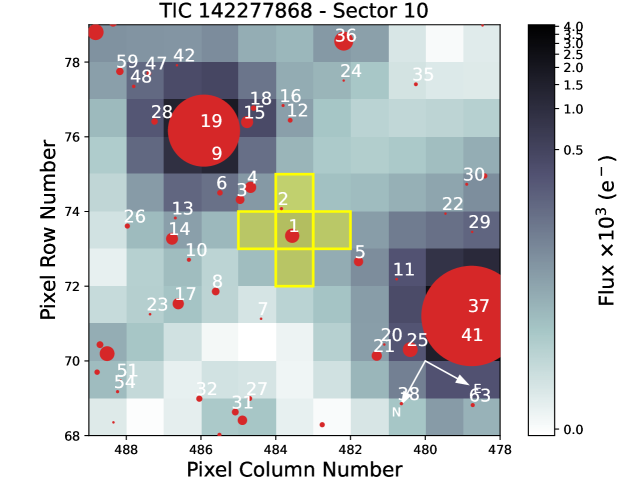
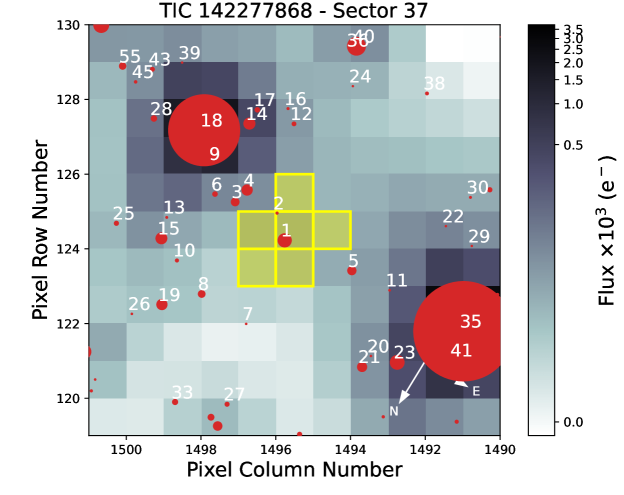
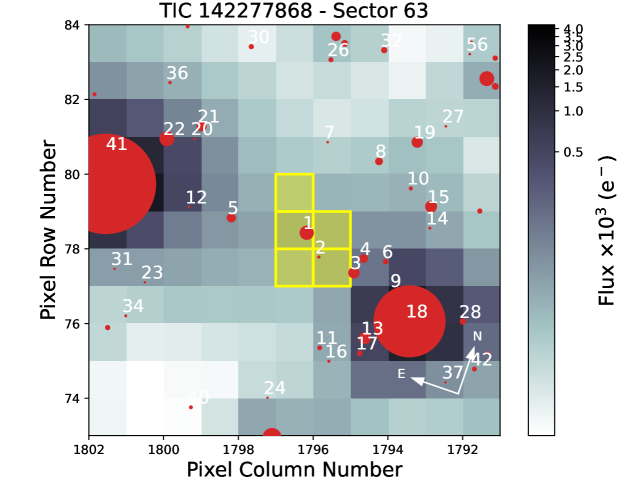
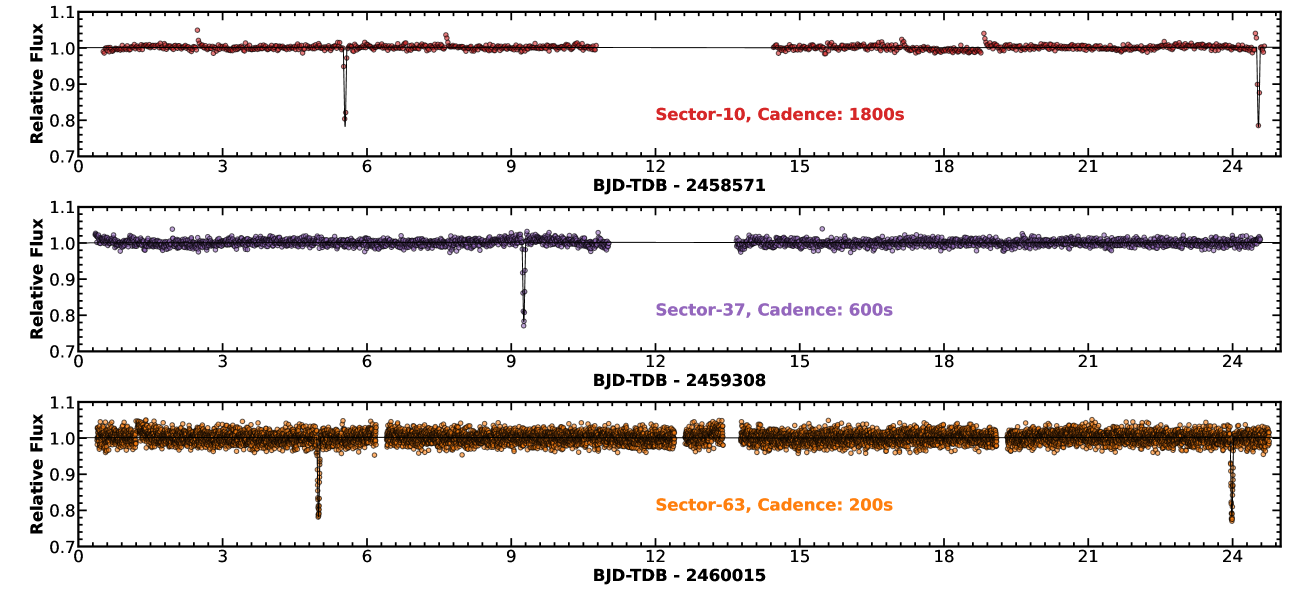
The host star TIC 142277868 (TOI-6508) was observed by the TESS mission (Ricker et al. 2015) in Sector 10, from March 26 to 22 April 2019. The relevant data are available within the full-frame images (FFIs) with a cadence of 1800 seconds. The target was re-observed during the extended mission in Sectors 37 and 63, and FFI data are available with a cadence of 600 seconds and 200 seconds, respectively (see Table 1). We used the Pre-search Data Conditioning Simple Aperture Photometry flux (PDC-SAP; Stumpe et al. 2012; Smith et al. 2012; Stumpe et al. 2014), constructed by the TESS Science Processing Operations Center (SPOC; Jenkins et al. 2016) at the Ames Research Center, from the Mikulski Archive for Space Telescopes 111https://archive.stsci.edu/missions-and-data/tess. The PDC-SAP light curves were calibrated for any instrument systematics and crowding effects. The TOI-6508 light curves are normalized using the lightkurve (Lightkurve Collaboration et al. 2018) Python package. Figure 1 shows the TOI-6508 field of view in the TESS data, as well as the photometric apertures that were used to construct the light curves. The locations of nearby Gaia DR3 sources are also marked (Gaia Collaboration et al. 2021). Figure 2 shows the TESS photometric data.
| Sector | Exptime [s] | Camera | CCD | Observation date |
|---|---|---|---|---|
| 10 | 1800 | 2 | 4 | 2019 Mar-26 – Apr-22 |
| 37 | 600 | 2 | 4 | 2021 Apr-02 – Apr-28 |
| 63 | 200 | 1 | 2 | 2023 Mar-10 – Apr-06 |
2.2 Ground-based photometric observation
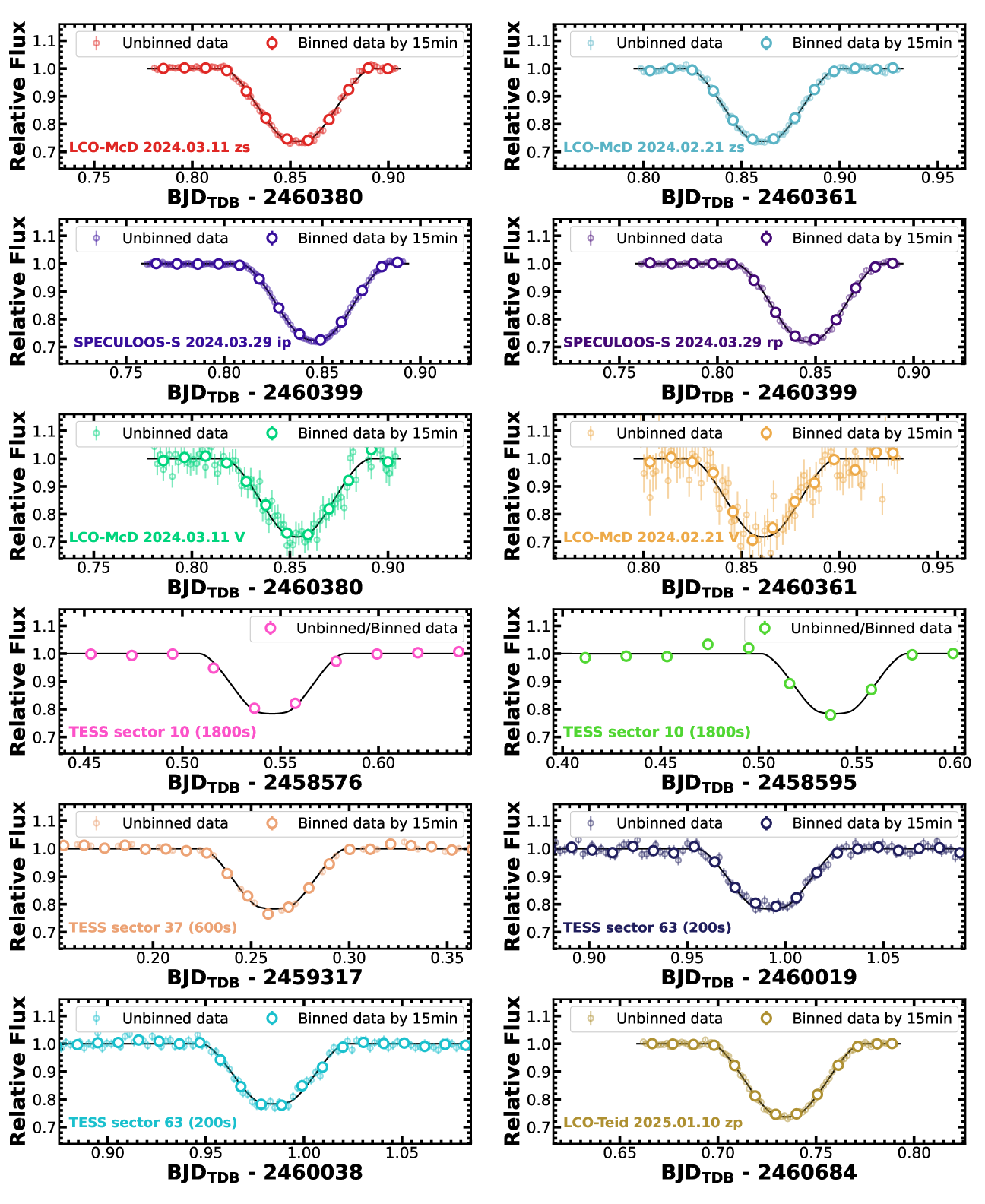
We performed ground-based follow-up observations of TOI-6508 as part of the TESS follow-up observing program (TFOP) in order to confirm the transit event on the target star, rule out nearby eclipsing binaries (NEBs) as the source of the transit signal, measure the transit depth, as well as refine the transit ephemerides. To schedule time-series observations, we used the TESS transit finder tool (Jensen 2013), which is a customized version of the Tapir software package. The ground-based photometric observations are summarized in Table 2. The observed transit light curves are presented in Figures 3 and 4.
2.2.1 SPECULOOS-South
We used the SPECULOOS-South (Search for habitable Planets EClipsing ULtra-cOOl Stars, Jehin et al. (2018); Delrez et al. (2018); Sebastian et al. (2021)) facilities to observe the transits of TOI-6508 b simultaneously in the Sloan- and - filters on UTC March 29 2024 with an exposure time of 180 seconds and 105 seconds, respectively. Each 1.0 m telescope is equipped with a 2K2K CCD camera with a pixel scale of 0.35 and a total FOV of 1212. Data reduction and aperture photometry were performed using the PROSE222Prose: https://github.com/lgrcia/prose pipeline (Garcia et al. 2022).
2.2.2 LCOGT-1.0m
We used the Las Cumbres Observatory Global Telescope (LCOGT; Brown et al. 2013) 1.0m facilities to observe simultaneously four full transits of TOI-6508 b in the Pan-STARRS- and V filters. Two transits were observed on UTC Feb 21 2024, and two others were observed on UTC March 11 2024. An additional transit of TOI-6508 b was observed with LCO-Teid-1m0 at the Teide Observatory on UTC Jan 10 2025 in the Pan-STARRS-. The LCOGT telescopes are equipped with SINISTRO camera with a pixel scale of per pixel and a total FOV of .
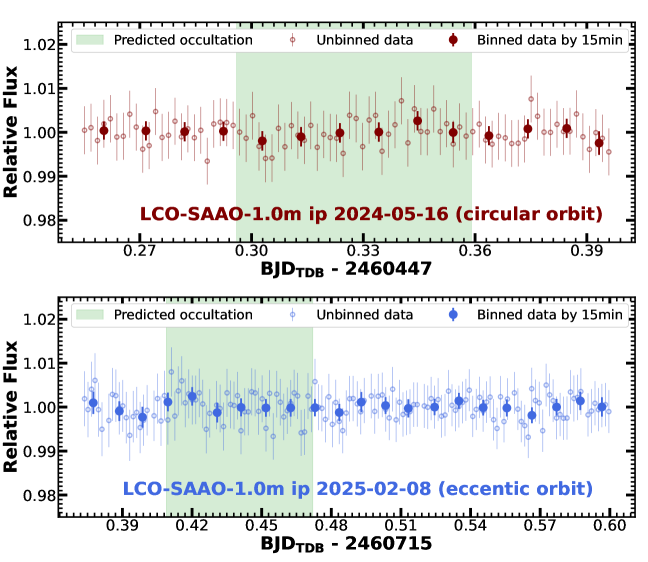
TOI-6508 b was also observed during an occulation at the Southern African Astronomical Observatory (SAAO) in the Sloan- filter. The first observation was carried out on UTC May 16 2024 assuming a circular orbit. The Second observation was carried out on UTC February 8 2025 assuming an eccentric orbit. Figure 5 shows the secondary eclipse light curves.
The science data processing was performed using the standard LCOGT BANZAI pipeline (McCully et al. 2018), and aperture & differential photometric were performed using AstroImageJ333AstroImageJ:https://www.astro.louisville.edu/software/astroimagej/ (Collins et al. 2017).
| Telescope | Date (UT) | Filter | Exptime | FWHM | Aperture | Comment |
| [second] | [arcsec] | [arcsec] | ||||
| LCO-Teid-1.0m | Jan 9 2025 | Pan-STARRS- | 100 | 1.8 | 4.0 | Full transit |
| SPECULOOS-South-1.0m | March 29 2024 | Sloan- | 180 | 2.0 | 2.1 | Full transit |
| SPECULOOS-South-1.0m | March 29 2024 | Sloan- | 105 | 2.1 | 3.5 | Full transit |
| LCO-McD-1.0m | March 11 2024 | Pan-STARRS- | 100 | 2.2 | 4.7 | Full transit |
| LCO-McD-1.0m | March 11 2024 | V | 100 | 2.9 | 5.4 | Full transit |
| LCO-McD-1.0m | Feb 21 2024 | Pan-STARRS- | 100 | 1.8 | 4.7 | Full transit |
| LCO-McD-1.0m | Feb 21 2024 | V | 100 | 3.1 | 5.4 | Full transit |
| LCO-SAAO-1.0m | May 16 2024 | Sloan- | 120 | 1.9 | 4.3 | Full occultation |
| LCO-SAAO-1.0m | Feb 8 2025 | Sloan- | 100 | 2.1 | 4.0 | Full occultation |
2.3 Spectroscopic observation for TOI-6508
2.3.1 NIRPS observation
TOI-6508 was observed with the Near-InfraRed Planet Searcher (NIRPS; Bouchy et al. (2017); Wildi et al. (2022)) spectrograph installed on the ESO-3.6m telescope at La Silla observatory in Chile. NIRPS is fiber-fed, stabilized high-resolution () echelle spectrograph operating in the near-infrared covering the range from 950nm to 1800nm, under an adaptive optics system. The observations were carried out as a DDT program (ID:113.27QV, Cycle: 113, PI: K. Barkaoui).
Over 3 individual nights, we collected two spectra of TOI-6508 per night with NIRPS with an exposure time of 900 s. The data were collected on June 1, 9 and July 3 2024 with an average signal-to-noise-ratio (SNR) of 12 at .
The NIRPS data were reduced with the nominal pipeline for NIRPS data reduction for the ESO science archive through the VLT Data Flow System444https://www.eso.org/sci/software/pipelines/. This pipeline is based on the publicly available ESPRESSO pipeline, which utilizes recipes adapted from software originally developed for the ESPRESSO instrument (Pepe, F. et al. 2021) and specifically refined for near-infrared spectroscopy555Nirps pipeline:https://www.eso.org/sci/software/pipelines/nirps/nirps-pipe-recipes.html (Artigau et al. 2024).
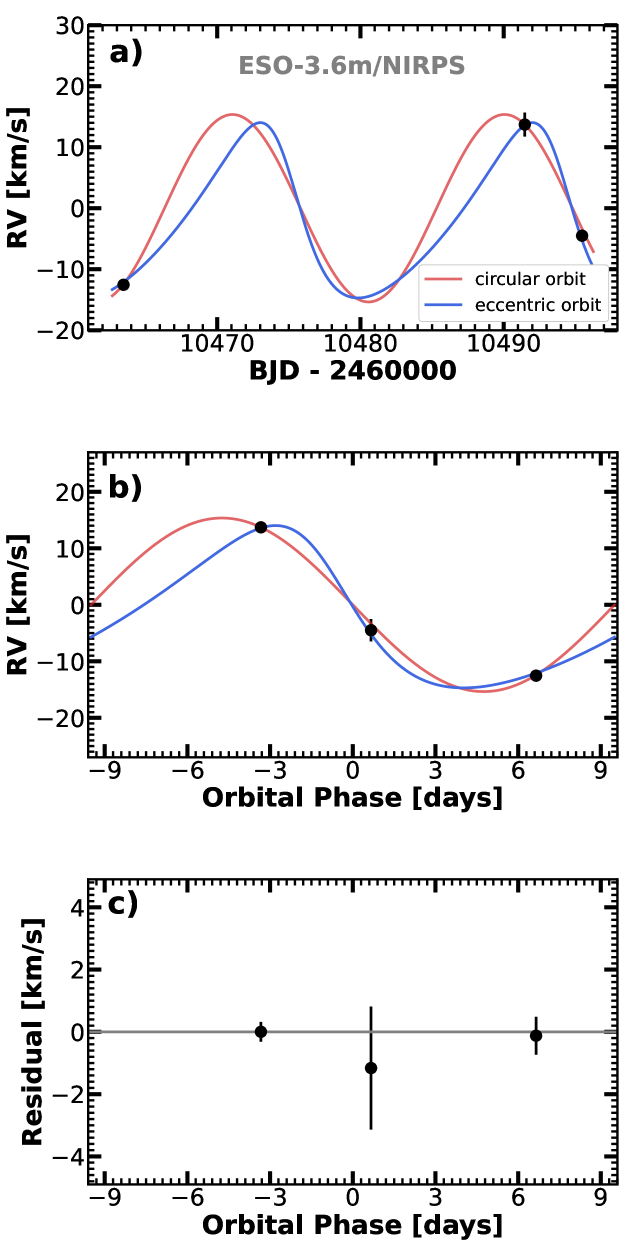
Radial velocities (RVs) were extracted using a cross-correlation with the line-mask for M4-type stars, which is implemented in the NIRPS pipeline. Due to the relatively low SNR we only use orders between 1.4-1.87 . The RV measurements are presented in Table 3.
| BJDTDB | RV [km/s] | [km/s] |
|---|---|---|
| 2460463.468286 | 24.384 | 0.203 |
| 2460491.481160 | 51.406 | 0.159 |
| 2460495.471592 | 30.840 | 0.790 |
2.3.2 Shane/Kast optical spectroscopy
We observed TOI-6508 with the Kast double spectrograph (Miller & Stone 1994) mounted on the Lick Observatory Shane 3m Telescope on UTC April 2024. Conditions were clear and windy with 18 at the southern declination of the source. We used the 25 (6 pixel) aligned with the parallactic angle and the 600/7500 grating in the Kast red channel to acquire 5800–9000 Å spectra at a resolution of 900. Two exposures of 1200 s each were acquired at an average airmass of 3.08, followed by observation of the nearby G2 V star HD 113207 ( = 7.62) at a similar airmass. The flux standard Feige 34 ( = 7.6; Massey & Gronwall 1990; Oke 1990) was observed earlier in the night. HeNeAr arclamps, quartz flat-field lamps, and bias frames were obtained at the start of the night for wavelength and pixel response calibration. Data were reduced using kastredux666kastredux: https://github.com/aburgasser/kastredux following standard procedures for optical spectroscopic data reduction (cf. Barkaoui et al. 2024). Our final spectrum has a signal-to-noise (S/N) of 76 at 7500 Å.
2.3.3 IRTF/SpeX spectroscopy
We collected a medium-resolution near-infrared spectrum of TOI-6508 on 10 May 2024 (UT) using the SpeX spectrograph (Rayner et al. 2003) on the 3.2-m NASA Infrared Telescope Facility (IRTF) during clear conditions with 05 seeing. We used the short-wavelength cross-dispersed (SXD) mode and the slit aligned to the parallactic angle, yielding spectra covering 0.80–2.42 m. We collected 12 integrations of 300 s on the target, nodding in an ABBA pattern. Afterwards we gathered a set of standard SXD flat-field and arc-lamp calibrations and six, 30 s integrations of the A0 V standard HD 100330. We reduced the data with Spextool v4.1 (Cushing et al. 2004), following the standard approach (e.g., Delrez et al. 2022; Barkaoui et al. 2023, 2024). The reduced spectrum has a median S/N of 107 per pixel and 2.5 pixels per resolution element.
2.3.4 High-resolution imaging
As part of the validation and confirmation process for a transiting exoplanet observation, high-resolution imaging is one of the critical assets required. The presence of a close companion star, whether truly bound or line of sight, will provide ”third-light” contamination of the observed transit, leading to derived properties for the exoplanet and host star that are incorrect (Ciardi et al. 2015; Furlan & Howell 2017, 2020). In addition, it has been shown that the presence of a close companion dilutes small planet transits () to the point of non-detection (Lester et al. 2021). Given that nearly one-half of FGK stars are in binary or multiple star systems (Matson et al. 2018) high-resolution imaging yields crucial information toward our understanding of each discovered exoplanet as well as more global information on its formation, dynamics and evolution.
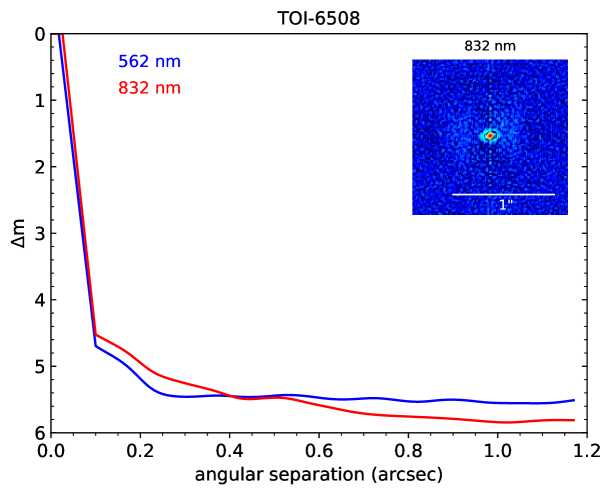
TOI-6508 was observed on UTC 2025 January 10 using the Zorro speckle instrument on Gemini South (Scott et al. 2021). Zorro provides simultaneous speckle imaging in two bands (562 nm and 832 nm) with output data products including a reconstructed image and robust contrast limits on companion detections. Nine sets of 1000 60-ms frames were obtained for TOI-6508 simultaneously in each channel. The data was reduced using our standard software pipeline (Howell et al. 2011). Figure 6 shows the 5-sigma magnitude contrast curves obtained and our 832 nm reconstructed speckle image. We find that TOI-6508 is a single star with no close companion brighter than about 5-6 magnitudes from the diffraction limit (0.02) out to 1.2. At the distance to TOI-6508 ( pc) TOI-700, these angular limits correspond to spatial limits of 0.97 to 58 au.
3 Stellar properties for TOI-6508
| Star information | ||
| Target designations: | ||
| TOI 6508 | ||
| TIC 142277868 | ||
| GAIA DR3 3465796341653768192 | ||
| 2MASS J12030396-3339552 | ||
| SIPS J1203-3339 | ||
| Parameter | Value | Source |
| Parallax and distance: | ||
| RA [J2000] | 12:03:03.42 | (1) |
| Dec [J2000] | -33:39:55.8 | (1) |
| Plx [] | (1) | |
| [mas yr-1] | (1) | |
| [mas yr-1] | (1) | |
| Distance [pc] | (1) | |
| Photometric properties: | ||
| TESSmag | (2) | |
| [UCAC4] | (3) | |
| [UCAC4] | (3) | |
| [UCAC4] | (3) | |
| [2MASS] | (4) | |
| [2MASS] | (4) | |
| [2MASS] | (4) | |
| [Gaia DR3] | (1) | |
| [WISE] | (5) | |
| [WISE] | (5) | |
| [WISE] | (5) | |
| [WISE] | (5) | |
| Spectroscopic and derived parameters | ||
| [K] | this work | |
| [dex] | this work | |
| [dex] | this work | |
| [] | a this work | |
| [] | a this work | |
| [erg s-1 cm-2] | this work | |
| [mag] | this work | |
| [] | this work | |
| [Gyr] | 7 | this work |
| Spectral type | M61 | [Shane/Kast] |
| Spectral type | M5.0 0.5 | this work [IRTF/SpeX] |
3.1 Shane/Kast
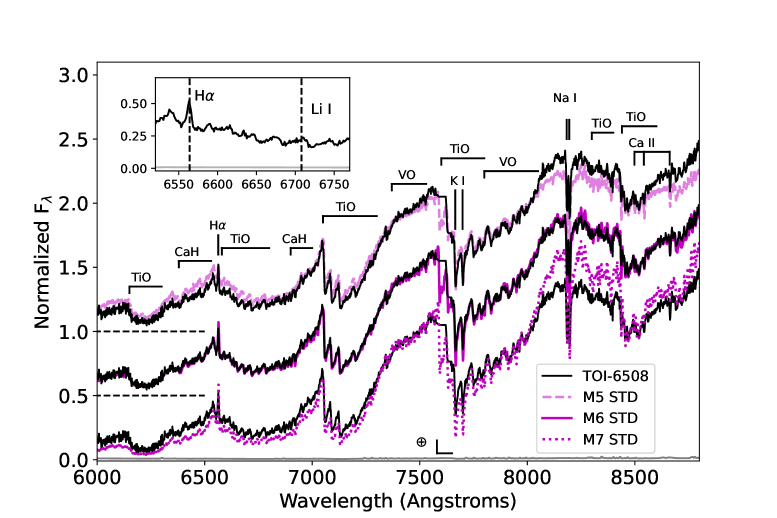
Figure 7 shows the Kast optical spectrum of TOI-6508. Characteristic spectral features for mid- to late- M dwarfs are present, including CaH, TiO, and VO molecular features and line absorption from Na I, K I and Ca II. The spectrum is an excellent match to the M6 SDSS spectral template data from Bochanski et al. (2007), implying an optical classification of M61. H is seen in clear emission with an equivalent width of 2.950.18 Å, which corresponds to a relative emission luminosity of = 4.360.10 using the -factor calibration of Douglas et al. (2014). The presence of magnetic emission is consistent with an activity age 7 Gyr (West et al. 2008; Rebassa-Mansergas et al. 2023). The relative strength of TiO and CaH absorption in the 7000 Å region yields a value of 0.850.02 (Lépine et al. 2013), near the boundary between dwarf and subdwarf classes, and the Mann et al. (2013) metallicity- relation yields [Fe/H]0.170.20.
3.2 IRTF/SpeX
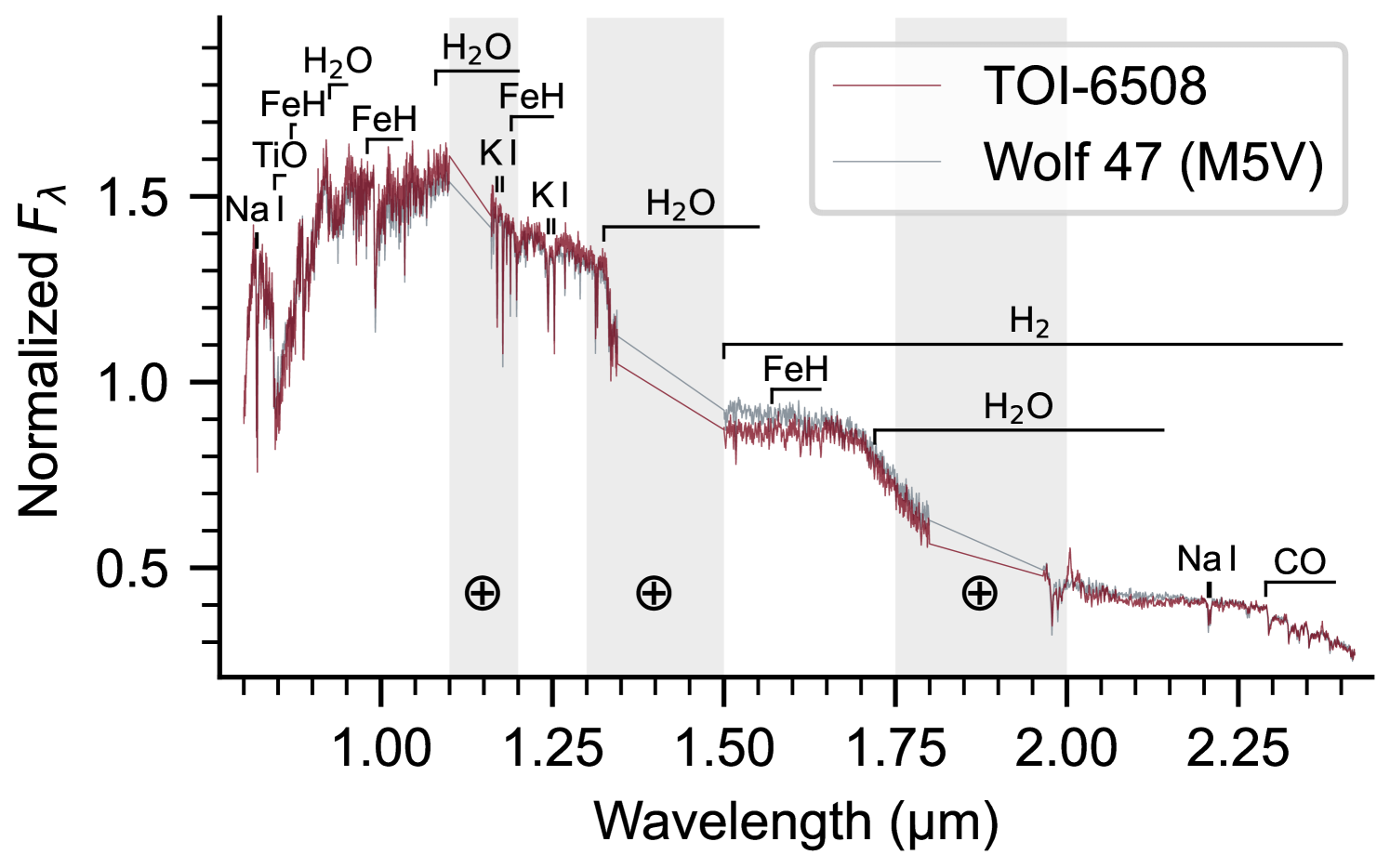
Figure 8 shows the SpeX SXD spectrum of TOI-6508. Following previous SpeX analyses (e.g., Triaud et al. 2023; Gillon et al. 2024; Timmermans et al. 2024), we used the SpeX Prism Library Analysis Toolkit (SPLAT, Burgasser & Splat Development Team 2017) to assign a spectral type and estimate a stellar metallicity. We compared the spectrum to those of single-star spectral standards in the IRTF Spectral Library (Cushing et al. 2005; Rayner et al. 2009). Finding the best match to the M5 dwarf Wolf 47, we adopt an infrared spectral type of M5.0 0.5, slightly earlier than but consistent with the optical classification. Using the H2O–K2 index (Rojas-Ayala et al. 2012) and Mann et al. (2014) relation, we estimate a sub-solar stellar iron abundance of for TOI-6508, consistent with the optical metallicity.
3.3 SED analysis
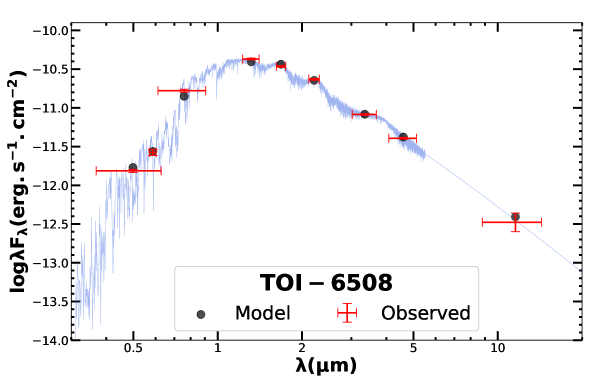
As an independent determination of the basic stellar parameters, we performed an analysis of the broadband spectral energy distribution (SED) of the star together with the Gaia DR3 parallax (with no systematic offset applied; see, e.g., Stassun & Torres 2021), as described in Stassun & Torres (2016); Stassun et al. (2017, 2018a). We used the the 2MASS magnitudes, the WISE W1–W3, and the Gaia magnitudes. Together, the available photometry spans the full stellar SED over the wavelength range 0.4–10 m (see Figure 9).
We performed a fit using PHOENIX stellar atmosphere models (Husser et al. 2013), with the free parameter being the effective temperature (), and the extinction which we limited to maximum line-of-sight value from the Galactic dust maps of Schlegel et al. (1998); we used the metallicity ([Fe/H]) value derived from spectroscopic observations (see Sections 3.1 and 3.2). The resulting fit (Figure 9) has a best-fit and K, with a reduced of 3.8. Integrating the (unreddened) model SED gives the bolometric flux at Earth, erg s-1 cm-2. Taking the and Gaia parallax gives directly the stellar bolometric luminosity, L⊙. The stellar radius follows from the Stefan-Boltzmann relation, giving R⊙. In addition, we estimated the stellar mass from the empirical relations of Mann et al. (2019), giving M⊙. Finally, we used the measured chromospheric activity with the empirical relations from Stassun et al. (2012) to predict the degree of radius inflation, which in this case is predicted to be 7%, roughly consistent with the apparent inflation of 10%.
3.4 Archival imaging for TOI-6508
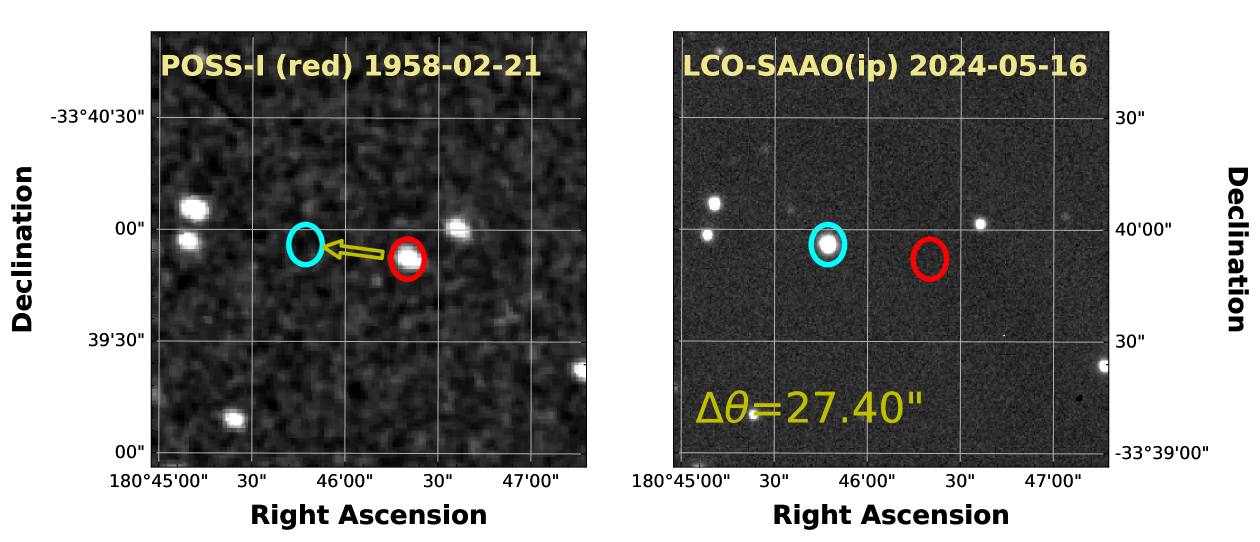
We used the archival images of TOI-6508 to exclude the possibility that there are background stars blended with the target at its current position. TOI-6508 has a high proper motion of 414 mas/yr. We used the POSS-I/red data taken in 1958, and the LCO-SAAO-1.0m/Sloan- data taken in 2024, spanning 72 years with our new observations. The target has been shifted by 2740 from 1958 to 2024. There is no bright background source in the current day position of the target (see Figure 10).
3.5 Stellar rotation
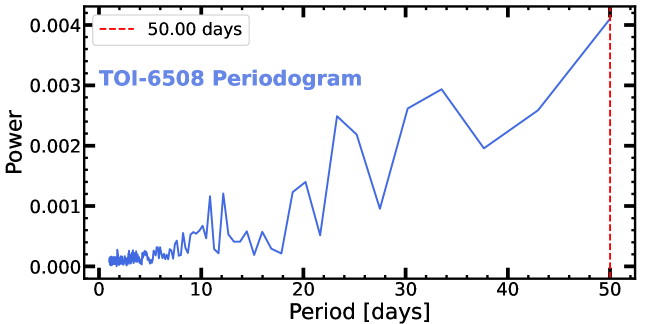
We searched for photometric modulation in TESS observations using the TESS-SIP (Hedges et al. 2020) package. TESS-SIP returns two outputs simulateneousely, which are a Lomb–Scargle periodogram (Lomb 1976; Scargle 1982) and detrend systematics. In our case, we used the available TESS photometric data from Sectors 10, 37 and 63. We limit our search to a rotation period range 1–50 days. Our results showed that no indications stellar modulation in the TESS data of TOI-6508 (see Figure 11). This implies that the rotational periods of the target star is probably longer than the TESS observation window for a single sector.
4 Photometric and RVs analysis
We performed a global modeling of transit light curves obtained from the TESS mission (described Section 2.1), and SPECULOOS-South-1.0m and LCO-SAAO-1.0m telescopes (described in Section 2.2), together with the radial velocity measurements collected by the ESO-3.6m/NIRPS spectrograph (described in Section 2.3.1), using the Metropolis-Hastings (Metropolis et al. 1953; Hastings 1970) method implemented in TRAFIT, a revised version of the Markov chain Monte Carlo (MCMC) code described in Gillon et al. (2010, 2012, 2014). We followed the same strategy as described in Barkaoui et al. (2023, 2024). The photometric data were modeled using the Mandel & Agol (2002) quadratic limb-darkening model, multiplied by a transit baseline, in order to correct for external systematic effects related to the time and FWHM of the PSF as well as the airmass, and background light level. The radial velocity data were modeled with the two-body Keplerian model (Murray & Correia 2010).
The baseline model for each transit was selected by minimizing the Bayesian information criterion (BIC; Schwarz (1978)). The error bars of TOI-6508 radial velocity measurements were quadratically rescaled using the ‘jitter’ noise, while the photometric error bars were rescaled using the correction factor , where is the red noise and is the white noise (Gillon et al. 2012).
For the joint fit, the global free parameters for transit modeling are the mid-transit time at a reference epoch (), the orbital period (), the transit depth (), the impact parameter (), the stellar density , as well as the total transit duration (). We applied a Gaussian prior distribution on the stellar quadratic limb-darkening coefficients ( and ), stellar mass , radius and effective temperature (computed from SED analysis), as well as the stellar atmospheric parameters computed from spectroscopic analysis (metallicity and surface gravity ). The quadratic limb-darkening coefficients and for the TESS, Pan-STARRS-, Sloan-, Sloan-, and Johnson- filters were computed using the stellar parameters (, and ) and Tables from Claret et al. (2012); Claret (2018). During our analysis, we converted the quadratic limb-darkening coefficients and into the combination and proposed by Kipping (2013).
We performed two MCMC fits. The first fit assumed an eccentric orbit (i.e. free eccentricity) and the second assumed a perfectly circular orbit (i.e., ). Our results favored an eccentric orbit solution based on the Bayes factor . For each transit, a preliminary analysis was performed composed of one Markov chain with steps to compute the (correction factor; Gillon et al. (2012)). Then, we performed a final MCMC fit composed of five Markov chains with one million steps to infer the physical properties of the system. The convergence for each Markov chain has been checked based on the Gelman & Rubin (1992) statistical test. Our final results for the eccentric orbit solution are presented in Table 5.
| TOI-6508 | |
|---|---|
| Parameter | Value |
| Quadratic Limb-Darkening coefficients | |
| Derived stellar parameters | |
| Stellar mass, [ ] | |
| Stellar radius, [] | |
| Mean density, [] | |
| Luminosity, [] | |
| Effective temperature, [K] | |
| Derived BD parameters | |
| Radius ratio | |
| Orbital period [days] | |
| Transit-timing | |
| Orbital semi-major axis [AU] | |
| Impact parameter [] | |
| Transit duration [min] | |
| Scaled semi-major axis | |
| Orbital inclination [deg] | |
| Eccentricity | |
| RV semi-amplitude [] | |
| Mass ratio | |
| BD Radius [] | |
| BD Mass [ ] | |
| BD density [] | |
| Surface gravity | |
| Incident flux [] | |
5 Discussion and Conclusion
Transiting BDs around M dwarf stars are rare, and they are helpful for understanding the formation and evolution of such systems. Only M dwarf/BD systems are known, and more detections are required to probe the formation and evolution paths.
In this paper, we present a BD orbiting a low-mass star, TOI-6508 b. The target was observed with the TESS mission during Sectors 10, 37 and 73 with long-cadence of 1800 s, 600 s and 200 s, respectively (Section 2.1). The candidate was first identified by TESS. Ground-based photometric follow-up observations were performed with the SPECULOOS-South-1.0m and LCOGT-McD-1.0m telescopes (Section 2.2). Radial velocity measurements were collected using the NIRPS spectrograph as described in Section 2.3.1. The host star was characterized by combining optical spectra collected by IRTF/SpeX and Shane/Kast instruments, the spectral energy distribution (SED), and stellar evolutionary models (Section 3). TOI-6508 is a M5.5 sub-solar star with metallicity of , a mass of , a radius of and an effective temperature of .
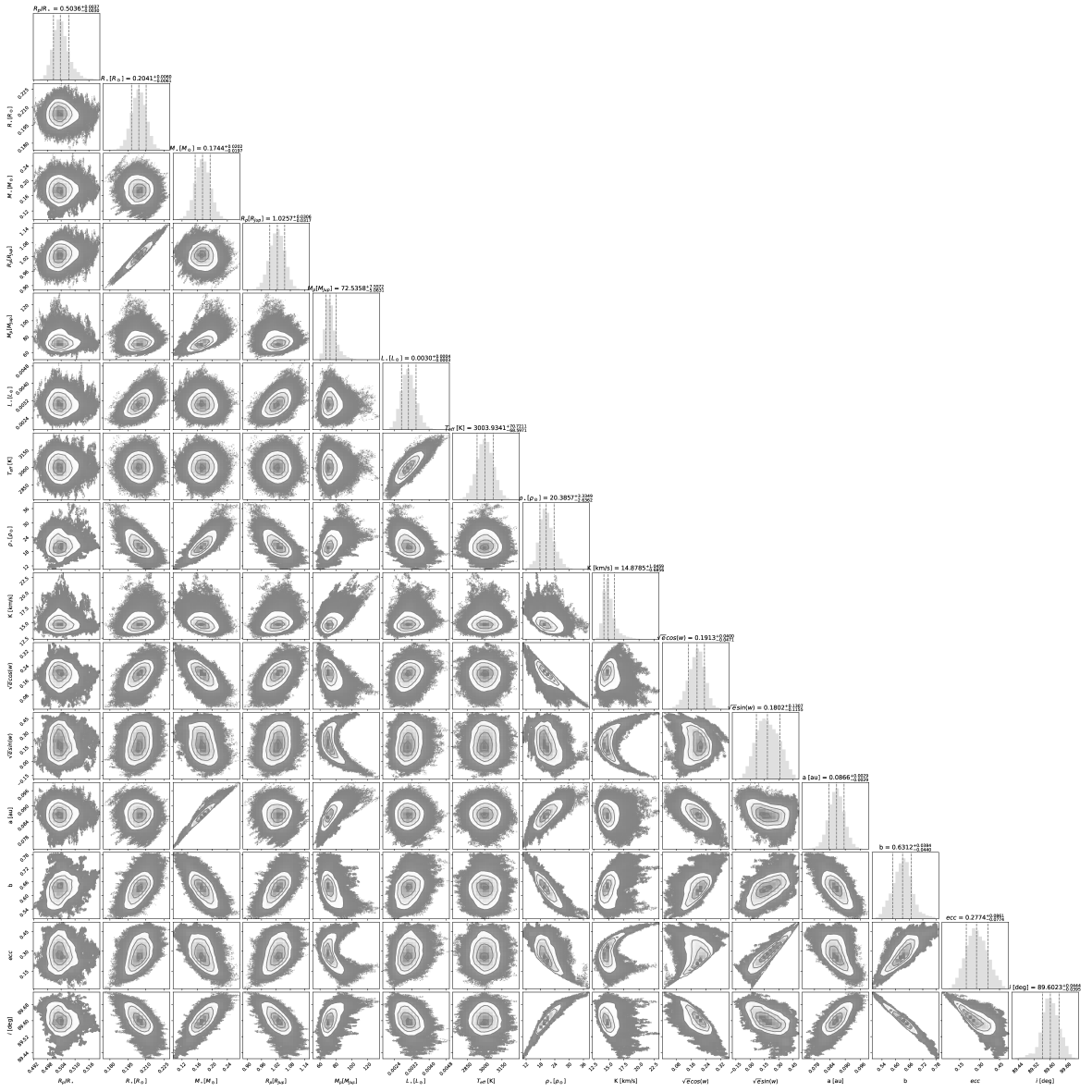
We performed a global analysis of the TESS observations together with ground-based photometric and radial velocity observations in order to derive the physical parameters of the system (Section 4). Table 7 shows the stellar physical characteristics of the host star TOI-6508. The derived physical parameters of the system are presented in Table 5. The posterior distribution parameters of TOI-6508 b are presented in Figure 18. We find that TOI-6508 b is a massive brown dwarf with a mass of and a radius of . It is the second highest mass ratio BD transiting a low-mass star.
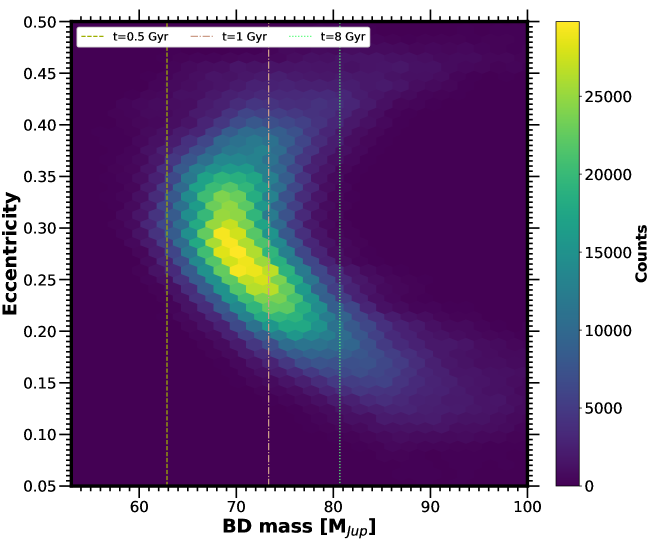
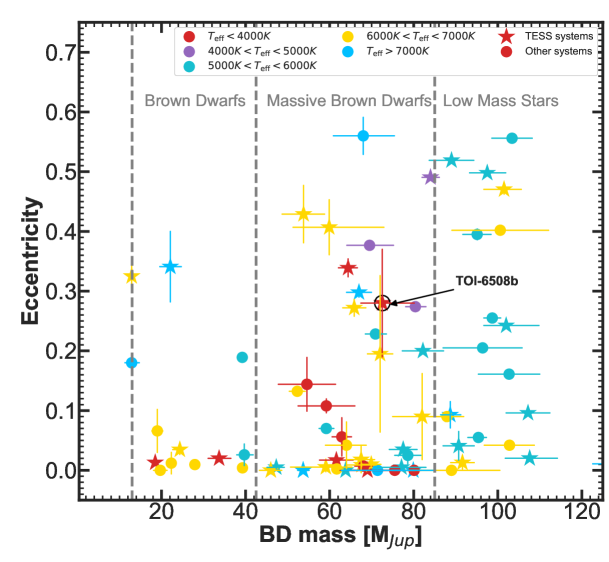
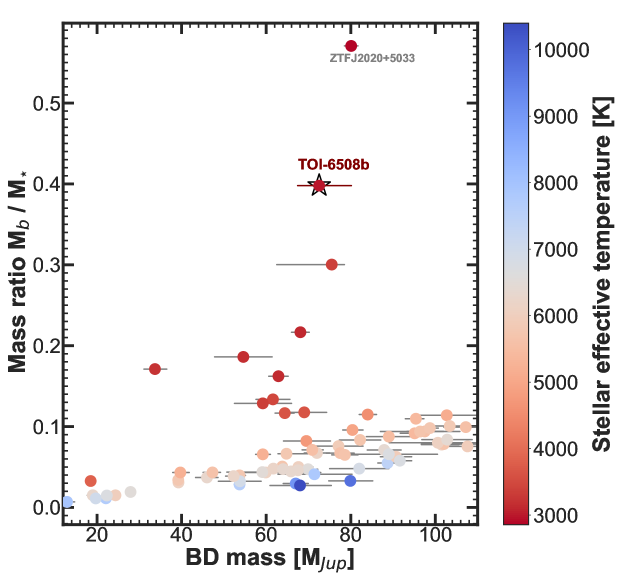
During our modeling, we performed two MCMC fits. The first assuming a circular orbit and the second assuming an eccentric orbit. The best solution is compatible with an eccentric orbit, based on the Bayes factor . TOI-6508 b orbits its host star with an orbital period of days and an eccentricity of . Figure 12 shows the posterior probability distribution of the orbital eccentricity and the mass of TOI-6508 b, including the evolutionary models from Baraffe et al. (2003). Additional observations of radial velocity are required to improve the orbital eccentricity and mass measurements of TOI-6508 b (see Figure 13). Figure 14 presents the mass ratio as a function of the BD mass. TOI-6508 b has the second highest mass ratio among all known transiting BDs.
The surface gravity of the transiting BDs , can be derived directly from the transit observations and radial velocity measurements, and is given by,
| (1) |
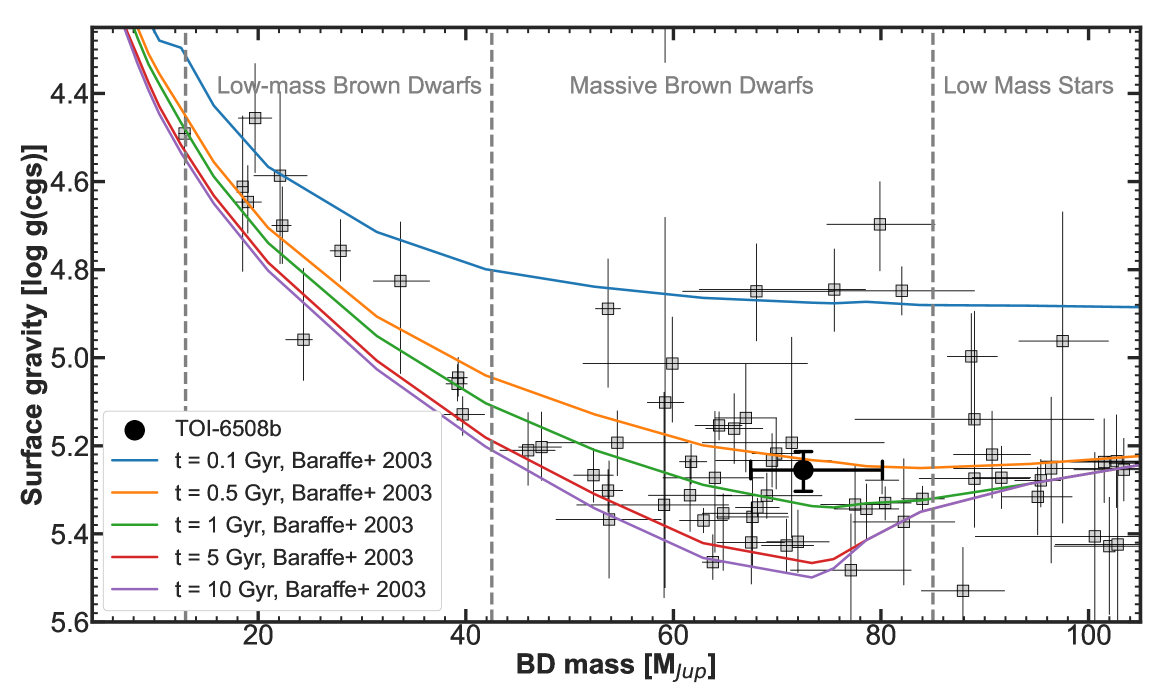
where, the semi-amplitude and the orbital eccentricity are derived from the radial velocity fit. The orbital period , the scaled BD radius , and the orbital inclination are derived from the fit of transit light curves. The BD’s surface gravity is related directly to the observable parameters independent of those of the host star.
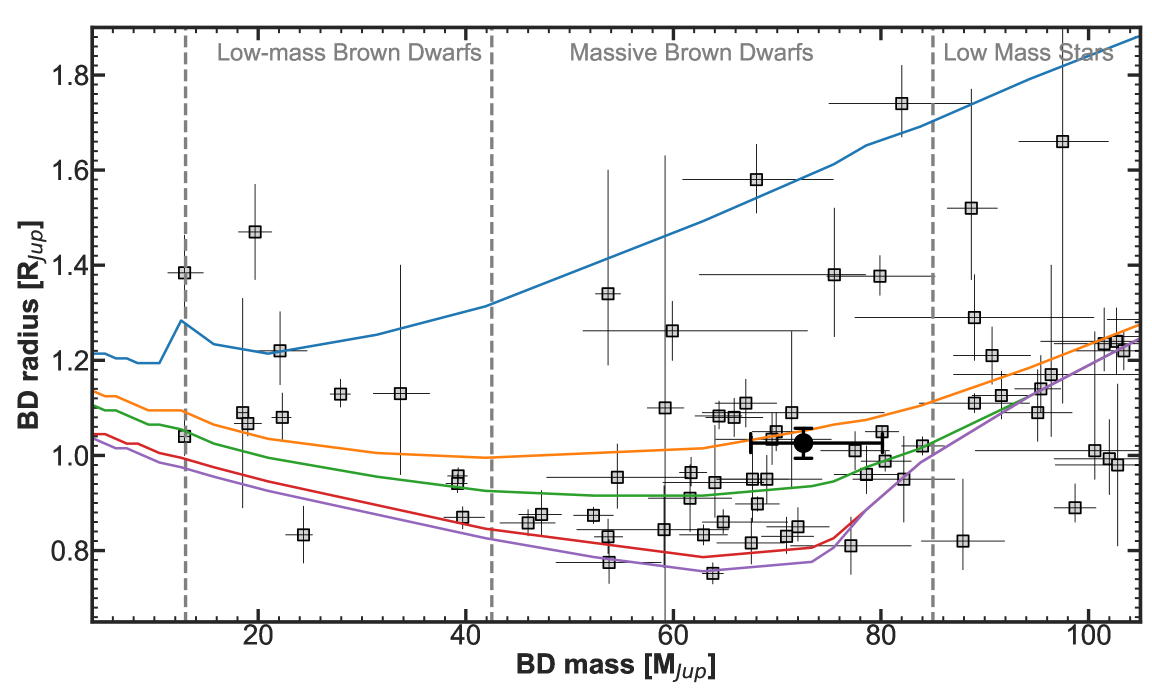
Figure 15 presents the radius–mass diagram for all known transiting objects with masses ranging 10 and 120 . Figure 16 presents the surface gravity as a function of the mass of known transiting objects. Table 6 shows the updated list of transiting BDs from
Carmichael (2022) and Henderson et al. (2024). Some new objects have been included from Vowell et al. (2025). As a preliminary comparison, TOI-6508 b is well placed within the edge of the brown dwarf regime, means, near the hydrogen burning limit (Baraffe et al. 2002). We also presented the tabulated isochrones models for substellar objects derived by Baraffe et al. (2003) (colored solid lines), with different ages of 0.1, 0.5, 1, 5 and 10 Gyr 888Isochrones Models: http://perso.ens-lyon.fr/isabelle.baraffe/.
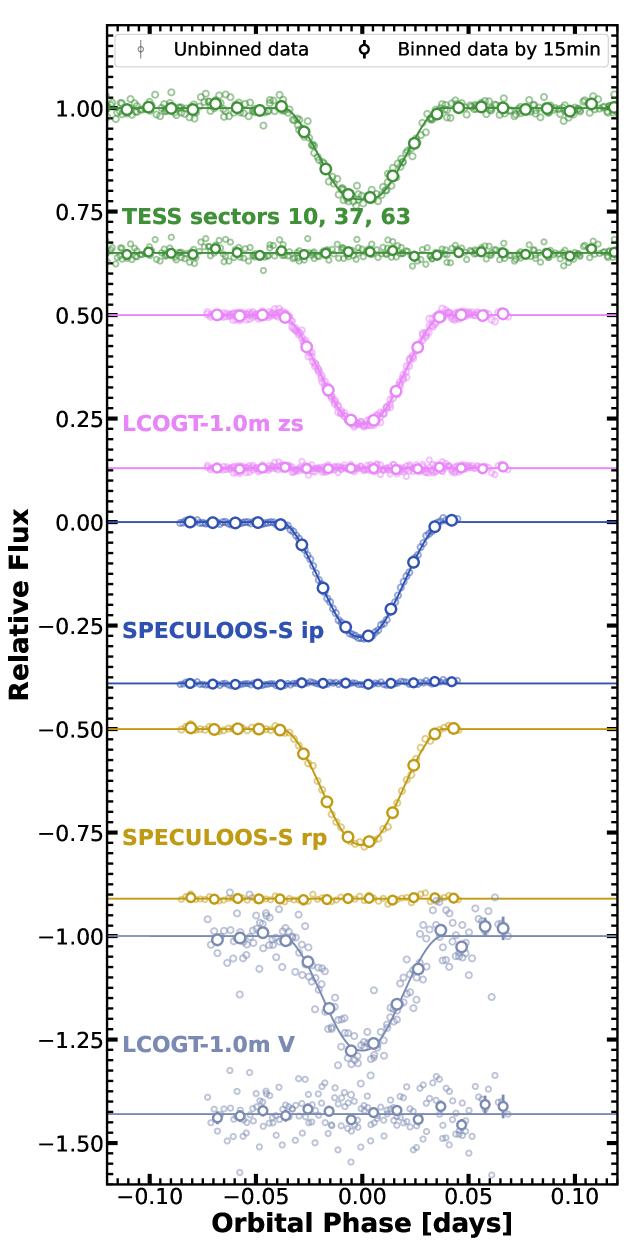
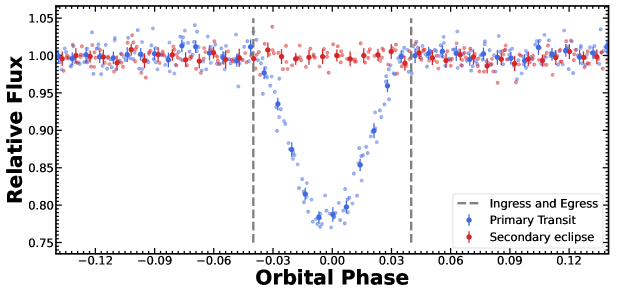
TOI-6508 b shows a deeper primary eclipse of 250 ppt (parts per thousand), but no detectable secondary eclipse. This implies that the secondary component has a lower surface brightness than the primary component. Phase-folded TESS observations are shown in Figure 17. The absence of a detectable secondary eclipse in the data suggested that the companion is a brown dwarf. Based on TESS data, we might rule out a secondary eclipse of ppt. We observed two full occultations of TOI-6508 b from LCO-SAAO-1m0 in the Sloan- on UTC May 16 2024 (assuming a circular orbit) and UTC Feb 8 2025 (assuming an eccentric orbit of constrained from our global MCMC analysis). Based on these observations, we might rule out a secondary eclipse of ppt (see Figure 5). Moreover, the effective temperature for the companion can be computed by combining the companion and stellar radius ratio with the Planck function for blackbody via the formula:
| (2) |
where and are the Planck distribution functions for the companion and host star, respectively. This resulted in an effective temperature of the companion of K, indicative of a brown dwarf. Since the luminosity of a BD is mainly emitted at infrared wavelengths, the secondary eclipse should be deeper when observed at infrared wavelengths. Moreover, a new observation in the infrared is required to confirm or not the secondary eclipse of the companion. If a secondary eclipse is present, this will allow an independent determination of the effective temperature of the brown dwarf TOI-6508 b. Moreover, the combination of low mass and low luminosity of the host star, and low incident flux of the companion, make TOI-6508 b a favorable target for upcoming secondary eclipse observation with the JWST, in order to measure its luminosity, its Albedo, and its effective temperature.
6 Acknowledgments
The postdoctoral fellowship of KB is funded by F.R.S.-FNRS grant T.0109.20 and by the Francqui Foundation. This publication benefits from the support of the French Community of Belgium in the context of the FRIA Doctoral Grant awarded to MT. MG is F.R.S.-FNRS Research Director. Author F.J.P acknowledges financial support from the Severo Ochoa grant CEX2021-001131-S funded by MCIN/AEI/10.13039/501100011033 and Ministerio de Ciencia e Innovación through the project PID2022-137241NB-C43. This material is based upon work supported by the National Aeronautics and Space Administration under Agreement No. 80NSSC21K0593 for the program “Alien Earths”. The results reported herein benefited from collaborations and/or information exchange within NASA’s Nexus for Exoplanet System Science (NExSS) research coordination network sponsored by NASA’s Science Mission Directorate. Based on observations collected at the European Southern Observatory under ESO programme 113.27QV.001. Visiting Astronomer at the Infrared Telescope Facility, which is operated by the University of Hawaii under contract 80HQTR24DA010 with the National Aeronautics and Space Administration. Funding for the TESS mission is provided by NASA’s Science Mission Directorate. KAC acknowledges support from the TESS mission via subaward s3449 from MIT. This paper made use of data collected by the TESS mission, obtained from the Mikulski Archive for Space Telescopes MAST data archive at the Space Telescope Science Institute (STScI). Funding for the TESS mission is provided by the NASA Explorer Program. STScI is operated by the Association of Universities for Research in Astronomy, Inc., under NASA contract NAS 5–26555. We acknowledge the use of public TESS data from pipelines at the TESS Science Office and at the TESS Science Processing Operations Center. Resources supporting this work were provided by the NASA High-End Computing (HEC) Program through the NASA Advanced Supercomputing (NAS) Division at Ames Research Center for the production of the SPOC data products. This research has made use of the Exoplanet Follow-up Observation Program (ExoFOP; DOI: 10.26134/ExoFOP5) website, which is operated by the California Institute of Technology, under contract with the National Aeronautics and Space Administration under the Exoplanet Exploration Program. Based on data collected by the SPECULOOS-South Observatory at the ESO Paranal Observatory in Chile. The ULiege’s contribution to SPECULOOS has received funding from the European Research Council under the European Union’s Seventh Framework Programme (FP/2007-2013) (grant Agreement n∘ 336480/SPECULOOS), from the Balzan Prize and Francqui Foundations, from the Belgian Scientific Research Foundation (F.R.S.-FNRS; grant n∘ T.0109.20), from the University of Liege, and from the ARC grant for Concerted Research Actions financed by the Wallonia-Brussels Federation. The Birmingham contribution is in part funded by the European Union’s Horizon 2020 research and innovation programme (grant’s agreement n∘ 803193/BEBOP), and from the Science and Technology Facilities Council (STFC; grant n∘ ST/S00193X/1, ST/W000385/1 and ST/Y001710/1). The Cambridge contribution is supported by a grant from the Simons Foundation (PI Queloz, grant number 327127). This work makes use of observations from the LCOGT network. Part of the LCOGT telescope time was granted by NOIRLab through the Mid-Scale Innovations Program (MSIP). MSIP is funded by NSF. Some of the observations in this paper made use of the High-Resolution Imaging instrument Zorro and were obtained under Gemini LLP Proposal Number: GN/S-2021A-LP-105. Zorro was funded by the NASA Exoplanet Exploration Program and built at the NASA Ames Research Center by Steve B. Howell, Nic Scott, Elliott P. Horch, and Emmett Quigley. Zorro was mounted on the Gemini South telescope of the international Gemini Observatory, a program of NSF’s OIR Lab, which is managed by the Association of Universities for Research in Astronomy (AURA) under a cooperative agreement with the National Science Foundation. on behalf of the Gemini partnership: the National Science Foundation (United States), National Research Council (Canada), Agencia Nacional de Investigación y Desarrollo (Chile), Ministerio de Ciencia, Tecnología e Innovación (Argentina), Ministério da Ciência, Tecnologia, Inovações e Comunicações (Brazil), and Korea Astronomy and Space Science Institute (Republic of Korea).
References
- Acton et al. (2021) Acton, J. S., Goad, M. R., Burleigh, M. R., et al. 2021, MNRAS, 505, 2741–2752
- Aller et al. (2020) Aller, A., Lillo-Box, J., Jones, D., Miranda, L. F., & Barceló Forteza, S. 2020, A&A, 635, A128
- Artigau et al. (2024) Artigau, É., Bouchy, F., Doyon, R., et al. 2024, in Ground-based and Airborne Instrumentation for Astronomy X, ed. J. J. Bryant, K. Motohara, & J. R. D. Vernet, Vol. 13096, International Society for Optics and Photonics (SPIE), 130960C
- Artigau et al. (2021) Artigau, É., Hébrard, G., Cadieux, C., et al. 2021, AJ, 162, 144
- Baraffe et al. (2002) Baraffe, I., Chabrier, G., Allard, F., & Hauschildt, P. H. 2002, A&A, 382, 563
- Baraffe et al. (2003) Baraffe, I., Chabrier, G., Barman, T. S., Allard, F., & Hauschildt, P. H. 2003, A&A, 402, 701
- Barkaoui et al. (2024) Barkaoui, K., Schwarz, R. P., Narita, N., et al. 2024, A&A, 687, A264
- Barkaoui et al. (2023) Barkaoui, K., Timmermans, M., Soubkiou, A., et al. 2023, A&A, 677, A38
- Bayliss et al. (2017) Bayliss, D., Hojjatpanah, S., Santerne, A., et al. 2017, AJ, 153, 15
- Benni et al. (2021) Benni, P., Burdanov, A. Y., Krushinsky, V. V., et al. 2021, MNRAS, 505, 4956
- Bochanski et al. (2007) Bochanski, J. J., West, A. A., Hawley, S. L., & Covey, K. R. 2007, AJ, 133, 531
- Bonomo et al. (2015) Bonomo, A. S., Sozzetti, A., Santerne, A., et al. 2015, A&A, 575, A85
- Bouchy et al. (2011) Bouchy, F., Deleuil, M., Guillot, T., et al. 2011, A&A, 525, A68
- Bouchy et al. (2017) Bouchy, F., Doyon, R., Artigau, É., et al. 2017, The Messenger, 169, 21
- Brown et al. (2013) Brown, T. M., Baliber, N., Bianco, F. B., et al. 2013, Publications of the Astronomical Society of the Pacific, 125, 1031
- Burgasser & Splat Development Team (2017) Burgasser, A. J. & Splat Development Team. 2017, in Astronomical Society of India Conference Series, Vol. 14, Astronomical Society of India Conference Series, 7–12
- Burn et al. (2021) Burn, R., Schlecker, M., Mordasini, C., et al. 2021, A&A, 656, A72
- Cañas et al. (2018) Cañas, C. I., Bender, C. F., Mahadevan, S., et al. 2018, ApJ, 861, L4
- Carmichael (2022) Carmichael, T. W. 2022, Monthly Notices of the Royal Astronomical Society, 519, 5177
- Carmichael et al. (2022) Carmichael, T. W., Irwin, J. M., Murgas, F., et al. 2022, MNRAS, 514, 4944
- Carmichael et al. (2019) Carmichael, T. W., Latham, D. W., & Vanderburg, A. M. 2019, AJ, 158, 38
- Carmichael et al. (2020) Carmichael, T. W., Quinn, S. N., Mustill, A. J., et al. 2020, AJ, 160, 53
- Carmichael et al. (2021) Carmichael, T. W., Quinn, S. N., Zhou, G., et al. 2021, AJ, 161, 97
- Chabrier et al. (2023) Chabrier, G., Baraffe, I., Phillips, M., & Debras, F. 2023, A&A, 671, A119
- Chaturvedi et al. (2016) Chaturvedi, P., Chakraborty, A., Anandarao, B. G., Roy, A., & Mahadevan, S. 2016, MNRAS, 462, 554
- Ciardi et al. (2015) Ciardi, D. R., Beichman, C. A., Horch, E. P., & Howell, S. B. 2015, The Astrophysical Journal, 805, 16
- Claret (2018) Claret, A. 2018, A&A, 618, A20
- Claret et al. (2012) Claret, A., Hauschildt, P. H., & Witte, S. 2012, A&A, 546, A14
- Collins et al. (2017) Collins, K. A., Kielkopf, J. F., Stassun, K. G., & Hessman, F. V. 2017, The Astronomical Journal, 153, 77
- Csizmadia (2016) Csizmadia, S. 2016, in The CoRoT Legacy Book (EDP Sciences), 143
- Csizmadia et al. (2015) Csizmadia, S., Hatzes, A., Gandolfi, D., et al. 2015, A&A, 584, A13
- Cushing et al. (2005) Cushing, M. C., Rayner, J. T., & Vacca, W. D. 2005, ApJ, 623, 1115
- Cushing et al. (2004) Cushing, M. C., Vacca, W. D., & Rayner, J. T. 2004, PASP, 116, 362
- Cutri et al. (2021) Cutri, R. M., Wright, E. L., Conrow, T., et al. 2021, VizieR Online Data Catalog, II/328
- David et al. (2019) David, T. J., Hillenbrand, L. A., Gillen, E., et al. 2019, ApJ, 872, 161
- Deleuil et al. (2008) Deleuil, M., Deeg, H. J., Alonso, R., et al. 2008, A&A, 491, 889
- Delrez et al. (2018) Delrez, L., Gillon, M., Queloz, D., et al. 2018, in Society of Photo-Optical Instrumentation Engineers (SPIE) Conference Series, Vol. 10700, Ground-based and Airborne Telescopes VII, ed. H. K. Marshall & J. Spyromilio, 107001I
- Delrez et al. (2022) Delrez, L., Murray, C. A., Pozuelos, F. J., et al. 2022, A&A, 667, A59
- D´ıaz et al. (2013) Díaz, R. F., Damiani, C., Deleuil, M., et al. 2013, A&A, 551, L9
- D´ıaz et al. (2014) Díaz, R. F., Montagnier, G., Leconte, J., et al. 2014, A&A, 572, A109
- Douglas et al. (2014) Douglas, S. T., Agüeros, M. A., Covey, K. R., et al. 2014, ApJ, 795, 161
- El-Badry et al. (2023) El-Badry, K., Burdge, K. B., van Roestel, J., & Rodriguez, A. C. 2023, The Open Journal of Astrophysics, 6, 33
- Ferreira dos Santos et al. (2024) Ferreira dos Santos, T., Rice, M., Wang, X.-Y., & Wang, S. 2024, AJ, 168, 145
- Furlan & Howell (2017) Furlan, E. & Howell, S. B. 2017, AJ, 154, 66
- Furlan & Howell (2020) Furlan, E. & Howell, S. B. 2020, The Astrophysical Journal, 898, 47
- Gaia Collaboration et al. (2021) Gaia Collaboration, Brown, A. G. A., Vallenari, A., et al. 2021, A&A, 650, C3
- Garcia et al. (2022) Garcia, L. J., Timmermans, M., Pozuelos, F. J., et al. 2022, MNRAS, 509, 4817
- Gelman & Rubin (1992) Gelman, A. & Rubin, D. B. 1992, Statistical Science, 7, 457
- Gill et al. (2022) Gill, S., Ulmer-Moll, S., Wheatley, P. J., et al. 2022, MNRAS, 513, 1785
- Gillen et al. (2017) Gillen, E., Hillenbrand, L. A., David, T. J., et al. 2017, ApJ, 849, 11
- Gillon et al. (2010) Gillon, M., Deming, D., Demory, B. O., et al. 2010, A&A, 518, A25
- Gillon et al. (2014) Gillon, M., Demory, B. O., Madhusudhan, N., et al. 2014, A&A, 563, A21
- Gillon et al. (2024) Gillon, M., Pedersen, P. P., Rackham, B. V., et al. 2024, Nature Astronomy, 8, 865
- Gillon et al. (2012) Gillon, M., Triaud, A. H. M. J., Fortney, J. J., et al. 2012, A&A, 542, A4
- Grieves et al. (2021) Grieves, N., Bouchy, F., Lendl, M., et al. 2021, A&A, 652, A127
- Hastings (1970) Hastings, W. K. 1970, Biometrika, 57, 97
- Hedges et al. (2020) Hedges, C., Angus, R., Barentsen, G., et al. 2020, Research Notes of the AAS, 4, 220
- Henderson et al. (2024) Henderson, B. A., Casewell, S. L., Goad, M. R., et al. 2024, Monthly Notices of the Royal Astronomical Society, 530, 318
- Hodžić et al. (2018) Hodžić, V., Triaud, A. H. M. J., Anderson, D. R., et al. 2018, MNRAS, 481, 5091
- Howell et al. (2011) Howell, S. B., Everett, M. E., Sherry, W., Horch, E., & Ciardi, D. R. 2011, AJ, 142, 19
- Husser et al. (2013) Husser, T. O., Wende-von Berg, S., Dreizler, S., et al. 2013, A&A, 553, A6
- Irwin et al. (2018) Irwin, J. M., Charbonneau, D., Esquerdo, G. A., et al. 2018, AJ, 156, 140
- Jackman et al. (2019) Jackman, J. A. G., Wheatley, P. J., Bayliss, D., et al. 2019, MNRAS, 489, 5146
- Jehin et al. (2018) Jehin, E., Gillon, M., Queloz, D., et al. 2018, The Messenger, 174, 2
- Jenkins et al. (2016) Jenkins, J. M., Twicken, J. D., McCauliff, S., et al. 2016, in Society of Photo-Optical Instrumentation Engineers (SPIE) Conference Series, Vol. 9913, Software and Cyberinfrastructure for Astronomy IV, ed. G. Chiozzi & J. C. Guzman, 99133E
- Jensen (2013) Jensen, E. 2013, Tapir: A web interface for transit/eclipse observability, Astrophysics Source Code Library, record ascl:1306.007
- Johnson et al. (2011) Johnson, J. A., Apps, K., Gazak, J. Z., et al. 2011, ApJ, 730, 79
- Kanodia et al. (2022) Kanodia, S., Libby-Roberts, J., Cañas, C. I., et al. 2022, AJ, 164, 81
- Khandelwal, A. et al. (2023) Khandelwal, A., Sharma, Rishikesh, Chakraborty, Abhijit, et al. 2023, A&A, 672, L7
- Kipping (2013) Kipping, D. M. 2013, MNRAS, 435, 2152
- Lépine et al. (2013) Lépine, S., Hilton, E. J., Mann, A. W., et al. 2013, AJ, 145, 102
- Lester et al. (2021) Lester, K. V., Matson, R. A., Howell, S. B., et al. 2021, The Astronomical Journal, 162, 75
- Lightkurve Collaboration et al. (2018) Lightkurve Collaboration, Cardoso, J. V. d. M., Hedges, C., et al. 2018, Lightkurve: Kepler and TESS time series analysis in Python, Astrophysics Source Code Library, record ascl:1812.013
- Lin et al. (2023) Lin, Z., Gan, T., Wang, S. X., et al. 2023, MNRAS, 523, 6162
- Lomb (1976) Lomb, N. R. 1976, Ap&SS, 39, 447
- Mandel & Agol (2002) Mandel, K. & Agol, E. 2002, ApJ, 580, L171
- Mann et al. (2013) Mann, A. W., Brewer, J. M., Gaidos, E., Lépine, S., & Hilton, E. J. 2013, AJ, 145, 52
- Mann et al. (2014) Mann, A. W., Deacon, N. R., Gaidos, E., et al. 2014, AJ, 147, 160
- Mann et al. (2019) Mann, A. W., Dupuy, T., Kraus, A. L., et al. 2019, ApJ, 871, 63
- Mann et al. (2015) Mann, A. W., Feiden, G. A., Gaidos, E., Boyajian, T., & von Braun, K. 2015, The Astrophysical Journal, 804, 64
- Massey & Gronwall (1990) Massey, P. & Gronwall, C. 1990, ApJ, 358, 344
- Matson et al. (2018) Matson, R. A., Howell, S. B., Horch, E. P., & Everett, M. E. 2018, The Astronomical Journal, 156, 31
- McCully et al. (2018) McCully, C., Volgenau, N. H., Harbeck, D.-R., et al. 2018, in Society of Photo-Optical Instrumentation Engineers (SPIE) Conference Series, Vol. 10707, Software and Cyberinfrastructure for Astronomy V, ed. J. C. Guzman & J. Ibsen, 107070K
- Metropolis et al. (1953) Metropolis, N., Rosenbluth, A. W., Rosenbluth, M. N., Teller, A. H., & Teller, E. 1953, J. Chem. Phys., 21, 1087
- Miller & Stone (1994) Miller, J. S. & Stone, R. P. S. 1994, The Kast Double Spectrograph, Tech. Rep. 66, University of California Lick Observatory Technical Reports
- Mireles et al. (2020) Mireles, I., Shporer, A., Grieves, N., et al. 2020, AJ, 160, 133
- Moutou et al. (2013) Moutou, C., Bonomo, A. S., Bruno, G., et al. 2013, A&A, 558, L6
- Murray & Correia (2010) Murray, C. D. & Correia, A. C. M. 2010, in Exoplanets, ed. S. Seager (University of Arizona Press), 15–23
- Nowak et al. (2017) Nowak, G., Palle, E., Gandolfi, D., et al. 2017, AJ, 153, 131
- Oke (1990) Oke, J. B. 1990, AJ, 99, 1621
- Palle et al. (2021) Palle, E., Luque, R., Zapatero Osorio, M. R., et al. 2021, A&A, 650, A55
- Parviainen et al. (2020) Parviainen, H., Palle, E., Zapatero-Osorio, M. R., et al. 2020, A&A, 633, A28
- Pepe, F. et al. (2021) Pepe, F., Cristiani, S., Rebolo, R., et al. 2021, A&A, 645, A96
- Persson et al. (2019) Persson, C. M., Csizmadia, S., Mustill, A. J., et al. 2019, A&A, 628, A64
- Phillips et al. (2020) Phillips, M. W., Tremblin, P., Baraffe, I., et al. 2020, A&A, 637, A38
- Pont et al. (2005) Pont, F., Melo, C. H. F., Bouchy, F., et al. 2005, A&A, 433, L21
- Pont et al. (2006) Pont, F., Moutou, C., Bouchy, F., et al. 2006, A&A, 447, 1035
- Psaridi et al. (2022) Psaridi, A., Bouchy, F., Lendl, M., et al. 2022, A&A, 664, A94
- Rayner et al. (2009) Rayner, J. T., Cushing, M. C., & Vacca, W. D. 2009, ApJS, 185, 289
- Rayner et al. (2003) Rayner, J. T., Toomey, D. W., Onaka, P. M., et al. 2003, PASP, 115, 362
- Rebassa-Mansergas et al. (2023) Rebassa-Mansergas, A., Maldonado, J., Raddi, R., et al. 2023, MNRAS, 526, 4787
- Ricker et al. (2015) Ricker, G. R., Winn, J. N., Vanderspek, R., et al. 2015, Journal of Astronomical Telescopes, Instruments, and Systems, 1, 014003
- Rojas-Ayala et al. (2012) Rojas-Ayala, B., Covey, K. R., Muirhead, P. S., & Lloyd, J. P. 2012, ApJ, 748, 93
- Saumon & Marley (2008) Saumon, D. & Marley, M. S. 2008, ApJ, 689, 1327
- Scargle (1982) Scargle, J. D. 1982, ApJ, 263, 835
- Schlegel et al. (1998) Schlegel, D. J., Finkbeiner, D. P., & Davis, M. 1998, ApJ, 500, 525
- Schmidt et al. (2023) Schmidt, S. P., Schlaufman, K. C., Ding, K., et al. 2023, The Astronomical Journal, 166, 225
- Schwarz (1978) Schwarz, G. 1978, Ann. Statist., 6, 461
- Scott et al. (2021) Scott, N. J., Howell, S. B., Gnilka, C. L., et al. 2021, Frontiers in Astronomy and Space Sciences, 8, 138
- Sebastian et al. (2021) Sebastian, D., Gillon, M., Ducrot, E., et al. 2021, A&A, 645, A100
- Sebastian et al. (2022) Sebastian, D., Guenther, E. W., Deleuil, M., et al. 2022, MNRAS, 516, 636
- Shporer et al. (2017) Shporer, A., Zhou, G., Vanderburg, A., et al. 2017, ApJ, 847, L18
- Siverd et al. (2012) Siverd, R. J., Beatty, T. G., Pepper, J., et al. 2012, ApJ, 761, 123
- Skrutskie et al. (2006) Skrutskie, M. F., Cutri, R. M., Stiening, R., et al. 2006, AJ, 131, 1163
- Smith et al. (2012) Smith, J. C., Stumpe, M. C., Van Cleve, J. E., et al. 2012, PASP, 124, 1000
- Spiegel et al. (2011) Spiegel, D. S., Burrows, A., & Milsom, J. A. 2011, ApJ, 727, 57
- Stassun et al. (2017) Stassun, K. G., Collins, K. A., & Gaudi, B. S. 2017, AJ, 153, 136
- Stassun et al. (2018a) Stassun, K. G., Corsaro, E., Pepper, J. A., & Gaudi, B. S. 2018a, AJ, 155, 22
- Stassun et al. (2012) Stassun, K. G., Kratter, K. M., Scholz, A., & Dupuy, T. J. 2012, ApJ, 756, 47
- Stassun et al. (2018b) Stassun, K. G., Oelkers, R. J., Pepper, J., et al. 2018b, AJ, 156, 102
- Stassun & Torres (2016) Stassun, K. G. & Torres, G. 2016, AJ, 152, 180
- Stassun & Torres (2021) Stassun, K. G. & Torres, G. 2021, ApJ, 907, L33
- Stumpe et al. (2014) Stumpe, M. C., Smith, J. C., Catanzarite, J. H., et al. 2014, Publications of the Astronomical Society of the Pacific, 126, 100
- Stumpe et al. (2012) Stumpe, M. C., Smith, J. C., Van Cleve, J. E., et al. 2012, PASP, 124, 985
- Tal-Or et al. (2013) Tal-Or, L., Mazeh, T., Alonso, R., et al. 2013, A&A, 553, A30
- Timmermans et al. (2024) Timmermans, M., Dransfield, G., Gillon, M., et al. 2024, A&A, 687, A48
- Triaud et al. (2023) Triaud, A. H. M. J., Dransfield, G., Kagetani, T., et al. 2023, MNRAS, 525, L98
- Triaud et al. (2013) Triaud, A. H. M. J., Hebb, L., Anderson, D. R., et al. 2013, A&A, 549, A18
- von Boetticher et al. (2017) von Boetticher, A., Triaud, A. H. M. J., Queloz, D., et al. 2017, A&A, 604, L6
- von Boetticher et al. (2019) von Boetticher, A., Triaud, A. H. M. J., Queloz, D., et al. 2019, A&A, 625, A150
- Vowell et al. (2025) Vowell, N., Rodriguez, J. E., Latham, D. W., et al. 2025, arXiv e-prints, arXiv:2501.09795
- Vowell et al. (2023) Vowell, N., Rodriguez, J. E., Quinn, S. N., et al. 2023, The Astronomical Journal, 165, 268
- Šubjak et al. (2020) Šubjak, J., Sharma, R., Carmichael, T. W., et al. 2020, AJ, 159, 151
- West et al. (2008) West, A. A., Hawley, S. L., Bochanski, J. J., et al. 2008, AJ, 135, 785
- Wildi et al. (2022) Wildi, F., Bouchy, F., Doyon, R., et al. 2022, in Society of Photo-Optical Instrumentation Engineers (SPIE) Conference Series, Vol. 12184, Ground-based and Airborne Instrumentation for Astronomy IX, ed. C. J. Evans, J. J. Bryant, & K. Motohara, 121841H
- Zacharias et al. (2012) Zacharias, N., Finch, C. T., Girard, T. M., et al. 2012, VizieR Online Data Catalog, I/322A
- Zhou et al. (2019) Zhou, G., Bakos, G. Á., Bayliss, D., et al. 2019, AJ, 157, 31
Appendix A List of published transiting BDs
| Object | P [d] | M2 [] | R2 [] | [K] | M1 [] | R1 [] | ecc | [Fe/H] | Source | |
|---|---|---|---|---|---|---|---|---|---|---|
| TOI-4603b | 7.246 | Khandelwal, A. et al. (2023) | ||||||||
| HATS-70b | 1.89 | ¡ | Zhou et al. (2019) | |||||||
| TOI-1278b | 14.48 | Artigau et al. (2021) | ||||||||
| GPX-1b | 1.74 | (fixed) | Benni et al. (2021) | |||||||
| Kepler-39b | 21.09 | Bonomo et al. (2015) | ||||||||
| CoRoT-3b | 4.26 | (fixed) | Deleuil et al. (2008) | |||||||
| TOI-5882b | 7.1489 | Vowell et al. (2025) | ||||||||
| KELT-1b | 1.22 | Siverd et al. (2012) | ||||||||
| NLTT41135b | 2.89 | (fixed) | Csizmadia (2016) | |||||||
| WASP-128b | 2.21 | Hodžić et al. (2018) | ||||||||
| CWW89Ab | 5.29 | Nowak et al. (2017) | ||||||||
| KOI-205b | 11.72 | D´ıaz et al. (2013) | ||||||||
| TOI-1406b | 10.57 | Carmichael et al. (2020) | ||||||||
| TOI-3755b | 5.5437 | Vowell et al. (2025) | ||||||||
| EPIC212036875b | 5.17 | Persson et al. (2019) | ||||||||
| TOI-503b | 3.68 | (fixed) | Šubjak et al. (2020) | |||||||
| TOI-852b | 4.95 | Carmichael et al. (2021) | ||||||||
| TOI-2844b | 3.552 | Vowell et al. (2025) | ||||||||
| AD3116b | 1.98 | (fixed) | Gillen et al. (2017) | |||||||
| CoRoT-33b | 5.82 | Csizmadia et al. (2015) | ||||||||
| TOI-3577b | 5.2667 | Vowell et al. (2025) | ||||||||
| RIK72b | 97.76 | (David et al. 2019) | ||||||||
| TOI-811b | 25.17 | Carmichael et al. (2021) | ||||||||
| TOI-263b | 0.56 | Parviainen et al. (2020) | ||||||||
| KOI-415b | 166.79 | Moutou et al. (2013) | ||||||||
| WASP-30b | 4.16 | Triaud et al. (2013) | ||||||||
| LHS6343c | 12.71 | Johnson et al. (2011) | ||||||||
| CoRoT-15b | 3.06 | (fixed) | Bouchy et al. (2011) | |||||||
| TOI-569b | 6.56 | Carmichael et al. (2020) | ||||||||
| TOI-2119b | 7.20 | Carmichael et al. (2022) | ||||||||
| TOI-1982b | 17.17 | Psaridi et al. (2022) | ||||||||
| NGTS-28Ab | 1.25 | Henderson et al. (2024) | ||||||||
| EPIC201702477b | 40.74 | Bayliss et al. (2017) | ||||||||
| TOI-629b | 8.72 | Psaridi et al. (2022) | ||||||||
| TOI-4737b | 9.320 | Vowell et al. (2025) | ||||||||
| TOI-2543b | 7.54 | Psaridi et al. (2022) | ||||||||
| HIP33609b | 39.4718 | Vowell et al. (2023) | ||||||||
| LP261-75b | 1.88 | 0.0 | Irwin et al. (2018) | |||||||
| NGTS-19b | 17.84 | Acton et al. (2021) | ||||||||
| TOI-2336b | 7.71198 | Lin et al. (2023) | ||||||||
| CoRoT-34b | 2.1185 | Sebastian et al. (2022) | ||||||||
| TOI-2533b | 6.6847 | Ferreira dos Santos et al. (2024) | ||||||||
| TOI-6508b | 18.99 | This work | ||||||||
| NGTS-7Ab | 0.68 | (fixed) | (fixed) | Jackman et al. (2019) | ||||||
| TOI-148b | 4.87 | Grieves et al. (2021) | ||||||||
| TOI-2521b | 5.5630 | Lin et al. (2023) | ||||||||
| KOI-189b | 30.36 | D´ıaz et al. (2014) | ||||||||
| Kepler-503b | 7.2584 | Cañas et al. (2018) | ||||||||
| ZTFJ2020+5033 | 0.07928 | El-Badry et al. (2023) | ||||||||
| TOI-587b | 8.04 | Grieves et al. (2021) | ||||||||
| TOI-1712b | 3.5666 | Schmidt et al. (2023) | ||||||||
| TOI-746b | 10.98 | Grieves et al. (2021) | ||||||||
| TOI-4635b | 12.2769 | Vowell et al. (2025) | ||||||||
| EBLM J0555-57Ab | 7.76 | von Boetticher et al. (2017) | ||||||||
| TOI-681b | 15.78 | Grieves et al. (2021) | ||||||||
| OGLE-TR-123b | 1.80 | (fixed) | - | Pont et al. (2006) | ||||||
| TOI-694b | 48.05 | Mireles et al. (2020) | ||||||||
| TOI-1608b | 2.4727 | Lin et al. (2023) | ||||||||
| TOI-5467b | 2.6571 | Vowell et al. (2025) | ||||||||
| KOI-607b | 5.89 | Carmichael et al. (2019) | ||||||||
| EBLM J1219-39b | 6.76 | Triaud et al. (2013) | ||||||||
| TIC-320687387 B | 29.77 | Gill et al. (2022) | ||||||||
| OGLE-TR-122b | 7.27 | Pont et al. (2005) | ||||||||
| TOI-1213b | 27.22 | Grieves et al. (2021) | ||||||||
| K2-76b | 11.99 | Shporer et al. (2017) | ||||||||
| CoRoT-101186644 | 20.68 | Tal-Or et al. (2013) | ||||||||
| TOI-3122b | 6.1836 | Vowell et al. (2025) | ||||||||
| TOI-4759b | 9.65779 | Vowell et al. (2025) | ||||||||
| J2343+29Ab | 16.95 | Chaturvedi et al. (2016) | ||||||||
| EBLM J0954-23Ab | 7.57 | von Boetticher et al. (2019) | ||||||||
| KOI-686b | 52.51 | D´ıaz et al. (2014) | ||||||||
| TIC-220568520b | 18.56 | Mireles et al. (2020) | ||||||||
| TOI-4462b | 4.9133 | Vowell et al. (2025) | ||||||||
| TOI-5240b | 4.17930 | Vowell et al. (2025) |
Appendix B Posterior probability distribution for the system TOI-6508.