Virtual Hawking Radiation
Abstract
We consider the effects of off-shell Hawking radiation on scattering processes involving black holes coupled to quantum fields. The focus here is to the case of gravitational scattering of a scalar field mediated by the exchange of virtual Hawking gravitons from a four-dimensional Schwarzschild black hole. Our result is obtained in the context of a worldline effective field theory for the black hole, and is valid in the semi-classical limit where the Schwarzschild radius is larger than the Planck length . In addition, we assume that four-momentum exchange is smaller than and that the incoming particle has energy larger then the black hole’s Hawking temperature. The inelastic cross section we obtain is a new, leading order quantum gravity effect, arising at the same order in as the well understood one-loop graviton vacuum polarization corrections to gravitational scattering between massive particles.
1 Introduction
While quantum gravity at the Planck scale still remains a mystery, it is commonly believed that the low-energy gravitational -matrix is by now completely understood. In particular, the UV divergences that arise in the calculation of scattering amplitudes containing either on-shell or virtual gravitons can be treated systematically by the standard tools of effective field theory (EFT) donoghue . For instance, the graviton-graviton elastic scattering amplitude in pure gravity is finite at one-loop tv , while at two loops Goroff:1985th it exhibits logarithmic divergences which can be absorbed into the Einstein-Hilbert action supplemented by higher-derivative operators, schematically111We define . In Eq. (1), curvature squared terms can be either removed by field redefinitions of the graviton or traded for topological terms which have no effect on perturbative observables.
| (1) |
with higher order terms suppressed by more powers of at low energies.
Although this methodology yields well-defined long distance predictions of quantum gravity for processes involving elementary particles coupled to gravitons, the computation of the quantum gravity -matrix with black hole asymptotic states222The meaning of “asymptotic state” for the case of black holes which decay via the emission of Hawking radiation will be further discussed in sec. 2 has yet to be accomplished, even at energies below the Planck scale. In this case, there are new non-perturbative quantum effects associated with Hawking radiation Hawking:1974sw , which play a crucial role. The emission of on-shell Hawking radiation from fixed black hole backgrounds has been thoroughly studied page2 . However, the effects of virtual Hawking modes represent another source of quantum gravity corrections whose analysis is still unchartered territory that should be amenable to a field theoretic treatment.
In a recent paper GnR3 , we have introduced an effective field theory framework designed to calculate quantum corrections to processes involving black holes interacting through the exchange of long wavelength fields. It builds on methods described in GnR2 ; GnR4 to treat the effects of classical absorption by the horizon of a black hole within a world-line effective theory GnR1 of the gravitational dynamics of compact objects. The main idea of GnR3 ; GnR2 ; GnR4 is that emission and absorption of quanta by the horizon are due to horizon localized degrees of freedom which couple to external fields. In the limit where the black hole radius is small, these localized modes are described by a quantum mechanical () theory whose correlation functions can be extracted model-independently, by matching to on-shell emission and absorption processes in the full semi-classical black hole spacetime. The same correlators can then be used to predict observables where the black hole horizon exchanges off-shell modes with other objects, for instance the classical dissipation of energy in the binary dynamics of comparable mass black holes GnR2 ; GnR4 .
A somewhat counterinuitve property of the black hole worldline correlators obtained in GnR3 is that, for black holes in the Unruh state Unruh:1976db (i.e. black holes formed from the gravitational collapse of matter), Hawking emission is not suppressed by powers of . Instead the Hawking response is enhanced at low frequency relative to classical absorption by the horizon. This is tied to the well-known fact the the distribution of emitted Hawking quanta from a semi-classical black hole is independent of , as well as to detailed balance arguments for black holes in thermal equilibrium Hartle:1976tp with a radiation bath at the Hawking temperature . While the Wightman functions calculated in GnR3 are themselves not suppressed by powers of or, equivalently, , the causal (retarded) Green’s functions in the Unruh state were shown to be insensitive to Hawking radiation, at least up to corrections from bulk interactions of the fields propagating around the black hole. As a consequence, there are no observable corrections to classical processes (e.g. binary dynamics) from Hawking modes, as classical intuition would suggest.
On the other hand, there are processes, such as quantum mechanical scattering of matter fields incident on the black hole, which depend on worldline correlators other than the causal two-point function. In this case, the effects of (off-shell) Hawking radiation do not cancel. It is then interesting to ask how their magnitude compares to the more familiar loop corrections based on a perturbative treatment of Eq. (1). To address this, in this paper we consider an inelastic scattering process where a quantum field (for simplicity, a complex scalar ) minimally coupled to gravity scatters off a black hole via the exchange of an off-shell Hawking graviton mode. We obtain a well-defined (calculable) prediction for the inelastic scattering cross section, which is of the same order in as the canonical one-loop quantum gravity corrections to the elastic scattering cross section corrections arising from interference with single graviton exchange.
In sec. 2, we summarize the EFT setup, including the relevant hierarchy of scales in which our description holds as well as the systematics of the power counting. Details of the matching calculation needed to extract the relevant worldline correlators can be found in the appendix A. In sec. 3, we compute the leading order inelastic process induced by Hawking graviton exchange and compare to the elastic scattering process. Our main result is given in Eq. (19). Finally, in sec. 4 we summarize and outline directions for future work.
2 The EFT formalism and power counting
We are interested in scattering processes where matter fields scatter gravitationally off a quantum mechanical black hole. To be definite, we consider the case of a complex scalar field coupled minimally to gravity,
| (2) |
This action, along with the Einstein-Hilbert term , is sufficient to study the effects of quantum gravity as long as we are interested in processes where all energy and momentum scales, and therefore the curvature, are small compared to the Planck scale.
Of particular interest here is the case where the scalar and the graviton field propagate in the background of a black hole solution to Einstein’s equations. We take the case of Schwarzschild black holes for simplicity, and assume that the curvature at the horizon is small in Planck units. Then the interactions of scalar and graviton can be analyzed in a derivative expansion of the action about the Schwarzschild background that is both systematic and tractable.
In order to sidestep the technical difficulties of quantizing the graviton in the full Schwarzschild background, including the effects of Hawking radiation from the black hole horizon, we will use the effective field theory methods developed in GnR1 ; GnR2 ; GnR3 ; GnR4 . In this EFT one begins by first considering the black hole in the point particle approximation. In so doing we have integrated out all of the internal dynamics, with finite size effects systematically accounted for by including all higher dimensional operators (composed of the curvature, as well as other fields) that are consistent with symmetries of the underlying UV theory. This will not suffice, however, to describe either Hawking radiation or absorption, which imply the existence of gapless degrees of freedom associated with the dynamics of the horizon.
To account for these gapless modes in a model independent way, we introduce a quantum mechanical Hilbert space of states localized on the black hole worldline coordinate . In this description the semi-classical black hole with mass corresponds to a highly excited state where the mass is hierarchically larger than the gap between states, of order . In the absence of couplings to, e.g., external gravitational or electromagnetic interactions, the state is an eigenstate of the black hole Hamiltonian . The external fields couple to composite worldline operators made out of the black hole internal degrees of freedom. Absent a specific model, we classify these operators by their quantum numbers under isometries of the Schwarzschild geometry, and couple them to external fields in all ways consistent with symmetry. For instance, at leading order in the multipole expansion, the tidal gravitational response is accounted for by including (quadrupole) operators , of electric and magnetic parity, whose gravitational interactions are encoded in the action
| (3) |
Here, the indices refer to a spatial frame that describes the orientation of the black hole relative to the ambient space. By definition this frame obeys the constraints , and
| (4) |
with the four-velocity of the black hole. The projected curvature tensors are , and , where the electric and magnetic components of the curvature tensor333In practice, the Ricci curvature parts of can be removed by field redefinitions of the graviton, so do not have any physical effects are
| (5) |
The validity of the effective worldline description is limited to the regime where the black hole interacts with probes whose typical frequency (or wavenumber) lies in the range
| (6) |
where the upper bound arises as a consequence of the point particle approximation ( is the Schwarzschild radius), and the lower bound ensures that we are looking at time scales short compared to the Page time , so that we can ignore the backreaction due to the evaporation process. We also take the black hole to be semi-classical, with mass .
As explained in GnR2 ; GnR3 , physical processes involving the black hole coupled to other fields are described in this EFT in terms of the Wightman functions of worldline operators such as , which can be obtained by a matching calculation to the full theory of fields propagating in the black hole spacetime. For a non-rotating black hole, the two-point Wightman functions in the frame where the black hole is at rest then take the form,
| (7) |
where is the identity operator on the space of tensors.
The Wightman function are obtained by a matching calculation described in GnR2 , which compares the EFT to multi-particle scattering and production probabilites bek ; wald for the black hole in the Unruh state Unruh:1976db (corresponding to a non-eternal black hole, formed by realistic gravitational collapse). Adapting the methods of GnR2 to the case of gravitons, we find in the appendix that to leading order in ,
| (8) |
In particular, the presence of non-vanishing response at accounts for emission of Hawking gravitons near the horizon, while the branch represents absorption.
In this paper, we will use the EFT to analyze the inelastic scattering of matter fields, represented here by the complex scalar of Eq. (2) incident on a black hole with mass . Since the case where the scalar field has negligible mass compared to the Hawking temperature, , corresponding to absorption and re-emission of on-shell scalars, is well understood bek , we focus instead on the limit . In this regime, the dominant inelastic process is through the exchange of off-shell Hawking gravitons between the scalar and the black hole. Alternatively, one could also study the limit where the incoming scalar has energy , where again the scattering process is dominated by graviton exchange. However, in order to remain within the regime of validity of the EFT, we take the typical momentum transfer (or equivalently, the impact parameter ) to lie in the region defined by Eq. (6). Thus to ensure the validity of the EFT, we assume the following hierarchy of kinematic scales
| (9) |
3 Scattering by off-shell Hawking radiation
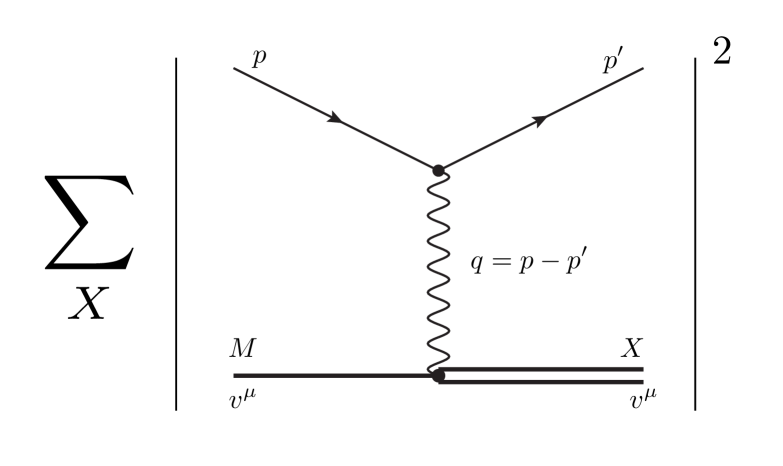
We now compute the inelastic process where a scalar field scatters off a heavy Schwarzschild black hole. Due to the presence of the horizon, the scalar can tidally exchange energy and momentum with the black hole. In the Unruh state, the exchanged energy can be of either sign, due to the possibility that absorbs a virtual Hawking mode emitted by the black hole.
In the EFT, the inclusive probability is given in Fig. 1, where we sum over the unobserved internal states of the final black hole. The interaction between the black hole and is mediated by graviton exchange. Linearizing about flat space, , the relevant term in Eq. (2) is
| (10) |
Our calculation is performed in Feynman gauge, where the propagator of the exchanged graviton is , with
| (11) |
In the rest frame of the black hole , the amplitude to leading order in the EFT of Eq. (3) takes the form ( is the momentum transfer)
| (12) |
where the tensors are given by444, .
| (13) | |||||
| (14) |
In order to perform the tensor contractions, we have used the package Mertig:1990an .
Summing over the final states , and assuming unitarity of the black hole quantum mechanics, , the inclusive squared amplitude breaks up into electric and magnetic contributions
| (15) |
which depend on the two-point Wightman functions defined in Eq. (7) (note that by parity invariance, the mixed correlator vanishes). For example, the electric term in the case of zero black hole spin is
| (16) |
and similarly for the magnetic piece. The time scale is an arbitrary IR cutoff associated with time translation invariance which will not appear in physical observables. We find, from Eqs. (13), (14),
where we drop terms subleading in powers of the momentum transfer . The resulting black hole-frame differential cross section for inelastic scattering is then
| (19) | |||||
It is useful to compare the magnitude of this result with the leading order cross section for Newtonian potential scattering off the black hole. In the black hole rest frame, this is given by
| (20) |
To compare this to the off-shell Hawking process, we would need to integrate Eqs. (LABEL:eq:a), Eq. (LABEL:eq:b) over the region . Although the EFT breaks down when the magnitude of is of order , we expect, by unitarity, that the integral over the form factors is finite, and dominated by scales near . Thus we may estimate the magnitude of the integrated inelastic (Hawking) differential cross section by taking the result in Eq. (19) and multiplying it by a factor of . We then find that, parametrically,
| (21) |
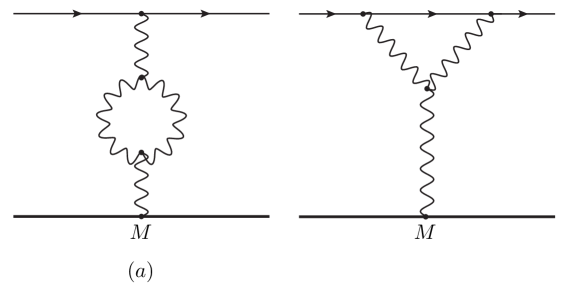
up to factors which we cannot determine by purely dimensional arguments and are treated as being of order unity for the purposes of this estimate. We see that inelastic scattering is a quantum gravity effect, of the same order in as the one-loop correction to elastic scattering that arises from graviton vacuum polarization effects of the type first computed in tv and illustrated in Fig. 2. Our result in Eq. (19) should then be interpreted as a new type of calculable, leading order, quantum gravity effect in black hole quantum mechanics. Moreover, the prediction is made within a systematic expansion with calculable corrections.
4 Conclusions
We have presented what, to our knowledge, is the first computation of quantum gravity effects in scattering processes with black holes appearing as asymptotic states. Our approach relies on EFT methods presented in GnR2 ; GnR3 . In this EFT, the leading quantum corrections due to horizon dynamics is represented by the exchange of virtual Hawking radiation. What is interesting about these effects is that, despite being non-perturbative in nature, are not as suppressed as one might naively have expected. Instead, they scale in the same way in the power counting as the more familiar one-loop graviton vacuum polarization tv corrections to scattering which arise when treating the black hole sources as elementary particles (i.e. quantum fields).
A natural question to ask is how the inelastic scattering rate calculated here compares to on-shell processes, e.g radiative pressure. Given the on-shell nature of the incoming graviton in this case and the fundamental (point-like) nature of the scattered particle, such a process will necessarily be suppressed by further powers of due to the existence of final state re-radiation. Similarly, such a process would be suppressed in the case of a particle with non-trivial internal structure, even if no radiation appears in the final state.
In this paper we have only considered a simple inelastic process in which a scalar field scatters gravitationally off a 4D Schwarzschild black hole. However, our methods should apply more broadly to a larger class of scattering processes as well as to more generic black holes, for instance carrying electric and magnetic charges and/or spin. Work on such generalizations is underway and will be presented in future publications.
5 Acknowledgments
We thank Ted Jacobson for helpful comments. This work was partially supported by the US Department of Energy under grants DE-SC00-17660 (WG) and DE- FG02-04ER41338 and FG02-06ER41449. (IZR).
Appendix A Matching the quadrupole Wightman functions
In this appendix, we extract the Wightman two-point functions of the quadrupole operators in Eq. (3) by comparing to the the transition probability obtained in bek ; wald to emit identical Hawking bosons, all in the same one-particle state , from an initial asymptotic state of bosons, also in the state .
While bek ; wald only explicitly considered scalar emission and absorption, their result only relies on canonical quantization of a massless free bosonic field in the background of the black hole, and therefore generalizes to particles with higher spin. We therefore interpret the result in bek ; wald ,
| (22) |
as the transition probability for particles in a one-particle wavepacket localized around some energy , and carrying definite total angular momentum quantum numbers with , and helicity . Then is the classical reflection coefficient for the wavepacket , obtained in page2 , is the Boltzmann factor for the non-rotating black hole, . In the limit in which the EFT is valid, the single particle transition probabilities reduce to
| (23) |
where, is the classical absorption probability in the state with angular quantum numbers .
In the EFT, the transition probabilities are
| (24) |
where, using Eq. (3), the absorption amplitude to leading order in perturbation theory is given
| (25) |
in the rest frame of the black hole, assumed to be non-rotating.
To evaluate the matrix element , we expand in helicity partial waves rqm of definite energy , which we normalize as
| (26) |
Using the relation between these states and the four-momentum eigenstates , it is straightforward to show (for instance by working in unitary gauge where only the transverse traceless graviton contributes to on-shell matrix elements):
| (27) |
and . In Eq. (27), the symbol denotes the change of basis matrix between Cartesian and spherical rank traceless symmetric tensors, with the normalization of the Cartesian states set by . It follows that for the unit normalized wavepacket ,
| (28) |
with , the matrix elements are
| (29) |
and for respectively.
Squaring the amplitude in Eq. (25), we find that after summing over the final states with , the single particle absorption probability depends on the two-point functions defined in Eq. (7). Given that is sharply localized around ,
| (30) | |||||
Similarly, the emission probability is
| (31) |
Under the assumption that the magnetic and electric correlators are equal GnR2 , comparison to the full theory Eq. (23), with the graybody factor given by page2 at low energies, then yields the result in Eq. (8). By comparing the EFT to the full theory transition probabilities with more than one particle in the final or initial state, it is possible also to extract the higher-point correlators of the worldline quadrupole operators. As in GnR3 , one would find that the higher-point functions are Gaussian and composed of products of Schwinger-Keldysh two-point functions.
References
- (1) J. F. Donoghue, Phys. Rev. Lett. 72, 2996-2999 (1994) [arXiv:gr-qc/9310024 [gr-qc]]; Phys. Rev. D 50, 3874-3888 (1994) [arXiv:gr-qc/9405057 [gr-qc]].
- (2) G. ’t Hooft and M. J. G. Veltman, Ann. Inst. H. Poincare Phys. Theor. A 20, 69 (1974).
- (3) M. H. Goroff and A. Sagnotti, Nucl. Phys. B 266 (1986), 709-736
- (4) S. W. Hawking, Commun. Math. Phys. 43, 199 (1975) Erratum: [Commun. Math. Phys. 46, 206 (1976)].
- (5) D. N. Page, Phys. Rev. D 13, 198 (1976).
- (6) W. D. Goldberger and I. Z. Rothstein, JHEP 04, 056 (2020) [arXiv:1912.13435 [hep-th]].
- (7) W. D. Goldberger and I. Z. Rothstein, Phys. Rev. D 73, 104030 (2006) [hep-th/0511133].
- (8) W. D. Goldberger and I. Z. Rothstein, arXiv:2006.xxxxx [hep-th].
- (9) W. D. Goldberger and I. Z. Rothstein, Phys. Rev. D 73, 104029 (2006) [hep-th/0409156]; Gen. Rel. Grav. 38, 1537-1546 (2006) [arXiv:hep-th/0605238 [hep-th]].
- (10) W. G. Unruh, Phys. Rev. D 14, 870 (1976).
- (11) J. B. Hartle and S. W. Hawking, Phys. Rev. D 13, 2188 (1976).
- (12) J. D. Bekenstein and A. Meisels, Phys. Rev. D 15, 2775 (1977).
- (13) P. Panangaden and R. M. Wald, Phys. Rev. D 16, 929 (1977).
- (14) R. Mertig, M. Bohm and A. Denner, Comput. Phys. Commun. 64 (1991), 345-359; V. Shtabovenko, R. Mertig and F. Orellana, Comput. Phys. Commun. 207, 432-444 (2016).
- (15) V.B. Berestetskii, E.M. Lifshitz, and L.P. Pitaevskii, Relativistic Quantum Theory (Volume 4 part 1 of A Course of Theoretical Physics ), Pergamon Press (1971).